1 Kings 7:47

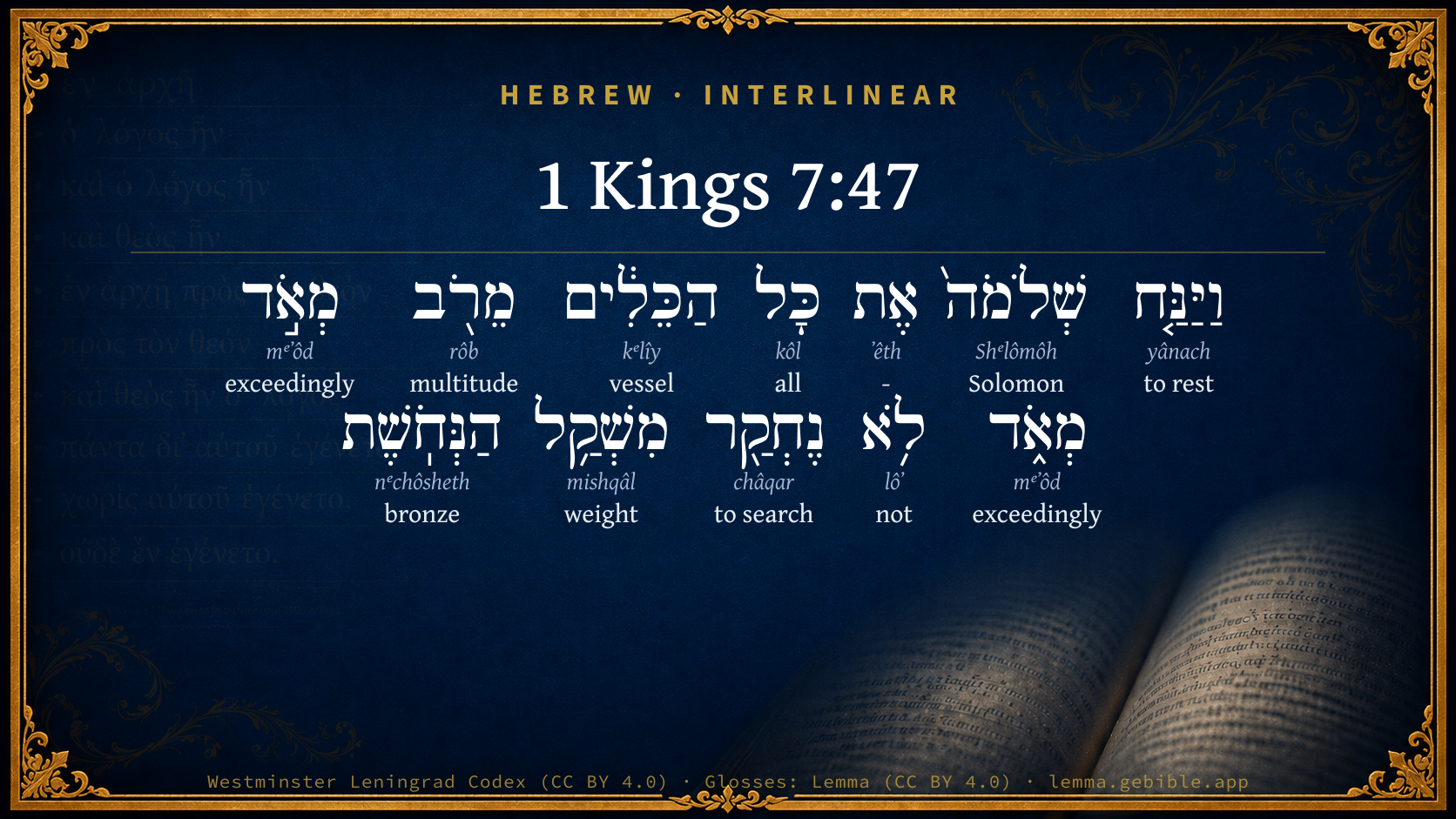
Hebrew (Westminster Leningrad Codex) 1 Kings 7:47 appears in the Hebrew Old Testament. The text above is from the Westminster Leningrad Codex. Each word links to its Strong’s number, a concise gloss, and parsing drawn from the Open Scriptures Hebrew Bible morphology. Click any word for its full Brown-Driver-Briggs (BDB) entry.
Download image
Cite this verse

1 Kings 7:47 (World English Bible). Public Domain. Lemma interlinear Bible study tool, https://lemma.gebible.app/v/1-kings/7/47.

Show BibTeX & RIS
BibTeX
RIS
English Translation
Solomon left all the vessels [unweighed], because they were exceeding many: the weight of the brass could not be found out.
World English Bible · Public Domain
Download a study sheet

One document with this verse’s original text, its word-by-word gloss line, the meaning frame, cross-references with their text, attributed commentary, and full source and license credits — printable, and it pastes into notes with its structure intact.

This verse Autodidact and up

Study sheet (.html) Plain text (.txt)

A passage Seminary Student

Up to 50 verses in one chapter. A passage sheet keeps up to 6 commentary sources and 12 cross-references per verse, in the order this page ranks them, and says so on the sheet whenever that leaves anything out. Ask for a single verse and you get the Autodidact verse sheet above.

Everything on this page stays free to read, with no account — the sheet is a download of what is already on screen, not access to it.

Want to remove ads? Support Godless Engineer
Compare translations 3

The same verse in 3 English versions, stacked beneath the original-language interlinear above. Click any original word for its lexicon entry.

Each is an independent rendering of the whole verse — the interlinear is not word-aligned to these translations.

Highlighted words mark where these versions differ — a whole-verse word diff, not a word-by-word alignment.

  • World English Bible Public Domain
    Solomon left all the vessels [unweighed], because they were exceeding many: the weight of the brass could not be found out.
  • King James Version Public Domain
    And Solomon left all the vessels unweighed, because they were exceeding many: neither was the weight of the brass found out.
  • unfoldingWord Literal Text CC BY-SA 4.0
    And Solomon let all of the vessels rest, from great, great abundance. The weight of the bronze was not determined.

unfoldingWord Literal Text — © unfoldingWord, licensed CC BY-SA 4.0. Word-aligned USFM3 via Door43 (git.door43.org/unfoldingWord/en_ult).

Versions to compare (up to 4)

3 of 4 selected

Show all 18 translations

Every available English version of this verse, each an independent rendering of the whole verse.

  • World English Bible Public Domain
    Solomon left all the vessels [unweighed], because they were exceeding many: the weight of the brass could not be found out.
  • Berean Standard Bible Public Domain
    Solomon left all these articles unweighed, because there were so many. The weight of the bronze could not be determined.
  • Majority Standard Bible Public Domain
    Solomon left all these articles unweighed, because there were so many. The weight of the bronze could not be determined.
  • King James Version Public Domain
    And Solomon left all the vessels unweighed, because they were exceeding many: neither was the weight of the brass found out.
  • American Standard Version (1901) Public Domain
    And Solomon left all the vessels `unweighed', because they were exceeding many: the weight of the brass could not be found out.
  • Revised Version (1885) Public Domain
    And Solomon left all the vessels unweighed, because they were exceeding many: the weight of the brass could not be found out.
  • Geneva Bible (1599) Public Domain
    And Salomon left to weigh all the vessels because of the exceeding aboundance, neyther could the weight of the brasse be counted.
  • Douay-Rheims (1899) Public Domain
    And Solomon placed all the vessels: but for exceeding great multitude the brass could not be weighed.
  • Young's Literal Translation Public Domain
    And Solomon placeth the whole of the vessels; because of the very great abundance, the weight of the brass hath not been searched out.
  • Literal Standard Version CC BY-SA 4.0
    And Solomon places the whole of the vessels; because of the very great abundance, the weight of the bronze has not been searched out.
  • Unlocked Literal Bible CC BY-SA 4.0
    Solomon did not weigh all the utensils because there were too many to weigh, because the weight of the bronze could not be measured.
  • unfoldingWord Literal Text CC BY-SA 4.0
    And Solomon let all of the vessels rest, from great, great abundance. The weight of the bronze was not determined.
  • Darby Bible Public Domain
    And Solomon left all the vessels [unweighed] from their exceeding number; the weight of the brass was not ascertained.
  • World Messianic Bible Public Domain
    Solomon left all the vessels unweighed, because there were so many of them. The weight of the bronze could not be determined.
  • Webster's Bible Public Domain
    And Solomon left all the vessels unweighed, because they were very numerous: neither was the weight of the brass ascertained.
  • Free Bible Version CC BY-SA 4.0
    Solomon did not weigh anything that had been made because there was just so much—the weight of bronze used could not be measured.
  • Bible in Basic English Public Domain
    The weight of all these vessels was not measured, because there was such a number of them; it was not possible to get the weight of the brass.
  • JPS Tanakh (1917) Public Domain
    And Solomon left all the vessels unweighed, because they were exceeding many; the weight of the brass could not be found out.

Literal Standard Version (2020), Covenant Press — licensed CC BY-SA 4.0. Text via the HelloAO Bible API (eBible.org). Unlocked Literal Bible (unfoldingWord) — licensed CC BY-SA 4.0. Text via the HelloAO Bible API (eBible.org). unfoldingWord Literal Text — © unfoldingWord, licensed CC BY-SA 4.0. Word-aligned USFM3 via Door43 (git.door43.org/unfoldingWord/en_ult). Free Bible Version, Dr. Jonathan Gallagher — licensed CC BY-SA 4.0. Text via the HelloAO Bible API (eBible.org).

Word by word

More ways to search: Search by grammar → Find every occurrence → Compare this word →

Practice this passage: Drill this verse → Learn its vocabulary →

נֶחְקַ֖ר
châqar
H2713
“to search”
Verb, Niphal, Perfect, 3rd Person, Masculine, Singular
Part of Speech
Verb
Stem
Niphal
Form
Perfect
Person
3rd Person
Gender
Masculine
Number
Singular
Full BDB Definition

Origin: a primitive root

TWOT: 729

to search, search for, search out, examine, investigate - (Qal) - to search (for) - to search through, explore - to examine thoroughly - (Niphal) - to be searched out, be found out, be ascertained, be examined - (Piel) to search out, seek out
  1. וַיַּנַּ֤ח yânach H3240 “and · to rest” Conjunction + Verb, Hiphil, Sequential Imperfect, 3rd Person, Masculine, Singular
  2. שְׁלֹמֹה֙ Shᵉlômôh H8010 “Solomon” Noun, Proper
  3. אֶת ʼêth H853 “-” Particle, Direct Object
  4. כָּל kôl H3605 “all of” Noun, Common, Masculine, Singular, Construct
  5. הַכֵּלִ֔ים kᵉlîy H3627 “the · vessels” Particle, Definite Article + Noun, Common, Masculine, Plural, Absolute
  6. מֵרֹ֖ב rôb H7230 “from · multitude” Preposition + Noun, Common, Both, Singular, Absolute
  7. מְאֹ֣ד mᵉʼôd H3966 “exceedingly” Adverb
  8. מְאֹ֑ד mᵉʼôd H3966 “exceedingly” Adverb
  9. לֹ֥א lôʼ H3808 “not” Particle, Negative
  10. מִשְׁקַ֥ל mishqâl H4948 “weight of” Noun, Common, Masculine, Singular, Construct
  11. הַנְּחֹֽשֶׁת nᵉchôsheth H5178 “the · bronze” Particle, Definite Article + Noun, Common, Feminine, Singular, Absolute

About this verse

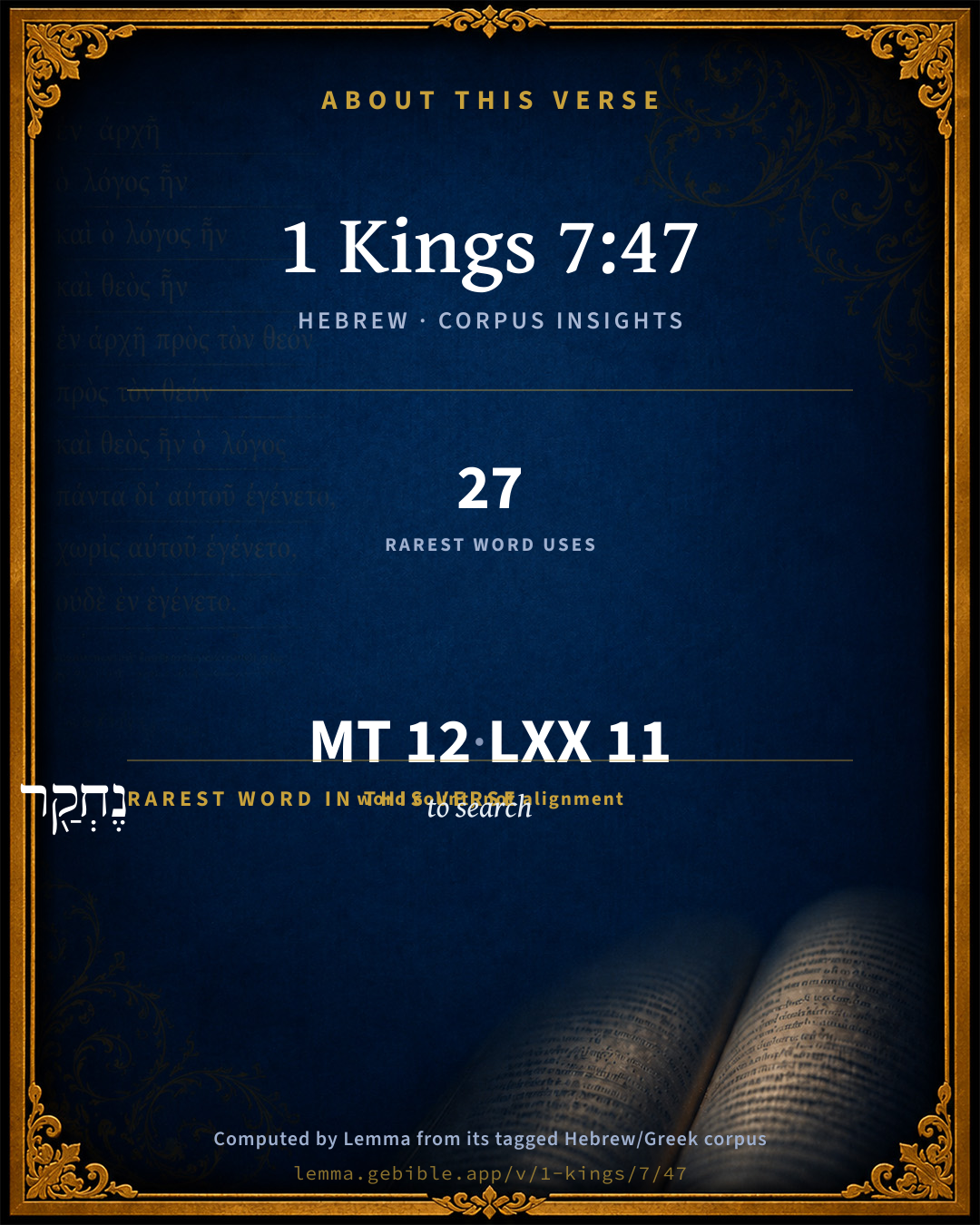
These counts appear in no published source. They are computed here, from the morphology-tagged text and Lemma’s own curated glosses. What Lemma adds →

12
words
11
distinct lemmas
Historical
section

Shared distinctive vocabulary

נֶחְקַ֖ר to search H2713 occurs in 26 verses of the Hebrew Bible. Also found in:

Grammatical profile

  • 2 verbs
  • 6 nouns
  • 2 adverbs
  • 2 particles

Verb forms

  • וַיַּנַּ֤ח Hiphil · Sequential Imperfect
  • נֶחְקַ֖ר Niphal · Perfect

Repetition

A word recurs within this verse — often emphatic in Hebrew:

  • מְאֹ֣ד exceedingly H3966 ×2

Hebrew & Septuagint length

In English translation the verse runs 21 words from the Hebrew and 48 from the Septuagint (LXX English) — the Septuagint runs noticeably longer here. See the side-by-side →

A rough comparison of the two English renderings, which tokenize alike — not a word-level alignment.

Word counts can differ between the Hebrew and the Greek without any difference in meaning — e.g. the Hebrew direct-object marker אֵת has no separate Greek word, and Greek often adds the article ὁ.

In the original languages it is 12 Hebrew tokens and 11 Greek tokens — but the two are counted differently (Hebrew bundles its prefixes and suffixes into one token; the Greek is in lemma form), so that isn’t a like-for-like length.

Cross-references

4

Topical passages linked to 1 Kings 7:47 in the Treasury of Scripture Knowledge — connected by theme and wording, ordered by reader-vote popularity; previews shown in the World English Bible.

  • 1 Chronicles 22:14 Now, behold, in my affliction I have prepared for the house of Yahweh one hundred thousand talents of gold, and one thousand thousand talents of silver, and of brass and iron without weight; for it is in abundance: timber also and stone have I prepared; and you may add to them.
  • 1 Chronicles 22:3 David prepared iron in abundance for the nails for the doors of the gates, and for the couplings; and brass in abundance without weight;
  • 1 Chronicles 22:16 of the gold, the silver, and the brass, and the iron, there is no number. Arise and be doing, and Yahweh be with you.
  • 2 Chronicles 4:18 Thus Solomon made all these vessels in great abundance: for the weight of the brass could not be found out.

Cross-references courtesy of OpenBible.info (CC BY 4.0).

Hebrew and Greek witnesses Masoretic Hebrew ↔ Greek Septuagint

The same verse in the two great witnesses to the Old Testament, shown verse-for-verse.

Here the Septuagint runs noticeably longer than the Hebrew — LXX2012 (modern English Septuagint) 48 words vs World English Bible 21. A rough length comparison of the two English translations, not a word-level alignment — read both below.

These are two independent witnesses, not word-aligned to each other, and the Septuagint is shown in lemma (dictionary) form.

Hebrew 1 Kings 7:47 Masoretic · Westminster Leningrad Codex

וַיַּנַּ֤ח שְׁלֹמֹה֙ אֶת כָּל הַכֵּלִ֔ים מֵרֹ֖ב מְאֹ֣ד מְאֹ֑ד לֹ֥א נֶחְקַ֖ר מִשְׁקַ֥ל הַנְּחֹֽשֶׁת

Solomon left all the vessels [unweighed], because they were exceeding many: the weight of the brass could not be found out.

World English Bible · Public Domain

Greek LXX 1 Kings 7:47 Septuagint · lemma form

ὁ θεμελιόω ἐν τίμιος λίθος μέγας λίθος δεκάπηχυς καί ὁ ὀκτάπηχυς

There was no reckoning of the brass of which he made all these works, from the very great abundance, there was no end of the weight of the brass. 46 In the country round about Jordan did he cast them, in the clay land between Socchoth and Sira.

LXX2012 (modern English Septuagint) · Public Domain

Hebrew: Westminster Leningrad Codex (CC BY 4.0). Greek: Septuagint (public domain); English from LXX2012 (modern English Septuagint) (Public Domain). How the Septuagint differs from the Hebrew →

Targum (Aramaic paraphrase)

1

The Targum is the ancient Jewish Aramaic paraphrase of the Hebrew Scriptures — an interpretive translation, not the Hebrew text itself. Onkelos (literal) and Pseudo-Jonathan (expansive) render the Torah, and Jonathan the Prophets. Coverage is partial: where no permissively-licensed English translation exists for a verse, only the Aramaic is shown. This is verse-level text, not a word-by-word alignment to the Hebrew.

  1. Targum Jonathan Prophets (Joshua–Malachi)
    וְאַצְנַע שְׁלֹמֹה יַת כָּל מָנַיָא מִסְגֵי לַחְדָא לַחְדָא לֵית סוֹף לְמִתְקַל נְחָשָׁא:

    (no public-domain English translation for this verse)

    Targum Jonathan — Aramaic: “Mikraot Gedolot” (public domain). English: “Sefaria Community Translation” (CC0 1.0 (public-domain dedication)); “London "Chaldee Paraphrase," 1871” (public domain). Text via Sefaria.

Commentary

Notes on 1 Kings 7:47 from classic Christian and Jewish commentators (each source and its license shown beneath its notes). The classic Christian expositions comment on the surrounding passage and are grouped to its opening verse, so a note may address several verses; the Jewish commentaries on the Tanakh (Rashi and others) are per-verse, so they appear only where the commentator wrote on this verse.

Lemma curates 59 commentaries, every one of them public domain or Creative Commons licensed, each selected and text-cleaned for this edition rather than reprinted as found. About our sources →

Trapp's Complete Commentary

John Trapp

1Ki 7:47 And Solomon left all the vessels [unweighed], because they were exceeding many: neither was the weight of the brass found out.

Ver. 47. Solomon left all the vessels unweighed.] Many men deal with their preservations, saith one, as Solomon did with the brass of the temple: it was so much, he weighed it not. See 1Ch 22:3; 1Ch 22:14.

John Trapp, A Commentary or Exposition upon All the Books of the Old and New Testament (1647–1656) — public domain. Text from a community e-Sword module.

Ellicott's Commentary for English Readers

(47) Solomon left all the vessels unweighed.—The brass for these vessels had (1Ch_18:8) been taken by David from Tibhath and Chun, cities of the territory of Zobah, and laid up with other stores for the purpose of the Temple. How these cities were so rich in brass we are not told; but there are very ancient copper-mines, once worked by the Egyptians, in the Sinaitic peninsula; and the allusions to mining of various kinds in Job_28:1-11 (perhaps belonging to the time of Solomon) are very striking.

A Bible Commentary for English Readers, edited by Charles John Ellicott (1878–1897) — public domain. Text from a community e-Sword module.

The Cambridge Bible for Schools and Colleges

gen. ed. J. J. S. Perowne

47. neither was the weight of the brass found out] The R.V. gives ‘could not be found out.’ The verb, which signifies literally ‘to investigate,’ ‘to search out,’ seems employed to indicate that no attempt was made to discover it.

The Cambridge Bible for Schools and Colleges (gen. ed. J. J. S. Perowne; Cambridge University Press, 1878–1918) — public domain. Text from a community e-Sword module.

John Gill's Exposition

And Solomon made all the vessels that pertained unto the house of the Lord,.... That is, he ordered them to be made, even all that were in the tabernacle of Moses; all were newly made, excepting the ark, mercy seat, and cherubim:

the altar of gold; the altar of incense, which was made of cedar, covered with gold, Kg1 6:20, hence called the golden altar, Rev 8:3.

and the table of gold, whereupon the shewbread was; this includes all the tables, for there were ten of them, Ch2 4:8 where they are said to be placed, five on the right hand, and five on the left; which, according to the Jews (k), were not on the right and left of the temple, but on the right and left of the table of Moses, and which being placed on the north side, these must be also, Exo 40:22 there being more tables in the temple than in the tabernacle may denote the greater provision of spiritual food in the word and ordinances of the Gospel church, of which the temple was a figure, than under the legal dispensation.

(k) T. Bab. Meuachot, fol. 98. Kimchi in loc. Targum in 2 Chron. iv. 8.

John Gill's Exposition of the Whole Bible (1746–1763) — public domain (CC PDM 1.0). Text via the HelloAO Bible API.

Albert Barnes' Notes on the Bible

The brass of which the two pillars, Jachin and Boaz, the brass sea, and the various vessels were made had been taken by David from two cities belonging to Hadadezer, king of Zobah 1Ch 18:8.

Albert Barnes' Notes on the Bible (1834–1885) — public domain. Text from a community e-Sword/MySword module.

Haydock's Catholic Bible Commentary

Weighed. It was deemed unnecessary, and too troublesome. (Haydock) --- Hebrew, "And Solomon would not have all the vessels weighed," on account of the too great number: "the weight of the brass was not discovered." (Vatable)

George Leo Haydock (1774–1849), Haydock's Catholic Family Bible and Commentary, 1859 edition — public domain. Excludes Psalms (Douay-Rheims chapter numbering differs from Protestant) and Deuterocanonical books (Catholic canon only).

Matthew Poole's English Annotations

Solomon left all the vessels unweighed, because the weighing of them was very troublesome, and to no purpose.

Matthew Poole's English Annotations on the Holy Bible (1683–1685) — public domain. Text from a community e-Sword/MySword module.

The Pulpit Commentary

And Solomon left all the vessels unweighed (the interpretation of the A.V italics is justified by the next clauses) because they were exceeding many: neither was the weight of the brass found out. Marg. searched. So Gesen. al. This does not mean that the "brass for each vessel was not weighed out" (Bahr), but that the total weight of the metal was not, perhaps could not, be ascertained.

The sacred record now proceeds to enumerate the vessels, etc., used inside the temple those hitherto described having been for external use. These latter, as became the furniture of a house which blazed in gold, were all of gold, while the former were of brass. It would seem to be a fair inference, from the omission of Hiram"s name, that he was not employed on the manufacture of these latter vessels.

The Pulpit Commentary (1880–1919), ed. H.D.M. Spence-Jones & Joseph S. Exell — public domain. Text from a community e-Sword module.

Rashi

Rabbi Shlomo Yitzchaki (Rashi)

Shlomo gave up. [He refrained] from determining the weight of these vessels because there were very many, and [therefore] he ceased to determine their weight.

Rashi on the Tanakh — English translations: “The Judaica Press complete Tanach with Rashi, translated by A. J. Rosenberg” (CC BY 4.0); “Pentateuch with Rashi's commentary by M. Rosenbaum and A.M. Silbermann, 1929-1934” (public domain); “The Metsudah Tanach series, Lakewood, N.J” (CC BY 4.0); and “The Book of Joshua, Metsudah Publications, 1997” (CC BY 4.0). Text via Sefaria.

Lesson kit

Teaching starters — assembled from the data on this page, not authored interpretation. Every prompt links to the verse data it draws on. Edit before teaching.

1 Kings, in the Historical, opens this verse with 12 words (11 distinct Hebrew lemmas). Its most distinctive word is châqar (“to search”). The Greek Septuagint runs longer here. A historical commentator’s framing appears above. Read the whole chapter for the surrounding context.

Discussion questions

  1. The word châqar carries the sense “to search.” How does it shape the verse?
  2. How does Deuteronomy 13:14, which shares the word «to search», read alongside this verse?
  3. What does the repetition of “exceedingly” (2× in this one verse) do in this verse?
  4. The Septuagint runs longer here than the Hebrew. What might account for the difference?
  5. The translations on this page render this verse differently — a whole-verse word diff, not a word-by-word alignment. What might account for the different wordings?
  6. «וַיַּנַּ֤ח» is a Hiphil Sequential Imperfect verb. How does that grammatical form shape the action described?
  7. Compare how Trapp's Complete Commentary and Ellicott's Commentary for English Readers read this verse. Where do they agree or differ?

Things to notice

Reading settings

Reading text

Shown beneath each verse's original-language words.

Old Testament
Old Testament edition

Read the OT as the Masoretic Hebrew (MT) or the Greek Septuagint (LXX).

English shown for the Greek Septuagint (in the Hebrew ↔ Greek comparison).

Comparing translations? Open the Compare panel on any verse page to stack up to four side by side.