Ezra 8:27

Hebrew (Westminster Leningrad Codex) Ezra 8:27 appears in the Hebrew Old Testament. The text above is from the Westminster Leningrad Codex. Each word links to its Strong’s number, a concise gloss, and parsing drawn from the Open Scriptures Hebrew Bible morphology. Click any word for its full Brown-Driver-Briggs (BDB) entry.
Download image
Cite this verse

Ezra 8:27 (World English Bible). Public Domain. Lemma interlinear Bible study tool, https://lemma.gebible.app/v/ezra/8/27.

Show BibTeX & RIS
BibTeX
RIS
English Translation
and twenty bowls of gold, of one thousand darics; and two vessels of fine bright brass, precious as gold.
World English Bible · Public Domain
Highlights
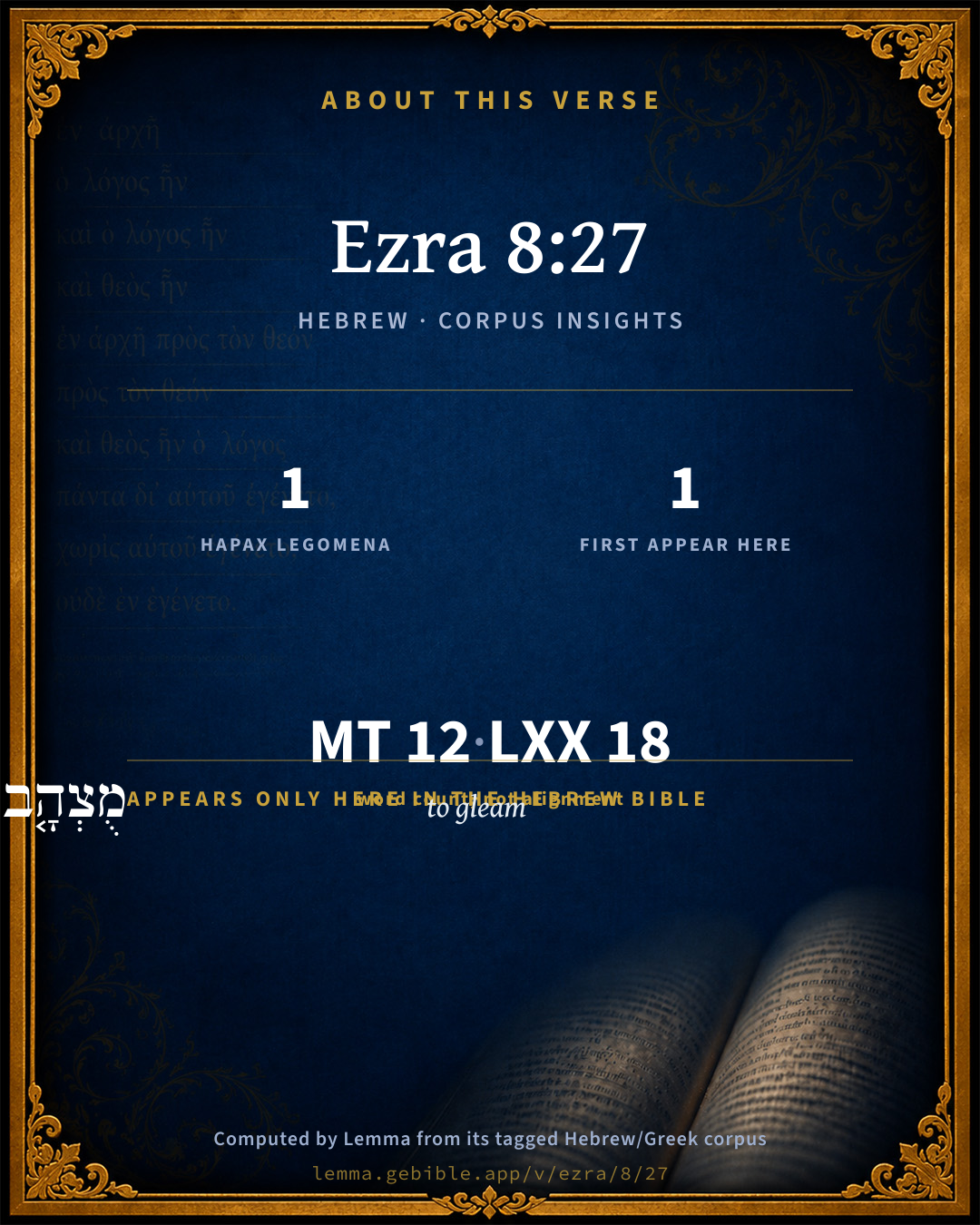
  • 1 hapax legomenon — only here in the Hebrew Bible
  • 1 first appearance in the Hebrew Bible
Full analysis ↓
Download a study sheet

One document with this verse’s original text, its word-by-word gloss line, the meaning frame, cross-references with their text, attributed commentary, and full source and license credits — printable, and it pastes into notes with its structure intact.

This verse Autodidact and up

Study sheet (.html) Plain text (.txt)

A passage Seminary Student

Up to 50 verses in one chapter. A passage sheet keeps up to 6 commentary sources and 12 cross-references per verse, in the order this page ranks them, and says so on the sheet whenever that leaves anything out. Ask for a single verse and you get the Autodidact verse sheet above.

Everything on this page stays free to read, with no account — the sheet is a download of what is already on screen, not access to it.

Want to remove ads? Support Godless Engineer
Compare translations 3

The same verse in 3 English versions, stacked beneath the original-language interlinear above. Click any original word for its lexicon entry.

Each is an independent rendering of the whole verse — the interlinear is not word-aligned to these translations.

Highlighted words mark where these versions differ — a whole-verse word diff, not a word-by-word alignment.

  • World English Bible Public Domain
    and twenty bowls of gold, of one thousand darics; and two vessels of fine bright brass, precious as gold.
  • King James Version Public Domain
    Also twenty basons of gold, of a thousand drams; and two vessels of fine copper, precious as gold.
  • unfoldingWord Literal Text CC BY-SA 4.0
    and 20 bowls of gold of 1,000 darics, and two good, gleaming vessels of bronze, precious as gold.

unfoldingWord Literal Text — © unfoldingWord, licensed CC BY-SA 4.0. Word-aligned USFM3 via Door43 (git.door43.org/unfoldingWord/en_ult).

Versions to compare (up to 4)

3 of 4 selected

Show all 18 translations

Every available English version of this verse, each an independent rendering of the whole verse.

  • World English Bible Public Domain
    and twenty bowls of gold, of one thousand darics; and two vessels of fine bright brass, precious as gold.
  • Berean Standard Bible Public Domain
    20 gold bowls valued at 1,000 darics, and two articles of fine polished bronze, as precious as gold.
  • Majority Standard Bible Public Domain
    20 gold bowls valued at 1,000 darics, and two articles of fine polished bronze, as precious as gold.
  • King James Version Public Domain
    Also twenty basons of gold, of a thousand drams; and two vessels of fine copper, precious as gold.
  • American Standard Version (1901) Public Domain
    and twenty bowls of gold, of a thousand darics; and two vessels of fine bright brass, precious as gold.
  • Revised Version (1885) Public Domain
    and twenty bowls of gold, of a thousand darics; and two vessels of fine bright brass, precious as gold.
  • Geneva Bible (1599) Public Domain
    And twentie basins of golde, of a thousand drammes, and two vessels of shining brasse very good, and precious as golde.
  • Douay-Rheims (1899) Public Domain
    And twenty cups of gold, of a thousand solids, and two vessels of the best shining brass, beautiful as gold.
  • Young's Literal Translation Public Domain
    and basins of gold twenty, of a thousand drams, and two vessels of good shining brass, desirable as gold.
  • Literal Standard Version CC BY-SA 4.0
    and twenty basins of gold, of one thousand drams, and two vessels of good shining bronze, desirable as gold.
  • Unlocked Literal Bible CC BY-SA 4.0
    twenty gold bowls that were together valued at one thousand darics, and two well-polished bronze vessels as precious as gold.
  • unfoldingWord Literal Text CC BY-SA 4.0
    and 20 bowls of gold of 1,000 darics, and two good, gleaming vessels of bronze, precious as gold.
  • Darby Bible Public Domain
    and twenty basons of gold, of a thousand darics; and two vessels of shining copper, precious as gold.
  • World Messianic Bible Public Domain
    twenty bowls of gold weighing one thousand darics, and two vessels of fine bright bronze, precious as gold.
  • Webster's Bible Public Domain
    Also twenty basins of gold, of a thousand drams; and two vessels of fine copper, precious as gold.
  • Free Bible Version CC BY-SA 4.0
    20 gold bowls worth 1,000 darics, and two articles of highly-polished bronze, as valuable as gold.
  • Bible in Basic English Public Domain
    And twenty gold basins, of a thousand darics, and two vessels of the best bright brass, equal in value to gold.
  • JPS Tanakh (1917) Public Domain
    and twenty bowels of gold, of a thousand darics; and two vessels of fine bright brass, precious as gold.

Literal Standard Version (2020), Covenant Press — licensed CC BY-SA 4.0. Text via the HelloAO Bible API (eBible.org). Unlocked Literal Bible (unfoldingWord) — licensed CC BY-SA 4.0. Text via the HelloAO Bible API (eBible.org). unfoldingWord Literal Text — © unfoldingWord, licensed CC BY-SA 4.0. Word-aligned USFM3 via Door43 (git.door43.org/unfoldingWord/en_ult). Free Bible Version, Dr. Jonathan Gallagher — licensed CC BY-SA 4.0. Text via the HelloAO Bible API (eBible.org).

Word by word

More ways to search: Search by grammar → Find every occurrence → Compare this word →

Practice this passage: Drill this verse → Learn its vocabulary →

מֻצְהָ֤ב
tsâhab
H6668
“gleamed”
Verb, Hophal, Participle Passive, Masculine, Singular, Absolute
Part of Speech
Verb
Stem
Hophal
Form
Participle Passive
Gender
Masculine
Number
Singular
State
Absolute
Full BDB Definition

Origin: a primitive root

TWOT: 1880

to gleam, shine - (Hophal) to gleam
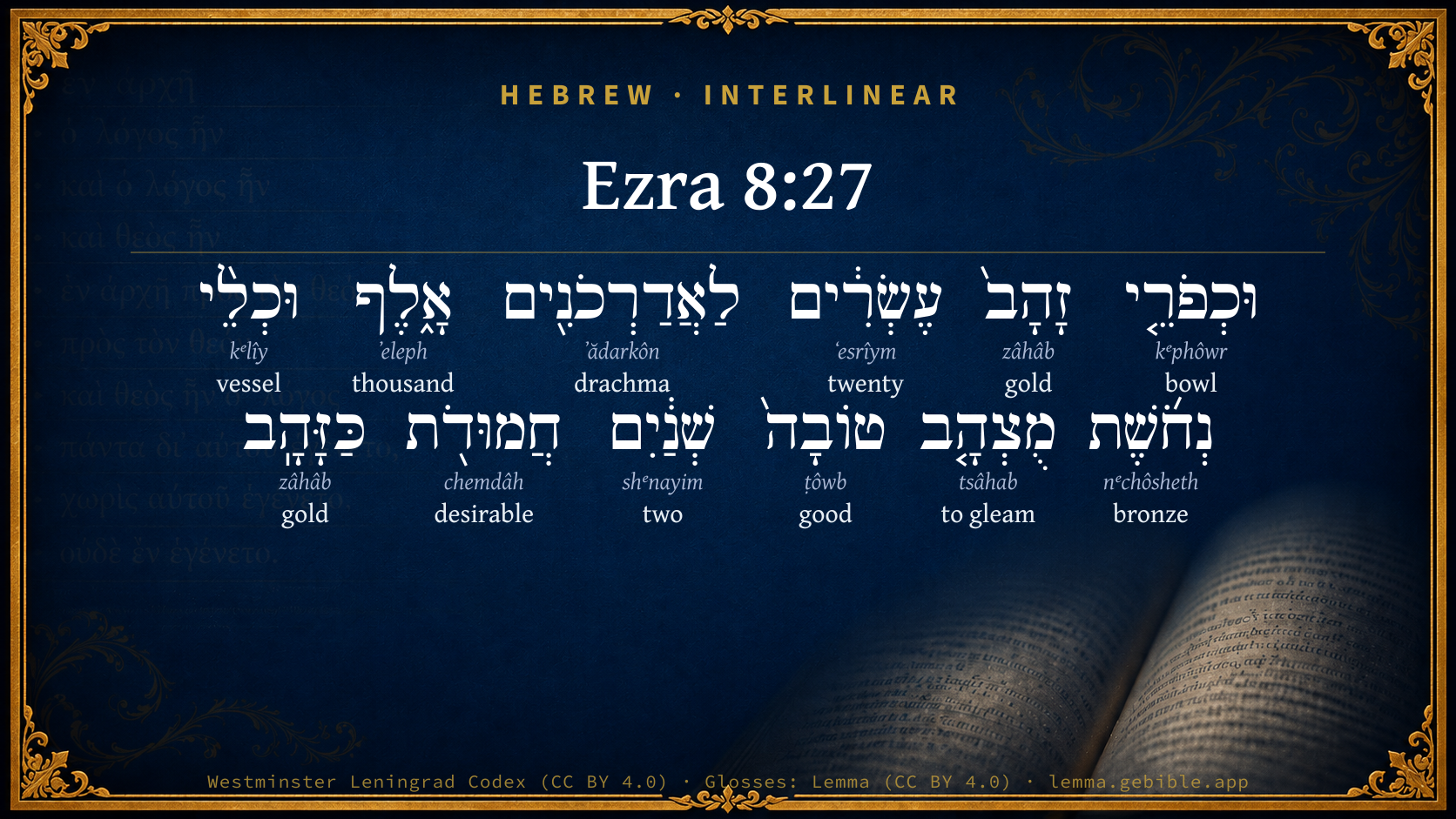
  1. וּכְפֹרֵ֤י kᵉphôwr H3713 “and · bowls of” Conjunction + Noun, Common, Masculine, Plural, Construct
  2. זָהָב֙ zâhâb H2091 “gold” Noun, Common, Masculine, Singular, Absolute
  3. עֶשְׂרִ֔ים ʻesrîym H6242 “twenty” Adjective, Cardinal number, Both, Plural, Absolute
  4. לַאֲדַרְכֹנִ֖ים ʼădarkôn H150 “to/for · drachmas” Preposition + Noun, Common, Masculine, Plural, Absolute
  5. אָ֑לֶף ʼeleph H505 “thousand” Adjective, Cardinal number, Both, Singular, Absolute
  6. וּכְלֵ֨י kᵉlîy H3627 “and · vessels of” Conjunction + Noun, Common, Masculine, Plural, Construct
  7. נְחֹ֜שֶׁת nᵉchôsheth H5178 “bronze” Noun, Common, Feminine, Singular, Absolute
  8. טוֹבָה֙ ṭôwb H2896 “good” Adjective, Adjective, Feminine, Singular, Absolute
  9. שְׁנַ֔יִם shᵉnayim H8147 “two” Adjective, Cardinal number, Masculine, Dual, Absolute
  10. חֲמוּדֹ֖ת chemdâh H2532 “desirable things” Noun, Common, Feminine, Plural, Absolute
  11. כַּזָּהָֽב zâhâb H2091 “like/as the · gold” Preposition, Determined + Noun, Common, Masculine, Singular, Absolute

About this verse

These counts appear in no published source. They are computed here, from the morphology-tagged text and Lemma’s own curated glosses. What Lemma adds →

12
words
11
distinct lemmas
Historical
section

Notable vocabulary

1 hapax legomenon — a word that appears only here in the entire Hebrew Bible:

  • מֻצְהָ֤ב to gleam H6668

First appearance in Scripture

This word makes its first canonical appearance in the Hebrew Bible here:

  • מֻצְהָ֤ב to gleam H6668

Shared distinctive vocabulary

לַאֲדַרְכֹנִ֖ים drachma H150 occurs in 2 verses of the Hebrew Bible. Also found in:

Grammatical profile

  • 1 verb
  • 7 nouns
  • 4 adjectives

Verb forms

  • מֻצְהָ֤ב Hophal · Participle Passive

Repetition

A word recurs within this verse — often emphatic in Hebrew:

  • זָהָב֙ gold H2091 ×2

Hebrew & Septuagint length

In English translation the verse runs 19 words from the Hebrew and 19 from the Septuagint (LXX English) — the same length.

A rough comparison of the two English renderings, which tokenize alike — not a word-level alignment.

Word counts can differ between the Hebrew and the Greek without any difference in meaning — e.g. the Hebrew direct-object marker אֵת has no separate Greek word, and Greek often adds the article ὁ.

In the original languages it is 12 Hebrew tokens and 18 Greek tokens — but the two are counted differently (Hebrew bundles its prefixes and suffixes into one token; the Greek is in lemma form), so that isn’t a like-for-like length.

Cross-references

1

Topical passages linked to Ezra 8:27 in the Treasury of Scripture Knowledge — connected by theme and wording, ordered by reader-vote popularity; previews shown in the World English Bible.

  • Lamentations 4:2 The precious sons of Zion, comparable to fine gold, How are they esteemed as earthen pitchers, the work of the hands of the potter!

Cross-references courtesy of OpenBible.info (CC BY 4.0).

Hebrew and Greek witnesses Masoretic Hebrew ↔ Greek Septuagint

The same verse in the two great witnesses to the Old Testament, shown verse-for-verse.

These are two independent witnesses, not word-aligned to each other, and the Septuagint is shown in lemma (dictionary) form.

Hebrew Ezra 8:27 Masoretic · Westminster Leningrad Codex

וּכְפֹרֵ֤י זָהָב֙ עֶשְׂרִ֔ים לַאֲדַרְכֹנִ֖ים אָ֑לֶף וּכְלֵ֨י נְחֹ֜שֶׁת מֻצְהָ֤ב טוֹבָה֙ שְׁנַ֔יִם חֲמוּדֹ֖ת כַּזָּהָֽב

and twenty bowls of gold, of one thousand darics; and two vessels of fine bright brass, precious as gold.

World English Bible · Public Domain

Greek LXX Ezra 8:27 Septuagint · lemma form

καί καφουρη χρυσοῦς εἴκοσι εἰς ὁ ὁδός χαμανιμ χίλιοι καί σκεῦος χαλκοῦς στίλβω ἀγαθός διάφορος ἐπιθυμητά ἐν χρυσίον

and twenty golden bowls, weighing about a thousand drachmas, and superior vessels of fine shining brass, precious as gold.

LXX2012 (modern English Septuagint) · Public Domain

In the Septuagint this is one book — Esdras B (2 Esdras): Ezra is chapters 1–10, Nehemiah 11–23.

On this verse, The Cambridge Bible for Schools and Colleges discusses the Septuagint’s reading. Read the note in Commentary ↓

Hebrew: Westminster Leningrad Codex (CC BY 4.0). Greek: Septuagint (public domain); English from LXX2012 (modern English Septuagint) (Public Domain). How the Septuagint differs from the Hebrew →

Commentary

Notes on Ezra 8:27 from classic Christian and Jewish commentators (each source and its license shown beneath its notes). The classic Christian expositions comment on the surrounding passage and are grouped to its opening verse, so a note may address several verses; the Jewish commentaries on the Tanakh (Rashi and others) are per-verse, so they appear only where the commentator wrote on this verse.

Lemma curates 59 commentaries, every one of them public domain or Creative Commons licensed, each selected and text-cleaned for this edition rather than reprinted as found. About our sources →

Trapp's Complete Commentary

John Trapp

Ezr 8:27 Also twenty basons of gold, of a thousand drams; and two vessels of fine copper, precious as gold.

Ver. 27. Of a thousand drachms] 312 pounds 10 shillings. The Hebrew (or rather Chaldee) word here rendered a drachm seems to be taken from the Greek word Dραχμη.

And two vessels of fine copper] Ex orichalco praestante, Of some choice mixed metal, Auro contra non caro. Overlaid with gold without no dross.

John Trapp, A Commentary or Exposition upon All the Books of the Old and New Testament (1647–1656) — public domain. Text from a community e-Sword module.

Geneva Bible (1599)

Geneva Bible translators

Read Ezra 2:29.

Geneva Bible (1599) marginal notes — public domain. Text via Bolls.life.

Jamieson, Fausset & Brown

Robert Jamieson, A. R. Fausset & David Brown

two vessels of fine copper, precious as gold--Almost all commentators agree in maintaining that the vessels referred to were not made of copper, but of an alloy capable of taking on a bright polish, which we think highly probable, as copper was then in common use among the Babylonians, and would not be as precious as gold. This alloy, much esteemed among the Jews, was composed of gold and other metals, which took on a high polish and was not subject to tarnish [NOYES].

Jamieson, Fausset & Brown — Commentary Critical and Explanatory on the Whole Bible (1871) — public domain (CC PDM 1.0). Text via the HelloAO Bible API.

Ellicott's Commentary for English Readers

(27) A thousand drams.—Darics, and therefore the whole worth rather more than a thousand guineas.

Fine copper.—Probably the Roman Orichalcum, a metal very highly valued.

A Bible Commentary for English Readers, edited by Charles John Ellicott (1878–1897) — public domain. Text from a community e-Sword module.

The Cambridge Bible for Schools and Colleges

gen. ed. J. J. S. Perowne

27. also twenty basons of gold] R.V. and twenty bowls of gold: ‘bowl’ as in Ezr_1:10.

of a thousand drams] R.V. of a thousand darics. About £1 each: see on Ezr_2:69.

The total specified values then are about

£243,750 + £37,500 + £675,000 + £1,000 = £957,250,

or nearly a million of our money.

fine copper] R.V. fine bright brass. The Hebrew word (Muçhâbh) occurs only here. LXX. στίλβοντος. Some have suggested ‘orichalchum’, a variety of brass.

1Es_8:57, ‘And twelve (not ‘two’) vessels of brass even of fine brass, glittering like gold’.

precious] a rare word in the Hebrew, occurring also in Gen_27:15, ‘goodly raiment’; 2Ch_20:25; Dan_11:38; Dan_11:43, ‘precious things’ (cf. Dan_10:3, ‘pleasant bread’ or bread of preciousness), applied metaphorically to Daniel himself ‘greatly beloved’ (lit. a man of precious things), Dan_9:23; Dan_10:11; Dan_10:19.

The Cambridge Bible for Schools and Colleges (gen. ed. J. J. S. Perowne; Cambridge University Press, 1878–1918) — public domain. Text from a community e-Sword module.

John Gill's Exposition

And I said unto them, ye are holy unto the Lord, the vessels are holy also,.... As they were dedicated and set apart to holy service, so the vessels were sacred to holy uses, and therefore not to be converted to any other:

and the silver and the gold are a freewill offering unto the Lord God of your fathers: and therefore not to be made use of but in his service.

John Gill's Exposition of the Whole Bible (1746–1763) — public domain (CC PDM 1.0). Text via the HelloAO Bible API.

Albert Barnes' Notes on the Bible

Twenty basons of gold, of a thousand drams - Not of a thousand drams (i. e., darics) each, but worth altogether a thousand darics. As the value of the daric was about 22 shillings of British money, each basin, or saucer, would have been worth (apart from the fashioning) 55 British pounds.

Of fine copper - The word translated “fine,” which occurs here only, is thought to mean either “yellow” or “glittering” (see the margin). Probably the vessels were of orichalcum, an amalgam which was either brass or something nearly approaching to brass, but which was very rarely produced in the ancient world, and, when produced, was regarded as highly valuable.

Albert Barnes' Notes on the Bible (1834–1885) — public domain. Text from a community e-Sword/MySword module.

Haydock's Catholic Bible Commentary

CHAPTER VIII.

Solids. Hebrew adarconim. Darics, equivalent to the golden sicle. (Calmet) (1 Paralipomenon xxix. 7.) --- Best. Protestants, "of fine copper, precious as gold." It might resemble the Corinthian brass, or aurichalcum, (Haydock) composed of gold, silver, and brass melted together, in the burning of Corinth, by L. Mummius. (Pliny, [Natural History?] xxxiv. 2.) --- Yet no such Corinthian vessels have come down to us; so that the account seems fabulous; and, at any rate, the city was not taken in the days of Esdras, but in the year 608 of Rome. We cannot say whether he speaks of copper, brass, &c. (Calmet)

George Leo Haydock (1774–1849), Haydock's Catholic Family Bible and Commentary, 1859 edition — public domain. Excludes Psalms (Douay-Rheims chapter numbering differs from Protestant) and Deuterocanonical books (Catholic canon only).

Matthew Poole's English Annotations

Heb. desirable as gold; not that it was of equal price and worth with it, but for its incomparable excellency in its kind, and for its great rarity, for which cause there were only two vessels of that sort.

Matthew Poole's English Annotations on the Holy Bible (1683–1685) — public domain. Text from a community e-Sword/MySword module.

Whedon's Commentary on the Bible

Daniel D. Whedon

27. A thousand drams — Worth about five thousand five hundred dollars. See on the word dram, or daric, at Ezr_2:69.

Fine copper — Or, rather, copper shining beautifully. The value of all these treasures, according to the above estimate, must have been nearly seven million dollars, an amount so great as to lead us to suspect some corruption or error in the numbers.

Daniel D. Whedon (gen. ed.), Commentary on the Old and New Testaments (1874–1909) — public domain. Text from a community e-Sword module.

The Pulpit Commentary

Twenty basons of gold, of a thousand drams. (see comment Ezr_2:69) The "basons" would be worth about each. Fine copper, precious as gold. The metal intended is probably that known to the Romans as orichalchum, which is generally believed to have been brass, but which may have been a more complicated amalgam. Being rarely, and perhaps only accidentally, produced, this metal was highly valued.

The Pulpit Commentary (1880–1919), ed. H.D.M. Spence-Jones & Joseph S. Exell — public domain. Text from a community e-Sword module.

Rashi

Rabbi Shlomo Yitzchaki (Rashi)

And...sprinkling bowls bowls for sprinkling [the blood of the sacrifices].

of one thousand darics a type of coin. There were one thousand darics in these twenty sprinkling bowls of gold.

golden of golden copper (or) a type of copper coin.

fine Heb. טוֹבָה, the feminine form, modifying copper (נְחֹשֶּׁת).

two two vessels.

precious as gold Heb. חֲמוּדוֹת כַּזָהָב. He calls the vessels חֲמוּדוֹת in the feminine form.

Rashi on the Tanakh — English translations: “The Judaica Press complete Tanach with Rashi, translated by A. J. Rosenberg” (CC BY 4.0); “Pentateuch with Rashi's commentary by M. Rosenbaum and A.M. Silbermann, 1929-1934” (public domain); “The Metsudah Tanach series, Lakewood, N.J” (CC BY 4.0); and “The Book of Joshua, Metsudah Publications, 1997” (CC BY 4.0). Text via Sefaria.

Lesson kit

Teaching starters — assembled from the data on this page, not authored interpretation. Every prompt links to the verse data it draws on. Edit before teaching.

Ezra, in the Historical, opens this verse with 12 words (11 distinct Hebrew lemmas). Its most distinctive word is tsâhab (“to gleam”). A historical commentator’s framing appears above. Read the whole chapter for the surrounding context.

Discussion questions

  1. What does “to gleam” (tsâhab) contribute to the verse as a whole?
  2. 1 word here appears nowhere else in the Hebrew Bible. Why might the author reach for such rare wording?
  3. This is the first place “to gleam” appears in Scripture (first appears here). What does its debut here establish?
  4. How does 1 Chronicles 29:7, which shares the word «drachma», read alongside this verse?
  5. What does the repetition of “gold” (2× in this one verse) do in this verse?
  6. These translations render this verse differently; the difference is in the English rendering, not the original. What questions does that raise?
  7. «מֻצְהָ֤ב» is a Hophal Participle Passive verb. How does that grammatical form shape the action described?
  8. Compare how Trapp's Complete Commentary and Geneva Bible (1599) read this verse. Where do they agree or differ?

Things to notice

  • 1 word in this verse appears nowhere else in the Hebrew Bible.
  • 1 word makes its first canonical appearance in Scripture here.
  • This verse counts 12 Hebrew ↔ 18 Greek words.
  • These translations choose different wording for 17 words in this verse.
  • “gold” occurs 2× in this single verse.

Reading settings

Reading text

Shown beneath each verse's original-language words.

Old Testament
Old Testament edition

Read the OT as the Masoretic Hebrew (MT) or the Greek Septuagint (LXX).

English shown for the Greek Septuagint (in the Hebrew ↔ Greek comparison).

Comparing translations? Open the Compare panel on any verse page to stack up to four side by side.