Leviticus 13:53

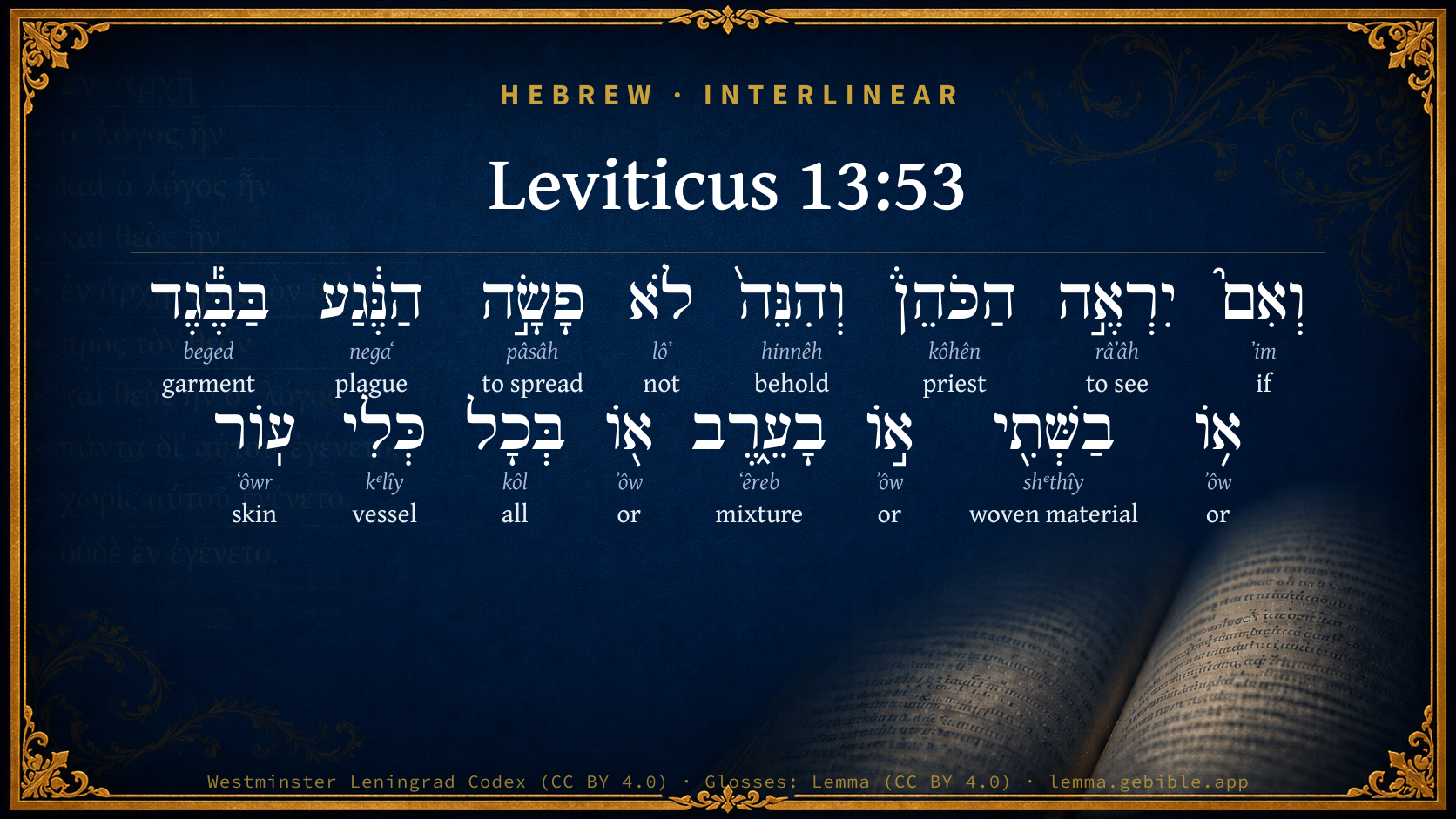
Hebrew (Westminster Leningrad Codex) Leviticus 13:53 appears in the Hebrew Old Testament. The text above is from the Westminster Leningrad Codex. Each word links to its Strong’s number, a concise gloss, and parsing drawn from the Open Scriptures Hebrew Bible morphology. Click any word for its full Brown-Driver-Briggs (BDB) entry.
Download image
Cite this verse

Leviticus 13:53 (World English Bible). Public Domain. Lemma interlinear Bible study tool, https://lemma.gebible.app/v/leviticus/13/53.

Show BibTeX & RIS
BibTeX
RIS
English Translation
"If the priest examines it, and, behold, the plague hasn't spread in the garment, either in the warp, or in the woof, or in anything of skin;
World English Bible · Public Domain
Download a study sheet

One document with this verse’s original text, its word-by-word gloss line, the meaning frame, cross-references with their text, attributed commentary, and full source and license credits — printable, and it pastes into notes with its structure intact.

This verse Autodidact and up

Study sheet (.html) Plain text (.txt)

A passage Seminary Student

Up to 50 verses in one chapter. A passage sheet keeps up to 6 commentary sources and 12 cross-references per verse, in the order this page ranks them, and says so on the sheet whenever that leaves anything out. Ask for a single verse and you get the Autodidact verse sheet above.

Everything on this page stays free to read, with no account — the sheet is a download of what is already on screen, not access to it.

Want to remove ads? Support Godless Engineer
Compare translations 3

The same verse in 3 English versions, stacked beneath the original-language interlinear above. Click any original word for its lexicon entry.

Each is an independent rendering of the whole verse — the interlinear is not word-aligned to these translations.

Highlighted words mark where these versions differ — a whole-verse word diff, not a word-by-word alignment.

  • World English Bible Public Domain
    "If the priest examines it, and, behold, the plague hasn't spread in the garment, either in the warp, or in the woof, or in anything of skin;
  • King James Version Public Domain
    And if the priest shall look, and, behold, the plague be not spread in the garment, either in the warp, or in the woof, or in any thing of skin;
  • unfoldingWord Literal Text CC BY-SA 4.0
    But if the priest sees, and behold, the infection has not spread on the clothing or in the warp or in the woof or on any equipment of leather,

unfoldingWord Literal Text — © unfoldingWord, licensed CC BY-SA 4.0. Word-aligned USFM3 via Door43 (git.door43.org/unfoldingWord/en_ult).

Versions to compare (up to 4)

3 of 4 selected

Show all 18 translations

Every available English version of this verse, each an independent rendering of the whole verse.

  • World English Bible Public Domain
    "If the priest examines it, and, behold, the plague hasn't spread in the garment, either in the warp, or in the woof, or in anything of skin;
  • Berean Standard Bible Public Domain
    But when the priest reexamines it, if the mildew has not spread in the fabric, weave, knit, or leather article,
  • Majority Standard Bible Public Domain
    But when the priest reexamines it, if the mildew has not spread in the fabric, weave, knit, or leather article,
  • King James Version Public Domain
    And if the priest shall look, and, behold, the plague be not spread in the garment, either in the warp, or in the woof, or in any thing of skin;
  • American Standard Version (1901) Public Domain
    And if the priest shall look, and, behold, the plague be not spread in the garment, either in the warp, or in the woof, or in anything of skin;
  • Revised Version (1885) Public Domain
    And if the priest shall look, and, behold, the plague be not spread in the garment, either in the warp, or in the woof, or in any thing of skin;
  • Geneva Bible (1599) Public Domain
    If the Priest yet see that the plague grow not in the garment, or in the woofe, or in whatsoeuer thing of skin it be,
  • Douay-Rheims (1899) Public Domain
    But if he see that it is not grown,
  • Young's Literal Translation Public Domain
    `And if the priest see, and lo, the plague hath not spread in the garment, or in the warp, or in the woof, or in any vessel of skin,
  • Literal Standard Version CC BY-SA 4.0
    And if the priest sees, and behold, the plague has not spread in the garment, or in the warp, or in the woof, or in any vessel of skin,
  • Unlocked Literal Bible CC BY-SA 4.0
    If the priest examines the item and sees that the mildew has not spread in the garment or material woven or knitted from wool or linen, or leather goods,
  • unfoldingWord Literal Text CC BY-SA 4.0
    But if the priest sees, and behold, the infection has not spread on the clothing or in the warp or in the woof or on any equipment of leather,
  • Darby Bible Public Domain
    But if the priest look, and behold, the sore hath not spread in the garment, or in the warp, or in the woof, or in anything of skin,
  • World Messianic Bible Public Domain
    “If the priest examines it, and behold, the plague hasn’t spread in the garment, either in the warp, or in the woof, or in anything of skin;
  • Webster's Bible Public Domain
    And if the priest shall look, and behold, the plague is not spread in the garment, either in the warp or in the woof, or in any thing of skin;
  • Free Bible Version CC BY-SA 4.0
    However, if when the priest inspects it again, the patch of mold has not spread,
  • Bible in Basic English Public Domain
    And if the priest sees that the mark is not increased in the clothing or in any part of the material or in the leather,
  • JPS Tanakh (1917) Public Domain
    And if the priest shall look, and, behold, the plague be not spread in the garment, or in the warp, or in the woof, or in any thing of skin;

Literal Standard Version (2020), Covenant Press — licensed CC BY-SA 4.0. Text via the HelloAO Bible API (eBible.org). Unlocked Literal Bible (unfoldingWord) — licensed CC BY-SA 4.0. Text via the HelloAO Bible API (eBible.org). unfoldingWord Literal Text — © unfoldingWord, licensed CC BY-SA 4.0. Word-aligned USFM3 via Door43 (git.door43.org/unfoldingWord/en_ult). Free Bible Version, Dr. Jonathan Gallagher — licensed CC BY-SA 4.0. Text via the HelloAO Bible API (eBible.org).

Word by word

More ways to search: Search by grammar → Find every occurrence → Compare this word →

Practice this passage: Drill this verse → Learn its vocabulary →

בַשְּׁתִ֖י
shᵉthîy
H8359
“in/at the · woven material”
Preposition, Determined + Noun, Common, Masculine, Singular, Absolute
Part of Speech
Preposition + Noun
Type
Common
Gender
Masculine
Number
Singular
State
Absolute
Full BDB Definition

Origin: from H7896

TWOT: 2479a

warp, woven material
  1. וְאִם֮ ʼim H518 “and · if” Conjunction + Conjunction
  2. יִרְאֶ֣ה râʼâh H7200 “to see” Verb, Qal, Imperfect, 3rd Person, Masculine, Singular
  3. הַכֹּהֵן֒ kôhên H3548 “the · priest” Particle, Definite Article + Noun, Common, Masculine, Singular, Absolute
  4. וְהִנֵּה֙ hinnêh H2009 “and · behold” Conjunction + Particle, Demonstrative
  5. לֹא lôʼ H3808 “not” Particle, Negative
  6. פָשָׂ֣ה pâsâh H6581 “to spread” Verb, Qal, Perfect, 3rd Person, Masculine, Singular
  7. הַנֶּ֔גַע negaʻ H5061 “the · plague” Particle, Definite Article + Noun, Common, Masculine, Singular, Absolute
  8. בַּבֶּ֕גֶד beged H899 “in/at the · garment” Preposition, Determined + Noun, Common, Masculine, Singular, Absolute
  9. א֥וֹ ʼôw H176 “or” Conjunction
  10. א֣וֹ ʼôw H176 “or” Conjunction
  11. בָעֵ֑רֶב ʻêreb H6154 “in/at the · mixture” Preposition, Determined + Noun, Common, Masculine, Singular, Absolute
  12. א֖וֹ ʼôw H176 “or” Conjunction
  13. בְּכָל kôl H3605 “in/at · all of” Preposition + Noun, Common, Masculine, Singular, Construct
  14. כְּלִי kᵉlîy H3627 “vessel of” Noun, Common, Masculine, Singular, Construct
  15. עֽוֹר ʻôwr H5785 “skin” Noun, Common, Masculine, Singular, Absolute

About this verse

These counts appear in no published source. They are computed here, from the morphology-tagged text and Lemma’s own curated glosses. What Lemma adds →

16
words
14
distinct lemmas
Pentateuch
section

Notable vocabulary

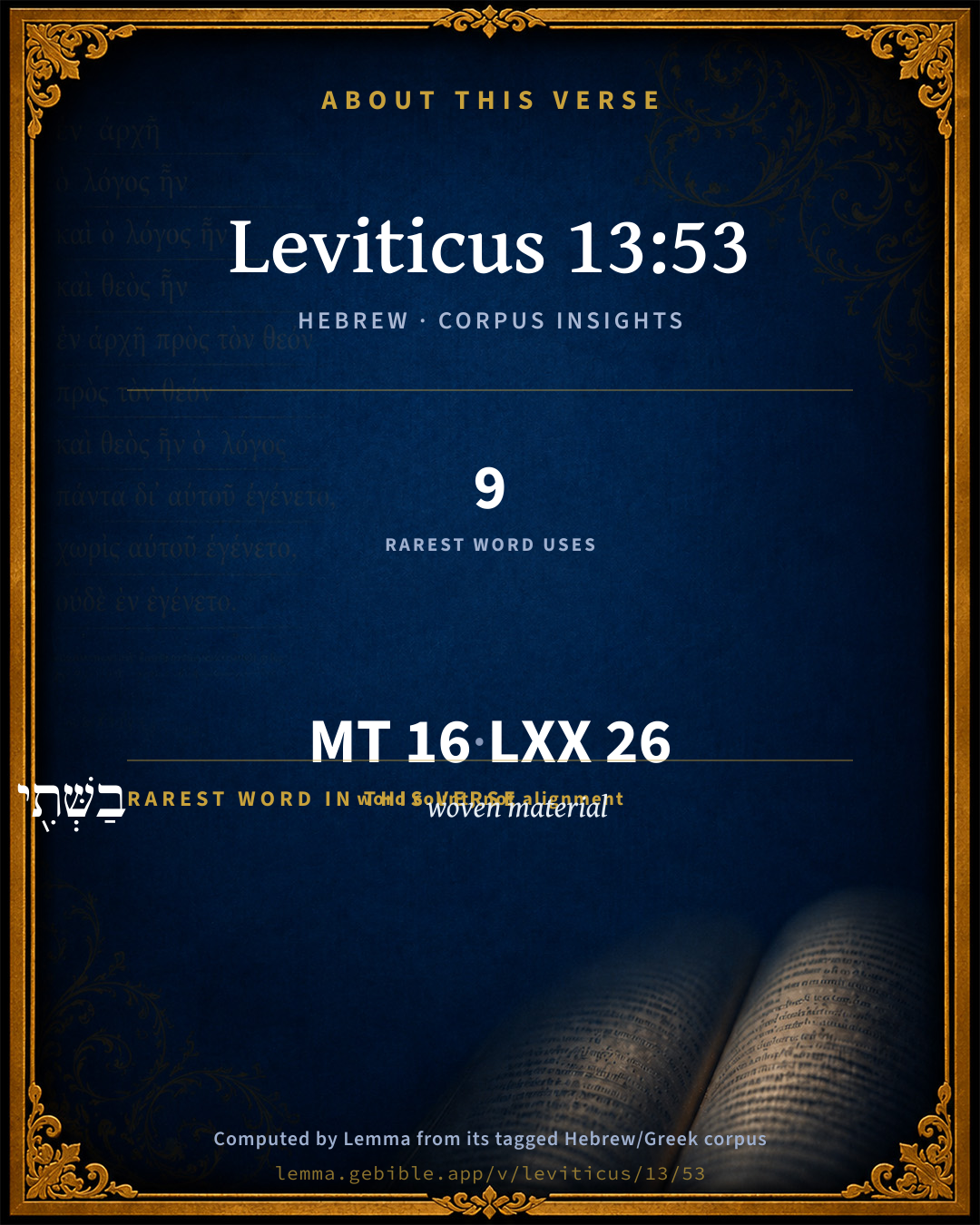
The rarest word here is בַשְּׁתִ֖י woven material H8359 — appearing just 9 times in the whole Hebrew Bible.

Shared distinctive vocabulary

בַשְּׁתִ֖י woven material H8359 occurs in 9 verses of the Hebrew Bible. Also found in:

Grammatical profile

  • 2 verbs
  • 8 nouns
  • 4 conjunctions
  • 2 particles

Verb forms

  • יִרְאֶ֣ה Qal · Imperfect
  • פָשָׂ֣ה Qal · Perfect

Repetition

A word recurs within this verse — often emphatic in Hebrew:

  • א֥וֹ or H176 ×3

Hebrew & Septuagint length

In English translation the verse runs 27 words from the Hebrew and 29 from the Septuagint (LXX English) — closely comparable.

A rough comparison of the two English renderings, which tokenize alike — not a word-level alignment.

Word counts can differ between the Hebrew and the Greek without any difference in meaning — e.g. the Hebrew direct-object marker אֵת has no separate Greek word, and Greek often adds the article ὁ.

In the original languages it is 16 Hebrew tokens and 26 Greek tokens — but the two are counted differently (Hebrew bundles its prefixes and suffixes into one token; the Greek is in lemma form), so that isn’t a like-for-like length.

Hebrew and Greek witnesses Masoretic Hebrew ↔ Greek Septuagint

The same verse in the two great witnesses to the Old Testament, shown verse-for-verse.

These are two independent witnesses, not word-aligned to each other, and the Septuagint is shown in lemma (dictionary) form.

Hebrew Leviticus 13:53 Masoretic · Westminster Leningrad Codex

וְאִם֮ יִרְאֶ֣ה הַכֹּהֵן֒ וְהִנֵּה֙ לֹא פָשָׂ֣ה הַנֶּ֔גַע בַּבֶּ֕גֶד א֥וֹ בַשְּׁתִ֖י א֣וֹ בָעֵ֑רֶב א֖וֹ בְּכָל כְּלִי עֽוֹר

"If the priest examines it, and, behold, the plague hasn't spread in the garment, either in the warp, or in the woof, or in anything of skin;

World English Bible · Public Domain

Greek LXX Leviticus 13:53 Septuagint · lemma form

ἐάν δέ ὁράω ὁ ἱερεύς καί μή διαχέω ὁ ἁφή ἐν ὁ ἱμάτιον ἤ ἐν ὁ στήμων ἤ ἐν ὁ κρόκη ἤ ἐν πᾶς σκεῦος δερμάτινος

And if the priest should see, and the plague be not spread in the garments, either in the warp or in the woof, or in any utensil of skin,

LXX2012 (modern English Septuagint) · Public Domain

Hebrew: Westminster Leningrad Codex (CC BY 4.0). Greek: Septuagint (public domain); English from LXX2012 (modern English Septuagint) (Public Domain). How the Septuagint differs from the Hebrew →

Targum (Aramaic paraphrase)

2

The Targum is the ancient Jewish Aramaic paraphrase of the Hebrew Scriptures — an interpretive translation, not the Hebrew text itself. Onkelos (literal) and Pseudo-Jonathan (expansive) render the Torah, and Jonathan the Prophets. Coverage is partial: where no permissively-licensed English translation exists for a verse, only the Aramaic is shown. This is verse-level text, not a word-by-word alignment to the Hebrew.

  1. Targum Onkelos Torah (Genesis–Deuteronomy)
    וְאִם יֶחֱזֵי כַהֲנָא וְהָא לָא אוֹסֵף מַכְתָּשָׁא בִּלְבוּשָׁא אוֹ בְשִׁתְיָא אוֹ בְעַרְבָא אוֹ בְּכָל מָאן דִמְשָׁךְ

    (no public-domain English translation for this verse)

    Targum Onkelos — Aramaic: “Onkelos Genesis” (public domain); “Onkelos Exodus” (public domain); “Onkelos Leviticus” (public domain); “Onkelos Numbers” (public domain); “Onkelos Deuteronomy” (public domain). English: “Sefaria Community Translation” (CC0 1.0 (public-domain dedication)); “J.W. Etheridge. The Targums of Onkelos and Jonathan Ben Uzziel on the Pentateuch. London: Longmans, Green, 1862” (public domain). Text via Sefaria.

  2. Targum Pseudo-Jonathan Torah (Genesis–Deuteronomy)
    וְאִין יֶחֱמֵי כַהֲנָא וְהָא לָא הֲלִיךְ פִּסְיוֹן מַכְתְּשָׁא בִּלְבוּשָׁא אוֹ בְשִׁיתְיָא אוֹ בְּעַרְבָא אוֹ בְּכָל מַאן דִיצְלָא

    But if the priest look, and, behold, the width of the plague hath not advanced in the garment, in warp or woof, or anything of skin,

    Targum Pseudo-Jonathan — Aramaic: “Targum Jonathan on Genesis” (public domain); “Targum Jonathan on Exodus” (public domain); “Targum Jonathan on Leviticus” (public domain); “Targum Jonathan on Numbers” (public domain); “Targum Jonathan on Deuteronomy” (public domain). English: “The Targum of Jonathan ben Uzziel, trans. J. W. Etheridge, London, 1862” (public domain). Text via Sefaria.

Commentary

Notes on Leviticus 13:53 from classic Christian and Jewish commentators (each source and its license shown beneath its notes). The classic Christian expositions comment on the surrounding passage and are grouped to its opening verse, so a note may address several verses; the Jewish commentaries on the Tanakh (Rashi and others) are per-verse, so they appear only where the commentator wrote on this verse.

Lemma curates 59 commentaries, every one of them public domain or Creative Commons licensed, each selected and text-cleaned for this edition rather than reprinted as found. About our sources →

Geneva Bible (1599)

Geneva Bible translators

But abide still in one place, as verse 37.

Geneva Bible (1599) marginal notes — public domain. Text via Bolls.life.

Ellicott's Commentary for English Readers

(53, 54) And if the priest shall look.—If, however, after a week’s quarantine, the priest on examination finds that the disease has not spread, he must order the affected garments to be washed, and shut them up for another week, when it will be seen whether the colour has changed, and the distemper has disappeared or not.

A Bible Commentary for English Readers, edited by Charles John Ellicott (1878–1897) — public domain. Text from a community e-Sword module.

John Gill's Exposition

And the priest shall look on the plague after it is washed,.... That is, on the second seventh day, or thirteenth day from his first inspection of it:

and, behold, if the plague has not changed its colour; and the plague be not spread, it is unclean, thou shalt burn it in the fire; if it remains just as it was at first, very green or very red, and has not diminished of its colour at all, nor changed from one colour to another, although it should not have spread itself, yet it is defiled, and to be burnt without the camp, as before; that which spreads itself here and there, it is to be burnt:

it is after inward, whether it be bare within or without; that is, whether it be threadbare on the wrong or right side of the garment, the nap being eaten off by the leprosy; which shows it to be a fretting, eating, and corroding one: in the Hebrew text it is, "in the boldness of the hinder", or "in the baldness of the fore part"; they are the same words which are used of the boldness of the back part and fore part of the head, Lev 13:42; the nap being off either of the outer and right side of the cloth, or of the inner and wrong side, made it look like a bald head, whether before or behind.

John Gill's Exposition of the Whole Bible (1746–1763) — public domain (CC PDM 1.0). Text via the HelloAO Bible API.

Keil & Delitzsch

C. F. Keil & F. Delitzsch

If the mole had not spread during the seven days, the priest was to cause the fabric in which the mole appeared to be washed, and then shut it up for seven days more. If the mole did not alter its appearance after being washed, even though it had not spread, the fabric was unclean, and was therefore to be burned. "It is a corroding in the back and front" (of the fabric of leather). פּחתת, from פּחת, in Syriac fodit, from which comes פּחת a pit, lit., a digging: here a corroding depression. קרחת a bald place in the front or right side, גּבּחת a bald place in the back or left side of the fabric or leather.

Keil & Delitzsch — Biblical Commentary on the Old Testament (1861–1891) — public domain (CC PDM 1.0). Text via the HelloAO Bible API. (Old Testament only.)

unfoldingWord translationNotes

Door43 World Missions Community

then he will command them

"then the priest will command the owners" Here the priest is telling the people what to do with household items that were possibly infected.

in which the mildew was found

This can be translated in active form. AT: "in which they found the mildew" (See: Active or Passive)

after the mildewed item was washed

This can be translated in active form. AT: "after they washed the mildewed item" (See: Active or Passive)

it is unclean

Something that God has declared to be unfit for people to touch is spoken of as if it were physically unclean. (See: Metaphor)

You must burn the item

Here "you" does not refer to the priest specifically. It just means someone must burn the object.

translationWords

priest

command

clean

unfoldingWord translationNotes — © Distant Shores Media and the Door43 World Missions Community, licensed CC BY-SA 4.0. Source: git.door43.org/Door43/en_tn.

Lesson kit

Teaching starters — assembled from the data on this page, not authored interpretation. Every prompt links to the verse data it draws on. Edit before teaching.

Leviticus, in the Pentateuch, opens this verse with 16 words (14 distinct Hebrew lemmas). Its most distinctive word is shᵉthîy (“woven material”). A historical commentator’s framing appears above. Read the whole chapter for the surrounding context.

Discussion questions

  1. What does “woven material” (shᵉthîy) contribute to the verse as a whole?
  2. Leviticus 13:48 shares the word «woven material» with this verse. How do the two illuminate each other?
  3. “or” occurs 3× in this one verse. What is the effect of the repetition?
  4. These translations render this verse differently. What is at stake in choosing one wording over another?
  5. The verb «יִרְאֶ֣ה» is Qal Imperfect. How does its form color the action?
  6. Reading how Geneva Bible (1599) and Ellicott's Commentary for English Readers read this verse, where do the two commentators agree and where do they part?

Things to notice

Reading settings

Reading text

Shown beneath each verse's original-language words.

Old Testament
Old Testament edition

Read the OT as the Masoretic Hebrew (MT) or the Greek Septuagint (LXX).

English shown for the Greek Septuagint (in the Hebrew ↔ Greek comparison).

Comparing translations? Open the Compare panel on any verse page to stack up to four side by side.