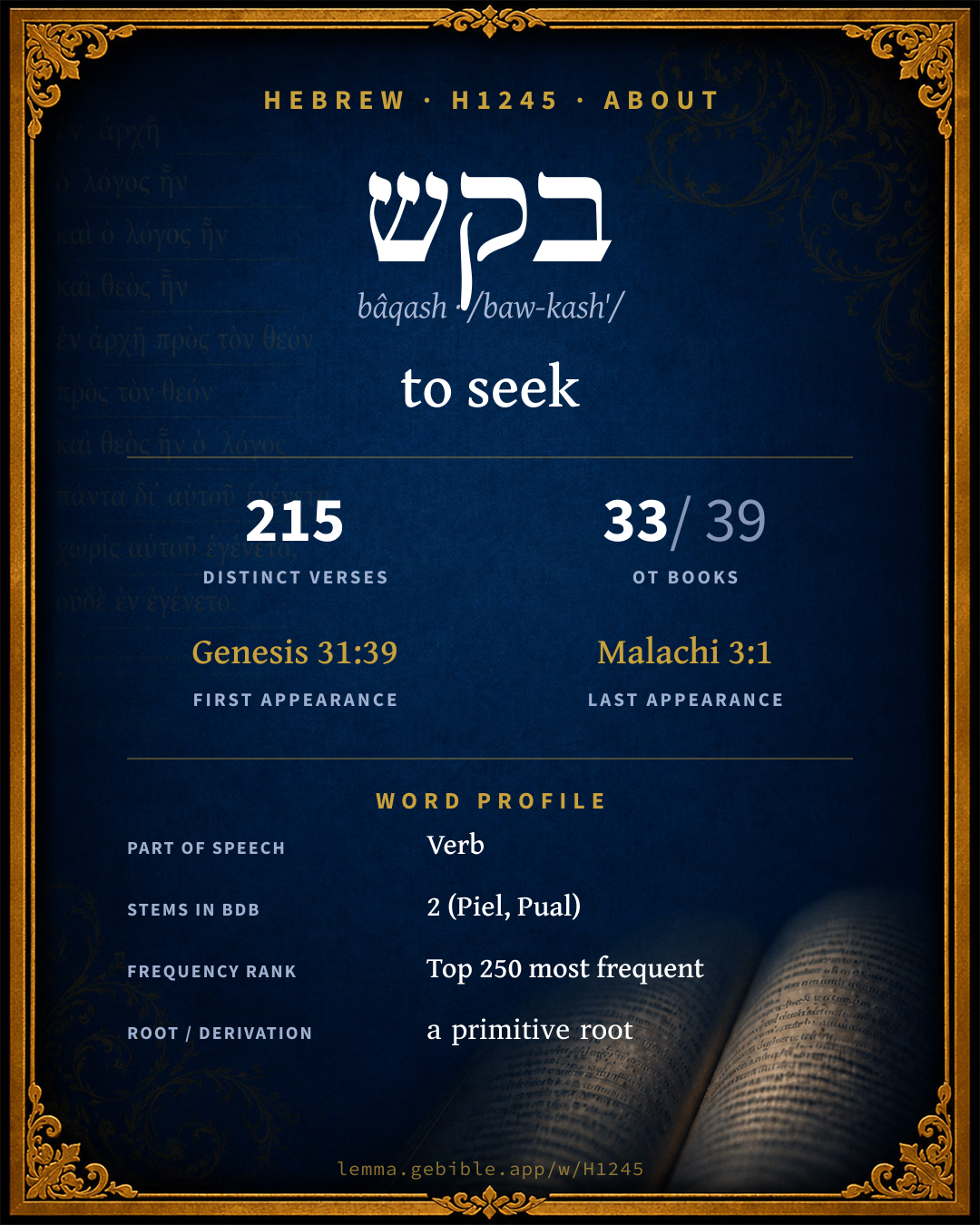
בָּקַשׁ
to seek
also: require, desire, exact, request fuller range ↓
Full lexicon entry — Brown-Driver-Briggs (BDB)
From Brown-Driver-Briggs (BDB)
Where this word appears
See every Piel verb in the Hebrew Bible →
Grammar key — what these labels mean
Part of speech
- Verb
- An action or state-of-being word.
Stem
- Piel
- An intensive or resultative active stem. Here: ‘seek to find’
- Pual
- The passive counterpart of the Piel.
Form
- Infinitive Construct
- A bound verbal noun, frequently with prepositions (“to write / in writing”).
- Participle Active
- A verbal adjective expressing ongoing or characteristic action (“writing / one who writes”).
- Sequential Imperfect
- An imperfect with prefixed waw — the standard past-narrative form (waw-consecutive imperfect).
- Imperfect
- An incomplete, ongoing, or future action (“he will / would write”).
- Perfect
- A completed action or state — Hebrew marks aspect (completeness) more than strict tense (“he wrote”).
- Imperative
- A direct command (“write!”).
- Sequential Perfect
- A perfect with prefixed waw continuing a preceding imperfect or command (waw-consecutive perfect).
- Jussive
- A third- or second-person volitional form expressing wish or command (“let him write”).
- Cohortative
- A first-person volitional form expressing wish or resolve (“let me / let us write”).
State
- Absolute
- The independent form of a noun, not bound to a following word.
- Construct
- A noun bound to a following noun in a possessive / “of” relationship (the construct chain).
Person
- 3rd Person
- The one spoken about (“he / she / it / they”).
- 1st Person
- The speaker (“I / we”).
- 2nd Person
- The one addressed (“you”).
Gender
- Masculine
- Grammatically masculine.
- Common
- Either gender — not distinguished for this form.
- Feminine
- Grammatically feminine.
Number
- Singular
- One.
- Plural
- More than one (in Hebrew, generally three or more).
Grammatical forms 33 distinct
- Verb, Piel, Infinitive Construct 32 times (14%)
- Verb, Piel, Participle Active, Masculine, Plural, Construct 27 times (12%)
- Verb, Piel, Participle Active, Masculine, Singular, Absolute 24 times (11%)
- Verb, Piel, Sequential Imperfect, 3rd Person, Masculine, Singular 13 times (6%)
- Verb, Piel, Perfect, 3rd Person, Common, Plural 13 times (6%)
- Verb, Piel, Participle Active, Masculine, Plural, Absolute 12 times (5%)
- Verb, Piel, Imperfect, 3rd Person, Masculine, Singular 11 times (5%)
- Verb, Piel, Imperfect, 1st Person, Common, Singular 11 times (5%)
+25 more forms (82 occurrences)
Parsed forms decoded from the imported morphology (morphhb / Westminster Leningrad Codex — WLC text public domain, morphhb tagging CC BY 4.0), counted across 225 parsed occurrences — not distinct verses.
Page 1 of 2 — showing verses 1–200 of 215 distinct verses where H1245 appears, across 33 books. Click any verse to open its interlinear word-by-word view. Verse text shown in the World English Bible for context — . Each verse’s Hebrew form is shown with its reference; the English is not keyword-highlighted, since the data carries no word-level English alignment. Use “Compare translations” on any verse to read it across multiple English versions. This concordance covers the Hebrew Bible; Septuagint (Greek Old Testament) occurrences are not indexed here.
Genesis 5 verses
- Genesis 31:39 תְּבַקְשֶׁ֑/נָּה Piel impf 2ms + sfx pers 3fs That which was torn of animals, I didn't bring to you. I bore the loss of it. Of my hand you required it, whether stolen by day or stolen by night.
- Genesis 37:15 תְּבַקֵּֽשׁ Piel impf 2ms A certain man found him, and behold, he was wandering in the field: and the man asked him, saying, "What are you looking for?"
- Genesis 37:16 מְבַקֵּ֑שׁ Piel ptcp.act ms He said, "I am looking for my brothers. Tell me, please, where they are feeding the flock."
- Genesis 43:9 תְּבַקְשֶׁ֑/נּוּ Piel impf 2ms + sfx pers 3ms I will be collateral for him. From my hand will you require him. If I don't bring him to you, and set him before you, then let me bear the blame forever,
- Genesis 43:30 וַ/יְבַקֵּ֖שׁ conj + Piel wimpf 3ms Joseph made haste; for his heart yearned over his brother: and he sought a place to weep; and he entered into his room, and wept there.
Exodus 5 verses
- Exodus 2:15 וַ/יְבַקֵּ֖שׁ conj + Piel wimpf 3ms Now when Pharaoh heard this thing, he sought to kill Moses. But Moses fled from the face of Pharaoh, and lived in the land of Midian, and he sat down by a well.
- Exodus 4:19 הַֽ/מְבַקְשִׁ֖ים ptcl def.art + Piel ptcp.act mp Yahweh said to Moses in Midian, "Go, return into Egypt; for all the men who sought your life are dead."
- Exodus 4:24 וַ/יְבַקֵּ֖שׁ conj + Piel wimpf 3ms It happened on the way at a lodging place, that Yahweh met him and wanted to kill him.
- Exodus 10:11 מְבַקְשִׁ֑ים Piel ptcp.act mp Not so! Go now you who are men, and serve Yahweh; for that is what you desire!" They were driven out from Pharaoh's presence.
- Exodus 33:7 מְבַקֵּ֣שׁ Piel ptcp.act ms Now Moses used to take the tent and to pitch it outside the camp, far away from the camp, and he called it "The tent of meeting." It happened that everyone who sought Yahweh went out to the tent of meeting, which was outside the camp.
Leviticus 1 verse
Numbers 2 verses
- Numbers 16:10 וּ/בִקַּשְׁתֶּ֖ם conj + Piel wpf 2mp and that he has brought you near, and all your brothers the sons of Levi with you? and seek you the priesthood also?
- Numbers 35:23 מְבַקֵּ֖שׁ Piel ptcp.act ms or with any stone, by which a man may die, not seeing him, and cast it on him, so that he died, and he was not his enemy, neither sought his harm;
Deuteronomy 2 verses
- Deuteronomy 4:29 וּ/בִקַּשְׁתֶּ֥ם conj + Piel wpf 2mp But from there you shall seek Yahweh your God, and you shall find him, when you search after him with all your heart and with all your soul.
- Deuteronomy 13:10 בִקֵּ֗שׁ Piel pf 3ms You shall stone him to death with stones, because he has sought to draw you away from Yahweh your God, who brought you out of the land of Egypt, out of the house of bondage.
Joshua 2 verses
- Joshua 2:22 וַ/יְבַקְשׁ֧וּ conj + Piel wimpf 3mp They went, and came to the mountain, and abode there three days, until the pursuers were returned: and the pursuers sought them throughout all the way, but didn't find them.
- Joshua 22:23 יְבַקֵּֽשׁ Piel impf 3ms that we have built us an altar to turn away from following Yahweh; or if to offer thereon burnt offering or meal-offering, or if to offer sacrifices of peace-offerings thereon, let Yahweh himself require it;
Judges 4 verses
- Judges 4:22 מְבַקֵּ֑שׁ Piel ptcp.act ms Behold, as Barak pursued Sisera, Jael came out to meet him, and said to him, Come, and I will show you the man whom you seek. He came to her; and, behold, Sisera lay dead, and the tent-pin was in his temples.
- Judges 6:29 וַ/יְבַקְשׁ֔וּ conj + Piel wimpf 3mp They said one to another, Who has done this thing? When they inquired and asked, they said, Gideon the son of Joash has done this thing.
- Judges 14:4 מְבַקֵּ֖שׁ Piel ptcp.act ms But his father and his mother didn't know that it was of Yahweh; for he sought an occasion against the Philistines. Now at that time the Philistines had rule over Israel.
- Judges 18:1 מְבַקֶּשׁ Piel ptcp.act ms In those days there was no king in Israel: and in those days the tribe of the Danites sought them an inheritance to dwell in; for to that day [their] inheritance had not fallen to them among the tribes of Israel.
Ruth 1 verse
1 Samuel 25 verses
- 1 Samuel 9:3 בַּקֵּ֖שׁ Piel impv 2ms The donkeys of Kish, Saul's father, were lost. Kish said to Saul his son, Take now one of the servants with you, and arise, go seek the donkeys.
- 1 Samuel 10:2 לְ/בַקֵּ֔שׁ prep + Piel inf.cs When you are departed from me today, then you shall find two men by Rachel's tomb, in the border of Benjamin at Zelzah; and they will tell you, The donkeys which you went to seek are found; and, behold, your father has left off caring for the donkeys, and is anxious for you, saying, What shall I do for my son?
- 1 Samuel 10:14 לְ/בַקֵּשׁ֙ prep + Piel inf.cs Saul's uncle said to him and to his servant, Where went you? He said, To seek the donkeys; and when we saw that they were not found, we came to Samuel.
- 1 Samuel 10:21 וַ/יְבַקְשֻׁ֖/הוּ conj + Piel wimpf 3mp + sfx pers 3ms He brought the tribe of Benjamin near by their families; and the family of the Matrites was taken; and Saul the son of Kish was taken: but when they sought him, he could not be found.
- 1 Samuel 13:14 בִּקֵּשׁ֩ Piel pf 3ms But now your kingdom shall not continue: Yahweh has sought him a man after his own heart, and Yahweh has appointed him to be prince over his people, because you have not kept that which Yahweh commanded you.
- 1 Samuel 14:4 בִּקֵּ֤שׁ Piel pf 3ms Between the passes, by which Jonathan sought to go over to the Philistines' garrison, there was a rocky crag on the one side, and a rocky crag on the other side: and the name of the one was Bozez, and the name of the other Seneh.
- 1 Samuel 16:16 יְבַקְשׁ֕וּ Piel impf 3mp Let our lord now command your servants who are before you, to seek out a man who is a skillful player on the harp: and it shall happen, when the evil spirit from God is on you, that he shall play with his hand, and you shall be well.
- 1 Samuel 19:2 מְבַקֵּ֛שׁ Piel ptcp.act ms Jonathan told David, saying, Saul my father seeks to kill you: now therefore, please take care of yourself in the morning, and live in a secret place, and hide yourself:
- 1 Samuel 19:10 וַ/יְבַקֵּ֨שׁ conj + Piel wimpf 3ms Saul sought to strike David even to the wall with the spear; but he slipped away out of Saul's presence, and he struck the spear into the wall: and David fled, and escaped that night.
- 1 Samuel 20:1 מְבַקֵּ֖שׁ Piel ptcp.act ms David fled from Naioth in Ramah, and came and said before Jonathan, "What have I done? What is my iniquity?" and "What is my sin before your father, that he seeks my life?"
- 1 Samuel 20:16 וּ/בִקֵּ֣שׁ conj + Piel pf 3ms So Jonathan made a covenant with the house of David, [saying], Yahweh will require it at the hand of David's enemies.
- 1 Samuel 22:23 יְבַקֵּ֥שׁ יְבַקֵּ֣שׁ Piel impf 3ms Piel impf 3ms Abide you with me, don't be afraid; for he who seeks my life seeks your life: for with me you shall be in safeguard.
- 1 Samuel 23:10 מְבַקֵּ֥שׁ Piel ptcp.act ms Then said David, O Yahweh, the God of Israel, your servant has surely heard that Saul seeks to come to Keilah, to destroy the city for my sake.
- 1 Samuel 23:14 וַ/יְבַקְשֵׁ֤/הוּ conj + Piel wimpf 3ms + sfx pers 3ms David abode in the wilderness in the strongholds, and remained in the hill-country in the wilderness of Ziph. Saul sought him every day, but God didn't deliver him into his hand.
- 1 Samuel 23:15 לְ/בַקֵּ֣שׁ prep + Piel inf.cs David saw that Saul had come out to seek his life: and David was in the wilderness of Ziph in the wood.
- 1 Samuel 23:25 לְ/בַקֵּשׁ֒ prep + Piel inf.cs Saul and his men went to seek him. They told David: why he came down to the rock, and abode in the wilderness of Maon. When Saul heard [that], he pursued after David in the wilderness of Maon.
- 1 Samuel 24:2 לְ/בַקֵּ֤שׁ prep + Piel inf.cs Then Saul took three thousand chosen men out of all Israel, and went to seek David and his men on the rocks of the wild goats.
- 1 Samuel 24:9 מְבַקֵּ֖שׁ Piel ptcp.act ms David said to Saul, Why listen you to men's words, saying, Behold, David seeks your hurt?
- 1 Samuel 25:26 וְ/הַֽ/מְבַקְשִׁ֥ים conj + ptcl def.art + Piel ptcp.act mp Now therefore, my lord, as Yahweh lives, and as your soul lives, seeing Yahweh has withheld you from blood guiltiness, and from avenging yourself with your own hand, now therefore let your enemies, and those who seek evil to my lord, be as Nabal.
- 1 Samuel 25:29 וּ/לְ/בַקֵּ֖שׁ conj + prep + Piel inf.cs Though men be risen up to pursue you, and to seek your soul, yet the soul of my lord shall be bound in the bundle of life with Yahweh your God; and the souls of your enemies, them shall he sling out, as from the hollow of a sling.
- 1 Samuel 26:2 לְ/בַקֵּ֥שׁ prep + Piel inf.cs Then Saul arose, and went down to the wilderness of Ziph, having three thousand chosen men of Israel with him, to seek David in the wilderness of Ziph.
- 1 Samuel 26:20 לְ/בַקֵּשׁ֙ prep + Piel inf.cs Now therefore, don't let my blood fall to the earth away from the presence of Yahweh: for the king of Israel is come out to seek a flea, as when one does hunt a partridge in the mountains.
- 1 Samuel 27:1 לְ/בַקְשֵׁ֤/נִי prep + Piel inf.cs + sfx pers 1cs David said in his heart, I shall now perish one day by the hand of Saul: there is nothing better for me than that I should escape into the land of the Philistines; and Saul will despair of me, to seek me any more in all the borders of Israel: so shall I escape out of his hand.
- 1 Samuel 27:4 לְ/בַקְשֽׁ/וֹ prep + Piel inf.cs + sfx pers 3ms It was told Saul that David was fled to Gath: and he sought no more again for him.
- 1 Samuel 28:7 בַּקְּשׁוּ Piel impv 2mp Then said Saul to his servants, Seek me a woman who has a familiar spirit, that I may go to her, and inquire of her. His servants said to him, Behold, there is a woman who has a familiar spirit at En-dor.
2 Samuel 11 verses
- 2 Samuel 3:17 מְבַקְשִׁ֧ים Piel ptcp.act mp Abner had communication with the elders of Israel, saying, In times past you sought for David to be king over you:
- 2 Samuel 4:8 בִּקֵּ֖שׁ Piel pf 3ms They brought the head of Ish-bosheth to David to Hebron, and said to the king, Behold, the head of Ish-bosheth, the son of Saul, your enemy, who sought your life; and Yahweh has avenged my lord the king this day of Saul, and of his seed.
- 2 Samuel 4:11 אֲבַקֵּ֤שׁ Piel impf 1cs How much more, when wicked men have slain a righteous person in his own house on his bed, shall I not now require his blood of your hand, and take you away from the earth?
- 2 Samuel 5:17 לְ/בַקֵּ֣שׁ prep + Piel inf.cs When the Philistines heard that they had anointed David king over Israel, all the Philistines went up to seek David; and David heard of it, and went down to the stronghold.
- 2 Samuel 12:16 וַ/יְבַקֵּ֥שׁ conj + Piel wimpf 3ms David therefore begged God for the child; and David fasted, and went in, and lay all night on the earth.
- 2 Samuel 16:11 מְבַקֵּ֣שׁ Piel ptcp.act ms David said to Abishai, and to all his servants, Behold, my son, who came forth from my bowels, seeks my life: how much more [may] this Benjamite now [do it]? let him alone, and let him curse; for Yahweh has invited him.
- 2 Samuel 17:3 מְבַקֵּ֔שׁ Piel ptcp.act ms and I will bring back all the people to you: the man whom you seek is as if all returned: [so] all the people shall be in peace.
- 2 Samuel 17:20 וַ/יְבַקְשׁוּ֙ conj + Piel wimpf 3mp Absalom's servants came to the woman to the house; and they said, Where are Ahimaaz and Jonathan? The woman said to them, They have gone over the brook of water. When they had sought and could not find them, they returned to Jerusalem.
- 2 Samuel 20:19 מְבַקֵּ֗שׁ Piel ptcp.act ms I am of those who are peaceable and faithful in Israel: you seek to destroy a city and a mother in Israel: why will you swallow up the inheritance of Yahweh?
- 2 Samuel 21:1 וַ/יְבַקֵּ֥שׁ conj + Piel wimpf 3ms There was a famine in the days of David three years, year after year; and David sought the face of Yahweh. Yahweh said, It is for Saul, and for his bloody house, because he put to death the Gibeonites.
- 2 Samuel 21:2 וַ/יְבַקֵּ֤שׁ conj + Piel wimpf 3ms The king called the Gibeonites, and said to them (now the Gibeonites were not of the children of Israel, but of the remnant of the Amorites; and the children of Israel had sworn to them: and Saul sought to kill them in his zeal for the children of Israel and Judah);
1 Kings 10 verses
- 1 Kings 1:2 יְבַקְשׁ֞וּ Piel impf 3mp Therefore his servants said to him, Let there be sought for my lord the king a young virgin: and let her stand before the king, and cherish him; and let her lie in your bosom, that my lord the king may keep warm.
- 1 Kings 1:3 וַ/יְבַקְשׁוּ֙ conj + Piel wimpf 3mp So they sought for a beautiful young lady throughout all the borders of Israel, and found Abishag the Shunammite, and brought her to the king.
- 1 Kings 2:40 לְ/בַקֵּ֖שׁ prep + Piel inf.cs Shimei arose, and saddled his donkey, and went to Gath to Achish, to seek his servants; and Shimei went, and brought his servants from Gath.
- 1 Kings 10:24 מְבַקְשִׁ֖ים Piel ptcp.act mp All the earth sought the presence of Solomon, to hear his wisdom, which God had put in his heart.
- 1 Kings 11:22 מְבַקֵּ֖שׁ Piel ptcp.act ms Then Pharaoh said to him, But what have you lacked with me, that behold, you seek to go to your own country? He answered, Nothing: however only let me depart.
- 1 Kings 11:40 וַ/יְבַקֵּ֥שׁ conj + Piel wimpf 3ms Solomon sought therefore to kill Jeroboam; but Jeroboam arose, and fled into Egypt, to Shishak king of Egypt, and was in Egypt until the death of Solomon.
- 1 Kings 18:10 לְ/בַקֶּשְׁ/ךָ֔ prep + Piel inf.cs + sfx pers 2ms As Yahweh your God lives, there is no nation or kingdom, where my lord has not sent to seek you: and when they said, He is not here, he took an oath of the kingdom and nation, that they didn't find you.
- 1 Kings 19:10 וַ/יְבַקְשׁ֥וּ conj + Piel wimpf 3mp He said, I have been very jealous for Yahweh, the God of hosts; for the children of Israel have forsaken your covenant, thrown down your altars, and slain your prophets with the sword: and I, even I only, am left; and they seek my life, to take it away.
- 1 Kings 19:14 וַ/יְבַקְשׁ֥וּ conj + Piel wimpf 3mp He said, I have been very jealous for Yahweh, the God of hosts; for the children of Israel have forsaken your covenant, thrown down your altars, and slain your prophets with the sword; and I, even I only, am left; and they seek my life, to take it away.
- 1 Kings 20:7 מְבַקֵּ֑שׁ Piel ptcp.act ms Then the king of Israel called all the elders of the land, and said, Please notice how this man seeks mischief: for he sent to me for my wives, and for my children, and for my silver, and for my gold; and I didn't deny him.
2 Kings 3 verses
- 2 Kings 2:16 וִ/יבַקְשׁ֣וּ conj + Piel juss 3mp They said to him, See now, there are with your servants fifty strong men; let them go, we pray you, and seek your master, lest the Spirit of Yahweh has taken him up, and cast him on some mountain, or into some valley. He said, You shall not send.
- 2 Kings 2:17 וַ/יְבַקְשׁ֥וּ conj + Piel wimpf 3mp When they urged him until he was ashamed, he said, Send. They sent therefore fifty men; and they sought three days, but didn't find him.
- 2 Kings 6:19 תְּבַקֵּשׁ֑וּ/ן Piel impf 2mp + sfx n Elisha said to them, This is not the way, neither is this the city: follow me, and I will bring you to the man whom you seek. He led them to Samaria.
1 Chronicles 5 verses
- 1 Chronicles 4:39 לְ/בַקֵּ֥שׁ prep + Piel inf.cs They went to the entrance of Gedor, even to the east side of the valley, to seek pasture for their flocks.
- 1 Chronicles 14:8 לְ/בַקֵּ֣שׁ prep + Piel inf.cs When the Philistines heard that David was anointed king over all Israel, all the Philistines went up to seek David: and David heard of it, and went out against them.
- 1 Chronicles 16:10 מְבַקְשֵׁ֥י Piel ptcp.act mp cs Glory you in his holy name; Let the heart of them rejoice who seek Yahweh.
- 1 Chronicles 16:11 בַּקְּשׁ֥וּ Piel impv 2mp Seek you Yahweh and his strength; Seek his face forever more.
- 1 Chronicles 21:3 יְבַקֵּ֥שׁ Piel impf 3ms Joab said, Yahweh make his people a hundred times as many as they are: but, my lord the king, aren't they all my lord's servants? why does my lord require this thing? why will he be a cause of guilt to Israel?
2 Chronicles 7 verses
- 2 Chronicles 7:14 וִֽ/יבַקְשׁ֣וּ conj + Piel impf 3mp if my people, who are called by my name, shall humble themselves, and pray, and seek my face, and turn from their wicked ways; then will I hear from heaven, and will forgive their sin, and will heal their land.
- 2 Chronicles 9:23 מְבַקְשִׁ֖ים Piel ptcp.act mp All the kings of the earth sought the presence of Solomon, to hear his wisdom, which God had put in his heart.
- 2 Chronicles 11:16 לְ/בַקֵּ֕שׁ prep + Piel inf.cs After them, out of all the tribes of Israel, such as set their hearts to seek Yahweh, the God of Israel, came to Jerusalem to sacrifice to Yahweh, the God of their fathers.
- 2 Chronicles 15:4 וַ/יְבַקְשֻׁ֖/הוּ conj + Piel wimpf 3mp + sfx pers 3ms But when in their distress they turned to Yahweh, the God of Israel, and sought him, he was found of them.
- 2 Chronicles 15:15 בִּקְשֻׁ֔/הוּ Piel pf 3cp + sfx pers 3ms All Judah rejoiced at the oath; for they had sworn with all their heart, and sought him with their whole desire; and he was found of them: and Yahweh gave them rest round about.
- 2 Chronicles 20:4 לְ/בַקֵּ֖שׁ לְ/בַקֵּ֥שׁ prep + Piel inf.cs prep + Piel inf.cs Judah gathered themselves together, to seek [help] of Yahweh: even out of all the cities of Judah they came to seek Yahweh.
- 2 Chronicles 22:9 וַ/יְבַקֵּשׁ֩ conj + Piel wimpf 3ms He sought Ahaziah, and they caught him (now he was hiding in Samaria), and they brought him to Jehu, and killed him; and they buried him, for they said, He is the son of Jehoshaphat, who sought Yahweh with all his heart. The house of Ahaziah had no power to hold the kingdom.
Ezra 4 verses
- Ezra 2:62 בִּקְשׁ֧וּ Piel pf 3cp These sought their register [among] those who were reckoned by genealogy, but they were not found: therefore were they deemed polluted and put from the priesthood.
- Ezra 8:21 לְ/בַקֵּ֤שׁ prep + Piel inf.cs Then I proclaimed a fast there, at the river Ahava, that we might humble ourselves before our God, to seek of him a straight way for us, and for our little ones, and for all our substance.
- Ezra 8:22 מְבַקְשָׁי/ו֙ Piel ptcp.act mp cs + sfx pers 3ms For I was ashamed to ask of the king a band of soldiers and horsemen to help us against the enemy in the way, because we had spoken to the king, saying, The hand of our God is on all those who seek him, for good; but his power and his wrath is against all those who forsake him.
- Ezra 8:23 וַ/נְּבַקְשָׁ֥/ה conj + Piel wimpf 1cp + sfx h So we fasted and begged our God for this: and he was entreated of us.
Nehemiah 6 verses
- Nehemiah 2:4 מְבַקֵּ֑שׁ Piel ptcp.act ms Then the king said to me, For what do you make request? So I prayed to the God of heaven.
- Nehemiah 2:10 לְ/בַקֵּ֥שׁ prep + Piel inf.cs When Sanballat the Horonite, and Tobiah the servant, the Ammonite, heard of it, it grieved them exceedingly, because a man had come to seek the welfare of the children of Israel.
- Nehemiah 5:12 נְבַקֵּ֔שׁ Piel impf 1cp Then said they, We will restore them, and will require nothing of them; so will we do, even as you say. Then I called the priests, and took an oath of them, that they would do according to this promise.
- Nehemiah 5:18 בִקַּ֔שְׁתִּי Piel pf 1cs Now that which was prepared for one day was one ox and six choice sheep; also fowls were prepared for me, and once in ten days store of all sorts of wine: yet for all this I didn't demand the bread of the governor, because the bondage was heavy on this people.
- Nehemiah 7:64 בִּקְשׁ֧וּ Piel pf 3cp These sought their register [among] those who were reckoned by genealogy, but it was not found: therefore were they deemed polluted and put from the priesthood.
- Nehemiah 12:27 בִּקְשׁ֤וּ Piel pf 3cp At the dedication of the wall of Jerusalem they sought the Levites out of all their places, to bring them to Jerusalem, to keep the dedication with gladness, both with giving thanks, and with singing, with cymbals, psalteries, and with harps.
Esther 9 verses
- Esther 2:2 יְבַקְשׁ֥וּ Piel juss 3mp Then said the king's servants who ministered to him, Let there be beautiful young virgins sought for the king:
- Esther 2:15 בִקְשָׁה֙ Piel pf 3fs Now when the turn of Esther, the daughter of Abihail the uncle of Mordecai, who had taken her for his daughter, was come to go in to the king, she required nothing but what Hegai the king's chamberlain, the keeper of the women, appointed. Esther obtained favor in the sight of all those who looked at her.
- Esther 2:21 וַ/יְבַקְשׁוּ֙ conj + Piel wimpf 3mp In those days, while Mordecai was sitting in the king's gate, two of the king's chamberlains, Bigthan and Teresh, of those who kept the threshold, were angry, and sought to lay hands on the king Ahasuerus.
- Esther 2:23 וַ/יְבֻקַּ֤שׁ conj + Pual wimpf 3ms When inquisition was made of the matter, and it was found to be so, they were both hanged on a tree: and it was written in the book of the chronicles before the king.
- Esther 3:6 וַ/יְבַקֵּ֣שׁ conj + Piel wimpf 3ms But he scorned the thought of laying hands on Mordecai alone; for they had made known to him the people of Mordecai: therefore Haman sought to destroy all the Jews who were throughout the whole kingdom of Ahasuerus, even the people of Mordecai.
- Esther 4:8 וּ/לְ/בַקֵּ֥שׁ conj + prep + Piel inf.cs Also he gave him the copy of the writing of the decree that was given out in Shushan to destroy them, to show it to Esther, and to declare it to her, and to charge her that she should go in to the king, to make supplication to him, and to make request before him, for her people.
- Esther 6:2 בִּקְשׁוּ֙ Piel pf 3cp It was found written that Mordecai had told of Bigthana and Teresh, two of the king's chamberlains, of those who kept the threshold, who had sought to lay hands on the king Ahasuerus.
- Esther 7:7 לְ/בַקֵּ֤שׁ prep + Piel inf.cs The king arose in his wrath from the banquet of wine [and went] into the palace garden: and Haman stood up to make request for his life to Esther the queen; for he saw that there was evil determined against him by the king.
- Esther 9:2 בִּ/מְבַקְשֵׁ֖י prep + Piel ptcp.act mp cs the Jews gathered themselves together in their cities throughout all the provinces of the king Ahasuerus, to lay hand on such as sought their hurt: and no man could withstand them; for the fear of them was fallen on all the peoples.
Job 1 verse
Psalms 26 verses
- Psalms 4:2 תְּבַקְשׁ֖וּ Piel impf 2mp You sons of men, how long shall my glory be turned into dishonor? Will you love vanity, and seek after falsehood? Selah.
- Psalms 24:6 מְבַקְשֵׁ֨י Piel ptcp.act mp cs This is the generation of those who seek Him, Who seek your face--even Jacob. Selah.
- Psalms 27:4 אֲבַ֫קֵּ֥שׁ Piel impf 1cs One thing I have asked of Yahweh, that I will seek after, That I may dwell in the house of Yahweh all the days of my life, To see Yahweh's beauty, And to inquire in his temple.
- Psalms 27:8 בַּקְּשׁ֣וּ אֲבַקֵּֽשׁ Piel impv 2mp Piel impf 1cs When you said, "Seek my face," My heart said to you, "I will seek your face, Yahweh."
- Psalms 34:14 בַּקֵּ֖שׁ Piel impv 2ms Depart from evil, and do good. Seek peace, and pursue it.
- Psalms 35:4 מְבַקְשֵׁ֪י Piel ptcp.act mp cs Let those who seek after my soul be disappointed and brought to dishonor. Let those who plot my ruin be turned back and confounded.
- Psalms 37:25 מְבַקֶּשׁ Piel ptcp.act ms I have been young, and now am old, Yet I have not seen the righteous forsaken, Nor his children begging for bread.
- Psalms 37:32 וּ֝/מְבַקֵּ֗שׁ conj + Piel ptcp.act ms The wicked watches the righteous, And seeks to kill him.
- Psalms 37:36 וָֽ֝/אֲבַקְשֵׁ֗/הוּ conj + Piel wimpf 1cs + sfx pers 3ms But he passed away, and, behold, he was not. Yes, I sought him, but he could not be found.
- Psalms 38:12 מְבַקְשֵׁ֬י Piel ptcp.act mp cs They also who seek after my life lay snares. Those who seek my hurt speak mischievous things, And meditate deceits all day long.
- Psalms 40:14 מְבַקְשֵׁ֥י Piel ptcp.act mp cs Let them be disappointed and confounded together who seek after my soul to destroy it. Let them be turned backward and brought to dishonor who delight in my hurt.
- Psalms 40:16 מְבַ֫קְשֶׁ֥י/ךָ Piel ptcp.act mp cs + sfx pers 2ms Let all those who seek you rejoice and be glad in you. Let such as love your salvation say continually, "Let Yahweh be exalted!"
- Psalms 54:3 בִּקְשׁ֣וּ Piel pf 3cp For strangers have risen up against me. Violent men have sought after my soul. They haven't set God before them. Selah.
- Psalms 63:9 יְבַקְשׁ֣וּ Piel impf 3mp But those who seek my soul, to destroy it, Shall go into the lower parts of the earth.
- Psalms 69:6 מְבַקְשֶׁ֑י/ךָ Piel ptcp.act mp cs + sfx pers 2ms Don't let those who wait for you be shamed through me, Lord Yahweh of Hosts. Don't let those who seek you be brought to dishonor through me, God of Israel.
- Psalms 70:2 מְבַקְשֵׁ֪י Piel ptcp.act mp cs Let them be disappointed and confounded who seek my soul. Let those who desire my ruin be turned back in disgrace.
- Psalms 70:4 מְבַ֫קְשֶׁ֥י/ךָ Piel ptcp.act mp cs + sfx pers 2ms Let all those who seek you rejoice and be glad in you. Let those who love your salvation continually say, "Let God be exalted!"
- Psalms 71:13 מְ֝בַקְשֵׁ֗י Piel ptcp.act mp cs Let my accusers be disappointed and consumed. Let them be covered with disgrace and scorn who want to harm me.
- Psalms 71:24 מְבַקְשֵׁ֥י Piel ptcp.act mp cs My tongue will also talk about your righteousness all day long, For they are disappointed, and they are confounded, who want to harm me.
- Psalms 83:16 וִֽ/יבַקְשׁ֖וּ conj + Piel juss 3mp Fill their faces with confusion, That they may seek your name, Yahweh.
- Psalms 86:14 בִּקְשׁ֣וּ Piel pf 3cp God, the proud have risen up against me. A company of violent men have sought after my soul, And they don't hold regard for you before them.
- Psalms 104:21 וּ/לְ/בַקֵּ֖שׁ conj + prep + Piel inf.cs The young lions roar after their prey, And seek their food from God.
- Psalms 105:3 מְבַקְשֵׁ֬י Piel ptcp.act mp cs Glory in his holy name. Let the heart of those who seek Yahweh rejoice.
- Psalms 105:4 בַּקְּשׁ֖וּ Piel impv 2mp Seek Yahweh and his strength. Seek his face forever more.
- Psalms 119:176 בַּקֵּ֣שׁ Piel impv 2ms I have gone astray like a lost sheep. Seek your servant, for I don't forget your commandments.
- Psalms 122:9 אֲבַקְשָׁ֖ה Piel coh 1cs For the sake of the house of Yahweh our God, I will seek your good.
Proverbs 14 verses
- Proverbs 2:4 תְּבַקְשֶׁ֥/נָּה Piel impf 2ms + sfx pers 3fs If you seek her as silver, And search for her as for hidden treasures:
- Proverbs 11:27 יְבַקֵּ֣שׁ Piel impf 3ms He who diligently seeks good seeks favor, But he who searches after evil, it shall come to him.
- Proverbs 14:6 בִּקֶּשׁ Piel pf 3ms A scoffer seeks wisdom, and doesn't find it, But knowledge comes easily to a discerning person.
- Proverbs 15:14 יְבַקֶּשׁ Piel impf 3ms The heart of one who has understanding seeks knowledge, But the mouths of fools feed on folly.
- Proverbs 17:9 מְבַקֵּ֣שׁ Piel ptcp.act ms He who covers an offense promotes love; But he who repeats a matter separates best friends.
- Proverbs 17:11 יְבַקֶּשׁ Piel impf 3ms An evil man seeks only rebellion; Therefore a cruel messenger shall be sent against him.
- Proverbs 17:19 מְבַקֶּשׁ Piel ptcp.act ms He who loves disobedience loves strife. One who builds a high gate seeks destruction.
- Proverbs 18:1 יְבַקֵּ֣שׁ Piel impf 3ms An unfriendly man pursues selfishness, And defies all sound judgment.
- Proverbs 18:15 תְּבַקֶּשׁ Piel impf 3fs The heart of the discerning gets knowledge. The ear of the wise seeks knowledge.
- Proverbs 21:6 מְבַקְשֵׁי Piel ptcp.act mp cs Getting treasures by a lying tongue Is a fleeting vapor for those who seek death.
- Proverbs 23:35 אֲבַקְשֶׁ֥/נּוּ Piel impf 1cs + sfx pers 3ms "They hit me, and I was not hurt; They beat me, and I don't feel it! When will I wake up? I can do it again. I can find another."
- Proverbs 28:5 וּ/מְבַקְשֵׁ֥י conj + Piel ptcp.act mp cs Evil men don't understand justice; But those who seek Yahweh understand it fully.
- Proverbs 29:10 יְבַקְשׁ֥וּ Piel impf 3mp The bloodthirsty hate a man of integrity; And they seek the life of the upright.
- Proverbs 29:26 מְבַקְשִׁ֣ים Piel ptcp.act mp Many seek the ruler's favor, But a man's justice comes from Yahweh.
Ecclesiastes 7 verses
- Ecclesiastes 3:6 לְ/בַקֵּשׁ֙ prep + Piel inf.cs A time to seek, And a time to lose; A time to keep, And a time to cast away;
- Ecclesiastes 3:15 יְבַקֵּ֥שׁ Piel impf 3ms That which is has been long ago, and that which is to be has been long ago: and God seeks again that which is passed away.
- Ecclesiastes 7:25 וּ/בַקֵּ֥שׁ conj + Piel inf.cs I turned around, and my heart sought to know and to search out, and to seek wisdom and the scheme of things, and to know that wickedness is stupidity, and that foolishness is madness.
- Ecclesiastes 7:28 בִּקְשָׁ֥ה Piel pf 3fs which my soul still seeks; but I have not found: one man among a thousand have I found; but a woman among all those have I not found.
- Ecclesiastes 7:29 בִקְשׁ֖וּ Piel pf 3cp Behold, this only have I found: that God made man upright; but they search for many schemes.
- Ecclesiastes 8:17 לְ/בַקֵּ֖שׁ prep + Piel inf.cs then I saw all the work of God, that man can't find out the work that is done under the sun, because however much a man labors to seek it out, yet he won't find it. Yes even though a wise man thinks he can comprehend it, he won't be able to find it.
- Ecclesiastes 12:10 בִּקֵּ֣שׁ Piel pf 3ms The Preacher sought to find out acceptable words, and that which was written blamelessly, words of truth.
Song of Solomon 4 verses
- Song of Solomon 3:1 בִּקַּ֕שְׁתִּי בִּקַּשְׁתִּ֖י/ו Piel pf 1cs Piel pf 1cs + sfx pers 3ms By night on my bed, I sought him whom my soul loves. I sought him, but I didn't find him.
- Song of Solomon 3:2 אֲבַקְשָׁ֕ה בִּקַּשְׁתִּ֖י/ו Piel coh 1cs Piel pf 1cs + sfx pers 3ms I will get up now, and go about the city; In the streets and in the squares I will seek him whom my soul loves. I sought him, but I didn't find him.
- Song of Solomon 5:6 בִּקַּשְׁתִּ֨י/הוּ֙ Piel pf 1cs + sfx pers 3ms I opened to my beloved; But my beloved left; gone away. My heart went out when he spoke. I looked for him, but I didn't find him. I called him, but he didn't answer.
- Song of Solomon 6:1 וּ/נְבַקְשֶׁ֖/נּוּ conj + Piel impf 1cp + sfx pers 3ms Where has your beloved gone, you fairest among women? Where has your beloved turned, that we may seek him with you? Beloved
Isaiah 7 verses
- Isaiah 1:12 בִקֵּ֥שׁ Piel pf 3ms When you come to appear before me, Who has required this at your hand, to trample my courts?
- Isaiah 40:20 יְבַקֶּשׁ Piel impf 3ms He who is too impoverished for [such] an offering chooses a tree that will not rot; he seeks to him a skillful workman to set up an engraved image, that shall not be moved.
- Isaiah 41:12 תְּבַקְשֵׁ/ם֙ Piel impf 2ms + sfx pers 3mp You shall seek them, and shall not find them, even those who contend with you: those who war against you shall be as nothing, and as a thing of nothing.
- Isaiah 41:17 מְבַקְשִׁ֥ים Piel ptcp.act mp The poor and needy seek water, and there is none, and their tongue fails for thirst; I, Yahweh, will answer them, I, the God of Israel, will not forsake them.
- Isaiah 45:19 בַקְּשׁ֑וּ/נִי Piel impv 2mp + sfx pers 1cs I have not spoken in secret, in a place of the land of darkness; I didn't say to the seed of Jacob, Seek you me in vain: I, Yahweh, speak righteousness, I declare things that are right.
- Isaiah 51:1 מְבַקְשֵׁ֣י Piel ptcp.act mp cs Listen to me, you who follow after righteousness, you who seek Yahweh: look to the rock whence you were hewn, and to the hold of the pit whence you were dug.
- Isaiah 65:1 בִקְשֻׁ֑/נִי Piel pf 3cp + sfx pers 1cs I am inquired of by those who didn't ask; I am found by those who didn't seek me: I said, See me, see me, to a nation that was not called by my name.
Jeremiah 20 verses
- Jeremiah 2:24 מְבַקְשֶׁ֨י/הָ֙ Piel ptcp.act mp cs + sfx pers 3fs a wild donkey used to the wilderness, that snuffs up the wind in her desire; in her occasion who can turn her away? all those who seek her will not weary themselves; in her month they shall find her.
- Jeremiah 2:33 לְ/בַקֵּ֣שׁ prep + Piel inf.cs How trimmest you your way to seek love! therefore even the wicked women have you taught your ways.
- Jeremiah 4:30 יְבַקֵּֽשׁוּ Piel impf 3mp You, when you are made desolate, what will you do? Though you clothe yourself with scarlet, though you deck you with ornaments of gold, though you enlarge your eyes with paint, in vain do you make yourself beautiful; [your] lovers despise you, they seek your life.
- Jeremiah 5:1 וּ/בַקְשׁ֣וּ מְבַקֵּ֣שׁ conj + Piel impv 2mp Piel ptcp.act ms Run you back and forth through the streets of Jerusalem, and see now, and know, and seek in the broad places of it, if you can find a man, if there are any who does justly, who seeks truth; and I will pardon her.
- Jeremiah 11:21 הַֽ/מְבַקְשִׁ֥ים ptcl def.art + Piel ptcp.act mp Therefore thus says Yahweh concerning the men of Anathoth, who seek your life, saying, You shall not prophesy in the name of Yahweh, that you not die by our hand;
- Jeremiah 19:7 מְבַקְשֵׁ֣י Piel ptcp.act mp cs I will make void the counsel of Judah and Jerusalem in this place; and I will cause them to fall by the sword before their enemies, and by the hand of those who seek their life: and their dead bodies will I give to be food for the birds of the sky, and for the animals of the earth.
- Jeremiah 19:9 וּ/מְבַקְשֵׁ֥י conj + Piel ptcp.act mp cs I will cause them to eat the flesh of their sons and the flesh of their daughters; and they shall eat everyone the flesh of his friend, in the siege and in the distress, with which their enemies, and those who seek their life, shall distress them.
- Jeremiah 21:7 מְבַקְשֵׁ֣י Piel ptcp.act mp cs Afterward, says Yahweh, I will deliver Zedekiah king of Judah, and his servants, and the people, even such as are left in this city from the pestilence, from the sword, and from the famine, into the hand of Nebuchadrezzar king of Babylon, and into the hand of their enemies, and into the hand of those who seek their life: and he shall strike them with the edge of the sword; he shall not spare them, neither have pity, nor have mercy.
- Jeremiah 22:25 מְבַקְשֵׁ֣י Piel ptcp.act mp cs and I will give you into the hand of those who seek your life, and into the hand of them of whom you are afraid, even into the hand of Nebuchadrezzar king of Babylon, and into the hand of the Chaldeans.
- Jeremiah 26:21 וַ/יְבַקֵּ֥שׁ conj + Piel wimpf 3ms and when Jehoiakim the king, with all his mighty-men, and all the princes, heard his words, the king sought to put him to death; but when Uriah heard it, he was afraid, and fled, and went into Egypt:
- Jeremiah 29:13 וּ/בִקַּשְׁתֶּ֥ם conj + Piel wpf 2mp You shall seek me, and find me, when you shall search for me with all your heart.
- Jeremiah 34:20 מְבַקְשֵׁ֣י Piel ptcp.act mp cs I will even give them into the hand of their enemies, and into the hand of those who seek their life; and their dead bodies shall be for food to the birds of the sky, and to the animals of the earth.
- Jeremiah 34:21 מְבַקְשֵׁ֣י Piel ptcp.act mp cs Zedekiah king of Judah and his princes will I give into the hand of their enemies, and into the hand of those who seek their life, and into the hand of the king of Babylon's army, who have gone away from you.
- Jeremiah 38:16 מְבַקְשִׁ֖ים Piel ptcp.act mp So Zedekiah the king swore secretly to Jeremiah, saying, As Yahweh lives, who made us this soul, I will not put you to death, neither will I give you into the hand of these men who seek your life.
- Jeremiah 44:30 מְבַקְשֵׁ֣י וּ/מְבַקֵּ֥שׁ Piel ptcp.act mp cs conj + Piel ptcp.act ms Thus says Yahweh, Behold, I will give Pharaoh Hophra king of Egypt into the hand of his enemies, and into the hand of those who seek his life; as I gave Zedekiah king of Judah into the hand of Nebuchadrezzar king of Babylon, who was his enemy, and sought his life.
- Jeremiah 45:5 תְּבַקֶּשׁ תְּבַקֵּ֑שׁ Piel impf 2ms Piel juss 2ms Seek you great things for yourself? Don't seek them; for, behold, I will bring evil on all flesh, says Yahweh; but your life will I give to you for a prey in all places where you go.
- Jeremiah 46:26 מְבַקְשֵׁ֣י Piel ptcp.act mp cs and I will deliver them into the hand of those who seek their lives, and into the hand of Nebuchadrezzar king of Babylon, and into the hand of his servants; and afterwards it shall be inhabited, as in the days of old, says Yahweh.
- Jeremiah 49:37 מְבַקְשֵׁ֣י Piel ptcp.act mp cs I will cause Elam to be dismayed before their enemies, and before those who seek their life; and I will bring evil on them, even my fierce anger, says Yahweh; and I will send the sword after them, until I have consumed them;
- Jeremiah 50:4 יְבַקֵּֽשׁוּ Piel impf 3mp In those days, and in that time, says Yahweh, the children of Israel shall come, they and the children of Judah together; they shall go on their way weeping, and shall seek Yahweh their God.
- Jeremiah 50:20 יְבֻקַּ֞שׁ Pual impf 3ms In those days, and in that time, says Yahweh, the iniquity of Israel shall be sought for, and there shall be none; and the sins of Judah, and they shall not be found: for I will pardon them whom I leave as a remnant.
Lamentations 2 verses
- Lamentations 1:11 מְבַקְּשִׁ֣ים Piel ptcp.act mp All her people sigh, they seek bread; They have given their pleasant things for food to refresh the soul: Look, Yahweh, and see; for I am become abject.
- Lamentations 1:19 בִקְשׁ֥וּ Piel pf 3cp I called for my lovers, [but] they deceived me: My priests and my elders gave up the spirit in the city, While they sought them food to refresh their souls.
Ezekiel 10 verses
- Ezekiel 3:18 אֲבַקֵּֽשׁ Piel impf 1cs When I tell the wicked, You shall surely die; and you give him no warning, nor speak to warn the wicked from his wicked way, to save his life; the same wicked man shall die in his iniquity; but his blood will I require at your hand.
- Ezekiel 3:20 אֲבַקֵּֽשׁ Piel impf 1cs Again, when a righteous man does turn from his righteousness, and commit iniquity, and I lay a stumbling block before him, he shall die: because you have not given him warning, he shall die in his sin, and his righteous deeds which he has done shall not be remembered; but his blood will I require at your hand.
- Ezekiel 7:25 וּ/בִקְשׁ֥וּ conj + Piel wpf 3cp Destruction comes; and they shall seek peace, and there shall be none.
- Ezekiel 7:26 וּ/בִקְשׁ֤וּ conj + Piel wpf 3cp Mischief shall come on mischief, and rumor shall be on rumor; and they shall seek a vision of the prophet; but the law shall perish from the priest, and counsel from the elders.
- Ezekiel 22:30 וָ/אֲבַקֵּ֣שׁ conj + Piel wimpf 1cs I sought for a man among them, who should build up the wall, and stand in the gap before me for the land, that I should not destroy it; but I found none.
- Ezekiel 26:21 וּֽ/תְבֻקְשִׁ֗י conj + Pual impf 2fs I will make you a terror, and you shall no more have any being; though you are sought for, yet shall you never be found again, says the Lord Yahweh.
- Ezekiel 33:8 אֲבַקֵּֽשׁ Piel impf 1cs When I tell the wicked, O wicked man, you shall surely die, and you don't speak to warn the wicked from his way; that wicked man shall die in his iniquity, but his blood will I require at your hand.
- Ezekiel 34:4 בִקַּשְׁתֶּ֑ם Piel pf 2mp You haven't strengthened the diseased, neither have you healed that which was sick, neither have you bound up that which was broken, neither have you brought back that which was driven away, neither have you sought that which was lost; but with force and with rigor have you ruled over them.
- Ezekiel 34:6 מְבַקֵּֽשׁ Piel ptcp.act ms My sheep wandered through all the mountains, and on every high hill: yes, my sheep were scattered on all the surface of the earth; and there was none who searched or sought.
- Ezekiel 34:16 אֲבַקֵּשׁ֙ Piel impf 1cs I will seek that which was lost, and will bring back that which was driven away, and will bind up that which was broken, and will strengthen that which was sick: but the fat and the strong I will destroy; I will feed them in justice.
Daniel 4 verses
- Daniel 1:8 וַ/יְבַקֵּשׁ֙ conj + Piel wimpf 3ms But Daniel purposed in his heart that he would not defile himself with the king's dainties, nor with the wine which he drank: therefore he requested of the prince of the eunuchs that he might not defile himself.
- Daniel 1:20 בִּקֵּ֥שׁ Piel pf 3ms In every matter of wisdom and understanding, concerning which the king inquired of them, he found them ten times better than all the magicians and enchanters who were in all his realm.
- Daniel 8:15 וָ/אֲבַקְשָׁ֣/ה conj + Piel wimpf 1cs + sfx h It happened, when I, even I Daniel, had seen the vision, that I sought to understand it; and, behold, there stood before me as the appearance of a man.
- Daniel 9:3 לְ/בַקֵּ֥שׁ prep + Piel inf.cs I set my face to the Lord God, to seek by prayer and petitions, with fasting and sackcloth and ashes.
Hosea 5 verses
- Hosea 2:7 וּ/בִקְשָׁ֖תַ/ם conj + Piel wpf 3fs + sfx pers 3mp She will follow after her lovers, But she won't overtake them; And she will seek them, But won't find them. Then she will say, 'I will go and return to my first husband; For then was it better with me than now.'
- Hosea 3:5 וּ/בִקְשׁוּ֙ conj + Piel wpf 3cp Afterward the children of Israel shall return, and seek Yahweh their God, and David their king, and shall come with trembling to Yahweh and to his blessings in the last days.
- Hosea 5:6 לְ/בַקֵּ֥שׁ prep + Piel inf.cs They will go with their flocks and with their herds to seek Yahweh; But they won't find him. He has withdrawn himself from them.
About this entry
At a glance — auto-summarized from this page’s data, not written by a person. Every figure links to its source below. This summary describes the numbers; it doesn’t interpret them.
“to seek” is the headline sense of the Hebrew verb בקש (bâqash). First canonically at Genesis 31:39, it enters the text early. It appears 215 verses across 33 books of the Hebrew Bible, among its common vocabulary. Across 2 stems, its meaning turns on the binyan (Piel, Pual). Related forms include בקשה. See the sense tree, 215-verse concordance, and the renderings breakdown below.
Gloss history
Strong's 1890 vs modern scholarship

About this word
Strong's H1245 catalogs a Hebrew word from the Hebrew Old Testament.
These counts are not copied from any lexicon or concordance. They are computed here, from the morphology-tagged Hebrew Old Testament. What Lemma adds →
- 215
- distinct verses
- The word appears in 215 distinct verses.
- 33 / 39
- OT books
- The word appears in 33 of 39 Old Testament books.
- #210
- by frequency
- Top 250 most frequent Hebrew words (rank 210 of 8,640 Hebrew words by occurrence).
View all 215 occurrences in the concordance →
By section of the Old Testament
By traditional corpus
Conventional, traditional groupings — biblical authorship is debated, so this is a traditional corpus grouping, not an authorship claim. Each share is this word’s portion of its verses in that division of the Hebrew canon. Each figure is a share of the word’s 215 distinct verses.
- Prophets (Nevi'im) 110 verses · 51%
- Writings (Ketuvim) 90 verses · 42%
- Torah (Pentateuch) 15 verses · 7%
How translations render this word
Counts come from each version’s own published word-to-Strong’s tagging or interlinear alignment — an approximate guide to how each version renders this word, not a word-level alignment the data otherwise carries. Because each total is that version’s own tagged count, the per-version totals vary from one another and need not match the appearance or distinct-verse counts above. These counts may also differ from a printed concordance because Lemma counts each distinctly tagged rendering and does not collapse phrase taggings into a single head-word total. This is a fixed set of word-tagged versions (KJV, ASV, BSB, ULT) and does not change with the reading translation you choose elsewhere. Each version’s license is shown beside its name below (and on Sources).
- King James Version: Seek 67×, Sought 28×, Seeketh 13×
- American Standard Version: Seek 59×, Sought 24×, Seeketh 11×
- Berean Standard Bible: Seek 44×, Seeks 8×, Sought 8×
- unfoldingWord Literal Text: Seek 51×, Sought 16×, Seeks 12×
King James Version Public Domain
Renders H1245 across 225 tagged occurrences — most commonly:
Plus other, less common renderings. Plus 68 renderings that appear only once — usually multi-word phrases or single function words the recovered tagging swept in, not distinct renderings.
American Standard Version Public Domain
Renders H1245 across 224 tagged occurrences — most commonly:
Plus other, less common renderings. Plus 80 renderings that appear only once — usually multi-word phrases or single function words the recovered tagging swept in, not distinct renderings.
Berean Standard Bible Public Domain
Renders H1245 across 222 tagged occurrences — most commonly:
Plus other, less common renderings. Plus 96 renderings that appear only once — usually multi-word phrases or single function words the recovered tagging swept in, not distinct renderings. Not rendered by a distinct English word in 3 further occurrences.
unfoldingWord Literal Text CC BY-SA 4.0
Renders H1245 across 243 tagged occurrences — most commonly:
Plus other, less common renderings. Plus 57 renderings that appear only once — usually multi-word phrases or single function words the recovered tagging swept in, not distinct renderings.
23 senses and sub-senses in the full BDB
Hebrew verbs can shift meaning by stem (binyan): Qal is the basic action, Niphal is often passive or reflexive, Piel often intensifies or makes it factitive, and Hiphil is typically causative. The senses below are grouped under the stem BDB assigns to each. This entry also uses Pual (the passive of Piel).
What do BDB’s symbols mean?
BDB uses these scholarly abbreviations:
| Symbol | Meaning |
|---|---|
| 𝔊 | the Septuagint (the ancient Greek translation, LXX) |
| 𝔙 | the Vulgate (the Latin translation) |
| 𝔖 | the Syriac version (the Peshitta) |
| 𝔗 | the Targum (the Aramaic translation) |
| ψ | the Psalms |
| √ | root (the underlying root or stem) |
| ‖ | parallel passage (a synonymous or contrasted parallel) |
| † | the dagger: every passage where the word occurs is cited |
The 23 senses and sub-senses the full Brown-Driver-Briggs lexicon distinguishes for this word, in lexicon order (not ranked by frequency), with BDB’s own verbatim wording and sub-sense lettering. Shown in Hebrew script with BDB’s own scholarly abbreviations. The condensed entry is in the Lexicon Entry tab. See also the Forms in the corpus table below.
Piel
- Pf. בִּקֵּשׁ Dt 13:11 + 15 times; בִּקְשָׁה Ex 7:28 Est 2:15; sf. בִּקְשָׁתַם Ho 2:9; בִּקַּשְׁתִּיו Ct 3:1, 2 cf. 5:6; בִּקְשׁוּ Ezr 2:62 + 12 times; sf. בִּקְשֻׁנִי Is 65:1 + 2 times; Impf. יְבַקֵּשׁ Jos 22:23 + 37 times; יְבַקֶּשׁ־ Pr 15:14 + 2 times; אֲבַקְשָׁה ψ 122:9 + 3 times, sf. יְבַקְשֵׁהוּ 1 S 23:14 + 7 times; יְבַקְשׁוּ 1 S 16:16 + 23 times; Imv. בַּקֵּשׁ 1 S 9:3 + 3 times בַּקְּשׁוּ; 1 S 28:7 + 8 times; Inf. לְבַקֵּשׁ 1 S 10:2 + 29 times; Pt. מְבַקֵּשׁ Gn 37:16 + 23 times; pl. מְבַקְשִׁים Ex 10:11 + 38 times;— e.g. Deuteronomy 13:11
- 1. seek to find:
- a. abs. Ju 6:29 2 K 2:17 Je 5:1 Ez 34:6 Ec 3:6; 8:17 (yet v. Ew). e.g. Judges 6:29
- b. acc. Gn 37:15, 16 Jos 2:22 (J) Ju 4:22; 14:4 1 S 9:3; 10:2, 14, 21; 16:16 1 S 23:14, 25; 24:3; 26:2; 27:1, 4 + 26:20 obj. a flea, but read נַפְשִׁי 𝔊 Th We Kirkp Klo Dr; 2 S 17:3, 20 1 K 1:3; 2:40; 18:10 2 K 2:16; 6:19 1 Ch 4:39 2 Ch 22:9 Ezr 2:62 (= Ne 7:64) Ne 12:27 ψ 37:25, 36; 119:176 Pr 2:4; 21:6; 23:35; Ec 7:28; Ct 3:1, 2; 5:6; 6:1 Is 41:12, 17 Je 2:24, 33 La 1:11 Ez 7:25; 22:30; 34:4, 16 Ho 2:9 Na 3:11 Zc 11:16 Mal 2:15 Ec 3:15. e.g. Genesis 37:15
- c. with לְ Jb 10:6. e.g. Job 10:6
- d. acc. rei לְ pers. Ju 18:1 1 S 13:14; 28:7 1 K 1:2 Ru 3:1 Est 2:2 ψ 122:9 Is 40:20 La 1:19 Na 3:7. e.g. Judges 18:1
- 2. seek to secure:
- a. acc. the priesthood Nu 16:10 (P); David for king 2 S 3:17; in battle 2 S 5:17 (= 1 Ch 14:8); ψ 27:4 Je 45:5 (cf. v 5); בקשׁ נפשׁ seek to take one’s life Ex 4:19 (J) 1 S 20:1; 22:23(×2); 23:15; 25:29 2 S 4:8; 16:11 1 K 19:10, 14 ψ 35:4; 38:13; 40:15; 54:5; 63:10; 70:3; 86:14 Pr 29:10 Je 4:30; 11:21; 19:7, 9; 21:7; 22:25; 34:20, 21; 38:16; 44:30(×2); 46:26; 49:37. e.g. Numbers 16:10
- b. aim at, practise: בקשׁ רעה seek hurt of Nu 35:23 (P) 1 S 24:10; 25:26 (אֶל) 1 K 20:7 ψ 71:13, 24 Est 9:2; ב׳ כזב ψ 4:3 cf. Pr 17:11, שׁבר Pr 17:19, רצון Pr 11:27, טובה Ne 2:10, אמונה Je 5:1, צדק, ענוה Zp 2:3(×2) שׁלום ψ 34:15, חכמה Pr 14:6 Ec 7:25, בינה Dn 8:15, דעת Pr 15:14; 18:15, תורה Mal 2:7, אהבה Pr 17:9, תאוה 18:1 (ל of dir. obj.), חשׁבנות Ec 7:29. e.g. Numbers 35:23
- c. Inf. Ex 4:24 (J) Je 26:21. e.g. Exodus 4:24
- d. לְ & Inf. Gn 43:30 Ex 2:15 (JE) Dt 13:11 1 S 14:4; 19:2, 10; 23:10 2 S 20:19; 21:2 1 K 11:22, 40 Est 2:21; 3:6; 6:2 ψ 37:32 Ec 12:10 Zc 6:7; 12:9. e.g. Genesis 43:30
- 3. seek the face
- a. of rulers 1 K 10:24 (= 2 Ch 9:23) Pr 29:26. e.g. 1 Kings 10:24
- b. of God (from resorting to sacred places) Ho 5:15 1 Ch 16:11 (= ψ 105:4) 2 Ch 7:14 2 S 21:1 ψ 24:6; 27:8(×2); without פְּנֵי e.g. Hosea 5:15
- c. יהוה Dt 4:29 Zp 1:6; 2:3 Ho 3:5; 5:6 Ex 33:7 (J) 1 Ch 16:10 (= ψ 105:3) 2 Ch 11:16; 20:4 Is 51:1 Pr 28:5 Zc 8:21, 22 Je 50:4; אלהים 2 S 12:16, cf. Ezr 8:22 Is 45:19; 65:1 2 Ch 15:4, 15 Ho 7:10 Je 29:13 Mal 3:1 ψ 40:17; 70:5; 69:7 Dn 9:3; דבר י׳ Am 8:12; שׁמד ψ 83:17. e.g. Deuteronomy 4:29
- d. sq. Inf. c. לְ, of resort to wizards, but no obj. Lv 19:31 (H). e.g. Leviticus 19:31
- 4. desire, demand:
- a. acc. Ex 10:11 1 Ch 21:3. e.g. Exodus 10:11
- b. acc. rei מִן pers. Ez 7:26 Dn 1:20. e.g. Ezekiel 7:26
- 5.
- a. require, exact, acc. rei מִיַּד pers. Is 1:12; מִן pers. Ne 5:12, acc. rei v 18. e.g. Isaiah 1:12
- b. exact equivalent or penalty for, acc. rei, מִיַּד pers. Gn 31:39; 43:9 (JE) 1 S 20:16 2 S 4:11 Ez 3:18, 20; 33:8, cf. דרשׁ; no obj. expr. Jos 22:23 (P). e.g. Genesis 31:39
- 6. (late) ask, request, acc. rei Est 2:15; עַל rei Ne 2:4; עַל rei מִן pers. Est 7:7 Ezr 8:23; עַל rei מִלִּפְנֵי pers. Est 4:8; acc. rei מִן pers. Dn 1:8 (obj. cl. c. אשׁר), ψ 104:21; מִן pers. 2 Ch 20:4. e.g. Esther 2:15
Pual
- Impf. יְבֻקַּשׁ Je 50:20, וַיְב׳ Est 2:23; תֲּבֻקְשִׁי Ez 26:21 be sought. e.g. Jeremiah 50:20
Senses from the full Brown-Driver-Briggs lexicon (Brown, Driver, Briggs; Oxford 1906 — public domain), digitized via Sefaria, supplemented by the OpenScriptures HebrewLexicon (CC BY 4.0). Full attribution on Sources.
Word origin
vb. seek (Ph. בקש)—
— Brown-Driver-Briggs (Oxford 1906, public domain), digitized via Sefaria, supplemented by the OpenScriptures HebrewLexicon (CC BY 4.0). See Sources.
Origin: a primitive root
Jastrow Dictionary
A second Hebrew/Aramaic lexicon for comparison, covering Aramaic and post-biblical (Talmudic, Targumic, Midrashic) usage that the biblical-Hebrew BDB does not. Matched by lemma rather than by Strong’s number, so a lemma may carry more than one Jastrow headword (shown separately below), and the entries cover usage well beyond the Bible.
בָּקַשׁ
- , v. בקא; corresp. to ch. בעי); Pi. בִּיקֵּשׁ, בִּקֵּשׁ to seek, desire, beg, ask. Kidd. 65ᵃ מְבַקְּשִׁין וכ׳ the court begs him to give her a letter of divorce, opp. to כופין. Ber. 12ᵇ בִּקְּשׁוּ לקבוע וכ׳ they (the Rabbis) intended to insert the chapter about Balak &c. Gen. R. s. 84 ב׳ לישב וכ׳ he intended to live in peace; a. fr.—ב׳ רחמים to pray (for mercy), v. בעי. Ber. l. c. B. Bath. 91ᵇ; a. fr.
- , Nithpa. נִתְבַּקֵּשׁ to be sought, to be hunted for (by detectives); to be summoned. Taan. 29ᵃ (a disguised warning given to R. Gamliel) בעל החוטם מִתְבַּקֵּשׁ the well-known man is wanted; v. חוֹטֶם. B. Mets. 86ᵃ, v. יְשִׁיבָה.
קַשׁ
- old, v. קְשַׁשׁ.
קַשׁ ²
- קשש to be hard, stiff; cmp. קָשֶׁה) straw, stubble. Sabb. III, 1 בקש ובגבבא with straw or rakings. Ib. 66ᵃ כוורת של קש; Kel. XV, 1 כוורת הקש, v. כְּוֶורֶת. Ib. XVII, 17, v. שְׁפוֹפֶרֶת. Y. Peah IV, beg. 18ᵃ הנח … בקַשָּׁהּ leave for them (the poor) the grain with its straw (stalks); a. fr.—[Tosef. Sabb. IX (X), 2 הקש שבחזיר some ed. the stiff bristle &c., v. קָשֶׁה.]—Pl. קַשִּׁים, קַשִּׁין. Y. Peah V, end, 19ᵃ בזוכר את הק׳ when he recalls the straw (with which he covered the sheaves). Taan. 6ᵃ בקַשֶּׁיהָ, v. מַלְקוֹשׁ.
A Dictionary of the Targumim, the Talmud Babli and Yerushalmi, and the Midrashic Literature (Marcus Jastrow; London, Luzac, 1903) — Public Domain. Digitized via Sefaria. Digitized via Sefaria. Full attribution on Sources.
Forms in the corpus
The 146 distinct written forms H1245 takes in the Hebrew Bible, most frequent first — each parse links to that stem’s occurrences in the concordance. Hebrew forms include their vowel points and cantillation, so a single lemma takes many written forms.
The 60 most common forms are shown; 86 rarer forms follow in the full concordance.
Same root — word family
Other BDB entries built from the same root as H1245, grouped by Strong’s listed origin. These share a root / origin per the lexicon — not necessarily a shared meaning. Each links to that word’s own entry.
Derived from this word
Compare all same-root words → They share a root, not necessarily a meaning.
Septuagint verse parallels
This word appears in 194 verses that also exist in the Greek Old Testament (Septuagint), out of the 215 Hebrew verses it occurs in. You can read those verses in Greek by switching the Old Testament edition to the Septuagint.
Read these verses in the Septuagint
- Genesis 31:39
- Exodus 2:15
- Leviticus 19:31
- Numbers 16:10
- Deuteronomy 4:29
- Joshua 2:22
- Judges 4:22
- Ruth 3:1
- 1 Samuel 9:3
- 2 Samuel 3:17
- 1 Kings 1:2
- 2 Kings 2:16
This is a verse-level parallel only — the same verses exist in both the Hebrew and Greek Old Testaments. No word-level Hebrew↔Greek correspondence is claimed: the data carries no such alignment, so no Greek word is shown as this Hebrew word’s translation. Coverage is not total — the Septuagint omits the deuterocanon and renumbers the Psalms, so some Hebrew verses have no direct Greek parallel.