

Proverbs 17:11

Hebrew (Westminster Leningrad Codex) Proverbs 17:11 appears in the Hebrew Old Testament. The text above is from the Westminster Leningrad Codex. Each word links to its Strong’s number, a concise gloss, and parsing drawn from the Open Scriptures Hebrew Bible morphology. Click any word for its full Brown-Driver-Briggs (BDB) entry.
Download image
Cite this verse

Proverbs 17:11 (World English Bible). Public Domain. Lemma interlinear Bible study tool, https://lemma.gebible.app/v/proverbs/17/11.

Show BibTeX & RIS
BibTeX
RIS
English Translation
An evil man seeks only rebellion; Therefore a cruel messenger shall be sent against him.
World English Bible · Public Domain
Download a study sheet

One document with this verse’s original text, its word-by-word gloss line, the meaning frame, cross-references with their text, attributed commentary, and full source and license credits — printable, and it pastes into notes with its structure intact.

This verse Autodidact and up

Study sheet (.html) Plain text (.txt)

A passage Seminary Student

Up to 50 verses in one chapter. A passage sheet keeps up to 6 commentary sources and 12 cross-references per verse, in the order this page ranks them, and says so on the sheet whenever that leaves anything out. Ask for a single verse and you get the Autodidact verse sheet above.

Everything on this page stays free to read, with no account — the sheet is a download of what is already on screen, not access to it.

Want to remove ads? Support Godless Engineer
Compare translations 3

The same verse in 3 English versions, stacked beneath the original-language interlinear above. Click any original word for its lexicon entry.

Each is an independent rendering of the whole verse — the interlinear is not word-aligned to these translations.

Highlighted words mark where these versions differ — a whole-verse word diff, not a word-by-word alignment.

  • World English Bible Public Domain
    An evil man seeks only rebellion; Therefore a cruel messenger shall be sent against him.
  • King James Version Public Domain
    An evil man seeketh only rebellion: therefore a cruel messenger shall be sent against him.
  • unfoldingWord Literal Text CC BY-SA 4.0
    An evil one seeks only rebellion, and a cruel messenger will be sent against him.

unfoldingWord Literal Text — © unfoldingWord, licensed CC BY-SA 4.0. Word-aligned USFM3 via Door43 (git.door43.org/unfoldingWord/en_ult).

Versions to compare (up to 4)

3 of 4 selected

Show all 18 translations

Every available English version of this verse, each an independent rendering of the whole verse.

  • World English Bible Public Domain
    An evil man seeks only rebellion; Therefore a cruel messenger shall be sent against him.
  • Berean Standard Bible Public Domain
    An evil man seeks only rebellion; a cruel messenger will be sent against him.
  • Majority Standard Bible Public Domain
    An evil man seeks only rebellion; a cruel messenger will be sent against him.
  • King James Version Public Domain
    An evil man seeketh only rebellion: therefore a cruel messenger shall be sent against him.
  • American Standard Version (1901) Public Domain
    An evil man seeketh only rebellion; Therefore a cruel messenger shall be sent against him.
  • Revised Version (1885) Public Domain
    An evil man seeketh only rebellion; therefore a cruel messenger shall be sent against him.
  • Geneva Bible (1599) Public Domain
    A sedicious person seeketh onely euill, and a cruel messenger shall be sent against him.
  • Douay-Rheims (1899) Public Domain
    An evil man always seeketh quarrels: but a cruel angel shall be sent against him.
  • Young's Literal Translation Public Domain
    An evil man seeketh only rebellion, And a fierce messenger is sent against him.
  • Literal Standard Version CC BY-SA 4.0
    An evil man seeks only rebellion, || And a fierce messenger is sent against him.
  • Unlocked Literal Bible CC BY-SA 4.0
    An evil person only seeks rebellion, so a cruel messenger will be sent against him.
  • unfoldingWord Literal Text CC BY-SA 4.0
    An evil one seeks only rebellion, and a cruel messenger will be sent against him.
  • Darby Bible Public Domain
    An evil [man] seeketh only rebellion; but a cruel messenger shall be sent against him.
  • World Messianic Bible Public Domain
    An evil man seeks only rebellion; therefore a cruel messenger shall be sent against him.
  • Webster's Bible Public Domain
    An evil man seeketh only rebellion: therefore a cruel messenger shall be sent against him.
  • Free Bible Version CC BY-SA 4.0
    Evil people are only looking to rebel, so a cruel messenger will be sent to attack them.
  • Bible in Basic English Public Domain
    An uncontrolled man is only looking for trouble, so a cruel servant will be sent against him.
  • JPS Tanakh (1917) Public Domain
    A rebellious man seeketh only evil; therefore a cruel messenger shall be sent against him.

Literal Standard Version (2020), Covenant Press — licensed CC BY-SA 4.0. Text via the HelloAO Bible API (eBible.org). Unlocked Literal Bible (unfoldingWord) — licensed CC BY-SA 4.0. Text via the HelloAO Bible API (eBible.org). unfoldingWord Literal Text — © unfoldingWord, licensed CC BY-SA 4.0. Word-aligned USFM3 via Door43 (git.door43.org/unfoldingWord/en_ult). Free Bible Version, Dr. Jonathan Gallagher — licensed CC BY-SA 4.0. Text via the HelloAO Bible API (eBible.org).

Word by word

More ways to search: Search by grammar → Find every occurrence → Compare this word →

Practice this passage: Drill this verse → Learn its vocabulary →

About this verse

These counts appear in no published source. They are computed here, from the morphology-tagged text and Lemma’s own curated glosses. What Lemma adds →

8
words
7
distinct lemmas
Wisdom
section

Notable vocabulary

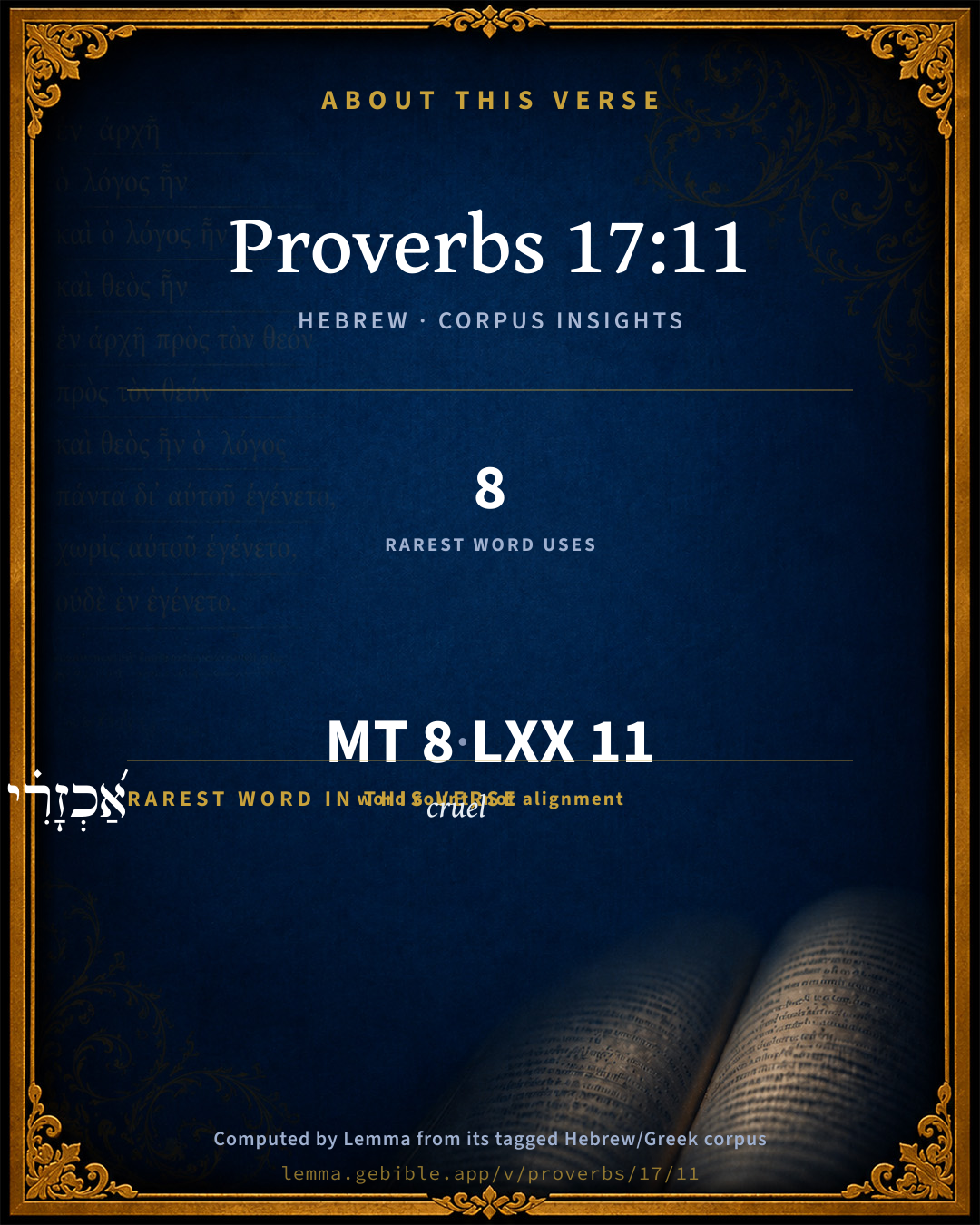
The rarest word here is אַ֝כְזָרִ֗י cruel H394 — appearing just 8 times in the whole Hebrew Bible.

Shared distinctive vocabulary

אַ֝כְזָרִ֗י cruel H394 occurs in 8 verses of the Hebrew Bible. Also found in:

Grammatical profile

  • 2 verbs
  • 2 nouns
  • 2 adjectives
  • 1 preposition
  • 1 particle

Verb forms

  • יְבַקֶּשׁ Piel · Imperfect
  • יְשֻׁלַּח Pual · Imperfect

Hebrew & Septuagint length

In English translation the verse runs 15 words from the Hebrew and 17 from the Septuagint (LXX English) — closely comparable.

A rough comparison of the two English renderings, which tokenize alike — not a word-level alignment.

Word counts can differ between the Hebrew and the Greek without any difference in meaning — e.g. the Hebrew direct-object marker אֵת has no separate Greek word, and Greek often adds the article ὁ.

In the original languages it is 8 Hebrew tokens and 11 Greek tokens — but the two are counted differently (Hebrew bundles its prefixes and suffixes into one token; the Greek is in lemma form), so that isn’t a like-for-like length.

Cross-references

3

Topical passages linked to Proverbs 17:11 in the Treasury of Scripture Knowledge — connected by theme and wording, ordered by reader-vote popularity; previews shown in the World English Bible.

  • 1 Kings 2:46 So the king commanded Benaiah the son of Jehoiada; and he went out, and fell on him, so that he died. The kingdom was established in the hand of Solomon.
  • 2 Samuel 16:5–9 When king David came to Bahurim, behold, a man of the family of the house of Saul came out, whose name was Shimei, the son of Gera. He came out, and cursed still as he came.
  • 2 Samuel 18:15 Ten young men who bore Joab's armor compassed about and struck Absalom, and killed him.

Cross-references courtesy of OpenBible.info (CC BY 4.0).

Hebrew and Greek witnesses Masoretic Hebrew ↔ Greek Septuagint

The same verse in the two great witnesses to the Old Testament, shown verse-for-verse.

These are two independent witnesses, not word-aligned to each other, and the Septuagint is shown in lemma (dictionary) form.

Hebrew Proverbs 17:11 Masoretic · Westminster Leningrad Codex

אַךְ מְרִ֥י יְבַקֶּשׁ רָ֑ע וּמַלְאָ֥ךְ אַ֝כְזָרִ֗י יְשֻׁלַּח בּֽוֹ

An evil man seeks only rebellion; Therefore a cruel messenger shall be sent against him.

World English Bible · Public Domain

Greek LXX Proverbs 17:11 Septuagint · lemma form

ἀντιλογία ἐγείρω πᾶς κακός ὁ δέ κύριος ἄγγελος ἀνελεήμων ἐκπέμπω αὐτός

Every bad man stirs up strifes: but the Lord will send out against him an unmerciful messenger.

LXX2012 (modern English Septuagint) · Public Domain

On this verse, The Cambridge Bible for Schools and Colleges discusses the Septuagint’s reading. Read the note in Commentary ↓

Hebrew: Westminster Leningrad Codex (CC BY 4.0). Greek: Septuagint (public domain); English from LXX2012 (modern English Septuagint) (Public Domain). How the Septuagint differs from the Hebrew →

Commentary

Notes on Proverbs 17:11 from classic Christian and Jewish commentators (each source and its license shown beneath its notes). The classic Christian expositions comment on the surrounding passage and are grouped to its opening verse, so a note may address several verses; the Jewish commentaries on the Tanakh (Rashi and others) are per-verse, so they appear only where the commentator wrote on this verse.

Lemma curates 59 commentaries, every one of them public domain or Creative Commons licensed, each selected and text-cleaned for this edition rather than reprinted as found. About our sources →

Trapp's Complete Commentary

John Trapp

Pro 17:11 An evil [man] seeketh only rebellion: therefore a cruel messenger shall be sent against him.

Ver. 11. An evil man seeketh only rebellion.] Viz., How to gainstand and mischief those that by words or stripes seek to reclaim him. Some read it thus, ‘The rebellious seeketh mischief only’; he is set upon sin, he shall be sure of punishment. No warnings will serve obdurate hearts. Wicked men are even ambitious of destruction. Judgments need not go to find them out; they run to meet their bane - they seek it, and as it were send for it. But this they need not do, "for a cruel messenger shall be sent against him." God hath forces enough at hand to fetch in his rebels - viz., good and evil angels, stars, meteors, elements - other creatures, reasonable, unreasonable, insensible. The stones in the wall of Aphek shall sooner turn executioners than a rebellious Aramite shall escape unrevenged; not to speak of hell torments prepared for the devil and his angels, and by them to be inflicted on rebels and reprobates.

John Trapp, A Commentary or Exposition upon All the Books of the Old and New Testament (1647–1656) — public domain. Text from a community e-Sword module.

Joseph Benson's Commentary

Pro 17:11. An evil man seeketh only rebellion — Seeketh nothing but his own will; and being so refractory that he hath shaken off all reverence for God and his governors, he is wholly bent upon mischief, and cannot be reclaimed; therefore a cruel messenger shall be sent against him — Some dreadful judgment or other, as a messenger from God; angels, God’s messengers, shall be employed as ministers of justice against him, Psa 78:49. Satan, the angel of death, and the messengers of Satan, shall be let loose upon him. His prince shall send a sergeant to arrest him, and an executioner to cut him off. He that kicks against the pricks is waited for of the sword.

Joseph Benson's Commentary on the Old and New Testaments (1811–1818) — public domain. Text from a community e-Sword module.

The Preacher's Complete Homiletical Commentary

Joseph S. Exell (gen. ed.)

CRITICAL NOTES.—

Pro_17:11. Many commentators translate the first clause “Rebellion,” or “a rebel” seeketh only after evil, i.e., brings retribution upon himself.

Pro_17:12. Miller translates the latter clause “but not a fool his folly.” (See his comment.)

MAIN HOMILETICS OF THE PARAGRAPH.—Pro_17:11-13

PHASES OF EVIL

I. The main characteristic of a sinner is that he is a rebel against the moral order of the universe. “He seeketh only rebellion.” The planets in their courses describe their orbits in obedience to the law of gravitation, and because they do so the order of the heavens is preserved. God is the sun of the moral universe, and before sin entered it all His creatures kept the path of obedience to His will, held to their allegiance by the love and confidence which they bore to their Lawgiver. But sin snapped the bond, and the word sinner stands for one who has broken away from the moral law of God; every sinner seeketh rebellion.

II. A sinner is a restless being. He seeks rebellion. These words seem to depict the restless character of the ungodly man. When a soul has lost its centre of gravity—when the will of God is not the polestar of life—it drifts about in obedience first to one lawless passion and then another, following in the footsteps of the great leader of rebellion, the first sinner, who, by his own confession, is continually going to and fro in the earth, and walking up and down in it (Job_1:7).

III. A sinner is an injurious man. No man can set himself in antagonism to the law of God, which tends to the happiness of his creatures, without bringing misery upon others, and the more determined his rebellion the more cruel are the effects of his sin upon them. A bear is naturally a cruel beast, but when a bear is robbed of what her instinct leads her to guard most jealously she is an object to be dreaded and avoided. Yet a wicked man is more to be feared, for there are in him capabilities of mischief beyond those possessed by the furious brute. The anger of the beast might be diverted or appeased—even a bear robbed of her whelps would forget her anger if a carcase were thrown in her path upon which she might wreak her vengeance. But the wrath of an angry man is less easily appeased. The mischief which the furious bear can do is more limited. The superior skill of man can soon put a stop to the ravages of a wild beast, but the angry folly of a single fool has often destroyed many lives and broken many hearts.

IV. A sinner is an ungrateful being. Many an ungodly man would deny this charge, but everyone who continues in a state of rebellion against God is continually rewarding evil for good. But the sin of the text doubtless refers to the ingratitude towards a fellow-man. This sin cannot be charged home upon every ungodly man—there are those who, though careless of rendering to God that which is His due, are content with rendering to their fellow-men evil for evil, and would not knowingly render evil for good. But while the heart is in a state of rebellion against its rightful sovereign, every evil tendency is continually growing stronger, and men by degrees descend to depths of evil from which they would once have recoiled with horror.

V. God will, sooner or later, call His rebellious subjects to account. Although men sometimes go on in open rebellion against God for many years, not one shall finally escape. A writ has been issued for the apprehension of each one, although the execution is in some cases deferred. “Every one of us shall give an account of himself to God” (Rom_14:12), and the messenger that summons the ungodly man to the Divine tribunal will be “cruel” because looked at through the medium of a guilty conscience.

VI. The sinner brings evil upon his posterity. It is a truth which is illustrated by the experience of our daily life that no man stands alone in the world—that the sins of the fathers are, in some measure, visited upon the children—that “whoso rewardeth evil for good,” not only brings evil upon himself but upon “his house.”

OUTLINES AND SUGGESTIVE COMMENTS

Pro_17:11. God sometimes employs terrible messengers to chastise His own people. When David numbered his subjects, 70,000 of them were destroyed in three days by a visible messenger of severity, under the direction of an invisible minister of providence. If God takes such vengeance of the rebellions of some whom He pardons, what will the end be of them that seek only rebellion!—Lawson.

God hath forces enough at hand to fetch in His rebels.… The stones in the walls of Aphek shall sooner turn executioners than a rebellious Aramite shall escape unrevenged.—Trapp.

Many things there are which an evil man proposeth to his seeking: sometimes pleasures, sometimes profit, sometimes honour, sometimes favour, but in truth it is only rebellion against God that is sought by him. For these things are not to be found in the ways of wickedness, and therefore it is only his deceived imagination that looketh for them there. But rebellion against God is found in all his ways.—Jermin.

There are men that are summoning a cruel messenger to be sent against themselves.… They are “only the rebellious.” A door of mercy! and a ransom fixed for sin! and only one class to fail! and they spontaneously rebels! These are the men that go in search of evil, and this is the meaning of the wise man.—Miller.

Pro_17:12. Witness Jacob’s sons putting a whole city to fire and sword for the folly of one man; Saul slaying a large company of innocent priests; Nebuchadnezzar heating the furnace sevenfold; Herod murdering the children in Ramah; “Saul breathing out threatenings and slaughter against the disciples of the Lord”—was not all this the rage of a beast, not the reason of a man? Humbling, indeed, is this picture of man, once “created in the image of God” (Gen_1:27).—Bridges.

For the “fool,” what a meeting! when he has been robbed of every earthly chance! and is dead eternally! and the “folly,” that has robbed him, is shut up with him in everlasting misery!—Miller.

See Miller’s rendering of the verse in Critical Notes.

Pro_17:13. To render good for evil is Divine, good for good is human, evil for evil is brutish, evil for good is devilish.—Trapp.

The most striking illustration of this sentence, is the history of the Jewish nation. Never was such ingratitude showed to any benefactor, as they showed to the Son of God, and never was the punishment of any people so dreadful, and of so long continuance. That scattered people proclaim to every nation under heaven how dangerous the sin of ingratitude is, especially when God our Saviour is the object of it.—Lawson.

The Preacher's Complete Homiletical Commentary (gen. ed. Joseph S. Exell; Funk & Wagnalls, c. 1892) — public domain (pre-1929). A full-Bible homiletical/sermon-outline anthology covering 65 of 66 books (2 John is absent from the source module). Text from a community e-Sword module.

Tyndale Open Study Notes

Tyndale Open Resources

17:11 Rebellion flows from the inner character of evil people who defy the punishment that will follow.

Tyndale Open Study Notes — © Tyndale Open Resources, licensed CC BY-SA 4.0. Text via the HelloAO Bible API.

Geneva Bible (1599)

Geneva Bible translators

By the messenger is meant such means as God useth to punish the rebels.

Geneva Bible (1599) marginal notes — public domain. Text via Bolls.life.

Matthew Henry's Commentary

Here is the sin and punishment of an evil man. 1. His sin. He is an evil man indeed that seeks all occasions to rebel against God, and the government God has set over him, and to contradict and quarrel with those about him. Quaerit jurgia - He picks quarrels; so some. There are some that are actuated by a spirit of opposition, that will contradict for contradiction-sake, that will go on frowardly in their wicked ways in spite of all restraint and check. A rebellious man seeks mischief (so some read it), watches all opportunities to disturb the public peace. 2. His punishment. Because he will not be reclaimed by mild and gentle methods, a cruel messenger shall be sent against him, some dreadful judgment or other, as a messenger from God. Angels, God's messengers, shall be employed as ministers of his justice against him, Psa 78:49. Satan, the angel of death, shall be let loose upon him, and the messengers of Satan. His prince shall send a sergeant to arrest him, an executioner to cut him off. He that kicks against the pricks is waited for of the sword.

Matthew Henry's Commentary on the Whole Bible (1708–1710) — public domain (CC PDM 1.0). Text via the HelloAO Bible API.

Jamieson, Fausset & Brown

Robert Jamieson, A. R. Fausset & David Brown

Such meet just retribution (Kg1 2:25).

a cruel messenger--one to inflict it.

Jamieson, Fausset & Brown — Commentary Critical and Explanatory on the Whole Bible (1871) — public domain (CC PDM 1.0). Text via the HelloAO Bible API.

Ellicott's Commentary for English Readers

(11) An evil man seeketh only rebellion.—Or. A rebellious man (literally, rebellion; comp. Eze_2:7) seeketh only evil.

A cruel messenger.—Such as the “chief of the executioners” (margin of Gen_37:36), who was always ready to carry out the bidding of an Oriental king. (Comp. 1Ki_2:34; 1Ki_2:46.) The ministers of the Divine wrath against impenitent sinners appear as “tormentors” in Mat_18:34. (For the office of the angels in the same work, comp. Rev_8:6, sqq.)

A Bible Commentary for English Readers, edited by Charles John Ellicott (1878–1897) — public domain. Text from a community e-Sword module.

The Cambridge Bible for Schools and Colleges

gen. ed. J. J. S. Perowne

11. rebellion] This, in its highest reference, is an anticipation of the divine philosophy of St John, “sin is lawlessness” (ἡ ἁμαρτία ἐστὶν ἡ ἀνομία). “Sin is lawlessness. Sin and lawlessness are convertible terms. Sin is not an arbitrary conception; it is the assertion of the selfish will against a paramount authority. He who sins breaks, not only by accident or in an isolated detail, but essentially, the law which he was created to fulfil,” Westcott on 1Jn_3:4.

a cruel messenger] The stern, implacable minister of the rebel’s doom. Comp., for illustration, 1Ki_2:25; 1Ki_2:34. The LXX. refer the sending of the merciless messenger, whether human or angelic, to Jehovah, against whom ultimately all rebellion is aimed: ὁ δὲ κύριος ἄγγελον ἀνελεήμονα ἐκπέμψει αὐτῷ.

The Cambridge Bible for Schools and Colleges (gen. ed. J. J. S. Perowne; Cambridge University Press, 1878–1918) — public domain. Text from a community e-Sword module.

John Gill's Exposition

An evil man seeketh only rebellion,.... For he seeks nothing but what is evil; and all sin is rebellion against God, a contempt of his laws, and a transgression of them; a trampling upon his legislative power and authority; an act of hostility against him, and a casting off allegiance to him. Or rather the words may be rendered, "rebellion", that is, "the rebellious man", so the Targum, the abstract for the concrete, "verily" or "only seeketh evil" (m); a man that is rebellious against his prince, that is of a rebellious disposition, is continually seeking to do mischief in the commonwealth; he is continually plotting and contriving destructive schemes, and stirring up sedition, and causing trouble; and so a rebel against God is always seeking that which is sinful, which is evil in its own nature, and contrary to the law and will of God; and in the issue brings the evil of punishment on himself;

therefore a cruel messenger shall be sent against him: if a rebel against his lawful sovereign, a messenger shall be sent by him to take him into custody, who will show him no mercy; or an executioner to dispatch him, who will not spare to perform his orders: and if a rebel against God, some judgment of God shall fall upon him in a very severe manner; or his own conscience shall accuse him, and shall be filled with dreadful apprehensions of divine vengeance; or Satan, the angel of death, shall be let loose upon him, to terrify or destroy him; or death itself, which spares none. The Septuagint and Arabic versions ascribe this to God as his act, rendering it, "the Lord shall send", &c. and so Aben Ezra; who also refers the former clause to him, and gives it as the sense of it; that he shall seek to do the rebellious man evil, inflict on him the evil of punishment for the evil of sin.

(m) "profecto rebellio quaeret malum", Montanus; so Schultens, Piscator, Tigurine version, Cocceius.

John Gill's Exposition of the Whole Bible (1746–1763) — public domain (CC PDM 1.0). Text via the HelloAO Bible API.

Albert Barnes' Notes on the Bible

The proverb expresses the reverence of the East for the supreme authority of the king. The “cruel messenger” is probably the king’s officer despatched to subdue and punish. The Septuagint renders it: “The Lord will send a pitiless Angel.”

Albert Barnes' Notes on the Bible (1834–1885) — public domain. Text from a community e-Sword/MySword module.

Haydock's Catholic Bible Commentary

Angel. Messenger of death, (Menochius) which is sometimes inflicted by good, at others by bad, angels of death, or satan, 2 Corinthians xii. 7., and Psalm lxxvii. 49.

George Leo Haydock (1774–1849), Haydock's Catholic Family Bible and Commentary, 1859 edition — public domain. Excludes Psalms (Douay-Rheims chapter numbering differs from Protestant) and Deuterocanonical books (Catholic canon only).

Matthew Poole's English Annotations

An evil man seeketh only rebellion; it is the constant study and business of wicked men to rebel, either,

1. Against men in authority. But this is not universally true, for many most wicked persons are not guilty of that sin. Or rather,

2. Against God. For,

1. Thus it is true of all wicked men.

2. This word is used of rebellion against God, Deu 31:27; Eze 2:5,6; 3:9, &c.

3. This word being put alone, without any addition of the object, seems most probably to be meant of the highest and worst kind of rebellion, according to the common rule of interpretation in such cases. A cruel messenger; or, a cruel angel; the angel of death, the devil, or some bloody men employed by God to avenge his quarrel; or some dreadful punishment; it being very usual in Scripture to represent things under the notion of persons, as Ro 8, and elsewhere.

Matthew Poole's English Annotations on the Holy Bible (1683–1685) — public domain. Text from a community e-Sword/MySword module.

Whedon's Commentary on the Bible

Daniel D. Whedon

11. An evil man — An evil citizen.

Seeketh… rebellion — Endeavours to promote disorders in society and insubordination to law. A cruel messenger, etc. — Such men may expect, sooner or later, the vengeance of the government. See on Pro_6:11; Pro_24:24. Some interpreters transpose the subject and predicate in the first clause, and render, “Rebellion seeks only evil;” or, the rebellious seek, etc. Critics and versions are about equally divided here. Conant sustains the common version. Miller reads, “Only rebellion goes in search of evil, and has a cruel messenger sent by its very self.”

Daniel D. Whedon (gen. ed.), Commentary on the Old and New Testaments (1874–1909) — public domain. Text from a community e-Sword module.

The Pulpit Commentary

An evil man seeketh only rebellion. So the Greek and Latin Versions; but, as Nowack intimates, a bad man seeks many other things which do not come directly in the category of rebellion; and it is better to take meri, "rebellion," as the subject, regarding it as put for the concrete, thus: "A rebellious man striveth only for what is evil." From the point of view of an Eastern potentate, this is true enough. Absolute government looks upon any rising against constituted authority, any movement in the masses, as necessarily evil, and to be repressed with a high hand. Hence the succeeding clause. Therefore a cruel messenger shall be sent against him. The "cruel messenger" (Pro_16:14) is the executioner of the king"s wrath. (comp. 1Ki_2:29, etc.) He is called "cruel" because his errand is deadly, and he is pitiless in its performance. This seems to be the sense intended. The LXX gives a different notion, derived from the ambiguous term malak, like the Greek aggelov : "The Lord will send forth a pitiless angel against him." The verse then becomes a statement concerning the retribution inflicted by God on obstinate sinners, such as Pharaoh and the Egyptians. These are delivered over to "the tormentors", (Mat_18:34) the angels that execute the wrath of God, as in Psa_78:49 and Rev_8:6, etc. As all sin is rebellion against God, it is natural to read into the passage a religious meaning, and for homiletical purposes it is legitimate to do so. But the writer"s intention is doubtless as explained above, though his language may be divinely directed to afford a further application.

The Pulpit Commentary (1880–1919), ed. H.D.M. Spence-Jones & Joseph S. Exell — public domain. Text from a community e-Sword module.

John Wesley's Explanatory Notes

Rebellion - Against God. Messenger - Or, a cruel angel, the angel of death, the devil, or some bloody men employed by God to avenge his quarrel.

John Wesley, Explanatory Notes Upon the Whole Bible (1754–1765) — public domain. Text via the GEBible commentary corpus.

Keil & Delitzsch

C. F. Keil & F. Delitzsch

Five proverbs of dangerous men against whom one has to be on his guard:

11 The rebellious seeketh only after evil,

And a cruel messenger is sent out against him.

It is a question what is subj. and what obj. in 11a. It lies nearest to look on מרי as subj., and this word (from מרה, stringere, to make oneself exacting against any, to oppose, ἀντιτείνειν) is appropriate thereto; it occurs also at Eze 2:7 as abstr. pro concreto. That it is truly subj. appears from this, that בּקּשׁ רע, to seek after evil (cf. Pro 29:10; Kg1 20:7, etc.), is a connection of idea much more natural than בּקּשׁ מרי to seek after rebellion. Thus אך will be logically connected with רע, and the reading אך מרי will be preferred to the reading אך־מרי; אך (corresponding to the Arab. âinnama) belongs to those particles which are placed before the clause, without referring to the immediately following part of the sentence, for they are much more regarded as affecting the whole sentence (vid., Pro 13:10): the rebellious strives after nothing but only evil. Thus, as neut. obj. רע is rendered by the Syr., Targ., Venet., and Luther; on the contrary, the older Greek translators and Jerome regard רע as the personal subject. If now, in reference to rebellion, the discourse is of a מלאך אכזרי, we are not, with Hitzig, to think of the demon of wild passions unfettered in the person of the rebellious, for that is a style of thought and of expression that is modern, not biblical; but the old unpoetic yet simply true remark remains: Loquendi formula inde petita quod regis aut summi magistratus minister rebelli supplicium nunciat infligitque. מלאך is n. officii, not naturae. Man as a messenger, and the spiritual being as messenger, are both called מלאך. Therefore one may not understand מלאך אכזרי, with the lxx, Jerome, and Luther, directly and exclusively of an angel of punishment. If one thinks of Jahve as the Person against whom the rebellion is made, then the idea of a heavenly messenger lies near, according to Psa 35:5., Psa 78:49; but the proverb is so meant, that it is not the less true if an earthly king sends out against a rebellious multitude a messenger with an unlimited commission, or an officer against a single man dangerous to the state, with strict directions to arrest him at all hazards. אכזרי we had already at Pro 12:10; the root קש חש means, to be dry, hard, without feeling. The fut. does not denote what may be done (Bertheau, Zckler), which is contrary to the parallelism, the order of the words, and the style of the proverb, but what is done. And the relation of the clause is not, as Ewald interprets it, "scarcely does the sedition seek out evil when an inexorable messenger is sent." Although this explanation is held by Ewald as "unimprovable," yet it is incorrect, because אך in this sense demands, e.g., Gen 27:3, the perf. (strengthened by the infin. intensivus). The relation of the clause is, also, not such as Bttcher has interpreted it: a wicked man tries only scorn though a stern messenger is sent against him, but not because such a messenger is called אכזרי, against whom this "trying of scorn" helps nothing, so that it is not worth being spoken of; besides, שׁלּח or משׁלּח would have been used if this relation had been intended. We have in 11a and 11b, as also e.g., at Pro 26:24; Pro 28:1, two clauses standing in internal reciprocal relation, but syntactically simply co-ordinated; the force lies in this, that a messenger who recognises no mitigating circumstances, and offers no pardon, is sent out against such an one.

Keil & Delitzsch — Biblical Commentary on the Old Testament (1861–1891) — public domain (CC PDM 1.0). Text via the HelloAO Bible API. (Old Testament only.)

Bridges on Proverbs

Charles Bridges

Some awful pictures of man are here set out. Look at his waywardness — seeking only rebellion — resisting all authority of God and man. This is no light sin. (1Sa 15:23 .) Therefore a cruel messenger, one that will not be turned from his work, shall be sent against him. The disobedient son in the family;†1 Korah in the Church;†2 Absalom,†3 Sheba,†4 and Pekah,†5 in the kingdom — all stand out as monuments of retributive justice. Not that rebellion is the only sin, but that it is the grand outbreaking of the stubborn will. It may be hidden under a peaceful and amiable cover. But it "is not dead, but sleepeth."†6 Let God remove the restraint; let Satan bring the occasion of temptation; and, when all before appeared love and unity, "hateful, and hating one another" (Tit 3:3 ) — will be the dark features of the prospect.

Look again at man in his folly. The strength and accuracy of the figure can scarcely be surpassed. The savage beast under the strongest excitement — a bear robbed of her whelps — is less dangerous to meet. Witness Jacob’s sons putting a whole city to fire and sword for the folly of one man;†7 Saul slaying a large company of innocent priests;†8 Nebuchadnezzar heating the furnace sevenfold;†9 Herod murdering the children in Ramah;†10 "Saul breathing out threatenings and slaughter against the disciples of the Lord"†11 — was not all this the rage of a beast, not the reason of a man? Humbling, indeed, is this picture of man, once "created in the image of God." (Gen 1:27 .) More humbling is it to see this folly in a child of God; to see David binding himself with an oath to massacre a whole family, some of whom had taken up his cause against the sottish offender. Yet the melting away of his fury under wise remonstrance shewed the man of God covered with the shame of his folly; not the fool living in it as his nature, habit, and delight. (1Sa 25:32-33 .)

But to turn nearer home — are there no households where uncontrolled anger governs all at pleasure? Does the self-willed victim remember, that ’nothing is said or done in a passion, but may be better said or done afterwards?’†12 Do we never see the Christian, whom his Master’s discipline and example ought to have transformed to a lamb, still like the bear robbed of her whelps? Man — the holiest, "left of God to try him that he might know all that was in his heart" (2Ch 32:31 ) — "man," so left to himself, "verily at his best estate is altogether vanity." (Psa 39:5 .) Abhorred be that vain, but too common excuse — ’It is my way.’ Is not this the very cause of grief to a contrite soul, calling for deep humiliation and increasing watchfulness?

Look again at man in his ingratitude. God forbids to reward evil for evil; much more evil for good. This sin even the Heathen deemed to include every other.†13 And so hateful is it to God, that he visits the evil, not only on the sinner himself, but on his house. Israel was punished for the ill return to Gideon.†14 The traitor’s house was doomed to a curse.†15 And how fearful the evil to the ungrateful nation, who does not know?†16

This ingratitude is by no means uncommon, though the conscience is little awake to the guilt. What else is it, when the ungodly resent an attempt to promote their best interests? David complained of this unkind and undeserved return, simply because he was pursuing active benevolence. (Psa 38:20 .) Such a recompense is marked out for special reprobation.

And surely evil rewarded for good was the stamp of our father’s sin. (Gen 3:5-6, with Gen 2:8-18 .) And ever since has the curse been fearfully verified — Evil shall not depart from his house. Nor is this unjust severity. What say we to a child, nourished with the tenderest care, yet casting off all filial regard, and rewarding evil for good? Could any other appearances of virtue atone for this unnatural abomination, this awful deformity? And yet is not this sin — the astonishment of heaven and earth — the mark of every child of fallen Adam? "I have nourished and brought up children, and they have rebelled against me." (Isa 1:2 .) But for the transfer of this mighty mass of guilt, how could we stand before God? And who of us still in the consciousness of this guilt, will not seek for a more full influence of that no less perfect work, by which the rebel spirit is tamed and humbled into the meekness and love of the Gospel?

Footnotes:

†1 Deu 21:18.

†2 Num 16:1-50.

†3 2Sa 18:15-16 .

†4 2Sa 20:1, 2Sa 20:22 .

†5 2Ki 15:27-30 .

†6 The philosophical remark of Burke — ’Those who do not love religion, hate it’ — is the spirit of our Divine Master’s saying, Mat 12:30 .

†7 Gen 34:25.

†8 1Sa 22:18 .

†9 Dan 3:13-19.

†10 Mat 2:16.

†11 Act 9:1.

†12 Matthew Henry’s Sermon on Meekness.

†13 ’Ingratum si dixeris, omnia dixeris.’ Yet was it the aggravation of their own sin. Rom 1:21 .

†14 Jdg 8:35; Jdg 9:56-57 . Compare Jer 18:20-23 .

†15 Psa 55:12-15; Psa 109:9-13 .

†16 Mat 27:25, with Mat 23:32-39 .

Charles Bridges, An Exposition of the Book of Proverbs (1846) — public domain. Text from a community e-Sword module.

Kretzmann's Popular Commentary

Paul E. Kretzmann

v. 11. An evil man seeketh only rebellion, that is, he who rebels against the Lord in willful transgression of His Law has evil in mind; therefore a cruel messenger shall be sent against him, that is, evil will be punished with inexorable severity.

Paul E. Kretzmann, Popular Commentary of the Bible (1921–1924) — public domain. Text from a community e-Sword module.

unfoldingWord translationNotes

Door43 World Missions Community

seeks rebellion

The word "rebellion" can be expressed as a verb. AT: "seeks to rebel" (See: Abstract Nouns)

a cruel messenger will be sent against him

This can be stated in active form. AT: "a cruel messenger will come against him" (See: Active or Passive)

will be sent against him

To be "sent against" someone means to be sent to harm them. AT: "will be sent to harm him" (See: Idiom)

a bear robbed of her cubs

This can be stated in active form. AT: "a bear who has just lost her cubs" (See: Active or Passive)

in his foolishness

The word "foolishness" can be expressed as an adjective. AT: "who is acting foolish" (See: Abstract Nouns)

translationWords

evil

messenger

fool

unfoldingWord translationNotes — © Distant Shores Media and the Door43 World Missions Community, licensed CC BY-SA 4.0. Source: git.door43.org/Door43/en_tn.

Rashi

Rabbi Shlomo Yitzchaki (Rashi)

He who is only rebellious seeks evil One whose every word is rebelliousness and stubbornness constantly seeks evil.

Rashi on the Tanakh — English translations: “The Judaica Press complete Tanach with Rashi, translated by A. J. Rosenberg” (CC BY 4.0); “Pentateuch with Rashi's commentary by M. Rosenbaum and A.M. Silbermann, 1929-1934” (public domain); “The Metsudah Tanach series, Lakewood, N.J” (CC BY 4.0); and “The Book of Joshua, Metsudah Publications, 1997” (CC BY 4.0). Text via Sefaria.

Lesson kit

Teaching starters — assembled from the data on this page, not authored interpretation. Every prompt links to the verse data it draws on. Edit before teaching.

Proverbs, in the Wisdom, opens this verse with 8 words (7 distinct Hebrew lemmas). Its most distinctive word is ʼakzârîy (“cruel”). A historical commentator’s framing appears above. Read the whole chapter for the surrounding context.

Discussion questions

  1. The word ʼakzârîy carries the sense “cruel.” How does it shape the verse?
  2. How does Proverbs 5:9, which shares the word «cruel», read alongside this verse?
  3. These translations render this verse differently. What is at stake in choosing one wording over another?
  4. «יְבַקֶּשׁ» is a Piel Imperfect verb. How does that grammatical form shape the action described?
  5. Compare how Trapp's Complete Commentary and Joseph Benson's Commentary read this verse. Where do they agree or differ?

Things to notice

Reading settings

Reading text

Shown beneath each verse's original-language words.

Old Testament
Old Testament edition

Read the OT as the Masoretic Hebrew (MT) or the Greek Septuagint (LXX).

English shown for the Greek Septuagint (in the Hebrew ↔ Greek comparison).

Comparing translations? Open the Compare panel on any verse page to stack up to four side by side.