
Jeremiah 2:24

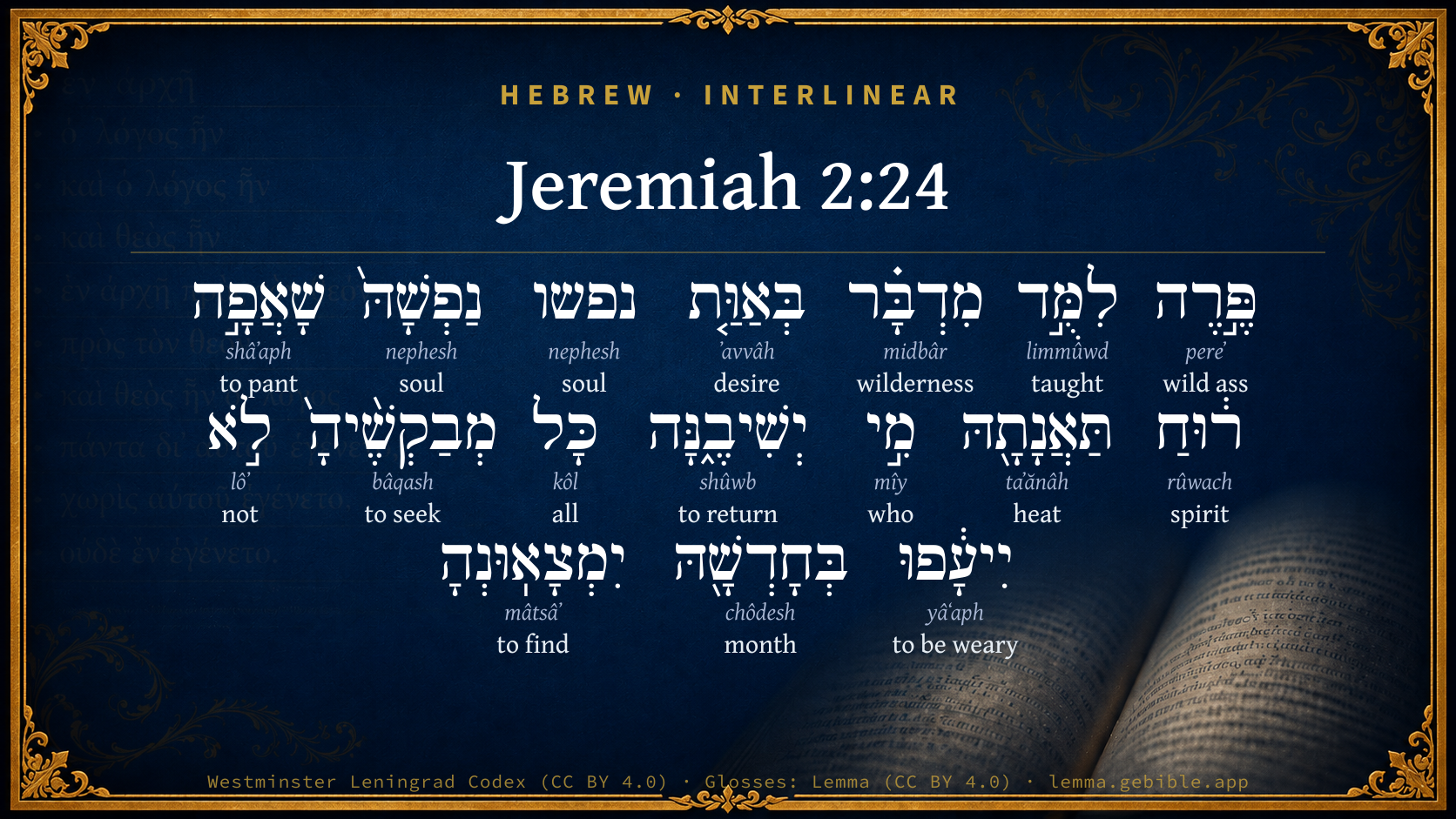
Hebrew (Westminster Leningrad Codex) Jeremiah 2:24 appears in the Hebrew Old Testament. The text above is from the Westminster Leningrad Codex. Each word links to its Strong’s number, a concise gloss, and parsing drawn from the Open Scriptures Hebrew Bible morphology. Click any word for its full Brown-Driver-Briggs (BDB) entry.
Download image
Cite this verse

Jeremiah 2:24 (World English Bible). Public Domain. Lemma interlinear Bible study tool, https://lemma.gebible.app/v/jeremiah/2/24.

Show BibTeX & RIS
BibTeX
RIS
English Translation
a wild donkey used to the wilderness, that snuffs up the wind in her desire; in her occasion who can turn her away? all those who seek her will not weary themselves; in her month they shall find her.
World English Bible · Public Domain
Download a study sheet

One document with this verse’s original text, its word-by-word gloss line, the meaning frame, cross-references with their text, attributed commentary, and full source and license credits — printable, and it pastes into notes with its structure intact.

This verse Autodidact and up

Study sheet (.html) Plain text (.txt)

A passage Seminary Student

Up to 50 verses in one chapter. A passage sheet keeps up to 6 commentary sources and 12 cross-references per verse, in the order this page ranks them, and says so on the sheet whenever that leaves anything out. Ask for a single verse and you get the Autodidact verse sheet above.

Everything on this page stays free to read, with no account — the sheet is a download of what is already on screen, not access to it.

Want to remove ads? Support Godless Engineer
Compare translations 3

The same verse in 3 English versions, stacked beneath the original-language interlinear above. Click any original word for its lexicon entry.

Each is an independent rendering of the whole verse — the interlinear is not word-aligned to these translations.

Highlighted words mark where these versions differ — a whole-verse word diff, not a word-by-word alignment.

  • World English Bible Public Domain
    a wild donkey used to the wilderness, that snuffs up the wind in her desire; in her occasion who can turn her away? all those who seek her will not weary themselves; in her month they shall find her.
  • King James Version Public Domain
    A wild ass used to the wilderness, that snuffeth up the wind at her pleasure; in her occasion who can turn her away? all they that seek her will not weary themselves; in her month they shall find her.
  • unfoldingWord Literal Text CC BY-SA 4.0
    a wild donkey, taught ones of the wilderness, in the desire of its spirit sniffing at the air! her heat, who can turn her away? All of the ones seeking her will not tire; in her month they will find her.

unfoldingWord Literal Text — © unfoldingWord, licensed CC BY-SA 4.0. Word-aligned USFM3 via Door43 (git.door43.org/unfoldingWord/en_ult).

Versions to compare (up to 4)

3 of 4 selected

Show all 18 translations

Every available English version of this verse, each an independent rendering of the whole verse.

  • World English Bible Public Domain
    a wild donkey used to the wilderness, that snuffs up the wind in her desire; in her occasion who can turn her away? all those who seek her will not weary themselves; in her month they shall find her.
  • Berean Standard Bible Public Domain
    a wild donkey at home in the wilderness, sniffing the wind in the heat of her desire. Who can restrain her passion? All who seek her need not weary themselves; in mating season they will find her.
  • Majority Standard Bible Public Domain
    a wild donkey at home in the wilderness, sniffing the wind in the heat of her desire. Who can restrain her passion? All who seek her need not weary themselves; in mating season they will find her.
  • King James Version Public Domain
    A wild ass used to the wilderness, that snuffeth up the wind at her pleasure; in her occasion who can turn her away? all they that seek her will not weary themselves; in her month they shall find her.
  • American Standard Version (1901) Public Domain
    a wild ass used to the wilderness, that snuffeth up the wind in her desire; in her occasion who can turn her away? all they that seek her will not weary themselves; in her month they shall find her.
  • Revised Version (1885) Public Domain
    a wild ass used to the wilderness, that snuffeth up the wind in her desire; in her occasion who can turn her away? all they that seek her will not weary themselves; in her month they shall find her.
  • Geneva Bible (1599) Public Domain
    And as a wilde asse, vsed to the wildernesse, that snuffeth vp the winde by occasion at her pleasure: who can turne her backe? all they that seeke her, will not wearie themselues, but wil finde her in her moneth.
  • Douay-Rheims (1899) Public Domain
    A wild ass accustomed to the wilderness in the desire of his heart, snuffed up the wind of his love: none shall turn her away: all that seek her shall not fail: in her monthly filth they shall find her.
  • Young's Literal Translation Public Domain
    A wild ass accustomed to a wilderness, In the desire of her soul she hath swallowed up wind, Her meeting -- who doth turn her back? None seeking her do weary themselves, In her month they find her.
  • Literal Standard Version CC BY-SA 4.0
    A wild donkey accustomed to a wilderness, || She has swallowed up wind in the desire of her soul, || Her meeting—who turns her back? None seeking her weary themselves, || In her month they find her.
  • Unlocked Literal Bible CC BY-SA 4.0
    a wild donkey accustomed to the wilderness, in her heat sniffing the wind! Who can restrain her lust? None of the males need wear themselves out pursuing her; at mating time they will find her.
  • unfoldingWord Literal Text CC BY-SA 4.0
    a wild donkey, taught ones of the wilderness, in the desire of its spirit sniffing at the air! her heat, who can turn her away? All of the ones seeking her will not tire; in her month they will find her.
  • Darby Bible Public Domain
    -- a wild ass, used to the wilderness, that snuffeth up the wind in her desire! In her ardour, who shall turn her away? All they that seek her will not weary themselves; in her month they shall find her.
  • World Messianic Bible Public Domain
    a wild donkey used to the wilderness, that sniffs the wind in her craving. When she is in heat, who can turn her away? All those who seek her will not weary themselves. In her month, they will find her.
  • Webster's Bible Public Domain
    A wild ass used to the wilderness, that snuffeth up the wind at her pleasure; in her occasion who can turn her away? all they that seek her will not weary themselves; in her month they shall find her.
  • Free Bible Version CC BY-SA 4.0
    You're a female donkey living in the desert, sniffing the wind for a mate because she's in heat. No one can control her at mating time. All those who're looking for her won't have trouble finding her when she's in heat.
  • Bible in Basic English Public Domain
    An untrained ass, used to the waste land, breathing up the wind in her desire; at her time, who is able to send her away? all those who are looking for her will have no need to make themselves tired; in her month they will get her.
  • JPS Tanakh (1917) Public Domain
    A wild ass used to the wilderness, that snuffeth up the wind in her desire; her lust, who can hinder it? All they that seek her will not weary themselves; in her month they shall find her.

Literal Standard Version (2020), Covenant Press — licensed CC BY-SA 4.0. Text via the HelloAO Bible API (eBible.org). Unlocked Literal Bible (unfoldingWord) — licensed CC BY-SA 4.0. Text via the HelloAO Bible API (eBible.org). unfoldingWord Literal Text — © unfoldingWord, licensed CC BY-SA 4.0. Word-aligned USFM3 via Door43 (git.door43.org/unfoldingWord/en_ult). Free Bible Version, Dr. Jonathan Gallagher — licensed CC BY-SA 4.0. Text via the HelloAO Bible API (eBible.org).

Word by word

More ways to search: Search by grammar → Find every occurrence → Compare this word →

Practice this passage: Drill this verse → Learn its vocabulary →

תַּאֲנָתָ֖הּ
taʼănâh
H8385
“heat · her”
Noun, Common, Feminine, Singular, Construct + Suffix, Personal, 3rd Person, Feminine, Singular
Part of Speech
Noun
Type
Common
Gender
Feminine
Number
Singular
State
Construct
Full BDB Definition

Origin: from H579

TWOT: 126a , 126b

occasion, time of heat or oestrous or copulation, sexual drive (of animal) - occasion, opportunity (for a quarrel)
  1. פֶּ֣רֶה pereʼ H6501 “wild ass” Noun, Common, Masculine, Singular, Absolute
  2. לִמֻּ֣ד limmûwd H3928 “taught of” Adjective, Adjective, Masculine, Singular, Construct
  3. מִדְבָּ֗ר midbâr H4057 “wilderness” Noun, Common, Masculine, Singular, Absolute
  4. בְּאַוַּ֤ת ʼavvâh H185 “in/at · desire of” Preposition + Noun, Common, Feminine, Singular, Construct
  5. נפשו nephesh H5315 “soul · his” Noun, Common, Both, Singular, Construct + Suffix, Personal, 3rd Person, Masculine, Singular
  6. נַפְשָׁהּ֙ nephesh H5315 “soul · her” Noun, Common, Both, Singular, Construct + Suffix, Personal, 3rd Person, Feminine, Singular
  7. שָׁאֲפָ֣ה shâʼaph H7602 “to pant” Verb, Qal, Perfect, 3rd Person, Feminine, Singular
  8. ר֔וּחַ rûwach H7307 “spirit” Noun, Common, Both, Singular, Absolute
  9. מִ֣י mîy H4310 “who” Particle, Interrogative
  10. יְשִׁיבֶ֑נָּה shûwb H7725 “to return · her” Verb, Hiphil, Imperfect, 3rd Person, Masculine, Singular + Suffix, Personal, 3rd Person, Feminine, Singular
  11. כָּל kôl H3605 “all of” Noun, Common, Masculine, Singular, Construct
  12. מְבַקְשֶׁ֨יהָ֙ bâqash H1245 “seeking · her” Verb, Piel, Participle Active, Masculine, Plural, Construct + Suffix, Personal, 3rd Person, Feminine, Singular
  13. לֹ֣א lôʼ H3808 “not” Particle, Negative
  14. יִיעָ֔פוּ yâʻaph H3286 “to be weary” Verb, Qal, Imperfect, 3rd Person, Masculine, Plural
  15. בְּחָדְשָׁ֖הּ chôdesh H2320 “in/at · month · her” Preposition + Noun, Common, Masculine, Singular, Construct + Suffix, Personal, 3rd Person, Feminine, Singular
  16. יִמְצָאֽוּנְהָ mâtsâʼ H4672 “to find · her” Verb, Qal, Imperfect, 3rd Person, Masculine, Plural + Suffix, Personal, 3rd Person, Feminine, Singular

About this verse

These counts appear in no published source. They are computed here, from the morphology-tagged text and Lemma’s own curated glosses. What Lemma adds →

17
words
16
distinct lemmas
Prophets
section

Notable vocabulary

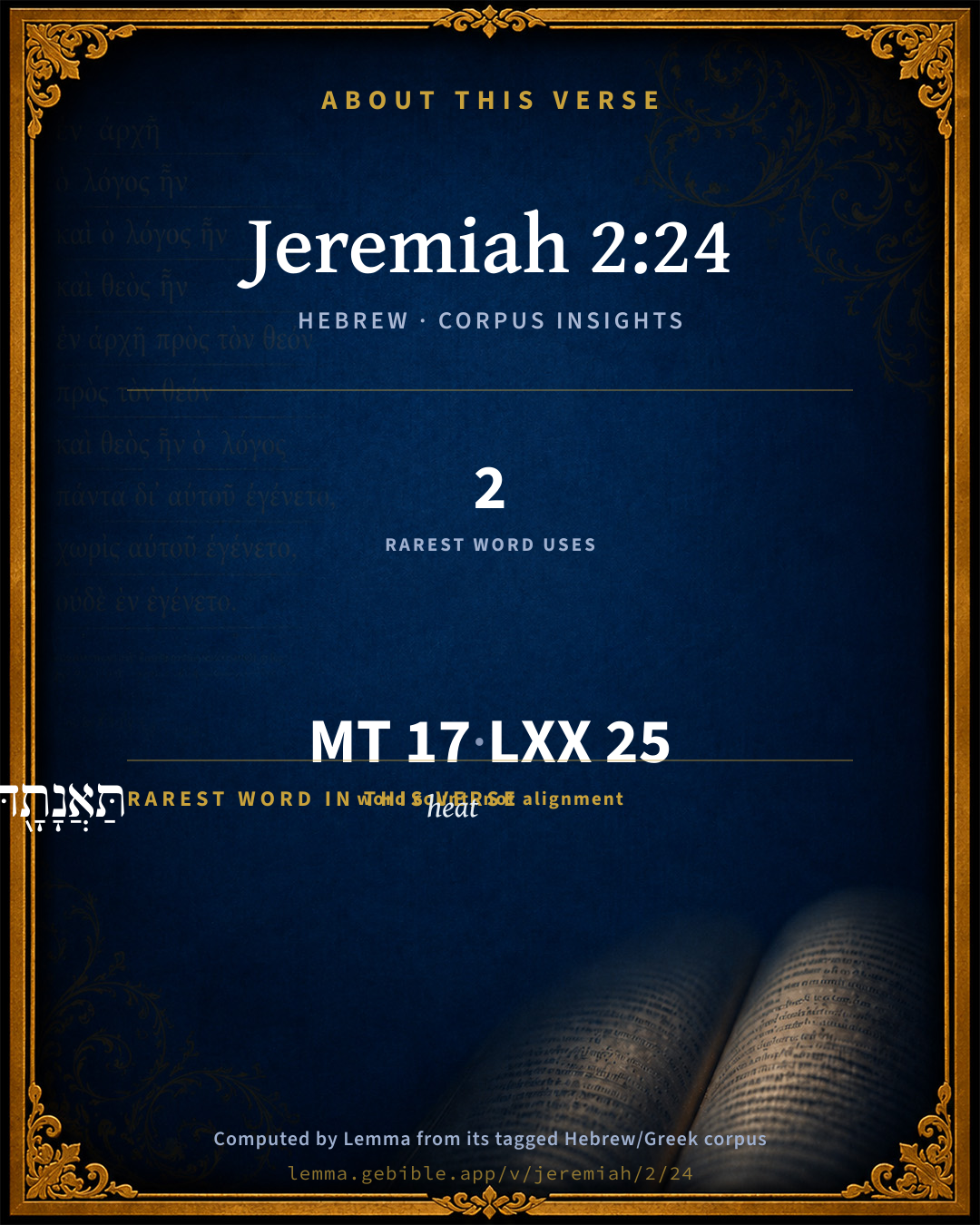
The rarest word here is תַּאֲנָתָ֖הּ heat H8385 — appearing just 2 times in the whole Hebrew Bible.

Shared distinctive vocabulary

תַּאֲנָתָ֖הּ heat H8385 occurs in 2 verses of the Hebrew Bible. Also found in:

Grammatical profile

  • 5 verbs
  • 9 nouns
  • 1 adjective
  • 2 particles

Verb forms

  • שָׁאֲפָ֣ה Qal · Perfect
  • יְשִׁיבֶ֑נָּה Hiphil · Imperfect
  • מְבַקְשֶׁ֨יהָ֙ Piel · Participle Active
  • יִיעָ֔פוּ Qal · Imperfect
  • יִמְצָאֽוּנְהָ Qal · Imperfect

Repetition

A word recurs within this verse — often emphatic in Hebrew:

  • נפשו soul H5315 ×2

Hebrew & Septuagint length

In the original languages it is 17 Hebrew tokens and 25 Greek tokens — but the two are counted differently (Hebrew bundles its prefixes and suffixes into one token; the Greek is in lemma form), so that isn’t a like-for-like length.

Cross-references

5

Topical passages linked to Jeremiah 2:24 in the Treasury of Scripture Knowledge — connected by theme and wording, ordered by reader-vote popularity; previews shown in the World English Bible.

  • Jeremiah 14:6 The wild donkeys stand on the bare heights, they pant for air like jackals; their eyes fail, because there is no herbage.
  • Job 39:5–8 "Who has set the wild donkey free? Or who has loosened the bonds of the swift donkey,
  • Jeremiah 2:27 who tell a stock, You are my father; and to a stone, You have brought me forth: for they have turned their back to me, and not their face; but in the time of their trouble they will say, Arise, and save us.
  • Hosea 5:15 I will go and return to my place, until they acknowledge their offense, And seek my face. In their affliction they will seek me earnestly."
  • Job 11:12 But vain man can become wise If a man can be born as a wild donkey's colt.

Cross-references courtesy of OpenBible.info (CC BY 4.0).

Hebrew and Greek witnesses Masoretic Hebrew ↔ Greek Septuagint

The same verse in the two great witnesses to the Old Testament, shown verse-for-verse.

These are two independent witnesses, not word-aligned to each other, and the Septuagint is shown in lemma (dictionary) form.

Hebrew Jeremiah 2:24 Masoretic · Westminster Leningrad Codex

פֶּ֣רֶה לִמֻּ֣ד מִדְבָּ֗ר בְּאַוַּ֤ת נפשו נַפְשָׁהּ֙ שָׁאֲפָ֣ה ר֔וּחַ תַּאֲנָתָ֖הּ מִ֣י יְשִׁיבֶ֑נָּה כָּל מְבַקְשֶׁ֨יהָ֙ לֹ֣א יִיעָ֔פוּ בְּחָדְשָׁ֖הּ יִמְצָאֽוּנְהָ

a wild donkey used to the wilderness, that snuffs up the wind in her desire; in her occasion who can turn her away? all those who seek her will not weary themselves; in her month they shall find her.

World English Bible · Public Domain

Greek LXX Structure differs

In the Septuagint, Jeremiah is about an eighth shorter than the Hebrew and arranges its material differently — the Oracles Against the Nations (Hebrew chapters 46–51) appear in the middle of the Greek book, after 25:13. Because the chapter and verse boundaries do not line up, a verse-for-verse comparison with the Hebrew is not shown.

A verse-for-verse comparison isn’t shown here because the chapters and verses don’t line up. Switch to the LXX edition with the MT / LXX toggle above to read the Greek directly.

Hebrew: Westminster Leningrad Codex (CC BY 4.0). Greek: Septuagint (public domain); English from a public-domain English Septuagint. How the Septuagint differs from the Hebrew →

Targum (Aramaic paraphrase)

1

The Targum is the ancient Jewish Aramaic paraphrase of the Hebrew Scriptures — an interpretive translation, not the Hebrew text itself. Onkelos (literal) and Pseudo-Jonathan (expansive) render the Torah, and Jonathan the Prophets. Coverage is partial: where no permissively-licensed English translation exists for a verse, only the Aramaic is shown. This is verse-level text, not a word-by-word alignment to the Hebrew.

  1. Targum Jonathan Prophets (Joshua–Malachi)
    כְּעָרוֹדָא דִמְדוֹרָהּ בְּמַדְבְּרָא בִּרְעוּת נַפְשָׁהּ שַׁתְיָא רוּחָא כְּיָרוֹדָא כֵּן כְּנִשְׁתָּא דְיִשְׂרָאֵל מְרָדַת וּטְעַת מִן אוֹרַיְתָא וְלָא צַבְיָא לְמֵיתַב נְבִיָא אָמַר לָהּ כָּל בָּעָהָא דְאוֹרַיְתִי לָא יִשְׁתַּלְהוּן בְּזִמְנָא יִשְׁכְּחוּנָהּ:

    (no public-domain English translation for this verse)

    Targum Jonathan — Aramaic: “Mikraot Gedolot” (public domain). English: “Sefaria Community Translation” (CC0 1.0 (public-domain dedication)); “London "Chaldee Paraphrase," 1871” (public domain). Text via Sefaria.

Commentary

Notes on Jeremiah 2:24 from classic Christian and Jewish commentators (each source and its license shown beneath its notes). The classic Christian expositions comment on the surrounding passage and are grouped to its opening verse, so a note may address several verses; the Jewish commentaries on the Tanakh (Rashi and others) are per-verse, so they appear only where the commentator wrote on this verse.

Lemma curates 59 commentaries, every one of them public domain or Creative Commons licensed, each selected and text-cleaned for this edition rather than reprinted as found. About our sources →

Trapp's Complete Commentary

John Trapp

Jer 2:24 A wild ass used to the wilderness, [that] snuffeth up the wind at her pleasure; in her occasion who can turn her away? all they that seek her will not weary themselves; in her month they shall find her.

Ver. 24. A wild ass used to the wilderness.] Untameable and untractable, {Job 39:8} especially when proud and in the heat of lust, as these were after their idols.

That snuffeth up the wind.] When she windeth the male; so this people when acted by a spirit of fornications.

In her month they shall find her,] i.e., In her last month, when she is so big with young that she cannot wield herself. So sinners, be they never so stubborn, so stiff and high in the instep, that there is no dealing with them, yet when they are in straits and distresses it will be otherwise. God, said Mr Marbury, is fain to deal with wicked men, as men do with frisking jades in a pasture, that cannot be taken up till gotten to a gate; so till he seize upon them by some judgment or summons to die, &c.

John Trapp, A Commentary or Exposition upon All the Books of the Old and New Testament (1647–1656) — public domain. Text from a community e-Sword module.

Geneva Bible (1599)

Geneva Bible translators

That is, when she is with foal, and therefore the hunters wait their time: so though thou canst not be turned back now from thine idolatry, yet when thine iniquity shall be at the fall, God will meet with thee.

He compareth the idolaters to a wild ass: for she can never be tamed nor yet wearied: for as she runneth she can take her wind at every occasion.

Geneva Bible (1599) marginal notes — public domain. Text via Bolls.life.

Jamieson, Fausset & Brown

Robert Jamieson, A. R. Fausset & David Brown

(Jer 14:6; Job 39:5). "A wild ass," agreeing with "thou" (Jer 2:23).

at her pleasure--rather, "in her ardor," namely, in pursuit of a male, sniffing the wind to ascertain where one is to be found [MAURER].

occasion--either from a Hebrew root, "to meet"; "her meeting (with the male for sexual intercourse), who can avert it?" Or better from an Arabic root: "her heat (sexual impulse), who can allay it?" [MAURER].

all they--whichever of the males desire her company [HORSLEY].

will not weary themselves--have no need to weary themselves in searching for her.

her month--in the season of the year when her sexual impulse is strongest, she puts herself in the way of the males, so that they have no difficulty in finding her.

Jamieson, Fausset & Brown — Commentary Critical and Explanatory on the Whole Bible (1871) — public domain (CC PDM 1.0). Text via the HelloAO Bible API.

Adam Clarke's Commentary

Verse 24. A wild ass used to the wilderness] Another comparison to express the same thing.

Snuffeth up the wind] In a high fever from the inward heat felt at such times, these animals open their mouths and nostrils as wide as possible, to take in large draughts of fresh air, in order to cool them.

In her mouth they shall find her.] The meaning is, that although such animals are exceedingly fierce and dangerous when they are in this state; yet, as soon as they have found the male, the desire is satisfied, and they become quiet and governable as before. But it was not so with this idolatrous people: their desires were ever fierce and furious; they were never satiated, one indulgence always leading to an other. The brute beasts had only a short season in which this appetite prevailed; but they acted without restraint or limit.

Adam Clarke's Commentary on the Bible (1810–1826) — public domain. Text from a community e-Sword/MySword module.

John Calvin's Commentaries

As Jeremiah had called the people a dromedary, so he now calls them a wild ass: “Thou,” he says, “art both a dromedary and a wild ass.” For when a wild ass has caught the wind according to her desire, that is, when she has pantingly sought it, and has caught the wind of her occasion, that is, such as may chance to be; for he meant to shew, by this expression, that there is no choice made by beasts, no judgment shewn, no moderation exercised; — when, therefore, she has caught the wind, wherever chance may take her, no one can restrain her from her impetuous course; and he who pursues her will in vain fatigue himself, until he finds her in her month

By these words the Prophet intimates the untamable madness of the people, that they could not by any means be restrained, being like a wild ass, which cannot be tamed nor divested of its wildness, especially when she has caught the wind. For were she shut in, bolts might do something, so as to prevent her headlong course: but when a wild ass is free, and allowed to ramble over hill and dale, when she catches the wind, and catches it according to her desire; that is, when she can wander here and there, and nothing prevents her from rambling in all directions, — when such a liberty is allowed to wild animals that they catch the wind, and the wind of occasion; that is, any wind that may chance to be, there is no reason, as the Prophet seems to intimate, in wild beasts, nor do they keep within any due bounds. When any one of us undertakes a journey, he inquires how far he can go in one day, he avoids weariness, and provides against it as far as he can, and after having fixed the extent of his journey, he thinks of a resting — place; and he also makes inquiries as to the right way, and the best road. The case is different with wild animals; for when they begin to run, they go not to Lyons or to Lausanne, but abandon themselves to a blind impulse: and then when they are fatigued, they cease not to proceed in their course, for lust hurries them on. We now perceive the design of the Prophet.

He then adds, Who can bring her back? As though he had said, that the people could not be stopped or brought back to anything like moderation, for a wildness, yea rather a complete madness, had taken an entire possession of them.

It afterwards follows, There is no reason for any one to weary himself, he will at length find her in her month All interpreters agree that this month is to be taken for the time of foaling. When the wild asses are in foal, and the time of parturition draws nigh, they are then restrained by their burden, and may be easily caught, as they retain not their previous swiftness, for they carry a burden. The Prophet then says, that the people were like wild asses, for they could be restrained by no instruction, and nothing could bridle their excesses; but that the time of parturition must be waited for.

Let us now see how this similitude applies to the people. The verse contains two parts. The first shews, as I have already said, that the people could not be turned by any warnings, nor would they obey any counsels, but were carried away by their insane passions, as it were by the wind of occasion, or any wind that might blow. This is the first part. Now as the obstinacy of the people was so great, God here declares to hypocrites, that the time would come when he would put a restraint on them, and break down their impetuous infatuation. How? The time of parturition would come; that is, “when ye shall have done many iniquities, your burden will stop and restrain you.” And he intimates, that it would be the time of his judgment; as though he had said, “you must be dealt with not as sane men, endued with a sound mind; for ye are wild beasts which cannot be tamed.” What, then, remains to be done? As the wild ass is weighed down with her burden when the time of parturition approaches, so I will cause you at length to feel the burden of your iniquities, which will be by its weight intolerable; and though your perverseness is untamable, yet my hand will be sufficient to restrain you; for I shall break you down, as ye will not bend nor obey my instruction.” We now, then, understand the import of the similitude, and how applicable it was to the case of the people; the use of which ought to be learnt, also, by us in the present day. The rest tomorrow.

John Calvin's Commentaries (1540-1563) — public domain. Text from the Calvin Translation Society English edition (1840s-50s) via the Christian Classics Ethereal Library (ccel.org). Calvin's coverage is partial (roughly two-thirds of the Bible); uncommented books and verses are honest gaps, never fabricated. The 19th-century editor's footnotes and remarks are omitted so the notes are faithfully Calvin's own voice.

Ellicott's Commentary for English Readers

(24) A wild ass . . .—One image of animal desire suggests another, and the “wild ass” appears (as in the Hebrew of Gen_16:12; Job_11:12; Job_39:5) as even a stronger type of passion that defies control. The description is startling in its boldness, but has a parallel in that of Virgil (Georg. iii. 250).

That snuffeth up the wind at her pleasure.—Better, in the desire of her heart, as it bears to her the scent that draws her on. The “occasion” and the “month” are, of course, the season when the stimulus of animal desire is strongest. There is no need for the stallion to seek her with a weary search, she presents herself and pursues him. So there was in Israel what we should describe as a mania for the hateful worship of the heathen.

A Bible Commentary for English Readers, edited by Charles John Ellicott (1878–1897) — public domain. Text from a community e-Sword module.

The Cambridge Bible for Schools and Colleges

gen. ed. J. J. S. Perowne

24. a wild ass used to the wilderness] revelling in uncontrolled licence. Cp. Job_39:5 ff. The noun is not a simile for the young camel of Jer_2:23 (a metaphor within a metaphor), but a further metaphor for Israel. Some commentators propose to read the Heb. consonants with other vowels, giving the meaning heifer. But the whole expression requires, not an animal originally tame, but one “used to” a wilderness life. Co., however, would omit from a “wild ass” to “desire,” conjecturing that it is a gloss suggested by Jer_14:6.

snuffeth up the wind] looking out for every occasion that offers to sin.

will not weary themselves, etc.] Her lovers (i.e. the Baals) need not trouble themselves. No courting of her favour will be wanted on their part. In the month of her pairing she will seek them eagerly.

The Cambridge Bible for Schools and Colleges (gen. ed. J. J. S. Perowne; Cambridge University Press, 1878–1918) — public domain. Text from a community e-Sword module.

John Gill's Exposition

Withhold thy foot from being unshod,.... That it may not be unshod, be naked and bare. The sense is, either, as some, do not take long journeys into foreign countries for help, as into Assyria and Egypt, whither they used to go barefoot; or wore out their shoes by their long journeys, and so returned without; or refrain from idolatry, as Jarchi interprets it, that thou mayest not go naked into captivity; or this is an euphemism, as others think, forbidding adulterous actions, showing the naked foot, the putting off of the shoes, in order to lie upon the bed, and prostitute herself to her lovers; and is to be understood of idolatry:

and thy throat from thirst; after wine, which excites lust; abstain from eager and burning lust after adulterous, that is, idolatrous practices; so the Targum,

"refrain thy feet from being joined with the people, and thy mouth from worshipping the idols of the people.''

The words are paraphrased in the Talmud (e) thus,

"withhold thyself from sinning, that thy foot may not become naked; (the gloss is, "when thou goest into captivity") refrain thy tongue from idle words, that thy throat may not thirst:''

this was said by the Lord, or by the prophets of the Lord sent unto them, to which the following is an answer:

but thou saidst, there is no hope; of ever being prevailed upon to relinquish those idolatrous practices, or of being received into the favour of God after such provocations: no; I will never refrain from them; I will not be persuaded to leave them:

for I have loved strangers; the strange gods of the nations:

and after them will I go; and worship them; so the Targum,

"I love to he joined to the people, and after the Worship of their idols will I go.''

(e) T. Bab. Yoma, fol. 77. 1.

John Gill's Exposition of the Whole Bible (1746–1763) — public domain (CC PDM 1.0). Text via the HelloAO Bible API.

Albert Barnes' Notes on the Bible

A wild donkey used to the wilderness - The type of an untamed and reckless nature.

Snuffeth up the wind - The wind brings with it the scent of the male. Israel does not wait until temptation comes of itself, but looks out for any and every incentive to idolatry.

Occasion ... month - i. e., the pairing season.

Albert Barnes' Notes on the Bible (1834–1885) — public domain. Text from a community e-Sword/MySword module.

Haydock's Catholic Bible Commentary

Away. The female may easily be found by the poisonous hippo-manes. (Georg. iii.) --- Thus Jerusalem is an impudent prostitute. (Haydock)

George Leo Haydock (1774–1849), Haydock's Catholic Family Bible and Commentary, 1859 edition — public domain. Excludes Psalms (Douay-Rheims chapter numbering differs from Protestant) and Deuterocanonical books (Catholic canon only).

Matthew Poole's English Annotations

A wild ass; or, O wild ass; another similitude for the more lively description of the same thing; neither need we be solicitous about the variety or extravagancies of conjectures about this beast; or you may consult as before. It is said to be wild and untamed, as being

used to the wilderness doth also imply; and as to satisfying its lust, much of the nature of the other.

That snuffeth up the wind: this snuffing properly appertains to the sense of smelling, by which certain creatures, by a natural sagacity, find out what they miss, which huntsmen express by a proper term of

winding, or having in the wind; and thus it is understood here; for this creature, by the wind; smells afar off which way her male is; for there is another sense of

snuffing up the wind, viz. for the service of health, as allaying inward heat and drought, &c., Jer 14:6.

At her pleasure; as her desire or lust serves when it runs out after the male; implying also that no choice, or judgment, or measure is observed in these beasts, when carried out after their lusts.

In her occasion who can turn her away? i.e. when she is set upon it, and hath an occasion and opportunity to run impetuously to her male for the satisfying her pleasure, she bears down all opposition before her; there is none can stop or put a bridle upon her raging lust.

Will not weary themselves, i.e. either they need not weary themselves; (speaking of Jerusalem, to which all the rest also is to be applied as in an allegory;) they that have a mind to be filthy with her may easily trace her, Jer 2:23, she refuges none: or rather, they will not bestow their labour in vain, when she is hot upon her lust, but let her take her course until she be satisfied, and wait their time and opportunity; and this agrees with the next words.

In her month they shall find her: if this relate to the former sense of not wearying themselves, it notes her impudence and unsatiableness; you may have her at any time, even in her months or new moons, a season wherein such acts are abhorrent even to nature itself. Some understand this of the idolatry they committed every new moon; but it more properly points at the month of her breeding, or growing big and weighty; month put collectively for months, such as Job speaks of, Job 39:1,2. Or, in her last month, because they grow then unwieldy. That this creature sleeps one month in the year, and that is the month she may be taken, is generally deemed but a fancy. The sense of the verse is, that though Jerusalem be now madly bent upon going after her idols, and other unclean courses, that there is no stopping or controlling of her, as in the next verse, and Jer 2:31; 22:21; yet the time may come, in their afflictions, that they may grow more tame, and willing to receive counsel, as Jer 2:27, and Hos 5:15.

Matthew Poole's English Annotations on the Holy Bible (1683–1685) — public domain. Text from a community e-Sword/MySword module.

The Pulpit Commentary

A wild ass, etc. The type of wildness and independence. (Gen_16:12Jo Gen_39:5-8) That snuffeth up the wind; to cool the heat of her passion. In her occasion... in her month; i.e. at the pairing-time.

The Pulpit Commentary (1880–1919), ed. H.D.M. Spence-Jones & Joseph S. Exell — public domain. Text from a community e-Sword module.

John Wesley's Explanatory Notes

A wild ass - Another similitude for the more lively description of the same thing. The wind - This creature, by the wind, smells afar off which way her male is. In her occasion - That is, when she has an occasion to run impetuously to her male, she bears down all opposition. In her month - Perhaps the sense is, though Jerusalem be now madly bent upon going after her idols, that there is no stopping her, yet the time may come, in their afflictions, that they may grow more tame, and willing to receive counsel.

John Wesley, Explanatory Notes Upon the Whole Bible (1754–1765) — public domain. Text via the GEBible commentary corpus.

Rashi

Rabbi Shlomo Yitzchaki (Rashi)

A wild donkey (salvatico in O.F.) wild, and some interpret it as poulain in O.F., a foal.

accustomed to the desert Accustomed to be in the deserts, so she loves to wander.

that snuffs up the wind She opens her mouth and snuffs up the wind, and he always returns to his place.

her tendency like the sea creatures, who can hinder her? That trait of the sea creatures that she has, for also the sea creature snuffs up the wind, as it is said: “They snuff up the wind like sea creatures” (infra 14:6). Who can hinder her from that trait? So it is with you who can return you from your evil way? her tendency like a sea creature Son dagronemant in O.F., dragon nature. Jonathan rendered it in this manner, כערודה. Another explanation: It is an expression of wailing, comp. “moaning and wailing”.

all who seek her will not weary For they will weary needlessly, for they will be unable to overtake her. What will her end be? In her month, they will find her. There is one month in the year that she sleeps for the whole month, and then she is captured. You, too, - one month (viz. Ab) was already prepared for you from the days of the spies, when your forefathers established it as a time of vain weeping, therein, you will be captured. (תּאניה ואניה) (Lam. 2:5). Another explanation: (sa contree in French,) her country, comp. Taanath Shiloh (Josh. 16:6).

Rashi on the Tanakh — English translations: “The Judaica Press complete Tanach with Rashi, translated by A. J. Rosenberg” (CC BY 4.0); “Pentateuch with Rashi's commentary by M. Rosenbaum and A.M. Silbermann, 1929-1934” (public domain); “The Metsudah Tanach series, Lakewood, N.J” (CC BY 4.0); and “The Book of Joshua, Metsudah Publications, 1997” (CC BY 4.0). Text via Sefaria.

Lesson kit

Teaching starters — assembled from the data on this page, not authored interpretation. Every prompt links to the verse data it draws on. Edit before teaching.

Jeremiah, in the Prophets, opens this verse with 17 words (16 distinct Hebrew lemmas). Its most distinctive word is taʼănâh (“heat”). A historical commentator’s framing appears above. Read the whole chapter for the surrounding context.

Discussion questions

  1. What does “heat” (taʼănâh) contribute to the verse as a whole?
  2. How does Judges 14:4, which shares the word «heat», read alongside this verse?
  3. What does the repetition of “soul” (2× in this one verse) do in this verse?
  4. These translations render this verse differently; the difference is in the English rendering, not the original. What questions does that raise?
  5. «שָׁאֲפָ֣ה» is a Qal Perfect verb. How does that grammatical form shape the action described?
  6. Compare how Trapp's Complete Commentary and Geneva Bible (1599) read this verse. Where do they agree or differ?

Things to notice

Reading settings

Reading text

Shown beneath each verse's original-language words.

Old Testament
Old Testament edition

Read the OT as the Masoretic Hebrew (MT) or the Greek Septuagint (LXX).

English shown for the Greek Septuagint (in the Hebrew ↔ Greek comparison).

Comparing translations? Open the Compare panel on any verse page to stack up to four side by side.