
1 Samuel 26:2

Hebrew (Westminster Leningrad Codex) 1 Samuel 26:2 appears in the Hebrew Old Testament. The text above is from the Westminster Leningrad Codex. Each word links to its Strong’s number, a concise gloss, and parsing drawn from the Open Scriptures Hebrew Bible morphology. Click any word for its full Brown-Driver-Briggs (BDB) entry.
Download image
Cite this verse

1 Samuel 26:2 (World English Bible). Public Domain. Lemma interlinear Bible study tool, https://lemma.gebible.app/v/1-samuel/26/2.

Show BibTeX & RIS
BibTeX
RIS
English Translation
Then Saul arose, and went down to the wilderness of Ziph, having three thousand chosen men of Israel with him, to seek David in the wilderness of Ziph.
World English Bible · Public Domain
Download a study sheet

One document with this verse’s original text, its word-by-word gloss line, the meaning frame, cross-references with their text, attributed commentary, and full source and license credits — printable, and it pastes into notes with its structure intact.

This verse Autodidact and up

Study sheet (.html) Plain text (.txt)

A passage Seminary Student

Up to 50 verses in one chapter. A passage sheet keeps up to 6 commentary sources and 12 cross-references per verse, in the order this page ranks them, and says so on the sheet whenever that leaves anything out. Ask for a single verse and you get the Autodidact verse sheet above.

Everything on this page stays free to read, with no account — the sheet is a download of what is already on screen, not access to it.

Want to remove ads? Support Godless Engineer
Compare translations 3

The same verse in 3 English versions, stacked beneath the original-language interlinear above. Click any original word for its lexicon entry.

Each is an independent rendering of the whole verse — the interlinear is not word-aligned to these translations.

Highlighted words mark where these versions differ — a whole-verse word diff, not a word-by-word alignment.

  • World English Bible Public Domain
    Then Saul arose, and went down to the wilderness of Ziph, having three thousand chosen men of Israel with him, to seek David in the wilderness of Ziph.
  • King James Version Public Domain
    Then Saul arose, and went down to the wilderness of Ziph, having three thousand chosen men of Israel with him, to seek David in the wilderness of Ziph.
  • unfoldingWord Literal Text CC BY-SA 4.0
    And Saul arose and went down to the wilderness of Ziph, and with him 3,000 men, chosen of Israel, to seek David in the wilderness of Ziph.

unfoldingWord Literal Text — © unfoldingWord, licensed CC BY-SA 4.0. Word-aligned USFM3 via Door43 (git.door43.org/unfoldingWord/en_ult).

Versions to compare (up to 4)

3 of 4 selected

Show all 18 translations

Every available English version of this verse, each an independent rendering of the whole verse.

  • World English Bible Public Domain
    Then Saul arose, and went down to the wilderness of Ziph, having three thousand chosen men of Israel with him, to seek David in the wilderness of Ziph.
  • Berean Standard Bible Public Domain
    So Saul, accompanied by three thousand chosen men of Israel, went down to the Wilderness of Ziph to search for David there.
  • Majority Standard Bible Public Domain
    So Saul, accompanied by three thousand chosen men of Israel, went down to the Wilderness of Ziph to search for David there.
  • King James Version Public Domain
    Then Saul arose, and went down to the wilderness of Ziph, having three thousand chosen men of Israel with him, to seek David in the wilderness of Ziph.
  • American Standard Version (1901) Public Domain
    Then Saul arose, and went down to the wilderness of Ziph, having three thousand chosen men of Israel with him, to seek David in the wilderness of Ziph.
  • Revised Version (1885) Public Domain
    Then Saul arose, and went down to the wilderness of Ziph, having three thousand chosen men of Israel with him, to seek David in the wilderness of Ziph.
  • Geneva Bible (1599) Public Domain
    Then Saul arose, and went downe to the wildernes of Ziph, hauing three thousand chosen men of Israel with him, for to seeke Dauid in the wildernesse of Ziph.
  • Douay-Rheims (1899) Public Domain
    And Saul arose, and went down to the wilderness of Ziph, having with him three thousand chosen men of Israel, to seek David in the wilderness of Ziph.
  • Young's Literal Translation Public Domain
    And Saul riseth, and goeth down unto the wilderness of Ziph, and with him three thousand men, chosen ones of Israel, to seek David in the wilderness of Ziph.
  • Literal Standard Version CC BY-SA 4.0
    And Saul rises, and goes down to the wilderness of Ziph, and with him [are] three thousand men, chosen ones of Israel, to seek David in the wilderness of Ziph.
  • Unlocked Literal Bible CC BY-SA 4.0
    Then Saul arose and went down to the wilderness of Ziph, having three thousand chosen men of Israel with him, to seek David in the wilderness of Ziph.
  • unfoldingWord Literal Text CC BY-SA 4.0
    And Saul arose and went down to the wilderness of Ziph, and with him 3,000 men, chosen of Israel, to seek David in the wilderness of Ziph.
  • Darby Bible Public Domain
    And Saul arose, and went down to the wilderness of Ziph, having three thousand chosen men of Israel with him, to seek David in the wilderness of Ziph.
  • World Messianic Bible Public Domain
    Then Saul arose and went down to the wilderness of Ziph, having three thousand chosen men of Israel with him, to seek David in the wilderness of Ziph.
  • Webster's Bible Public Domain
    Then Saul arose, and went down to the wilderness of Ziph, having three thousand chosen men of Israel with him, to seek David in the wilderness of Ziph.
  • Free Bible Version CC BY-SA 4.0
    So Saul went to the Desert of Ziph along with three thousand specially-picked men from Israel to search for David there.
  • Bible in Basic English Public Domain
    Then Saul went down to the waste land of Ziph, taking with him three thousand of the best men of Israel, to make search for David in the waste land of Ziph.
  • JPS Tanakh (1917) Public Domain
    Then Saul arose, and went down to the wilderness of Ziph, having three thousand chosen men of Israel with him, to seek David in the wilderness of Ziph.

Literal Standard Version (2020), Covenant Press — licensed CC BY-SA 4.0. Text via the HelloAO Bible API (eBible.org). Unlocked Literal Bible (unfoldingWord) — licensed CC BY-SA 4.0. Text via the HelloAO Bible API (eBible.org). unfoldingWord Literal Text — © unfoldingWord, licensed CC BY-SA 4.0. Word-aligned USFM3 via Door43 (git.door43.org/unfoldingWord/en_ult). Free Bible Version, Dr. Jonathan Gallagher — licensed CC BY-SA 4.0. Text via the HelloAO Bible API (eBible.org).

Word by word

More ways to search: Search by grammar → Find every occurrence → Compare this word →

Practice this passage: Drill this verse → Learn its vocabulary →

זִ֔יף
Zîyph
H2128
“Ziph”
Noun, Proper
Part of Speech
Noun
Type
Proper
Full BDB Definition

Origin: from the same as H2203

TWOT: None

Ziph = "battlement" - a son of Jehaleleel, a descendant of Judah, and brother of Ziphah (noun proper masculine) - a city in southern Judah, between Ithnan and Telem; site unknown (noun proper locative) - a city of Judah, southeast of Hebron, between Carmel and Juttah in the highland district (noun proper locative)
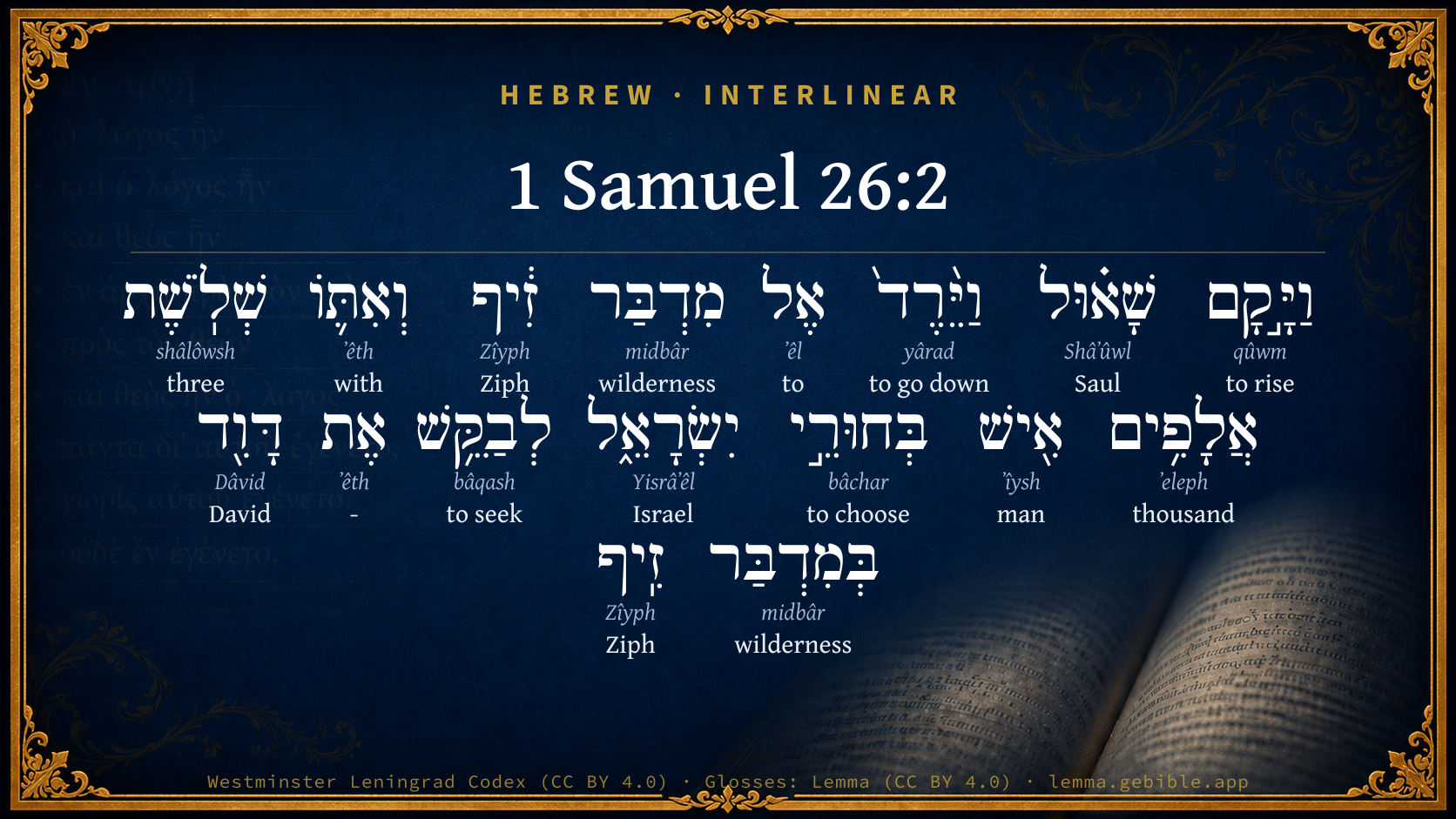
  1. וַיָּ֣קָם qûwm H6965 “and · to rise” Conjunction + Verb, Qal, Sequential Imperfect, 3rd Person, Masculine, Singular
  2. שָׁא֗וּל Shâʼûwl H7586 “Saul” Noun, Proper
  3. וַיֵּ֨רֶד֙ yârad H3381 “and · to go down” Conjunction + Verb, Qal, Sequential Imperfect, 3rd Person, Masculine, Singular
  4. אֶל ʼêl H413 “to” Preposition
  5. מִדְבַּר midbâr H4057 “wilderness of” Noun, Common, Masculine, Singular, Construct
  6. וְאִתּ֛וֹ ʼêth H854 “and · with · him” Conjunction + Preposition + Suffix, Personal, 3rd Person, Masculine, Singular
  7. שְׁלֹֽשֶׁת shâlôwsh H7969 “three” Adjective, Cardinal number, Masculine, Singular, Construct
  8. אֲלָפִ֥ים ʼeleph H505 “thousand” Adjective, Cardinal number, Both, Plural, Absolute
  9. אִ֖ישׁ ʼîysh H376 “man” Noun, Common, Masculine, Singular, Absolute
  10. בְּחוּרֵ֣י bâchar H977 “chosen” Verb, Qal, Participle Passive, Masculine, Plural, Construct
  11. יִשְׂרָאֵ֑ל Yisrâʼêl H3478 “Israel” Noun, Proper
  12. לְבַקֵּ֥שׁ bâqash H1245 “to seek” Preposition + Verb, Piel, Infinitive Construct
  13. אֶת ʼêth H853 “-” Particle, Direct Object
  14. דָּוִ֖ד Dâvid H1732 “David” Noun, Proper
  15. בְּמִדְבַּר midbâr H4057 “in/at · wilderness of” Preposition + Noun, Common, Masculine, Singular, Construct
  16. זִֽיף Zîyph H2128 “Ziph” Noun, Proper

About this verse

These counts appear in no published source. They are computed here, from the morphology-tagged text and Lemma’s own curated glosses. What Lemma adds →

17
words
15
distinct lemmas
Historical
section

Notable vocabulary

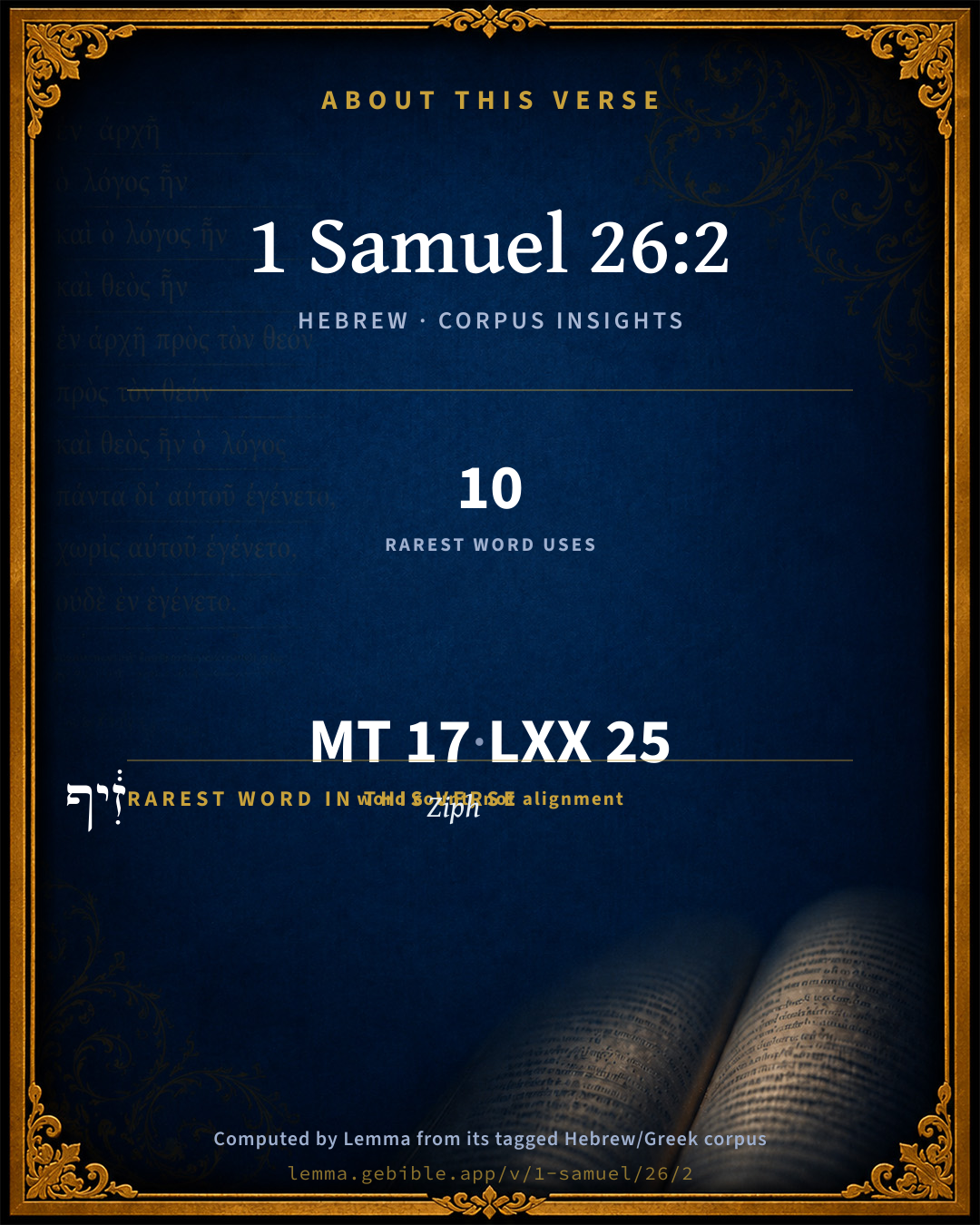
The rarest word here is זִ֔יף Ziph H2128 — appearing just 10 times in the whole Hebrew Bible.

Shared distinctive vocabulary

זִ֔יף Ziph H2128 occurs in 9 verses of the Hebrew Bible. Also found in:

Grammatical profile

  • 4 verbs
  • 8 nouns
  • 2 adjectives
  • 2 prepositions
  • 1 particle

Verb forms

  • וַיָּ֣קָם Qal · Sequential Imperfect
  • וַיֵּ֨רֶד֙ Qal · Sequential Imperfect
  • בְּחוּרֵ֣י Qal · Participle Passive
  • לְבַקֵּ֥שׁ Piel · Infinitive Construct

Repetition

Words recur within this verse — often emphatic in Hebrew:

  • מִדְבַּר wilderness H4057 ×2
  • זִ֔יף Ziph H2128 ×2

Hebrew & Septuagint length

In English translation the verse runs 28 words from the Hebrew and 30 from the Septuagint (LXX English) — closely comparable.

A rough comparison of the two English renderings, which tokenize alike — not a word-level alignment.

Word counts can differ between the Hebrew and the Greek without any difference in meaning — e.g. the Hebrew direct-object marker אֵת has no separate Greek word, and Greek often adds the article ὁ.

In the original languages it is 17 Hebrew tokens and 25 Greek tokens — but the two are counted differently (Hebrew bundles its prefixes and suffixes into one token; the Greek is in lemma form), so that isn’t a like-for-like length.

Cross-references

6

Topical passages linked to 1 Samuel 26:2 in the Treasury of Scripture Knowledge — connected by theme and wording, ordered by reader-vote popularity; previews shown in the World English Bible.

  • 1 Samuel 24:2 Then Saul took three thousand chosen men out of all Israel, and went to seek David and his men on the rocks of the wild goats.
  • 1 Samuel 13:2 Saul chose him three thousand men of Israel, of which two thousand were with Saul in Michmash and in the Mount of Bethel, and one thousand were with Jonathan in Gibeah of Benjamin: and the rest of the people he sent every man to his tent.
  • 1 Samuel 23:23–25 See therefore, and take knowledge of all the lurking-places where he hides himself, and come you again to me of a certainty, and I will go with you: and it shall happen, if he be in the land, that I will search him out among all the thousands of Judah.
  • 1 Samuel 24:17 He said to David, You are more righteous than I; for you have rendered to me good, whereas I have rendered to you evil.
  • Psalms 38:12 They also who seek after my life lay snares. Those who seek my hurt speak mischievous things, And meditate deceits all day long.
  • Psalms 140:4–9 Yahweh, keep me from the hands of the wicked. Preserve me from the violent men who have determined to trip my feet.

Cross-references courtesy of OpenBible.info (CC BY 4.0).

Hebrew and Greek witnesses Masoretic Hebrew ↔ Greek Septuagint

The same verse in the two great witnesses to the Old Testament, shown verse-for-verse.

These are two independent witnesses, not word-aligned to each other, and the Septuagint is shown in lemma (dictionary) form.

Hebrew 1 Samuel 26:2 Masoretic · Westminster Leningrad Codex

וַיָּ֣קָם שָׁא֗וּל וַיֵּ֨רֶד֙ אֶל מִדְבַּר זִ֔יף וְאִתּ֛וֹ שְׁלֹֽשֶׁת אֲלָפִ֥ים אִ֖ישׁ בְּחוּרֵ֣י יִשְׂרָאֵ֑ל לְבַקֵּ֥שׁ אֶת דָּוִ֖ד בְּמִדְבַּר זִֽיף

Then Saul arose, and went down to the wilderness of Ziph, having three thousand chosen men of Israel with him, to seek David in the wilderness of Ziph.

World English Bible · Public Domain

Greek LXX 1 Samuel 26:2 Septuagint · lemma form

καί ἀναἵστημι σαούλ καί καταβαίνω εἰς ὁ ἔρημος ζιφ καί μετά αὐτός τρεῖς χιλιάς ἀνήρ ἐκλεκτός ἐκ ἰσραήλ ζητέω ὁ δαυίδ ἐν ὁ ἔρημος ζιφ

And Saul arose, and went down to the wilderness of Ziph, and with him went three thousand men chosen out of Israel, to seek David in the wilderness of Ziph.

LXX2012 (modern English Septuagint) · Public Domain

Hebrew: Westminster Leningrad Codex (CC BY 4.0). Greek: Septuagint (public domain); English from LXX2012 (modern English Septuagint) (Public Domain). How the Septuagint differs from the Hebrew →

Targum (Aramaic paraphrase)

1

The Targum is the ancient Jewish Aramaic paraphrase of the Hebrew Scriptures — an interpretive translation, not the Hebrew text itself. Onkelos (literal) and Pseudo-Jonathan (expansive) render the Torah, and Jonathan the Prophets. Coverage is partial: where no permissively-licensed English translation exists for a verse, only the Aramaic is shown. This is verse-level text, not a word-by-word alignment to the Hebrew.

  1. Targum Jonathan Prophets (Joshua–Malachi)
    וְקָם שָׁאוּל וּנְחַת לְמַדְבְּרָא דְזִיף וְעִמֵיהּ תְּלָתָא אַלְפִין גַבְרָא בְחוּרֵי יִשְׂרָאֵל לְמִבְעֵי יַת דָוִד בְּמַדְבְּרָא דְזִיף:

    (no public-domain English translation for this verse)

    Targum Jonathan — Aramaic: “Mikraot Gedolot” (public domain). English: “Sefaria Community Translation” (CC0 1.0 (public-domain dedication)); “London "Chaldee Paraphrase," 1871” (public domain). Text via Sefaria.

Commentary

Notes on 1 Samuel 26:2 from classic Christian and Jewish commentators (each source and its license shown beneath its notes). The classic Christian expositions comment on the surrounding passage and are grouped to its opening verse, so a note may address several verses; the Jewish commentaries on the Tanakh (Rashi and others) are per-verse, so they appear only where the commentator wrote on this verse.

Lemma curates 59 commentaries, every one of them public domain or Creative Commons licensed, each selected and text-cleaned for this edition rather than reprinted as found. About our sources →

Trapp's Complete Commentary

John Trapp

1Sa 26:2 Then Saul arose, and went down to the wilderness of Ziph, having three thousand chosen men of Israel with him, to seek David in the wilderness of Ziph.

Ver. 2. Then Saul arose.] Though he had otherwise resolved. {1Sa 24:16-22} Good motions that fall into wicked hearts, are like some sparks that fall from the flint and steel into wet tinder; light some for the time, but soon go out.

John Trapp, A Commentary or Exposition upon All the Books of the Old and New Testament (1647–1656) — public domain. Text from a community e-Sword module.

Geneva Bible (1599)

Geneva Bible translators

That is, of the most skillful and valiant soldiers.

Geneva Bible (1599) marginal notes — public domain. Text via Bolls.life.

Adam Clarke's Commentary

Verse 2. Three thousand chosen men] Though they knew that David was but six hundred strong, yet Saul thought it was not safe to pursue such an able general with a less force than that mentioned in the text; and, that he might the better depend on them, they were all elect or picked men out of the whole of his army.

Adam Clarke's Commentary on the Bible (1810–1826) — public domain. Text from a community e-Sword/MySword module.

Ellicott's Commentary for English Readers

(2) Then Saul arose, and went down to the wilderness of Ziph.—We assume, then, that after the marriage of David with Abigail he and his armed band returned again to his old neighbourhood in the south—in the desert of Judah—the district named after the Hill of Hachilah being, no doubt, in all respects well adapted for the permanent encampment of such a large band as David’s now most certainly was. David, who had been forced on a previous occasion to leave it on account of the hot pursuit of Saul, aided by the Ziphites, who knew the country and its resources so well, probably now supposed, after the protestation of Saul at En-gedi, that he would now at least be left in peace. But he forgot with whom he had to do—forgot the state of mind of his determined foe, and how likely it was that the old mania would return with redoubled force. The Ziphites, however, who knew Saul, and the feeling respecting David which existed at the court of Saul, repeated their old tactics, and sent, as on a previous occasion, to suggest that with their help the obnoxious chieftain and his free lances could be destroyed. The temptation was too great to be resisted; so probably, with the advice of Abner, Saul took the field again. The 3,000 seem to have been the standing force which Saul kept round him in the Gibeah garrison. (See the first notice of this standing army in 1Sa_13:2.)

A Bible Commentary for English Readers, edited by Charles John Ellicott (1878–1897) — public domain. Text from a community e-Sword module.

The Cambridge Bible for Schools and Colleges

gen. ed. J. J. S. Perowne

2. three thousand chosen men] Cp. 1Sa_24:2. This was the number of his standing army. See 1Sa_13:2.

The Cambridge Bible for Schools and Colleges (gen. ed. J. J. S. Perowne; Cambridge University Press, 1878–1918) — public domain. Text from a community e-Sword module.

John Gill's Exposition

Then Saul arose,.... Immediately, glad of an opportunity to seize on David, having the same disposition towards him as ever; and perhaps had repented he had not laid hold on him when he followed him out of the cave:

and went down to the wilderness of Ziph: or towards it:

having three thousand chosen men of Israel; young men, so called, because usually chosen for business, and for war particularly, rather than old men; the same number he took with him when he sought him at Engedi, Sa1 24:2,

to seek David in the wilderness of Ziph; where or whereabouts he was informed by the Ziphites he was.

John Gill's Exposition of the Whole Bible (1746–1763) — public domain (CC PDM 1.0). Text via the HelloAO Bible API.

Whedon's Commentary on the Bible

Daniel D. Whedon

2. Three thousand chosen men — His select standing army. 1Sa_13:2.

Daniel D. Whedon (gen. ed.), Commentary on the Old and New Testaments (1874–1909) — public domain. Text from a community e-Sword module.

The Pulpit Commentary

Vers. 2-4. Three thousand chosen men. Not chosen for this expedition, but the force which Saul always kept under arms. (1Sa_13:2) By the way. The high road which led down to Arad. David abode in the wilderness. Hebrew, "abides." Instead of fleeing in haste as before, he remains apparently on the higher ground, as he speaks in ver. 6 of going down to Saul"s comp. And he saw. Ie. learned, was told. It was only when his scouts brought him their report that he knew that Saul was come in very deed, or "for a certainty". (see 1Sa_23:23)

The Pulpit Commentary (1880–1919), ed. H.D.M. Spence-Jones & Joseph S. Exell — public domain. Text from a community e-Sword module.

Lesson kit

Teaching starters — assembled from the data on this page, not authored interpretation. Every prompt links to the verse data it draws on. Edit before teaching.

1 Samuel, in the Historical, opens this verse with 17 words (15 distinct Hebrew lemmas). Its most distinctive word is Zîyph (“Ziph”). A historical commentator’s framing appears above. Read the whole chapter for the surrounding context.

Discussion questions

  1. How does “Ziph” (Zîyph) shape what this verse is saying?
  2. Joshua 15:24 shares the word «Ziph» with this verse. How do the two illuminate each other?
  3. “wilderness” occurs 2× in this one verse. What is the effect of the repetition?
  4. These translations render this verse differently. What is at stake in choosing one wording over another?
  5. The verb «וַיָּ֣קָם» is Qal Sequential Imperfect. How does its form color the action?
  6. Reading how Trapp's Complete Commentary and Geneva Bible (1599) read this verse, where do the two commentators agree and where do they part?

Things to notice

Reading settings

Reading text

Shown beneath each verse's original-language words.

Old Testament
Old Testament edition

Read the OT as the Masoretic Hebrew (MT) or the Greek Septuagint (LXX).

English shown for the Greek Septuagint (in the Hebrew ↔ Greek comparison).

Comparing translations? Open the Compare panel on any verse page to stack up to four side by side.