
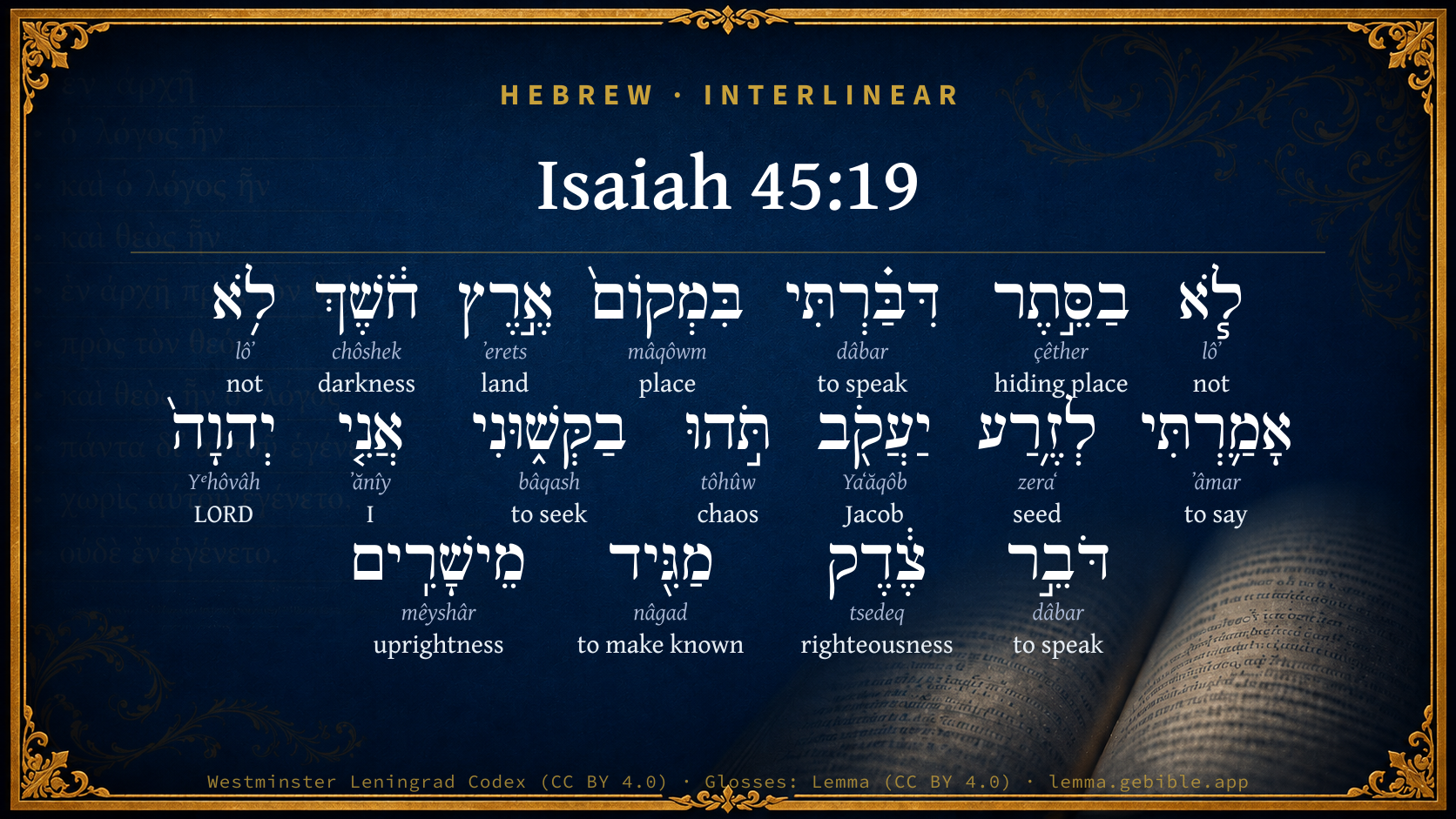
Isaiah 45:19

Hebrew (Westminster Leningrad Codex) Isaiah 45:19 appears in the Hebrew Old Testament. The text above is from the Westminster Leningrad Codex. Each word links to its Strong’s number, a concise gloss, and parsing drawn from the Open Scriptures Hebrew Bible morphology. Click any word for its full Brown-Driver-Briggs (BDB) entry.
Download image
Cite this verse

Isaiah 45:19 (World English Bible). Public Domain. Lemma interlinear Bible study tool, https://lemma.gebible.app/v/isaiah/45/19.

Show BibTeX & RIS
BibTeX
RIS
English Translation
I have not spoken in secret, in a place of the land of darkness; I didn't say to the seed of Jacob, Seek you me in vain: I, Yahweh, speak righteousness, I declare things that are right.
World English Bible · Public Domain
Download a study sheet

One document with this verse’s original text, its word-by-word gloss line, the meaning frame, cross-references with their text, attributed commentary, and full source and license credits — printable, and it pastes into notes with its structure intact.

This verse Autodidact and up

Study sheet (.html) Plain text (.txt)

A passage Seminary Student

Up to 50 verses in one chapter. A passage sheet keeps up to 6 commentary sources and 12 cross-references per verse, in the order this page ranks them, and says so on the sheet whenever that leaves anything out. Ask for a single verse and you get the Autodidact verse sheet above.

Everything on this page stays free to read, with no account — the sheet is a download of what is already on screen, not access to it.

Want to remove ads? Support Godless Engineer
Compare translations 3

The same verse in 3 English versions, stacked beneath the original-language interlinear above. Click any original word for its lexicon entry.

Each is an independent rendering of the whole verse — the interlinear is not word-aligned to these translations.

Highlighted words mark where these versions differ — a whole-verse word diff, not a word-by-word alignment.

  • World English Bible Public Domain
    I have not spoken in secret, in a place of the land of darkness; I didn't say to the seed of Jacob, Seek you me in vain: I, Yahweh, speak righteousness, I declare things that are right.
  • King James Version Public Domain
    I have not spoken in secret, in a dark place of the earth: I said not unto the seed of Jacob, Seek ye me in vain: I the LORD speak righteousness, I declare things that are right.
  • unfoldingWord Literal Text CC BY-SA 4.0
    I have not spoken in secret, in a place of a land of darkness. I did not say to the seed of Jacob, ‘Seek me emptiness.’ I Yahweh, speaking righteousness, declaring uprightnesses. q1

unfoldingWord Literal Text — © unfoldingWord, licensed CC BY-SA 4.0. Word-aligned USFM3 via Door43 (git.door43.org/unfoldingWord/en_ult).

Versions to compare (up to 4)

3 of 4 selected

Show all 18 translations

Every available English version of this verse, each an independent rendering of the whole verse.

  • World English Bible Public Domain
    I have not spoken in secret, in a place of the land of darkness; I didn't say to the seed of Jacob, Seek you me in vain: I, Yahweh, speak righteousness, I declare things that are right.
  • Berean Standard Bible Public Domain
    I have not spoken in secret, from a place in a land of darkness. I did not say to the descendants of Jacob, ‘Seek Me in a wasteland.’ I, the LORD, speak the truth; I say what is right.
  • Majority Standard Bible Public Domain
    I have not spoken in secret, from a place in a land of darkness. I did not say to the descendants of Jacob, ‘Seek Me in a wasteland.’ I, the LORD, speak the truth; I say what is right.
  • King James Version Public Domain
    I have not spoken in secret, in a dark place of the earth: I said not unto the seed of Jacob, Seek ye me in vain: I the LORD speak righteousness, I declare things that are right.
  • American Standard Version (1901) Public Domain
    I have not spoken in secret, in a place of the land of darkness; I said not unto the seed of Jacob, Seek ye me in vain: I, Jehovah, speak righteousness, I declare things that are right.
  • Revised Version (1885) Public Domain
    I have not spoken in secret, in a place of the land of darkness; I said not unto the seed of Jacob, Seek ye me in vain: I the LORD speak righteousness, I declare things that are right.
  • Geneva Bible (1599) Public Domain
    I haue not spoken in secrete, neither in a place of darkenes in the earth: I saide not in vaine vnto the seede of Iaakob, Seeke you me: I the Lord doe speake righteousnesse, and declare righteous things.
  • Douay-Rheims (1899) Public Domain
    I have not spoken in secret, in a dark place of the earth: I have not said to the seed of Jacob: Seek me in vain. I am the Lord that speak justice, that declare right things.
  • Young's Literal Translation Public Domain
    Not in secret have I spoken, in a dark place of the earth, I have not said to the seed of Jacob, In vain seek ye Me, I `am' Jehovah, speaking righteousness, Declaring uprightness.
  • Literal Standard Version CC BY-SA 4.0
    I have not spoken in secret, in a dark place of the earth, || I have not said to the seed of Jacob, || Seek Me in vain, || I [am] YHWH, speaking righteousness, || Declaring uprightness.
  • Unlocked Literal Bible CC BY-SA 4.0
    I have not spoken in private, in some hidden place; I did not say to Jacob's descendants, 'Seek me in vain!' I am Yahweh, who speaks sincerely; I declare the things that are right.
  • unfoldingWord Literal Text CC BY-SA 4.0
    I have not spoken in secret, in a place of a land of darkness. I did not say to the seed of Jacob, ‘Seek me emptiness.’ I Yahweh, speaking righteousness, declaring uprightnesses. q1
  • Darby Bible Public Domain
    I have not spoken in secret, in a dark place of the earth; I said not unto the seed of Jacob, Seek me in vain: I [am] Jehovah, speaking righteousness, declaring things which are right.
  • World Messianic Bible Public Domain
    I have not spoken in secret, in a place of the land of darkness. I didn’t say to the offspring of Jacob, ‘Seek me in vain.’ I, the LORD, speak righteousness. I declare things that are right.
  • Webster's Bible Public Domain
    I have not spoken in secret, in a dark place of the earth: I have not said to the seed of Jacob, Seek ye me in vain: I the LORD speak righteousness, I declare things that are right.
  • Free Bible Version CC BY-SA 4.0
    I haven't been talking in secret in an obscure place. I didn't tell the descendants of Jacob: Look for me in a place where no one can be found. I, the Lord, tell the truth—I say what's right.
  • Bible in Basic English Public Domain
    I have not given my word in secret, in a place in the underworld; I did not say to the seed of Jacob, Go into a waste land to make request of me: I the Lord say what is true, my word is righteousness.
  • JPS Tanakh (1917) Public Domain
    I have not spoken in secret, in a place of the land of darkness; I said not unto the seed of Jacob: 'Seek ye Me in vain'; I the LORD speak righteousness, I declare things that are right.

Literal Standard Version (2020), Covenant Press — licensed CC BY-SA 4.0. Text via the HelloAO Bible API (eBible.org). Unlocked Literal Bible (unfoldingWord) — licensed CC BY-SA 4.0. Text via the HelloAO Bible API (eBible.org). unfoldingWord Literal Text — © unfoldingWord, licensed CC BY-SA 4.0. Word-aligned USFM3 via Door43 (git.door43.org/unfoldingWord/en_ult). Free Bible Version, Dr. Jonathan Gallagher — licensed CC BY-SA 4.0. Text via the HelloAO Bible API (eBible.org).

Word by word

More ways to search: Search by grammar → Find every occurrence → Compare this word →

Practice this passage: Drill this verse → Learn its vocabulary →

מֵישָׁרִֽים
mêyshâr
H4339
“uprightness”
Noun, Common, Masculine, Plural, Absolute
Part of Speech
Noun
Type
Common
Gender
Masculine
Number
Plural
State
Absolute
Full BDB Definition

Origin: from H3474

TWOT: 930e

evenness, uprightness, straightness, equity - evenness, level, smoothness - uprightness, equity - rightly (as adverb)
  1. לֹ֧א lôʼ H3808 “not” Particle, Negative
  2. בַסֵּ֣תֶר çêther H5643 “in/at the · hiding place” Preposition, Determined + Noun, Common, Masculine, Singular, Absolute
  3. דִּבַּ֗רְתִּי dâbar H1696 “to speak” Verb, Piel, Perfect, 1st Person, Common, Singular
  4. בִּמְקוֹם֙ mâqôwm H4725 “in/at · place of” Preposition + Noun, Common, Masculine, Singular, Construct
  5. אֶ֣רֶץ ʼerets H776 “land of” Noun, Common, Both, Singular, Construct
  6. חֹ֔שֶׁךְ chôshek H2822 “darkness” Noun, Common, Masculine, Singular, Absolute
  7. לֹ֥א lôʼ H3808 “not” Particle, Negative
  8. אָמַ֛רְתִּי ʼâmar H559 “to say” Verb, Qal, Perfect, 1st Person, Common, Singular
  9. לְזֶ֥רַע zeraʻ H2233 “to/for · seed of” Preposition + Noun, Common, Masculine, Singular, Construct
  10. יַעֲקֹ֖ב Yaʻăqôb H3290 “Jacob” Noun, Proper
  11. תֹּ֣הוּ tôhûw H8414 “chaos” Noun, Common, Masculine, Singular, Absolute
  12. בַקְּשׁ֑וּנִי bâqash H1245 “seek · me” Verb, Piel, Imperative, 2nd Person, Masculine, Plural + Suffix, Personal, 1st Person, Common, Singular
  13. אֲנִ֤י ʼănîy H589 “I” Pronoun, Personal, 1st Person, Common, Singular
  14. יְהוָה֙ Yᵉhôvâh H3068 “LORD” Noun, Proper
  15. דֹּבֵ֣ר dâbar H1696 “speaking” Verb, Qal, Participle Active, Masculine, Singular, Absolute
  16. צֶ֔דֶק tsedeq H6664 “righteousness” Noun, Common, Masculine, Singular, Absolute
  17. מַגִּ֖יד nâgad H5046 “making known” Verb, Hiphil, Participle Active, Masculine, Singular, Absolute

About this verse

These counts appear in no published source. They are computed here, from the morphology-tagged text and Lemma’s own curated glosses. What Lemma adds →

18
words
16
distinct lemmas
Prophets
section

Notable vocabulary

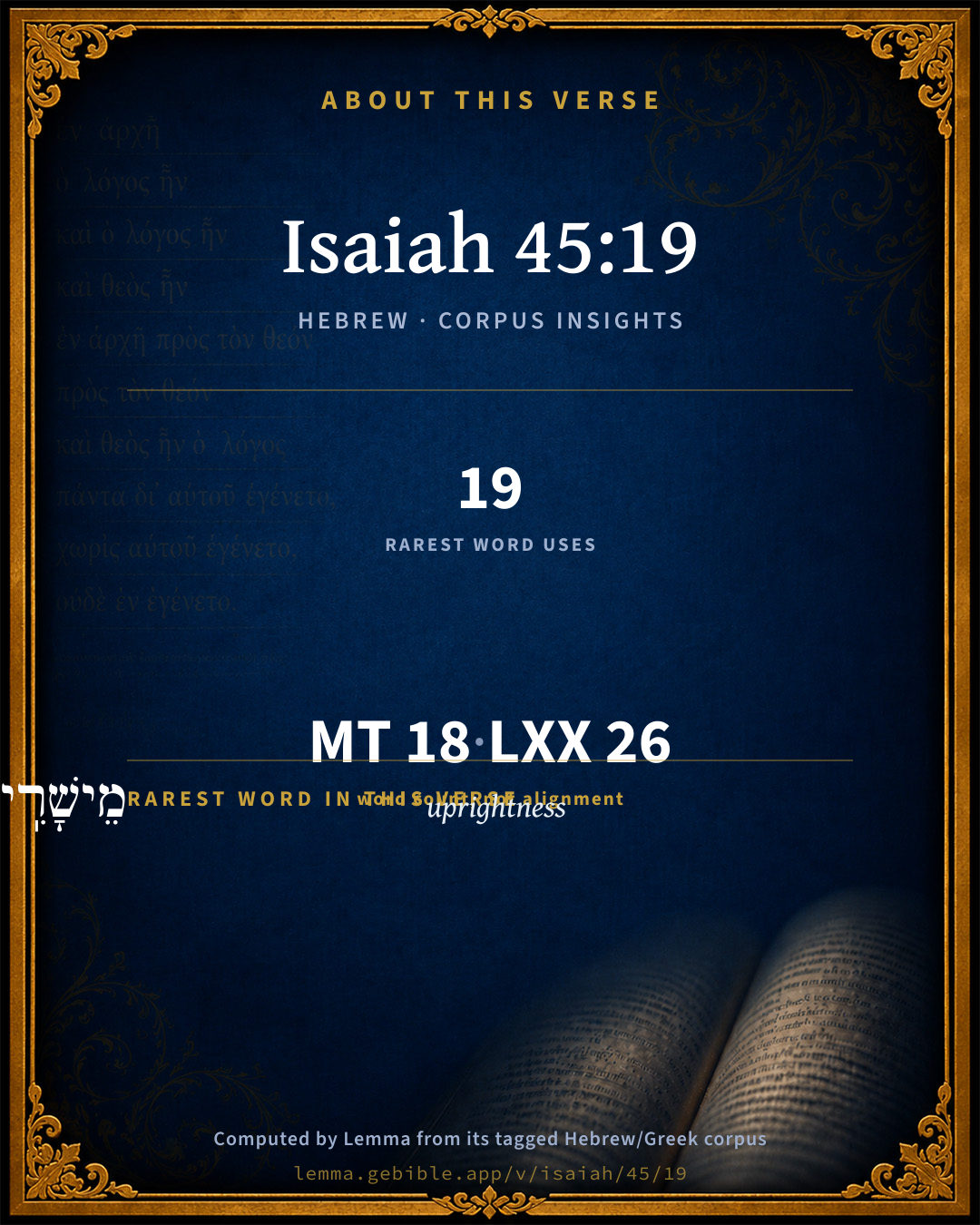
The rarest word here is מֵישָׁרִֽים uprightness H4339 — appearing just 19 times in the whole Hebrew Bible.

Shared distinctive vocabulary

מֵישָׁרִֽים uprightness H4339 occurs in 19 verses of the Hebrew Bible. Also found in:

Grammatical profile

  • 5 verbs
  • 10 nouns
  • 1 pronoun
  • 2 particles

Verb forms

  • דִּבַּ֗רְתִּי Piel · Perfect
  • אָמַ֛רְתִּי Qal · Perfect
  • בַקְּשׁ֑וּנִי Piel · Imperative
  • דֹּבֵ֣ר Qal · Participle Active
  • מַגִּ֖יד Hiphil · Participle Active

Repetition

Words recur within this verse — often emphatic in Hebrew:

  • דִּבַּ֗רְתִּי to speak H1696 ×2
  • לֹ֧א not H3808 ×2

Hebrew & Septuagint length

In English translation the verse runs 37 words from the Hebrew and 35 from the Septuagint (LXX English) — closely comparable.

A rough comparison of the two English renderings, which tokenize alike — not a word-level alignment.

Word counts can differ between the Hebrew and the Greek without any difference in meaning — e.g. the Hebrew direct-object marker אֵת has no separate Greek word, and Greek often adds the article ὁ.

In the original languages it is 18 Hebrew tokens and 26 Greek tokens — but the two are counted differently (Hebrew bundles its prefixes and suffixes into one token; the Greek is in lemma form), so that isn’t a like-for-like length.

Cross-references

38

Topical passages linked to Isaiah 45:19 in the Treasury of Scripture Knowledge — connected by theme and wording, ordered by reader-vote popularity; previews shown in the World English Bible.

  • Isaiah 48:16 Come you near to me, hear you this; from the beginning I have not spoken in secret; from the time that it was, there am I: and now the Lord Yahweh has sent me, and his Spirit.
  • Numbers 23:19–20 God is not a man, that he should lie, Neither the son of man, that he should repent: Has he said, and will he not do it? Or has he spoken, and will he not make it good?
  • Amos 5:4 For thus says Yahweh to the house of Israel: "Seek me, and you will live;
  • Jeremiah 29:13–14 You shall seek me, and find me, when you shall search for me with all your heart.
  • Proverbs 30:5 "Every word of God is flawless. He is a shield to those who take refuge in him.
  • John 18:20 Jesus answered him, "I spoke openly to the world. I always taught in synagogues, and in the temple, where the Jews always meet. I said nothing in secret.
  • Psalms 9:10 Those who know your name will put their trust in you, For you, Yahweh, have not forsaken those who seek you.
  • Psalms 69:32 The humble have seen it, and are glad. You who seek after God, let your heart live.
  • Psalms 111:7–8 The works of his hands are truth and justice. All his precepts are sure.
  • Proverbs 15:8 The sacrifice made by the wicked is an abomination to Yahweh, But the prayer of the upright is his delight.
  • Malachi 3:13–14 "Your words have been stout against me," says Yahweh. "Yet you say, 'What have we spoken against you?'
  • James 4:3 You ask, and don't receive, because you ask with wrong motives, so that you may spend it for your pleasures.
  • Deuteronomy 29:29 The secret things belong to Yahweh our God; but the things that are revealed belong to us and to our children forever, that we may do all the words of this law.
  • 1 Chronicles 28:8 Now therefore, in the sight of all Israel, the assembly of Yahweh, and in the audience of our God, observe and seek out all the commandments of Yahweh your God; that you may possess this good land, and leave it for an inheritance to your children after you forever.
  • Psalms 19:7–10 Yahweh's law is perfect, restoring the soul. Yahweh's testimony is sure, making wise the simple.
  • Psalms 69:13 But as for me, my prayer is to you, Yahweh, in an acceptable time. God, in the abundance of your loving kindness, answer me in the truth of your salvation.
  • Psalms 119:137–138 You are righteous, Yahweh. Your judgments are upright.
  • Proverbs 8:1–4 Doesn't wisdom cry out? Doesn't understanding raise her voice?
  • Isaiah 1:15 When you spread forth your hands, I will hide my eyes from you; Yes, when you make many prayers, I will not hear. Your hands are full of blood.
  • Isaiah 8:19 When they shall tell you, "Consult with those who have familiar spirits and with the wizards, who chirp and who mutter:" shouldn't a people consult with their God? on behalf of the living [should they consult] with the dead?
  • Deuteronomy 30:11–14 For this commandment which I command you this day, it is not too hard for you, neither is it far off.
  • Deuteronomy 32:4 The Rock, his work is perfect; For all his ways are justice: A God of faithfulness and without iniquity, Just and right is he.
  • 2 Chronicles 15:2 and he went out to meet Asa, and said to him, Hear you me, Asa, and all Judah and Benjamin: Yahweh is with you, while you are with him; and if you seek him, he will be found of you; but if you forsake him, he will forsake you.
  • Ezra 8:22 For I was ashamed to ask of the king a band of soldiers and horsemen to help us against the enemy in the way, because we had spoken to the king, saying, The hand of our God is on all those who seek him, for good; but his power and his wrath is against all those who forsake him.
  • Psalms 12:6 The words of Yahweh are flawless words, As silver refined in a clay furnace, purified seven times.
  • Psalms 24:6 This is the generation of those who seek Him, Who seek your face--even Jacob. Selah.
  • Proverbs 1:21 She calls at the head of noisy places. At the entrance of the city gates, she utters her words:
  • Isaiah 58:1–3 Cry aloud, don't spare, lift up your voice like a trumpet, and declare to my people their disobedience, and to the house of Jacob their sins.
  • Isaiah 63:1 Who is this who comes from Edom, with dyed garments from Bozrah? this who is glorious in his clothing, marching in the greatness of his strength? I who speak in righteousness, mighty to save.
  • Matthew 15:8–9 'These people draw near to me with their mouth, And honor me with their lips; But their heart is far from me.
  • John 7:26 Behold, he speaks openly, and they say nothing to him. Can it be that the rulers indeed know that this is truly the Christ?
  • John 7:28 Jesus therefore cried out in the temple, teaching and saying, "You both know me, and know where I am from. I have not come of myself, but he who sent me is true, whom you don't know.
  • John 7:37–39 Now on the last and greatest day of the feast, Jesus stood and cried out, "If anyone is thirsty, let him come to me and drink!
  • Acts 2:4–8 They were all filled with the Holy Spirit, and began to speak with other languages, as the Spirit gave them the ability to speak.
  • Proverbs 8:6 Hear, for I will speak excellent things. The opening of my lips is for right things.
  • Isaiah 43:9–10 Let all the nations be gathered together, and let the peoples be assembled: who among them can declare this, and show us former things? let them bring their witnesses, that they may be justified; or let them hear, and say, It is truth.
  • Isaiah 45:23 By myself have I sworn, the word is gone forth from my mouth [in] righteousness, and shall not return, that to me every knee shall bow, every tongue shall swear.
  • Isaiah 55:6–7 Seek you Yahweh while he may be found; call you on him while he is near:

Cross-references courtesy of OpenBible.info (CC BY 4.0).

Hebrew and Greek witnesses Masoretic Hebrew ↔ Greek Septuagint

The same verse in the two great witnesses to the Old Testament, shown verse-for-verse.

These are two independent witnesses, not word-aligned to each other, and the Septuagint is shown in lemma (dictionary) form.

Hebrew Isaiah 45:19 Masoretic · Westminster Leningrad Codex

לֹ֧א בַסֵּ֣תֶר דִּבַּ֗רְתִּי בִּמְקוֹם֙ אֶ֣רֶץ חֹ֔שֶׁךְ לֹ֥א אָמַ֛רְתִּי לְזֶ֥רַע יַעֲקֹ֖ב תֹּ֣הוּ בַקְּשׁ֑וּנִי אֲנִ֤י יְהוָה֙ דֹּבֵ֣ר צֶ֔דֶק מַגִּ֖יד מֵישָׁרִֽים

I have not spoken in secret, in a place of the land of darkness; I didn't say to the seed of Jacob, Seek you me in vain: I, Yahweh, speak righteousness, I declare things that are right.

World English Bible · Public Domain

Greek LXX Isaiah 45:19 Septuagint · lemma form

οὐ ἐν κρυφῇ λαλέω οὐδέ ἐν τόπος γῆ σκοτεινός οὐ εἶπον ὁ σπέρμα ἰακώβ μάταιος ζητέω ἐγώ εἰμί ἐγώ εἰμί κύριος λαλέω δικαιοσύνη καί ἀναἀγγέλλω ἀλήθεια

I have not spoken in secret, nor in a dark place of the earth: I said not to the seed of Jacob, Seek vanity: I, even I, am the Lord, speaking righteousness, and proclaiming truth.

LXX2012 (modern English Septuagint) · Public Domain

Hebrew: Westminster Leningrad Codex (CC BY 4.0). Greek: Septuagint (public domain); English from LXX2012 (modern English Septuagint) (Public Domain). How the Septuagint differs from the Hebrew →

Targum (Aramaic paraphrase)

1

The Targum is the ancient Jewish Aramaic paraphrase of the Hebrew Scriptures — an interpretive translation, not the Hebrew text itself. Onkelos (literal) and Pseudo-Jonathan (expansive) render the Torah, and Jonathan the Prophets. Coverage is partial: where no permissively-licensed English translation exists for a verse, only the Aramaic is shown. This is verse-level text, not a word-by-word alignment to the Hebrew.

  1. Targum Jonathan Prophets (Joshua–Malachi)
    לָא בְסִתְרָא מַלְלֵית בַּאֲתַר אַרְעָא קָבֵל וְלָא אֲמָרֵית לְזַרְעָא דְבֵית יַעֲקֹב לְרֵיקָנוּ תְּבַעוּ דְחַלְתִּי אֲנָא יְיָ מְמַלֵל קְשׁוֹט מְחַוֵי כֵּיוְנָן:

    I have not spoken in secret, in a dark place of the earth; I said not unto the seed of the house of Jacob, Seek me reverently in vain; I the Lord speak the truth, declaring upright things.

    Targum Jonathan — Aramaic: “Mikraot Gedolot” (public domain). English: “Sefaria Community Translation” (CC0 1.0 (public-domain dedication)); “London "Chaldee Paraphrase," 1871” (public domain). Text via Sefaria.

Commentary

Notes on Isaiah 45:19 from classic Christian and Jewish commentators (each source and its license shown beneath its notes). The classic Christian expositions comment on the surrounding passage and are grouped to its opening verse, so a note may address several verses; the Jewish commentaries on the Tanakh (Rashi and others) are per-verse, so they appear only where the commentator wrote on this verse.

Lemma curates 59 commentaries, every one of them public domain or Creative Commons licensed, each selected and text-cleaned for this edition rather than reprinted as found. About our sources →

Trapp's Complete Commentary

John Trapp

Isa 45:19 I have not spoken in secret, in a dark place of the earth: I said not unto the seed of Jacob, Seek ye me in vain: I the LORD speak righteousness, I declare things that are right.

Ver. 19. I have not spoken in secret.] As the sibyls did out of their dens; as the idol priests did out of their holes and underground vaults; as heretics and seducers, who creep into corners and there vend their false wares, as Vincentins Lirinensis long since observed. (Epiphanius fitly compareth them to moles, who do all their mischief by working underground.) But God, as he delivered his law openly on Mount Sinai, so his gospel he commanded to be preached "on the house top," and in Mount Zion. Christ "spoke openly" to the world. {Joh 18:20} Truth seeketh no corners: "I am not ashamed of the gospel of Christ." {Rom 1:16} But what was this word that was delivered so plainly and perspicuously?

Seek ye me.] And for your encouragement ye shall not do it "in vain"; for I am "a rewarder of all those that diligently seek me." {Heb 11:6} Let heathen deities disappoint and delude those that seek to them; Jacob’s God scorneth the motion. He is better to his people than their prayers, better than their hopes; and when, with Gehazi, they ask but one talent, he, like Naaman, forceth them to take two.

I the Lord speak righteousness; I declare the things that are right.] Or, Even. So doth not the devil, but things sinful and obscene; as human sacrifices, promiscuous uncleannesses, ut in nefariis Priapi et Veneris sacris. Contrariwise, "all the words of God’s mouth are in righteousness; there is nothing froward or perverse in them." {Pro 8:8}

John Trapp, A Commentary or Exposition upon All the Books of the Old and New Testament (1647–1656) — public domain. Text from a community e-Sword module.

The Biblical Illustrator

Joseph S. Exell

Isa_45:19

I have not spoken in secret

In a dark place of the earth,

In a dark place of the earth, is an expression used for the purpose of pointing out the contrast between the prophecies of Jehovah and the heathen cave, oracles and spirit-voices of the necromancers, which seemed to rise up from the interior of the earth.

(C. Short, M. A.)

Gods speech to men

Two thoughts branch off--

1. Prophecy, proceeding from Him is a thing of the light, no black art, essentially different from heathen divination.

2. The same love of Jehovah which is revealed already in creation, is also shown in His relation to Israel; He did not point Israel to Himself as chaos (I said not to the seed of Jacob; seek Me as chaos!), even as He did not create the earth a chaos (He has not created it a chaos, Isa_45:18). (F. Delitzsch, D. D.)

I said not unto the seed of Jacob, Seek ye Me in vain.

Seek ye Me in vain,

Seek ye Me in vain, literally, in waste, i.e where there are no ways or indications how He is to be found. (A. B. Davidson, D. D.)

Comfort to seekers from what the Lord has not said

We might gain much solace by considering what God has not said. We have an assurance that God will answer prayer, because He hath not said unto the seed of Israel, Seek ye My face in vain. The proposition is this: that those who seek God, in Gods own appointed way, cannot, by any possibility seek Him in vain; that earnest, penitent, prayerful hearts, though they may be delayed for a time, can never be sent away with a final denial (Ro Mat_7:8).

I. I SHALL PROVE THIS BY THE NEGATIVE, as our text has it.

1. Suppose that sincere prayer could be fruitless, then the question arises, Why are men exhorted to pray at all? Would it not be a piece of heartless tyranny if the Queen should wait upon a man in his condemned cell, and encourage him to petition her favour, nay, command him to do it, saying to him, be importunate, and you will prevail; and yet, all the while, should intend never to pardon the man, but had determined in her heart that his death-warrant should be signed and sealed, and that on the execution morning he should be launched into eternity? Would this be consistent with royal bounty--fit conduct for a gracious monarch? Can you for a moment suppose that God would bid you come to Him through Jesus Christ, and yet intend never to be gracious at the voice of your cry?

2. If prayer could be offered continuously, and God could be sought earnestly, but no mercy found, then he who prays would be worse off than he who does not pray, and supplications would be an ingenious invention for increasing the ills of mankind. For a man who does not pray has less woes than a man who does pray, if God be not the answerer of prayer. He who has been taught to pray has great desires and wants; his heart is an aching void which the world can never fill; but he that never prays has no longings and pinnings after God. If, then, a man may have these vehement longings, and yet God will never grant them, then assuredly the man who prays is in a worse position than he who prays not. How can this be?

3. If God do not hear prayer, since it is clear that in that case the praying man would be more wretched than the careless sinner, then it would follow that God would be the author of unnecessary misery. This is inconsistent with the character of God.

4. Should there still be some desponding ones, who think that God would invite them to pray and yet reject them, I would put it on another ground. Would men do so? Would you? Can God be less generous than men?

5. This is Gods memorial by which He is distinguished from the false gods Psa_115:6; Psa_65:2). One of the standing proofs of the Deity of Jehovah is, that He does answer the supplications of His people.

6. If God do not hear prayer what is the meaning of His promises?

7. What is the meaning of all the provisions which He has already made for hearing prayer? Why a mediator, an intercessor? &c.

8. If God hear not prayer, what Gospel have I to preach?

9. Where, then, were the believers hope?

10. What would they say in hell, if a soul could really seek the Lord and be refused? There are some who, when under conviction of sin, still cleave to this dark delusion, that God will not hear them. Therefore, I have tried, by blow after blow, to smite this fear dead.

II. THAT THE LORD DOES HEAR PRAYER MAY BE POSITIVELY SUBSTANTIATED.

1. For the Lord to hear prayer is consistent with His nature.

2. It is harmonious with all His past actions (Psa_107:3). Conclusion--Try for yourself. (C. H. Spurgeon.)

Gods praying people

1. The seed of Jacob are a praying people; it is the generation of them that seek Him (Psa_24:6).

2. As He has invited them to seek Him, so He never denied their believing prayers, nor disappointed their believing expectations.

3. If He did not think fit to give them the particular thing they prayed for, yet He gave them that grace sufficient and that comfort and satisfaction of soul which was equivalent. (M. Henry.)

Gods straightforwardness

I, the Lord, speak righteousness. The word is used in its ethical sense of trustworthiness, or straightforwardness,--perfect correspondence between deeds and words. (Prof. J. Skinner, D. D.)

The Biblical Illustrator, edited by Joseph S. Exell (c. 1880s–1900s) — public domain. Text from a community e-Sword module.

Joseph Benson's Commentary

Isa 45:19. I have not spoken in secret, in a dark place, &c. — This is declared in opposition to the manner in which the heathen oracles gave their answers; which were generally delivered not only darkly and doubtfully, but from obscure cells and caverns of the earth: such was the seat of the Cumean Sibyl:

“Excisum Euboicæ latus ingens rupis in antrum.”

“A spacious cave within its farmost part Was hew’d, and fashion’d by laborious art:

Through the hill’s hollow sides —” VIRG. ÆN., 6:42.

Such was that of the famous oracle at Delphi: of which, says Strabo, lib. 9., “The oracle is said to be, αντρον κοιλον μετα βαθους, ου μαλα ευρυστομον, a hollow cavern of considerable depth, with an opening not very wide.” And Diodorus, giving an account of the same oracle, says, “There was in that place a great chasm, or cleft, in the earth; in which very place is situated what is called Adytum;” that is, the cavern, or hidden part of the temple. Jehovah, on the contrary, delivered his oracles to Israel publicly and plainly. I said not to the seed of Jacob, Seek ye me in vain — Serve and worship me for naught. As I appointed them work, so from time to time I have given them abundant recompense. I Jehovah speak righteousness, &c. — That which I promise is true, and that which I command is just and good. I require nothing of my people but what is righteous in itself, and for their real advantage: whereas the idols, or their priests rather, command their worshippers to do many sinful and shameful things, even in their worship, as is most notorious. Bishop Lowth renders this clause, I am Jehovah, who speak truth, who give direct answers; observing, “This also is said in opposition to the false and ambiguous answers given by the heathen oracles; of which there are many noted examples.”

Joseph Benson's Commentary on the Old and New Testaments (1811–1818) — public domain. Text from a community e-Sword module.

The Preacher's Complete Homiletical Commentary

Joseph S. Exell (gen. ed.)

COMFORT TO SEEKERS FROM WHAT THE LORD HAS NOT SAID

Isa_45:19. I have not spoken in secret, &c.

We might gain much solace by considering what God has not said. In our text we have an assurance that God will answer prayer, because He hath not said unto the seed of Israel, “Seek ye my face in vain.” The proposition I come to deal with is this: that those who seek God, in God’s own appointed way, cannot, by any possibility, seek Him in vain; that earnest, penitent, prayerful hearts, though they may be delayed for a time, can never be sent away with a final denial (Rom_10:13; Mat_7:8).

I. I shall prove this, first, by the negative, as our text has it. It is not possible that a man should sincerely, in God’s own appointed way, seek for mercy and eternal life, and yet a gracious answer be finally refused. For several reasons.

1. Suppose that sincere prayer could be fruitless, then the question arises, Why, then, are men exhorted to pray at all? Would it not be a piece of heartless tyranny if the Queen should wait upon a man in his condemned cell, and encourage him to petition her favour, nay, command him to do it, saying to him, “If I do not send you at once an answer, send another petition, and another; send to me seven times, yea, continue to do it, and never cease so long as you live; be importunate, and you will prevail.” And what if the Queen should tell the man the story of the importunate widow—should describe to him the case of the man who, by perseverance, obtained the three loaves for his weary friend, and say to him, “Even so, if you ask you shall receive,” and yet all the while should intend never to pardon the man, but had determined in her heart that his death-warrant should be signed and sealed, and that on the execution morning he should be launched into eternity? Would this be consistent with royal bounty—fit conduct for a gracious monarch? Can you for a moment suppose that God would bid you come to Him through Jesus Christ, and yet intend never to be gracious at the voice of your cry?

2. If prayer could be offered continuously, and God could be sought earnestly, but no mercy found, then he who prays would be worse off than he who does not pray, and supplication would be an ingenious invention for increasing the ills of mankind. For a man who does not pray has less woes than a man who does pray, if God be not the answerer of prayer. The man who prays is made to hunger; shall he hunger and not eat? Were it not, then, better never to hunger? How, then, can it be said, “Blessed are they that hunger”! &c. The man who prays thirsts; as the hart panteth after the water-brooks, so he pants after his God; but if God will never give him the living water to drink, is not a thirsty soul much more wretched than one who never learned to thirst at all? He who has been taught to pray has great desires and wants; his heart is an aching void which the world can never fill; but he that never prays has no longings and pinings after God, he feels no ungratified desires after eternal things. If, then, a man may have these vehement longings, and yet God will never grant them, then assuredly the man who prays is in a worse position than he who prays not. How can this be?

3. If God do not hear prayer, since it is clear that in that case the praying man would be more wretched than the careless sinner, then it would follow that God would be the author of unnecessary misery. Now, we know that this is inconsistent with the character of our God. We look around the world and we see punishment for sin, but no punishment for good desires, &c.

4. Should there still be some desponding ones, who think that God would invite them to pray and yet reject them, I would put it on another ground. Would men do so? Would you do so? Can God be less generous than men?

5. Have you forgotten that this is God’s memorial, by which He is distinguished from the false gods? (Comp. Psa_115:5; Psa_65:2.) One of the standing proofs of the Deity of Jehovah is, that He does to this day answer the supplications of His people. Could you seek His face, and yet He should refuse you, where would be His memorial? The answer may tarry, but only that it may be the more sweet when it comes (H. E. I. 3895–3898).

6. If God do not hear prayer, what is the meaning of His promises? (e.g., Psa_50:15; Psa_91:15; Jer_33:3; Isa_65:24, &c.) How shall He make His veracity to be proved if He do not answer His people? But His word must stand, though heaven and earth should pass away.

7. If God hath virtually said to us, “Pray, but I will never hear you; seek ye my face in vain,” then, I ask, what is the meaning of all the provisions which He has already made for hearing prayer? I see a way to God; ’tis paved with stones inlaid in the fair crimson of the Saviour’s blood. I see a door; it is the wounded side of Jesus. Why a Mediator, an Intercessor, &c., &c., if prayer be unavailing?

8. I use the argument which the apostle uses upon the resurrection. If God hear not prayer, what gospel have I to preach? As the apostle said concerning the resurrection, “then is our preaching vain, and your faith is also vain; ye are yet in your sins.”

9. Where, then, were the believer’s hope? Hang the heavens in sackcloth, let the sun be turned into darkness, let the moon become a clot of blood, if the mercy-seat can be proved to be a mockery.

10. What would they say in hell, if a soul could really seek the Lord and be refused? Oh, the unholy merriment of devils then!

I have been arguing against a thing which you know theoretically is not possible; but yet there are some who, when they are under conviction of sin, still cleave to this dark delusion, that God will not hear them. Therefore I have tried, by blow after blow, if possible, to smite this fear dead.

II. That the Lord does hear prayer may be positively substantiated by the following considerations:—

1. For the Lord to hear prayer is consistent with His nature. Whatever is consistent with God’s nature, in the view of a sound judgment, we believe is true. Now we cannot perceive any attribute of God which would stand in the way of His hearing prayer.

2. It is harmonious with all His past actions. If you want a history of God’s dealings with men, turn to Psa_107:3. What does He mean by His promises? As I said negatively, if He did not hear, where were His promises? so I say positively, Because of His promises He must hear. God is free, but His promises bind Him: God may do as He wills, but He always wills to do what He has said He will do. We have no claim upon God, but God makes a claim for us; when He gives a promise, we may confidently plead it. Promises made in Scripture are God’s engagements, and as no honourable man ever runs back from his engagements, so a God of honour and a God of truth cannot, from the necessity of His nature, suffer one of His words to fall to the ground.

CONCLUSION.—Try for yourself. If you would know that God hears prayer, you must test the fact, for you will never learn it through my saying, “He heard me;” you will only know it through His having heard you; and I therefore exhort you, since it is not a peradventure but a living certainty, that “he that asketh receiveth,” &c., pray to Him even now to save your souls. Pray as if you meant it, and continue as Elijah did, till you get the blessing.—C. H. Spurgeon, Metropolitan Tabernacle Pulpit, No. 508.

The Preacher's Complete Homiletical Commentary (gen. ed. Joseph S. Exell; Funk & Wagnalls, c. 1892) — public domain (pre-1929). A full-Bible homiletical/sermon-outline anthology covering 65 of 66 books (2 John is absent from the source module). Text from a community e-Sword module.

MacLaren's Expositions of Holy Scripture

Alexander MacLaren

Isaiah

HIDDEN AND REVEALED

Isa 45:15, Isa 45:19.

The former of these verses expresses the thoughts of the prophet in contemplating the close of a great work of God’s power which issues in the heathen’s coming to Israel and acknowledging God. He adores the depth of the divine counsels which, by devious ways and after long ages, have led to this bright result. And as he thinks of all the long-stretching preparations, all the apparently hostile forces which have been truly subsidiary, all the generations during which these Egyptian and Ethiopian tribes have been the enemies and oppressors of that Israel whom they at last acknowledge for the dwelling-place of God, and enemies of that Jehovah before whom they finally bow down, he feels that he has no measuring-line to fathom the divine purposes, and bows his face to the ground in reverent contemplation with that word upon his lips: ‘Verily Thou art a God that hidest Thyself, O God of Israel, the Saviour.’ It is a parallel to the apostolic words, ‘O the depths of the riches both of the wisdom and knowledge of God. How unsearchable are His judgments, and His ways past finding out.’

But such thoughts are but a half truth, and may very easily become in men’s minds a whole error, and therefore they are followed by a marvellous section in which the Lord Himself speaks, and of which the whole burden is-the clearness and fulness with which God makes Himself known to men. True it is that there are depths inaccessible in the divine nature. True it is that there are mysteries unrevealed in the method of the divine procedure, and especially in that of the relation of heathen tribes to His gospel and His love. True it is that there are mysteries opened in the very word of His grace. But notwithstanding all this-it is also true that He makes Himself known to us all, that He declares righteousness, that He calls us to seek Him, and that He wills to be found and known by us.

The collocation of these two passages may be taken, then, as representing the two phases of the Divine Manifestation, the obscurity which must ever be associated with all our finite knowledge of God, and the clear sunlight in which blazes all that we need to know of Him.

I. After all revelation, God is hidden.

There is revelation of His Name in all His works. His action must be all self-manifestation. But after all it is obscure and hidden.

1. Nature hides while it reveals.

Nature’s revelation is unobtrusive.

God is concealed behind second causes.

God is concealed behind regular modes of working {laws}.

Nature’s revelation is partial, disclosing only a fragment of the name.

Nature’s revelation is ambiguous. Dark shadows of death and pain in the sensitive world, of ruin and convulsions, of shivered stars, seem to contradict the faith that all is very good; so that it has been possible for men to drop their plummet in the deep and say, ‘I find no God,’ and for others to fall into Manichaeism or some form or other of dualism.

2. Providence hides while it reveals.

That is the sphere in which men are most familiar with the idea of mystery.

There is much of which we do not see the issue. The process is not completed, and so the end is not visible.

Even when we believe that ‘to Him’ and ‘for good’ are ‘all things,’ we cannot tell how all will come circling round. We are like men looking only at one small segment of an ellipse which is very eccentric.

There is much of which we do not see the consistency with the divine character.

We are confronted with stumbling-blocks in the allotment of earthly conditions; in the long ages and many tribes which are without knowledge of God; in the sore sorrows, national and individual.

We can array a formidable host. But it is to be remembered that revelation actually increases these. It is just because we know so much of God that we feel them so keenly. I suppose the mysteries of the divine government trouble others outside the sphere of revelation but little. The darkness is made visible by the light.

3. Even in ‘grace’ God is hidden while revealed.

The Infinite and Eternal cannot be grasped by man.

The conception of infinity and eternity is given us by revelation, but it is not comprehended so that its contents are fully known. The words are known, but their full meaning is not, and no revelation can make them, known to finite intelligences.

God dwells in light inaccessible, which is darkness.

Revelation opens abysses down which we cannot look. It raises and leaves unsettled as many questions as it solves.

The telescope resolves many nebulae, but only to bring more unresolvable ones into the field of vision.

Now all this is but one side of the truth. There is a tendency in some minds to underrate what is plain because all is not plain. For some minds the obscure has a fascination, apart altogether from its nature, just because it is obscure. It is a noble emulation to press forward and ‘still to be closing up what we know not with what we know.’ But neither in science nor in religion shall we make progress if we do not take heed of the opposing errors of thinking that all is seen, and of thinking that what we have is valueless because there are gaps in it. The constellations are none the less bright nor immortal fires, though there be waste places in heaven where nothing but opaque blackness is seen. In these days it is especially needful to insist both on the incompleteness of all our religious knowledge, and to say that-

II. Notwithstanding all obscurity, God has amply revealed Himself.

Though God hides Himself, still there comes from heaven the voice-’I have not spoken in secret,’ Now these words contain these thoughts-

1. That whatever darkness there may be, there is none due to the manner of the revelation.

God has not spoken in secret, in a corner. There are no arbitrary difficulties made or unnecessary darkness left in His revelation. We have no right to say that He has left difficulties to test our faith. He Himself has never said so. He deals with us in good faith, doing all that can be done to enlighten, regard being had to still loftier considerations, to the freedom of the human will, to the laws which He has Himself imposed on our nature, and the purposes for which we are here. It is very important to grasp this. We have been told as much as can be told. Contrast with such a revelation the cave-muttered oracles of heathenism and their paltering double sense. Be sure that when God speaks, He speaks clearly and to all, and that in Christianity there is no esoteric teaching for a few initiated only, while the multitude are put off with shows.

2. That whatever obscurity there may be, there is none which hides the divine invitation or Him from those who obey it.

‘I have never said . . . seek ye Me in vain.’ Much is obscure if speculative completeness is looked for, but the moral relations of God and man are not obscure.

All which the heart needs is made known. His revelation is clearly His seeking us, and His revelation is His gracious call to us to seek Him. He is ever found by those who seek. They have not to press through obscurities to find Him, but the desire to possess must precede possession in spiritual matters. He is no hidden God, lurking in obscurity and only to be found by painful search. They who ‘seek’ Him know where to find Him, and seek because they know.

3. That whatever may be obscure, the Revelation of righteousness is clear.

We have to face speculative difficulties in plenty, but the great fact remains that in Revelation steady light is focussed on the moral qualities of the divine Nature and especially on His righteousness.

And the revelation of the divine righteousness reaches its greatest brightness, as that of all the divine Nature does, in the Person and work of Jesus. Very significantly the idea of God’s righteousness is fully developed in the immediately subsequent context. There we find that attribute linked in close and harmonious conjunction with what shallower thought is apt to regard as being in antagonism to it. He declares Himself to be ‘a just {righteous} God and a Saviour.’ So then, if we would rightly conceive of His righteousness, we must give it a wider extension than that of retributive justice or cold, inflexible aloofness from sinners. It impels God to be man’s saviour. And with similar enlarging of popular conceptions there follows: ‘In the Lord is righteousness and strength,’ and therefore, ‘In the Lord shall all the seed of Israel be justified {declared and made righteous} and shall glory’-then, the divine Righteousness is communicative.

All these thoughts, germinal in the prophet’s words, are set in fullest light, and certified by the most heart-moving facts, in the Person and work of Jesus Christ. He ‘declares at this time His righteousness, that He might Himself be righteous and the maker righteous of them that have faith in Jesus.’ Whatever is dark, this is clear, that ‘Jehovah our Righteousness’ has come to us in His Son, in whom seeking Him we shall never seek in vain, but ‘be found in Him, not having a righteousness of our own, even that which is of the law, but that which is through faith in Christ, the righteousness which is of God by faith.’

If the great purpose of revelation is to make us know that God loves us, and has given us His Son that in Him we may know Him and possess His Righteousness, difficulties and obscurities in its form or in its substance take a very different aspect. What need we more than that knowledge and possession? Be not robbed of them.

Many things are not written in the book of the divine Revelation, whether it be that of Nature, of human history, or of our own spirits, or even of the Gospel, but these are written that we may believe that Jesus is the Son of God, and believing, may have life in His name.

Alexander MacLaren, Expositions of Holy Scripture (1904–1910) — public domain. Text from a community e-Sword module.

Geneva Bible (1599)

Geneva Bible translators

As do the false gods, which give uncertain answers.

Geneva Bible (1599) marginal notes — public domain. Text via Bolls.life.

Jamieson, Fausset & Brown

Robert Jamieson, A. R. Fausset & David Brown

not . . . secret--not like the heathen oracles which gave their responses from dark caverns, with studied obscurity (Isa 48:16). Christ plainly quotes these words, thereby identifying Himself with Jehovah (Joh 18:20).

I said not . . . Seek . . . in vain--When I commanded you to seek Me (Jehovah did so, Isa 45:11, "Ask Me," &c.), it was not in order that ye might be sent empty away (Deu 32:47). Especially in Israel's time of trial, God's interposition, in behalf of Zion hereafter, is expressly stated as about to be the answer to prayer (Isa 62:6-10; Psa 102:13-17, Psa 102:19-21). So in the case of all believers, the spiritual Israel.

righteousness--that which is veracious: not in the equivocal terms of heathen responses, fitly symbolized by the "dark places" from which they were uttered.

right--true (see on Isa 41:26).

Jamieson, Fausset & Brown — Commentary Critical and Explanatory on the Whole Bible (1871) — public domain (CC PDM 1.0). Text via the HelloAO Bible API.

Adam Clarke's Commentary

Verse 19. I have not spoken in secret, in a dark place of the earth] In opposition to the manner in which the heathen oracles gave their answers, which were generally delivered from some deep and obscure cavern. Such was the seat of the Cumean Sybil: -

Excisum Euboicae latus ingens rupis in antrum.

VIRG. AEn. vi. 42.

"A cave cut in the side of a huge rock."

Such was that of the famous oracle at Delphi; of which, says Strabo, lib. ix., φασι δ' ειναι το μαντειον αντρον κοιλον μετα βαθους, ου μαλα ευρυστομον. "The oracle is said to be a hollow cavern of considerable depth, with an opening not very wide." And Diodorus, giving an account of the origin of this oracle, says "that there was in that place a great chasm or cleft in the earth; in which very place is now situated what is called the Adytum of the temple." Αδυτον· σπηλαιον, η το αποκρυφον μερος του ἱερου. Hesych. "Adytum means a cavern, or the hidden part of the temple."

I the Lord speak righteousness, I declare things that are right - "I am JEHOVAH, who speak truth, who give direct answers."] This also is said in opposition to the false and ambiguous answers given by the heathen oracles, of which there are many noted examples; none more so than that of the answer given to Croesus when he marched against Cyrus, which piece of history has some connexion with this part of Isaiah's prophecies. Let us hear Cicero's account of the Delphic answers in general, and of this in particular: Sed jam ad te venio,

O sancte Apollo, qui umbilicum certum terrarum obsides,

Unde superstitiosa primum saeva evasit vox fera.

Tuis enim oraculis Chrysippus totum volumen implevit, partim falsis, ut ego opinor; partim casu veris, ut fit in omni oratione saepissime; partim flexiloquis et obscuris, ut interpres egeat interprete, et sors ipsa ad sortes referenda sit; partim ambiguis, et quae ad dialecticum deferenda sint. Nam cum sors illa edita est opulentissimo regi Asiea,

Croesus Halym penetrans magnam pervertet opum vim: hostium vim sese perversurum putavit; pervertit autem suam. Utrum igitur eorum accidisset, verum oraculum fuisset. De Divinat. ii. 56. Mountainous countries, and those which abounded in chasms, caves, and grottos, were the places in which oracles were most frequent. The horror and gloom inspired by such places were useful to the lying priests in their system of deception. The terms in which those oracles were conceived, (they were always ambiguous, or equivocal, or false, or illusory,) sometimes the turn of a phrase, or a peculiarity in idiom or construction which might be turned pro or con, contained the essence of the oracular declaration. Sometimes, in the multitude of guesses, one turned out to be true; at other times, so equivocal was the oracle, that, however the thing fell out, the declaration could be interpreted in that way, as in the above to Croesus, from the oracle at Delphi, which was: If Croesus march against Cyrus, he shall overthrow a great empire: he, supposing that this promised him success, fought, and lost his own, while he expected to destroy that of his enemy. Here the quack demon took refuge in his designed ambiguity. He predicted the destruction of a great empire, but did not say which it was; and therefore he was safe, howsoever the case fell out. Not one of the predictions of God's prophets is conceived in this way.

Adam Clarke's Commentary on the Bible (1810–1826) — public domain. Text from a community e-Sword/MySword module.

Ellicott's Commentary for English Readers

(19) I have not spoken in secret.—The words are in marked contrast to the thought expressed in Isa_45:15. God had been all along revealing Himself, not like the oracles of the heathen, in the gloom of caves and darkened shrines (Isa_8:19; Isa_65:4; Isa_29:4), but in the broad daylight of history and in the law written on men’s hearts. He had bidden men seek Him not in chaos, but in a world of order, and to recognise His utterances by their righteousness.

A Bible Commentary for English Readers, edited by Charles John Ellicott (1878–1897) — public domain. Text from a community e-Sword module.

The Cambridge Bible for Schools and Colleges

gen. ed. J. J. S. Perowne

19. The same character of goodwill to men is manifest in the manner of Jehovah’s revelation to Israel. It has been intelligible, explicit, and (if the word may be used) candid.

in a dark place of the earth] R.V. in a place of the land of darkness. It is doubtful if there is any direct allusion to the oracles of heathenism, which had frequently to be sought in caves and deserts. The “land of darkness” might be the under-world, from which dubious oracles were obtained by necromancy and other magical arts (ch. Isa_8:19; 1Sa_28:7 ff.). But the sense is perhaps sufficiently explained (in accordance with what follows) by Jer_2:31 : “Have I been a wilderness unto Israel, a land of darkness?” Jehovah’s revelation has not been like a dark, trackless desert, but a light in which men might walk towards an assured goal.

I said not … Seek ye me in vain] Lit. in chaos (tôhû, as Isa_45:18), i.e. without definite guidance and without hope of result. When Jehovah said, “Seek me,” He meant that He should be found (Jer_29:13); in other words He has dealt openly and frankly with His people. It is this quality of revelation that is denoted by the word righteousness in the last line of the verse. It is used in its ethical sense of “trust-worthiness” or straightforwardness,—perfect correspondence between deeds and words.

things that are right] uprightness. The plural, as always in this word, expresses the abstract idea (see ch. Isa_26:7).

The Cambridge Bible for Schools and Colleges (gen. ed. J. J. S. Perowne; Cambridge University Press, 1878–1918) — public domain. Text from a community e-Sword module.

John Gill's Exposition

I have not spoken in secret, in a dark place of the earth,.... In a private whisper, in a muttering manner, and out of the belly, as the Heathen priests did; and from out of cells, dens, and caverns of the earth, from whence the oracles of Heathen deities were delivered; but in a free, open, clear, and public manner, before multitudes, in the face of all men, or where there was a great concourse of people: so Christ delivered the law on Mount Sinai, in an audible manner, attended with a multitude of angels, and before all the people; and when here on earth he said nothing in secret, but openly to the world, in the synagogues and temple of the Jews, where they resorted in great numbers, Joh 18:20 and ordered his disciples also to publish on the housetops what they heard with their ears, Mat 10:27,

I said not unto the seed of Jacob, seek ye me in vain; that is, he never suffered the seed of Jacob, Israelites indeed, praying Jacobs and prevailing Israels, the true worshippers of him, to seek him in vain; to pray unto and worship him to no purpose, or without fruit to themselves; for all such who seek him early and earnestly, heartily and diligently, and where he may be found, always find him; he receives them, and not rejects them; and they receive that from him which is worth seeking after, and amply rewards all their trouble. The Targum is,

"nor have I said to the seed of the house of Jacob in vain, seek my fear:''

I the Lord speak righteousness; the word of righteousness, the doctrine of justification by his own righteousness; that which he wrought out by his obedience, sufferings, and death, he declared and brought near in the ministry of the word; see Isa 46:13. The Targum renders it, "truth"; grace and truth came by Christ, Joh 1:17,

I declare things that are right; according to right reason, agreeably to the word of God, both law and Gospel, fit for men to receive, and what made for his own and his Father's glory; see Pro 8:6.

John Gill's Exposition of the Whole Bible (1746–1763) — public domain (CC PDM 1.0). Text via the HelloAO Bible API.

Albert Barnes' Notes on the Bible

I have not spoken in secret - The word rendered ‘secret’ (סתר sı̂ther) denotes a hiding, or covering; and the phrase here means secretly, privately. He did not imitate the pagan oracles by uttering his predictions from dark and deep caverns, and encompassed with the circumstances of awful mystery, and with designed obscurity.

In a dark place of the earth - From a cave, or dark recess, in the manner of the pagan oracles. The pagan responses were usually given from some dark cavern or recess, doubtless the bettcr to impress with awe the minds of those who consulted the oracles, and to make them more ready to credit the revelations of the fancied god. Such was the seat of the Sybil, mentioned by Virgil, AEn. vi. 4:

Excisum Euhoicae latus ingens rupis in antrum

Such also was the famous oracle at Delphi. Strobe (ix.) says, ‘The oracle is said to be a hollow cavern of considerable depth, with an opening not very wide.’ Diodorus, giving an account of this oracle, says, ‘that there was in that place a great chasm, or cleft in the earth; in which very place is now situated what is called the Adytum of the temple.’ In contradistinction from all this, God says that he had spoken openly, and without these circumstances of designed obscurity and darkness. In the language here, there is a remarkable resemblance to what the Saviour said of himself, and it is not improbable that he had this passage in his mind: ‘I spoke openly to the world; I ever taught in the synagogue, and in the temple, whither the Jews always resort; and in secret have I said nothing’ Joh 18:20. A similar declaration occurs in Deu 30:11 : ‘This commandment which I command thee this day, it is not hidden from thee, neither is it far off.’

I said not to the seed of Jacob - The seed, or the race of Jacob, here means his people: and the idea is, that he had not commanded them to call upon him without his being ready to answer them.

Seek ye me in vain - The phrase, ‘seek ye,’ may refer to worship in general; or more properly to their calling upon him in times of calamity and trial. The sense is, that it had not been a vain or useless thing for them to serve him; that he had been their protector, and their friend; and that they had not gone to him, and spread out their needs for nothing. It is still true, that God does not command his people to seek him in vain (compare Deu 32:47). His service is always attended with a rich blessing to them; and they are his witnesses that he confers on them inexpressibly great and valuable rewards. It follows from this - first, that his people have abundant encouragement to go to him in all times of trial, persecution, and affliction; secondly, that they have encouragement to go to him in a low state of religion, to confess their sins, to supplicate his mercy, and to pray for the influences of his Holy Spirit, and the revival of his work; and, thirdly, that the service of God is always attended with rich reward. Idols do not benefit those wire serve them. The pursuit of pleasure, gain, and ambition, is often attended with no reward, and is never attended with any benefits that satisfy the needs of the undying mind; but the service of God meets all the needs of the soul; fills all its desires, and confers permanent and eternal rewards.

I the Lord speak righteousness - This stands in opposition to the pagan oracles, which often gave false, delusive, and unjust responses. But not so with God. He had not spoken, as they did, from deep and dark plates - fit emblems of the obscurity of their answers; he had not, as they had, commanded a service that was unprofitable and vain; and he had not, as they had, uttered oracles which were untrue and fitted to delude.

I declare things that are right - Lowth renders this, ‘Who give direct answers;’ and supposes it refers to the fact, that the pagan oracles often give ambiguous and deceitful responses. God never deceived. His responses were always true and unambiguous.

Albert Barnes' Notes on the Bible (1834–1885) — public domain. Text from a community e-Sword/MySword module.

Haydock's Catholic Bible Commentary

Earth. The pagan oracles were given chiefly in mountains, where the impostures of the priests might escape detection. They were also generally ambiguous, or mere guesses. The declarations of the true prophets were quite the reverse. --- In vain; without reward. (Calmet)

George Leo Haydock (1774–1849), Haydock's Catholic Family Bible and Commentary, 1859 edition — public domain. Excludes Psalms (Douay-Rheims chapter numbering differs from Protestant) and Deuterocanonical books (Catholic canon only).

Matthew Poole's English Annotations

I have not spoken in secret, in a dark place of the earth: the heathen idols deliver their oracles darkly and doubtfully, in obscure cells and caverns of the earth, or out of the bellies of their priests; but I have delivered my oracles to Israel publicly and plainly, as one that was neither afraid nor ashamed to utter my mind, lest I should be convinced of folly and falsehood; which was the case of idols.

Seek ye me in vain; serve and worship me for nought. As I appointed them work, so I promised, and from time to time have given, and shall give, them abundant recompence for their service; whereas the Gentiles seek to their idols in vain, for they can do them no good, as is observed in the next verse.

I the Lord speak righteousness, I declare things that are right; I require nothing of my people which is not highly just and good; whereas the idols commanded their worshippers to do many sinful and shameful things, even in their worship, as is notoriously known.

Matthew Poole's English Annotations on the Holy Bible (1683–1685) — public domain. Text from a community e-Sword/MySword module.

The Pulpit Commentary

I have not spoken in secret, in a dark place of the earth; literally, in a place of the land of darkness. Jehovah"s oracles have not been given, like those of the necromancers, or those of the heathen gods, in dark places of the earth caves like that of Trophonius (Pansan., 9:29, or the inmost recesses (adyta) of temples; but openly on Sinai, or by the mouth of prophets who proclaimed his words to all Israel. (comp. Deu_30:11-14, "This commandment which I command thee this day, is not hidden from thee, neither is it far off.... But the word is very nigh unto thee, in thy mouth, and in thy heart, that thou mayest do it So our Lord says of his own teaching, "I spake openly to the world; I ever taught in the synagogue, and in the temple, whither the Jews always resort; and in secret have I said nothing". (Joh_18:20) Seek ye me in vain; rather, seek ye me as a chaos. (comp. Jer_2:31, where God says to his people, "Have I been a wilderness unto Israel? a land of darkness? God has no more revealed himself to his people as chaotic, confused, disordered, than he has presented the world to them in this condition.! the Lord speak righteousness, I declare things that are right. There is an allusion to the crooked and ambiguous utterances of the heathen oracles, which rarely gave direct answers or plainly expressed any definite meaning. God in his utterances never diverges from the straight line of righteousness and truth. (Pro_8:6)

Seeking in vain.

Henderson regards this as an appeal "to the publicity" and perspicuity with which the Divine predictions had been announced; with manifest reference to the responses of the heathen oracles, which were given from deep and obscure caverns, or the hidden recesses of temples; and were, at the best, artful and equivocal, and, in cases of extreme difficulty, were altogether withheld." Cheyne says, "The heathen oracles are as obscure in their origin as they are unveracious and disappointing. Those who deliver them say, as it were, "Seek ye me as chaos." But the revelations of Jehovah are the embodiments of righteousness and uprightness.". (comp. Pro_8:6) It may be urged

(1) that God"s message to men is plain;

(2) is satisfactory;

(3) is just.

Or it may be shown that God"s will is clearly and sufficiently revealed, in all its several forms:

(1) in creation;

(2) in history;

(3) in individual experiences;

(4) in Word-revelations spoken directly within man, as the law of conscience; and

(5) in Word-revelations spoken to man, as the law of conduct.

It is suggestive of illustration to recall the declaration of our Lord Jesus, "In secret have I said nothing". (Joh_18:20) Another line of treatment may be offered.

I MEN"S SELF-PURSUITS END IN VANITY. We do "seek them in vain" Illustrations should be taken from the Book of Ecclesiastes, which is precisely this a man"s record of his seeking the "chief good" as he could conceive it. He sought this way and that, in every conceivably hopeful direction, and with every possible advantage in the search; and his conclusion of the matter is, "Nothing satisfies. All is vanity." Byron sought self-satisfaction in pursuing self-ends; and long ere old age could come with its burdens he wrote, "The worm, the canker, and the grief, are mine alone." Before the ruins of the self-seeking life, we stand and say, "So is he who heapeth up riches for himself, and is not rich toward God.

II MAN-MADE RELIGIONS END IN VANITY. To trust them is "spending money for that which is not bread." Illustrate this by showing how, in St. Paul"s day, the Athenians had multiplied gods because, one after another, they had been sought, and failed to satisfy; and at length they even, in their unrest, inscribed altars to the "Unknown God.

III GOD"S WAY OF LIFE IS ABUNDANTLY SATISFYING. It is a living fountain of waters.

1. It meets the soul-cry for righteousness in God.

2. It meets the soul-cry for pardon of sin.

3. It meets the soul-cry for restored and happy relations with God.

4. It meets the soul-cry for power to perform that which is good.

5. It meets the yearning of the soul for assurance concerning the future.

So men never seek God in vain. R.T.

The Pulpit Commentary (1880–1919), ed. H.D.M. Spence-Jones & Joseph S. Exell — public domain. Text from a community e-Sword module.

John Wesley's Explanatory Notes

In secret - The Heathen idols deliver oracles in obscure cells and caverns: but I have delivered my oracles to Israel publickly and plainly. In vain - Serve and worship me for nought. As I appointed them work, so from time to time I have given them abundant recompence. Right - I require nothing of my people which is not highly just and good.

John Wesley, Explanatory Notes Upon the Whole Bible (1754–1765) — public domain. Text via the GEBible commentary corpus.

J. A. Alexander on Isaiah

Joseph Addison Alexander

“Not in secret have I spoken, in a dark place of the earth (or in a place, to wit, a land of darkness). I have not said to the seed of Jacob, In vain seek ye me. I (am) Jehovah, speaking truth, declaring rectitudes (or right things).” The doctrine of the preceding verse is no new revelation, but one long ago and universally made known. Some suppose an allusion to the mysterious and doubtful responses of the heathen oracles. The analogy of vs. 1, 2, 3, makes it not improbable that such an allusion is couched under the general terms of the verse before us. Of the next clause there are several distinct interpretations. The oldest and most common makes it mean that God had not required the people to consult him in relation to futurity without obtaining satisfactory responses.

Joseph Addison Alexander, The Prophecies of Isaiah (1846–1847; New York: Scribner, 1870–1878) — public domain. Text from a community e-Sword module.

unfoldingWord translationNotes

Door43 World Missions Community

General Information:

Yahweh continues speaking.

translationWords

Jacob

descend

vain

Yahweh

declare

unfoldingWord translationNotes — © Distant Shores Media and the Door43 World Missions Community, licensed CC BY-SA 4.0. Source: git.door43.org/Door43/en_tn.

Rashi

Rabbi Shlomo Yitzchaki (Rashi)

Not in secret did I speak When I gave the Torah, and I did not say for naught and in vain to the seed of Jacob, Seek Me, but to receive great reward.

I am the Lord Who speaks righteousness Since I commenced to speak to them concerning My righteousness, to inform them of the giving of their reward, afterwards I told them things that are right, My statutes and My laws, for before the giving of the Torah it was said to them, “And now, if you heed, etc., you shall be for Me a treasure...a kingdom of priests, etc.” (Ex. 19:5f.).

Rashi on the Tanakh — English translations: “The Judaica Press complete Tanach with Rashi, translated by A. J. Rosenberg” (CC BY 4.0); “Pentateuch with Rashi's commentary by M. Rosenbaum and A.M. Silbermann, 1929-1934” (public domain); “The Metsudah Tanach series, Lakewood, N.J” (CC BY 4.0); and “The Book of Joshua, Metsudah Publications, 1997” (CC BY 4.0). Text via Sefaria.

Ibn Ezra

Rabbi Abraham ibn Ezra

I have not spoken, etc. I have not made the earth in vain, how then should I say to the Israelites Seek ye me in vain. Many refer this verse to the revelation on Sinai; but I refer it to those future events, of which the Lord informed the prophet, and which the prophet announced to Israel and all other nations; this may be gathered from the words מגיד מישרים I declare things that are right.

Ibn Ezra on the Tanakh — English translations: “Sefaria Community Translation” (CC0 1.0 (public-domain dedication)); “Yalkut, Sifsei Chachomim Chumash, Metsudah Publications, 2009” (CC BY 4.0); and “Commentary of Ibn Ezra on Isaiah - trans. by M. Friedlander, 1873” (public domain). Text via Sefaria.

Lesson kit

Teaching starters — assembled from the data on this page, not authored interpretation. Every prompt links to the verse data it draws on. Edit before teaching.

Isaiah, in the Prophets, opens this verse with 18 words (16 distinct Hebrew lemmas). Its most distinctive word is mêyshâr (“uprightness”). A historical commentator’s framing appears above. Read the whole chapter for the surrounding context.

Discussion questions

  1. How does “uprightness” (mêyshâr) shape what this verse is saying?
  2. 1 Chronicles 29:17 shares the word «uprightness» with this verse. How do the two illuminate each other?
  3. “to speak” occurs 2× in this one verse. What is the effect of the repetition?
  4. The translations on this page render this verse differently — a whole-verse word diff, not a word-by-word alignment. What might account for the different wordings?
  5. The verb «דִּבַּ֗רְתִּי» is Piel Perfect. How does its form color the action?
  6. Reading how Trapp's Complete Commentary and The Biblical Illustrator read this verse, where do the two commentators agree and where do they part?

Things to notice

Reading settings

Reading text

Shown beneath each verse's original-language words.

Old Testament
Old Testament edition

Read the OT as the Masoretic Hebrew (MT) or the Greek Septuagint (LXX).

English shown for the Greek Septuagint (in the Hebrew ↔ Greek comparison).

Comparing translations? Open the Compare panel on any verse page to stack up to four side by side.