
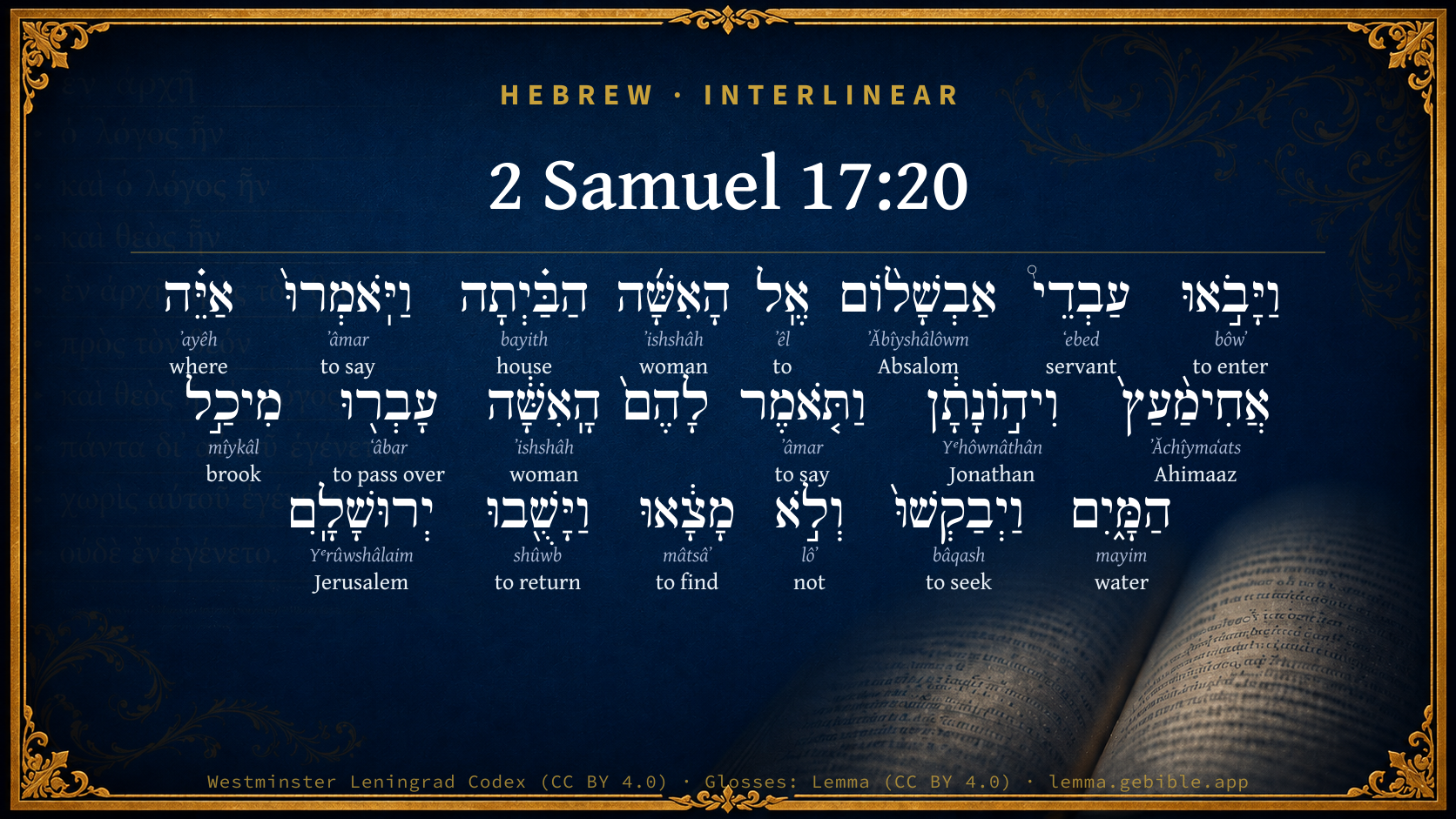
2 Samuel 17:20

Hebrew (Westminster Leningrad Codex) 2 Samuel 17:20 appears in the Hebrew Old Testament. The text above is from the Westminster Leningrad Codex. Each word links to its Strong’s number, a concise gloss, and parsing drawn from the Open Scriptures Hebrew Bible morphology. Click any word for its full Brown-Driver-Briggs (BDB) entry.
Download image
Cite this verse

2 Samuel 17:20 (World English Bible). Public Domain. Lemma interlinear Bible study tool, https://lemma.gebible.app/v/2-samuel/17/20.

Show BibTeX & RIS
BibTeX
RIS
English Translation
Absalom's servants came to the woman to the house; and they said, Where are Ahimaaz and Jonathan? The woman said to them, They have gone over the brook of water. When they had sought and could not find them, they returned to Jerusalem.
World English Bible · Public Domain
Highlights
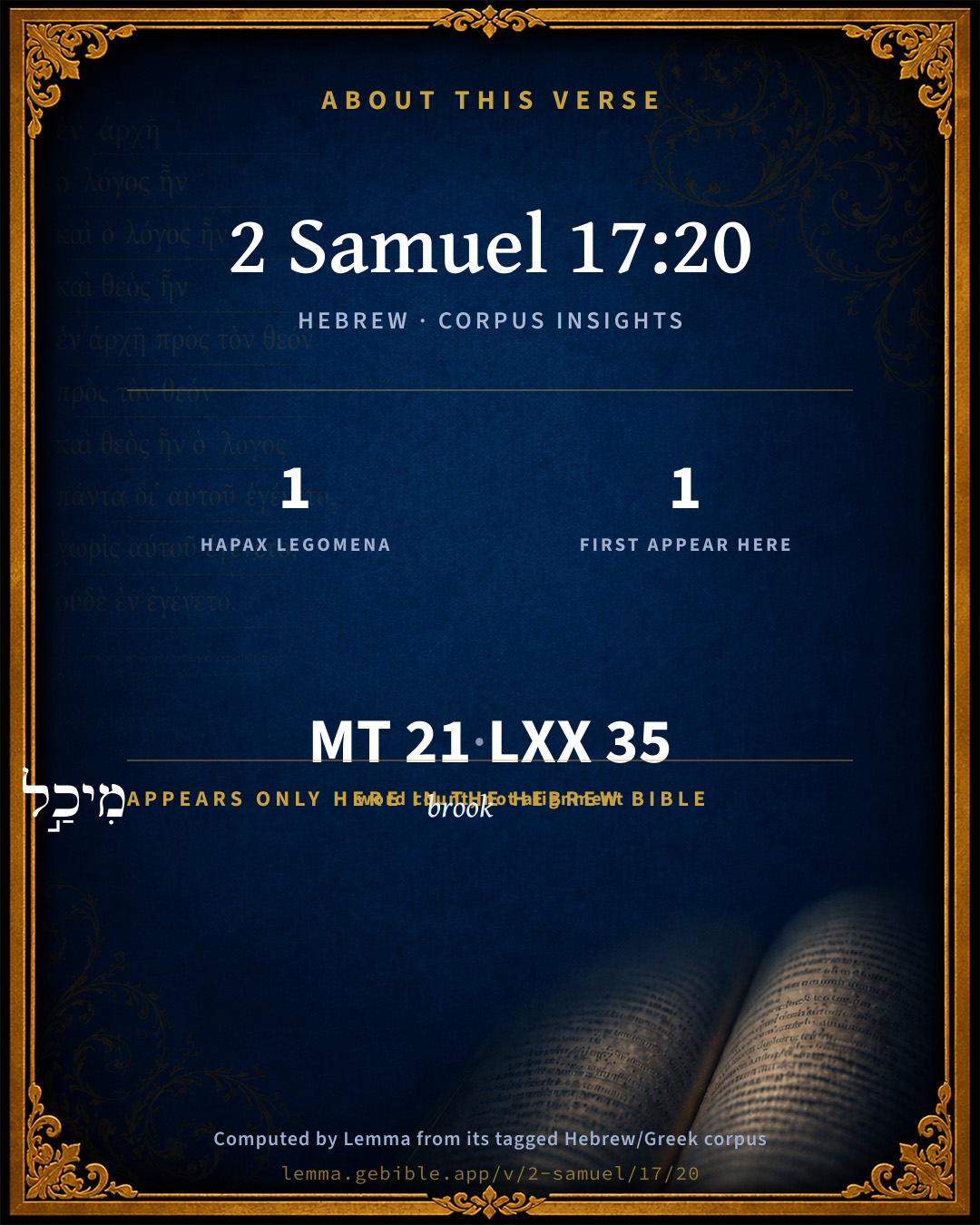
  • 1 hapax legomenon — only here in the Hebrew Bible
  • 1 first appearance in the Hebrew Bible
Full analysis ↓
Download a study sheet

One document with this verse’s original text, its word-by-word gloss line, the meaning frame, cross-references with their text, attributed commentary, and full source and license credits — printable, and it pastes into notes with its structure intact.

This verse Autodidact and up

Study sheet (.html) Plain text (.txt)

A passage Seminary Student

Up to 50 verses in one chapter. A passage sheet keeps up to 6 commentary sources and 12 cross-references per verse, in the order this page ranks them, and says so on the sheet whenever that leaves anything out. Ask for a single verse and you get the Autodidact verse sheet above.

Everything on this page stays free to read, with no account — the sheet is a download of what is already on screen, not access to it.

Want to remove ads? Support Godless Engineer
Compare translations 3

The same verse in 3 English versions, stacked beneath the original-language interlinear above. Click any original word for its lexicon entry.

Each is an independent rendering of the whole verse — the interlinear is not word-aligned to these translations.

Highlighted words mark where these versions differ — a whole-verse word diff, not a word-by-word alignment.

  • World English Bible Public Domain
    Absalom's servants came to the woman to the house; and they said, Where are Ahimaaz and Jonathan? The woman said to them, They have gone over the brook of water. When they had sought and could not find them, they returned to Jerusalem.
  • King James Version Public Domain
    And when Absalom's servants came to the woman to the house, they said, Where is Ahimaaz and Jonathan? And the woman said unto them, They be gone over the brook of water. And when they had sought and could not find them, they returned to Jerusalem.
  • unfoldingWord Literal Text CC BY-SA 4.0
    And the servants of Absalom came to the woman the house, and they said, “Where Ahimaaz and Jonathan?” And the woman said to them, “They crossed over the brook of waters.” And they sought, but they did not find, so they returned Jerusalem.

unfoldingWord Literal Text — © unfoldingWord, licensed CC BY-SA 4.0. Word-aligned USFM3 via Door43 (git.door43.org/unfoldingWord/en_ult).

Versions to compare (up to 4)

3 of 4 selected

Show all 18 translations

Every available English version of this verse, each an independent rendering of the whole verse.

  • World English Bible Public Domain
    Absalom's servants came to the woman to the house; and they said, Where are Ahimaaz and Jonathan? The woman said to them, They have gone over the brook of water. When they had sought and could not find them, they returned to Jerusalem.
  • Berean Standard Bible Public Domain
    When Absalom’s servants came to the woman at the house, they asked, “Where are Ahimaaz and Jonathan?” “They have crossed over the brook,” she replied. The men searched but did not find them, so they returned to Jerusalem.
  • Majority Standard Bible Public Domain
    When Absalom’s servants came to the woman at the house, they asked, “Where are Ahimaaz and Jonathan?” “They have crossed over the brook,” she replied. The men searched but did not find them, so they returned to Jerusalem.
  • King James Version Public Domain
    And when Absalom's servants came to the woman to the house, they said, Where is Ahimaaz and Jonathan? And the woman said unto them, They be gone over the brook of water. And when they had sought and could not find them, they returned to Jerusalem.
  • American Standard Version (1901) Public Domain
    And Absalom's servants came to the woman to the house; and they said, Where are Ahimaaz and Jonathan? And the woman said unto them, They are gone over the brook of water. And when they had sought and could not find them, they returned to Jerusalem.
  • Revised Version (1885) Public Domain
    And Absalom’s servants came to the woman to the house; and they said, Where are Ahimaaz and Jonathan? And the woman said unto them, They be gone over the brook of water. And when they had sought and could not find them, they returned to Jerusalem.
  • Geneva Bible (1599) Public Domain
    And when Absaloms seruants came to the wife into the house, they said, Where is Ahimaaz and Ionathan? And the woman answered them, They be gone ouer the brooke of water. And when they had sought them, and could not finde them, they returned to Ierusalem.
  • Douay-Rheims (1899) Public Domain
    And when Absalom's servants were come into the house, they said to the woman: Where is Achimaas and Jonathan? and the woman answered them: They passed on in haste, after they had tasted a little water. But they that sought them, when they found them not, returned into Jerusalem.
  • Young's Literal Translation Public Domain
    And the servants of Absalom come in unto the woman to the house, and say, `Where `are' Ahimaaz and Jonathan?' and the woman saith to them, `They passed over the brook of water;' and they seek, and have not found, and turn back to Jerusalem.
  • Literal Standard Version CC BY-SA 4.0
    And the servants of Absalom come to the woman at the house, and say, “Where [are] Ahimaaz and Jonathan?” And the woman says to them, “They passed over the brook of water”; and they seek, and have not found, and return to Jerusalem.
  • Unlocked Literal Bible CC BY-SA 4.0
    Absalom's men came to the woman of the house and said, “Where are Ahimaaz and Jonathan?” The woman told them, “They have crossed over the river.” So after they had looked around and could not find them, they returned to Jerusalem.
  • unfoldingWord Literal Text CC BY-SA 4.0
    And the servants of Absalom came to the woman the house, and they said, “Where Ahimaaz and Jonathan?” And the woman said to them, “They crossed over the brook of waters.” And they sought, but they did not find, so they returned Jerusalem.
  • Darby Bible Public Domain
    And Absalom's servants came to the woman to the house, and said, Where are Ahimaaz and Jonathan? And the woman said to them, They have gone over the brook of water. And they sought and could not find [them], and returned to Jerusalem.
  • World Messianic Bible Public Domain
    Absalom’s servants came to the woman to the house; and they said, “Where are Ahimaaz and Jonathan?” The woman said to them, “They have gone over the brook of water.” When they had sought and could not find them, they returned to Jerusalem.
  • Webster's Bible Public Domain
    And when Absalom's servants came to the woman to the house, they said, Where is Ahimaaz and Jonathan? And the woman said to them, they have gone over the brook of water. And when they had sought and could not find them, they returned to Jerusalem.
  • Free Bible Version CC BY-SA 4.0
    When Absalom's officers arrived they asked the woman, “Where are Ahimaaz and Jonathan?” “They crossed over the stream,” she replied. The men searched for them but didn't find them, so they went back to Jerusalem.
  • Bible in Basic English Public Domain
    And Absalom's servants came to the woman at the house and said, Where are Ahimaaz and Jonathan? And the woman said to them, They have gone from here to the stream. And after searching for them, and seeing nothing of them, they went back to Jerusalem.
  • JPS Tanakh (1917) Public Domain
    And Absalom's servants came to the woman to the house; and they said: 'Where are Ahimaaz and Jonathan?' And the woman said unto them: 'They are gone over the brook of water.' And when they had sought and could not find them, they returned to Jerusalem.

Literal Standard Version (2020), Covenant Press — licensed CC BY-SA 4.0. Text via the HelloAO Bible API (eBible.org). Unlocked Literal Bible (unfoldingWord) — licensed CC BY-SA 4.0. Text via the HelloAO Bible API (eBible.org). unfoldingWord Literal Text — © unfoldingWord, licensed CC BY-SA 4.0. Word-aligned USFM3 via Door43 (git.door43.org/unfoldingWord/en_ult). Free Bible Version, Dr. Jonathan Gallagher — licensed CC BY-SA 4.0. Text via the HelloAO Bible API (eBible.org).

Word by word

More ways to search: Search by grammar → Find every occurrence → Compare this word →

Practice this passage: Drill this verse → Learn its vocabulary →

מִיכַ֣ל
mîykâl
H4323
“brook of”
Noun, Common, Masculine, Singular, Construct
Part of Speech
Noun
Type
Common
Gender
Masculine
Number
Singular
State
Construct
Full BDB Definition

Origin: from H3201

TWOT: 1190

brook, stream - meaning dubious
  1. וַיָּבֹ֣אוּ bôwʼ H935 “and · to enter” Conjunction + Verb, Qal, Sequential Imperfect, 3rd Person, Masculine, Plural
  2. עַבְדֵי֩ ʻebed H5650 “servants of” Noun, Common, Masculine, Plural, Construct
  3. אַבְשָׁל֨וֹם ʼĂbîyshâlôwm H53 “Absalom” Noun, Proper
  4. אֶֽל ʼêl H413 “to” Preposition
  5. הָאִשָּׁ֜ה ʼishshâh H802 “the · woman” Particle, Definite Article + Noun, Common, Feminine, Singular, Absolute
  6. הַבַּ֗יְתָה bayith H1004 “the · house · toward” Particle, Definite Article + Noun, Common, Masculine, Singular, Absolute + Suffix, Demonstrative
  7. וַיֹּֽאמְרוּ֙ ʼâmar H559 “and · to say” Conjunction + Verb, Qal, Sequential Imperfect, 3rd Person, Masculine, Plural
  8. אַיֵּ֗ה ʼayêh H346 “where” Particle, Interrogative
  9. אֲחִימַ֨עַץ֙ ʼĂchîymaʻats H290 “Ahimaaz” Noun, Proper
  10. וִיה֣וֹנָתָ֔ן Yᵉhôwnâthân H3083 “and · Jonathan” Conjunction + Noun, Proper
  11. וַתֹּ֤אמֶר ʼâmar H559 “and · to say” Conjunction + Verb, Qal, Sequential Imperfect, 3rd Person, Feminine, Singular
  12. הָֽאִשָּׁ֔ה ʼishshâh H802 “the · woman” Particle, Definite Article + Noun, Common, Feminine, Singular, Absolute
  13. עָבְר֖וּ ʻâbar H5674 “to pass over” Verb, Qal, Perfect, 3rd Person, Common, Plural
  14. הַמָּ֑יִם mayim H4325 “the · water(s)” Particle, Definite Article + Noun, Common, Masculine, Plural, Absolute
  15. וַיְבַקְשׁוּ֙ bâqash H1245 “and · to seek” Conjunction + Verb, Piel, Sequential Imperfect, 3rd Person, Masculine, Plural
  16. וְלֹ֣א lôʼ H3808 “and · not” Conjunction + Particle, Negative
  17. מָצָ֔אוּ mâtsâʼ H4672 “to find” Verb, Qal, Perfect, 3rd Person, Common, Plural
  18. וַיָּשֻׁ֖בוּ shûwb H7725 “and · to return” Conjunction + Verb, Qal, Sequential Imperfect, 3rd Person, Masculine, Plural
  19. יְרוּשָׁלִָֽם Yᵉrûwshâlaim H3389 “Jerusalem” Noun, Proper

About this verse

These counts appear in no published source. They are computed here, from the morphology-tagged text and Lemma’s own curated glosses. What Lemma adds →

21
words
18
distinct lemmas
Historical
section

Notable vocabulary

1 hapax legomenon — a word that appears only here in the entire Hebrew Bible:

  • מִיכַ֣ל brook H4323

First appearance in Scripture

This word makes its first canonical appearance in the Hebrew Bible here:

  • מִיכַ֣ל brook H4323

Shared distinctive vocabulary

אֲחִימַ֨עַץ֙ Ahimaaz H290 occurs in 15 verses of the Hebrew Bible. Also found in:

Grammatical profile

  • 7 verbs
  • 10 nouns
  • 2 prepositions
  • 2 particles

Verb forms

  • וַיָּבֹ֣אוּ Qal · Sequential Imperfect
  • וַיֹּֽאמְרוּ֙ Qal · Sequential Imperfect
  • וַתֹּ֤אמֶר Qal · Sequential Imperfect
  • עָבְר֖וּ Qal · Perfect
  • וַיְבַקְשׁוּ֙ Piel · Sequential Imperfect
  • מָצָ֔אוּ Qal · Perfect
  • וַיָּשֻׁ֖בוּ Qal · Sequential Imperfect

Repetition

Words recur within this verse — often emphatic in Hebrew:

  • הָאִשָּׁ֜ה woman H802 ×2
  • וַיֹּֽאמְרוּ֙ to say H559 ×2

Hebrew & Septuagint length

In English translation the verse runs 43 words from the Hebrew and 45 from the Septuagint (LXX English) — closely comparable.

A rough comparison of the two English renderings, which tokenize alike — not a word-level alignment.

Word counts can differ between the Hebrew and the Greek without any difference in meaning — e.g. the Hebrew direct-object marker אֵת has no separate Greek word, and Greek often adds the article ὁ.

In the original languages it is 21 Hebrew tokens and 35 Greek tokens — but the two are counted differently (Hebrew bundles its prefixes and suffixes into one token; the Greek is in lemma form), so that isn’t a like-for-like length.

Cross-references

7

Topical passages linked to 2 Samuel 17:20 in the Treasury of Scripture Knowledge — connected by theme and wording, ordered by reader-vote popularity; previews shown in the World English Bible.

  • Exodus 1:19 The midwives said to Pharaoh, "Because the Hebrew women aren't like the Egyptian women; for they are vigorous, and give birth before the midwife comes to them."
  • Joshua 2:3–5 The king of Jericho sent to Rahab, saying, Bring forth the men who are come to you, who have entered into your house; for they have come to search out all the land.
  • Joshua 2:22–23 They went, and came to the mountain, and abode there three days, until the pursuers were returned: and the pursuers sought them throughout all the way, but didn't find them.
  • 1 Samuel 19:12–17 So Michal let David down through the window: and he went, and fled, and escaped.
  • 1 Samuel 21:2 David said to Ahimelech the priest, The king has commanded me a business, and has said to me, Let no man know anything of the business about which I send you, and what I have commanded you: and I have appointed the young men to such and such a place.
  • 1 Samuel 27:11–12 David saved neither man nor woman alive, to bring them to Gath, saying, Lest they should tell of us, saying, So did David, and so has been his manner all the while he has lived in the country of the Philistines.
  • 2 Samuel 15:34 but if you return to the city, and tell Absalom, I will be your servant, O king; as I have been your father's servant in time past, so will I now be your servant; then will you defeat for me the counsel of Ahithophel.

Cross-references courtesy of OpenBible.info (CC BY 4.0).

Hebrew and Greek witnesses Masoretic Hebrew ↔ Greek Septuagint

The same verse in the two great witnesses to the Old Testament, shown verse-for-verse.

These are two independent witnesses, not word-aligned to each other, and the Septuagint is shown in lemma (dictionary) form.

Hebrew 2 Samuel 17:20 Masoretic · Westminster Leningrad Codex

וַיָּבֹ֣אוּ עַבְדֵי֩ אַבְשָׁל֨וֹם אֶֽל הָאִשָּׁ֜ה הַבַּ֗יְתָה וַיֹּֽאמְרוּ֙ אַיֵּ֗ה אֲחִימַ֨עַץ֙ וִיה֣וֹנָתָ֔ן וַתֹּ֤אמֶר לָהֶם֙ הָֽאִשָּׁ֔ה עָבְר֖וּ מִיכַ֣ל הַמָּ֑יִם וַיְבַקְשׁוּ֙ וְלֹ֣א מָצָ֔אוּ וַיָּשֻׁ֖בוּ יְרוּשָׁלִָֽם

Absalom's servants came to the woman to the house; and they said, Where are Ahimaaz and Jonathan? The woman said to them, They have gone over the brook of water. When they had sought and could not find them, they returned to Jerusalem.

World English Bible · Public Domain

Greek LXX 2 Samuel 17:20 Septuagint · lemma form

καί ἔρχομαι ὁ παῖς αβεσσαλωμ πρός ὁ γυνή εἰς ὁ οἰκία καί εἶπον ποῦ αχιμαας καί ιωναθαν καί εἶπον αὐτός ὁ γυνή παραἔρχομαι μικρός ὁ ὕδωρ καί ζητέω καί οὐ εὑρίσκω καί ἀναστρέφω εἰς ἰερουσαλήμ

And the servants of Abessalom came to the woman into the house, and said, Where are Achimaas and Jonathan? and the woman said to them, They are gone a little way beyond the water. And they sought and found them not, and returned to Jerusalem.

LXX2012 (modern English Septuagint) · Public Domain

Hebrew: Westminster Leningrad Codex (CC BY 4.0). Greek: Septuagint (public domain); English from LXX2012 (modern English Septuagint) (Public Domain). How the Septuagint differs from the Hebrew →

Targum (Aramaic paraphrase)

1

The Targum is the ancient Jewish Aramaic paraphrase of the Hebrew Scriptures — an interpretive translation, not the Hebrew text itself. Onkelos (literal) and Pseudo-Jonathan (expansive) render the Torah, and Jonathan the Prophets. Coverage is partial: where no permissively-licensed English translation exists for a verse, only the Aramaic is shown. This is verse-level text, not a word-by-word alignment to the Hebrew.

  1. Targum Jonathan Prophets (Joshua–Malachi)
    וַאֲתוֹ עַבְדֵי אַבְשָׁלוֹם לְוַת אִתְּתָא לְבֵיתָא וַאֲמַרוּ אָן אֲחִימַעַץ וִיהוֹנָתָן וַאֲמַרַת לְהוֹן אִתְּתָא כְּבַר עֲבָרוּ יַרְדְנָא וּבְעוֹ וְלָא אַשְׁכָּחוּ וְתָבוּ לִירוּשְׁלֵם:

    (no public-domain English translation for this verse)

    Targum Jonathan — Aramaic: “Mikraot Gedolot” (public domain). English: “Sefaria Community Translation” (CC0 1.0 (public-domain dedication)); “London "Chaldee Paraphrase," 1871” (public domain). Text via Sefaria.

Commentary

Notes on 2 Samuel 17:20 from classic Christian and Jewish commentators (each source and its license shown beneath its notes). The classic Christian expositions comment on the surrounding passage and are grouped to its opening verse, so a note may address several verses; the Jewish commentaries on the Tanakh (Rashi and others) are per-verse, so they appear only where the commentator wrote on this verse.

Lemma curates 59 commentaries, every one of them public domain or Creative Commons licensed, each selected and text-cleaned for this edition rather than reprinted as found. About our sources →

Trapp's Complete Commentary

John Trapp

2Sa 17:20 And when Absalom’s servants came to the woman to the house, they said, Where [is] Ahimaaz and Jonathan? And the woman said unto them, They be gone over the brook of water. And when they had sought and could not find [them], they returned to Jerusalem.

Ver. 20. They be gone over the brook of water.] Her hiding of them was ingenious - as women’s wits, they say, are best at a pinch; but her lie, though but officious, cannot be excused; for God could and would have wrought without it: nevertheless he is graciously pleased to lay the finger of mercy on the scars of such infirmities, where the bent and intent of the heart, for the main, is upright.

John Trapp, A Commentary or Exposition upon All the Books of the Old and New Testament (1647–1656) — public domain. Text from a community e-Sword module.

Joseph Benson's Commentary

2Sa 17:20. When Absalom’s servants — Who were sent to pursue them; came to the woman to the house — For some had informed them that Jonathan and Ahimaaz had turned that way. The woman said, They be gone over the brook — According to Josephus, the woman told them; they made no stay at her house, but, after they had asked for a little water, made haste away: but, if they pursued them speedily, she believed they might overtake them. This, however, was a manifest lie; and, though spoken for no hurt, but good only; and though, as is probable, it was pardoned by God; yet was it certainly moral evil, as all kinds of lies are, and are condemned by plain passages of Scripture, which inform us we must not do evil that good may come, nor tell a lie for God’s glory, Rom 3:7-8.

Joseph Benson's Commentary on the Old and New Testaments (1811–1818) — public domain. Text from a community e-Sword module.

Geneva Bible (1599)

Geneva Bible translators

The Chaldea text readeth: Now they have passed the Jordan.

Geneva Bible (1599) marginal notes — public domain. Text via Bolls.life.

Ellicott's Commentary for English Readers

(20) The brook of water.—This peculiar word for brook occurs only here, and is thought by some writers to be a proper name. A small brook bearing the same name, Michal, is said to exist now in this locality. On the deceit practised by the women, comp. Jos_2:4-7; 1Sa_19:12-17. The historian simply records without comment what was done.

A Bible Commentary for English Readers, edited by Charles John Ellicott (1878–1897) — public domain. Text from a community e-Sword module.

The Cambridge Bible for Schools and Colleges

gen. ed. J. J. S. Perowne

20. The brook of water] The word Michal, translated brook, is found here only. It may have been some local name. The woman sent the pursuers off in the wrong direction, and then at once despatched Jonathan and Ahimaaz. Compare the deceit practised by Rahab (Jos_2:4 ff.), and by Michal (1Sa_19:12-17). As stated in the note on the latter passage, Holy Scripture affirms the universal duty of Truth without any exception (Lev_19:11), nor can it be understood to sanction breaches of this general law by recording them without express disapproval. See also note on ch. 2Sa_15:34. It is left to the casuist to discuss whether any necessity is sufficient to justify a falsehood or an act of deception. See Whewell’s Elements of Morality, Chaps. xv. xvi.

The Cambridge Bible for Schools and Colleges (gen. ed. J. J. S. Perowne; Cambridge University Press, 1878–1918) — public domain. Text from a community e-Sword module.

John Gill's Exposition

And it came to pass after they were departed,.... The servants of Absalom:

that they came up out of the well; the sons of the priests, being informed by the woman that they were gone; Josephus (s) says they were drawn up by the woman with a rope:

and went and told King David; who was now in the plain of the wilderness, perhaps near Jericho, and not a great way from Jordan, to whom they related the whole of their message:

and said unto David; as they were directed:

arise, and pass quickly over the water; the river Jordan:

for thus hath Ahithophel counselled against you; to come with twelve thousand men, and fall upon him that very night; and it was not certain his counsel would be rejected; and therefore it was advisable for David to prepare against the worst.

(s) Antiqu. l. 7. c. 9. sect. 7. Hudson. not. in ib.

John Gill's Exposition of the Whole Bible (1746–1763) — public domain (CC PDM 1.0). Text via the HelloAO Bible API.

Albert Barnes' Notes on the Bible

As soon as ever she had hid the men she went into the house, as if busy about her usual occupations. Had Absalom’s servants, who had had information from some of the people of Bahurim that the men had come to this house, found her in the court it might have directed their attention to the peeled barley.

Over the brook of water - Compare 2Sa 16:9 note. The word for “brook” (“Michal”) occurs only here. One has been found in this very district, still so called. The woman showed great presence of mind and adroitness in not denying that they had been there.

Albert Barnes' Notes on the Bible (1834–1885) — public domain. Text from a community e-Sword/MySword module.

Haydock's Catholic Bible Commentary

Water. Hebrew, "they have crossed the brook of water." (Calmet)

George Leo Haydock (1774–1849), Haydock's Catholic Family Bible and Commentary, 1859 edition — public domain. Excludes Psalms (Douay-Rheims chapter numbering differs from Protestant) and Deuterocanonical books (Catholic canon only).

Matthew Poole's English Annotations

Over the brook of water, i.e. over Jordan. This was a manifest lie; but because it was spoken for no hurt, but good only, many persons in those times conceived such lies to be lawful. Compare Exo 1:19; Jos 2:4,5. But although God was pleased to overlook and pardon the sin, and graciously to reward the good intention which accompanied them; yet it is certain that all kinds of lies are moral evils, and condemned by plain scriptures, and that we must not do evil that good may come, nor tell a lie for God’s glory, Rom 3:7,8.

Matthew Poole's English Annotations on the Holy Bible (1683–1685) — public domain. Text from a community e-Sword/MySword module.

The Pulpit Commentary

They be gone over the brook of water. The word michal, translated "brook," does not occur elsewhere, and probably it was a local name for some stream near Bahurim. It was, we may suppose, in the right direction, but when the pursuers had followed for some time, and caught no glimpse of the runners, knowing their swiftness of foot, they concluded that they had outstripped them. and, giving up the chase as hopeless, returned to Jerusalem. It was only when she had seen them far on their way back that she removed the cover and allowed the young priests to resume their journey. The delay, would have been fatal to David if vigorous counsel had been followed at Jerusalem; as it was, they reached David"s camp without further incident, and acquainted him with Ahithophel"s plan; and the king at once recognized his danger, and without more delay, commenced at once the passage of the Jordan, and carried it out so skilfully and rapidly, that by the morning every one of his company was safe on the other side.

The Pulpit Commentary (1880–1919), ed. H.D.M. Spence-Jones & Joseph S. Exell — public domain. Text from a community e-Sword module.

John Wesley's Explanatory Notes

Over the brook of water - That is, over Jordan. This was a manifest lie.

John Wesley, Explanatory Notes Upon the Whole Bible (1754–1765) — public domain. Text via the GEBible commentary corpus.

Keil & Delitzsch

C. F. Keil & F. Delitzsch

When Absalom's servants came and asked for the priest's sons, the woman said, They have gone over the little water-brook (המּים מיכל, ἁπ. λεγ.), and thus led them wrong, so that they did not find them.

Keil & Delitzsch — Biblical Commentary on the Old Testament (1861–1891) — public domain (CC PDM 1.0). Text via the HelloAO Bible API. (Old Testament only.)

Rashi

Rabbi Shlomo Yitzchaki (Rashi)

Stream of water. I do not know the translation of this word מִיכַל. In the Machberes [under the entry] כַּל [he writes] that its translation is according to the context. [Here] its as [if to say] streaming water of the river.

Rashi on the Tanakh — English translations: “The Judaica Press complete Tanach with Rashi, translated by A. J. Rosenberg” (CC BY 4.0); “Pentateuch with Rashi's commentary by M. Rosenbaum and A.M. Silbermann, 1929-1934” (public domain); “The Metsudah Tanach series, Lakewood, N.J” (CC BY 4.0); and “The Book of Joshua, Metsudah Publications, 1997” (CC BY 4.0). Text via Sefaria.

Lesson kit

Teaching starters — assembled from the data on this page, not authored interpretation. Every prompt links to the verse data it draws on. Edit before teaching.

2 Samuel, in the Historical, opens this verse with 21 words (18 distinct Hebrew lemmas). Its most distinctive word is mîykâl (“brook”). A historical commentator’s framing appears above. Read the whole chapter for the surrounding context.

Discussion questions

  1. The word mîykâl carries the sense “brook.” How does it shape the verse?
  2. 1 word here appears nowhere else in the Hebrew Bible. Why might the author reach for such rare wording?
  3. This is the first place “brook” appears in Scripture (first appears here). What does its debut here establish?
  4. How does 1 Samuel 14:50, which shares the word «Ahimaaz», read alongside this verse?
  5. What does the repetition of “woman” (2× in this one verse) do in this verse?
  6. These translations render this verse differently. What is at stake in choosing one wording over another?
  7. «וַיָּבֹ֣אוּ» is a Qal Sequential Imperfect verb. How does that grammatical form shape the action described?
  8. Compare how Trapp's Complete Commentary and Joseph Benson's Commentary read this verse. Where do they agree or differ?

Things to notice

  • 1 word in this verse appears nowhere else in the Hebrew Bible.
  • 1 word makes its first canonical appearance in Scripture here.
  • This verse counts 21 Hebrew ↔ 35 Greek words.
  • These translations choose different wording for 11 words in this verse.
  • “woman” occurs 2× in this single verse.

Reading settings

Reading text

Shown beneath each verse's original-language words.

Old Testament
Old Testament edition

Read the OT as the Masoretic Hebrew (MT) or the Greek Septuagint (LXX).

English shown for the Greek Septuagint (in the Hebrew ↔ Greek comparison).

Comparing translations? Open the Compare panel on any verse page to stack up to four side by side.