Nehemiah 7:64

Hebrew (Westminster Leningrad Codex) Nehemiah 7:64 appears in the Hebrew Old Testament. The text above is from the Westminster Leningrad Codex. Each word links to its Strong’s number, a concise gloss, and parsing drawn from the Open Scriptures Hebrew Bible morphology. Click any word for its full Brown-Driver-Briggs (BDB) entry.
Download image
Cite this verse

Nehemiah 7:64 (World English Bible). Public Domain. Lemma interlinear Bible study tool, https://lemma.gebible.app/v/nehemiah/7/64.

Show BibTeX & RIS
BibTeX
RIS
English Translation
These sought their register [among] those who were reckoned by genealogy, but it was not found: therefore were they deemed polluted and put from the priesthood.
World English Bible · Public Domain
Download a study sheet

One document with this verse’s original text, its word-by-word gloss line, the meaning frame, cross-references with their text, attributed commentary, and full source and license credits — printable, and it pastes into notes with its structure intact.

This verse Autodidact and up

Study sheet (.html) Plain text (.txt)

A passage Seminary Student

Up to 50 verses in one chapter. A passage sheet keeps up to 6 commentary sources and 12 cross-references per verse, in the order this page ranks them, and says so on the sheet whenever that leaves anything out. Ask for a single verse and you get the Autodidact verse sheet above.

Everything on this page stays free to read, with no account — the sheet is a download of what is already on screen, not access to it.

Want to remove ads? Support Godless Engineer
Compare translations 3

The same verse in 3 English versions, stacked beneath the original-language interlinear above. Click any original word for its lexicon entry.

Each is an independent rendering of the whole verse — the interlinear is not word-aligned to these translations.

Highlighted words mark where these versions differ — a whole-verse word diff, not a word-by-word alignment.

  • World English Bible Public Domain
    These sought their register [among] those who were reckoned by genealogy, but it was not found: therefore were they deemed polluted and put from the priesthood.
  • King James Version Public Domain
    These sought their register among those that were reckoned by genealogy, but it was not found: therefore were they, as polluted, put from the priesthood.
  • unfoldingWord Literal Text CC BY-SA 4.0
    These ones sought their record among the ones who were enrolled by genealogy, but it was not found. And they were desecrated from the priesthood.

unfoldingWord Literal Text — © unfoldingWord, licensed CC BY-SA 4.0. Word-aligned USFM3 via Door43 (git.door43.org/unfoldingWord/en_ult).

Versions to compare (up to 4)

3 of 4 selected

Show all 18 translations

Every available English version of this verse, each an independent rendering of the whole verse.

  • World English Bible Public Domain
    These sought their register [among] those who were reckoned by genealogy, but it was not found: therefore were they deemed polluted and put from the priesthood.
  • Berean Standard Bible Public Domain
    These men searched for their family records, but they could not find them and so were excluded from the priesthood as unclean.
  • Majority Standard Bible Public Domain
    These men searched for their family records, but they could not find them and so were excluded from the priesthood as unclean.
  • King James Version Public Domain
    These sought their register among those that were reckoned by genealogy, but it was not found: therefore were they, as polluted, put from the priesthood.
  • American Standard Version (1901) Public Domain
    These sought their register `among' those that were reckoned by genealogy, but it was not found: therefore were they deemed polluted and put from the priesthood.
  • Revised Version (1885) Public Domain
    These sought their register among those that were reckoned by genealogy, but it was not found: therefore were they deemed polluted and put from the priesthood.
  • Geneva Bible (1599) Public Domain
    These sought their writing of the genealogies, but it was not founde: therefore they were put from the Priesthood.
  • Douay-Rheims (1899) Public Domain
    These sought their writing in the re- cord, and found it not: and they were cast out of the priesthood.
  • Young's Literal Translation Public Domain
    These have sought their register among those reckoning themselves by genealogy, and it hath not been found, and they are redeemed from the priesthood,
  • Literal Standard Version CC BY-SA 4.0
    These have sought their register among those reckoning themselves by genealogy, and it has not been found, and they are redeemed from the priesthood,
  • Unlocked Literal Bible CC BY-SA 4.0
    These sought their records among those enrolled by their genealogy, but they could not be found, so they were excluded from the priesthood as unclean.
  • unfoldingWord Literal Text CC BY-SA 4.0
    These ones sought their record among the ones who were enrolled by genealogy, but it was not found. And they were desecrated from the priesthood.
  • Darby Bible Public Domain
    These sought their genealogical register, but it was not found; therefore were they, as polluted, removed from the priesthood.
  • World Messianic Bible Public Domain
    These searched for their genealogical records, but couldn’t find them. Therefore they were deemed disqualified and removed from the priesthood.
  • Webster's Bible Public Domain
    These sought their register among those that were reckoned by genealogy, but it was not found: therefore were they, as polluted, put from the priesthood.
  • Free Bible Version CC BY-SA 4.0
    They searched for a record of them in the genealogies, but their names weren't found, so they were barred from serving as priests.
  • Bible in Basic English Public Domain
    They made search for their record among the lists of families, but their names were nowhere to be seen, so they were looked on as unclean and no longer priests.
  • JPS Tanakh (1917) Public Domain
    These sought their register, that is, the genealogy, but it was not found; therefore were they deemed polluted and put from the priesthood.

Literal Standard Version (2020), Covenant Press — licensed CC BY-SA 4.0. Text via the HelloAO Bible API (eBible.org). Unlocked Literal Bible (unfoldingWord) — licensed CC BY-SA 4.0. Text via the HelloAO Bible API (eBible.org). unfoldingWord Literal Text — © unfoldingWord, licensed CC BY-SA 4.0. Word-aligned USFM3 via Door43 (git.door43.org/unfoldingWord/en_ult). Free Bible Version, Dr. Jonathan Gallagher — licensed CC BY-SA 4.0. Text via the HelloAO Bible API (eBible.org).

Word by word

More ways to search: Search by grammar → Find every occurrence → Compare this word →

Practice this passage: Drill this verse → Learn its vocabulary →

וַיְגֹֽאֲל֖וּ
gâʼal
H1351
“and · to defile”
Conjunction + Verb, Pual, Sequential Imperfect, 3rd Person, Masculine, Plural
Part of Speech
Conjunction + Verb
Stem
Pual
Form
Sequential Imperfect
Person
3rd Person
Gender
Masculine
Number
Plural
Full BDB Definition

Origin: a primitive root

TWOT: 301

to defile, pollute, desecrate - (Niphal) to be defiled, be polluted - (Piel) to pollute, desecrate - (Pual) to be desecrated (of removal from priesthood) - (Hiphil) to pollute, stain - (Hithpael) to defile oneself
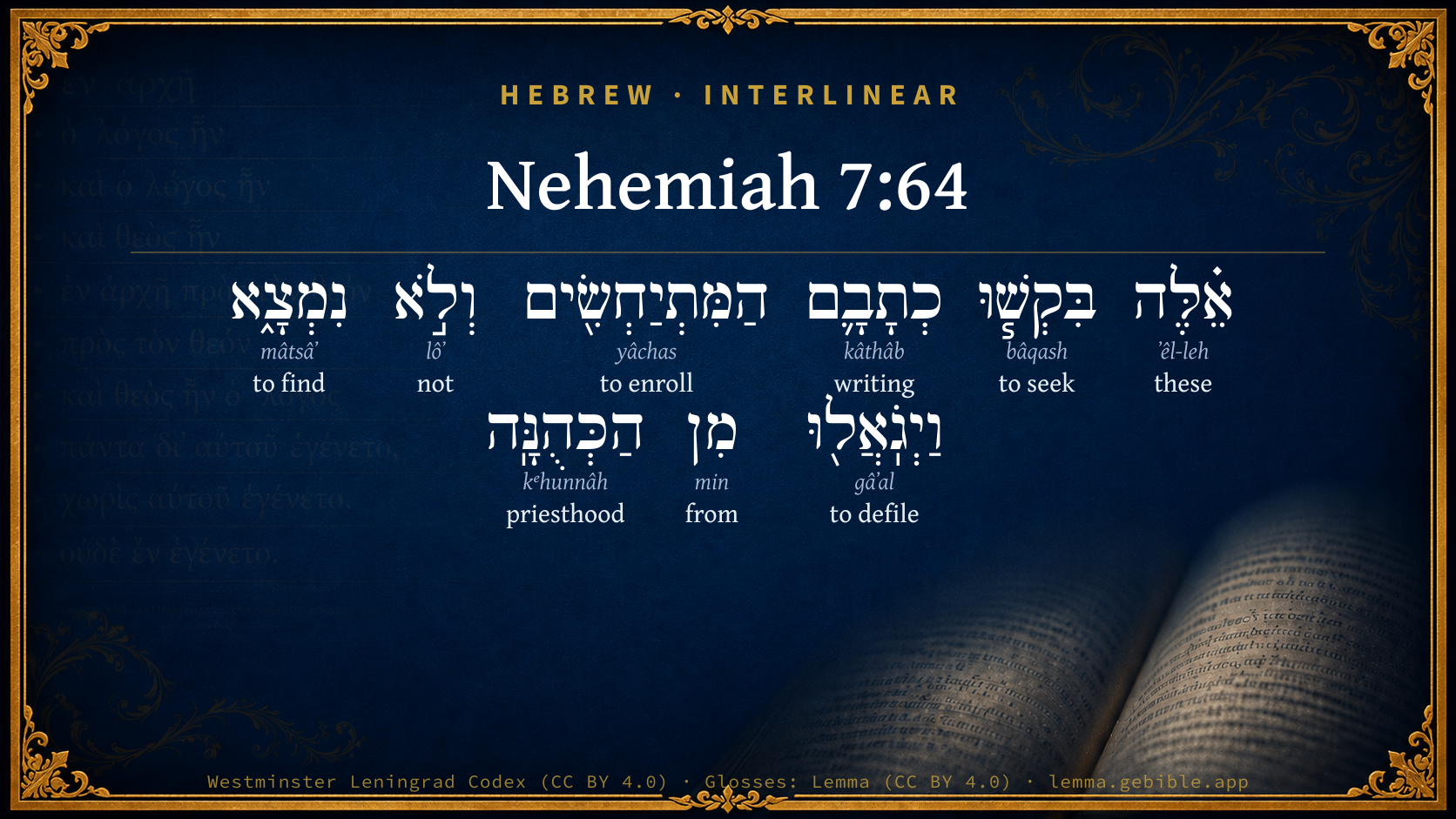
  1. אֵ֗לֶּה ʼêl-leh H428 “these” Pronoun, Demonstrative, Common, Plural
  2. בִּקְשׁ֧וּ bâqash H1245 “to seek” Verb, Piel, Perfect, 3rd Person, Common, Plural
  3. כְתָבָ֛ם kâthâb H3791 “writing · their” Noun, Common, Masculine, Singular, Construct + Suffix, Personal, 3rd Person, Masculine, Plural
  4. הַמִּתְיַחְשִׂ֖ים yâchas H3187 “the · enrolling” Particle, Definite Article + Verb, Hithpael, Participle Active, Masculine, Plural, Absolute
  5. וְלֹ֣א lôʼ H3808 “and · not” Conjunction + Particle, Negative
  6. נִמְצָ֑א mâtsâʼ H4672 “to find” Verb, Niphal, Perfect, 3rd Person, Masculine, Singular
  7. מִן min H4480 “from” Preposition
  8. הַכְּהֻנָּֽה kᵉhunnâh H3550 “the · priesthood” Particle, Definite Article + Noun, Common, Feminine, Singular, Absolute

About this verse

These counts appear in no published source. They are computed here, from the morphology-tagged text and Lemma’s own curated glosses. What Lemma adds →

9
words
9
distinct lemmas
Historical
section

Notable vocabulary

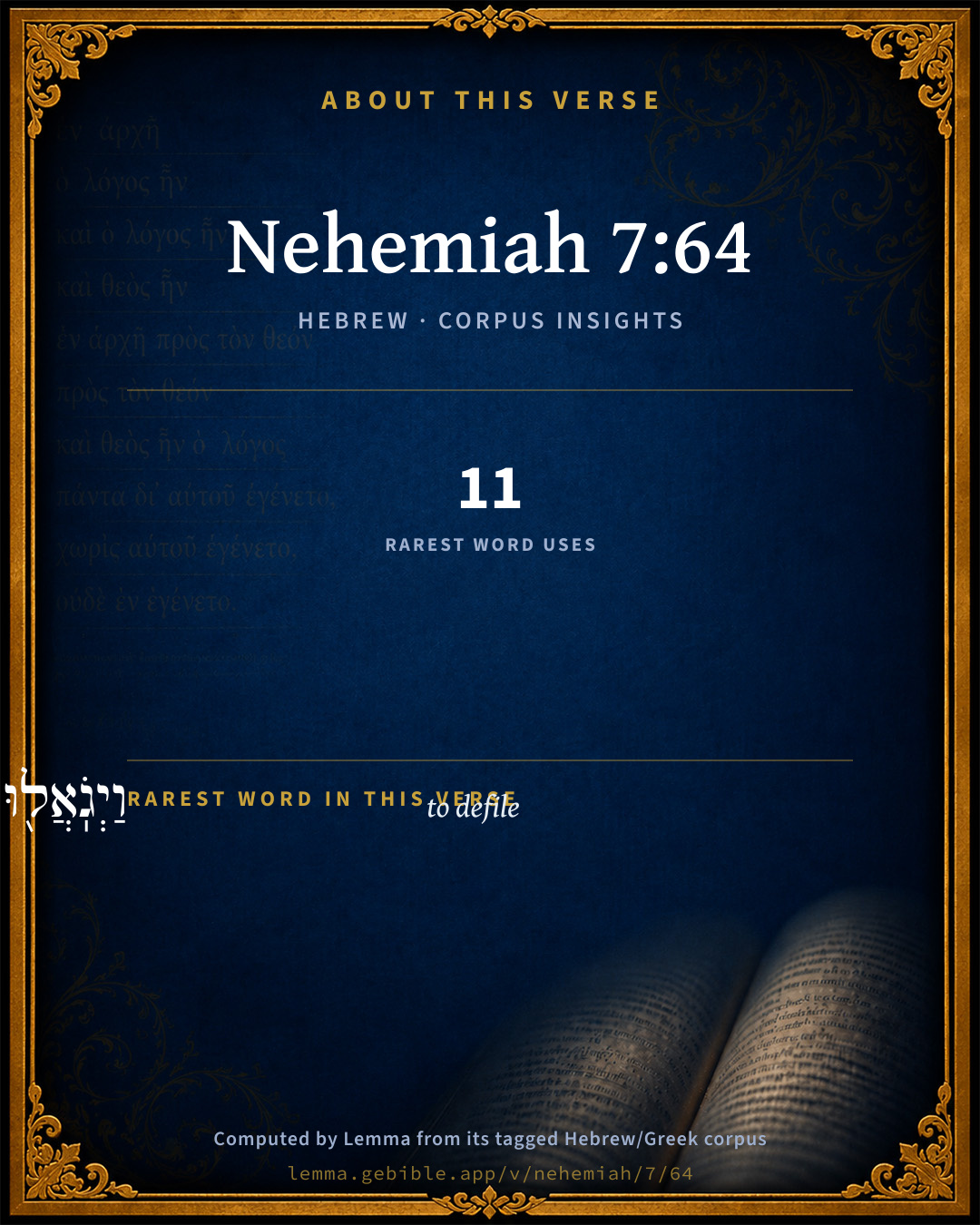
The rarest word here is וַיְגֹֽאֲל֖וּ to defile H1351 — appearing just 11 times in the whole Hebrew Bible.

Shared distinctive vocabulary

וַיְגֹֽאֲל֖וּ to defile H1351 occurs in 9 verses of the Hebrew Bible. Also found in:

Grammatical profile

  • 4 verbs
  • 2 nouns
  • 1 pronoun
  • 1 preposition
  • 1 particle

Verb forms

  • בִּקְשׁ֧וּ Piel · Perfect
  • הַמִּתְיַחְשִׂ֖ים Hithpael · Participle Active
  • נִמְצָ֑א Niphal · Perfect
  • וַיְגֹֽאֲל֖וּ Pual · Sequential Imperfect

Cross-references

4

Topical passages linked to Nehemiah 7:64 in the Treasury of Scripture Knowledge — connected by theme and wording, ordered by reader-vote popularity; previews shown in the World English Bible.

  • 1 Chronicles 9:1 So all Israel were reckoned by genealogies; and, behold, they are written in the book of the kings of Israel: and Judah was carried away captive to Babylon for their disobedience.
  • Nehemiah 7:5 My God put into my heart to gather together the nobles, and the rulers, and the people, that they might be reckoned by genealogy. I found the book of the genealogy of those who came up at the first, and I found written therein:
  • Nehemiah 13:29 Remember them, my God, because they have defiled the priesthood, and the covenant of the priesthood, and of the Levites.
  • Matthew 22:11–13 But when the king came in to see the guests, he saw there a man who didn't have on wedding clothing,

Cross-references courtesy of OpenBible.info (CC BY 4.0).

Hebrew and Greek witnesses Masoretic Hebrew ↔ Greek Septuagint

The same verse in the two great witnesses to the Old Testament, shown verse-for-verse.

These are two independent witnesses, not word-aligned to each other, and the Septuagint is shown in lemma (dictionary) form.

Hebrew Nehemiah 7:64 Masoretic · Westminster Leningrad Codex

אֵ֗לֶּה בִּקְשׁ֧וּ כְתָבָ֛ם הַמִּתְיַחְשִׂ֖ים וְלֹ֣א נִמְצָ֑א וַיְגֹֽאֲל֖וּ מִן הַכְּהֻנָּֽה

These sought their register [among] those who were reckoned by genealogy, but it was not found: therefore were they deemed polluted and put from the priesthood.

World English Bible · Public Domain

Greek LXX Structure differs

The Septuagint has no separate book of Nehemiah. Its Greek text is the second half of Esdras B (2 Esdras), chapters 11–23; Ezra is the first half (1–10).

A verse-for-verse comparison isn’t shown here because the chapters and verses don’t line up. Switch to the LXX edition with the MT / LXX toggle above to read the Greek directly.

Hebrew: Westminster Leningrad Codex (CC BY 4.0). Greek: Septuagint (public domain); English from a public-domain English Septuagint. How the Septuagint differs from the Hebrew →

Commentary

Notes on Nehemiah 7:64 from classic Christian and Jewish commentators (each source and its license shown beneath its notes). The classic Christian expositions comment on the surrounding passage and are grouped to its opening verse, so a note may address several verses; the Jewish commentaries on the Tanakh (Rashi and others) are per-verse, so they appear only where the commentator wrote on this verse.

Lemma curates 59 commentaries, every one of them public domain or Creative Commons licensed, each selected and text-cleaned for this edition rather than reprinted as found. About our sources →

The Cambridge Bible for Schools and Colleges

gen. ed. J. J. S. Perowne

64. were they, as polluted, put from the priesthood] R.V. were they deemed polluted and put, &c. Marg. Heb. they were polluted from, &c.

The Cambridge Bible for Schools and Colleges (gen. ed. J. J. S. Perowne; Cambridge University Press, 1878–1918) — public domain. Text from a community e-Sword module.

unfoldingWord translationNotes

Door43 World Missions Community

These sought their records among those enrolled by their genealogy

"They sought their written genealogical records" or "They searched their written genealogical records"

These sought

"These" refers to the descendants of Hobaiah, Hakkoz and Barzillai. (See: Nehemiah 7:63)

but they could not be found

This can be expressed in active form. AT: "but they could not find their records" (See: Active or Passive)

they were excluded from the priesthood as unclean

This can be translated in active form. The abstract noun "priesthood" can be translated as the verb "work as priests." AT: "the governor treated them as if they were unclean and did not allow them to work as priests" (See: Active or Passive and Abstract Nouns)

until there rose up a priest with Urim and Thummim

This can be stated in active form. AT: "until a priest with Urim and Thummim approved" (See: Active or Passive)

Urim and Thummim

These were sacred stones that the high priest carried on his breastplate and used at times to determine God's will. (See: Translate Unknowns)

translationWords

priest

clean

govern

sacrifice

raise

unfoldingWord translationNotes — © Distant Shores Media and the Door43 World Missions Community, licensed CC BY-SA 4.0. Source: git.door43.org/Door43/en_tn.

Lesson kit

Teaching starters — assembled from the data on this page, not authored interpretation. Every prompt links to the verse data it draws on. Edit before teaching.

Nehemiah, in the Historical, opens this verse with 9 words (9 distinct Hebrew lemmas). Its most distinctive word is gâʼal (“to defile”). A historical commentator’s framing appears above. Read the whole chapter for the surrounding context.

Discussion questions

  1. What does “to defile” (gâʼal) contribute to the verse as a whole?
  2. Ezra 2:62 shares the word «to defile» with this verse. How do the two illuminate each other?
  3. The translations on this page render this verse differently — a whole-verse word diff, not a word-by-word alignment. What might account for the different wordings?
  4. The verb «בִּקְשׁ֧וּ» is Piel Perfect. How does its form color the action?
  5. Reading how The Cambridge Bible for Schools and Colleges and unfoldingWord translationNotes read this verse, where do the two commentators agree and where do they part?

Things to notice

Reading settings

Reading text

Shown beneath each verse's original-language words.

Old Testament
Old Testament edition

Read the OT as the Masoretic Hebrew (MT) or the Greek Septuagint (LXX).

English shown for the Greek Septuagint (in the Hebrew ↔ Greek comparison).

Comparing translations? Open the Compare panel on any verse page to stack up to four side by side.