
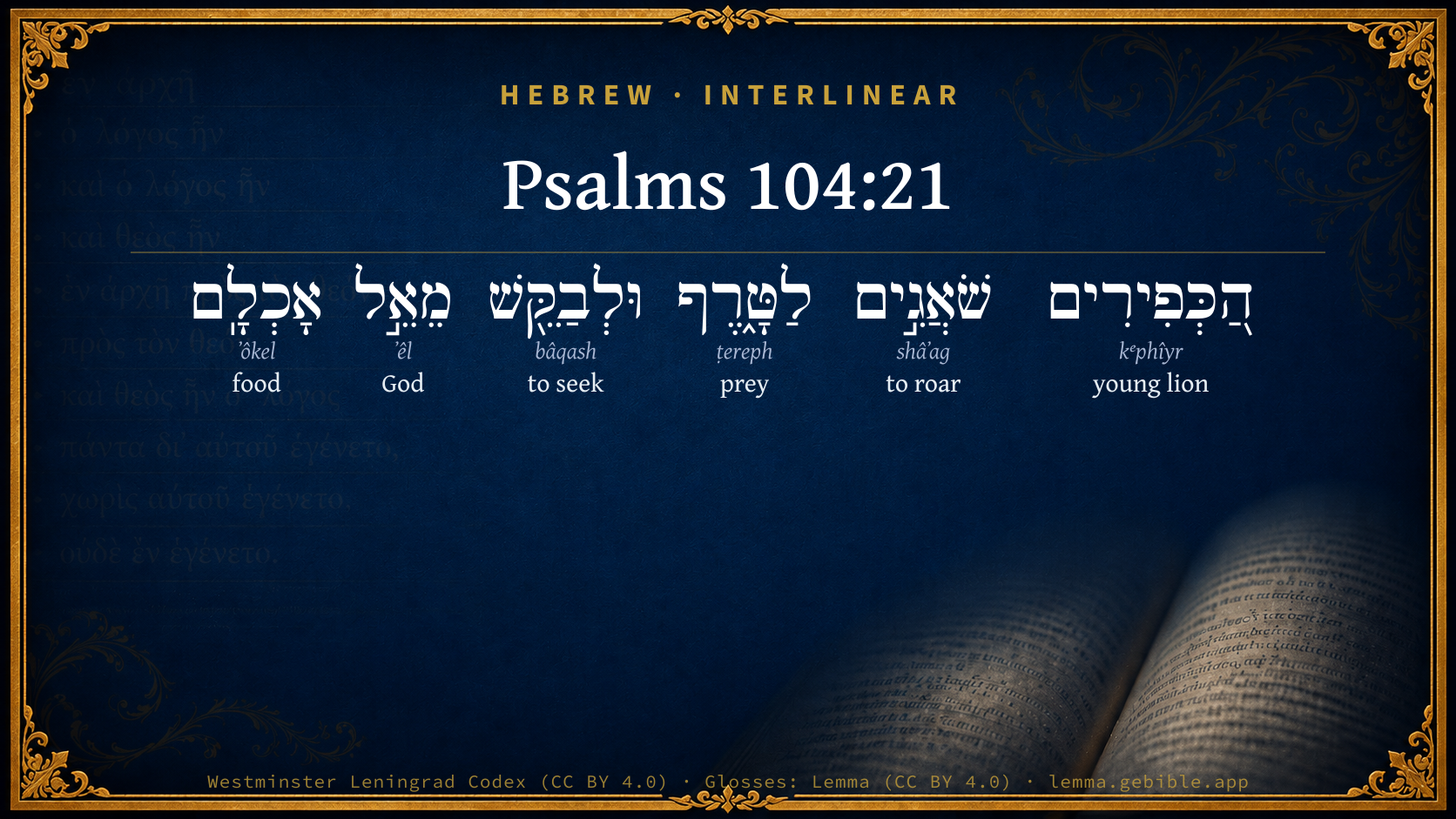
Psalms 104:21

Hebrew (Westminster Leningrad Codex) Psalms 104:21 appears in the Hebrew Old Testament. The text above is from the Westminster Leningrad Codex. Each word links to its Strong’s number, a concise gloss, and parsing drawn from the Open Scriptures Hebrew Bible morphology. Click any word for its full Brown-Driver-Briggs (BDB) entry.
Download image
Cite this verse

Psalms 104:21 (World English Bible). Public Domain. Lemma interlinear Bible study tool, https://lemma.gebible.app/v/psalms/104/21.

Show BibTeX & RIS
BibTeX
RIS
English Translation
The young lions roar after their prey, And seek their food from God.
World English Bible · Public Domain
Download a study sheet

One document with this verse’s original text, its word-by-word gloss line, the meaning frame, cross-references with their text, attributed commentary, and full source and license credits — printable, and it pastes into notes with its structure intact.

This verse Autodidact and up

Study sheet (.html) Plain text (.txt)

A passage Seminary Student

Up to 50 verses in one chapter. A passage sheet keeps up to 6 commentary sources and 12 cross-references per verse, in the order this page ranks them, and says so on the sheet whenever that leaves anything out. Ask for a single verse and you get the Autodidact verse sheet above.

Everything on this page stays free to read, with no account — the sheet is a download of what is already on screen, not access to it.

Want to remove ads? Support Godless Engineer
Compare translations 3

The same verse in 3 English versions, stacked beneath the original-language interlinear above. Click any original word for its lexicon entry.

Each is an independent rendering of the whole verse — the interlinear is not word-aligned to these translations.

Highlighted words mark where these versions differ — a whole-verse word diff, not a word-by-word alignment.

  • World English Bible Public Domain
    The young lions roar after their prey, And seek their food from God.
  • King James Version Public Domain
    The young lions roar after their prey, and seek their meat from God.
  • unfoldingWord Literal Text CC BY-SA 4.0
    the young lions roaring for prey and seeking their food from God.

unfoldingWord Literal Text — © unfoldingWord, licensed CC BY-SA 4.0. Word-aligned USFM3 via Door43 (git.door43.org/unfoldingWord/en_ult).

Versions to compare (up to 4)

3 of 4 selected

Show all 18 translations

Every available English version of this verse, each an independent rendering of the whole verse.

  • World English Bible Public Domain
    The young lions roar after their prey, And seek their food from God.
  • Berean Standard Bible Public Domain
    The young lions roar for their prey and seek their food from God.
  • Majority Standard Bible Public Domain
    The young lions roar for their prey and seek their food from God.
  • King James Version Public Domain
    The young lions roar after their prey, and seek their meat from God.
  • American Standard Version (1901) Public Domain
    The young lions roar after their prey, And seek their food from God.
  • Revised Version (1885) Public Domain
    The young lions roar after their prey, and seek their meat from God.
  • Geneva Bible (1599) Public Domain
    The lions roare after their praye, and seeke their meate at God.
  • Douay-Rheims (1899) Public Domain
    The young lions roaring after their prey, and seeking their meat from God.
  • Young's Literal Translation Public Domain
    The young lions are roaring for prey, And to seek from God their food.
  • Literal Standard Version CC BY-SA 4.0
    The young lions are roaring for prey, || And to seek their food from God.
  • Unlocked Literal Bible CC BY-SA 4.0
    The young lions roar for their prey and seek their food from God.
  • unfoldingWord Literal Text CC BY-SA 4.0
    the young lions roaring for prey and seeking their food from God.
  • Darby Bible Public Domain
    The young lions roar after the prey, and to seek their food from ùGod.
  • World Messianic Bible Public Domain
    The young lions roar after their prey, and seek their food from God.
  • Webster's Bible Public Domain
    The young lions roar after their prey, and seek their food from God.
  • Free Bible Version CC BY-SA 4.0
    The young lions roar as they seek their prey, looking for the food that God provides for them.
  • Bible in Basic English Public Domain
    The young lions go thundering after their food; searching for their meat from God.
  • JPS Tanakh (1917) Public Domain
    The young lions roar after their prey, and seek their food from God.

Literal Standard Version (2020), Covenant Press — licensed CC BY-SA 4.0. Text via the HelloAO Bible API (eBible.org). Unlocked Literal Bible (unfoldingWord) — licensed CC BY-SA 4.0. Text via the HelloAO Bible API (eBible.org). unfoldingWord Literal Text — © unfoldingWord, licensed CC BY-SA 4.0. Word-aligned USFM3 via Door43 (git.door43.org/unfoldingWord/en_ult). Free Bible Version, Dr. Jonathan Gallagher — licensed CC BY-SA 4.0. Text via the HelloAO Bible API (eBible.org).

Word by word

More ways to search: Search by grammar → Find every occurrence → Compare this word →

Practice this passage: Drill this verse → Learn its vocabulary →

About this verse

These counts appear in no published source. They are computed here, from the morphology-tagged text and Lemma’s own curated glosses. What Lemma adds →

6
words
6
distinct lemmas
Wisdom
section

Notable vocabulary

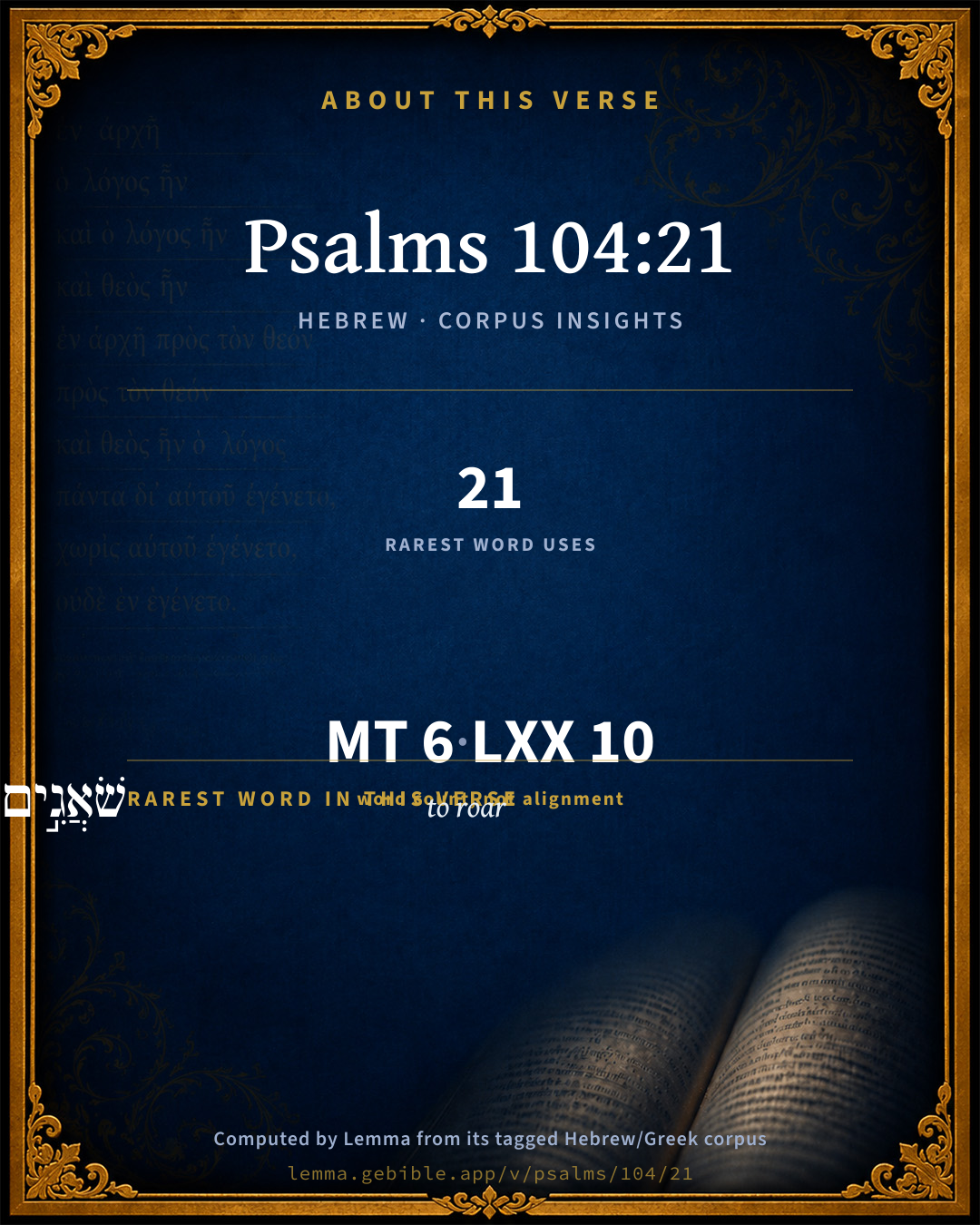
The rarest word here is שֹׁאֲגִ֣ים to roar H7580 — appearing just 21 times in the whole Hebrew Bible.

Shared distinctive vocabulary

שֹׁאֲגִ֣ים to roar H7580 occurs in 17 verses of the Hebrew Bible. Also found in:

Grammatical profile

  • 2 verbs
  • 4 nouns

Verb forms

  • שֹׁאֲגִ֣ים Qal · Participle Active
  • וּלְבַקֵּ֖שׁ Piel · Infinitive Construct

Hebrew & Septuagint length

In English translation the verse runs 13 words from the Hebrew and 14 from the Septuagint (LXX English) — closely comparable.

A rough comparison of the two English renderings, which tokenize alike — not a word-level alignment.

Word counts can differ between the Hebrew and the Greek without any difference in meaning — e.g. the Hebrew direct-object marker אֵת has no separate Greek word, and Greek often adds the article ὁ.

In the original languages it is 6 Hebrew tokens and 10 Greek tokens — but the two are counted differently (Hebrew bundles its prefixes and suffixes into one token; the Greek is in lemma form), so that isn’t a like-for-like length.

Cross-references

11

Topical passages linked to Psalms 104:21 in the Treasury of Scripture Knowledge — connected by theme and wording, ordered by reader-vote popularity; previews shown in the World English Bible.

  • Job 38:39 "Can you hunt the prey for the lioness, Or satisfy the appetite of the young lions,
  • Joel 1:20 Yes, the animals of the field pant to you, For the water brooks have dried up, And the fire has devoured the pastures of the wilderness.
  • Psalms 34:10 The young lions do lack, and suffer hunger, But those who seek Yahweh shall not lack any good thing.
  • Ezekiel 19:2–14 and say, What was your mother? A lioness: she couched among lions, in the midst of the young lions she nourished her cubs.
  • Joel 2:22 Don't be afraid, you animals of the field; For the pastures of the wilderness spring up, For the tree bears its fruit. The fig tree and the vine yield their strength.
  • Job 38:41 Who provides for the raven his prey, When his young ones cry to God, And wander for lack of food?
  • Psalms 145:15 The eyes of all wait for you. You give them their food in due season.
  • Psalms 147:9 He provides food for the cattle, And for the young ravens when they call.
  • Isaiah 31:4 For thus says Yahweh to me, As the lion and the young lion growling over his prey, if a multitude of shepherds are called forth against him, will not be dismayed at their voice, nor abase himself for the noise of them: so will Yahweh of Hosts come down to fight on Mount Zion, and on the hill of it.
  • Joel 1:18 How the animals groan! The herds of cattle are perplexed, because they have no pasture. Yes, the flocks of sheep are made desolate.
  • Amos 3:4 Will a lion roar in the thicket, When he has no prey? Does a young lion cry out of his den, If he has caught nothing?

Cross-references courtesy of OpenBible.info (CC BY 4.0).

Hebrew and Greek witnesses Masoretic Hebrew ↔ Greek Septuagint

The same verse in the two great witnesses to the Old Testament, shown verse-for-verse.

You’re reading Greek Psalm 103 (Hebrew Psalm 104). The Septuagint counts the superscription, so verse numbers can differ from the Hebrew — chapter-level alignment, not verse-by-verse. Numbering follows Rahlfs.

These are two independent witnesses, not word-aligned to each other, and the Septuagint is shown in lemma (dictionary) form.

Hebrew Psalms 104:21 Masoretic · Westminster Leningrad Codex

הַ֭כְּפִירִים שֹׁאֲגִ֣ים לַטָּ֑רֶף וּלְבַקֵּ֖שׁ מֵאֵ֣ל אָכְלָֽם

The young lions roar after their prey, And seek their food from God.

World English Bible · Public Domain

Greek LXX Greek Psalm 103:21 Septuagint · lemma form

σκύμνος ὠρύομαι ἁρπάζω καί ζητέω παρά ὁ θεός βρῶσις αὐτός

even young lions roaring for prey, and to seek meat for themselves from God.

LXX2012 (modern English Septuagint) · Public Domain

Hebrew: Westminster Leningrad Codex (CC BY 4.0). Greek: Septuagint (public domain); English from LXX2012 (modern English Septuagint) (Public Domain). How the Septuagint differs from the Hebrew →

Commentary

Notes on Psalms 104:21 from classic Christian and Jewish commentators (each source and its license shown beneath its notes). The classic Christian expositions comment on the surrounding passage and are grouped to its opening verse, so a note may address several verses; the Jewish commentaries on the Tanakh (Rashi and others) are per-verse, so they appear only where the commentator wrote on this verse.

Lemma curates 59 commentaries, every one of them public domain or Creative Commons licensed, each selected and text-cleaned for this edition rather than reprinted as found. About our sources →

Trapp's Complete Commentary

John Trapp

Psa 104:21 The young lions roar after their prey, and seek their meat from God.

Ver. 21. The young lions roar] Rousing themselves out of their dens by night, and then usually seizing upon what prey God sendeth them in; for they are at his, and not at their own, finding.

And seek] Like as the young ravens cry to him, Psa 147:9. by implication only. See Joe 1:18; Joe 1:20.

John Trapp, A Commentary or Exposition upon All the Books of the Old and New Testament (1647–1656) — public domain. Text from a community e-Sword module.

Joseph Benson's Commentary

Psa 104:21. The young lions — Which can no more subsist, without Divine Providence, than those that are old and infirm; roar after their prey — They roar, as naturalists observe, when they come within sight of their prey, by which interpretation this place is reconciled with Amo 3:4, Will a lion roar in the forest when he hath no prey? that is, when he hath no prey in view. And seek their meat from God — This is a figurative and poetical expression; their roaring is a kind of natural prayer to God for relief, as the cries of infants are a kind of prayer to their mothers for the breast. It is observed by Dr. Hammond here, that lions are not provided with great swiftness of foot to pursue those beasts on which they prey, and that it was necessary, therefore, that this defect should be provided for some other way: and, accordingly, it has been affirmed, that their very roaring is useful to them for this purpose; and that when they cannot overtake their prey, they do, by that terrible noise, so astonish and terrify the poor beasts, that they fall down, and become an easy prey to them.

Joseph Benson's Commentary on the Old and New Testaments (1811–1818) — public domain. Text from a community e-Sword module.

J. A. Alexander on Psalms

Joseph Addison Alexander

21. (Psa 104:21) The young lions roaring for the prey, and to seek from God their food. By translating the participle and infinitive both as presents, the common version makes this a distinct proposition. But in Hebrew it forms part of the preceding sentence, and contains a specification of the general state-ment there made. When night comes on, all the beasts of the forest are aroused, and among the rest the lion, roaring for his prey, (is roused) to seek his food from God. This last expression implies no such purpose on the lion's part, but merely that he seeks what can only be bestowed by an almighty being, which idea is suggested by the name of God here used.

Joseph Addison Alexander, The Psalms Translated and Explained (1850) — public domain. Text from a community e-Sword module.

Geneva Bible (1599)

Geneva Bible translators

That is, they only find meat according to God’s providence, who careth even for the brute beasts.

Geneva Bible (1599) marginal notes — public domain. Text via Bolls.life.

Adam Clarke's Commentary

Verse 21. The young lions roar after their prey] It is said of the lion, that his roaring is so terrible as to astonish and quite unnerve the beast which he pursues; so that, though fleeter than himself, it falls down and becomes an easy prey.

Adam Clarke's Commentary on the Bible (1810–1826) — public domain. Text from a community e-Sword/MySword module.

John Calvin's Commentaries

21. The lions roar after their prey Although lions, if hunger compels them, go forth from their dens and roar even at noon-day, yet the prophet describes what is most usually the case. He therefore says, that lions do not venture to go abroad during the daytime, but that, trusting to the darkness of the night, they then sally forth in quest of their prey. Herein is manifested the wonderful providence of God, that a beast so dreadful confines itself within its den, that men may walk abroad with the greater freedom. And if lions sometimes range with greater liberty, this is to be imputed to the fall of Adam, which has deprived men of their dominion over the wild beasts. There are, however, still some remains of the original blessing conferred by God on men, inasmuch as he holds in check so many wild beasts by the light of day, as if by iron cages or chains. The expression, They seek their food from God, is not to be understood of their casting themselves upon the care of God, as if they acknowledged him to be their foster-father, but it points out the fact itself, that God in a wonderful manner provides food for such ravenous beasts.

John Calvin's Commentaries (1540-1563) — public domain. Text from the Calvin Translation Society English edition (1840s-50s) via the Christian Classics Ethereal Library (ccel.org). Calvin's coverage is partial (roughly two-thirds of the Bible); uncommented books and verses are honest gaps, never fabricated. The 19th-century editor's footnotes and remarks are omitted so the notes are faithfully Calvin's own voice.

The Cambridge Bible for Schools and Colleges

gen. ed. J. J. S. Perowne

21. The dreaded beasts of prey are part of God’s creation, depending on His bounty. Cp. Psa_147:9.

The Cambridge Bible for Schools and Colleges (gen. ed. J. J. S. Perowne; Cambridge University Press, 1878–1918) — public domain. Text from a community e-Sword module.

John Gill's Exposition

The young lions roar after their prey,.... Or, "at the prey" (f); for, according to the Scriptures, it seems as if their time of roaring was when they have got their prey, and are tearing it and feeding on it, and not till then, Amo 3:4 though naturalists tell us, that, when they are pinched with hunger, they make such a hideous roaring, as quite stupefies, as well as terrifies, other creatures; that they have no power to stir, till they come up to them, and become their prey, who otherwise could outrun them; for the lion is neither a swift creature, nor of good scent: wherefore, according to credible accounts, a creature called a "jackal", little bigger than a fox, hunts its prey for it, and secures it till it comes up to it. Young lions are rather mentioned, because their appetite is keenest, and their voice loudest and strongest. This creature is an emblem of Satan, who goes about like a roaring lion, seeking whom he may devour, Pe1 5:8.

And seek their meat from God; as all creatures in their way do; as the ravens by crying, so the young lions by roaring; neither one nor other can provide for themselves, but God, in his providence, supplies them all with food; see Psa 104:27. And should not we seek and ask our meat of God too, even both temporal and spiritual? And may we not expect it from him? Does he feed the ravens, and also the young lions, and will he not take care of his own people, and feed them with food convenient for them, and especially when they ask it of him? Psa 34:10.

(f) "ad praedam", Pagninus, Montanus, Tigurine version, Junius & Tremellius, Piscator, &c.

John Gill's Exposition of the Whole Bible (1746–1763) — public domain (CC PDM 1.0). Text via the HelloAO Bible API.

Albert Barnes' Notes on the Bible

The young lions roar after their prey - This is a continuation of the description in the previous verse. At night the beasts which had been hidden in the daytime crawl forth and seek their food. The lion is particularly specified as one of the beasts that in a general survey would attract attention. The psalmist hears his “roar” as he goes forth in the forest in pursuit of his prey.

And seek their meat from God - Their food. That is, God bestows it on them, and they act as if they sought it at his hand. They seek it where he has placed it; they are dependent on him for it. It is a beautiful idea that even the brute creation act as if they called on God, and sought the supply of their needs at his hands.

Albert Barnes' Notes on the Bible (1834–1885) — public domain. Text from a community e-Sword/MySword module.

Matthew Poole's English Annotations

The young lions; which can no more subsist without Divine Providence than those which are most old and decrepit.

Roar after their prey; they roar when they come within sight and reach of their prey, as naturalists observe; whereby this place may be reconciled with Amo 3:4.

Seek their meat from God: this is a figurative and poetical expression: their roaring is a kind of natural prayer to God for relief, as the cries of infants are a kind of prayers to their mothers for the breast. And this is justly noted as an act of God’s special providence, because the lions are very ravenous, and need much prey, and also are dull in their scent, and so difficultly find it, and slow in their motion, and unable to reach it; and therefore God hath provided another creature, of quicker sense and motion, which is usually confederate with them, and procures prey for them, partaking of it with or after them.

Matthew Poole's English Annotations on the Holy Bible (1683–1685) — public domain. Text from a community e-Sword/MySword module.

The Treasury of David

Charles H. Spurgeon

Ver. 21. The young lions roar after their prey, and seek their meat from God. This is the poetic interpretation of a roar. To whom do the lions roar? Certainly not to their prey, for the terrible sound tends to alarm their victims, and drive them away. They after their own fashion express their desires for food, and the expression of desire is a kind of prayer. Out of this fact comes the devout thought of the wild beast's appealing to its Maker for food. But neither with lions nor men will the seeking of prayer suffice, there must be practical seeking too, and the lions are well aware of it. What they have in their own language asked for they go forth to seek; being in this thing far wiser than many men who offer formal prayers not half so earnest as those of the young lions, and then neglect the means in the use of which the object of their petitions might be gained. The lions roar and seek; too many are liars before God, and roar but never seek.

How comforting is the thought that the Spirit translates the voice of a lion, and finds it to be a seeking of meat from God! May we not hope that our poor broken cries and groans, which in our sorrow we have called "the voice of our roaring" Ps 12:10, will be understood by him, and interpreted in our favour. Evidently he considers the meaning rather than the music of the utterance and puts the best construction upon it.

Ver. 21. The young lions...seek their meat from God. God feeds not only sheep and lambs, but wolves and lions. It is a strange expression that young lions when they roar after their prey, should be said to seek their meat of God; implying that neither their own strength nor craft could feed them without help from God. The strongest creatures left to themselves cannot help themselves. As they who fear God are fed by a special providence of God, so all creatures are fed and nourished by a general providence. The lion, though he be strong and subtle, yet cannot get his own prey; we think a lion might shift for himself; no, it is the lord that provides for him; the young lions seek their meat of God. Surely, then, the mightiest of men cannot live upon themselves; as it is of God that we receive life and breath, so all things needful for the maintenance of this life. Joseph Caryl.

Ver. 21. The young lions roar. The roar of a lion, according to Burcheil, sometimes resembles the sound which is heard at the moment of an earthquake; and is produced by his laying his head on the ground, and uttering a half stifled growl, by which means the noise is conveyed along the earth. The instant it is heard by the animals reposing m the plains, they start up in alarm, fly in all directions, and even rush into the danger which they seek to avoid. From Cassell's Popular Natural History.

Ver. 21. The roaring of the young lions, like the crying of the ravens, is interpreted, asking their meat of God. Both God put this construction upon the language of mere nature, even in venomous creatures, and shall he not much more interpret favourably the language of grace in his own people, though it be weak and broken groanings which cannot be uttered? Matthew Henry.

Ver. 21. Inarticulate prayers, or how faulty the expression may be and yet how real the prayer in the esteem of God.

Psalms 104:22*

Charles H. Spurgeon's The Treasury of David (1869–1885) — public domain. Psalms only. Text from a community e-Sword/MySword module.

Whedon's Commentary on the Bible

Daniel D. Whedon

21. Young lions—The word denotes one in the vigour of life, as distinguished from the “old lion” which “perishes for lack of prey.” Job_4:11.

Roar—Thus startling and bewildering their prey.

Seek their meat from God—That is, in seeking their meat conformably to the laws of the nature which God gave them, they seem to ask him for food. Job_38:41

Daniel D. Whedon (gen. ed.), Commentary on the Old and New Testaments (1874–1909) — public domain. Text from a community e-Sword module.

John Wesley's Explanatory Notes

Roar - They roar when they come within sight of their prey. Seek - Their roaring is a kind of natural prayer to God, for relief.

John Wesley, Explanatory Notes Upon the Whole Bible (1754–1765) — public domain. Text via the GEBible commentary corpus.

unfoldingWord translationNotes

Door43 World Missions Community

prey

an animal that is food for another animal

and seek their food from God

"but they rely on God to provide their food"

retreat

go back to their dens

dens

the homes of some mammals and small animals

translationWords

lions

prey

God

unfoldingWord translationNotes — © Distant Shores Media and the Door43 World Missions Community, licensed CC BY-SA 4.0. Source: git.door43.org/Door43/en_tn.

Lesson kit

Teaching starters — assembled from the data on this page, not authored interpretation. Every prompt links to the verse data it draws on. Edit before teaching.

Psalms, in the Wisdom, opens this verse with 6 words (6 distinct Hebrew lemmas). Its most distinctive word is shâʼag (“to roar”). A historical commentator’s framing appears above. Read the whole chapter for the surrounding context.

Discussion questions

  1. How does “to roar” (shâʼag) shape what this verse is saying?
  2. Judges 14:5 shares the word «to roar» with this verse. How do the two illuminate each other?
  3. These translations render this verse differently; the difference is in the English rendering, not the original. What questions does that raise?
  4. The verb «שֹׁאֲגִ֣ים» is Qal Participle Active. How does its form color the action?
  5. Reading how Trapp's Complete Commentary and Joseph Benson's Commentary read this verse, where do the two commentators agree and where do they part?

Things to notice

Reading settings

Reading text

Shown beneath each verse's original-language words.

Old Testament
Old Testament edition

Read the OT as the Masoretic Hebrew (MT) or the Greek Septuagint (LXX).

English shown for the Greek Septuagint (in the Hebrew ↔ Greek comparison).

Comparing translations? Open the Compare panel on any verse page to stack up to four side by side.