
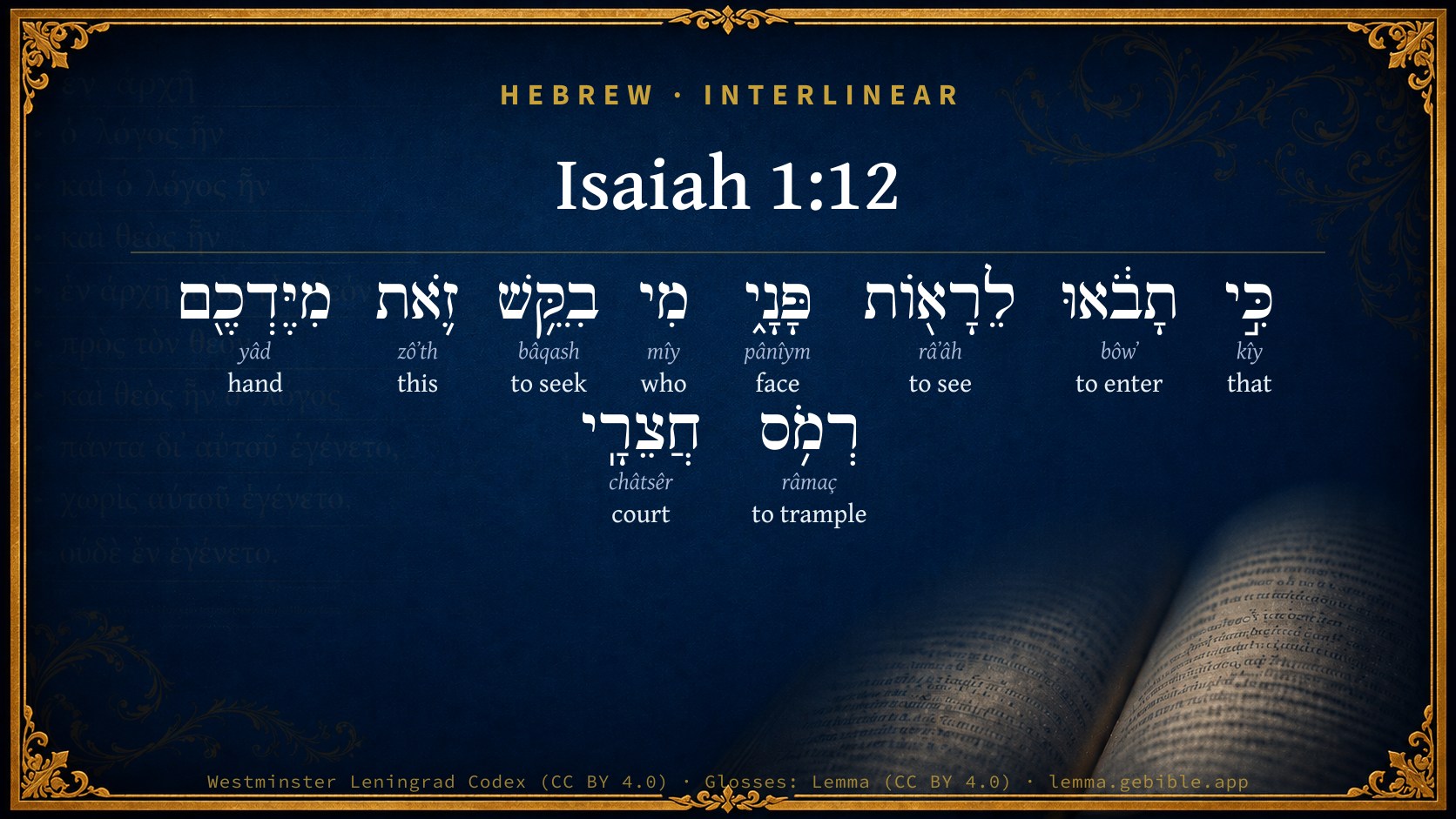
Isaiah 1:12

Hebrew (Westminster Leningrad Codex) Isaiah 1:12 appears in the Hebrew Old Testament. The text above is from the Westminster Leningrad Codex. Each word links to its Strong’s number, a concise gloss, and parsing drawn from the Open Scriptures Hebrew Bible morphology. Click any word for its full Brown-Driver-Briggs (BDB) entry.
Download image
Cite this verse

Isaiah 1:12 (World English Bible). Public Domain. Lemma interlinear Bible study tool, https://lemma.gebible.app/v/isaiah/1/12.

Show BibTeX & RIS
BibTeX
RIS
English Translation
When you come to appear before me, Who has required this at your hand, to trample my courts?
World English Bible · Public Domain
Download a study sheet

One document with this verse’s original text, its word-by-word gloss line, the meaning frame, cross-references with their text, attributed commentary, and full source and license credits — printable, and it pastes into notes with its structure intact.

This verse Autodidact and up

Study sheet (.html) Plain text (.txt)

A passage Seminary Student

Up to 50 verses in one chapter. A passage sheet keeps up to 6 commentary sources and 12 cross-references per verse, in the order this page ranks them, and says so on the sheet whenever that leaves anything out. Ask for a single verse and you get the Autodidact verse sheet above.

Everything on this page stays free to read, with no account — the sheet is a download of what is already on screen, not access to it.

Want to remove ads? Support Godless Engineer
Compare translations 3

The same verse in 3 English versions, stacked beneath the original-language interlinear above. Click any original word for its lexicon entry.

Each is an independent rendering of the whole verse — the interlinear is not word-aligned to these translations.

Highlighted words mark where these versions differ — a whole-verse word diff, not a word-by-word alignment.

  • World English Bible Public Domain
    When you come to appear before me, Who has required this at your hand, to trample my courts?
  • King James Version Public Domain
    When ye come to appear before me, who hath required this at your hand, to tread my courts?
  • unfoldingWord Literal Text CC BY-SA 4.0
    When you come to appear my face, who has sought this from your hand, trampling my courts?

unfoldingWord Literal Text — © unfoldingWord, licensed CC BY-SA 4.0. Word-aligned USFM3 via Door43 (git.door43.org/unfoldingWord/en_ult).

Versions to compare (up to 4)

3 of 4 selected

Show all 18 translations

Every available English version of this verse, each an independent rendering of the whole verse.

  • World English Bible Public Domain
    When you come to appear before me, Who has required this at your hand, to trample my courts?
  • Berean Standard Bible Public Domain
    When you come to appear before Me, who has required this of you—this trampling of My courts?
  • Majority Standard Bible Public Domain
    When you come to appear before Me, who has required this of you—this trampling of My courts?
  • King James Version Public Domain
    When ye come to appear before me, who hath required this at your hand, to tread my courts?
  • American Standard Version (1901) Public Domain
    When ye come to appear before me, who hath required this at your hand, to trample my courts?
  • Revised Version (1885) Public Domain
    When ye come to appear before me, who hath required this at your hand, to trample my courts?
  • Geneva Bible (1599) Public Domain
    When ye come to appeare before me, who required this of your hands to tread in my courts?
  • Douay-Rheims (1899) Public Domain
    When you came to appear before me, who required these things at your hands, that you should walk in my courts?
  • Young's Literal Translation Public Domain
    When ye come in to appear before Me, Who hath required this of your hand, To trample My courts?
  • Literal Standard Version CC BY-SA 4.0
    When you come to appear before Me, || Who has required this of your hand, || To trample My courts?
  • Unlocked Literal Bible CC BY-SA 4.0
    When you come to appear before me, who has required this of you, to trample my courts?
  • unfoldingWord Literal Text CC BY-SA 4.0
    When you come to appear my face, who has sought this from your hand, trampling my courts?
  • Darby Bible Public Domain
    When ye come to appear before me, who hath required this from your hand -- to tread my courts?
  • World Messianic Bible Public Domain
    When you come to appear before me, who has required this at your hand, to trample my courts?
  • Webster's Bible Public Domain
    When ye come to appear before me, who hath required this at your hand, to tread my courts?
  • Free Bible Version CC BY-SA 4.0
    When you come to appear before me in worship, who asked you to proudly tramp around my courts?
  • Bible in Basic English Public Domain
    At whose request do you come before me, making my house unclean with your feet?
  • JPS Tanakh (1917) Public Domain
    When ye come to appear before Me, who hath required this at your hand, to trample My courts?

Literal Standard Version (2020), Covenant Press — licensed CC BY-SA 4.0. Text via the HelloAO Bible API (eBible.org). Unlocked Literal Bible (unfoldingWord) — licensed CC BY-SA 4.0. Text via the HelloAO Bible API (eBible.org). unfoldingWord Literal Text — © unfoldingWord, licensed CC BY-SA 4.0. Word-aligned USFM3 via Door43 (git.door43.org/unfoldingWord/en_ult). Free Bible Version, Dr. Jonathan Gallagher — licensed CC BY-SA 4.0. Text via the HelloAO Bible API (eBible.org).

Word by word

More ways to search: Search by grammar → Find every occurrence → Compare this word →

Practice this passage: Drill this verse → Learn its vocabulary →

About this verse

These counts appear in no published source. They are computed here, from the morphology-tagged text and Lemma’s own curated glosses. What Lemma adds →

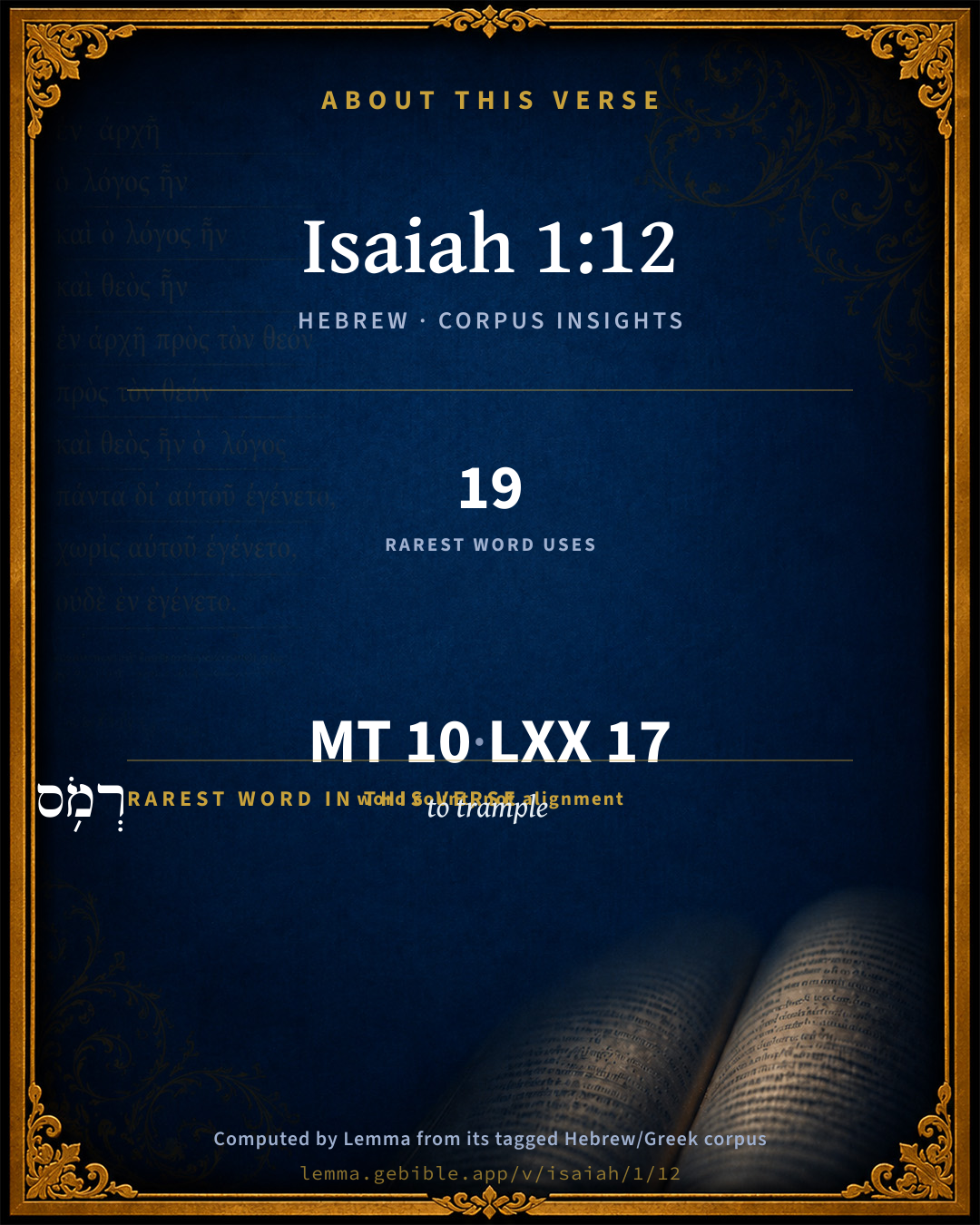
10
words
10
distinct lemmas
Prophets
section

Notable vocabulary

The rarest word here is רְמֹ֥ס to trample H7429 — appearing just 19 times in the whole Hebrew Bible.

Shared distinctive vocabulary

רְמֹ֥ס to trample H7429 occurs in 19 verses of the Hebrew Bible. Also found in:

Grammatical profile

  • 4 verbs
  • 3 nouns
  • 1 pronoun
  • 1 conjunction
  • 1 particle

Verb forms

  • תָבֹ֔אוּ Qal · Imperfect
  • לֵרָא֖וֹת Niphal · Infinitive Construct
  • בִקֵּ֥שׁ Piel · Perfect
  • רְמֹ֥ס Qal · Infinitive Construct

Hebrew & Septuagint length

In English translation the verse runs 18 words from the Hebrew and 26 from the Septuagint (LXX English) — the Septuagint runs noticeably longer here. See the side-by-side →

A rough comparison of the two English renderings, which tokenize alike — not a word-level alignment.

Word counts can differ between the Hebrew and the Greek without any difference in meaning — e.g. the Hebrew direct-object marker אֵת has no separate Greek word, and Greek often adds the article ὁ.

In the original languages it is 10 Hebrew tokens and 17 Greek tokens — but the two are counted differently (Hebrew bundles its prefixes and suffixes into one token; the Greek is in lemma form), so that isn’t a like-for-like length.

Cross-references

8

Topical passages linked to Isaiah 1:12 in the Treasury of Scripture Knowledge — connected by theme and wording, ordered by reader-vote popularity; previews shown in the World English Bible.

  • Exodus 34:23 Three times in the year all your males shall appear before the Lord Yahweh, the God of Israel.
  • Exodus 23:17 Three times in the year all your males shall appear before the Lord Yahweh.
  • Psalms 40:6 Sacrifice and offering you didn't desire. You have opened my ears: Burnt offering and sin offering you have not required.
  • Ecclesiastes 5:1 Guard your steps when you go to God's house; for to draw near to listen is better than to give the sacrifice of fools, for they don't know that they do evil.
  • Isaiah 58:1–2 Cry aloud, don't spare, lift up your voice like a trumpet, and declare to my people their disobedience, and to the house of Jacob their sins.
  • Micah 6:8 He has shown you, O man, what is good. What does Yahweh require of you, but to act justly, To love mercy, and to walk humbly with your God?
  • Matthew 23:5 But all their works they do to be seen by men. They make their phylacteries broad, enlarge the fringes of their garments,
  • Deuteronomy 16:16 Three times in a year shall all your males appear before Yahweh your God in the place which he shall choose: in the feast of unleavened bread, and in the feast of weeks, and in the feast of tents; and they shall not appear before Yahweh empty:

Cross-references courtesy of OpenBible.info (CC BY 4.0).

Hebrew and Greek witnesses Masoretic Hebrew ↔ Greek Septuagint

The same verse in the two great witnesses to the Old Testament, shown verse-for-verse.

Here the Septuagint runs noticeably longer than the Hebrew — LXX2012 (modern English Septuagint) 26 words vs World English Bible 18. A rough length comparison of the two English translations, not a word-level alignment — read both below.

These are two independent witnesses, not word-aligned to each other, and the Septuagint is shown in lemma (dictionary) form.

Hebrew Isaiah 1:12 Masoretic · Westminster Leningrad Codex

כִּ֣י תָבֹ֔אוּ לֵרָא֖וֹת פָּנָ֑י מִי בִקֵּ֥שׁ זֹ֛את מִיֶּדְכֶ֖ם רְמֹ֥ס חֲצֵרָֽי

When you come to appear before me, Who has required this at your hand, to trample my courts?

World English Bible · Public Domain

Greek LXX Isaiah 1:12 Septuagint · lemma form

οὐδέ ἐάν ἔρχομαι ὁράω ἐγώ τίς γάρ ἐκζητέω οὗτος ἐκ ὁ χείρ σύ πατέω ὁ αὐλή ἐγώ

neither shall you⌃ come with these to appear before me; for who has required these things at your hands? You⌃ shall no more tread my court.

LXX2012 (modern English Septuagint) · Public Domain

On this verse, Adam Clarke's Commentary discusses the Septuagint’s reading. Read the note in Commentary ↓

Hebrew: Westminster Leningrad Codex (CC BY 4.0). Greek: Septuagint (public domain); English from LXX2012 (modern English Septuagint) (Public Domain). How the Septuagint differs from the Hebrew →

Targum (Aramaic paraphrase)

1

The Targum is the ancient Jewish Aramaic paraphrase of the Hebrew Scriptures — an interpretive translation, not the Hebrew text itself. Onkelos (literal) and Pseudo-Jonathan (expansive) render the Torah, and Jonathan the Prophets. Coverage is partial: where no permissively-licensed English translation exists for a verse, only the Aramaic is shown. This is verse-level text, not a word-by-word alignment to the Hebrew.

  1. Targum Jonathan Prophets (Joshua–Malachi)
    כַּד אַתּוּן אָתָן לְאִתְחֲזָאָה קֳדָמַי מַן תְּבַע דָא מִיֶדְכוֹן לְמֵיתֵי וּלְאִתְדָשָׁא עֲזָרָתִי:

    When ye come to appear before me, who has required this at your hand, and that ye should come? Tread not my courts;

    Targum Jonathan — Aramaic: “Mikraot Gedolot” (public domain). English: “Sefaria Community Translation” (CC0 1.0 (public-domain dedication)); “London "Chaldee Paraphrase," 1871” (public domain). Text via Sefaria.

Commentary

Notes on Isaiah 1:12 from classic Christian and Jewish commentators (each source and its license shown beneath its notes). The classic Christian expositions comment on the surrounding passage and are grouped to its opening verse, so a note may address several verses; the Jewish commentaries on the Tanakh (Rashi and others) are per-verse, so they appear only where the commentator wrote on this verse.

Lemma curates 59 commentaries, every one of them public domain or Creative Commons licensed, each selected and text-cleaned for this edition rather than reprinted as found. About our sources →

Trapp's Complete Commentary

John Trapp

Isa 1:12 When ye come to appear before me, who hath required this at your hand, to tread my courts?

Ver. 12. When ye come to appear before me.] Heb., To be seen; else all had been lost. Hypocrisy is very ostentous, it would be noted and noticed; whereas true devotion desireth not to be seen of any save him who seeth in secret.

Who hath required this at your hand?] This is God’s voice to all superstitious will-worshippers and carnal gospellers. "Friend, how camest thou in hither?" Who sent for thee to my service? Who hath forewarned this generation of vipers to flee from the wrath to come? What hast thou to do to take up my name? &c., {Psa 50:16} to tread my courts, to pollute my presence? "This is the gate of the Lord, into which the righteous" only "should enter." {Psa 118:20} "The sacrifice of the wicked is abomination; how much more when he bringeth it with a wicked mind." {Pro 21:27}

To tread my courts.] Or, Trample on; {as Isa 63:3} to foul it, and wear it out with their feet, {a} as in some places marble crosses graven in pavements of Popish churches, with indulgences annexed for every time they are kissed, are even worn by the kisses of the devouter sex especially. {b} Diodate noteth here that a phrase is picked out on purpose to show that these false appearances were rather acts of profane contempt than of right religion. The Greeks gave such honour to their temples that they durst not tread on the threshold thereof, but leap over it. The priests at their solemn services cried aloud εκας εκας οστις αλιτρος, Gressus removete prophani. The Jews at this day, before they come to the synagogue, wash themselves, and scrape their shoes with an iron fastened in a wall at the entrance. The Habassines, a mongrel kind of Christians in Africa, do neither walk, nor talk, nor sit, nor spit, nor laugh in the church, nor admit dogs into the churchyards. Sed quorsum haec omnia? to what end is all this, without an honest care to lift up pure hands and holy hearts in God’s presence? See Jer 7:3-4; Jer 7:9-11.

{a} Calcatis atria et teritis pavimentum. - A Lap.

{b} Sandys’s Relat, of West. Relig., sec. 8.

John Trapp, A Commentary or Exposition upon All the Books of the Old and New Testament (1647–1656) — public domain. Text from a community e-Sword module.

Jamieson, Fausset & Brown

Robert Jamieson, A. R. Fausset & David Brown

appear before me--in the temple where the Shekinah, resting on the ark, was the symbol of God's presence (Exo 23:15; Psa 42:2).

who hath required this--as if you were doing God a service by such hypocritical offerings (Job 35:7). God did require it (Exo 23:17), but not in this spirit (Mic 6:6-7).

courts--areas, in which the worshippers were. None but priests entered the temple itself.

Jamieson, Fausset & Brown — Commentary Critical and Explanatory on the Whole Bible (1871) — public domain (CC PDM 1.0). Text via the HelloAO Bible API.

Adam Clarke's Commentary

Verse 12. When ye come to appear] Instead of לראות leraoth, to appear, one MS. has לראות liroth, to see. See De Rossi. The appearing before God here refers chiefly to the three solemn annual festivals. See Ex 23:14.

Tread my courts (no more)] So the Septuagint divide the sentence, joining the end of this verse to the beginning of the next: Πατειν την αυλην μου, ου προσθησεσθε; "To tread my court ye shall not add-ye shall not be again accepted in worship."

Adam Clarke's Commentary on the Bible (1810–1826) — public domain. Text from a community e-Sword/MySword module.

Ellicott's Commentary for English Readers

(12) When ye come to appear before me.—Literally, before my face. This is the meaning given by the present Hebrew text, and it is, of course, adequate. The Syriac version and some modern scholars (e.g., Cheyne) adopt a reading which gives to see my face. In either case the implied thought is that the worshippers believed they came into the more immediate presence of Jehovah when, they entered the Temple courts. To “appear before God” was the normal phrase for visiting the Temple at the three great Feasts and other solemn occasions (Exo_34:23; Psa_42:3; Psa_84:7).

A Bible Commentary for English Readers, edited by Charles John Ellicott (1878–1897) — public domain. Text from a community e-Sword module.

The Cambridge Bible for Schools and Colleges

gen. ed. J. J. S. Perowne

12. to appear before me] R.V. marg. (following one Hebr. MS.) suggests to see my face, which is grammatically easier. It is thought that here and elsewhere the traditional text has substituted the passive for the active so as to avoid the appearance of anthropomorphism. On either view the phrase is a technical one, denoting the act of worship in the sanctuary: Exo_23:15; Exo_23:17; Exo_34:20; Exo_34:23; Deu_16:16; Deu_31:11; 1Sa_1:22.

to tread] Better to trample; the idea of desecration is implied. This ending of the question seems weak: LXX. transfers the clause to the beginning of the next verse: “My courts ye shall no more trample; to bring oblations is vain, &c.”

The Cambridge Bible for Schools and Colleges (gen. ed. J. J. S. Perowne; Cambridge University Press, 1878–1918) — public domain. Text from a community e-Sword module.

John Gill's Exposition

When ye come to appear before me,.... At the grand festivals of the passover, pentecost, and tabernacles, at which times all the males in Israel appeared before God, Exo 23:17.

who hath required this at your hand; either to appear at such times, these feasts being no more to be observed; or to offer the above sacrifices; these were not required of the Israelites when they first came out of Egypt, Jer 7:22 nor were they necessary to appear before God with, or to introduce them to the throne of his grace, Mic 6:6 and much less under the Gospel dispensation, being abolished by the sacrifice of Christ; or this relates to what follows,

to tread my courts? in that unbecoming and hypocritical way they did, and with such wicked hearts and bloody hands. "Courts" are mentioned, because, as Kimchi observes, the Israelites stood in the courts of the Lord's house, and did not go into the temple, only the priests.

John Gill's Exposition of the Whole Bible (1746–1763) — public domain (CC PDM 1.0). Text via the HelloAO Bible API.

Albert Barnes' Notes on the Bible

When you come to appear before me - The temple was in Jerusalem, and was regarded as the habitation, or dwelling-place, of the God of Israel. Particularly, the most holy place of the temple was deemed the place of his sacred abode. The Shekinah - from שׁכן shâkan, to dwell - the visible symbol of his presence, rested on the cover of the ark, and from this place he was accustomed to commune with his people, and to give responses to their requests. Hence, ‘to appear before God,’ Hebrew ‘to be seen before my face,’ פני לראות lerâ'ôth pânāy for פני את 'et pânāy, means to appear in his temple as a worshipper. The phrase occurs in this sense in the following places: Exo 34:23-24; Deu 31:11; 1Sa 1:22; Psa 42:3.

Who hath required this - The Jews were required to appear there to worship God Exo 23:17; Deu 16:16; but it was not required that they should appear with that spirit and temper. A similar sentiment is expressed in Psa 50:16.

At your hand - From you. The emphasis in this expression is to be laid on your. ‘Who has asked it of you?’ It was indeed the duty of the humble, and the sincere, to tread those courts, but who had required such hypocrites as they were to do it? God sought the offerings of pure worshippers, not those of the hypocritical and the profane.

To tread my courts - The courts of the temple were the different areas or open spaces which surrounded it. None entered the temple itself but the priests. The people worshipped God in the courts assigned them around the temple. In one of those courts was the altar of burnt-offerings; and the sacrifices were all made there; see the notes at Mat 21:12. To tread his courts was an expression therefore, equivalent to, to worship. To tread the courts of the Lord here, has the idea of profanation. Who has required you to tread those courts with this hollow, heartless service? It is often used in the sense of treading down, or trampling on, 2Ki 7:17-20; Dan 8:7-10; Isa 63:3-16.

Albert Barnes' Notes on the Bible (1834–1885) — public domain. Text from a community e-Sword/MySword module.

Matthew Poole's English Annotations

When ye come to appear before me, upon the three solemn feasts, Exo 23:17; 34:23, or upon other occasions.

Who hath required this at your hands, to wit, in this manner, and upon these terms? The thing that I commanded was not only nor chiefly that you should offer external sacrifices to me, but that you should do it with true repentance for all your sins, with faith in my promises, with hearty love to me, and sincere resolutions of devoting yourselves to my service, without which you offer me a dead carcass instead of a living sacrifice.

My courts; the courts of my temple, which were two, that of the priests, and that where the people assembled, 2Ch 4:9. So this reproof seems to be directed against both priests and people, as unworthy to enjoy this privilege.

Matthew Poole's English Annotations on the Holy Bible (1683–1685) — public domain. Text from a community e-Sword/MySword module.

Whedon's Commentary on the Bible

Daniel D. Whedon

12. Who hath required this — That is, to appear in this formal, heartless, undevout way. The true way of appearing before the Lord is prescribed in Exo_34:23-24; Deu_16:16-17.

Daniel D. Whedon (gen. ed.), Commentary on the Old and New Testaments (1874–1909) — public domain. Text from a community e-Sword module.

The Pulpit Commentary

When ye come to appear before me. Mr. Cheyne translates, "to see my face;" but most other commentators (Gesenius, Delitzsch, Ewald, Kay) regard the phrase used as equivalent to that employed in Exo_23:17 Exo_34:23 Deu_16:16; and the passage as referring to that attendance in the temple at the three great annual festivals, which was required of all adult male Israelites. The requirement of the Law was still observed in the letter, but not in the spirit. They came with no true religious object. Hence the question which follows: Who hath required this at your hand, to tread my courts? This was not what God had enjoined a mere bodily attendance, a trampling of his courts with their feet, when their hearts were far from him.

The Pulpit Commentary (1880–1919), ed. H.D.M. Spence-Jones & Joseph S. Exell — public domain. Text from a community e-Sword module.

John Wesley's Explanatory Notes

To appear - Upon the three solemn feasts, or upon other occasions. Who required - The thing I commanded, was not only, nor chiefly, that you should offer external sacrifices, but that you should do it with true repentance, with faith in my promises, and sincere resolutions of devoting yourselves to my service.

John Wesley, Explanatory Notes Upon the Whole Bible (1754–1765) — public domain. Text via the GEBible commentary corpus.

Keil & Delitzsch

C. F. Keil & F. Delitzsch

Jeremiah says this with regard to the sacrifices (Isa 7:22); Isaiah also applies it to visits to the temple: "When ye come to appear before my face, who hath required this at your hand, to tread my courts?" לראות is a contracted infinitive niphal for להראות (compare the hiphil forms contracted in the same manner in Isa 3:8; Isa 23:11). This is the standing expression for the appearance of all male Israelites in the temple at the three high festivals, as prescribed by the law, and then for visits to the temple generally (cf., Psa 42:3; Psa 84:8). "My face" (panai): according to Ewald, 279, c, this is used with the passive to designate the subject ("to be seen by the face of God"); but why not rather take it as an adverbial accusative, "in the face of," or "in front of," as it is used interchangeably with the prepositions ל, את, and אל? It is possible that לראות is pointed as it is here, and in Exo 34:24 and in Deu 31:11, instead of לראות - like יראוּ for יראוּ, in Exo 23:15; Exo 34:20, - for the purpose of avoiding an expression which might be so easily misunderstood as denoting a sight of God with the bodily eye. But the niphal is firmly established in Exo 23:17; Exo 34:23, and Sa1 1:22; and in the Mishnah and Talmud the terms ראיה and ראיון are applied without hesitation to appearance before God at the principal feasts. They visited the temple diligently enough indeed, but who had required this at their hand, i.e., required them to do this? Jehovah certainly had not. "To tread my courts" is in apposition to this, which it more clearly defines. Jehovah did not want them to appear before His face, i.e., He did not wish for this spiritless and undevotional tramping thither, this mere opus operatum, which might as well have been omitted, since it only wore out the floor.

Keil & Delitzsch — Biblical Commentary on the Old Testament (1861–1891) — public domain (CC PDM 1.0). Text via the HelloAO Bible API. (Old Testament only.)

J. A. Alexander on Isaiah

Joseph Addison Alexander

What had just been said of the offerings themselves, is now said of attendance at the temple to present them. “When you come to appear before me, who hath required this at your hand to tread my courts,” not merely to frequent them, but to trample on them, as a gesture of contempt? The courts here meant are the enclosures around Solomon’s temple, for the priests, worshippers, and victims. The interrogative form implies negation. Such appearance, such attendance, God had not required, although it was their duty to frequent His courts. The word tread appears to be applied to the worshippers themselves in a twofold sense, which cannot be expressed by any single word in English. They were bound to tread His courts, but not to trample them.

Joseph Addison Alexander, The Prophecies of Isaiah (1846–1847; New York: Scribner, 1870–1878) — public domain. Text from a community e-Sword module.

unfoldingWord translationNotes

Door43 World Missions Community

General Information:

Isaiah speaks Yahweh's words to the people of Judah in the form of a poem. (See: Parallelism)

who has required this of you, to trample my courts?

The word "trample" means to step on and crush with one's feet. God is using a question to scold the people who live in Judah. This rhetorical question can be translated as a statement. AT: "no one told you to stomp around in my courtyards!" (See: Rhetorical Question)

Bring no more meaningless offerings

"Do not bring me any more of your worthless gifts"

incense is an abomination to me

Here the abstract noun "abomination" can expressed as the verb "hate." AT: "I hate the incense the priests burn" (See: Abstract Nouns)

I cannot tolerate these wicked assemblies

Possible meanings are 1) "I cannot allow you to gather together because of the wicked things you do" or 2) "I cannot allow myself to watch you gather together because of the wicked things you do."

translationWords

court

sacrifice

incense

abomination

new moon

Sabbath

assembly

evil

unfoldingWord translationNotes — © Distant Shores Media and the Door43 World Missions Community, licensed CC BY-SA 4.0. Source: git.door43.org/Door43/en_tn.

Rashi

Rabbi Shlomo Yitzchaki (Rashi)

who requested this of you, to trample My courts to trample [the preposition is absent in the Hebrew] My courts, since your heart is not whole with Me.

Rashi on the Tanakh — English translations: “The Judaica Press complete Tanach with Rashi, translated by A. J. Rosenberg” (CC BY 4.0); “Pentateuch with Rashi's commentary by M. Rosenbaum and A.M. Silbermann, 1929-1934” (public domain); “The Metsudah Tanach series, Lakewood, N.J” (CC BY 4.0); and “The Book of Joshua, Metsudah Publications, 1997” (CC BY 4.0). Text via Sefaria.

Ibn Ezra

Rabbi Abraham ibn Ezra

לפני═פני Before me; it is not the object of לֵרָאוֹח ‘ to be seen.’ לראות פני, according to this opinion, rejected by I. E., When my face is seen; ‘my face’ is called object, though the nominative case. Comp. I. E. on Exod. 23:15.

רמוס To tread. Infinitive.

Ibn Ezra on the Tanakh — English translations: “Sefaria Community Translation” (CC0 1.0 (public-domain dedication)); “Yalkut, Sifsei Chachomim Chumash, Metsudah Publications, 2009” (CC BY 4.0); and “Commentary of Ibn Ezra on Isaiah - trans. by M. Friedlander, 1873” (public domain). Text via Sefaria.

Lesson kit

Teaching starters — assembled from the data on this page, not authored interpretation. Every prompt links to the verse data it draws on. Edit before teaching.

Isaiah, in the Prophets, opens this verse with 10 words (10 distinct Hebrew lemmas). Its most distinctive word is râmaç (“to trample”). The Greek Septuagint runs longer here. A historical commentator’s framing appears above. Read the whole chapter for the surrounding context.

Discussion questions

  1. The word râmaç carries the sense “to trample.” How does it shape the verse?
  2. How does 2 Kings 7:17, which shares the word «to trample», read alongside this verse?
  3. The Septuagint runs longer here than the Hebrew. What might account for the difference?
  4. These translations render this verse differently; the difference is in the English rendering, not the original. What questions does that raise?
  5. «תָבֹ֔אוּ» is a Qal Imperfect verb. How does that grammatical form shape the action described?
  6. Compare how Trapp's Complete Commentary and Jamieson, Fausset & Brown read this verse. Where do they agree or differ?

Things to notice

Reading settings

Reading text

Shown beneath each verse's original-language words.

Old Testament
Old Testament edition

Read the OT as the Masoretic Hebrew (MT) or the Greek Septuagint (LXX).

English shown for the Greek Septuagint (in the Hebrew ↔ Greek comparison).

Comparing translations? Open the Compare panel on any verse page to stack up to four side by side.