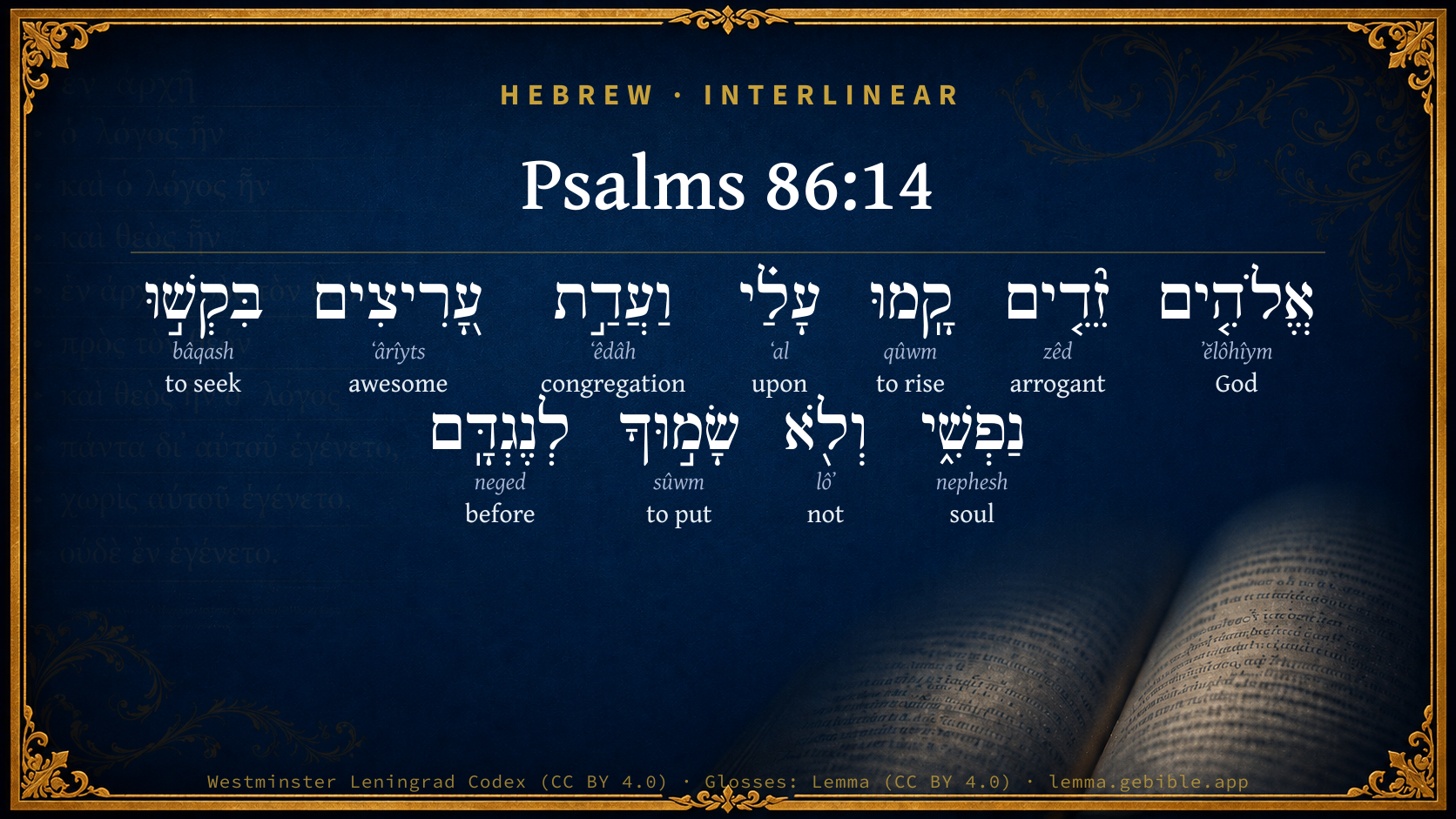
Psalms 86:14

Hebrew (Westminster Leningrad Codex) Psalms 86:14 appears in the Hebrew Old Testament. The text above is from the Westminster Leningrad Codex. Each word links to its Strong’s number, a concise gloss, and parsing drawn from the Open Scriptures Hebrew Bible morphology. Click any word for its full Brown-Driver-Briggs (BDB) entry.
Download image
Cite this verse

Psalms 86:14 (World English Bible). Public Domain. Lemma interlinear Bible study tool, https://lemma.gebible.app/v/psalms/86/14.

Show BibTeX & RIS
BibTeX
RIS
English Translation
God, the proud have risen up against me. A company of violent men have sought after my soul, And they don't hold regard for you before them.
World English Bible · Public Domain
Download a study sheet

One document with this verse’s original text, its word-by-word gloss line, the meaning frame, cross-references with their text, attributed commentary, and full source and license credits — printable, and it pastes into notes with its structure intact.

This verse Autodidact and up

Study sheet (.html) Plain text (.txt)

A passage Seminary Student

Up to 50 verses in one chapter. A passage sheet keeps up to 6 commentary sources and 12 cross-references per verse, in the order this page ranks them, and says so on the sheet whenever that leaves anything out. Ask for a single verse and you get the Autodidact verse sheet above.

Everything on this page stays free to read, with no account — the sheet is a download of what is already on screen, not access to it.

Want to remove ads? Support Godless Engineer
Compare translations 3

The same verse in 3 English versions, stacked beneath the original-language interlinear above. Click any original word for its lexicon entry.

Each is an independent rendering of the whole verse — the interlinear is not word-aligned to these translations.

Highlighted words mark where these versions differ — a whole-verse word diff, not a word-by-word alignment.

  • World English Bible Public Domain
    God, the proud have risen up against me. A company of violent men have sought after my soul, And they don't hold regard for you before them.
  • King James Version Public Domain
    O God, the proud are risen against me, and the assemblies of violent men have sought after my soul; and have not set thee before them.
  • unfoldingWord Literal Text CC BY-SA 4.0
    God, the arrogant arise against me, and the congregation of the violent seek my life, and they do not set you before them.

unfoldingWord Literal Text — © unfoldingWord, licensed CC BY-SA 4.0. Word-aligned USFM3 via Door43 (git.door43.org/unfoldingWord/en_ult).

Versions to compare (up to 4)

3 of 4 selected

Show all 18 translations

Every available English version of this verse, each an independent rendering of the whole verse.

  • World English Bible Public Domain
    God, the proud have risen up against me. A company of violent men have sought after my soul, And they don't hold regard for you before them.
  • Berean Standard Bible Public Domain
    The arrogant rise against me, O God; a band of ruthless men seeks my life, with no regard for You.
  • Majority Standard Bible Public Domain
    The arrogant rise against me, O God; a band of ruthless men seeks my life; they have no regard for You.
  • King James Version Public Domain
    O God, the proud are risen against me, and the assemblies of violent men have sought after my soul; and have not set thee before them.
  • American Standard Version (1901) Public Domain
    O God, the proud are risen up against me, And a company of violent men have sought after my soul, And have not set thee before them.
  • Revised Version (1885) Public Domain
    O God, the proud are risen up against me, and the congregation of violent men have sought after my soul, and have not set thee before them.
  • Geneva Bible (1599) Public Domain
    O God, the proude are risen against me, and the assemblies of violent men haue sought my soule, and haue not set thee before them.
  • Douay-Rheims (1899) Public Domain
    O God, the wicked are risen up against me, and the assembly of the mighty have sought my soul: and they have not set thee before their eyes.
  • Young's Literal Translation Public Domain
    O God, the proud have risen up against me, And a company of the terrible sought my soul, And have not placed Thee before them,
  • Literal Standard Version CC BY-SA 4.0
    O God, the proud have risen up against me, || And a company of the terrible sought my soul, || And have not placed You before them,
  • Unlocked Literal Bible CC BY-SA 4.0
    God, the arrogant have risen up against me. A gang of violent men seek my life. They have no regard for you.
  • unfoldingWord Literal Text CC BY-SA 4.0
    God, the arrogant arise against me, and the congregation of the violent seek my life, and they do not set you before them.
  • Darby Bible Public Domain
    O God, the proud are risen against me, and the assembly of the violent seek after my soul, and they have not set thee before them.
  • World Messianic Bible Public Domain
    God, the proud have risen up against me. A company of violent men have sought after my soul, and they don’t hold regard for you before them.
  • Webster's Bible Public Domain
    O God, the proud have risen against me, and the assemblies of violent men have sought after my soul; and have not set thee before them.
  • Free Bible Version CC BY-SA 4.0
    God, arrogant people are attacking me, vicious people are trying to kill me. To them you count for nothing.
  • Bible in Basic English Public Domain
    O God, men of pride have come up against me, and the army of violent men would take my life; they have not put you before them.
  • JPS Tanakh (1917) Public Domain
    O God, the proud are risen up against me, and the company of violent men have sought after my soul, and have not set Thee before them.

Literal Standard Version (2020), Covenant Press — licensed CC BY-SA 4.0. Text via the HelloAO Bible API (eBible.org). Unlocked Literal Bible (unfoldingWord) — licensed CC BY-SA 4.0. Text via the HelloAO Bible API (eBible.org). unfoldingWord Literal Text — © unfoldingWord, licensed CC BY-SA 4.0. Word-aligned USFM3 via Door43 (git.door43.org/unfoldingWord/en_ult). Free Bible Version, Dr. Jonathan Gallagher — licensed CC BY-SA 4.0. Text via the HelloAO Bible API (eBible.org).

Word by word

More ways to search: Search by grammar → Find every occurrence → Compare this word →

Practice this passage: Drill this verse → Learn its vocabulary →

זֵ֘דִ֤ים
zêd
H2086
“arrogant”
Adjective, Adjective, Masculine, Plural, Absolute
Part of Speech
Adjective
Type
Adjective
Gender
Masculine
Number
Plural
State
Absolute
Full BDB Definition

Origin: from H2102

TWOT: 547a

arrogant, proud, insolent, presumptuous - the arrogant ones (as noun collective plural) - presumptuous (as adjective)
  1. אֱלֹהִ֤ים ʼĕlôhîym H430 “God(s)” Noun, Common, Masculine, Plural, Absolute
  2. קָֽמוּ qûwm H6965 “to rise” Verb, Qal, Perfect, 3rd Person, Common, Plural
  3. עָלַ֗י ʻal H5921 “upon · me” Preposition + Suffix, Personal, 1st Person, Common, Singular
  4. וַעֲדַ֣ת ʻêdâh H5712 “and · congregation of” Conjunction + Noun, Common, Feminine, Singular, Construct
  5. עָ֭רִיצִים ʻârîyts H6184 “awesome” Adjective, Adjective, Masculine, Plural, Absolute
  6. בִּקְשׁ֣וּ bâqash H1245 “to seek” Verb, Piel, Perfect, 3rd Person, Common, Plural
  7. נַפְשִׁ֑י nephesh H5315 “soul · my” Noun, Common, Both, Singular, Construct + Suffix, Personal, 1st Person, Common, Singular
  8. וְלֹ֖א lôʼ H3808 “and · not” Conjunction + Particle, Negative
  9. שָׂמ֣וּךָ sûwm H7760 “to put · you” Verb, Qal, Perfect, 3rd Person, Common, Plural + Suffix, Personal, 2nd Person, Masculine, Singular
  10. לְנֶגְדָּֽם neged H5048 “to/for · before · them” Preposition + Preposition + Suffix, Personal, 3rd Person, Masculine, Plural

About this verse

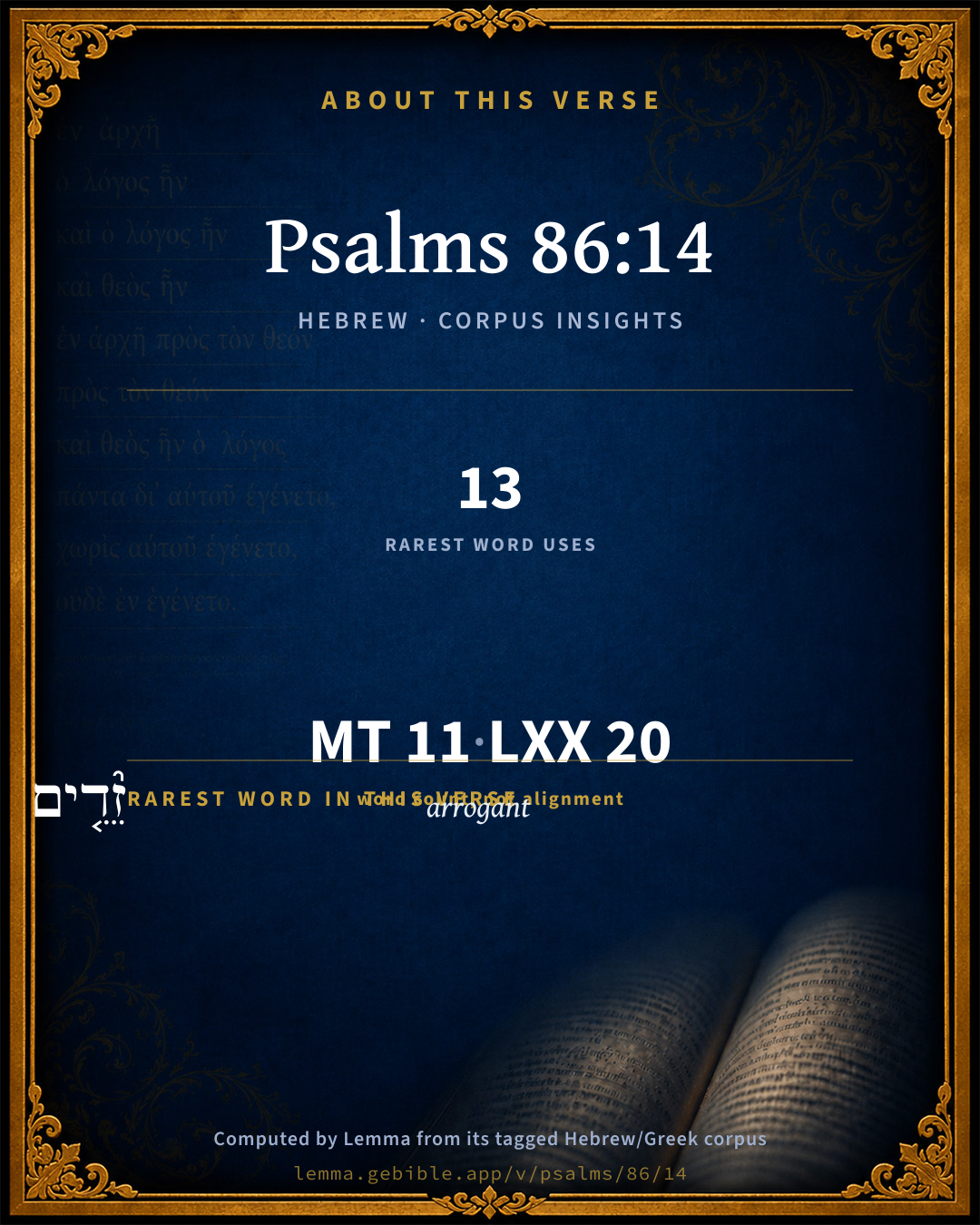
These counts appear in no published source. They are computed here, from the morphology-tagged text and Lemma’s own curated glosses. What Lemma adds →

11
words
11
distinct lemmas
Wisdom
section

Notable vocabulary

The rarest word here is זֵ֘דִ֤ים arrogant H2086 — appearing just 13 times in the whole Hebrew Bible.

Shared distinctive vocabulary

זֵ֘דִ֤ים arrogant H2086 occurs in 13 verses of the Hebrew Bible. Also found in:

Grammatical profile

  • 3 verbs
  • 3 nouns
  • 2 adjectives
  • 2 prepositions
  • 1 particle

Verb forms

  • קָֽמוּ Qal · Perfect
  • בִּקְשׁ֣וּ Piel · Perfect
  • שָׂמ֣וּךָ Qal · Perfect

Hebrew & Septuagint length

In English translation the verse runs 27 words from the Hebrew and 25 from the Septuagint (LXX English) — closely comparable.

A rough comparison of the two English renderings, which tokenize alike — not a word-level alignment.

Word counts can differ between the Hebrew and the Greek without any difference in meaning — e.g. the Hebrew direct-object marker אֵת has no separate Greek word, and Greek often adds the article ὁ.

In the original languages it is 11 Hebrew tokens and 20 Greek tokens — but the two are counted differently (Hebrew bundles its prefixes and suffixes into one token; the Greek is in lemma form), so that isn’t a like-for-like length.

Cross-references

19

Topical passages linked to Psalms 86:14 in the Treasury of Scripture Knowledge — connected by theme and wording, ordered by reader-vote popularity; previews shown in the World English Bible.

  • Psalms 54:3 For strangers have risen up against me. Violent men have sought after my soul. They haven't set God before them. Selah.
  • Psalms 14:4 Have all the workers of iniquity no knowledge, Who eat up my people as they eat bread, And don't call on Yahweh?
  • Psalms 36:1 An oracle is within my heart about the disobedience of the wicked: "There is no fear of God before his eyes."
  • Matthew 26:3–4 Then the chief priests, the scribes, and the elders of the people were gathered together in the court of the high priest, who was called Caiaphas.
  • Matthew 27:1–2 Now when morning had come, all the chief priests and the elders of the people took counsel against Jesus to put him to death:
  • 2 Samuel 15:1–12 It happened after this, that Absalom prepared him a chariot and horses, and fifty men to run before him.
  • 2 Samuel 16:20–17:1 Then said Absalom to Ahithophel, Give your counsel what we shall do.
  • 2 Samuel 17:14 Absalom and all the men of Israel said, The counsel of Hushai the Archite is better than the counsel of Ahithophel. For Yahweh had ordained to defeat the good counsel of Ahithophel, to the intent that Yahweh might bring evil on Absalom.
  • Psalms 10:4 The wicked, in the pride of his face, Has no room in his thoughts for God.
  • Psalms 10:11 He says in his heart, "God has forgotten. He hides his face. He will never see it."
  • Psalms 10:13 Why does the wicked person condemn God, And say in his heart, "God won't call me into account?"
  • Psalms 36:11 Don't let the foot of pride come against me. Don't let the hand of the wicked drive me away.
  • Psalms 119:51 The arrogant mock me excessively, But I don't swerve from your law.
  • Psalms 119:69 The proud have smeared a lie upon me. With my whole heart, I will keep your precepts.
  • Psalms 119:85 The proud have dug pits for me, Contrary to your law.
  • Psalms 140:5 The proud have hidden a snare for me, They have spread the cords of a net by the path. They have set traps for me. Selah.
  • Ezekiel 8:12 Then said he to me, Son of man, have you seen what the elders of the house of Israel do in the dark, every man in his chambers of imagery? for they say, Yahweh doesn't see us; Yahweh has forsaken the land.
  • Ezekiel 9:9 Then said he to me, The iniquity of the house of Israel and Judah is exceeding great, and the land is full of blood, and the city full of wrestling [of judgment]: for they say, Yahweh has forsaken the land, and Yahweh doesn't see.
  • Acts 4:27–28 For truly, in this city against your holy servant, Jesus, whom you anointed, both Herod and Pontius Pilate, with the Gentiles and the people of Israel, were gathered together

Cross-references courtesy of OpenBible.info (CC BY 4.0).

Hebrew and Greek witnesses Masoretic Hebrew ↔ Greek Septuagint

The same verse in the two great witnesses to the Old Testament, shown verse-for-verse.

You’re reading Greek Psalm 85 (Hebrew Psalm 86). The Septuagint counts the superscription, so verse numbers can differ from the Hebrew — chapter-level alignment, not verse-by-verse. Numbering follows Rahlfs.

These are two independent witnesses, not word-aligned to each other, and the Septuagint is shown in lemma (dictionary) form.

Hebrew Psalms 86:14 Masoretic · Westminster Leningrad Codex

אֱלֹהִ֤ים זֵ֘דִ֤ים קָֽמוּ עָלַ֗י וַעֲדַ֣ת עָ֭רִיצִים בִּקְשׁ֣וּ נַפְשִׁ֑י וְלֹ֖א שָׂמ֣וּךָ לְנֶגְדָּֽם

God, the proud have risen up against me. A company of violent men have sought after my soul, And they don't hold regard for you before them.

World English Bible · Public Domain

Greek LXX Greek Psalm 85:14 Septuagint · lemma form

ὁ θεός παράνομος ἐπι ἀναἵστημι ἐπί ἐγώ καί συναγωγή κραταιός ζητέω ὁ ψυχή ἐγώ καί οὐ προτίθημι σύ ἐνώπιον αὐτός

O God, transgressors have risen up against me, and an assembly of violent men have sought my life; and have not set you before them.

LXX2012 (modern English Septuagint) · Public Domain

On this verse, Albert Barnes' Notes on the Bible discusses the Septuagint’s reading. Read the note in Commentary ↓

Hebrew: Westminster Leningrad Codex (CC BY 4.0). Greek: Septuagint (public domain); English from LXX2012 (modern English Septuagint) (Public Domain). How the Septuagint differs from the Hebrew →

Commentary

Notes on Psalms 86:14 from classic Christian and Jewish commentators (each source and its license shown beneath its notes). The classic Christian expositions comment on the surrounding passage and are grouped to its opening verse, so a note may address several verses; the Jewish commentaries on the Tanakh (Rashi and others) are per-verse, so they appear only where the commentator wrote on this verse.

Lemma curates 59 commentaries, every one of them public domain or Creative Commons licensed, each selected and text-cleaned for this edition rather than reprinted as found. About our sources →

Trapp's Complete Commentary

John Trapp

Psa 86:14 O God, the proud are risen against me, and the assemblies of violent [men] have sought after my soul; and have not set thee before them.

Ver. 14. O God, the proud] The strangers, some read it (by the change of a letter in the original), who are commonly cruel.

And the assemblies of violent men] Nebulonum, some render it, sturdy varlets, fastuosi ac feroces.

John Trapp, A Commentary or Exposition upon All the Books of the Old and New Testament (1647–1656) — public domain. Text from a community e-Sword module.

Joseph Benson's Commentary

Psa 86:14-15. O God, the proud are risen against me — Behold, O God, a new opportunity to glorify that mercy, for ambitious men have risen up against me in open rebellion, and have not only plotted against me, but endeavoured to put their plots in execution, and both to depose and destroy me. The assemblies of violent men have sought after my soul — That is, after my life: to take it away; and have not set thee before them — They have no reverence nor regard for thee, neither for thy word, which hath conferred the kingdom upon me, nor for thine all-seeing eye, which beholds all their wicked devices and practices against me, nor for thy justice, which will undoubtedly bring their mischief upon their own heads. But thou art a God full of compassion, &c. — Namely, to thy people, and to me in particular, and therefore thou wilt forgive my manifold sins, for which thou mightest justly reject me, and wilt save me from my cruel enemies. Thus, from praises, the psalmist returns again to prayer, as all the people of God are frequently compelled to do. In the opposition he met with he was a type of the Messiah, his seed according to the flesh, and his church. “We know the treatment which Christ met with, when he was upon earth, from proud and violent men, who had not set God before their eyes; from self-righteous Jews, and conceited Gentiles, who rose up, and look counsel together against him. What his church afterward suffered, at the hands of the same enemies, is likewise well known. How much more she is to undergo in the latter days we know not as yet; but this we know, that the spirit of the world stands, now and ever, in opposition to the Spirit of God; its design is always the same, although its methods of working be divers.” — Horne. So that, even from without, and from visible enemies, not to mention those within the human heart, and such as are invisible, every one, who is a Christian indeed, shall be sure to find his state on earth a warfare, and to have his portion of tribulation in this life. But, like David, he may, in the midst of all the trials and oppositions he meets with, find a place of sure refuge, and an almighty helper, in that Being who is here said to be full of compassion and gracious, long-suffering, and plenteous in goodness and truth.

Joseph Benson's Commentary on the Old and New Testaments (1811–1818) — public domain. Text from a community e-Sword module.

Keil & Delitzsch

C. F. Keil & F. Delitzsch

The situation is like that in the Psalms of the time of Saul. The writer is a persecuted one, and in constant peril of his life. He has taken Psa 86:14 out of the Elohimic Psa 54:5, and retained the Elohim as a proper name of God (cf. on the other hand Psa 86:8, Psa 86:10); he has, however, altered זרים to זרים, which here, as in Isa 13:11 (cf. however, ibid. Psa 25:5), is the alternating word to עריצים. In Psa 86:15 he supports his petition that follows by Jahve's testimony concerning Himself in Exo 34:6. The appellation given to himself by the poet in Psa 86:16 recurs in Psa 116:16 (cf. Wisd. 9:5). The poet calls himself "the son of Thy handmaid" as having been born into the relation to Him of servant; it is a relationship that has come to him by birth. How beautifully does the Adonaj come in here for the seventh time! He is even from his mother's womb the servant of the sovereign Lord, from whose omnipotence he can therefore also look for a miraculous interposition on his behalf. A "token for good" is a special dispensation, from which it becomes evident to him that God is kindly disposed towards him. לטובה as in the mouth of Nehemiah, Neh 5:19; Neh 13:31; of Ezr 8:22; and also even in Jeremiah and earlier. ויבשׁוּ is just as parenthetical as in Isa 26:11.

Keil & Delitzsch — Biblical Commentary on the Old Testament (1861–1891) — public domain (CC PDM 1.0). Text via the HelloAO Bible API. (Old Testament only.)

J. A. Alexander on Psalms

Joseph Addison Alexander

14. (Psa 86:14) O God, proud (men) have arisen against me, and an assembly of violent (men) have sought my soul, and have not set thee before them. Nearly the same words had been used by David in reference to the Sauline persecution, Psa 54:3). But instead of aliens, he here speaks of proud ones, and before the parallel term violent, oppressive, or tyrannical (Psa 37:35), inserts congregation or assembly, as if to imply organization, both which variations agree well with the hypothesis that this psalm relates to the revolt of Absalom.

Joseph Addison Alexander, The Psalms Translated and Explained (1850) — public domain. Text from a community e-Sword module.

Tyndale Open Study Notes

Tyndale Open Resources

86:14-17 The arrogant exist both inside and outside the community. The psalmist asks for a vision of God’s character; God is so great that just a glimpse of his goodness will shut the mouths of the wicked.

Tyndale Open Study Notes — © Tyndale Open Resources, licensed CC BY-SA 4.0. Text via the HelloAO Bible API.

Geneva Bible (1599)

Geneva Bible translators

He showeth that there can be no moderation nor equity, where proud tyrants reign, and that the lack of God’s fear is as a privilege to all vice and cruelty.

Geneva Bible (1599) marginal notes — public domain. Text via Bolls.life.

Adam Clarke's Commentary

Verse 14. The assemblies of violent men] עדת עריצים adath aritsim, the congregation of the terrible ones. Men of violent passions, violent counsels, and violent acts; and, because they have power, terrible to all.

Have not set thee before them.] Who sins that sets God before his eyes? Who does not sin that has no consciousness of the Divine presence?

Adam Clarke's Commentary on the Bible (1810–1826) — public domain. Text from a community e-Sword/MySword module.

John Calvin's Commentaries

14. O God! the proud are risen up against me. Instead of זדים, zedim, the proud, some read, זרים, zarim, strangers; and, undoubtedly, the Scriptures often employ this word to denote barbarous cruelty, so that it is the same as if it had been said, the cruel. I, however, prefer following the generally received reading. As between the Hebrew word זדים, zedim, the proud, and זרים, zarim, strangers, there is only the difference of a single letter, the one having the letter ד, daleth, where the other has the letter ר, resh, it is obvious that, from the similarity of these two letters, the former might easily have been changed into the latter. Besides, the word, proud, agrees better with the scope of the passage; for, in the same sense, the Psalmist immediately after applies the epithet, strong, to those who, with headlong impetuosity and fierceness, rushed upon him to destroy him; and we know that where pride reigns no moderation is observed. He expresses without figure what he had just now said respecting the grave. Being as a lamb in the midst of wolves, he would have been quickly swallowed up, had not God miraculously delivered him, as it were, from the jaws of death. In representing his enemies as having no regard to God, he means to set forth the extreme excess of their cruelty. The fury of our lusts, unless we are restrained by the fear of God and the sense of his judgment, will become so great as to dare any thing, however atrocious. For these calamities he seeks a remedy, in the Divine mercy, in the following verse.

John Calvin's Commentaries (1540-1563) — public domain. Text from the Calvin Translation Society English edition (1840s-50s) via the Christian Classics Ethereal Library (ccel.org). Calvin's coverage is partial (roughly two-thirds of the Bible); uncommented books and verses are honest gaps, never fabricated. The 19th-century editor's footnotes and remarks are omitted so the notes are faithfully Calvin's own voice.

Ellicott's Commentary for English Readers

(14) See Note, Psa_54:3, whence the verse is taken.

A Bible Commentary for English Readers, edited by Charles John Ellicott (1878–1897) — public domain. Text from a community e-Sword module.

The Cambridge Bible for Schools and Colleges

gen. ed. J. J. S. Perowne

14. Again, though the Psalmist may be referring to personal circumstances, it is not impossible that he is alluding to dangers by which the community was threatened. The verse is taken almost word for word from Psa_54:3, with perhaps a reminiscence of Psa_22:16 (‘assembly of evil doers’). The variation proud for strangers may be accidental: the consonants of the two words zçdîm and zarim are easily confused, D (ד) and R (ר) being much alike in Hebrew. It should be noted that Psalms 54. is quoted in its ‘Elohistic’ form, so that apparently the collection had already been made and edited by the Elohistic editor.

assemblies] Assembly, or congregation.

The Cambridge Bible for Schools and Colleges (gen. ed. J. J. S. Perowne; Cambridge University Press, 1878–1918) — public domain. Text from a community e-Sword module.

John Gill's Exposition

O God, the proud are risen against me,.... As all men naturally are, and as all are without the grace of God; and because they are, they deal in proud wrath: as, through the pride of their heart, they seek not after God; so, through the same, they persecute his people, treating them with the utmost contempt, and as the offscouring of all things. Jarchi interprets this particularly of Doeg and Ahithophel:

and the assemblies of violent men have sought after my soul; or "terrible" (s) ones, who breathed out nothing but cruelty, threatenings, and slaughter; and who were many, and got together in bodies, and entered into combinations and conspiracies; and whom nothing would satisfy but the taking away of his life, which they sought after; see Psa 22:12.

and have not set thee before them; they did not consider the omniscience of God, that he knew and took notice of all they did; nor his omnipresence, that he was everywhere, and there was no fleeing from him; nor his omnipotence, who was able to crush them to pieces; nor his justice, which will render tribulation to them that trouble his; nor his goodness, which should lead to repentance; nor had they any fear of him, nor respect to his glory: in short, they were like the unjust judge, who neither feared God nor regarded men, Luk 18:4.

(s) "terribilium", Montanus; so some in Vatablus, Gejerus, Michaelis.

John Gill's Exposition of the Whole Bible (1746–1763) — public domain (CC PDM 1.0). Text via the HelloAO Bible API.

Albert Barnes' Notes on the Bible

O God, the proud are risen against me - People who are self-confident, ambitious, haughty; who do not regard the welfare or the rights of others; who are disposed to trample down all others in order that they may accomplish their own purposes; these are the people who have opposed me and sought my life. This would apply either to the time of Saul or of Absalom. In both these cases there were men who would correspond to this description.

And the assemblies of violent men - Margin,” terrible.” The Septuagint and the Vulgate render this, “the synagogue of the wicked.” The word rendered violent means properly terrible, inspiring terror; then, violent, fierce, lawless, tyrants. The idea here is that they pursued their object by violence and not by right; they did it in a fierce and savage manner, or in such a way as to inspire terror. The word assembly here means merely that they were banded together; what was done was the result of a conspiracy or combination.

Have sought after my soul - After my life.

And have not set thee before them - They do not fear thee; they do not act as if in thy presence; they have no regard for thee, for thy law, for thy favor, for thy threatenings.

Albert Barnes' Notes on the Bible (1834–1885) — public domain. Text from a community e-Sword/MySword module.

Matthew Poole's English Annotations

They have no reverence nor regard for thee, neither for thy word, which hath conferred the kingdom upon me; nor for thine all-seeing eye, which beholds all their wicked devices and practices against me; nor for thy justice, which will undoubtedly bring their mischief upon their own heads.

Matthew Poole's English Annotations on the Holy Bible (1683–1685) — public domain. Text from a community e-Sword/MySword module.

The Treasury of David

Charles H. Spurgeon

Ver. 14. O God, the proud are risen against me. They could not let God's poor servant alone, his walk with God was as smoke to their eyes, and therefore they determined to destroy him. None hate good men so fiercely as do the high minded and domineering.

And the assemblies of violent men have sought after my soul. Unitedly oppressors sought the good man's life; they hunted in packs, with keen scent, and eager foot. In persecuting times many a saint has used these words in reference to Papal bishops and inquisitors.

And have not set thee before them. They would not have molested the servant if they had cared one whit for the master. Those who fear not God are not afraid to commit violent and cruel acts. An atheist is a misanthrope. Irreligion is akin to inhumanity.

Psalms 86:15*

Charles H. Spurgeon's The Treasury of David (1869–1885) — public domain. Psalms only. Text from a community e-Sword/MySword module.

Whedon's Commentary on the Bible

Daniel D. Whedon

14. Proud… violent… have not set thee before them—A threefold description of David’s enemies.

Proud—The fundamental idea is contempt of all authority, restraint, or obligation.

Violent—One who inspires terror by his power and his contempt of the rights of men—a tyrant. The word is always translated terrible, terrible ones, in the prophets, in our common version, conformably to its radical sense.

Assemblies—Must be understood of the bands or companies of conspirators, as in Psa_22:16; Num_16:6.

And have not set thee before them—This clause gives at once their character and the cause of it. Humanity shudders when such men rule. In this verse David repeats himself from Psa_54:3, which is not a rare practice.

Daniel D. Whedon (gen. ed.), Commentary on the Old and New Testaments (1874–1909) — public domain. Text from a community e-Sword module.

The Pulpit Commentary

O God, the proud are risen against me. (comp. Psa_119:51, Psa_119:69, Psa_119:85, Psa_119:122; and also Psa_54:3) And the assemblies of violent men have sought after my soul; rather, a crew of violent ones have sought after my soul, or "plotted against my life". (comp. Psa_7:1, 2 17:13 35:3, 4, etc.) And have not set thee before them; i.e. "have given no thought to God, or how he would act, whether he would allow their wickedness or prevent it."

The Pulpit Commentary (1880–1919), ed. H.D.M. Spence-Jones & Joseph S. Exell — public domain. Text from a community e-Sword module.

Rashi

Rabbi Shlomo Yitzchaki (Rashi)

willful transgressors have risen against me Doeg and Ahithophel.

and they did not place You before themselves They did not remember what they saw, that Samuel anointed me on Your orders.

Rashi on the Tanakh — English translations: “The Judaica Press complete Tanach with Rashi, translated by A. J. Rosenberg” (CC BY 4.0); “Pentateuch with Rashi's commentary by M. Rosenbaum and A.M. Silbermann, 1929-1934” (public domain); “The Metsudah Tanach series, Lakewood, N.J” (CC BY 4.0); and “The Book of Joshua, Metsudah Publications, 1997” (CC BY 4.0). Text via Sefaria.

Lesson kit

Teaching starters — assembled from the data on this page, not authored interpretation. Every prompt links to the verse data it draws on. Edit before teaching.

Psalms, in the Wisdom, opens this verse with 11 words (11 distinct Hebrew lemmas). Its most distinctive word is zêd (“arrogant”). A historical commentator’s framing appears above. Read the whole chapter for the surrounding context.

Discussion questions

  1. The word zêd carries the sense “arrogant.” How does it shape the verse?
  2. How does Psalms 19:13, which shares the word «arrogant», read alongside this verse?
  3. These translations render this verse differently; the difference is in the English rendering, not the original. What questions does that raise?
  4. «קָֽמוּ» is a Qal Perfect verb. How does that grammatical form shape the action described?
  5. Compare how Trapp's Complete Commentary and Joseph Benson's Commentary read this verse. Where do they agree or differ?

Things to notice

Reading settings

Reading text

Shown beneath each verse's original-language words.

Old Testament
Old Testament edition

Read the OT as the Masoretic Hebrew (MT) or the Greek Septuagint (LXX).

English shown for the Greek Septuagint (in the Hebrew ↔ Greek comparison).

Comparing translations? Open the Compare panel on any verse page to stack up to four side by side.