
Ezra 8:21

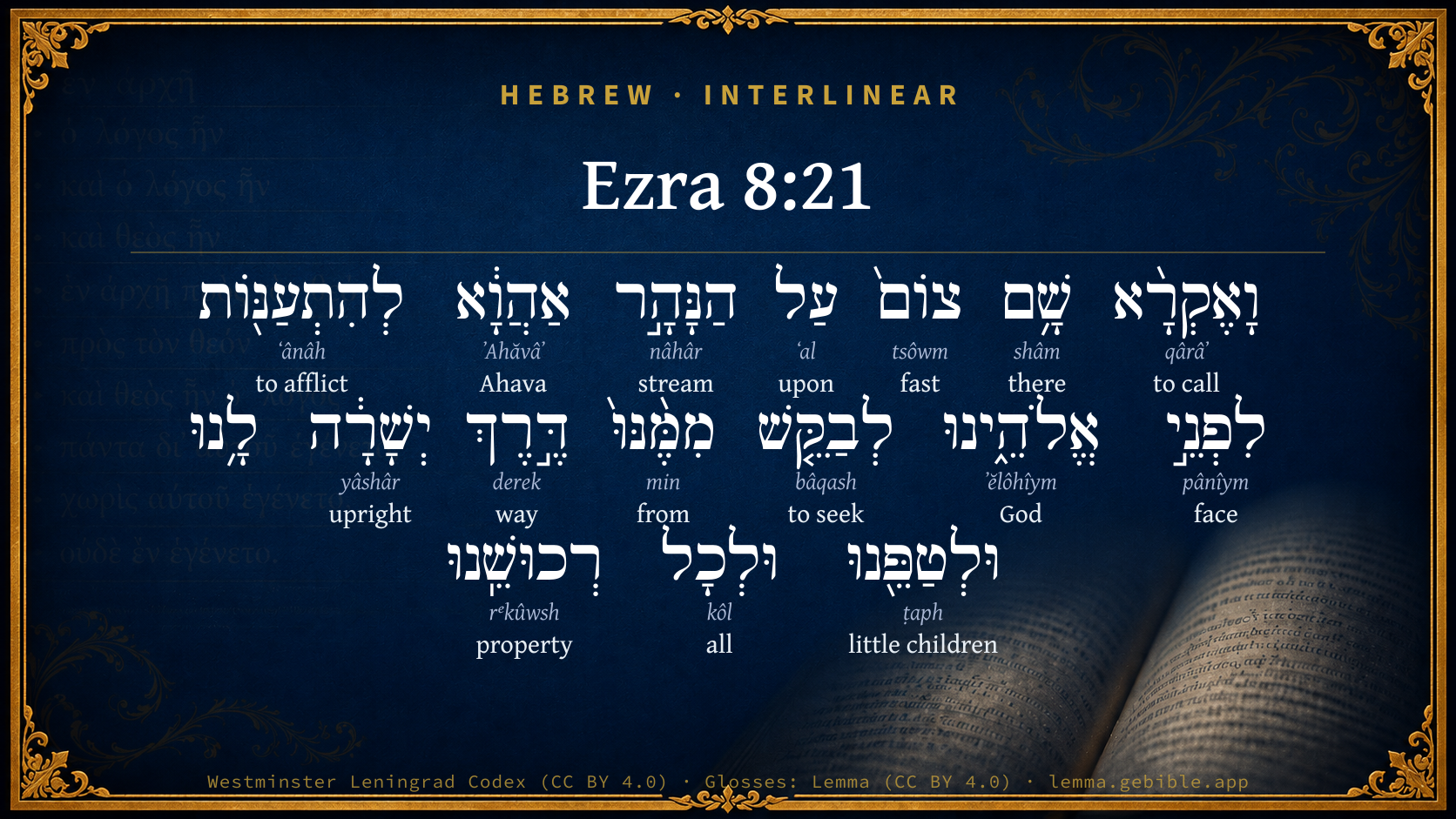
Hebrew (Westminster Leningrad Codex) Ezra 8:21 appears in the Hebrew Old Testament. The text above is from the Westminster Leningrad Codex. Each word links to its Strong’s number, a concise gloss, and parsing drawn from the Open Scriptures Hebrew Bible morphology. Click any word for its full Brown-Driver-Briggs (BDB) entry.
Download image
Cite this verse

Ezra 8:21 (World English Bible). Public Domain. Lemma interlinear Bible study tool, https://lemma.gebible.app/v/ezra/8/21.

Show BibTeX & RIS
BibTeX
RIS
English Translation
Then I proclaimed a fast there, at the river Ahava, that we might humble ourselves before our God, to seek of him a straight way for us, and for our little ones, and for all our substance.
World English Bible · Public Domain
Download a study sheet

One document with this verse’s original text, its word-by-word gloss line, the meaning frame, cross-references with their text, attributed commentary, and full source and license credits — printable, and it pastes into notes with its structure intact.

This verse Autodidact and up

Study sheet (.html) Plain text (.txt)

A passage Seminary Student

Up to 50 verses in one chapter. A passage sheet keeps up to 6 commentary sources and 12 cross-references per verse, in the order this page ranks them, and says so on the sheet whenever that leaves anything out. Ask for a single verse and you get the Autodidact verse sheet above.

Everything on this page stays free to read, with no account — the sheet is a download of what is already on screen, not access to it.

Want to remove ads? Support Godless Engineer
Compare translations 3

The same verse in 3 English versions, stacked beneath the original-language interlinear above. Click any original word for its lexicon entry.

Each is an independent rendering of the whole verse — the interlinear is not word-aligned to these translations.

Highlighted words mark where these versions differ — a whole-verse word diff, not a word-by-word alignment.

  • World English Bible Public Domain
    Then I proclaimed a fast there, at the river Ahava, that we might humble ourselves before our God, to seek of him a straight way for us, and for our little ones, and for all our substance.
  • King James Version Public Domain
    Then I proclaimed a fast there, at the river of Ahava, that we might afflict ourselves before our God, to seek of him a right way for us, and for our little ones, and for all our substance.
  • unfoldingWord Literal Text CC BY-SA 4.0
    Then I proclaimed a fast there at the river Ahava, to afflict ourselves before the face of our God to seek from him a straight way for us, and for our children, and for all our property.

unfoldingWord Literal Text — © unfoldingWord, licensed CC BY-SA 4.0. Word-aligned USFM3 via Door43 (git.door43.org/unfoldingWord/en_ult).

Versions to compare (up to 4)

3 of 4 selected

Show all 18 translations

Every available English version of this verse, each an independent rendering of the whole verse.

  • World English Bible Public Domain
    Then I proclaimed a fast there, at the river Ahava, that we might humble ourselves before our God, to seek of him a straight way for us, and for our little ones, and for all our substance.
  • Berean Standard Bible Public Domain
    And there by the Ahava Canal I proclaimed a fast, so that we might humble ourselves before our God and ask Him for a safe journey for us and our children, with all our possessions.
  • Majority Standard Bible Public Domain
    And there by the Ahava Canal I proclaimed a fast, so that we might humble ourselves before our God and ask Him for a safe journey for us and our children, with all our possessions.
  • King James Version Public Domain
    Then I proclaimed a fast there, at the river of Ahava, that we might afflict ourselves before our God, to seek of him a right way for us, and for our little ones, and for all our substance.
  • American Standard Version (1901) Public Domain
    Then I proclaimed a fast there, at the river Ahava, that we might humble ourselves before our God, to seek of him a straight way for us, and for our little ones, and for all our substance.
  • Revised Version (1885) Public Domain
    Then I proclaimed a fast there, at the river Ahava, that we might humble ourselves before our God, to seek of him a straight way, for us, and for our little ones, and for all our substance.
  • Geneva Bible (1599) Public Domain
    And there at the Riuer, by Ahaua, I proclaimed a fast, that we might humble our selues before our God, and seeke of him a right way for vs, and for our children, and for all our substance.
  • Douay-Rheims (1899) Public Domain
    And I proclaimed there a fast by the river Ahava, that we might afflict ourselves before the Lord our God, and might ask of him a right way for us and for our children, and for all our substance.
  • Young's Literal Translation Public Domain
    And I proclaim there a fast, by the river Ahava, to afflict ourselves before our God, to seek from Him a right way for us, and for our infants, and for all our substance,
  • Literal Standard Version CC BY-SA 4.0
    And I proclaim there a fast, by the river Ahava, to afflict ourselves before our God, to seek from Him a right way for us, and for our infants, and for all our substance,
  • Unlocked Literal Bible CC BY-SA 4.0
    Then I proclaimed a fast at the Ahava Canal to humble ourselves before God, to seek a straight path from him for us, our little ones, and all our possessions.
  • unfoldingWord Literal Text CC BY-SA 4.0
    Then I proclaimed a fast there at the river Ahava, to afflict ourselves before the face of our God to seek from him a straight way for us, and for our children, and for all our property.
  • Darby Bible Public Domain
    And I proclaimed a fast there, at the river Ahava, that we might humble ourselves before our God, to seek of him a right way for us, and for our little ones, and for all our substance.
  • World Messianic Bible Public Domain
    Then I proclaimed a fast there at the river Ahava, that we might humble ourselves before our God, to seek from him a straight way for us, for our little ones, and for all our possessions.
  • Webster's Bible Public Domain
    Then I proclaimed a fast there, at the river Ahava, that we might afflict ourselves before our God, to seek of him a right way for us, and for our little ones, and for all our substance.
  • Free Bible Version CC BY-SA 4.0
    At the Ahava Canal I called for a fast so we could confess our sins before God and ask him for a safe journey for us and our children, along with all our possessions.
  • Bible in Basic English Public Domain
    Then I gave orders for a time of going without food, there by the river Ahava, so that we might make ourselves low before our God in prayer, requesting from him a straight way for us and for our little ones and for all our substance.
  • JPS Tanakh (1917) Public Domain
    Then I proclaimed a fast there, at the river Ahava, that we might humble ourselves before our God, to seek of Him a straight way, for us, and for our little ones, and for all our substance.

Literal Standard Version (2020), Covenant Press — licensed CC BY-SA 4.0. Text via the HelloAO Bible API (eBible.org). Unlocked Literal Bible (unfoldingWord) — licensed CC BY-SA 4.0. Text via the HelloAO Bible API (eBible.org). unfoldingWord Literal Text — © unfoldingWord, licensed CC BY-SA 4.0. Word-aligned USFM3 via Door43 (git.door43.org/unfoldingWord/en_ult). Free Bible Version, Dr. Jonathan Gallagher — licensed CC BY-SA 4.0. Text via the HelloAO Bible API (eBible.org).

Word by word

More ways to search: Search by grammar → Find every occurrence → Compare this word →

Practice this passage: Drill this verse → Learn its vocabulary →

אַהֲוָ֔א
ʼAhăvâʼ
H163
“Ahava”
Noun, Proper
Part of Speech
Noun
Type
Proper
Full BDB Definition

Origin: probably of foreign origin

TWOT: None

Ahava = "I shall subsist" - town or area in Babylonia
  1. וָאֶקְרָ֨א qârâʼ H7121 “and · to call” Conjunction + Verb, Qal, Sequential Imperfect, 1st Person, Common, Singular
  2. שָׁ֥ם shâm H8033 “there” Adverb
  3. צוֹם֙ tsôwm H6685 “fast” Noun, Common, Masculine, Singular, Absolute
  4. עַל ʻal H5921 “upon” Preposition
  5. הַנָּהָ֣ר nâhâr H5104 “the · stream” Particle, Definite Article + Noun, Common, Masculine, Singular, Absolute
  6. לְהִתְעַנּ֖וֹת ʻânâh H6031 “to afflict” Preposition + Verb, Hithpael, Infinitive Construct
  7. לִפְנֵ֣י pânîym H6440 “to/for · face(s) of” Preposition + Noun, Common, Both, Plural, Construct
  8. אֱלֹהֵ֑ינוּ ʼĕlôhîym H430 “God(s) · our” Noun, Common, Masculine, Plural, Construct + Suffix, Personal, 1st Person, Common, Plural
  9. לְבַקֵּ֤שׁ bâqash H1245 “to seek” Preposition + Verb, Piel, Infinitive Construct
  10. מִמֶּ֨נּוּ֙ min H4480 “from · us” Preposition + Suffix, Personal, 1st Person, Common, Plural
  11. דֶּ֣רֶךְ derek H1870 “way” Noun, Common, Both, Singular, Absolute
  12. יְשָׁרָ֔ה yâshâr H3477 “upright” Adjective, Adjective, Feminine, Singular, Absolute
  13. וּלְטַפֵּ֖נוּ ṭaph H2945 “and · to/for · little children · our” Conjunction + Preposition + Noun, Common, Masculine, Singular, Construct + Suffix, Personal, 1st Person, Common, Plural
  14. וּלְכָל kôl H3605 “and · to/for · all of” Conjunction + Preposition + Noun, Common, Masculine, Singular, Construct
  15. רְכוּשֵֽׁנוּ rᵉkûwsh H7399 “property · our” Noun, Common, Masculine, Singular, Construct + Suffix, Personal, 1st Person, Common, Plural

About this verse

These counts appear in no published source. They are computed here, from the morphology-tagged text and Lemma’s own curated glosses. What Lemma adds →

17
words
16
distinct lemmas
Historical
section

Notable vocabulary

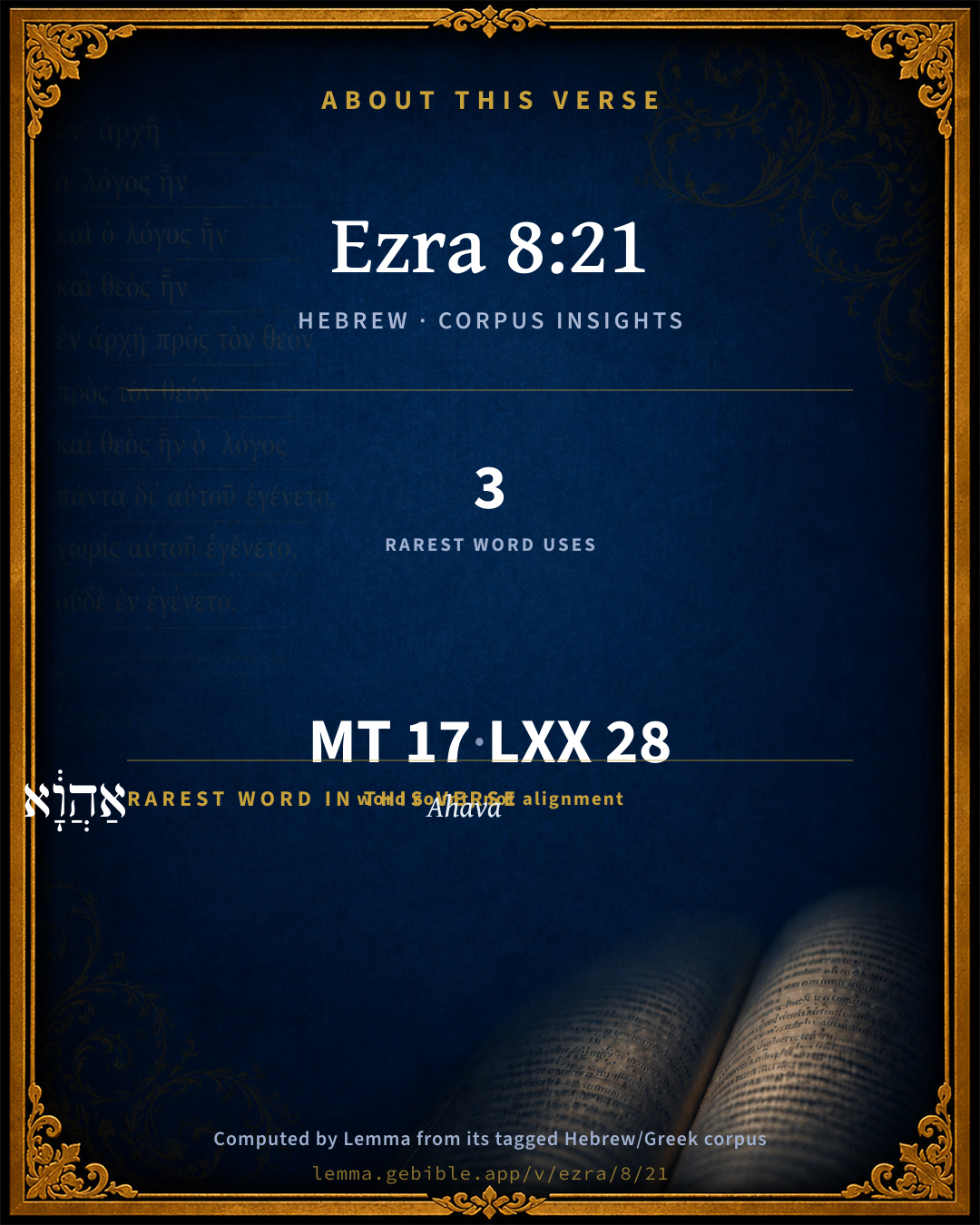
The rarest word here is אַהֲוָ֔א Ahava H163 — appearing just 3 times in the whole Hebrew Bible.

Shared distinctive vocabulary

אַהֲוָ֔א Ahava H163 occurs in 3 verses of the Hebrew Bible. Also found in:

Grammatical profile

  • 3 verbs
  • 9 nouns
  • 1 adjective
  • 3 prepositions
  • 1 adverb

Verb forms

  • וָאֶקְרָ֨א Qal · Sequential Imperfect
  • לְהִתְעַנּ֖וֹת Hithpael · Infinitive Construct
  • לְבַקֵּ֤שׁ Piel · Infinitive Construct

Hebrew & Septuagint length

In English translation the verse runs 37 words from the Hebrew and 36 from the Septuagint (LXX English) — closely comparable.

A rough comparison of the two English renderings, which tokenize alike — not a word-level alignment.

Word counts can differ between the Hebrew and the Greek without any difference in meaning — e.g. the Hebrew direct-object marker אֵת has no separate Greek word, and Greek often adds the article ὁ.

In the original languages it is 17 Hebrew tokens and 28 Greek tokens — but the two are counted differently (Hebrew bundles its prefixes and suffixes into one token; the Greek is in lemma form), so that isn’t a like-for-like length.

Cross-references

29

Topical passages linked to Ezra 8:21 in the Treasury of Scripture Knowledge — connected by theme and wording, ordered by reader-vote popularity; previews shown in the World English Bible.

  • 2 Chronicles 20:3 Jehoshaphat feared, and set himself to seek to Yahweh; and he proclaimed a fast throughout all Judah.
  • Joel 1:14 Sanctify a fast. Call a solemn assembly. Gather the elders, And all the inhabitants of the land, to the house of Yahweh, your God, And cry to Yahweh.
  • 1 Samuel 7:6 They gathered together to Mizpah, and drew water, and poured it out before Yahweh, and fasted on that day, and said there, We have sinned against Yahweh. Samuel judged the children of Israel in Mizpah.
  • Isaiah 30:21 and your ears shall hear a word behind you, saying, This is the way, walk you in it; when you turn to the right hand, and when you turn to the left.
  • Jonah 3:5 The people of Nineveh believed God; and they proclaimed a fast, and put on sackcloth, from the greatest of them even to the least of them.
  • Leviticus 16:29 "It shall be a statute to you forever: in the seventh month, on the tenth day of the month, you shall afflict your souls, and shall do no manner of work, the native-born, or the stranger who lives as a foreigner among you:
  • Leviticus 23:29 For whoever it is who shall not deny himself in that same day; shall be cut off from his people.
  • Psalms 107:2–8 Let the redeemed by Yahweh say so, Whom he has redeemed from the hand of the adversary,
  • Psalms 143:8–10 Cause me to hear your loving kindness in the morning, For I trust in you. Cause me to know the way in which I should walk, For I lift up my soul to you.
  • Psalms 5:8 Lead me, Yahweh, in your righteousness because of my enemies. Make your way straight before my face.
  • Proverbs 3:6 In all your ways acknowledge him, And he will direct your paths.
  • Isaiah 42:16 I will bring the blind by a way that they don't know; in paths that they don't know will I lead them; I will make darkness light before them, and crooked places straight. These things will I do, and I will not forsake them.
  • Joel 2:12–18 "Yet even now," says Yahweh, "turn to me with all your heart, And with fasting, and with weeping, and with mourning."
  • Ezra 8:15 I gathered them together to the river that runs to Ahava; and there we encamped three days: and I viewed the people, and the priests, and found there none of the sons of Levi.
  • Isaiah 49:10 They shall not hunger nor thirst; neither shall the heat nor sun strike them: for he who has mercy on them will lead them, even by springs of water will he guide them.
  • Isaiah 58:3 Why have we fasted, [say they], and you don't see? [why] have we afflicted our soul, and you take no knowledge? Behold, in the day of your fast you find [your own] pleasure, and exact all your labors.
  • Jeremiah 10:23 Yahweh, I know that the way of man is not in himself: it is not in man who walks to direct his steps.
  • Jeremiah 31:8–9 Behold, I will bring them from the north country, and gather them from the uttermost parts of the earth, [and] with them the blind and the lame, the woman with child and her who travails with child together: a great company shall they return here.
  • Mark 10:13–16 They were bringing to him little children, that he should touch them, but the disciples rebuked those who were bringing them.
  • Acts 2:39 For to you is the promise, and to your children, and to all who are far off, even as many as the Lord our God will call to himself."
  • Leviticus 16:31 It is a Sabbath of solemn rest to you, and you shall afflict your souls; it is a statute forever.
  • Judges 20:26 Then all the children of Israel, and all the people, went up, and came to Bethel, and wept, and sat there before Yahweh, and fasted that day until even; and they offered burnt-offerings and peace-offerings before Yahweh.
  • Isaiah 58:5 Is such the fast that I have chosen? the day for a man to afflict his soul? Is it to bow down his head as a rush, and to spread sackcloth and ashes under him? will you call this a fast, and an acceptable day to Yahweh?
  • Jeremiah 50:4–5 In those days, and in that time, says Yahweh, the children of Israel shall come, they and the children of Judah together; they shall go on their way weeping, and shall seek Yahweh their God.
  • Numbers 14:3 Why does Yahweh bring us to this land, to fall by the sword? Our wives and our little ones will be a prey: wouldn't it be better for us to return into Egypt?
  • Numbers 14:31 But your little ones, that you said should be a prey, them will I bring in, and they shall know the land which you have rejected.
  • Ezra 8:31 Then we departed from the river Ahava on the twelfth [day] of the first month, to go to Jerusalem: and the hand of our God was on us, and he delivered us from the hand of the enemy and the bandit by the way.
  • Psalms 8:2 From the lips of babes and infants you have established strength, Because of your adversaries, that you might silence the enemy and the avenger.
  • Isaiah 35:8 A highway shall be there, and a way, and it shall be called The way of holiness. The unclean shall not pass over it, but is shall be for for him who walks in the Way. Wicked fools will not go there.

Cross-references courtesy of OpenBible.info (CC BY 4.0).

Hebrew and Greek witnesses Masoretic Hebrew ↔ Greek Septuagint

The same verse in the two great witnesses to the Old Testament, shown verse-for-verse.

These are two independent witnesses, not word-aligned to each other, and the Septuagint is shown in lemma (dictionary) form.

Hebrew Ezra 8:21 Masoretic · Westminster Leningrad Codex

וָאֶקְרָ֨א שָׁ֥ם צוֹם֙ עַל הַנָּהָ֣ר אַהֲוָ֔א לְהִתְעַנּ֖וֹת לִפְנֵ֣י אֱלֹהֵ֑ינוּ לְבַקֵּ֤שׁ מִמֶּ֨נּוּ֙ דֶּ֣רֶךְ יְשָׁרָ֔ה לָ֥נוּ וּלְטַפֵּ֖נוּ וּלְכָל רְכוּשֵֽׁנוּ

Then I proclaimed a fast there, at the river Ahava, that we might humble ourselves before our God, to seek of him a straight way for us, and for our little ones, and for all our substance.

World English Bible · Public Domain

Greek LXX Ezra 8:21 Septuagint · lemma form

καί καλέω ἐκεῖ νηστεία ἐπί ὁ ποταμός αουε ὁ ταπεινόω ἐνώπιον θεός ἐγώ ζητέω παρά αὐτός ὁδός εὐθύς ἐγώ καί ὁ τέκνον ἐγώ καί πᾶς ὁ κτῆσις ἐγώ

And I proclaimed there a fast, at the river Aue, that we should humble ourselves before our God, to seek of him a straight way for us, and for our children, and for all our property.

LXX2012 (modern English Septuagint) · Public Domain

In the Septuagint this is one book — Esdras B (2 Esdras): Ezra is chapters 1–10, Nehemiah 11–23.

Hebrew: Westminster Leningrad Codex (CC BY 4.0). Greek: Septuagint (public domain); English from LXX2012 (modern English Septuagint) (Public Domain). How the Septuagint differs from the Hebrew →

Commentary

Notes on Ezra 8:21 from classic Christian and Jewish commentators (each source and its license shown beneath its notes). The classic Christian expositions comment on the surrounding passage and are grouped to its opening verse, so a note may address several verses; the Jewish commentaries on the Tanakh (Rashi and others) are per-verse, so they appear only where the commentator wrote on this verse.

Lemma curates 59 commentaries, every one of them public domain or Creative Commons licensed, each selected and text-cleaned for this edition rather than reprinted as found. About our sources →

Matthew Henry's Commentary

Ezra has procured Levites to go along with him; but what will that avail, unless he have God with him? That is therefore his chief care. In all our ways we must acknowledge God, and in those particularly wherein we are endeavouring to serve the interest of his kingdom among men. Ezra does so here. Observe,

I. The stedfast confidence he had in God and in his gracious protection. He told the king (Ezr 8:22) what principles he went upon, that those who seek God are safe under the shadow of his wings, even in their greats dangers, but that those who forsake him are continually exposed, even when they are most secure. God's servants have his power engaged for them; his enemies have it engaged against them. This Ezra believed with his heart, and with his mouth made confession of it before the king; and therefore he was ashamed to ask of the king a convoy, lest thereby he should give occasion to the king, and those about him, to suspect either God's power to help his people or Ezra's confidence in that power. Those that trust in God, and triumph in him, will be ashamed of seeking to the creature for protection, especially of using any sorry shifts for their own safety, because thereby they contradict themselves and their own confidence. Not but that those who depend upon God must use proper means for their preservation, and they need not be ashamed to do so; but, when the honour of God is concerned, one would rather expose one's-self than do any thing to the prejudice of that, which ought to be dearer to us than our lives.

II. The solemn application he made to God in that confidence: He proclaimed a fast, Ezr 8:21. No doubt he had himself begged of God direction in this affair from the first time he had it in his thoughts; but for public mercies public prayers must be made, that all who are to share in the comfort of them may join in the request for them. Their fasting was, 1. To express their humiliation. This he declares to be the intent and meaning of it. "that we might afflict ourselves before our God for our sins, and so be qualified for the pardon of them." When we are entering upon any new condition of life our care should be to bring none of the guilt of the sins of our former condition into it. When we are in any imminent peril let us be sure to make our peace with God, and then we are safe: nothing can do us any real hurt. 2. To excite their supplications. Prayer was always joined with religious fasting. Their errand to the throne of grace was to seek of God the right way, that is, to commit themselves to the guidance of the divine Providence, to put themselves under the divine protection, and to beg of God to guide and keep them in their journey and bring them safely to their journey's end. They were strangers in the road, were to march through their enemies' countries, and had not a pillar of cloud and fire to lead them, as their fathers had; but they believed that the power and favour of God, and the ministration of his angels, would be to them instead of that, and hoped by prayer to obtain divine assistance. Note, All our concerns about ourselves, our families, and our estates, it is our wisdom and duty by prayer to commit to God, and leave the care of with him, Phi 4:6.

III. The good success of their doing so (Ezr 8:23): We besought our God by joint-prayer, and he was entreated of us. They had some comfortable assurance in their own minds that their prayers were answered, and the event declared it; for never any that sought God in earnest sought him in vain.

Matthew Henry's Commentary on the Whole Bible (1708–1710) — public domain (CC PDM 1.0). Text via the HelloAO Bible API.

Jamieson, Fausset & Brown

Robert Jamieson, A. R. Fausset & David Brown

A FAST PROCLAIMED. (Ezra 8:21-36)

Then I proclaimed a fast there--The dangers to travelling caravans from the Bedouin Arabs that prowl through the desert were in ancient times as great as they still are; and it seems that travellers usually sought the protection of a military escort. But Ezra had spoken so much to the king of the sufficiency of the divine care of His people that he would have blushed to apply for a guard of soldiers. Therefore he resolved that his followers should, by a solemn act of fasting and prayer, commit themselves to the Keeper of Israel. Their faith, considering the many and constant perils of a journey across the Bedouin regions, must have been great, and it was rewarded by the enjoyment of perfect safety during the whole way.

Jamieson, Fausset & Brown — Commentary Critical and Explanatory on the Whole Bible (1871) — public domain (CC PDM 1.0). Text via the HelloAO Bible API.

Trapp's Complete Commentary

John Trapp

Ezr 8:21 Then I proclaimed a fast there, at the river of Ahava, that we might afflict ourselves before our God, to seek of him a right way for us, and for our little ones, and for all our substance.

Ver. 21. Then I proclaimed a fast there] A day of restraint from food, fine clothes, and other delights of life. There is a threefold fast, saith one, from meat, from mirth, and from sin; this last crowns all. Unless God sees turning, he sees no work in a fast, saith another, explaining that text, Jon 3:10, "God saw their works, that they turned." Of a fast, See Trapp on "Joe 2:12".

That we might afflict ourselves before our God] Not outwardly only (that is but the shell, Isa 58:3), but inwardly also, for that is the kernel of this exercise, Jer 16:19, which else is but bodily, and profiteth little; something it may, as it did Ahab; but if rightly performed, though it weakeneth the body, yet it strengtheneth the spirit, making it vigorous and victorious.

To seek of him a right way for us] To edge our prayers and give wings to them; for fasting inflameth prayer, and prayer sanctifieth fasting; hence they go coupled for the most part, Luk 2:37 Mat 17:21 1Co 7:5. And surely, if with fasting and prayer we can seek of God direction and protection, as here, we shall speed of both.

And for our little ones] These should be a main part of our care, to lay up prayers for them, to commend them to God’s safe keeping, forasmuch as puerilitas est periculorum pelagus, Little ones are liable to a thousand deaths and dangers.

And for all our substance] Our stock and our store, all the goods that we have got and gathered together. Our English word Riches answereth to the Hebrew Recush.

John Trapp, A Commentary or Exposition upon All the Books of the Old and New Testament (1647–1656) — public domain. Text from a community e-Sword module.

The Biblical Illustrator

Joseph S. Exell

Ezr_8:21

Then I proclaimed a fast there.

Prayer and fasting

(preached on the occasion of a public fast):--

I. That the best means to procure success upon our counsels and endeavours is to seek God for his blessing.

1. This results from the first principles on which all religion is built.

(1) That there is a God of infinite power who governs the world and can dispose all things in it to such ends as are agreeable to His will.

(2) That human policy and strength are of no moment when they come in opposition to His providence: There is no wisdom, nor understanding, nor counsel against the Lord.

(3) That He has a particular ears of those who serve Him faithfully.

2. In giving His assistance God does not always act in so palpable a manner as that whereby we see second causes producing their effects. But that it is the most rational and most religious way to begin at Heaven in all His consultations and designs will appear by reflecting--

(1) That it is impossible for a creature to be independent.

(2) That God can no more cease to govern the world than He can cease to be God.

(3) That He cannot govern His creatures if He does not influence them.

(4) That those who depend upon their own policy and strength, without any regard to His will, affront His majesty, reject His government, and justly provoke Him to punish and disappoint them (Pro_3:6-7).

II. That solemn fasting is a proper method to be used in such addresses to God. We have but two ways to express our thoughts and the inclinations of our minds, either by words or by such actions as naturally flow from them, and both of these are equally proper and therefore such as become our devotions. For God is the author of decency and order, and His service is then most decent and orderly when it is unaffected and agreeable to nature; and therefore such gestures or actions are proper in His worship which do naturally flow from or by custom are used to accompany such a disposition of mind as we ought to be in when we make our approaches to Him. Thus kneeling becomes us at our prayers, because it is the usual posture of supplicants; singing of hymns is decent in thanksgiving, because songs and music are fit attendants on praise and joy; and fasting is extremely proper for a solemn humiliation before God, for the begging pardon of our sins, and assistance in our difficulties, because it is a natural expression of sorrow, and is productive of humble thoughts in ourselves and devout ones towards God. And therefore we find that it has been the practice not only of the Churches of God, but even of the heathens themselves, to use solemn fasts upon extraordinary applications to Heaven, so that fasting is a part of worship prescribed by nature and by common sense of men. Public fasting should be attended with public demonstrations of seriousness, such as gravity in our discourse and behaviour, a ceasing from the business of our particular callings, abstaining from ornaments, recreations, and places of civil concourse, and spending the day in the public devotions of the Church and in the retirements of our closets. For though It private Christian may fast (as he may pray) without any of this pomp, and discharge the duty in his own breast, yet to make it public there is no other way but an outward solemnity; and a community cannot hold a fast but by such an appearance. In this the minds of men are more apt to be grave and serious when there is no appearance of jollity to divert them, they are drawn off from thoughts of worldly business and fixed on pious meditations, when they see their neighbours thronging to the temple, when there is no commerce in the shops nor hurry in the streets. Such a face of things shows that men are about the more serious business of another world. (William Hayley, D. D.)

The Biblical Illustrator, edited by Joseph S. Exell (c. 1880s–1900s) — public domain. Text from a community e-Sword module.

Joseph Benson's Commentary

Ezr 8:21. Then I proclaimed a fast there — Ezra had procured Levites to go along with him, but what would that avail unless he had God with him? this is therefore his chief care. No doubt he had himself begged of God direction in this affair, from the first time he had it in his thoughts: but for public mercies, public prayers must be made, that all who are to share in the comfort of them, may join in requests for them. Thus, in all our ways we must acknowledge God, and in those particularly wherein we are endeavouring to serve the interests of his kingdom among men. That we might afflict ourselves before our God — For our sins, and so be qualified for the pardon of them. When we are entering on any new condition of life, our care should be to bring none of the guilt of the sins of our former condition into it. When we are in any imminent peril, let us be sure to make our peace with God, and then we are safe; nothing can do us any real hurt. To seek of him a right way for us — A safe and prosperous journey; such a way and course as might be best for us. And for our little ones, and for all our substance — They had the greater reason to fast and pray, because they carried with them their little children, treasures of gold and silver, and divers vessels, and other things, of very considerable value, and were apprehensive of enemies, who would waylay them to plunder them of their substance; namely, the Arabs, Samaritans, and others, against whom they peculiarly needed the divine protection and aid.

Joseph Benson's Commentary on the Old and New Testaments (1811–1818) — public domain. Text from a community e-Sword module.

The Pulpit Commentary

CHAPTER 8:21-36

Then I proclaimed a fast there. The fight of the civil ruler to "proclaim a fast" was unquestioned among the Jews and Israelites. Jezebel proclaimed one in Ahab"s name when she wished to impress the Jezreelites with the notion that a great crime had been committed. Jehoshaphat did the same when he was invaded by the Ammonites, Moabites, and Mehunim. (2Ch_20:1-3) A fast was proclaimed in the fifth year of Jehoiakim when the kingdom of Judah was menaced by Nebuchadnezzar. (Jer_36:9) Ezra therefore assumes that he may command one now, in connection with the perils of the coming journey. That we might afflict ourselves. The Jews were commanded to "afflict themselves" on the great day of atonement, (Lev_16:29) and understood that the affliction was to be mainly by fasting and abstaining from the bath. To ask of him a right way. Or "a direct road," i.e. a prosperous and unimpeded journey to Jerusalem. For us and our little ones. The colonists went up attended by their families.

Vers. 21-30.

Before starting.

Ezra"s body of travellers now duly assembled and organised, what else was required? On the one hand, they were in a condition of much danger. Without being very numerous, they were numerous enough to be worth attacking while prosecuting their journey. On the other hand, they were in a position of much responsibility, being intrusted with the care of many treasures for God"s house. These were the two things Ezra had to see to before they actually moved. The plans he adopted in doing so are very characteristic and instructive, and may be employed to exhibit to us, in the first place, an example of courage, and in the second a model of caution.

I EZRA"S COURAGE. As we have partially noted already, the danger was great. The travellers were possessed of some "substance" (ver. 21). They were carrying trust-treasures as well. They were also bound on a route where persons so circumstanced were exceedingly likely to be attacked. At the same time, as a company, they were by no means organised for defence, being little more, in fact, than a large family party, with many women and "little ones" (ver. 21) among them. Almost like Luk_10:3. How natural, in such circumstances, to think of military protection! How readily obtainable, also, such protection in this case! Ezra seems to feel (naturally enough under the terms of his commission, (Ezr_7:12-26) that he had only to ask for this to obtain it. Instead, however, of going out of his way at all to obtain it, he rather goes out of his way to avoid it. He turns from the king to Jehovah. Refusing to ask at all in the one case, he asks with all his heart in the other, and prepares to go forward armed with nothing whatever but promise and prayer. How conspicuously great, therefore, his courage; more so even than that of David in 1Sa_17:39, 1Sa_17:40, 1Sa_17:45; still more so than that of Jacob, (Ge 32) and almost a contrast to Nehemiah. (Neh_2:9) The secret of this was to be found

(1) in his confidence in God"s power. Whatever the king could do for him in the way of protection, God could do more (comp. Rom_8:31; Psa_20:7; Psa_46:1-3, Psa_46:7, Psa_46:11)

(2) In his confidence in God"s faithfulness. Here was just one of those cases in which God might be expected to exert his great power. His well-known promise. (see 2Ch_16:9) to defend all those who sought him in truth had been openly referred to before the king (see end of ver. 22). If Ezra, in such circumstances, had now asked for an escort, he would have unsaid what he had said already, and put an open reproach on God"s truth. On the other hand, if God, when thus appealed to, had not granted his protection, may we not almost say that he would have brought a reproach on himself? It was Ezra"s conviction of this being an impossibility which gave him his great courage at this time. But chiefly, perhaps, that courage was due

(3) to his confidence in God"s mercy. God"s protection was ready for those who sought it. Sought it on what terms? Sought it

(a) with becoming earnestness, as shown by their "fasting" or turning aside from ordinary pleasures and occupations in order to be wholly occupied in this seeking (comp. Isa_58:3; Act_13:2) Sought it

(b) with proper humility, as shown by their "afflicting" themselves on account of their sins, and not asking this great favour as though they in any way deserved it. Sought it

(c) with a profound sense of his goodness, as being One concerned much for the "little ones" (ver. 21; comp. Gen_32:11; Jon_4:11) of his people, and far from unconcerned also even as to their "substance" or temporal welfare at large (comp. Psa_35:27; Mat_6:25, Mat_6:26, Mat_6:32; Luk_12:7) These were the kind of thoughts which made these companions of Ezra as we find them pictured to us here in ver. 23, viz., with Babylon left behind them, a perilous journey before them, yet all the defence they sought for found in fasting and prayer. (see Psa_36:7)

II EZRA"S CAUTION As we have already intimated, he was in a position now of great trust. The mere money value of the trust was exceedingly large, amounting in silver alone, if we take the talents as Hebrew talents, worth each, to 375 + 100 375. It was also valuable as being contributed by many of the chief personages of Persia (the "king," etc., etc.), and by all the elite of Israel in those parts ("all Israel there present"). And it was especially precious as being intended for the most sacred, as then known, of all purposes, "the house of the Lord." It was truly requisite, therefore, for such a steward not only to be "faithful," but to be "found" so (1Co_4:2; 2Co_8:20, 2Co_8:21) Accordingly, Ezra took care, first, to transfer the safe-keeping of thin precious trust to other hands than his own, thus avoiding all ground for mistrust or possibility of scandal in one important direction. Next he selected for this purpose, out of the two classes most suitable by office for such a trust, a company of no fewer (apparently) than twenty-four men (ver. 24), taking especial care to have among them two of those last-comers whose coming had been looked upon as so great a gain to them all. Further, all that was intrusted to them he duly and carefully weighed (we are told of this twice) in their presence, and then placed in their hands, evidently accompanied by a correct catalogue of the whole. And, finally, in handing it over, he sought to impress upon them a similar feeling of responsibility to that entertained by himself. "Watch ye and keep" (ver. 29) these treasures. Do so

(1) as a matter of principle. Ye yourselves are "holy," persons separated by your own office and by my choice for this work. The treasures, also, are "holy;" the vessels made for God"s house, the money a "freewill offering," i.e. something deliberately separated for his service whom we have worshipped so long. Nothing, therefore, can be plainer, nothing more solemn, than this trust. Do so

(2) as a matter of prudence. You will be asked for an account of this stewardship; a very exact account ("by weight"), a very public account ("before the chief of the priests," etc., etc.), a very solemn account, viz., in God"s own city, in God"s own house. Thus anxiously and scrupulously do we see him seeking to avoid any injury, or any occasion of blame, either to others or to himself, in connection with this trust.

From the whole we learn

1. To avoid some common mistakes. Courage is not imprudence. Caution is not cowardice. It was brave conduct on Ezra"s part to be afraid of the reproach of unfaithfulness or of bringing shame on God"s cause. It was prudent conduct on Ezra"s part to neglect human defence for Divine.

1. To make an important distinction. Precaution, in trusting God, is always weakness, generally folly, and sometimes sin. Precaution, in trusting men, even men of God, is none of the three. In such a case it is not unadvisable to associate men in companies so as to be checks and supports to one another; (Luk_10:1) and to appeal to comparatively low motives, such as prudence and the fear of detection, and not only to high ones. (Luk_12:1, Luk_12:2)

2. To recognise the spiritual unity of the Bible. In Ezra we find a man so identified with the "Law" that he has been called a second Moses. Yet the gospel itself could not teach us more than we have learnt here of the freeness of God"s mercy. (So comp. Exo_20:6, in the very heart of the Decalogue, with the Master"s own words in Joh_14:15)

HOMILIES BY J.A. MACDONALD. Vers. 21-23.

The fast at the Ahava.

The halt on the banks of the Ahava lasted three days. Ezra lost no time. He viewed his company, and finding no Levites, organised a mission to induce some of them to join him. To the credit of the sons of Levi, strong as was their attachment to the silver of Casiphia, they promptly forsook it in favour of Zion. On the third day the caravan was made up; but before the journey was undertaken Ezra proclaimed a fast. Consider

I THE OBJECT. It was to obtain the Divine guidance and protection.

1. The adults needed this for themselves.

(1) The weight of responsibility rested with them. Duties are claimed from adults which are not required from children: religious, civil. Excuses may be pleaded for infants which would not avail for adults.

(2) Where responsibilities are onerous, the greater the need of prayer and fasting. This is not sufficiently considered. Hence the serious blunders, the disasters.

2. They needed it on behalf of their little ones.

(1) Any army encumbered with women and children would be at an immense disadvantage in the face of a foe. The claims of natural affection would so distract as to destroy presence of mind, and expose to a more easy prey the very objects of solicitude.

(2) This would be so in the highest degree in an army of civilians. How helpless are we in the face of our spiritual adversaries! What need have we for the hand of God upon us for good I

3. They needed it for the safety of the treasure in their custody.

(1) It was vast in its value (vers. 24-27). The plate alone is estimated at Then there was the private property, "all the substance," of the whole caravan.

(2) It was therefore tempting to the cupidity and rapacity of marauders. These were known to exist. "The enemy in the way." We have to guard our Christian honour, which is of priceless value, against the rapacity of the "enemy in the way." So have we need of fasting and prayer.

II THE MOTIVE.

1. He was jealous for the honour of God.

(1) He might have had an escort from the king. He had influence enough at court to have procured this. The safety of the treasure, to which the king himself and his counsellors and princes had so handsomely contributed, would have been a sufficient reason to influence him.

(2) But then he had proclaimed to him great principles, viz.

(a) That "the hand of God is upon all them for good that seek him." The king might say, "Why then do you not seek him and trust in him?" May we not say this to ourselves when we are tempted to lean upon an arm of flesh?

(b) That "his power and his wrath are against all them that forsake him." The king might reply, "Why then do you not confide your defence to him from those wicked persons who would molest you?

(3) What a testimony to Artaxerxes of their faith in their principles, and of the jealousy of God for his honour, that Ezra did not ask for a military escort, and yet was prospered in his way!

2. He was jealous for the honour of his people.

(1) The great principles enunciated might be true, and yet the way of the people might be disastrous. In that case it would argue that they did not "seek God," and that, "forsaking" him, they made him their adversary.

(2) To prevent this the fast was proclaimed. The "afflicting of the soul" was to express repentance for departures from God, that his wrath might be averted and his favour conciliated. Do we not need this?

(3) Prayer was then added to the fasting (ver. 23). Fasting and prayer are naturally associated. (see Neh_1:4; Dan_9:3; Mat_17:21)

III THE ISSUE.

1. The Lord was entreated of them.

(1) Some favourable sign may have been given them. On another occasion God anthenticated his servant Ezra by sending heavy rain to show his anger. (Ezr_10:9) Their faith in God would have carried its own evidence. True faith is of Divine inspiration. (Col_2:12) Therefore it is the subsistence of things hoped for, i.e. things hoped for are to genuine faith as certain as though they subsisted.

2. The success of their journey proved it.

(1) They were "delivered from the hand of the enemy." The enemy was there, but he was restrained by the hand of God upon his people. The lurking foes as well as the avowed enemies were restrained (see ver. 31).

(2) They "came to Jerusalem" in safety (ver. 32). Our safe arrival in heaven will be the most glorious proof of the good hand of God upon us. But it would be folly to remain unassured of that good hand upon us until this proof may or may not be given. Until a present assurance be given we should not cease to pray; and if prayer without fasting does not secure it, then let fasting be added unto prayer. J.A.M.

HOMILIES BY J.S. EXELL Vers. 21-23.

The spiritual and secular aids of life.

I THE SPIRITUAL NEEDING THE AID OF THE SECULAR. "To require of the king a band of soldiers and horsemen to help us against the enemy in the way" (ver. 22). Ezra was about to conduct his comrades on a perilous journey to Jerusalem; hence he felt the need of a military guard as well as of the good hand of God upon him. The spiritual, as a rule, requires the aid of the secular.

1. Divine truth needs secular aid. As the companions of Ezra would be in danger during this march, so the word of God is often in peril in the world; infidels assail it, and secular aids are necessary to defend it.

2. The Church of God needs secular aid. It is exposed to many enemies on its journey to Jerusalem, and requires the defence of secular agencies legislative, intellectual, and social.

3. The life interests of the good need secular aid. The good man needs the aid of the physician; his property must be protected, his ships must be insured. True, God loves his own book, his own enterprise, his own people, but it is his method to aid them in the use of means. As a general rule Ezra must employ both horsemen and prayer; prayer and precaution must go together.

4. The moral needs the aid of the secular:

(1) Because God has ordained that the spiritual shall move in the sphere of the secular. The sacred vessels of the sanctuary journey in the desert under the care of man; piety is subject to physical law.

(2) Because the spiritual is in danger through the natural antagonism of the sinful heart. Ezra and his companions were endangered by men who wished to frustrate their mission; the carnal hates the spiritual, hence the need of horsemen.

(3) Because God has intrusted the spiritual to men as a discipline. The truth of God is put within the power of men that they may be cultured into a right attitude toward it; that they may become "fellow-helpers of the truth.

II THE SPIRITUAL ACTING WITHOUT THE AID OF THE SECULAR. "For I was ashamed to require of the king a band of soldiers.

1. Why did Ezra act without the aid of the secular?

(1) Because he feared lest he should manifest greater dependence upon the aid of a heathen king than in the God of heaven. Ezra did not wish Artaxerxes to take the place in his enterprise which belonged to God; he had more confidence in his God than he had in his king. There are times in religious life and in moral service when it would be wrong to put any trust in man, when Divine aid may alone be sought. Ezra wanted to show that God was the object of his supreme confidence; that he was indeed conducting the sacred vessels to Jerusalem.

(2) Because he feared lest he should deprive God of the glory of his own operation. Had Ezra obtained the band of soldiers, they would have concealed the operation of God; Christian workers must not give the glory of the Divine activity and achievement to another, much less to the soldiers of a heathen monarch.

(3) Because he feared lest he should seem to compromise Divine truth in the view of the king. Ezra had said to Artaxerxes that "the hand of our God was upon all them for good that seek him;" he feared even in appearance to compromise this statement.

(4) Because he feared lest he should substitute a carnal expedient for a spiritual preparation. Secular aids do not often avail in the absence of moral fitness. Soldiers cannot give safety to disobedience.

2. How did Ezra act without the aid of the secular? He was not indifferent to the danger to which he might be exposed in marching without the band of soldiers; he did not superstitiously seek to avert it; he did not frantically rush into it; he religiously braved it.

(1) Humility. He humbled himself before God in view of his perilous journey.

(2) Supplication. He sought the Divine aid. Thus must we act when we are called upon to reject the secular aids of life.

1. When did Ezra act without the aid of the secular? Ezra travelled without the soldiers n an important crisis; it is but seldom that we are called upon to divorce prayer and precaution.

2. What moral qualities did Ezra exhibit in thus acting without the aid of the spiritual? It is evident that he was zealous for the honour of God; courageous in sacred toil; devout in daily life; and could act alone when necessary. God answered his confidence by leading him safely to Jerusalem. E.

The Pulpit Commentary (1880–1919), ed. H.D.M. Spence-Jones & Joseph S. Exell — public domain. Text from a community e-Sword module.

Tyndale Open Study Notes

Tyndale Open Resources

8:21 fast and humble ourselves: Ezra recognized the need to look to God for the protection, safety, and health of 5,000 people going 800 miles on foot. Robbers might be hiding in the hills, there was danger in crossing rivers, and people could get sick.

Tyndale Open Study Notes — © Tyndale Open Resources, licensed CC BY-SA 4.0. Text via the HelloAO Bible API.

Geneva Bible (1599)

Geneva Bible translators

He showeth that the end of fasting, is to humble the body to the spirit, which must proceed of the heart lively touched, or else it is but hypocrisy.

Geneva Bible (1599) marginal notes — public domain. Text via Bolls.life.

Ellicott's Commentary for English Readers

(21) To seek of him a right way for us.—The wilderness was now before them, and an enemy, indefinitely referred to, was in the way: probably desert tribes, always lying in wait for unprotected caravans.

Our little ones.—An intimation that whole households went up.

Our substance.—Chiefly the treasures for the Temple, though the term signifies cattle and other goods, with an undertone of abundance.

A Bible Commentary for English Readers, edited by Charles John Ellicott (1878–1897) — public domain. Text from a community e-Sword module.

The Cambridge Bible for Schools and Colleges

gen. ed. J. J. S. Perowne

21–36. The Events of the Journey

21–30. Preparations for the journey. (a) 21–23. The rendezvous and solemn fast at Ahava

21. I proclaimed a fast] For “fasting” see also on Ezr_9:3, Ezr_10:6. Here however the fast is not proclaimed in connexion with any special commission of sin. Ezra appoints the fast (a) as the symbol of submission before God’s will and of repentance from sin, (b) as the means of intensifying religious fervour in prayer through the restraint laid upon physical appetite, (c) as the testimony that ‘man lives not by bread alone’.

Viewed in this aspect, the public fast proclaimed by Ezra was a spiritual exercise; from which the pagan notion of propitiating God’s favour by voluntary human suffering was altogether absent. Cf. 2Ch_20:3.

Compare the fast of Judas Maccabeus and his companions (1Ma_3:47) before they addressed themselves to the conflict with the forces of Antiochus Epiphanes.

that we might afflict ourselves] R.V. that we might humble ourselves. A moral not a physical discipline. The self-affliction or humiliation is expressed by a verb which gave rise to the regular word in later Hebrew for fasting, “Taanith”.

a right way] R.V. a straight way. Both a direct road, that they might not have to turn aside on account of attacks and dangers from robbers or enemies, and a level road without obstacles and inequalities. Cf. Isa_40:3, ‘make straight (or level) in the desert a high way for our God’; where the same word occurs.

our substance] same word as is rendered ‘goods’ in ch. Ezr_1:6 (see note).

The Cambridge Bible for Schools and Colleges (gen. ed. J. J. S. Perowne; Cambridge University Press, 1878–1918) — public domain. Text from a community e-Sword module.

John Gill's Exposition

For I was ashamed to require of the kings band of soldiers and horsemen,.... Which he might have had, only asking for them; so great was the interest he had in the king's favour:

to help us against the enemy in the way; the Arabs, Samaritans, and others, that might lie in wait for them, to rob them of their substance:

because we had spoken unto the king: of the special favour of God to them, his singular providence in the protection of them:

saying, the hand of our God is upon all them for good that seek him; that pray unto him, serve and worship him; his hand is open to them to bestow all needful good upon them, temporal and spiritual, and his power and providence are over them, to protect and defend them from all evil:

but his power and his wrath is against all them that forsake him; his word, his ways and worship; his powerful wrath, or the strength and force of it, is exerted against them and they are sure to feel the weight and dreadful effects of it: and now all this being said to the king, after this, to desire a guard to protect them, it would look as if they had not that favour in the sight of God, and did not believe what they had said, but distrusted his power and providence towards them; therefore, rather than reflect any dishonour on God, they chose to expose themselves to danger, seeking his face and favour, and relying on his goodness and power.

John Gill's Exposition of the Whole Bible (1746–1763) — public domain (CC PDM 1.0). Text via the HelloAO Bible API.

Haydock's Catholic Bible Commentary

Fast it seems for eight days, so that they departed on the 12th, ver. 31. (Menochius) --- It will not suffice to leave sin, we must also do works of satisfaction. (Worthington)

George Leo Haydock (1774–1849), Haydock's Catholic Family Bible and Commentary, 1859 edition — public domain. Excludes Psalms (Douay-Rheims chapter numbering differs from Protestant) and Deuterocanonical books (Catholic canon only).

Matthew Poole's English Annotations

A right way, i.e. a safe and prosperous journey; or such a way and course as might be best for us.

Matthew Poole's English Annotations on the Holy Bible (1683–1685) — public domain. Text from a community e-Sword/MySword module.

Whedon's Commentary on the Bible

Daniel D. Whedon

21. Proclaimed a fast — That by proper humiliation before God they might secure his blessing upon their journey.

Afflict ourselves — By abstinence and personal humiliation. Compare marginal references.

A right way for us — A course of righteousness and safety. Great and pressing dangers beset this expedition of Ezra. There was danger that transgressors might appear among these exiles to covet the treasures that had been given for the temple, and so, like Achan, be a curse to the whole camp. They were also in danger of robbers and perils by the way.

Daniel D. Whedon (gen. ed.), Commentary on the Old and New Testaments (1874–1909) — public domain. Text from a community e-Sword module.

John Wesley's Explanatory Notes

A fast - For public mercies. Publick prayers must be made, that all who are to share in the comfort, may share in the requests for it. Afflict ourselves - For our sins; and so be qualified for the pardon of them. When we are entering on any new condition of life, our care should be to bring into it none of the guilt of the sins of our former condition. When we are in any imminent danger, let us make our peace with God, and then nothing can hurt us. Right way - A safe and prosperous journey; such a way and course as might be best for us.

John Wesley, Explanatory Notes Upon the Whole Bible (1754–1765) — public domain. Text via the GEBible commentary corpus.

Kretzmann's Popular Commentary

Paul E. Kretzmann

The Priests Entrusted With The Lord’s Treasures

v. 21. Then I proclaimed a fast there, in preparation for the journey, its purpose being to implore from God safety amidst the many and various dangers of the desert, at the river of Ahava, that we might afflict ourselves before our God, to seek of Him a right way for us and for our little ones and for all our substance, both safe and easy to travel, that they might not be forced to abandon the best route.

v. 22. For I was ashamed to require of the king a band of soldiers and horsemen to help us against the enemy in the way, against the bands of Bedouins which infested the deserts and lived largely on robbery and plunder, because we had spoken unto the king, saying, The hand of our God is upon all them for good that seek Him, but Him power and His wrath is against all them that forsake Him. They had declared that they were traveling under the protection of the true God, and they did not want to lower the respect which Artaxerxes had for their religion at that time by applying for an armed escort.

v. 23. So we fasted and besought our God for this; and He was intreated of us. He rewarded their faith in Him by permitting them to enjoy perfect safety during the entire journey.

v. 24. Then I separated twelve of the chief of the priests, corresponding to the twelve tribes of Israel, Sherebiah, Hashabiah, and ten of their brethren with them, apparently twelve, each, of priests and of Levites,

v. 25. and weighed unto them the silver and the gold and the vessels, even the offering of the house of our God, which the king, and his counselors, and his lords, and all Israel there present had offered, Ezr 7:15-16.

v. 26. I even weighed unto their hand six hundred and fifty talents of silver and silver vessels an hundred talents and of gold an hundred talents;

v. 27. also twenty basins of gold, covered cups for pouring out drink-offerings,of a thousand drains, literally, "darics," Persian money; and two vessels of fine copper, of excellent polish, precious as gold. The value of all these treasures has been estimated at about two and one half million dollars.

v. 28. And I said unto them, Ye are holy unto the Lord, set apart for the special service of Jehovah; the vessels are holy also, intended for use in divine worship only, set apart for this purpose; and the silver and the gold are a free-will offering unto the Lord God of your fathers, voluntarily contributed by both the Jews of Babylon and by their heathen neighbors, together with the king and his counselors.

v. 29. Watch ye and keep them, as consecrated custodians, until ye weigh them before the chief of the priests and the Levites and chief of the fathers of Israel at Jerusalem, in the chambers of the house of the Lord, where all these treasures were to be delivered intact.

v. 30. So took the priests and the Levites the weight of the silver and the gold and the vessels to bring them to Jerusalem, unto the house of our God, they accepted the commission with the same solemnity with which it was tendered.

v. 31. Then we departed from the river of Ahava, from the region on the Euphrates known by that name, on the twelfth day of the first month, some time having elapsed during which the Levites who were summoned joined the caravan, to go unto Jerusalem; and the hand of our God was upon us, and He delivered us from the hand of the enemy, and of such as lay in wait by the way, both the organized and the unorganized desert robbers. "To accomplish a journey so long and so arduous in perfect safety is one of the most astonishing events recorded in history. Nothing but the vigilant care of a superintending Providence could have brought them securely to their destination. "

v. 32. And we came to Jerusalem, after a journey of about four months, and abode there three days, resting from the effects of their journey.

v. 33. Now, on the fourth day was the silver and the gold and the vessels weighed in the house of our God by the hand of Xeremoth, the son of Uriah, the priest, apparently in charge of the Lord’s treasures; and with him was Eleazar, the son of Phinehas; and with them was Jozabad, the son of Jeshua, and Noadiah, the son of Binnui, Levites, all these witnesses being present to see that everything was done decently and in order;

v. 34. by number and by weight of every one; and all the weight was written at that time, everything noted down carefully in an official document, so that the correct preservation might be confirmed.

v. 35. Also the children of those that had been carried away, which were come out of the captivity, those who had returned in this caravan, offered burnt offerings unto the God of Israel: twelve bullocks for all Israel, ninety and six rams, seventy and seven lambs, twelve he-goats for a sin-offering. Cf Ezr 6:17; Leviticus 4. All this was a burnt offering unto the Lord.

v. 36. And they delivered the king’s commissions unto the king’s lieutenants and to the governors on this side the river, both to the satraps, as civil officers, and to the chief military officers in the satrapy between the Euphrates and the Mediterranean; and they, these Persian magnates, furthered the people and the house of God, they brought their influence to bear in favor of the Jews. Even as the Jews of that time took care of the outward treasures of their worship, so the Christians must be the guardians of the spiritual treasures entrusted to them, the Gospel and the Sacraments.

Paul E. Kretzmann, Popular Commentary of the Bible (1921–1924) — public domain. Text from a community e-Sword module.

unfoldingWord translationNotes

Door43 World Missions Community

the Ahava Canal

This is the name of the canal that flows to the place called Ahava. See how you translated Ahava and canal in Esra 8:15. (See: How to Translate Names)

to seek a straight path from him for us, our little ones, and all our possessions

The word "seek" represents asking God to do something for them. Here a "straight path" represents safety while they travel. AT: "to ask God to give us, our little ones, and all our possessions safety while we travel" or "to ask God to protect us, our little ones, and all our possessions while we travel" (See: Metaphor)

The hand of our God is on all who seek him

The hand of God being on people is a metonym for God helping people. Seeking God is a metaphor for serving him. AT: "God helps all who serve him" (See: Metonymy and Metaphor)

but his might and wrath are on all who forget him

God's might and wrath being on people is a metonym for him punishing people. Forgetting God is a metaphor for refusing to serve him. AT: "but he punishes all who refuse to serve him" (See: Metonymy and Metaphor)

So we fasted and sought God about this

Here seeking God is a metaphor for asking God to do something for them. AT: "So we fasted and asked God to help us" (See: Metaphor)

translationWords

preach

fast

humble

possess

unfoldingWord translationNotes — © Distant Shores Media and the Door43 World Missions Community, licensed CC BY-SA 4.0. Source: git.door43.org/Door43/en_tn.

Rashi

Rabbi Shlomo Yitzchaki (Rashi)

to fast Heb. לְהִתְעַנוֹת to fast.

a straight way that the Omnipresent lead us in peace.

Rashi on the Tanakh — English translations: “The Judaica Press complete Tanach with Rashi, translated by A. J. Rosenberg” (CC BY 4.0); “Pentateuch with Rashi's commentary by M. Rosenbaum and A.M. Silbermann, 1929-1934” (public domain); “The Metsudah Tanach series, Lakewood, N.J” (CC BY 4.0); and “The Book of Joshua, Metsudah Publications, 1997” (CC BY 4.0). Text via Sefaria.

Lesson kit

Teaching starters — assembled from the data on this page, not authored interpretation. Every prompt links to the verse data it draws on. Edit before teaching.

Ezra, in the Historical, opens this verse with 17 words (16 distinct Hebrew lemmas). Its most distinctive word is ʼAhăvâʼ (“Ahava”). A historical commentator’s framing appears above. Read the whole chapter for the surrounding context.

Discussion questions

  1. What does “Ahava” (ʼAhăvâʼ) contribute to the verse as a whole?
  2. How does Ezra 8:15, which shares the word «Ahava», read alongside this verse?
  3. These translations render this verse differently; the difference is in the English rendering, not the original. What questions does that raise?
  4. «וָאֶקְרָ֨א» is a Qal Sequential Imperfect verb. How does that grammatical form shape the action described?
  5. Compare how Matthew Henry's Commentary and Jamieson, Fausset & Brown read this verse. Where do they agree or differ?

Things to notice

Reading settings

Reading text

Shown beneath each verse's original-language words.

Old Testament
Old Testament edition

Read the OT as the Masoretic Hebrew (MT) or the Greek Septuagint (LXX).

English shown for the Greek Septuagint (in the Hebrew ↔ Greek comparison).

Comparing translations? Open the Compare panel on any verse page to stack up to four side by side.