
Proverbs 17:19

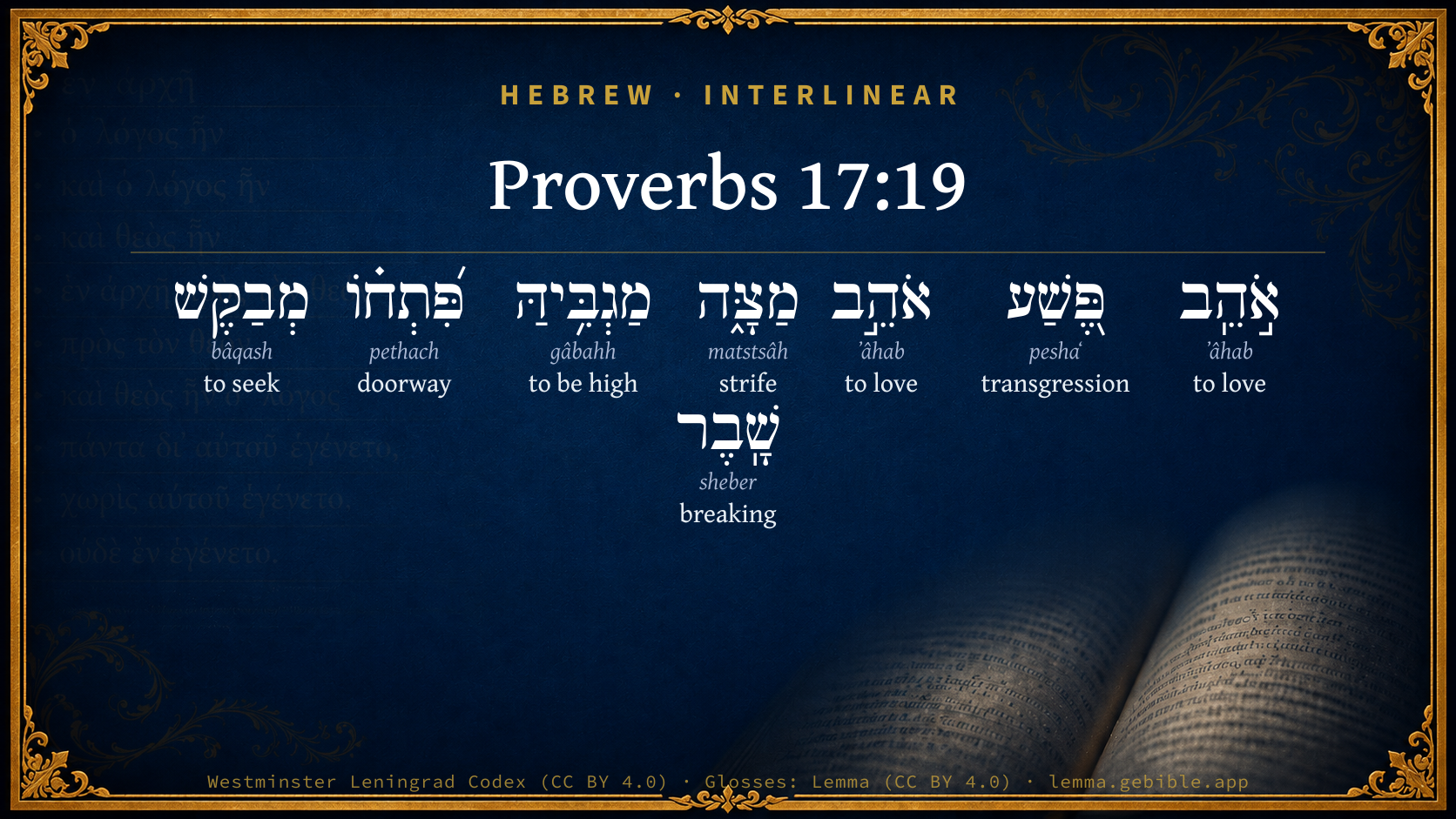
Hebrew (Westminster Leningrad Codex) Proverbs 17:19 appears in the Hebrew Old Testament. The text above is from the Westminster Leningrad Codex. Each word links to its Strong’s number, a concise gloss, and parsing drawn from the Open Scriptures Hebrew Bible morphology. Click any word for its full Brown-Driver-Briggs (BDB) entry.
Download image
Cite this verse

Proverbs 17:19 (World English Bible). Public Domain. Lemma interlinear Bible study tool, https://lemma.gebible.app/v/proverbs/17/19.

Show BibTeX & RIS
BibTeX
RIS
English Translation
He who loves disobedience loves strife. One who builds a high gate seeks destruction.
World English Bible · Public Domain
Download a study sheet

One document with this verse’s original text, its word-by-word gloss line, the meaning frame, cross-references with their text, attributed commentary, and full source and license credits — printable, and it pastes into notes with its structure intact.

This verse Autodidact and up

Study sheet (.html) Plain text (.txt)

A passage Seminary Student

Up to 50 verses in one chapter. A passage sheet keeps up to 6 commentary sources and 12 cross-references per verse, in the order this page ranks them, and says so on the sheet whenever that leaves anything out. Ask for a single verse and you get the Autodidact verse sheet above.

Everything on this page stays free to read, with no account — the sheet is a download of what is already on screen, not access to it.

Want to remove ads? Support Godless Engineer
Compare translations 3

The same verse in 3 English versions, stacked beneath the original-language interlinear above. Click any original word for its lexicon entry.

Each is an independent rendering of the whole verse — the interlinear is not word-aligned to these translations.

Highlighted words mark where these versions differ — a whole-verse word diff, not a word-by-word alignment.

  • World English Bible Public Domain
    He who loves disobedience loves strife. One who builds a high gate seeks destruction.
  • King James Version Public Domain
    He loveth transgression that loveth strife: and he that exalteth his gate seeketh destruction.
  • unfoldingWord Literal Text CC BY-SA 4.0
    One who loves transgression loves contention; one who makes his opening high seeks a breaking.

unfoldingWord Literal Text — © unfoldingWord, licensed CC BY-SA 4.0. Word-aligned USFM3 via Door43 (git.door43.org/unfoldingWord/en_ult).

Versions to compare (up to 4)

3 of 4 selected

Show all 18 translations

Every available English version of this verse, each an independent rendering of the whole verse.

  • World English Bible Public Domain
    He who loves disobedience loves strife. One who builds a high gate seeks destruction.
  • Berean Standard Bible Public Domain
    He who loves transgression loves strife; he who builds his gate high invites destruction.
  • Majority Standard Bible Public Domain
    He who loves transgression loves strife; he who builds his gate high invites destruction.
  • King James Version Public Domain
    He loveth transgression that loveth strife: and he that exalteth his gate seeketh destruction.
  • American Standard Version (1901) Public Domain
    He loveth transgression that loveth strife: He that raiseth high his gate seeketh destruction.
  • Revised Version (1885) Public Domain
    He loveth transgression that loveth strife: he that raiseth high his gate seeketh destruction.
  • Geneva Bible (1599) Public Domain
    He loueth transgression, that loueth strife: and he that exalteth his gate, seeketh destruction.
  • Douay-Rheims (1899) Public Domain
    He that studieth discords, loveth quarrels: and he that exalteth his door, seeketh ruin.
  • Young's Literal Translation Public Domain
    Whoso is loving transgression is loving debate, Whoso is making high his entrance is seeking destruction.
  • Literal Standard Version CC BY-SA 4.0
    Whoever is loving transgression is loving debate, || Whoever is making his entrance high is seeking destruction.
  • Unlocked Literal Bible CC BY-SA 4.0
    Whoever loves conflict loves sin; the one who makes the threshold of his door too high causes bones to be broken.
  • unfoldingWord Literal Text CC BY-SA 4.0
    One who loves transgression loves contention; one who makes his opening high seeks a breaking.
  • Darby Bible Public Domain
    He loveth transgression that loveth a quarrel; he that maketh high his gate seeketh destruction.
  • World Messianic Bible Public Domain
    He who loves disobedience loves strife. One who builds a high gate seeks destruction.
  • Webster's Bible Public Domain
    He loveth transgression that loveth strife: and he that exalteth his gate seeketh destruction.
  • Free Bible Version CC BY-SA 4.0
    People who love sin like to argue; those who build high gates invite destruction.
  • Bible in Basic English Public Domain
    The lover of fighting is a lover of sin: he who makes high his doorway is looking for destruction.
  • JPS Tanakh (1917) Public Domain
    He loveth transgression that loveth strife; he that exalteth his gate seeketh destruction.

Literal Standard Version (2020), Covenant Press — licensed CC BY-SA 4.0. Text via the HelloAO Bible API (eBible.org). Unlocked Literal Bible (unfoldingWord) — licensed CC BY-SA 4.0. Text via the HelloAO Bible API (eBible.org). unfoldingWord Literal Text — © unfoldingWord, licensed CC BY-SA 4.0. Word-aligned USFM3 via Door43 (git.door43.org/unfoldingWord/en_ult). Free Bible Version, Dr. Jonathan Gallagher — licensed CC BY-SA 4.0. Text via the HelloAO Bible API (eBible.org).

Word by word

More ways to search: Search by grammar → Find every occurrence → Compare this word →

Practice this passage: Drill this verse → Learn its vocabulary →

About this verse

These counts appear in no published source. They are computed here, from the morphology-tagged text and Lemma’s own curated glosses. What Lemma adds →

8
words
7
distinct lemmas
Wisdom
section

Notable vocabulary

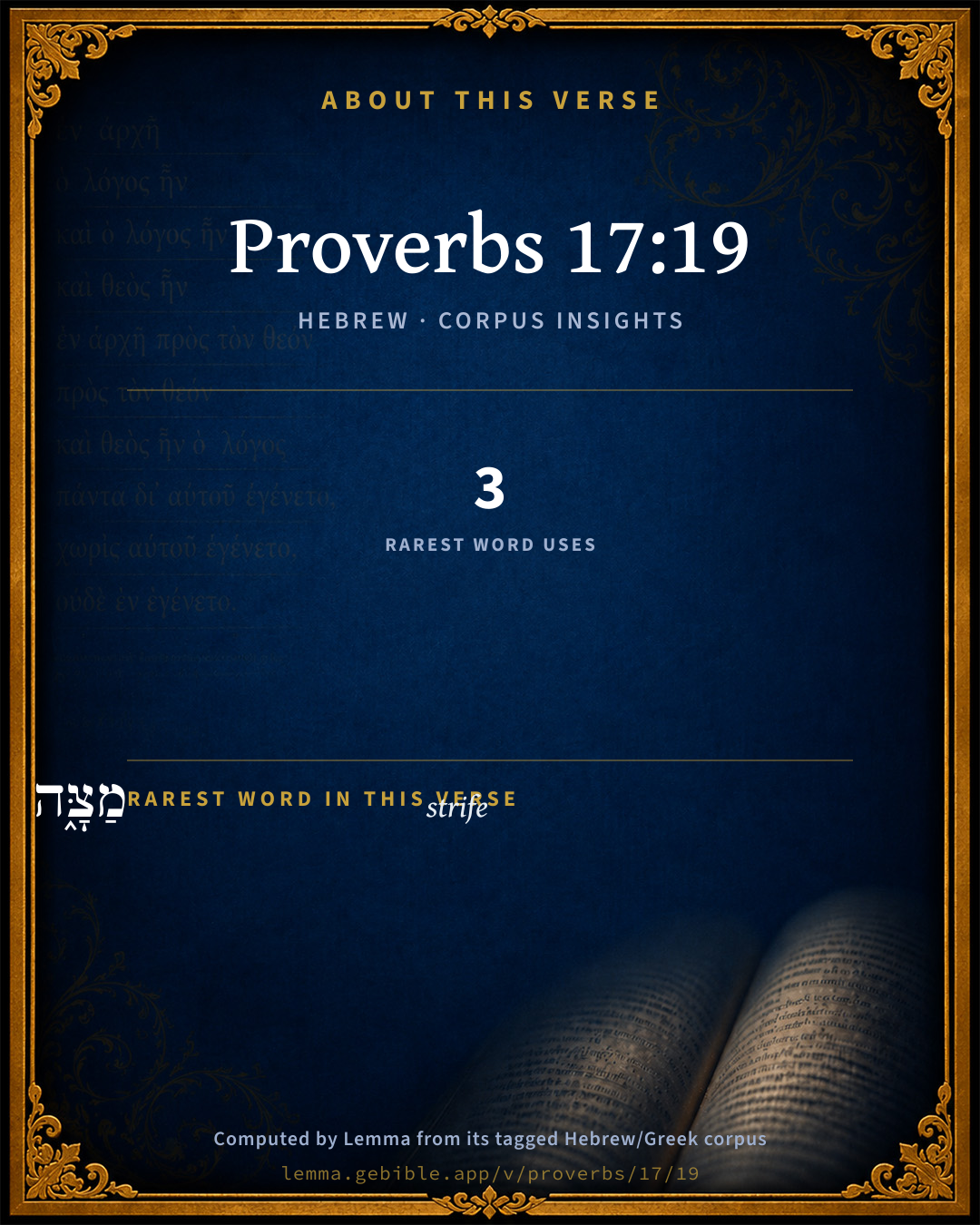
The rarest word here is מַצָּ֑ה strife H4683 — appearing just 3 times in the whole Hebrew Bible.

Shared distinctive vocabulary

מַצָּ֑ה strife H4683 occurs in 3 verses of the Hebrew Bible. Also found in:

Grammatical profile

  • 4 verbs
  • 4 nouns

Verb forms

  • אֹ֣הֵֽב Qal · Participle Active
  • אֹהֵ֣ב Qal · Participle Active
  • מַגְבִּ֥יהַּ Hiphil · Participle Active
  • מְבַקֶּשׁ Piel · Participle Active

Repetition

A word recurs within this verse — often emphatic in Hebrew:

  • אֹ֣הֵֽב to love H157 ×2

Hebrew & Septuagint length

In English translation the verse runs 14 words from the Hebrew and 7 from the Septuagint (LXX English) — the Septuagint runs noticeably shorter here. See the side-by-side →

A rough comparison of the two English renderings, which tokenize alike — not a word-level alignment.

Word counts can differ between the Hebrew and the Greek without any difference in meaning — e.g. the Hebrew direct-object marker אֵת has no separate Greek word, and Greek often adds the article ὁ.

Cross-references

14

Topical passages linked to Proverbs 17:19 in the Treasury of Scripture Knowledge — connected by theme and wording, ordered by reader-vote popularity; previews shown in the World English Bible.

  • Proverbs 16:18 Pride goes before destruction, And a haughty spirit before a fall.
  • Proverbs 18:12 Before destruction the heart of man is proud, But before honor is humility.
  • 1 Samuel 25:36–38 Abigail came to Nabal; and, behold, he held a feast in his house, like the feast of a king; and Nabal's heart was merry within him, for he was very drunken: therefore she told him nothing, less or more, until the morning light.
  • James 3:14–16 But if you have bitter jealousy and selfish ambition in your heart, don't boast and don't lie against the truth.
  • 2 Samuel 15:1 It happened after this, that Absalom prepared him a chariot and horses, and fifty men to run before him.
  • 1 Kings 1:5 Then Adonijah the son of Haggith exalted himself, saying, I will be king: and he prepared him chariots and horsemen, and fifty men to run before him.
  • Proverbs 17:14 The beginning of strife is like breaching a dam, Therefore stop contention before quarreling breaks out.
  • Proverbs 24:27 Prepare your work outside, And get your fields ready. Afterwards, build your house.
  • Proverbs 29:9 If a wise man goes to court with a foolish man, The fool rages or scoffs, and there is no peace.
  • Proverbs 29:22–23 An angry man stirs up strife, And a wrathful man abounds in sin.
  • James 1:20 for the anger of man doesn't produce the righteousness of God.
  • Jeremiah 22:13–15 Woe to him who builds his house by unrighteousness, and his chambers by injustice; who uses his neighbor's service without wages, and doesn't give him his hire;
  • Daniel 4:20–21 The tree that you saw, which grew, and was strong, whose height reached to the sky, and the sight of it to all the earth;
  • 2 Corinthians 12:20 For I am afraid that by any means, when I come, I might find you not the way I want to, and that I might be found by you as you don't desire; that by any means there would be strife, jealousy, outbursts of anger, factions, slander, whisperings, proud thoughts, riots;

Cross-references courtesy of OpenBible.info (CC BY 4.0).

Hebrew and Greek witnesses Masoretic Hebrew ↔ Greek Septuagint

The same verse in the two great witnesses to the Old Testament, shown verse-for-verse.

Here the Septuagint runs noticeably shorter than the Hebrew — LXX2012 (modern English Septuagint) 7 words vs World English Bible 14. A rough length comparison of the two English translations, not a word-level alignment — read both below.

These are two independent witnesses, not word-aligned to each other, and the Septuagint is shown in lemma (dictionary) form.

Hebrew Proverbs 17:19 Masoretic · Westminster Leningrad Codex

אֹ֣הֵֽב פֶּ֭שַׁע אֹהֵ֣ב מַצָּ֑ה מַגְבִּ֥יהַּ פִּ֝תְח֗וֹ מְבַקֶּשׁ שָֽׁבֶר

He who loves disobedience loves strife. One who builds a high gate seeks destruction.

World English Bible · Public Domain

Greek LXX Proverbs 17:19 Septuagint · lemma form

φιλαμαρτήμων χαίρω μάχη

A lover of sin rejoices in strifes;

LXX2012 (modern English Septuagint) · Public Domain

On this verse, John Gill's Exposition discusses the Septuagint’s reading. Read the note in Commentary ↓

Hebrew: Westminster Leningrad Codex (CC BY 4.0). Greek: Septuagint (public domain); English from LXX2012 (modern English Septuagint) (Public Domain). How the Septuagint differs from the Hebrew →

Commentary

Notes on Proverbs 17:19 from classic Christian and Jewish commentators (each source and its license shown beneath its notes). The classic Christian expositions comment on the surrounding passage and are grouped to its opening verse, so a note may address several verses; the Jewish commentaries on the Tanakh (Rashi and others) are per-verse, so they appear only where the commentator wrote on this verse.

Lemma curates 59 commentaries, every one of them public domain or Creative Commons licensed, each selected and text-cleaned for this edition rather than reprinted as found. About our sources →

Trapp's Complete Commentary

John Trapp

Pro 17:19 He loveth transgression that loveth strife: [and] he that exalteth his gate seeketh destruction.

Ver. 19. He loveth transgression that loveth strife.] It is strange that any should love strife, that hellhag, ερις ερυννις. And yet some, like trouts, love to swim against the stream; like salamanders, they live in the fire of contention; like Phocion, they hold it a goodly thing to dissent from others; like Pyrrhus, they are a "people that delight in war"; {Psa 68:30} like David’s enemies, "I am for peace," saith he (that was his motto), "but when I speak of it, they are for war." {Psa 120:7} These unquiet spirits are of the devil doubtless, that turbulent creature, that troubler of God’s Israel. He knows that "where envying and strife is, there is confusion and every evil work," {Jas 3:16} and that he loveth transgression that loveth strife; he taketh pleasure in sin, which is the cause of his unquietness. Good, therefore, and worthy of all acceptation is the council of the Psalmist, "Cease from anger, and forsake wrath; fret not thyself in any wise to do evil." {Psa 37:8} He that "frets" much will soon be drawn to "do evil." "An angry man stirs up strife, and a furious man aboundeth in transgression" {Pro 29:22} Hence our Saviour bids "have salt within yourselves"; that is, mortify your corruptions, and then "be at peace one with another." {Mar 9:50} Hence also St James saith, that "the wisdom from above is first pure, and then peaceable." And St Paul oft joins faith and love together; there can be no true love to, and good agreement with men, till the heart be purified by faith from the love of sin.

And he that exalteth his gate seeketh destruction.] Eventually he seeketh it, though not intentionally. "That exalteth his gate," that is, his whole house - a part being put for the whole - which he that builds too sumptuously is in the ready road to beggary; the beggar will soon have him by the back, as they say; quaerit rupturam, he will shortly break. Others read the words thus, "And he enlargeth his gate that seeketh a breach"; that is, say they, he that picketh quarrels, and is contentious, setteth open a wide door to let in many mischiefs.

John Trapp, A Commentary or Exposition upon All the Books of the Old and New Testament (1647–1656) — public domain. Text from a community e-Sword module.

Joseph Benson's Commentary

Pro 17:19. He loveth transgression that loveth strife — Because contention is in itself a sin, and is commonly accompanied or followed with many sins, as detraction, malice, hatred, pride, &c.; and he that exalteth his gate — Namely, the gate of his house, that maketh it, and consequently his house, lofty and magnificent beyond what becomes his quality, that he may overtop and outshine his neighbours; which being an effect and evidence of pride and haughtiness, is here mentioned for all other evidences thereof. So the sense is, he who carries himself loftily and scornfully; seeketh destruction — Seeks those things which will expose him to destruction, because he makes himself odious both to God and men.

Joseph Benson's Commentary on the Old and New Testaments (1811–1818) — public domain. Text from a community e-Sword module.

Tyndale Open Study Notes

Tyndale Open Resources

17:19 high walls: Foolish confidence in the ability to win a fight emboldens people to engage in disastrous arguments.

Tyndale Open Study Notes — © Tyndale Open Resources, licensed CC BY-SA 4.0. Text via the HelloAO Bible API.

Geneva Bible (1599)

Geneva Bible translators

Lifteth up himself above his degree.

Geneva Bible (1599) marginal notes — public domain. Text via Bolls.life.

Matthew Henry's Commentary

Note, 1. Those that are quarrelsome involve themselves in a great deal of guilt: He that loves strife, that in his worldly business loves to go to law, in religion loves controversies, and in common conversation loves to thwart and fall out, that is never well but when he is in the fire, he loves transgression; for a great deal of sin attends that sin, and the way of it is down-hill. He pretends to stand up for truth, and for his honour and right, but really he loves sin, which God hates. 2. Those that are ambitious and aspiring expose themselves to a great deal of trouble, such as often ends in their ruin: He that exalts his gate, builds a stately house, at least a fine frontispiece, that he may overtop and outshine his neighbours, seeks his own destruction and takes a deal of pains to ruin himself; he makes his gate so large that his house and estate go out at it.

Matthew Henry's Commentary on the Whole Bible (1708–1710) — public domain (CC PDM 1.0). Text via the HelloAO Bible API.

Jamieson, Fausset & Brown

Robert Jamieson, A. R. Fausset & David Brown

strife--contention is, and leads to, sin.

he that exalteth his gate--gratifies a vain love of costly building.

seeketh--or, "findeth," as if he sought (compare "loveth death," Pro 8:36).

Jamieson, Fausset & Brown — Commentary Critical and Explanatory on the Whole Bible (1871) — public domain (CC PDM 1.0). Text via the HelloAO Bible API.

Adam Clarke's Commentary

Verse 19. He that exalteth his gate] In different parts of Palestine they are obliged to have the doors of their courts and houses very low, not more than three feet high, to prevent the Arabs, who scarcely ever leave the backs of their horses, from riding into the courts and houses, and spoiling their goods. He, then, who, through pride and ostentation, made a high gate, exposed himself to destruction; and is said here to seek it, because he must know that this would be a necessary consequence of exalting his gate. But although the above is a fact, yet possibly gate is here taken for the mouth; and the exalting of the gate may mean proud boasting and arrogant speaking, such as has a tendency to kindle and maintain strife. And this interpretation seems to agree better with the scope of the context than the above.

Adam Clarke's Commentary on the Bible (1810–1826) — public domain. Text from a community e-Sword/MySword module.

Ellicott's Commentary for English Readers

(19) He that exalteth his gate.—Builds himself a sumptuous house.

A Bible Commentary for English Readers, edited by Charles John Ellicott (1878–1897) — public domain. Text from a community e-Sword module.

The Cambridge Bible for Schools and Colleges

gen. ed. J. J. S. Perowne

19. exalteth] Or, raiseth high, R.V. Comp. Pro_16:18. See for illustrations of such “raising high the gate” and of the “destruction” that follows it, Jer_22:13-19, and the case of Haman in the Book of Esther.

The relation of pride to strife (Pro_13:10) supplies a connecting link between the two clauses of this verse.

The Cambridge Bible for Schools and Colleges (gen. ed. J. J. S. Perowne; Cambridge University Press, 1878–1918) — public domain. Text from a community e-Sword module.

John Gill's Exposition

He loveth transgression that loveth strife,.... For strife is transgression, when it flows from a malignant spirit, is with bad views, about things to no profit, and for contention's sake; otherwise to contend earnestly for the truth; to strive together for the faith of the Gospel, for matters of moment and importance, and not mere words; to strive lawfully in a cause that is just, and for truth and justice, is commendable and praiseworthy;

and he that exalteth his gate seeketh destruction; that opens the door of his lips, and speaks proudly, as Jarchi and Aben Ezra interpret it; who compare it with Mic 7:5; who set their mouths against heaven, and God in it; and whose tongue walks through the earth, and spares none there, Psa 73:8; as antichrist, who opens his mouth in blasphemy against God and his tabernacle, and exalts himself above all that is called God; and such, sooner or later, bring destruction on themselves, and find it as surely as if they sought for it. Or this may be understood of proud ambitious persons, that build houses more magnificent than their substance will allow of, the gate being put for the whole; by which means they bring themselves to ruin. The Septuagint, Vulgate Latin, and Arabic versions, have it in Pro 17:16, "he that buildeth his house high"; or who behaves proudly.

John Gill's Exposition of the Whole Bible (1746–1763) — public domain (CC PDM 1.0). Text via the HelloAO Bible API.

Albert Barnes' Notes on the Bible

He that exalteth his gate - i. e., Builds a stately house, indulges in arrogant ostentation.

Albert Barnes' Notes on the Bible (1834–1885) — public domain. Text from a community e-Sword/MySword module.

Haydock's Catholic Bible Commentary

Door. Sixtus V reads, "mouth:" as some explain the door to mean. A large door supposes that the house is elevated, and thus exposed to danger from winds, &c.

George Leo Haydock (1774–1849), Haydock's Catholic Family Bible and Commentary, 1859 edition — public domain. Excludes Psalms (Douay-Rheims chapter numbering differs from Protestant) and Deuterocanonical books (Catholic canon only).

Matthew Poole's English Annotations

He loveth transgression that loveth strife, because contention is in itself a sin, and is commonly accompanied or followed with many sins, as detraction, malice, hatred, pride, &c.

His gate; either,

1. His mouth, i.e. who speaketh loftily; for we read of the gate or doors of one’s mouth in Mic 7:5. and elsewhere; but then the word mouth or tongue is added to determine the sense: but the mouth is no where called the gate, simply or absolutely. Or,

2. The gate of his house that maketh it, and consequently his house, lofty and magnificent, beyond what befits his quality, which being an evidence and effect of pride and haughtiness of spirit, is here mentioned for all the rest. So the sense is, He who carries himself loftily and scornfully.

Seeketh destruction; he seeks those things which will expose him to destruction, because he maketh himself odious both to God and men. Or, findeth destruction; seeking being put for finding or procuring, as above, Pro 17:9.

Matthew Poole's English Annotations on the Holy Bible (1683–1685) — public domain. Text from a community e-Sword/MySword module.

Whedon's Commentary on the Bible

Daniel D. Whedon

19. He loveth transgression — Or sin: or, a lover of rebellion is a lover of war. It is uncertain which is subject and which is predicate.

He that exalteth his gate seeketh destruction — That is, in effect. The imagery of the clause is supposed to come from the custom of making low gates, in order to guard against the incursions of predatory horsemen. A high gate, often made so at great expense for ornament and the gratification of the owner’s vanity, enabled them to dash in, without dismounting, to drive or carry off their booty hastily. The application is easy. He that makes a splendid display, especially in magnificent buildings beyond his means to erect, is, in effect, seeking financial ruin, or, as we say, “breaking up.”

Many a business man, by an outlay of this kind, has involved himself in bankruptcy. The proverb may be applied more generally to the effects of haughtiness. “Pride will have a fall.” Compare Pro_16:18.

Daniel D. Whedon (gen. ed.), Commentary on the Old and New Testaments (1874–1909) — public domain. Text from a community e-Sword module.

The Pulpit Commentary

He loveth transgression that loveth strife, because strife leads to many breaches of the commandments. (comp. Pro_29:22 Jam_1:20) Septuagint, "He who loveth sin rejoices in battles." And he that exalteth his gate seeketh destruction. He who builds a sumptuous house and lives in the way that his magnificent surroundings demand draws ruin on himself, either because he affects a state which he is unable to support, or acts so as to provoke reprisals and injurious consequences. The entrance to a Palestinian house would usually be of humble dimensions and sparse ornamentation; any doorway of great architectural pretensions would be uncommon, and would be regarded as a token of extraordinary wealth or reprehensible pride. Aben Ezra, taking "gate" as a metaphor for "mouth," explains the hemistich of the danger of random or excessive speech. This makes a good parallel with the first clause; but it is doubtful whether the words will bear this interpretation (see Hitzig); and the two clauses may present two forms of selfishness, captiousness and ostentation, both of which lead to quarrels and ruin. (comp. Pro_16:18)

The Pulpit Commentary (1880–1919), ed. H.D.M. Spence-Jones & Joseph S. Exell — public domain. Text from a community e-Sword module.

Bridges on Proverbs

Charles Bridges

We may indeed fall into strife without loving it. (Gen 13:7-8 .) But let us always look at it as a branch from the root of sin (Gal 5:19-21 ), and the prolific source of sin. (2Co 12:20 . Jas 3:16 .) The love of it is therefore the love of transgression. Yet who will own the charge? The man engaged in strife protests that he loves peace; only his neighbour’s perverseness drives him into strife. And yet if we are frequently in it; if we take no pains, make no sacrifice of self-will or interest (1Co 6:1-7 ), to avoid the occasion of strife — does not conscience bring home the charge? Ah! the love of transgression lies deeper than we often see. It shews itself in forms, that the world may overlook, but which prove its nature to be "carnal."†1

Very generally it proceeds from the root of pride.†2 The man exalts his gate†3 above his neighbour, and affects a style beyond his rank. Or his ambition would tread his neighbour under his feet. Nay, he will sometimes rise against his Sovereign,†4 or even stand in defiance of his God.†5 The sluggard sees his ruin before him, and indolently waits for it, without making any effort to avert it.†6 But the proud man seeketh destruction. He puts himself in the road and sooner or later his day comes; and his name, glory, and honour are swept away.†7 Watch over me, O my God, to preserve me from the first rising of my proud heart. Or if my frailty yield to it, O keep me from the prevalence of this presumptuous sin, that hurries me as a rival against thy throne into the pit of destruction.

Footnotes:

†1 1Co 3:3-4 . ’I never loved those salamanders, that are never well, but when they are in the fire of contention. I will rather suffer a thousand wrongs, than offer one. I will rather suffer an hundred, than inflict one. I will suffer many, ere I will complain of one and endeavour to right it by contending. I have ever found, that to strive with my superior is furious; with my equal doubtful; with my inferior sordid and base; with any, full of unquietness.’ — Bishop Hall, Meditations and Vows, Works, viii. 18.

†2 Pro 13:10. Mar 9:33-34 .

†3 An allusion to the gates of splendid palaces in the East, generally elevated according to the vanity of their owner. — Morier, quoted in Burder’s Oriental Customs.

†4 2Sa 15:1 . 1Ki 1:5 ; 1Ki 16:9-18 .

†5 Rom 13:1-2.

†6 Pro 6:11.

†7 Pro 16:18. Isa 22:15-19 . Jer 22:13-19 .

Charles Bridges, An Exposition of the Book of Proverbs (1846) — public domain. Text from a community e-Sword module.

Kretzmann's Popular Commentary

Paul E. Kretzmann

v. 19. He loveth transgression that loveth strife, for a quarrelsome disposition is usually combined with wickedness of heart; and he that exalteth his gate seeketh destruction, putting on the airs of the wealthy by building a lofty gateway to his house, thereby inviting jealousy and enmity and leading to his own ruin. Pride is the most common cause of ruinous quarrels.

Paul E. Kretzmann, Popular Commentary of the Bible (1921–1924) — public domain. Text from a community e-Sword module.

unfoldingWord translationNotes

Door43 World Missions Community

causes bones to be broken

This means that someone will trip on the threshold and break bones, probably in their foot. AT: "is sure to cause someone trip and break their the bones in their foot" or "is sure to cause someone to trip and injure himself" (See: Assumed Knowledge and Implicit Information)

who has a crooked heart

The "heart" represents a person's feelings, attitudes and motivations. AT: "who is deceptive" or "who is dishonest" (See: Metonymy)

has a perverse tongue

The "tongue" represents a person's speech. AT: "speaks perversely" or "speaks wickedly" (See: Metonymy)

falls into calamity

"falls into trouble" To "fall into" something means to get into that situation. AT: "will have calamity" (See: Idiom)

translationWords

love

sin

threshold

heart

good

tongue

unfoldingWord translationNotes — © Distant Shores Media and the Door43 World Missions Community, licensed CC BY-SA 4.0. Source: git.door43.org/Door43/en_tn.

Rashi

Rabbi Shlomo Yitzchaki (Rashi)

He who delights in transgression to sin against his friend.

delights in quarrels To quarrel and strive.

he who speaks haughtily lit. he who raises his opening, speaks with haughtiness, as in (Micah 7:5) “guard the openings of your mouth.”

Rashi on the Tanakh — English translations: “The Judaica Press complete Tanach with Rashi, translated by A. J. Rosenberg” (CC BY 4.0); “Pentateuch with Rashi's commentary by M. Rosenbaum and A.M. Silbermann, 1929-1934” (public domain); “The Metsudah Tanach series, Lakewood, N.J” (CC BY 4.0); and “The Book of Joshua, Metsudah Publications, 1997” (CC BY 4.0). Text via Sefaria.

Lesson kit

Teaching starters — assembled from the data on this page, not authored interpretation. Every prompt links to the verse data it draws on. Edit before teaching.

Proverbs, in the Wisdom, opens this verse with 8 words (7 distinct Hebrew lemmas). Its most distinctive word is matstsâh (“strife”). The Greek Septuagint runs shorter here. A historical commentator’s framing appears above. Read the whole chapter for the surrounding context.

Discussion questions

  1. How does “strife” (matstsâh) shape what this verse is saying?
  2. How does Proverbs 13:10, which shares the word «strife», read alongside this verse?
  3. What does the repetition of “to love” (2× in this one verse) do in this verse?
  4. The Septuagint runs shorter here than the Hebrew. What might account for the difference?
  5. These translations render this verse differently. What is at stake in choosing one wording over another?
  6. «אֹ֣הֵֽב» is a Qal Participle Active verb. How does that grammatical form shape the action described?
  7. Compare how Trapp's Complete Commentary and Joseph Benson's Commentary read this verse. Where do they agree or differ?

Things to notice

Reading settings

Reading text

Shown beneath each verse's original-language words.

Old Testament
Old Testament edition

Read the OT as the Masoretic Hebrew (MT) or the Greek Septuagint (LXX).

English shown for the Greek Septuagint (in the Hebrew ↔ Greek comparison).

Comparing translations? Open the Compare panel on any verse page to stack up to four side by side.