
Psalms 105:3

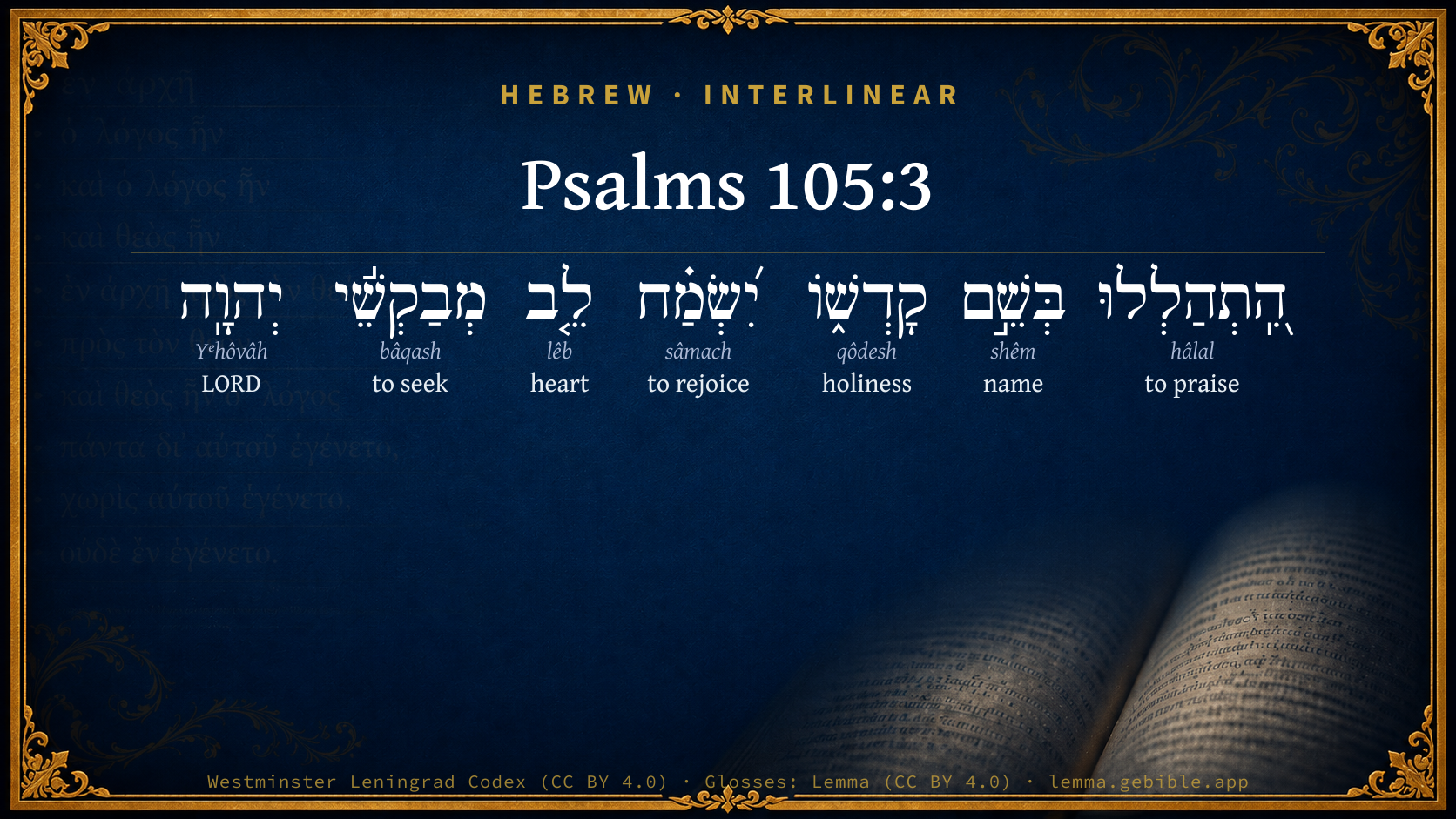
Hebrew (Westminster Leningrad Codex) Psalms 105:3 appears in the Hebrew Old Testament. The text above is from the Westminster Leningrad Codex. Each word links to its Strong’s number, a concise gloss, and parsing drawn from the Open Scriptures Hebrew Bible morphology. Click any word for its full Brown-Driver-Briggs (BDB) entry.
Download image
Cite this verse

Psalms 105:3 (World English Bible). Public Domain. Lemma interlinear Bible study tool, https://lemma.gebible.app/v/psalms/105/3.

Show BibTeX & RIS
BibTeX
RIS
English Translation
Glory in his holy name. Let the heart of those who seek Yahweh rejoice.
World English Bible · Public Domain
Download a study sheet

One document with this verse’s original text, its word-by-word gloss line, the meaning frame, cross-references with their text, attributed commentary, and full source and license credits — printable, and it pastes into notes with its structure intact.

This verse Autodidact and up

Study sheet (.html) Plain text (.txt)

A passage Seminary Student

Up to 50 verses in one chapter. A passage sheet keeps up to 6 commentary sources and 12 cross-references per verse, in the order this page ranks them, and says so on the sheet whenever that leaves anything out. Ask for a single verse and you get the Autodidact verse sheet above.

Everything on this page stays free to read, with no account — the sheet is a download of what is already on screen, not access to it.

Want to remove ads? Support Godless Engineer
Compare translations 3

The same verse in 3 English versions, stacked beneath the original-language interlinear above. Click any original word for its lexicon entry.

Each is an independent rendering of the whole verse — the interlinear is not word-aligned to these translations.

Highlighted words mark where these versions differ — a whole-verse word diff, not a word-by-word alignment.

  • World English Bible Public Domain
    Glory in his holy name. Let the heart of those who seek Yahweh rejoice.
  • King James Version Public Domain
    Glory ye in his holy name: let the heart of them rejoice that seek the LORD.
  • unfoldingWord Literal Text CC BY-SA 4.0
    Boast in the name of his holiness; let the heart of the seekers of Yahweh rejoice.

unfoldingWord Literal Text — © unfoldingWord, licensed CC BY-SA 4.0. Word-aligned USFM3 via Door43 (git.door43.org/unfoldingWord/en_ult).

Versions to compare (up to 4)

3 of 4 selected

Show all 18 translations

Every available English version of this verse, each an independent rendering of the whole verse.

  • World English Bible Public Domain
    Glory in his holy name. Let the heart of those who seek Yahweh rejoice.
  • Berean Standard Bible Public Domain
    Glory in His holy name; let the hearts of those who seek the LORD rejoice.
  • Majority Standard Bible Public Domain
    Glory in His holy name; let the hearts of those who seek the LORD rejoice.
  • King James Version Public Domain
    Glory ye in his holy name: let the heart of them rejoice that seek the LORD.
  • American Standard Version (1901) Public Domain
    Glory ye in his holy name: Let the heart of them rejoice that seek Jehovah.
  • Revised Version (1885) Public Domain
    Glory ye in his holy name: let the heart of them rejoice that seek the LORD.
  • Geneva Bible (1599) Public Domain
    Reioyce in his holy Name: let the heart of them that seeke the Lord, reioyce.
  • Douay-Rheims (1899) Public Domain
    Glory ye in his holy name: let the heart of them rejoice that seek the Lord.
  • Young's Literal Translation Public Domain
    Boast yourselves in His Holy Name, The heart of those seeking Jehovah rejoiceth.
  • Literal Standard Version CC BY-SA 4.0
    Boast yourselves in His Holy Name, || The heart of those seeking YHWH rejoices.
  • Unlocked Literal Bible CC BY-SA 4.0
    Boast in his holy name; let the heart of those who seek Yahweh rejoice.
  • unfoldingWord Literal Text CC BY-SA 4.0
    Boast in the name of his holiness; let the heart of the seekers of Yahweh rejoice.
  • Darby Bible Public Domain
    Glory ye in his holy name: let the heart of them rejoice that seek Jehovah.
  • World Messianic Bible Public Domain
    Glory in his holy name. Let the heart of those who seek the LORD rejoice.
  • Webster's Bible Public Domain
    Glory ye in his holy name: let the heart of them rejoice that seek the LORD.
  • Free Bible Version CC BY-SA 4.0
    Be proud of his holy character; be happy, all who come to the Lord!
  • Bible in Basic English Public Domain
    Have glory in his holy name; let the hearts of those who are searching after the Lord be glad.
  • JPS Tanakh (1917) Public Domain
    Glory ye in His holy name; let the heart of them rejoice that seek the LORD.

Literal Standard Version (2020), Covenant Press — licensed CC BY-SA 4.0. Text via the HelloAO Bible API (eBible.org). Unlocked Literal Bible (unfoldingWord) — licensed CC BY-SA 4.0. Text via the HelloAO Bible API (eBible.org). unfoldingWord Literal Text — © unfoldingWord, licensed CC BY-SA 4.0. Word-aligned USFM3 via Door43 (git.door43.org/unfoldingWord/en_ult). Free Bible Version, Dr. Jonathan Gallagher — licensed CC BY-SA 4.0. Text via the HelloAO Bible API (eBible.org).

Word by word

More ways to search: Search by grammar → Find every occurrence → Compare this word →

Practice this passage: Drill this verse → Learn its vocabulary →

About this verse

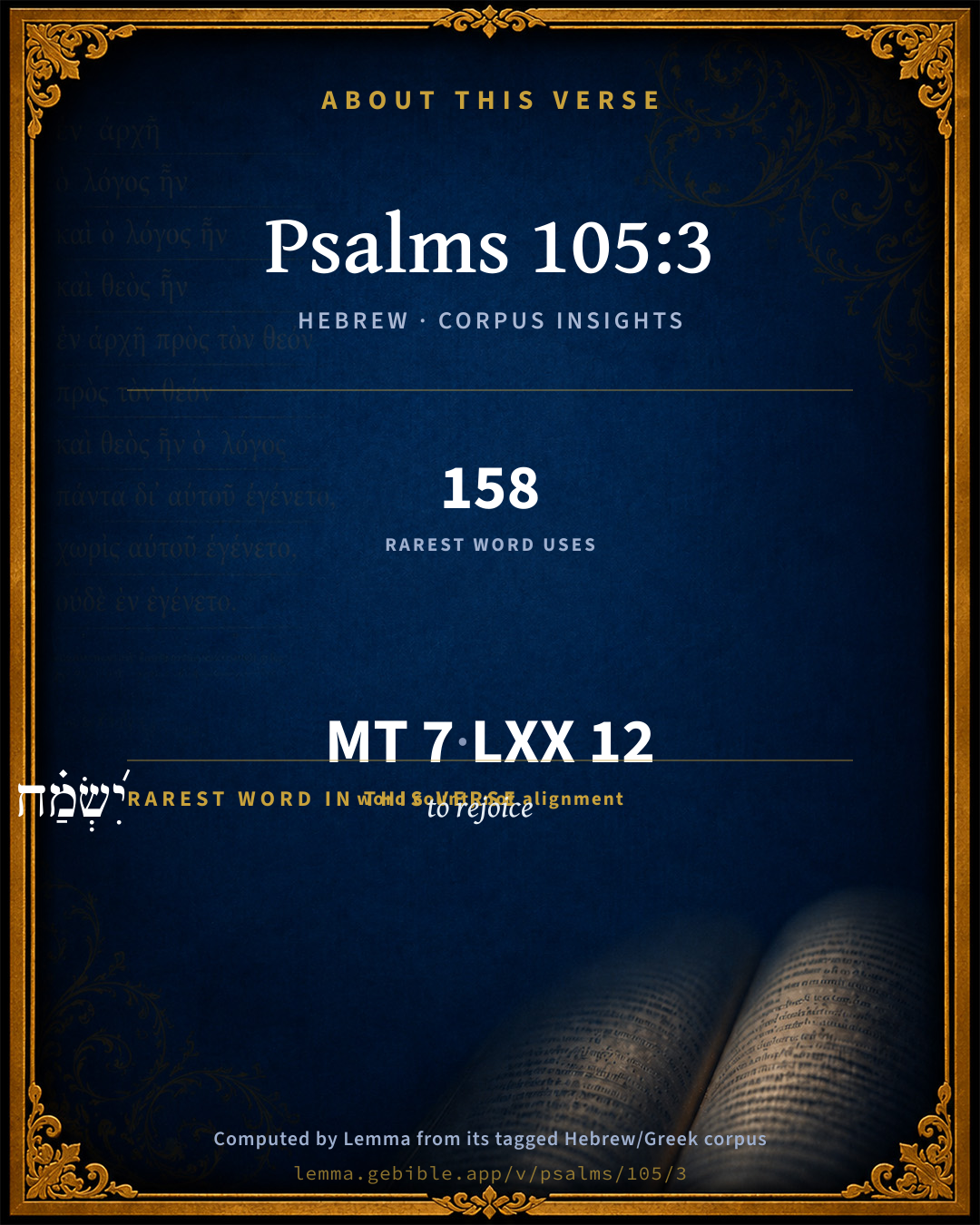
These counts appear in no published source. They are computed here, from the morphology-tagged text and Lemma’s own curated glosses. What Lemma adds →

7
words
7
distinct lemmas
Wisdom
section

Grammatical profile

  • 3 verbs
  • 4 nouns

Verb forms

  • הִֽ֭תְהַלְלוּ Hithpael · Imperative
  • יִ֝שְׂמַ֗ח Qal · Imperfect
  • מְבַקְשֵׁ֬י Piel · Participle Active

Hebrew & Septuagint length

In English translation the verse runs 14 words from the Hebrew and 15 from the Septuagint (LXX English) — closely comparable.

A rough comparison of the two English renderings, which tokenize alike — not a word-level alignment.

Word counts can differ between the Hebrew and the Greek without any difference in meaning — e.g. the Hebrew direct-object marker אֵת has no separate Greek word, and Greek often adds the article ὁ.

In the original languages it is 7 Hebrew tokens and 12 Greek tokens — but the two are counted differently (Hebrew bundles its prefixes and suffixes into one token; the Greek is in lemma form), so that isn’t a like-for-like length.

Cross-references

12

Topical passages linked to Psalms 105:3 in the Treasury of Scripture Knowledge — connected by theme and wording, ordered by reader-vote popularity; previews shown in the World English Bible.

  • Lamentations 3:25 Yahweh is good to those who wait for him, to the soul that seeks him.
  • Galatians 6:14 But far be it from me to boast, except in the cross of our Lord Jesus Christ, through which the world has been crucified to me, and I to the world.
  • Proverbs 8:17 I love those who love me. Those who seek me diligently will find me.
  • 1 Corinthians 1:29 that no flesh should boast before God.
  • 1 Corinthians 1:31 that, according as it is written, "He who boasts, let him boast in the Lord."
  • Psalms 34:2 My soul shall boast in Yahweh. The humble shall hear of it, and be glad.
  • Isaiah 45:25 In Yahweh shall all the seed of Israel be justified, and shall glory.
  • Jeremiah 9:23–24 Thus says Yahweh, Don't let the wise man glory in his wisdom, neither let the mighty man glory in his might, don't let the rich man glory in his riches;
  • Luke 11:9–10 "I tell you, keep asking, and it will be given you. Keep seeking, and you will find. Keep knocking, and it will be opened to you.
  • Isaiah 55:6–7 Seek you Yahweh while he may be found; call you on him while he is near:
  • Isaiah 45:19 I have not spoken in secret, in a place of the land of darkness; I didn't say to the seed of Jacob, Seek you me in vain: I, Yahweh, speak righteousness, I declare things that are right.
  • Psalms 9:10 Those who know your name will put their trust in you, For you, Yahweh, have not forsaken those who seek you.

Cross-references courtesy of OpenBible.info (CC BY 4.0).

Hebrew and Greek witnesses Masoretic Hebrew ↔ Greek Septuagint

The same verse in the two great witnesses to the Old Testament, shown verse-for-verse.

You’re reading Greek Psalm 104 (Hebrew Psalm 105). The Septuagint counts the superscription, so verse numbers can differ from the Hebrew — chapter-level alignment, not verse-by-verse. Numbering follows Rahlfs.

These are two independent witnesses, not word-aligned to each other, and the Septuagint is shown in lemma (dictionary) form.

Hebrew Psalms 105:3 Masoretic · Westminster Leningrad Codex

הִֽ֭תְהַלְלוּ בְּשֵׁ֣ם קָדְשׁ֑וֹ יִ֝שְׂמַ֗ח לֵ֤ב מְבַקְשֵׁ֬י יְהוָֽה

Glory in his holy name. Let the heart of those who seek Yahweh rejoice.

World English Bible · Public Domain

Greek LXX Greek Psalm 104:3 Septuagint · lemma form

ἐπιαἰνέω ἐν ὁ ὄνομα ὁ ἅγιος αὐτός εὐφραίνω καρδία ζητέω ὁ κύριος

Glory in his holy name: let the heart of them that seek the Lord rejoice.

LXX2012 (modern English Septuagint) · Public Domain

Hebrew: Westminster Leningrad Codex (CC BY 4.0). Greek: Septuagint (public domain); English from LXX2012 (modern English Septuagint) (Public Domain). How the Septuagint differs from the Hebrew →

Commentary

Notes on Psalms 105:3 from classic Christian and Jewish commentators (each source and its license shown beneath its notes). The classic Christian expositions comment on the surrounding passage and are grouped to its opening verse, so a note may address several verses; the Jewish commentaries on the Tanakh (Rashi and others) are per-verse, so they appear only where the commentator wrote on this verse.

Lemma curates 59 commentaries, every one of them public domain or Creative Commons licensed, each selected and text-cleaned for this edition rather than reprinted as found. About our sources →

Trapp's Complete Commentary

John Trapp

Psa 105:3 Glory ye in his holy name: let the heart of them rejoice that seek the LORD.

Ver. 3. Glory ye in his holy name] Of his power and goodness. See 1Co 1:31, with Jer 9:23. Non est gloriosior populus sub coelo quam Iudaicus, saith Alsted; there is not a more vain glorious people under heaven than the Jews; but "we are the circumcision, which worship in spirit, and glory in Christ Jesus, and have no confidence in the flesh," Php 3:3.

Let the heart of them rejoice, &c.] All others are forbidden to rejoice, Hos 9:1, and bidden to weep and howl, Jas 5:1.

John Trapp, A Commentary or Exposition upon All the Books of the Old and New Testament (1647–1656) — public domain. Text from a community e-Sword module.

The Biblical Illustrator

Joseph S. Exell

Psa_105:3

Let the heart of them rejoice that seek the Lord.

Christian joy

I. Who are to rejoice? Only those who seek the Lord. When are you to seek? Now. Where are you to seek? In His Word, His promises, His ordinances. Remember, the real seeking of God is when you are drawn by the Holy Ghost.

II. The grounds upon which believers who thus seek, and yet have not altogether found, Christian joy and rest, may undoubtedly rejoice. Not only is there the certainty of success in the event, but that success implies eternal life.

III. Why we are bound to make it a matter of conscience that we should rejoice in the Lord.

1. The honour of God Himself is concerned in it.

2. The extension of the Redeemers Kingdom requires it.

3. Your own personal usefulness, strength, and power to resist evil, is concerned (Neh_8:10).

IV. But there are hindrances to this joy.

1. The great hindrance is, unbelief in the real provisions made in the Gospel of Christ. What is the first idea which crosses the mind of the sinner when he is told that he will have perfect joy? The first idea that arises in his heart is, the news is too good to be true. What is that? It leads to nothing more nor less than that there is unbelief in the promises of the Father. Too good to be true! What does St. John think of this? He who believes this makes God a liar! Too good to be true! It was the very news He was sent to proclaim; it was the good tidings of salvation, and nothing short of salvation, Christ published. Beware, then, of unbelief, for it is a hindrance to all joy.

2. Again, you cannot have joy and indulge in your own sins. Joy in the Lord and joy in the devil cannot go on together. If you love your sin, you hate God. (Bp. M. Villiers.)

Psa_105:3

He brought them forth also with silver and gold.

A stanza of deliverance

Egypt may very fairly represent those states of sorrow and sadness, depression and oppression, into which Gods people come far too frequently. Specially is the house of bondage a true picture of our condition when we are convinced of sin, but are ignorant of the way to escape from its guilt and power. Then sin, which was once our Goshen of pleasure, becomes the iron furnace of fear. Glory be to God, He has now brought us out from that state of slavery, and we can sing of freedom given by His own right hand!

I. Our deliverance is by Divine power. When Israel came out of Egypt, it was Jehovah who brought with her armies. When any man is saved from spiritual bondage, it is the Lord Jesus who looseth the captive. But this does not exclude the use of means, or the action of the will. The Lord brought Israel forth; but they had cried unto the Lord by reason of their sore bondage, and they did not receive the blessing without desiring it, yea, and sighing for it; and when it came, they joyfully accepted it, and willingly trusted themselves with him whom the Lord had made to be their mediator and leader, even Moses. They did not share the honour of their deliverance with God, but still they gave their hearty assent and consent to His salvation. Willing as they were to move, it was still true, He brought them forth. We can never escape from the bondage of sin by our own power. If we are ever set free from sin and Satan, it will be eternally and infinitely true that the Lord brought us forth out of the house of bondage. Salvation is of the Lord. There is no true liberty but that wherewith Christ makes you free. If the Son shall make you free, ye shall be free indeed. Do you know what it is to be brought out of prison by a miracle of grace, by a revelation of the Holy Ghost, by the blood of Jesus shed for many? If so, you will join with all the saints in singing, As for His people, He brought them forth.

I. Our deliverance was attended with enrichment: He brought them forth also with silver and gold. The natives as good as said, Take whatever you please of us, for we have all treated you ill. Only leave us alone; for plagues and deaths fall upon us thick and fast so long as Pharaoh detains you here. However, this is not my point. I am dealing with more spiritual things. When God brings His people out of bondage, they come out enriched in the best and most emphatic sense. Trials and afflictions, which threaten to kill us, are made to sanctify us; and sanctification is the best form of enrichment. How much we owe to sorrow and sickness, crosses and losses! Our bondage ends in our coming forth with much that is better than silver and gold.

1. Thus do we come forth from conviction of sin. Now tell me, says one, what does a man gain by being in a desponding, sorrowful condition, convinced of sin, and full of fears? By the work of the Holy Spirit he will gain much. He will obtain a clearer knowledge of the evil of sin. An awful sense of guilt, an overwhelming conviction of sin, may be the foundation stone of a gloriously holy character. The tried and tempted man will also see clearly that salvation is all of grace. He can do nothing, and he knows it. When a child of God can spell grace, and can pronounce it clearly, as with the true Jerusalem accent, he has gained a great deal of spiritual silver and gold. Such persons gain by their soul trouble a fund of healthy experience. They have been in the prison, and have had their feet made fast in the stocks. Well, says one, I do not want to feel that sort of treatment. No, but suppose you had felt it, the next time you met with a brother who, was locked up in the castle of Giant Despair, you would know how to sympathize with him and help him. Where this is the result of severe trial, we may well say that the Lord has brought them forth with silver and gold.

2. Thus do saints come out of persecution. The Church is refined by the fires of martyrdom. Individual piety is also deeper, stronger, nobler in persecuting times than at other seasons.

3. Thus do believers come out of daily afflictions. They become wealthier in grace, and richer in experience. A man of God, whose life has been full of mental exercises and spiritual conflict, as well as outward tribulation, becomes, through Divine grace, a man of large wealth of knowledge, prudence, faith, foresight, and wisdom, and he is to the inexperienced like some great proprietor, by whom multitudes of the poorer class are fed and guided, housed and set to work. Those who have been much tried are in the peerage of the Church.

4. When you and I reach the shores of heaven, thus shall we come into glory. When we come forth out of our graves, it will not be with loss, but with enrichment. We shall leave corruption and the worm behind us, and with them all that earthly grossness which made us groan in these mortal bodies. God will bring us forth also with silver and gold. What golden songs will we sing! What silver notes of gratitude will we pour forth!

III. Our deliverance is accompanied with health and strength: There was not one feeble person among their tribes.

1. This fact is typical of the health and strength of the newly saved. The Lords people, at conversion, are as a rule wonderfully strong in their love to Jesus, and their hatred of sin. In most cases our young converts, when they have truly come to Christ, even if they are a little timid, are vigorous, much in prayer, abounding in zeal, and earnest in speaking out the Gospel. Many of them, I believe, would die at the stake readily enough, while they are in their first love. In their earliest days nothing is too hot or too heavy for them, for the sake of Christ.

2. Full often it is so with the persecuted. A man who has fulfilled an apprenticeship to this hard master, is likely to be a man indeed. If he has endured hardness as a good soldier of Jesus Christ, he will be fit to become an officer in the army, and an instructor of recruits.

3. It would be a glorious day if it were so with all Gods people, that there were none feeble. We should, as a Church, labour to reach this high standard. We would have the weakest to be as David, and David as the angel of the Lord. We would have our babes become young men, and our young men fathers in Christ. (C. H. Spurgeon.)

The Biblical Illustrator, edited by Joseph S. Exell (c. 1880s–1900s) — public domain. Text from a community e-Sword module.

J. A. Alexander on Psalms

Joseph Addison Alexander

3. (Psa 105:3) Glory in his holy name ! Glad shall be the heart of those who seek Jehovah. Congratulate yourselves that you possess a right and interest in the favour of so glorious a Being. The last clause presents as an inducement, that to seek the favour of this God is a source, and by implication the only source, of joy and happiness. Compare Psa 34:2; Psa 40:16; Psa 49:6.

Joseph Addison Alexander, The Psalms Translated and Explained (1850) — public domain. Text from a community e-Sword module.

Adam Clarke's Commentary

Verse 3. Glory ye in his holy name] Show the name Jesus: exult in it - praise it. His name was called Jesus; because he came to save his people from their sins.

Let the heart of them rejoice] That is, the heart of those shall rejoice who seek the Lord: therefore it is added, -

Adam Clarke's Commentary on the Bible (1810–1826) — public domain. Text from a community e-Sword/MySword module.

The Cambridge Bible for Schools and Colleges

gen. ed. J. J. S. Perowne

3. Glory ye in his holy name] Cp. Isa_41:16; and see note on Psa_103:1.

let the heart &c.] True devotion leads to deep inward joy which will find expression in thanksgiving. Cp. Neh_8:10; Act_2:46-47.

The Cambridge Bible for Schools and Colleges (gen. ed. J. J. S. Perowne; Cambridge University Press, 1878–1918) — public domain. Text from a community e-Sword module.

John Gill's Exposition

Glory ye in his holy name,.... In the knowledge of it, as proclaimed in Christ; in being called by his name, and in having the honour to call upon his name; in the holiness of it; and in Christ being made sanctification as well as righteousness, in whom all the seed of Israel are justified and glory; as they may also of interest in him, and communion with him.

Let the heart of them rejoice that seek the Lord; while he may be found, and where he may be found; who seek him in Christ, and under the guidance and direction of his Spirit; who seek him with their whole hearts, diligently and constantly. The Targum is,

"who seek doctrine from the Lord.''

Such may and should rejoice in him, and in him only; and that always, as they have reason to do, even in their hearts, since they that seek him find him; and whether it be at first conversion, or afterwards, or when he has for a time hid his face; it must be matter of joy to them, even to their very hearts, to find him whom they seek.

John Gill's Exposition of the Whole Bible (1746–1763) — public domain (CC PDM 1.0). Text via the HelloAO Bible API.

Albert Barnes' Notes on the Bible

Glory ye in his holy name - The original word rendered “glory” is the same word which is commonly used to denote “praise,” and it has that meaning here. The idea is, In your praises let the main subject be the name of God - that holy name by which he chooses to be known. The Hebrew is, “the name of his holiness.” It implies

(a) that we should rejoice in God - in his very name - in that by which he chooses to make himself known;

(b) that it is a special subject of praise and rejoicing that his name is “holy;” that is, that he is a holy Being.

This can be a subject of real rejoicing only to those who are themselves holy; but properly considered, one of the highest reasons for rejoicing in God is the fact that he is holy; that he cannot look upon sin but with abhorrence. There would be no ground of confidence in God if this were not so.

Let the heart of them rejoice that seek the Lord - That desire to know him; that come to praise him. Let their hearts rejoice - or, let them be happy:

(a) because they are “permitted” to seek him;

(b) because they are inclined to seek him;

(c) because they have such a God to come to - One so mighty, so holy, so good, so gracious.

Albert Barnes' Notes on the Bible (1834–1885) — public domain. Text from a community e-Sword/MySword module.

Matthew Poole's English Annotations

Glory ye in his holy name; glory in the God whom you serve, as the only true God, and one of infinite power and goodness.

That seek the Lord; that seek his face or presence, as it follows, his acquaintance and favour, above all the world.

Matthew Poole's English Annotations on the Holy Bible (1683–1685) — public domain. Text from a community e-Sword/MySword module.

The Treasury of David

Charles H. Spurgeon

Ver. 3. Glory ye in his holy name. Make it a matter of joy that you have such a God. His character and attributes are such as will never make you blush to call him your God. Idolaters may well be ashamed of the actions attributed to their fancied deities, their names are foul with lust and red with blood, but Jehovah is wholly glorious; every deed of his will bear the strictest scrutiny; his name is holy, his character is holy, his law is holy, his government is holy, his influence is holy. In all this we may make our boast, nor can any deny our right to do so.

Let the heart of them rejoice that seek the Lord. If they have not yet found him so fully as they desire, yet even to be allowed and enabled to seek after such a God is cause for gladness, To worship the Lord and seek his kingdom and righteousness is the sure way to happiness, mad indeed there is no other. True seekers throw their hearts into the engagement, hence their hearts receive joy; according to the text they have a permit to rejoice and they have the promise that they shall do so. How happy all these sentences are! Where can men's ears be when they talk of the gloom of psalm singing? What worldly songs are fuller of real mirth? One hears the sound of the timbrel and the harp in every verse. Even seekers find bliss in the name of the Lord Jesus, but as for the finders, we may say with the poet,

"And those who find thee find a bliss,

Nor tongue nor pen Call show:

The love of Jesus what it is,

None but his loved ones know."

Ver. 3.

1. Those who find: or"glory ye, "etc.

2. Those who seek: or"rejoice."

Ver. 3 (second clause). Let the seeker rejoice that there is such a God to seek, that he invites us to seek, that he moves us to seek, enables us to seek, and promises to be found of us. The tendency of the seeker is to despond, but there are many grounds of comfort.

Psalms 105:4*

Charles H. Spurgeon's The Treasury of David (1869–1885) — public domain. Psalms only. Text from a community e-Sword/MySword module.

Whedon's Commentary on the Bible

Daniel D. Whedon

3. Glory ye—Or, boast ye. Comp. Psa_34:2; Gal_6:14

Daniel D. Whedon (gen. ed.), Commentary on the Old and New Testaments (1874–1909) — public domain. Text from a community e-Sword module.

The Pulpit Commentary

Glory ye in his holy Name. (comp. Psa_34:2, "My soul shall glory in the Lord As worldly men glory in their strength and riches, so the saints of God glory in God. Let the heart of them rejoice that seek the Lord. (comp. Psa_33:21)

The Pulpit Commentary (1880–1919), ed. H.D.M. Spence-Jones & Joseph S. Exell — public domain. Text from a community e-Sword module.

John Wesley's Explanatory Notes

Glory - Glory in the God whom you serve, as the only true God.

John Wesley, Explanatory Notes Upon the Whole Bible (1754–1765) — public domain. Text via the GEBible commentary corpus.

Rashi

Rabbi Shlomo Yitzchaki (Rashi)

Boast of His holy name Boast of the stronghold of His holy name that you have a patron like Him. התהללוּ is “porvontez vous” in Old French, [vantez vous in modern French, boast].

Rashi on the Tanakh — English translations: “The Judaica Press complete Tanach with Rashi, translated by A. J. Rosenberg” (CC BY 4.0); “Pentateuch with Rashi's commentary by M. Rosenbaum and A.M. Silbermann, 1929-1934” (public domain); “The Metsudah Tanach series, Lakewood, N.J” (CC BY 4.0); and “The Book of Joshua, Metsudah Publications, 1997” (CC BY 4.0). Text via Sefaria.

Lesson kit

Teaching starters — assembled from the data on this page, not authored interpretation. Every prompt links to the verse data it draws on. Edit before teaching.

Psalms, in the Wisdom, opens this verse with 7 words (7 distinct Hebrew lemmas). Its most distinctive word is sâmach (“to rejoice”). A historical commentator’s framing appears above. Read the whole chapter for the surrounding context.

Discussion questions

  1. The word sâmach carries the sense “to rejoice.” How does it shape the verse?
  2. How does Lamentations 3:25, which shares this passage’s theme, read alongside this verse?
  3. The translations on this page render this verse differently — a whole-verse word diff, not a word-by-word alignment. What might account for the different wordings?
  4. «הִֽ֭תְהַלְלוּ» is a Hithpael Imperative verb. How does that grammatical form shape the action described?
  5. Compare how Trapp's Complete Commentary and The Biblical Illustrator read this verse. Where do they agree or differ?

Things to notice

Reading settings

Reading text

Shown beneath each verse's original-language words.

Old Testament
Old Testament edition

Read the OT as the Masoretic Hebrew (MT) or the Greek Septuagint (LXX).

English shown for the Greek Septuagint (in the Hebrew ↔ Greek comparison).

Comparing translations? Open the Compare panel on any verse page to stack up to four side by side.