
Judges 6:29

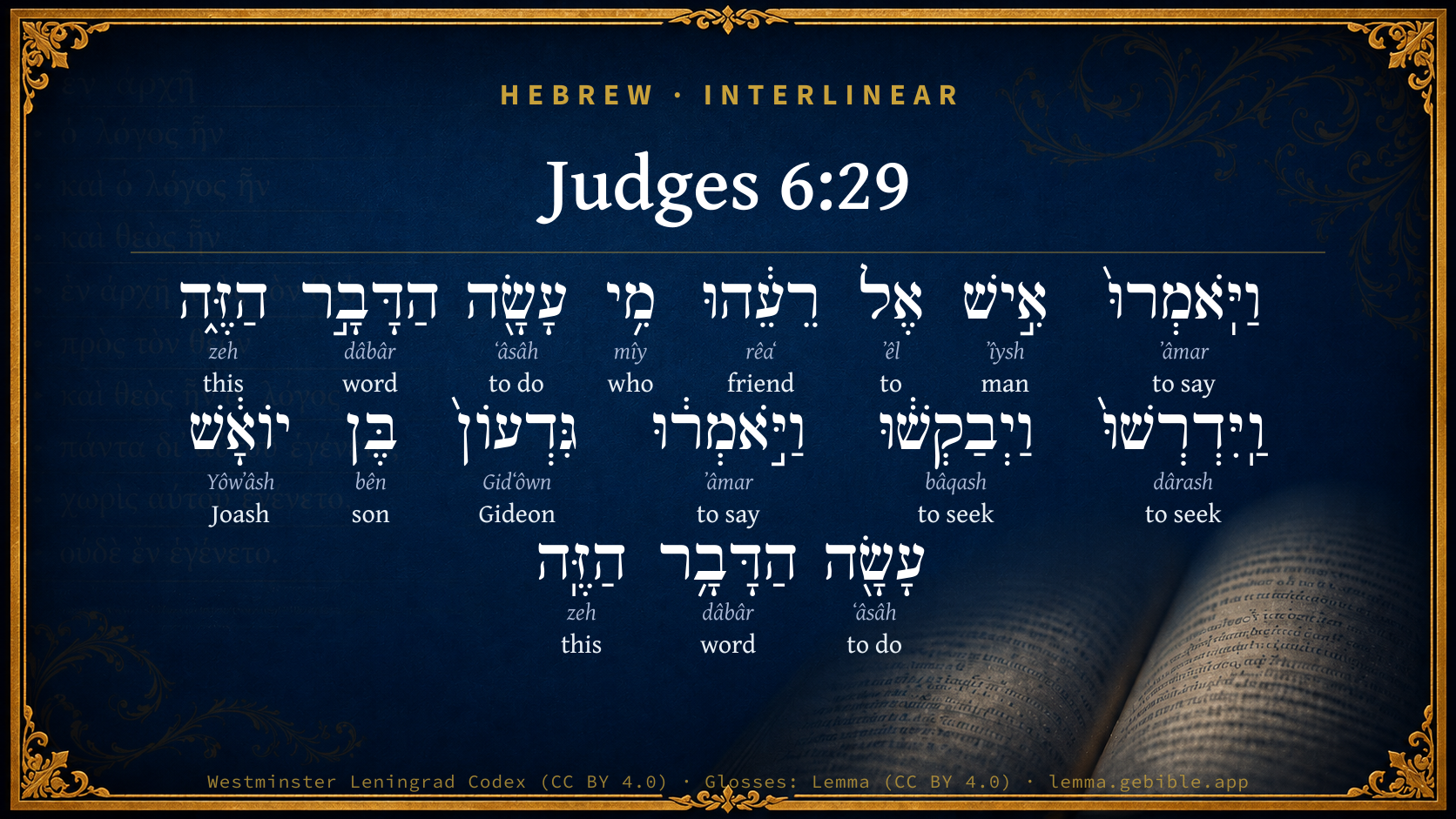
Hebrew (Westminster Leningrad Codex) Judges 6:29 appears in the Hebrew Old Testament. The text above is from the Westminster Leningrad Codex. Each word links to its Strong’s number, a concise gloss, and parsing drawn from the Open Scriptures Hebrew Bible morphology. Click any word for its full Brown-Driver-Briggs (BDB) entry.
Download image
Cite this verse

Judges 6:29 (World English Bible). Public Domain. Lemma interlinear Bible study tool, https://lemma.gebible.app/v/judges/6/29.

Show BibTeX & RIS
BibTeX
RIS
English Translation
They said one to another, Who has done this thing? When they inquired and asked, they said, Gideon the son of Joash has done this thing.
World English Bible · Public Domain
Download a study sheet

One document with this verse’s original text, its word-by-word gloss line, the meaning frame, cross-references with their text, attributed commentary, and full source and license credits — printable, and it pastes into notes with its structure intact.

This verse Autodidact and up

Study sheet (.html) Plain text (.txt)

A passage Seminary Student

Up to 50 verses in one chapter. A passage sheet keeps up to 6 commentary sources and 12 cross-references per verse, in the order this page ranks them, and says so on the sheet whenever that leaves anything out. Ask for a single verse and you get the Autodidact verse sheet above.

Everything on this page stays free to read, with no account — the sheet is a download of what is already on screen, not access to it.

Want to remove ads? Support Godless Engineer
Compare translations 3

The same verse in 3 English versions, stacked beneath the original-language interlinear above. Click any original word for its lexicon entry.

Each is an independent rendering of the whole verse — the interlinear is not word-aligned to these translations.

Highlighted words mark where these versions differ — a whole-verse word diff, not a word-by-word alignment.

  • World English Bible Public Domain
    They said one to another, Who has done this thing? When they inquired and asked, they said, Gideon the son of Joash has done this thing.
  • King James Version Public Domain
    And they said one to another, Who hath done this thing? And when they inquired and asked, they said, Gideon the son of Joash hath done this thing.
  • unfoldingWord Literal Text CC BY-SA 4.0
    And they said, a man to his fellow, “Who has done this thing?” And they searched and sought, and they said, “Gideon, the son of Joash, has done this thing.”

unfoldingWord Literal Text — © unfoldingWord, licensed CC BY-SA 4.0. Word-aligned USFM3 via Door43 (git.door43.org/unfoldingWord/en_ult).

Versions to compare (up to 4)

3 of 4 selected

Show all 18 translations

Every available English version of this verse, each an independent rendering of the whole verse.

  • World English Bible Public Domain
    They said one to another, Who has done this thing? When they inquired and asked, they said, Gideon the son of Joash has done this thing.
  • Berean Standard Bible Public Domain
    “Who did this?” they said to one another. And after they had investigated thoroughly, they were told, “Gideon son of Joash did it.”
  • Majority Standard Bible Public Domain
    “Who did this?” they said to one another. And after they had investigated thoroughly, they were told, “Gideon son of Joash did it.”
  • King James Version Public Domain
    And they said one to another, Who hath done this thing? And when they inquired and asked, they said, Gideon the son of Joash hath done this thing.
  • American Standard Version (1901) Public Domain
    And they said one to another, Who hath done this thing? And when they inquired and asked, they said, Gideon the son of Joash hath done this thing.
  • Revised Version (1885) Public Domain
    And they said one to another, Who hath done this thing? And when they inquired and asked, they said, Gideon the son of Joash hath done this thing.
  • Geneva Bible (1599) Public Domain
    Therefore they saide one to another, Who hath done this thing? and when they inquired and asked, they saide, Gideon the sonne of Ioash hath done this thing.
  • Douay-Rheims (1899) Public Domain
    And when the men of that town were risen in the morning, they saw the altar of Baal destroyed, and the grove cut down, and the second bullock laid upon the altar, which then was built.
  • Young's Literal Translation Public Domain
    And they say one to another, `Who hath done this thing?' and they inquire and seek, and they say, `Gideon son of Joash hath done this thing.'
  • Literal Standard Version CC BY-SA 4.0
    And they say to one another, “Who has done this thing?” And they inquire and seek, and they say, “Gideon son of Joash has done this thing.”
  • Unlocked Literal Bible CC BY-SA 4.0
    The men of the city said to one another, “Who has done this?” When they talked with others and searched for answers, they said, “Gideon son of Joash has done this thing.”
  • unfoldingWord Literal Text CC BY-SA 4.0
    And they said, a man to his fellow, “Who has done this thing?” And they searched and sought, and they said, “Gideon, the son of Joash, has done this thing.”
  • Darby Bible Public Domain
    And they said to one another, "Who has done this thing?" And after they had made search and inquired, they said, "Gideon the son of Jo'ash has done this thing."
  • World Messianic Bible Public Domain
    They said to one another, “Who has done this thing?” When they inquired and asked, they said, “Gideon the son of Joash has done this thing.”
  • Webster's Bible Public Domain
    And they said one to another, Who hath done this thing? And when they inquired and asked, they said, Gideon the son of Joash hath done this thing.
  • Free Bible Version CC BY-SA 4.0
    They asked one another, “Who did this?” They made inquiries and they were told, “Gideon, son of Joash, did it.”
  • Bible in Basic English Public Domain
    And they said to one another, Who has done this thing? And after searching with care, they said, Gideon, the son of Joash, has done this thing.
  • JPS Tanakh (1917) Public Domain
    And they said one to another: 'Who hath done this thing?' And when they inquired and asked, they said: 'Gideon the son of Joash hath done this thing.'

Literal Standard Version (2020), Covenant Press — licensed CC BY-SA 4.0. Text via the HelloAO Bible API (eBible.org). Unlocked Literal Bible (unfoldingWord) — licensed CC BY-SA 4.0. Text via the HelloAO Bible API (eBible.org). unfoldingWord Literal Text — © unfoldingWord, licensed CC BY-SA 4.0. Word-aligned USFM3 via Door43 (git.door43.org/unfoldingWord/en_ult). Free Bible Version, Dr. Jonathan Gallagher — licensed CC BY-SA 4.0. Text via the HelloAO Bible API (eBible.org).

Word by word

More ways to search: Search by grammar → Find every occurrence → Compare this word →

Practice this passage: Drill this verse → Learn its vocabulary →

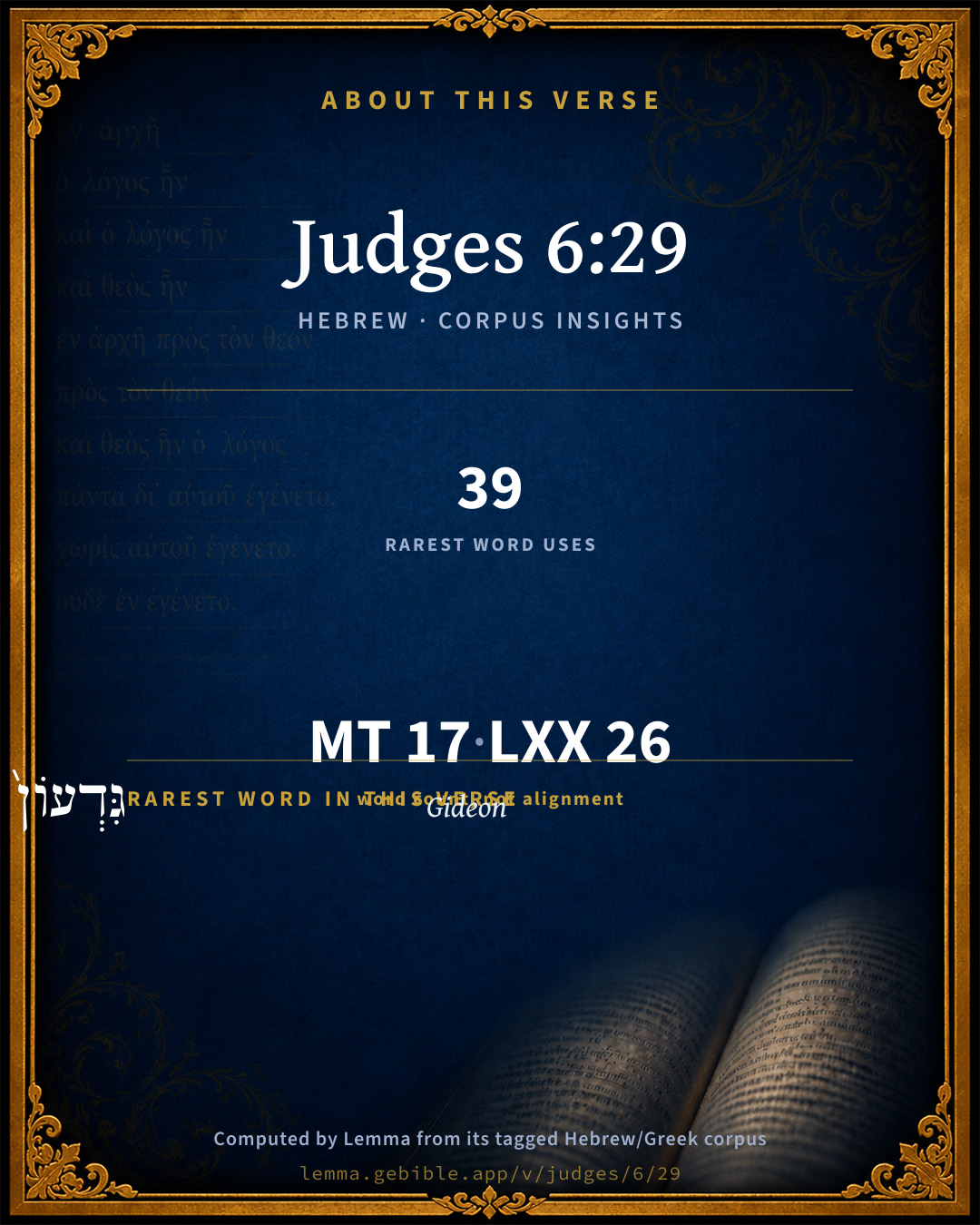
גִּדְעוֹן֙
Gidʻôwn
H1439
“Gideon”
Noun, Proper
Part of Speech
Noun
Type
Proper
Full BDB Definition

Origin: from H1438

TWOT: 316a

Gideon = "hewer" - youngest son of Joash of the Abiezrites, fifth judge of Israel who led the Israelites against the Midianites
  1. וַיֹּֽאמְרוּ֙ ʼâmar H559 “and · to say” Conjunction + Verb, Qal, Sequential Imperfect, 3rd Person, Masculine, Plural
  2. אִ֣ישׁ ʼîysh H376 “man” Noun, Common, Masculine, Singular, Absolute
  3. אֶל ʼêl H413 “to” Preposition
  4. רֵעֵ֔הוּ rêaʻ H7453 “friend · his” Noun, Common, Masculine, Singular, Construct + Suffix, Personal, 3rd Person, Masculine, Singular
  5. מִ֥י mîy H4310 “who” Particle, Interrogative
  6. עָשָׂ֖ה ʻâsâh H6213 “to do” Verb, Qal, Perfect, 3rd Person, Masculine, Singular
  7. הַדָּבָ֣ר dâbâr H1697 “the · word” Particle, Definite Article + Noun, Common, Masculine, Singular, Absolute
  8. הַזֶּ֑ה zeh H2088 “the · this” Particle, Definite Article + Pronoun, Demonstrative, Masculine, Singular
  9. וַֽיִּדְרְשׁוּ֙ dârash H1875 “and · to seek” Conjunction + Verb, Qal, Sequential Imperfect, 3rd Person, Masculine, Plural
  10. וַיְבַקְשׁ֔וּ bâqash H1245 “and · to seek” Conjunction + Verb, Piel, Sequential Imperfect, 3rd Person, Masculine, Plural
  11. וַיֹּ֣אמְר֔וּ ʼâmar H559 “and · to say” Conjunction + Verb, Qal, Sequential Imperfect, 3rd Person, Masculine, Plural
  12. בֶּן bên H1121 “son of” Noun, Common, Masculine, Singular, Construct
  13. יוֹאָ֔שׁ Yôwʼâsh H3101 “Joash” Noun, Proper
  14. עָשָׂ֖ה ʻâsâh H6213 “to do” Verb, Qal, Perfect, 3rd Person, Masculine, Singular
  15. הַדָּבָ֥ר dâbâr H1697 “the · word” Particle, Definite Article + Noun, Common, Masculine, Singular, Absolute
  16. הַזֶּֽה zeh H2088 “the · this” Particle, Definite Article + Pronoun, Demonstrative, Masculine, Singular

About this verse

These counts appear in no published source. They are computed here, from the morphology-tagged text and Lemma’s own curated glosses. What Lemma adds →

17
words
13
distinct lemmas
Historical
section

Shared distinctive vocabulary

גִּדְעוֹן֙ Gideon H1439 occurs in 37 verses of the Hebrew Bible. Also found in:

Grammatical profile

  • 6 verbs
  • 7 nouns
  • 2 pronouns
  • 1 preposition
  • 1 particle

Verb forms

  • וַיֹּֽאמְרוּ֙ Qal · Sequential Imperfect
  • עָשָׂ֖ה Qal · Perfect
  • וַֽיִּדְרְשׁוּ֙ Qal · Sequential Imperfect
  • וַיְבַקְשׁ֔וּ Piel · Sequential Imperfect
  • וַיֹּ֣אמְר֔וּ Qal · Sequential Imperfect
  • עָשָׂ֖ה Qal · Perfect

Repetition

Words recur within this verse — often emphatic in Hebrew:

  • וַיֹּֽאמְרוּ֙ to say H559 ×2
  • עָשָׂ֖ה to do H6213 ×2
  • הַדָּבָ֣ר word H1697 ×2
  • הַזֶּ֑ה this H2088 ×2

Hebrew & Septuagint length

In English translation the verse runs 26 words from the Hebrew and 29 from the Septuagint (LXX English) — closely comparable.

A rough comparison of the two English renderings, which tokenize alike — not a word-level alignment.

Word counts can differ between the Hebrew and the Greek without any difference in meaning — e.g. the Hebrew direct-object marker אֵת has no separate Greek word, and Greek often adds the article ὁ.

In the original languages it is 17 Hebrew tokens and 26 Greek tokens — but the two are counted differently (Hebrew bundles its prefixes and suffixes into one token; the Greek is in lemma form), so that isn’t a like-for-like length.

Hebrew and Greek witnesses Masoretic Hebrew ↔ Greek Septuagint

The same verse in the two great witnesses to the Old Testament, shown verse-for-verse.

These are two independent witnesses, not word-aligned to each other, and the Septuagint is shown in lemma (dictionary) form.

Hebrew Judges 6:29 Masoretic · Westminster Leningrad Codex

וַיֹּֽאמְרוּ֙ אִ֣ישׁ אֶל רֵעֵ֔הוּ מִ֥י עָשָׂ֖ה הַדָּבָ֣ר הַזֶּ֑ה וַֽיִּדְרְשׁוּ֙ וַיְבַקְשׁ֔וּ וַיֹּ֣אמְר֔וּ גִּדְעוֹן֙ בֶּן יוֹאָ֔שׁ עָשָׂ֖ה הַדָּבָ֥ר הַזֶּֽה

They said one to another, Who has done this thing? When they inquired and asked, they said, Gideon the son of Joash has done this thing.

World English Bible · Public Domain

Greek LXX Judges 6:29 Septuagint · lemma form

καί εἶπον ἀνήρ πρός ὁ πλησίον αὐτός τίς ποιέω ὁ ῥῆμα οὗτος καί ἐπιζητέω καί ἐρευνάω καί γιγνώσκω ὅτι γεδεων υἱός ιωας ποιέω ὁ ῥῆμα οὗτος

And a man said to his neighbor, Who has done this thing? and they enquired and searched, and learned that Gedeon the son of Joas had done this thing.

LXX2012 (modern English Septuagint) · Public Domain

Hebrew: Westminster Leningrad Codex (CC BY 4.0). Greek: Septuagint (public domain); English from LXX2012 (modern English Septuagint) (Public Domain). How the Septuagint differs from the Hebrew →

Targum (Aramaic paraphrase)

1

The Targum is the ancient Jewish Aramaic paraphrase of the Hebrew Scriptures — an interpretive translation, not the Hebrew text itself. Onkelos (literal) and Pseudo-Jonathan (expansive) render the Torah, and Jonathan the Prophets. Coverage is partial: where no permissively-licensed English translation exists for a verse, only the Aramaic is shown. This is verse-level text, not a word-by-word alignment to the Hebrew.

  1. Targum Jonathan Prophets (Joshua–Malachi)
    וַאֲמַרוּ גְבַר לְחַבְרֵיהּ מָן עֲבַד פִּתְגָמָא הָדֵין וּתְבַעוּ וּבְעוֹ וַאֲמַרוּ גִדְעוֹן בַּר יוֹאָשׁ עֲבַד פִּתְגָמָא הָדֵין:

    (no public-domain English translation for this verse)

    Targum Jonathan — Aramaic: “Mikraot Gedolot” (public domain). English: “Sefaria Community Translation” (CC0 1.0 (public-domain dedication)); “London "Chaldee Paraphrase," 1871” (public domain). Text via Sefaria.

Commentary

Notes on Judges 6:29 from classic Christian and Jewish commentators (each source and its license shown beneath its notes). The classic Christian expositions comment on the surrounding passage and are grouped to its opening verse, so a note may address several verses; the Jewish commentaries on the Tanakh (Rashi and others) are per-verse, so they appear only where the commentator wrote on this verse.

Lemma curates 59 commentaries, every one of them public domain or Creative Commons licensed, each selected and text-cleaned for this edition rather than reprinted as found. About our sources →

Trapp's Complete Commentary

John Trapp

Jdg 6:29 And they said one to another, Who hath done this thing? And when they enquired and asked, they said, Gideon the son of Joash hath done this thing.

Ver. 29. Who hath clone this thing?] They should have asked rather, Why hath any one done this? And was not there good reason he should do so? But idolaters "have eyes, and see not," &c.; they are brutishly carried on, more guided by rage than by right; violence and obstinacy, like two untamed horses, draw their desires in a blindfold career.

John Trapp, A Commentary or Exposition upon All the Books of the Old and New Testament (1647–1656) — public domain. Text from a community e-Sword module.

Adam Clarke's Commentary

Verse 29. Gideon the son of Joash hath done this thing.] They fixed on him the more readily because they knew he had not joined with them in their idolatrous worship.

Adam Clarke's Commentary on the Bible (1810–1826) — public domain. Text from a community e-Sword/MySword module.

Ellicott's Commentary for English Readers

(29) They said.—We are not told that Gideon’s servants betrayed his secret, but suspicion would naturally fall on so brave and prominent a worshipper of Jehovah as Gideon was; and it is rarely that actions which require so much effort and so many coadjutors can be kept secret. Gideon had proved himself to be what his name signifies—“a hewer.” A man so brave and so patriotic must have stood almost alone among a cringing and apostate people.

A Bible Commentary for English Readers, edited by Charles John Ellicott (1878–1897) — public domain. Text from a community e-Sword module.

John Gill's Exposition

Then the men of the city said unto Joash,.... The principal inhabitants of the place met together, and in a body went to Joash their chief magistrate, to have justice done in this case:

bring out thy son, that he may die; they do not ask to have the cause tried by him, to hear what proof they had of the fact, or what Gideon had to say in his own defence; nor do they wait for the sentence of Joash, but determine it themselves, and require the delinquent to be given up to them, that they might put him to death; a strange request of Israelites, whose law judged no man before it heard him; and besides, according to that, the worshippers of Baal, and not the destroyers of him, and his altars, were to be put to death, which shows how strangely mad and infatuated these people were:

because he hath cut down the altar of Baal, and because he hath cut down the grove that was by it; they take no notice of the bullock which he had taken and offered, it being his father's property; and which seems to confirm the sense of our version, that there was but one, Jdg 6:25 for had the second been a different one, and the people's property, they would have accused him of theft as well as sacrilege respecting that.

John Gill's Exposition of the Whole Bible (1746–1763) — public domain (CC PDM 1.0). Text via the HelloAO Bible API.

Matthew Poole's English Annotations

Which they might easily conjecture, partly by his known aversion from the worship of Baal, and partly because no other person durst presume to do such a thing; but they might more certainly learn it from some of the persons employed in it, who through fear or favour might inform them.

Matthew Poole's English Annotations on the Holy Bible (1683–1685) — public domain. Text from a community e-Sword/MySword module.

Whedon's Commentary on the Bible

Daniel D. Whedon

29. They said, Gideon — Who said? The answer is uncertain. Perhaps some of the ten servants who assisted Gideon reported his deed, or else the men of the city may have suspected Gideon because of some well-known opposition of his to the prevalent idolatry.

Daniel D. Whedon (gen. ed.), Commentary on the Old and New Testaments (1874–1909) — public domain. Text from a community e-Sword module.

The Pulpit Commentary

They said, Gideon hath, etc. No doubt one of the ten servants (ver. 27) employed by him had spoken about it.

Vers. 29, 30. Who hath done this thing?

A frequent inquiry. A natural curiosity to trace up to causes; a religious rancour to visit punishment upon the author.

I THE WORLD TAKES NOTE OF THE ACTIONS AND LIVES OF THE RIGHTEOUS. The effects of religion are ever an astonishment, a delight or a vexation. There is something in them that piques curiosity and rouses interest. Men tried to explain Christ. Religious questions ever the most keenly discussed.

II THE REASON OF THIS IS IN THE VITAL IMPORTANCE OF THE QUESTIONS INVOLVED. Temporal convenience and interests are compromised. The craftsmen of Ephesus. Life and death eternal depend upon our conduct here. Christians are a reproof to the unfruitful works of darkness.

III IT IS WELL WHEN OUR DEEDS ARE INQUIRED ABOUT THAT THEY SHOULD BE GOOD, AND NOT EVIL. The detective usually tracks the criminal. How much better so to act that we shall not fear when men discover our works. So act that when revelation comes "they may be ashamed who falsely accuse our good conversation in Christ." To our own Master we stand or fall. In that day we shall not heed the judgments of men. M.

The Pulpit Commentary (1880–1919), ed. H.D.M. Spence-Jones & Joseph S. Exell — public domain. Text from a community e-Sword module.

Lesson kit

Teaching starters — assembled from the data on this page, not authored interpretation. Every prompt links to the verse data it draws on. Edit before teaching.

Judges, in the Historical, opens this verse with 17 words (13 distinct Hebrew lemmas). Its most distinctive word is Gidʻôwn (“Gideon”). A historical commentator’s framing appears above. Read the whole chapter for the surrounding context.

Discussion questions

  1. The word Gidʻôwn carries the sense “Gideon.” How does it shape the verse?
  2. How does Judges 6:11, which shares the word «Gideon», read alongside this verse?
  3. What does the repetition of “to say” (2× in this one verse) do in this verse?
  4. These translations render this verse differently. What is at stake in choosing one wording over another?
  5. «וַיֹּֽאמְרוּ֙» is a Qal Sequential Imperfect verb. How does that grammatical form shape the action described?
  6. Compare how Trapp's Complete Commentary and Adam Clarke's Commentary read this verse. Where do they agree or differ?

Things to notice

Reading settings

Reading text

Shown beneath each verse's original-language words.

Old Testament
Old Testament edition

Read the OT as the Masoretic Hebrew (MT) or the Greek Septuagint (LXX).

English shown for the Greek Septuagint (in the Hebrew ↔ Greek comparison).

Comparing translations? Open the Compare panel on any verse page to stack up to four side by side.