
Proverbs 28:5

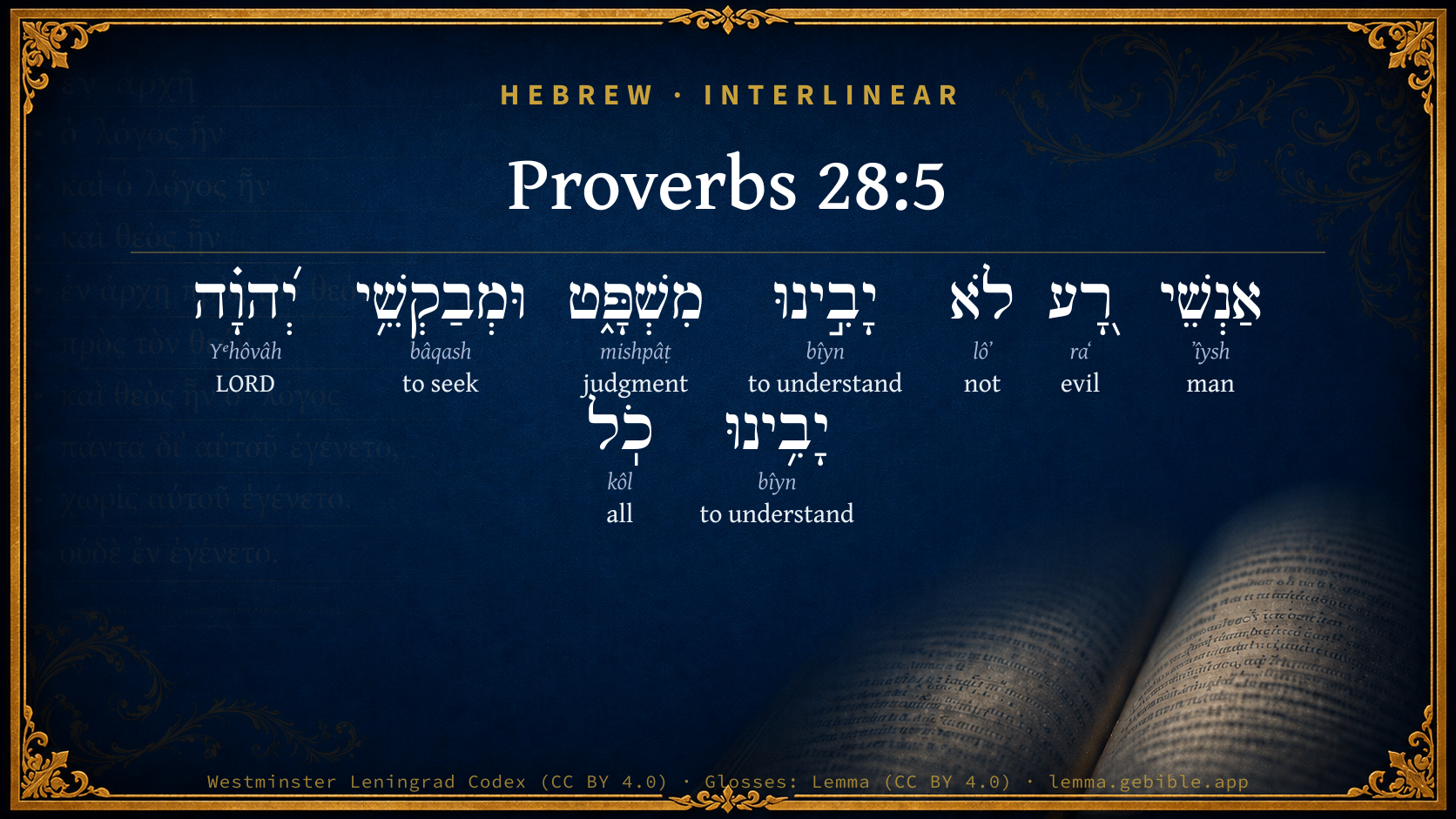
Hebrew (Westminster Leningrad Codex) Proverbs 28:5 appears in the Hebrew Old Testament. The text above is from the Westminster Leningrad Codex. Each word links to its Strong’s number, a concise gloss, and parsing drawn from the Open Scriptures Hebrew Bible morphology. Click any word for its full Brown-Driver-Briggs (BDB) entry.
Download image
Cite this verse

Proverbs 28:5 (World English Bible). Public Domain. Lemma interlinear Bible study tool, https://lemma.gebible.app/v/proverbs/28/5.

Show BibTeX & RIS
BibTeX
RIS
English Translation
Evil men don't understand justice; But those who seek Yahweh understand it fully.
World English Bible · Public Domain
Download a study sheet

One document with this verse’s original text, its word-by-word gloss line, the meaning frame, cross-references with their text, attributed commentary, and full source and license credits — printable, and it pastes into notes with its structure intact.

This verse Autodidact and up

Study sheet (.html) Plain text (.txt)

A passage Seminary Student

Up to 50 verses in one chapter. A passage sheet keeps up to 6 commentary sources and 12 cross-references per verse, in the order this page ranks them, and says so on the sheet whenever that leaves anything out. Ask for a single verse and you get the Autodidact verse sheet above.

Everything on this page stays free to read, with no account — the sheet is a download of what is already on screen, not access to it.

Want to remove ads? Support Godless Engineer
Compare translations 3

The same verse in 3 English versions, stacked beneath the original-language interlinear above. Click any original word for its lexicon entry.

Each is an independent rendering of the whole verse — the interlinear is not word-aligned to these translations.

Highlighted words mark where these versions differ — a whole-verse word diff, not a word-by-word alignment.

  • World English Bible Public Domain
    Evil men don't understand justice; But those who seek Yahweh understand it fully.
  • King James Version Public Domain
    Evil men understand not judgment: but they that seek the LORD understand all things.
  • unfoldingWord Literal Text CC BY-SA 4.0
    Men of evil do not understand justice, but seekers of Yahweh understand everything.

unfoldingWord Literal Text — © unfoldingWord, licensed CC BY-SA 4.0. Word-aligned USFM3 via Door43 (git.door43.org/unfoldingWord/en_ult).

Versions to compare (up to 4)

3 of 4 selected

Show all 18 translations

Every available English version of this verse, each an independent rendering of the whole verse.

  • World English Bible Public Domain
    Evil men don't understand justice; But those who seek Yahweh understand it fully.
  • Berean Standard Bible Public Domain
    Evil men do not understand justice, but those who seek the LORD comprehend fully.
  • Majority Standard Bible Public Domain
    Evil men do not understand justice, but those who seek the LORD comprehend fully.
  • King James Version Public Domain
    Evil men understand not judgment: but they that seek the LORD understand all things.
  • American Standard Version (1901) Public Domain
    Evil men understand not justice; But they that seek Jehovah understand all things.
  • Revised Version (1885) Public Domain
    Evil men understand not judgment: but they that seek the LORD understand all things.
  • Geneva Bible (1599) Public Domain
    Wicked men vnderstand not iudgemnt: but they that seeke the Lord vnderstand all things.
  • Douay-Rheims (1899) Public Domain
    Evil men think not on judgment: but they that seek after the Lord, take notice of all things.
  • Young's Literal Translation Public Domain
    Evil men understand not judgment, And those seeking Jehovah understand all.
  • Literal Standard Version CC BY-SA 4.0
    Evil men do not understand judgment, || And those seeking YHWH understand all.
  • Unlocked Literal Bible CC BY-SA 4.0
    Evil men do not understand justice, but those who seek Yahweh understand everything.
  • unfoldingWord Literal Text CC BY-SA 4.0
    Men of evil do not understand justice, but seekers of Yahweh understand everything.
  • Darby Bible Public Domain
    Evil men understand not judgment; but they that seek Jehovah understand everything.
  • World Messianic Bible Public Domain
    Evil men don’t understand justice; but those who seek the LORD understand it fully.
  • Webster's Bible Public Domain
    Evil men understand not judgment: but they that seek the LORD understand all things.
  • Free Bible Version CC BY-SA 4.0
    Evil people understand nothing about justice, but those who follow the Lord understand it completely.
  • Bible in Basic English Public Domain
    Evil men have no knowledge of what is right; but those who go after the Lord have knowledge of all things.
  • JPS Tanakh (1917) Public Domain
    Evil men understand not justice; but they that seek the LORD understand all things.

Literal Standard Version (2020), Covenant Press — licensed CC BY-SA 4.0. Text via the HelloAO Bible API (eBible.org). Unlocked Literal Bible (unfoldingWord) — licensed CC BY-SA 4.0. Text via the HelloAO Bible API (eBible.org). unfoldingWord Literal Text — © unfoldingWord, licensed CC BY-SA 4.0. Word-aligned USFM3 via Door43 (git.door43.org/unfoldingWord/en_ult). Free Bible Version, Dr. Jonathan Gallagher — licensed CC BY-SA 4.0. Text via the HelloAO Bible API (eBible.org).

Word by word

More ways to search: Search by grammar → Find every occurrence → Compare this word →

Practice this passage: Drill this verse → Learn its vocabulary →

יָבִ֣ינוּ
bîyn
H995
“to understand”
Verb, Qal, Imperfect, 3rd Person, Masculine, Plural
Part of Speech
Verb
Stem
Qal
Form
Imperfect
Person
3rd Person
Gender
Masculine
Number
Plural
Full BDB Definition

Origin: a primitive root

TWOT: 239

to discern, understand, consider - (Qal) - to perceive, discern - to understand, know (with the mind) - to observe, mark, give heed to, distinguish, consider - to have discernment, insight, understanding - (Niphal) to be discerning, intelligent, discreet, have understanding - (Hiphil) - to understand - to cause to understand, give understanding, teach - (Hithpolel) to show oneself discerning or attentive, consider diligently - (Polel) to teach, instruct - (TWOT) prudent, regard
  1. אַנְשֵׁי ʼîysh H376 “men of” Noun, Common, Masculine, Plural, Construct
  2. רָ֭ע raʻ H7451 “evil” Adjective, Adjective, Masculine, Singular, Absolute
  3. לֹא lôʼ H3808 “not” Particle, Negative
  4. מִשְׁפָּ֑ט mishpâṭ H4941 “judgment” Noun, Common, Masculine, Singular, Absolute
  5. וּמְבַקְשֵׁ֥י bâqash H1245 “and · seeking” Conjunction + Verb, Piel, Participle Active, Masculine, Plural, Construct
  6. יְ֝הוָ֗ה Yᵉhôvâh H3068 “LORD” Noun, Proper
  7. יָבִ֥ינוּ bîyn H995 “to understand” Verb, Qal, Imperfect, 3rd Person, Masculine, Plural
  8. כֹֽל kôl H3605 “all” Noun, Common, Masculine, Singular, Absolute

About this verse

These counts appear in no published source. They are computed here, from the morphology-tagged text and Lemma’s own curated glosses. What Lemma adds →

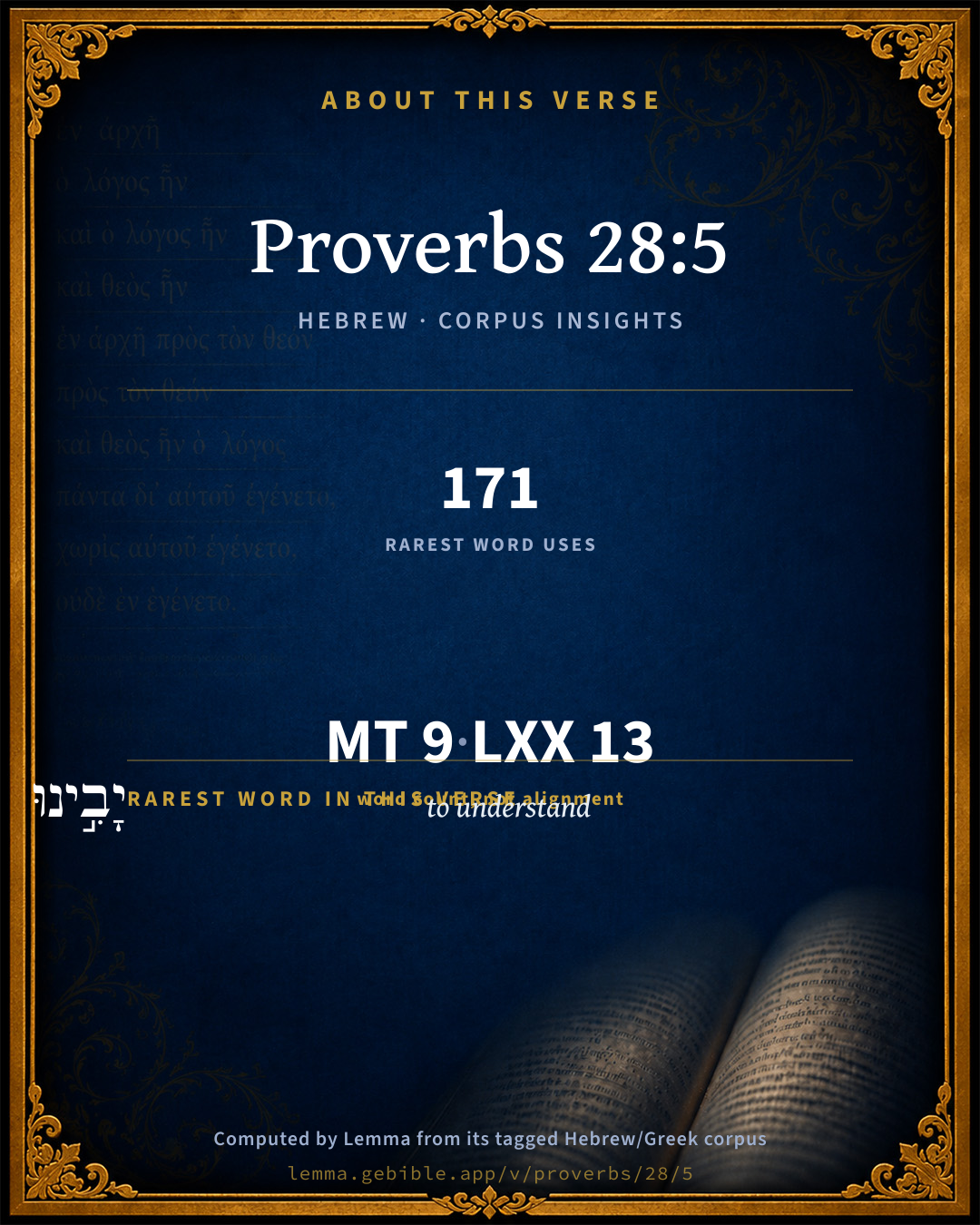
9
words
8
distinct lemmas
Wisdom
section

Grammatical profile

  • 3 verbs
  • 4 nouns
  • 1 adjective
  • 1 particle

Verb forms

  • יָבִ֣ינוּ Qal · Imperfect
  • וּמְבַקְשֵׁ֥י Piel · Participle Active
  • יָבִ֥ינוּ Qal · Imperfect

Repetition

A word recurs within this verse — often emphatic in Hebrew:

  • יָבִ֣ינוּ to understand H995 ×2

Hebrew & Septuagint length

In English translation the verse runs 13 words from the Hebrew and 15 from the Septuagint (LXX English) — closely comparable.

A rough comparison of the two English renderings, which tokenize alike — not a word-level alignment.

Word counts can differ between the Hebrew and the Greek without any difference in meaning — e.g. the Hebrew direct-object marker אֵת has no separate Greek word, and Greek often adds the article ὁ.

In the original languages it is 9 Hebrew tokens and 13 Greek tokens — but the two are counted differently (Hebrew bundles its prefixes and suffixes into one token; the Greek is in lemma form), so that isn’t a like-for-like length.

Cross-references

12

Topical passages linked to Proverbs 28:5 in the Treasury of Scripture Knowledge — connected by theme and wording, ordered by reader-vote popularity; previews shown in the World English Bible.

  • James 1:5 But if any of you lacks wisdom, let him ask of God, who gives to all liberally and without reproach; and it will be given to him.
  • Psalms 92:6 A senseless man doesn't know, Neither does a fool understand this:
  • 1 John 2:20 You have an anointing from the Holy One, and you know the truth.
  • 1 John 2:27 As for you, the anointing which you received from him remains in you, and you don't need for anyone to teach you. But as his anointing teaches you concerning all things, and is true, and is no lie, and even as it taught you, you will remain in him.
  • John 7:17 If anyone desires to do his will, he will know about the teaching, whether it is from God, or if I am speaking from myself.
  • Jeremiah 4:22 For my people are foolish, they don't know me; they are foolish children, and they have no understanding; they are wise to do evil, but to do good they have no knowledge.
  • Mark 4:10–13 When he was alone, those who were around him with the twelve asked him about the parables.
  • Psalms 25:14 The friendship of Yahweh is with those who fear him. He will show them his covenant.
  • Psalms 119:100 I understand more than the aged, Because I have kept your precepts.
  • Proverbs 15:24 The path of life leads upward for the wise, To keep him from going downward to Sheol.
  • Proverbs 24:7 Wisdom is too high for a fool: He doesn't open his mouth in the gate.
  • 1 Corinthians 2:14–15 Now the natural man doesn't receive the things of God's Spirit, for they are foolishness to him, and he can't know them, because they are spiritually discerned.

Cross-references courtesy of OpenBible.info (CC BY 4.0).

Hebrew and Greek witnesses Masoretic Hebrew ↔ Greek Septuagint

The same verse in the two great witnesses to the Old Testament, shown verse-for-verse.

These are two independent witnesses, not word-aligned to each other, and the Septuagint is shown in lemma (dictionary) form.

Hebrew Proverbs 28:5 Masoretic · Westminster Leningrad Codex

אַנְשֵׁי רָ֭ע לֹא יָבִ֣ינוּ מִשְׁפָּ֑ט וּמְבַקְשֵׁ֥י יְ֝הוָ֗ה יָבִ֥ינוּ כֹֽל

Evil men don't understand justice; But those who seek Yahweh understand it fully.

World English Bible · Public Domain

Greek LXX Proverbs 28:5 Septuagint · lemma form

ἀνήρ κακός οὐ νοέω κρίμα ὁ δέ ζητέω ὁ κύριος συνἵημι ἐν πᾶς

Evil men will not understand judgment: but they that seek the Lord will understand everything.

LXX2012 (modern English Septuagint) · Public Domain

Hebrew: Westminster Leningrad Codex (CC BY 4.0). Greek: Septuagint (public domain); English from LXX2012 (modern English Septuagint) (Public Domain). How the Septuagint differs from the Hebrew →

Commentary

Notes on Proverbs 28:5 from classic Christian and Jewish commentators (each source and its license shown beneath its notes). The classic Christian expositions comment on the surrounding passage and are grouped to its opening verse, so a note may address several verses; the Jewish commentaries on the Tanakh (Rashi and others) are per-verse, so they appear only where the commentator wrote on this verse.

Lemma curates 59 commentaries, every one of them public domain or Creative Commons licensed, each selected and text-cleaned for this edition rather than reprinted as found. About our sources →

Trapp's Complete Commentary

John Trapp

Pro 28:5 Evil men understand not judgment: but they that seek the LORD understand all [things].

Ver. 5. Evil men understand not judgment.] They are wise to do evil, but to do good they have no knowledge: their wits work not that way; they are bard and brutish as "horse and mule." {Psa 32:9} Yea, they fall beneath the stirrup of reason, and know not their owner, which yet the ox and ass doth; {Isa 1:3} no wiser at seventy years old than at seven. Ut liberius peccent, libenter ignorant, not willing to know what they are not minded to practise.

But they that seek the Lord understand all things.] Not all that is possible to be known, as Averroes saith Aristotle did; as the Civilians say their Baldus did; {a} as the Papists say Tostatus did; but they understand all things needful to salvation, and they often meditate on the last judgment.

{a} De Baldo dicere solebant nihil unquam eum ignorasse.

John Trapp, A Commentary or Exposition upon All the Books of the Old and New Testament (1647–1656) — public domain. Text from a community e-Sword module.

Joseph Benson's Commentary

Pro 28:5. Evil men understand not judgment — Because their minds are naturally blind, and are further blinded by their prejudices and passions, and by the god of this world, who rules in them, they understand not what is just and right, and what is their duty in all cases and conditions; but they that seek the Lord — By diligent study of his word, and by fervent prayer to him for divine illumination; understand all things — Which are necessary to be known by them, either for the discharge of their present duties to God and men: or for their everlasting happiness.

Joseph Benson's Commentary on the Old and New Testaments (1811–1818) — public domain. Text from a community e-Sword module.

Tyndale Open Study Notes

Tyndale Open Resources

28:5 Evil people seek gain by breaking the law. Justice ensures that they are punished and the righteous are rewarded.

Tyndale Open Study Notes — © Tyndale Open Resources, licensed CC BY-SA 4.0. Text via the HelloAO Bible API.

Matthew Henry's Commentary

Note, I. As the prevalency of men's lusts is owing to the darkness of their understandings, so the darkness of their understandings is very much owing to the dominion of their lusts: Men understand not judgment, discern not between truth and falsehood, right and wrong; they understand not the law of God as the rule either of their duty or of their doom; and, 1. Therefore it is that they are evil men; their wickedness is the effect of their ignorance and error, Eph 4:18. 2. Therefore they understand not judgment, because they are evil men; their corruptions blind their eyes, and fill them with prejudices, and because they do evil they hate the light. It is just with God also to give them up to strong delusions.

II. As men's seeking the Lord is a good sign that they do understand much, so it is a good means of their understanding more, even of their understanding all things needful for them. Those that set God's glory before them as their end, his favour as their felicity, and his word as their rule, and apply to him upon all occasions by prayer, they seek the Lord, and he will give them the spirit of wisdom. If a man do his will, he shall know his doctrine, Joh 7:17. A good understanding those have, and a better they shall have, that do his commandments, Psa 111:10; Co1 2:12, Co1 2:15.

Matthew Henry's Commentary on the Whole Bible (1708–1710) — public domain (CC PDM 1.0). Text via the HelloAO Bible API.

Jamieson, Fausset & Brown

Robert Jamieson, A. R. Fausset & David Brown

(Compare Joh 7:17). Ignorance of moral truth is due to unwillingness to know it.

Jamieson, Fausset & Brown — Commentary Critical and Explanatory on the Whole Bible (1871) — public domain (CC PDM 1.0). Text via the HelloAO Bible API.

Adam Clarke's Commentary

Verse 5. They that seek the Lord understand all things.] They are wise unto salvation; they "have the unction from the Holy One, and they know all things," 1Jo 2:20, every thing that is essentially needful for them to know, in reference to both worlds.

Adam Clarke's Commentary on the Bible (1810–1826) — public domain. Text from a community e-Sword/MySword module.

Ellicott's Commentary for English Readers

(5) Evil men understand not judgment.—Or, what is right. For God reveals Himself only to those who fear Him (Psa_25:14, comp. 1Co_2:11; 1Jn_2:20); they, by following the light they have, are “guided into all truth” (Joh_16:13); the evil, by continually shutting their eyes to the light, at last can not see it, even if they would (Joh_12:39, sqq.).

A Bible Commentary for English Readers, edited by Charles John Ellicott (1878–1897) — public domain. Text from a community e-Sword module.

The Cambridge Bible for Schools and Colleges

gen. ed. J. J. S. Perowne

5. The intellectual condition depends upon the moral and spiritual. “Obedience is the organ of spiritual knowledge.” Comp. Joh_7:17.

The Cambridge Bible for Schools and Colleges (gen. ed. J. J. S. Perowne; Cambridge University Press, 1878–1918) — public domain. Text from a community e-Sword module.

John Gill's Exposition

Evil men understand not judgment,.... Or, "men of wickedness" (b); that are under the governing power of it; who are given up and give up themselves unto it; who, like Ahab, sell themselves to work wickedness: these know not what is just and right between man and man, at least not to do it; they know it not practically; they are wise to do evil, but to do good have no knowledge, Jer 4:22; they know not the law of God, the rule of judgment, justice, and equity; at least not the extensiveness and spirituality of it, Jer 8:7; and much less the Gospel of Christ, which is sometimes so called, Isa 42:1. Nor do they notice, as they should, to the judgments of God in the earth; they do not consider his work, and the operation of his hand; the vengeance he takes on wicked men, so Jarchi interprets it; nor do they take any notice of the judgment to come, at which they must appear, and into which they will be brought, and all things done by them;

but they that seek the Lord understand all things; this character describes all good men that seek the Lord, in private and in public, that seek him by prayer and supplication, that wait upon him in the ordinances of his house; and all sensible sinners, who seek to Christ for righteousness, for rest, for life and salvation, for more grace from him, for more communion with him, for a greater degree of knowledge of him, and for immortality and eternal life, his kingdom and glory. And such "understand all things"; not in the most full and absolute sense; for this is proper and peculiar to God: nor all things natural and civil, which truly righteous persons, generally speaking, have the least share of, as arts, sciences, languages, trade and commerce in all its branches; and indeed universal knowledge of these things does not belong to anyone alan: nor all things in a religious sense; not all the difficult passages of Scripture, in which there are many things hard to be understood; but all things necessary to salvation; all things relating to their fallen, depraved, and miserable state and condition by nature, and to the way and means of their recovery and salvation by Christ; all things relating to a spiritual and saving knowledge of God in Christ; and to the knowledge of the person, offices, and grace of Christ; and to the work of the Spirit of God upon the heart; and of the doctrines of the Gospel, according to the measure of the gift of Christ, and so as to be food for their souls: and which understanding is given them, and they attain unto and increase in, by seeking the Lord, and using the means of knowledge, the word and ordinances; see Co1 2:15. The Targum and Syriac version render it,

"that understand all good things;''

and so Aben Ezra interprets it: the Arabic version is, "they understand it in all things"; that is, judgment, justice, and equity, in all its branches, and practise it.

(b) "viri mali, (in genitivo casu)", Mercerus; "vel malitiae", Baynus, Gejerus.

John Gill's Exposition of the Whole Bible (1746–1763) — public domain (CC PDM 1.0). Text via the HelloAO Bible API.

Albert Barnes' Notes on the Bible

The deep interdependence of morality and intellect. We have a right judgment in all things in proportion as our hearts seek to know God. Compare Jam 1:23-24.

Albert Barnes' Notes on the Bible (1834–1885) — public domain. Text from a community e-Sword/MySword module.

Matthew Poole's English Annotations

Understand not, because their minds are naturally blind, and are further blinded by their own prejudices and passions, and by the god of this world, who rules in and over them.

Judgment, i.e. what is just and right; what is their duty in all cases and conditions, as judgment is frequently understood.

That seek the Lord, by diligent study of his word, and by fervent prayers to him for advice. All things which are necessary to be known by them, either for the discharge of all their present duties to God and men, or for their everlasting happiness.

Matthew Poole's English Annotations on the Holy Bible (1683–1685) — public domain. Text from a community e-Sword/MySword module.

Whedon's Commentary on the Bible

Daniel D. Whedon

5. Judgment — Justice, or the principle of rectitude.

Understand not — Have no proper sense or appreciation of it.

All things — Every thing pertaining to the subject. An ingenuous and pious mind readily comprehends and properly appreciates the principle of rectitude. The proverb “asserts the deep interdependence of morality and intellect. We loose ethical discernment in proportion as we do evil. We have a right judgment in all things in proportion as our heart seeks to know God” — Speaker’s Commentary. Compare Pro_29:7; 1Jn_2:20; Joh_14:26; Joh_16:13; Jas_1:23-24.

Daniel D. Whedon (gen. ed.), Commentary on the Old and New Testaments (1874–1909) — public domain. Text from a community e-Sword module.

The Pulpit Commentary

Evil men understand not judgment; or, what is right. An evil man"s moral conception is perverted, he cannot distinguish between right and wrong; the light that was in him has become darkness. (comp. Pro_29:7) Many men, by giving themselves over to wickedness, awe judicially blinded, according to Joh_12:39, Joh_12:40. They who seek the Lord understand all things. These who do God"s will, seeking him in prayer, know what is morally right is every circumstance, have a right judgment in all things. (comp. Ecc_8:5 1Co_2:15) So 1Jn_2:20, "Ye have an unction from the Holy One, and ye know all things;" and our Lord has (declared, "If any man willeth to do his will, he shall know of the doctrine". Joh_7:17)

The Pulpit Commentary (1880–1919), ed. H.D.M. Spence-Jones & Joseph S. Exell — public domain. Text from a community e-Sword module.

John Wesley's Explanatory Notes

Judgment - What is just and right. All things - Which are necessary to be known by them.

John Wesley, Explanatory Notes Upon the Whole Bible (1754–1765) — public domain. Text via the GEBible commentary corpus.

Keil & Delitzsch

C. F. Keil & F. Delitzsch

A similar antithetic distich:

Wicked men understand not what is right;

But they who seek Jahve understand all.

Regarding the gen. expression אנשׁי־רע, vid., under Pro 2:14. He who makes wickedness his element, falls into the confusion of the moral conception; but he whose end is the one living God, gains from that, in every situation of life, even amid the greatest difficulties, the knowledge of that which is morally right. Similarly the Apostle John (Jo1 2:20): "ye have an unction from the Holy One, and ye know all things" (οἴδατε πάντα): i.e., ye need to seek that knowledge which ye require, and which ye long after, not without yourselves, but in the new divine foundation of your personal life; from thence all that ye need for the growth of your spiritual life, and for the turning away from you of hostile influences, will come into your consciences. It is a potential knowledge, all-comprehensive in its character, and obviously a human relative knowledge, that is here meant.

Keil & Delitzsch — Biblical Commentary on the Old Testament (1861–1891) — public domain (CC PDM 1.0). Text via the HelloAO Bible API. (Old Testament only.)

Bridges on Proverbs

Charles Bridges

Ignorance and knowledge are here contrasted, and each traced to their proper source. The Apostle draws the same contrast. "The natural man receiveth not the things of the Spirit of God. But he that is spiritual judgeth all things." (1Co 2:14-15 .) This unity of statement is beautiful and instructive. ’The two Testaments, like our two eyes, mutually enlighten us, and assist each other.’†1

Evil men understand not judgment.†2 They know not the true standard of right and wrong, the true way to God, or the end of God’s dealings with them. Their ignorance is willful. (Job 21:14 .) "Having the understanding darkened; because of the blindness of the heart. Men love darkness rather than light, because their deeds are evil. They call darkness light, and light darkness."†3 The most distinguished scholar is a very fool in understanding judgment; and, except he be humbled in the consciousness of his ignorance, and seek light from above, he will perish in gross darkness. What a curse are learning and intellect without an humble heart!

Nay — sometimes knowledge, no less than ignorance, hinders a right understanding. Where the knowledge of the truth goes before or beyond the power of it, the mind is often perplexed with difficulties, which the less intelligent, but more simple, escapes. When knowledge stands in the stead of faith; when the man reasons, instead of submitting to Divine teaching; knowledge abused becomes a positive hindrance to a correct understanding. Nothing is more revolting to our evil nature, than the study of Scripture, with an earnest and sincere desire to follow its light and teaching.

An undisciplined imagination is also a great hindrance to a spiritual judgment. Let this bright faculty be exercised in giving vivid apprehensions of divine things, and clothing the picture with brilliant but truthful coloring. It may thus, within its own province, be a valuable handmaid to the Gospel. But a ray of faith is better than a rainbow of fancy. The picture, if it be not in immediate connection with the reality, fades away without permanent influence. The feeblest faith, grounded upon the fundamentals of the Gospel, proves a steadfast principle of endurance and triumphant energy, even when under the prostration of natural and intellectual power, "the whole head is sick, and the whole heart is faint."

But pride fastens upon every faculty of man. And this is indeed the general cause. The source of light is despised. (Psa 10:4 .) Hence "there is none that understandeth," because "there is none that seeketh after God."†4 They that seek the LORD, babes though they may be in intellect, and ignorant in worldly things — shall have an accurate understanding of all things profitable, such as no "natural man" can attain.†5 "The words are plain to him that understandeth, and right to them that find knowledge." (Pro 8:9 .) Many things, dark to human reason, are simplified to humility.†6 The harmony of the divine attributes staggers reason, and can only be apprehended by humble faith. ’In thinking of the justice of the Deity’ (as a reclaimed infidel†7 describes his own conflict) man ’is at first ready to doubt his compassion. But the gospel answers him by the voice of an Apostle — "God so loved the world" that "he spared not his own Son, but delivered him up for us all." — It is then that the penitent sinner apprehends this ineffable mystery. His proud and blind reason had rejected it. His humble and contrite heart profoundly feels it. He believes, because he loves; because he is grateful; because he sees all the goodness of the Creator proportioned to the miseries of the creature. Oh my God! all thy mysteries are mysteries of love, and therefore are they indeed divine.’†8

Again — God’s working is the spring of diligence, not of inertion. Man works, but under the Master-worker. He is free, but under the free-making Spirit, giving him a will for the service. Thus, while active, he is kept dependent.†9 He works with deeper humility, and more assured confidence. (Php 2:12-13 .) This is a mystery to reason. But they that seek the LORD understand it. Practical experience shews it to them. Again — how dark are the LORD’s ways to man’s proud reason! Hard dispensation! a world of sorrow! But the child of God, seeking to know "the end," understands them "all to be mercy and truth."†10 Is it not the sharp trial, to probe the wound; the bitterness, to wean from the creature comfort; the burden, to prove "the patience and faith of the saints;" the sifting, to separate the chaff from the wheat; the furnace, to purify the gold? Thus does seeking the LORD expound the mysteries of Providence and grace! We are neither stumbled by the stones, perplexed by the labyrinths, or "discouraged because of" the length and weariness of the way. Those who desire the light shall have it. (Joh 7:17 .) To those who improve it more shall be given.†11

But — ’I cannot seek — that is — I cannot pray.’ Nor can you do anything right of yourself. But does this discharge you from the obligation? Does it not often mean — if the heart would speak out — ’I have no care for the blessing.’ But suppose the confession to be sincere — ’I cannot pray.’ Then do as you are taught. Carry this confession to the Lord. Repeat it again and again upon your knees. Let not inability be indolence, but faith. Not one of the Lord’s people, but sympathizes with the complaint. The connection of your utter helplessness is most profitable, as confirming the divine testimony. (2Co 3:5 .) Yet remember the help provided for weakness and ignorance. (Rom 8:26 .) If you cannot pray as you would, pray as you can. Desire — sincere and supreme — is the heart’s real prayer, God’s own work upon the soul.†12 Is this manifest? Wait in the constant use of the means. Be found in the way. (Isa 64:5 .) "Light is sown," and the seed in God’s best time will bring the harvest. (Psa 97:11 .) No one fails to make progress, who is really in earnest. It is a grand mistake to suppose, that some impression must be felt, as the warrant to seek. The only true warrant is the free invitation and promise of the gospel. You must come, if at all, as a sinner, not as a saint; as you are, not as you would be; now, not waiting for some better time or preparation; seeking your fitness in Christ, not in yourself. And then plead his promise — "Him that cometh unto me I will in no wise cast out." (Joh 6:37 .) Tell him that you are come on the ground of this promise, and to claim the fulfillment of it — "Remember the word unto thy servant, upon which thou hast caused me to hope." (Psa 119:49 .) This must prevail. "He cannot deny himself." (2Ti 2:13 .)

But if as yet you cannot come thus boldly, do not reason or despond about your state. Ask for divine teaching to understand, and divine grace to follow, the light vouchsafed. No depth of learning, no extraordinary inspiration, is needed. Simplicity, humility, diligence, will bring the unction "from the Holy One, by which ye shall know all things." (1Jn 2:20 .) In God’s best time the heart is given, as well as the mind. "The senses are exercised to discern between good and evil." (Heb 5:14 .) All is light, because the creative word has been given anew — "Let there be light; and there was light."†13 Are Christians then to be despised as fools? They are the most intelligent people in the world. Fixed at Wisdom’s gate, their religion is divine wisdom; and "Wisdom is justified of her children."†14

Footnotes:

†1 Serle’s Horœ Solitarœ, vol. i. 565.

†2 Psa 82:5. Jer 4:22 .

†3 Eph 4:18. Joh 3:19 . Isa 5:20 .

†4 Psa 14:2. Rom 3:11 . ’Wickedness’ — Bp. Taylor justly observes — ’corrupts a man’s reasoning, gives him false principles, and evil measuring of things.’ — Sermon before University of Dublin. ’I regard it as a fundamental error in the study of Divinity’ — remarks Professor Franke — ’for any one to persuade himself, that he can study divinity properly without the Holy Spirit. As long as he remains in this error all labor is lost on him.’ — Lect. Paræn. p. 184. ’A grain of true faith is more estimable than a mass of mere historical knowledge.’ — Ib. Idea. Studiosi Theologiæ. A man may as soon read the letter of Scripture without eyes, as properly understand their mysteries without grace.’ — Bp. Beveridge.

†5 Psa 25:9, Psa 25:12 ; Psa 119:98-100, Psa 119:130 . Mat 11:25 .

†6 Psa 25:14, with Pro 24:7 .

†7 The French poet and philosopher, De La Harpe.

†8 Quoted in Sheppard’s Thoughts on Devotion, pp. 308-310.

E-compiler’s note: there is a close-quote after the last word in this sentence, but no open-quote (?). I cannot guess from the context & words where the quote might begin & could not find this work by Sheppard on the internet.

†9 Psa 119:4-5, Psa 119:8, Psa 119:10, Psa 119:32, Psa 119:173 .

†10 Jas 5:11, with Psa 25:10 .

†11 Mat 13:12; Mat 25:29 . Compare Sir 1:26-27 .

†12 Psa 38:9. Isa 26:8-9 . See Homer’s fine description, ’Prayers the daughters of Jove’ — perhaps the most remarkable view of prayer to be found in Heathen literature — as Cowper in his Notes writes — ’well worthy of observation, considering where it is found.’ — Il. I. 502-514.

†13 Gen 1:3. 2Co 4:6 .

†14 Luk 7:35. Pro 8:34 . Compare Wis 6:11-16 .

Charles Bridges, An Exposition of the Book of Proverbs (1846) — public domain. Text from a community e-Sword module.

unfoldingWord translationNotes

Door43 World Missions Community

Evil men

Here "men" means people in general. AT: "People who do evil things" (See: When Masculine Words Include Women)

do not understand justice

The abstract noun "justice" can be expressed as an adjective. AT: "do not understand what is just" (See: Abstract Nouns)

those who seek Yahweh

Those who want to know Yahweh and please him are spoken of as if they are literally seeking to find Yahweh. (See: Metaphor)

understand everything

The implied information is that those who seek Yahweh understand all about justice. AT: "completely understand what is just" (See: Assumed Knowledge and Implicit Information)

It is better for a poor person ... than for a rich person

"It is better to be a poor person ... than it is to be a rich person"

walks in his integrity

This represents a person living a life of integrity. The abstract noun "integrity" can be expressed as an adverb. AT: "walks honestly" or "lives honestly" (See: Metaphor and Abstract Nouns)

who is crooked in his ways

Rich people who are dishonest are spoken of as if they walk on crooked or twisted paths. AT: "who is not honest in what he does" (See: Metaphor)

translationWords

evil

just

Yahweh

walk

integrity

unfoldingWord translationNotes — © Distant Shores Media and the Door43 World Missions Community, licensed CC BY-SA 4.0. Source: git.door43.org/Door43/en_tn.

Rashi

Rabbi Shlomo Yitzchaki (Rashi)

Men of evil do not understand judgment They do not give attention to the ultimate retribution, that they should think about it and repent of their way and be saved.

but those who seek the Lord understand everything Good and evil. משפט is justise in Old French. In this manner, Rabbi Tanhuma explained it as referring to the generation of the Flood.

Rashi on the Tanakh — English translations: “The Judaica Press complete Tanach with Rashi, translated by A. J. Rosenberg” (CC BY 4.0); “Pentateuch with Rashi's commentary by M. Rosenbaum and A.M. Silbermann, 1929-1934” (public domain); “The Metsudah Tanach series, Lakewood, N.J” (CC BY 4.0); and “The Book of Joshua, Metsudah Publications, 1997” (CC BY 4.0). Text via Sefaria.

Lesson kit

Teaching starters — assembled from the data on this page, not authored interpretation. Every prompt links to the verse data it draws on. Edit before teaching.

Proverbs, in the Wisdom, opens this verse with 9 words (8 distinct Hebrew lemmas). Its most distinctive word is bîyn (“to understand”). A historical commentator’s framing appears above. Read the whole chapter for the surrounding context.

Discussion questions

  1. The word bîyn carries the sense “to understand.” How does it shape the verse?
  2. James 1:5 shares this passage’s theme. How do the two illuminate each other?
  3. “to understand” occurs 2× in this one verse. What is the effect of the repetition?
  4. These translations render this verse differently. What is at stake in choosing one wording over another?
  5. The verb «יָבִ֣ינוּ» is Qal Imperfect. How does its form color the action?
  6. Reading how Trapp's Complete Commentary and Joseph Benson's Commentary read this verse, where do the two commentators agree and where do they part?

Things to notice

Reading settings

Reading text

Shown beneath each verse's original-language words.

Old Testament
Old Testament edition

Read the OT as the Masoretic Hebrew (MT) or the Greek Septuagint (LXX).

English shown for the Greek Septuagint (in the Hebrew ↔ Greek comparison).

Comparing translations? Open the Compare panel on any verse page to stack up to four side by side.