
Deuteronomy 4:29

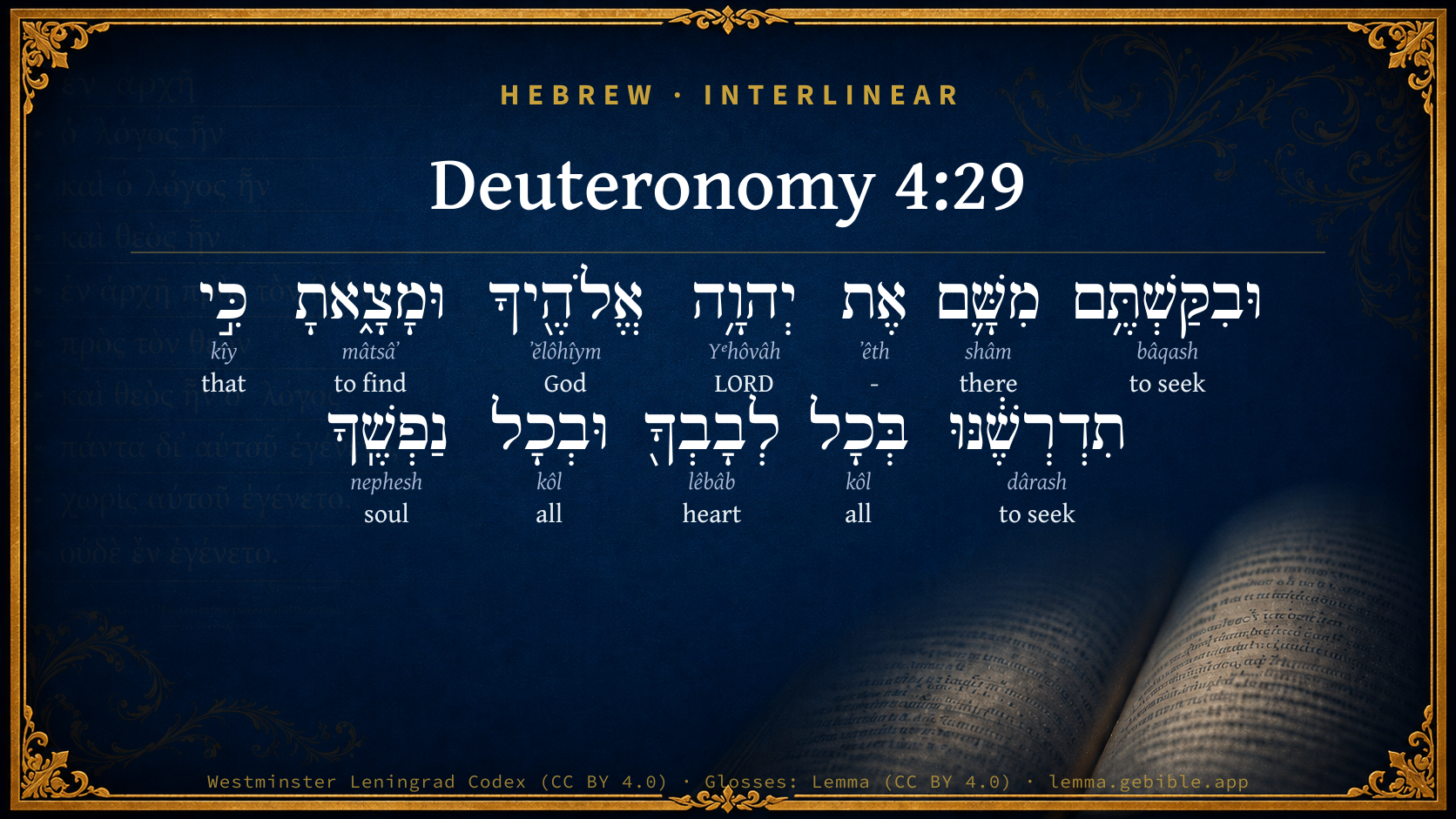
Hebrew (Westminster Leningrad Codex) Deuteronomy 4:29 appears in the Hebrew Old Testament. The text above is from the Westminster Leningrad Codex. Each word links to its Strong’s number, a concise gloss, and parsing drawn from the Open Scriptures Hebrew Bible morphology. Click any word for its full Brown-Driver-Briggs (BDB) entry.
Download image
Cite this verse

Deuteronomy 4:29 (World English Bible). Public Domain. Lemma interlinear Bible study tool, https://lemma.gebible.app/v/deuteronomy/4/29.

Show BibTeX & RIS
BibTeX
RIS
English Translation
But from there you shall seek Yahweh your God, and you shall find him, when you search after him with all your heart and with all your soul.
World English Bible · Public Domain
Download a study sheet

One document with this verse’s original text, its word-by-word gloss line, the meaning frame, cross-references with their text, attributed commentary, and full source and license credits — printable, and it pastes into notes with its structure intact.

This verse Autodidact and up

Study sheet (.html) Plain text (.txt)

A passage Seminary Student

Up to 50 verses in one chapter. A passage sheet keeps up to 6 commentary sources and 12 cross-references per verse, in the order this page ranks them, and says so on the sheet whenever that leaves anything out. Ask for a single verse and you get the Autodidact verse sheet above.

Everything on this page stays free to read, with no account — the sheet is a download of what is already on screen, not access to it.

Want to remove ads? Support Godless Engineer
Compare translations 3

The same verse in 3 English versions, stacked beneath the original-language interlinear above. Click any original word for its lexicon entry.

Each is an independent rendering of the whole verse — the interlinear is not word-aligned to these translations.

Highlighted words mark where these versions differ — a whole-verse word diff, not a word-by-word alignment.

  • World English Bible Public Domain
    But from there you shall seek Yahweh your God, and you shall find him, when you search after him with all your heart and with all your soul.
  • King James Version Public Domain
    But if from thence thou shalt seek the LORD thy God, thou shalt find him, if thou seek him with all thy heart and with all thy soul.
  • unfoldingWord Literal Text CC BY-SA 4.0
    And from there you will search for Yahweh your God, and you will find when you seek him with all your heart and with all your soul.

unfoldingWord Literal Text — © unfoldingWord, licensed CC BY-SA 4.0. Word-aligned USFM3 via Door43 (git.door43.org/unfoldingWord/en_ult).

Versions to compare (up to 4)

3 of 4 selected

Show all 18 translations

Every available English version of this verse, each an independent rendering of the whole verse.

  • World English Bible Public Domain
    But from there you shall seek Yahweh your God, and you shall find him, when you search after him with all your heart and with all your soul.
  • Berean Standard Bible Public Domain
    But if from there you will seek the LORD your God, you will find Him if you seek Him with all your heart and with all your soul.
  • Majority Standard Bible Public Domain
    But if from there you will seek the LORD your God, you will find Him if you seek Him with all your heart and with all your soul.
  • King James Version Public Domain
    But if from thence thou shalt seek the LORD thy God, thou shalt find him, if thou seek him with all thy heart and with all thy soul.
  • American Standard Version (1901) Public Domain
    But from thence ye shall seek Jehovah thy God, and thou shalt find him, when thou searchest after him with all thy heart and with all thy soul.
  • Revised Version (1885) Public Domain
    But if from thence ye shall seek the LORD thy God, thou shalt find him, if thou search after him with all thy heart and with all thy soul.
  • Geneva Bible (1599) Public Domain
    But if from thence thou shalt seeke the Lord thy God, thou shalt finde him, if thou seeke him with all thine heart, and with all thy soule.
  • Douay-Rheims (1899) Public Domain
    And when thou shalt seek there the Lord thy God, thou shalt find him: yet so, if thou seek him with all thy heart, and all the affliction of thy soul.
  • Young's Literal Translation Public Domain
    `And -- ye have sought from thence Jehovah thy God, and hast found, when thou seekest Him with all thy heart, and with all thy soul,
  • Literal Standard Version CC BY-SA 4.0
    And you have sought your God YHWH from there, and have found [Him] when you seek Him with all your heart and with all your soul.
  • Unlocked Literal Bible CC BY-SA 4.0
    But from there you will seek Yahweh your God, and you will find him, when you search after him with all your heart and with all your soul.
  • unfoldingWord Literal Text CC BY-SA 4.0
    And from there you will search for Yahweh your God, and you will find when you seek him with all your heart and with all your soul.
  • Darby Bible Public Domain
    And from thence ye shall seek Jehovah thy God, and thou shalt find him, if thou shalt seek him with thy whole heart and with thy whole soul.
  • World Messianic Bible Public Domain
    But from there you shall seek the LORD your God, and you will find him when you search after him with all your heart and with all your soul.
  • Webster's Bible Public Domain
    But if from thence thou shalt seek the LORD thy God, thou shalt find him, if thou shalt seek him with all thy heart, and with all thy soul.
  • Free Bible Version CC BY-SA 4.0
    However, if while you're there you decide to come to the Lord your God, you will find him if you come to him whole-heartedly, with complete commitment.
  • Bible in Basic English Public Domain
    But if in those lands you are turned again to the Lord your God, searching for him with all your heart and soul, he will not keep himself from you.
  • JPS Tanakh (1917) Public Domain
    But from thence ye will seek the LORD thy God; and thou shalt find Him, if thou search after Him with all thy heart and with all thy soul.

Literal Standard Version (2020), Covenant Press — licensed CC BY-SA 4.0. Text via the HelloAO Bible API (eBible.org). Unlocked Literal Bible (unfoldingWord) — licensed CC BY-SA 4.0. Text via the HelloAO Bible API (eBible.org). unfoldingWord Literal Text — © unfoldingWord, licensed CC BY-SA 4.0. Word-aligned USFM3 via Door43 (git.door43.org/unfoldingWord/en_ult). Free Bible Version, Dr. Jonathan Gallagher — licensed CC BY-SA 4.0. Text via the HelloAO Bible API (eBible.org).

Word by word

More ways to search: Search by grammar → Find every occurrence → Compare this word →

Practice this passage: Drill this verse → Learn its vocabulary →

תִדְרְשֶׁ֔נּוּ
dârash
H1875
“to seek · him”
Verb, Qal, Imperfect, 2nd Person, Masculine, Singular + Suffix, Personal, 3rd Person, Masculine, Singular
Part of Speech
Verb
Stem
Qal
Form
Imperfect
Person
2nd Person
Gender
Masculine
Number
Singular
Full BDB Definition

Origin: a primitive root

TWOT: 455

to resort to, seek, seek with care, enquire, require - (Qal) - to resort to, frequent (a place), (tread a place) - to consult, enquire of, seek - of God - of heathen gods, necromancers - to seek deity in prayer and worship - God - heathen deities - to seek (with a demand), demand, require - to investigate, enquire - to ask for, require, demand - to practice, study, follow, seek with application - to seek with care, care for - (Niphal) - to allow oneself to be enquired of, consulted (only of God) - to be sought, be sought out - to be required (of blood)
  1. וּבִקַּשְׁתֶּ֥ם bâqash H1245 “and · to seek” Conjunction + Verb, Piel, Sequential Perfect, 2nd Person, Masculine, Plural
  2. מִשָּׁ֛ם shâm H8033 “from · there” Preposition + Adverb
  3. אֶת ʼêth H853 “-” Particle, Direct Object
  4. יְהוָ֥ה Yᵉhôvâh H3068 “LORD” Noun, Proper
  5. אֱלֹהֶ֖יךָ ʼĕlôhîym H430 “God(s) · your” Noun, Common, Masculine, Plural, Construct + Suffix, Personal, 2nd Person, Masculine, Singular
  6. וּמָצָ֑אתָ mâtsâʼ H4672 “and · to find” Conjunction + Verb, Qal, Sequential Perfect, 2nd Person, Masculine, Singular
  7. כִּ֣י kîy H3588 “that” Conjunction
  8. בְּכָל kôl H3605 “in/at · all of” Preposition + Noun, Common, Masculine, Singular, Construct
  9. לְבָבְךָ֖ lêbâb H3824 “heart · your” Noun, Common, Masculine, Singular, Construct + Suffix, Personal, 2nd Person, Masculine, Singular
  10. וּבְכָל kôl H3605 “and · in/at · all of” Conjunction + Preposition + Noun, Common, Masculine, Singular, Construct
  11. נַפְשֶֽׁךָ nephesh H5315 “soul · your” Noun, Common, Both, Singular, Construct + Suffix, Personal, 2nd Person, Masculine, Singular

About this verse

These counts appear in no published source. They are computed here, from the morphology-tagged text and Lemma’s own curated glosses. What Lemma adds →

12
words
11
distinct lemmas
Pentateuch
section

Grammatical profile

  • 3 verbs
  • 6 nouns
  • 1 conjunction
  • 1 adverb
  • 1 particle

Verb forms

  • וּבִקַּשְׁתֶּ֥ם Piel · Sequential Perfect
  • וּמָצָ֑אתָ Qal · Sequential Perfect
  • תִדְרְשֶׁ֔נּוּ Qal · Imperfect

Repetition

A word recurs within this verse — often emphatic in Hebrew:

  • בְּכָל all H3605 ×2

Hebrew & Septuagint length

In English translation the verse runs 28 words from the Hebrew and 31 from the Septuagint (LXX English) — closely comparable.

A rough comparison of the two English renderings, which tokenize alike — not a word-level alignment.

Word counts can differ between the Hebrew and the Greek without any difference in meaning — e.g. the Hebrew direct-object marker אֵת has no separate Greek word, and Greek often adds the article ὁ.

Cross-references

20

Topical passages linked to Deuteronomy 4:29 in the Treasury of Scripture Knowledge — connected by theme and wording, ordered by reader-vote popularity; previews shown in the World English Bible.

  • Psalms 119:2 Blessed are those who keep his statutes, Who seek him with their whole heart.
  • Jeremiah 29:12–14 You shall call on me, and you shall go and pray to me, and I will listen to you.
  • 2 Chronicles 15:4 But when in their distress they turned to Yahweh, the God of Israel, and sought him, he was found of them.
  • Isaiah 55:6–7 Seek you Yahweh while he may be found; call you on him while he is near:
  • Psalms 119:10 With my whole heart, I have sought you. Don't let me wander from your commandments.
  • Deuteronomy 30:10 if you shall obey the voice of Yahweh your God, to keep his commandments and his statutes which are written in this book of the law; if you turn to Yahweh your God with all your heart, and with all your soul.
  • Jeremiah 3:12–14 Go, and proclaim these words toward the north, and say, Return, you backsliding Israel, says Yahweh; I will not look in anger on you; for I am merciful, says Yahweh, I will not keep [anger] forever.
  • 1 Kings 8:47–48 yet if they shall repent themselves in the land where they are carried captive, and turn again, and make supplication to you in the land of those who carried them captive, saying, We have sinned, and have done perversely, we have dealt wickedly;
  • Deuteronomy 30:1–3 It shall happen, when all these things are come on you, the blessing and the curse, which I have set before you, and you shall call them to mind among all the nations, where Yahweh your God has driven you,
  • Psalms 119:145 I have called with my whole heart. Answer me, Yahweh! I will keep your statutes.
  • Joel 2:12 "Yet even now," says Yahweh, "turn to me with all your heart, And with fasting, and with weeping, and with mourning."
  • Psalms 119:58 I sought your favor with my whole heart. Be merciful to me according to your word.
  • Jeremiah 3:10 Yet for all this her treacherous sister Judah has not returned to me with her whole heart, but only in pretense, says Yahweh.
  • 2 Chronicles 15:15 All Judah rejoiced at the oath; for they had sworn with all their heart, and sought him with their whole desire; and he was found of them: and Yahweh gave them rest round about.
  • Nehemiah 1:9 but if you return to me, and keep my commandments and do them, though your outcasts were in the uttermost part of the heavens, yet will I gather them from there, and will bring them to the place that I have chosen, to cause my name to dwell there.
  • Leviticus 26:39–42 Those of you who are left will pine away in their iniquity in your enemies' lands; and also in the iniquities of their fathers shall they pine away with them.
  • 2 Kings 10:31 But Jehu took no heed to walk in the law of Yahweh, the God of Israel, with all his heart: he didn't depart from the sins of Jeroboam, with which he made Israel to sin.
  • 2 Kings 23:3 The king stood by the pillar, and made a covenant before Yahweh, to walk after Yahweh, and to keep his commandments, and his testimonies, and his statutes, with all [his] heart, and all [his] soul, to confirm the words of this covenant that were written in this book: and all the people stood to the covenant.
  • 2 Chronicles 15:12 They entered into the covenant to seek Yahweh, the God of their fathers, with all their heart and with all their soul;
  • 2 Chronicles 31:21 In every work that he began in the service of the house of God, and in the law, and in the commandments, to seek his God, he did it with all his heart, and prospered.

Cross-references courtesy of OpenBible.info (CC BY 4.0).

Hebrew and Greek witnesses Masoretic Hebrew ↔ Greek Septuagint

The same verse in the two great witnesses to the Old Testament, shown verse-for-verse.

These are two independent witnesses, not word-aligned to each other, and the Septuagint is shown in lemma (dictionary) form.

Hebrew Deuteronomy 4:29 Masoretic · Westminster Leningrad Codex

וּבִקַּשְׁתֶּ֥ם מִשָּׁ֛ם אֶת יְהוָ֥ה אֱלֹהֶ֖יךָ וּמָצָ֑אתָ כִּ֣י תִדְרְשֶׁ֔נּוּ בְּכָל לְבָבְךָ֖ וּבְכָל נַפְשֶֽׁךָ

But from there you shall seek Yahweh your God, and you shall find him, when you search after him with all your heart and with all your soul.

World English Bible · Public Domain

Greek LXX Deuteronomy 4:29 Septuagint · lemma form

καί ζητέω ἐκεῖ κύριος ὁ θεός σύ καί εὑρίσκω ὅταν ἐκζητέω αὐτός ἐκ ὅλος ὁ καρδία σύ καί ἐκ ὅλος ὁ ψυχή σύ ἐν ὁ θλῖψις σύ

And there you⌃ shall seek the Lord your God, and you⌃ shall find him whenever you⌃ shall seek him with all your heart, and with all your soul in your affliction.

LXX2012 (modern English Septuagint) · Public Domain

On this verse, The Cambridge Bible for Schools and Colleges discusses the Septuagint’s reading. Read the note in Commentary ↓

Hebrew: Westminster Leningrad Codex (CC BY 4.0). Greek: Septuagint (public domain); English from LXX2012 (modern English Septuagint) (Public Domain). How the Septuagint differs from the Hebrew →

Targum (Aramaic paraphrase)

2

The Targum is the ancient Jewish Aramaic paraphrase of the Hebrew Scriptures — an interpretive translation, not the Hebrew text itself. Onkelos (literal) and Pseudo-Jonathan (expansive) render the Torah, and Jonathan the Prophets. Coverage is partial: where no permissively-licensed English translation exists for a verse, only the Aramaic is shown. This is verse-level text, not a word-by-word alignment to the Hebrew.

  1. Targum Onkelos Torah (Genesis–Deuteronomy)
    וְתִתְבְּעוּן מִתַּמָן יָת דַחֲלְתָּא דַייָ אֱלָהָךְ וְתִשְׁכָּח אֲרֵי תִבְעֵי מִן קֳדָמוֹהִי בְּכָל לִבָּךְ וּבְכָל נַפְשָׁךְ

    (no public-domain English translation for this verse)

    Targum Onkelos — Aramaic: “Onkelos Genesis” (public domain); “Onkelos Exodus” (public domain); “Onkelos Leviticus” (public domain); “Onkelos Numbers” (public domain); “Onkelos Deuteronomy” (public domain). English: “Sefaria Community Translation” (CC0 1.0 (public-domain dedication)); “J.W. Etheridge. The Targums of Onkelos and Jonathan Ben Uzziel on the Pentateuch. London: Longmans, Green, 1862” (public domain). Text via Sefaria.

  2. Targum Pseudo-Jonathan Torah (Genesis–Deuteronomy)
    וְתִתְבְּעוּן מִתַּמָּן לְמִיתַב לִדְחַלְתָּא דַיְיָ אֱלָהָכוֹן וְתִשְׁכְּחוּן רַחֲמִין אֲרוּם תִּבְעוּן מִן קֳדָמוֹי בְּכָל לִבְּכוֹן וּבְכָל נַפְשֵׁיכוֹן

    But if there you seek to return to the fear of the Lord your God, you shall find mercy, when you seek before Him with all your heart and with all your soul.

    Targum Pseudo-Jonathan — Aramaic: “Targum Jonathan on Genesis” (public domain); “Targum Jonathan on Exodus” (public domain); “Targum Jonathan on Leviticus” (public domain); “Targum Jonathan on Numbers” (public domain); “Targum Jonathan on Deuteronomy” (public domain). English: “The Targum of Jonathan ben Uzziel, trans. J. W. Etheridge, London, 1862” (public domain). Text via Sefaria.

Commentary

Notes on Deuteronomy 4:29 from classic Christian and Jewish commentators (each source and its license shown beneath its notes). The classic Christian expositions comment on the surrounding passage and are grouped to its opening verse, so a note may address several verses; the Jewish commentaries on the Tanakh (Rashi and others) are per-verse, so they appear only where the commentator wrote on this verse.

Lemma curates 59 commentaries, every one of them public domain or Creative Commons licensed, each selected and text-cleaned for this edition rather than reprinted as found. About our sources →

The Cambridge Bible for Schools and Colleges

gen. ed. J. J. S. Perowne

29. But if from thence ye shall seek … thou shalt find] The Pl. ye is due either to the attraction of the plurals of the previous verses or to a dittography. How easily the former worked is seen from the LXX which carries the Pl. as far as search after him. Read with Sam. thou shalt seek. Thus the Sg. stands throughout Deu_4:29-31. Omit him after find; cp. Jer_29:13.

with all thy heart and with all thy soul] Heart the seal of the practical intellect (see on Deu_4:9); soul of the desires, the two thus covering the whole man. See Deu_6:5, Deu_10:12, Deu_11:13, Deu_13:3, Deu_26:16, Deu_30:2; Deu_30:6; Deu_30:10 (Deu_6:5 adds with all thy force), and deuteronomic passages in Josh. and Kgs; once in Jer_32:41 of God. This enforcement of spiritual thoroughness is characteristic of D.

The Cambridge Bible for Schools and Colleges (gen. ed. J. J. S. Perowne; Cambridge University Press, 1878–1918) — public domain. Text from a community e-Sword module.

Trapp's Complete Commentary

John Trapp

Deu 4:29 But if from thence thou shalt seek the LORD thy God, thou shalt find [him], if thou seek him with all thy heart and with all thy soul.

Ver. 29. But if from thence.] Sweet and sour make the best sauce. Promises and menaces mixed, soonest operate upon the heart. The Sun of Righteousness loves not to set in a cloud; nor the God of consolation to leave his children comfortless.

John Trapp, A Commentary or Exposition upon All the Books of the Old and New Testament (1647–1656) — public domain. Text from a community e-Sword module.

The Biblical Illustrator

Joseph S. Exell

Deu_4:29-31

If from thence thou shalt seek the Lord thy God.

Conversions encouraged

I. First, then, there is a time mentioned. If from thence thou shalt seek the Lord . . . When thou art in tribulation, and all these things are come upon thee even in the latter days.

1. The time in which the Lord bids you seek Him, O you unforgiven ones, is, first of all, from thence--that is, from the condition into which you have fallen, or the position which you now occupy. Today, even today, He bids you seek Him with all your heart and with all your soul.

2. With regard to the time of turning, it is well worthy of our notice that we are specially encouraged to turn unto the Lord if we are in a painful plight. Our text says, When thou art in tribulation. Are you sick? Does your weakness increase upon you? Are you apprehensive that this sickness may even be unto death? When thou art in such tribulation, then thou mayest return to Him. A sick body should lead us the more earnestly to seek healing for our sick soul. Are you poor, have you come down from a comfortable position to one of hard labour and of scant provision? When thou art in this tribulation, then turn to the Lord, for He has sent thee this need to make thee see thy yet greater necessity, even thy need of Himself.

3. Notice further, when you feel that the judgments of God have begun to overtake you, then you may come to Him: When thou art in tribulation and all these things - these threatened things - are come upon thee.

4. There is yet one more word which appears to me to contain great comfort in it, and it is this, even in the latter days. It is a beautiful sight, though it is mingled with much sadness, to see a very old man become a babe in Christ--to see him, after he has been so many years the proud, wayward, self-confident master of himself, at last learning wisdom and sitting at Jesus feet. They hang up in the cathedrals and public halls old banners which have long been carried by the enemy into the thick of the fight. If they have been torn by shot and shell, so much the more do the captors value them: the older the standard the more honour is it, it seems, to seize it as a trophy.

II. But now look at the way appointed. To find mercy, what are we bidden to do? If from thence thou shalt seek the Lord thy God.

1. We have not, then, to bring anything to God, but to seek Him. We have not to seek a righteousness to bring to Him, nor seek a state of heart which will fit us for Him, but to seek Him at once. Salvation is not by doing, nor by being, nor by feeling, but simply by believing. We are not to be content with self, but to seek the Lord. Being ourselves unworthy, we are to find worthiness in Jesus.

2. We are also to grasp the Lord as ours, for the text says, Thou shalt seek the Lord thy God. Sinners, that is a part of saving faith, to take God to be your God; if He is only another mans God, He cannot save you; He must be yours to trust and love and serve all your days, or you will be lost.

3. Now, mark Gods directions--If thou seek Him with all thy heart and with all thy soul. There must be no pretence about this seeking. If you desire to be saved, there must be no playing and trifling and feigning. The search must be real, sincere, and earnest, intense, thorough going, or it will be a failure.

4. The text further adds that we are to turn to Him. Did you notice the 30th verse--If thou turn to the Lord thy God? It must be a thorough turn. You are looking now towards the world--you must turn in the opposite direction, and look Godward. It must not be an apparent turn, but a real change of the nature, a turning of the entire soul; a turning with repentance for the past, with confidence in Christ for the present, and with holy desires for the future. Heart, soul, life, speech, action, all must be changed.

5. Then it is added, and be obedient to His voice, for we cannot be saved in disobedience; Christ is not come to save His people in their sins, but from their sins.

III. Thirdly, the text contains very rich encouragements. How does it run?

1. For the Lord thy God is a merciful God; He will not forsake thee. Catch at that, sinner,--He will not forsake thee. If He were to say, Let him alone, Ephraim is given unto idols, it would be all over with you; but if you seek Him, He will not say, Let him alone, nor take His Holy Spirit from you. You are not yet given up, I hope, or you would not have been here.

2. And then it is added, Neither destroy thee. You have been afraid He would; you have often thought the earth would open and swallow you: you have been afraid to fall asleep lest you should never wake again; but the Lord will not destroy you; nay, rather He will reveal His saving power in you.

3. There is a sweeter word still in the 29th verse, Thou shalt find Him if thou seek Him. What more, poor sinner, what more dost thou want?

4. Then there are two reasons given: For the Lord thy God is a merciful God. Oh guilty soul, the Lord does not want to destroy you. Judgment is His strange work. Oh soul, God has such a care for man. He waits to be gracious, and His Spirit goes forth towards sinners; therefore return to Him.

5. Now dwell upon that last argument - He will not forget the covenant of thy fathers. The covenant always keeps open the path between God and man. The Lord has made a covenant concerning poor sinners with His Son Jesus Christ. He has laid help upon One that is mighty, and given Him for a covenant to the people. He evermore remembers Jesus, and how He kept that covenant; He calls to mind His sighs and death throes, and He fulfils His promise for the great Sufferers sake. Gods grace has kept His covenant on the behalf of men; God is even eager, to forgive, that He may reward Christ, and give Him to see of the travail of His soul. (C. H. Spurgeon.)

Seeking God

I. What is involved in seeking God?

1. A sense of dissatisfaction with distance from Him. When men have all they want they do not set out upon a quest. Only the heart that feels the destitution and misery of being without God will address itself to this quest.

2. A conviction that God is to be found. Men do not seek for fruits and grain upon the ocean, but they seek them with assurance from the soil they till. Doubtless many, searching in the wrong direction, have exclaimed, Who can, by searching, find out God? But those who look for the Eternal in His Word, and especially in the person of His Son, cannot look in vain.

3. The seeking for God to be successful must be sincere, earnest, diligent--i.e. with all thy heart and with all thy soul--more eagerly and resolutely than men in the East sought for hidden treasure, than men seek for health, knowledge, wealth or fame. Those who thus seek for Christ--the pearl of great price--are not far from Him.

III. What is promised to those who thus seek God?

1. They shall find the Object of their desire: They that seek Me early shall find Me. Not like the search for the philosophers stone, which men foolishly wasted life in endeavouring to find.

2. They shall find God in Christ.

3. In Christ they shall find rest to their souls, joy, life eternal. They who find Christ find Him never to lose Him, or aught that He bestows. (Family Churchman.)

Great sinners encouraged to return to God

I. A few cases to which this language applies.

1. I have gone great lengths in sin. I was a drunkard and blasphemer. God has now brought me into trouble; I cannot live long, and yet fear to die. But if from thence thou shalt seek the Lord, etc.

2. I was born of religious parents, I was long weary of religion, and wished to be free. At length my father died, and I gave myself up to evil, and now no one cares for my soul. But if from thence, etc.

3. My conduct has been correct and orderly; but I have prided myself upon it; I have lived a Pharisee. Now I feel the need of something with which to appear before God. Well, If from thence, etc.

4. I have made a profession of religion and thought well of my state, but indulged in secret sins, and afterwards in outward transgressions, and now I am all outcast; everyone shuns me. But if from thence, etc.

5. Though I have not lost my character, yet I have lost my peace of mind; I am a backslider. But if from thence, etc.

II. The grounds on which this encouragement rests. (A. Fuller.)

The penitent certain of acceptance

I. Now, the first thing that strikes us in this address is, that it is based upon the anticipation that the Jews would abuse their Makers blessings; that comfort would breed luxury, and luxury would wean the heart from God; that His place would be usurped by idols, till He should be provoked to withdraw His favour and protection. All this is foreseen as the natural propensity of the human heart. And yet, though evil is spoken of as the inevitable consequence of sin, the case was not desperate; however disgraced they might be by the tyranny of men, or degraded by the bondage of Satan, they might still find mercy from the Being they had incensed. But there is another feeling which is met by the gracious assurance of our text, which is very apt to prove a stumbling block to those whose eyes are newly opened to their sins.

II. We might persuade ourselves that God will not utterly cast off those who seek Him in sincerity and truth; but how can we tell whether our feelings are earnest enough, and pure enough, and abiding enough to prevail with Him to listen to our prayer? As long as we thought we might trifle with safety we put off religion to a more convenient season; and it was not till our fears became intolerable that we besought Him heartily that He would save us; but terror is not conversion, and who will ensure that the present feelings will be lasting if the danger be withdrawn? or who can tell whether, indeed, they are anything but a foretaste of eternal torment? Again, would not the world continue to be dear to us if its gifts were not embittered by Providence? We turn to God in our trouble; but it is the mere selfishness of those who find that they have no other comforter. Will He be satisfied with such a worthless offering as this? Oh! well may Scripture say that His ways are not as our ways, when it declares at the same time that such applications are welcome to Him. We bring to Him little but disappointed hopes and blighted feelings and enfeebled health; we have tried every broken cistern before we would apply to the fountain; and even when we come at last, we come rather to escape impending punishment than from any regret for having violated our duty towards Him; and yet He scorns us not. The aged sinner, who is tottering towards the tomb, he may bring the poor remains of an ill-spent life, and find himself received at the eleventh hour. The widowed mourner, who placed all her happiness below till death snatched it from her, she may turn to the God of all consolation, and find Him a husband to herself, and a father to the fatherless around her. The convert, in all his newborn indignation, though he is sensible that he is more anxious to escape the wrath to come than the evil which provokes it, shall be accepted according to that he hath, and more shall be imparted for his improvement. I do not say that such motives are the purest or the strongest by which we can be actuated; but I say the question is whether our hearts are really changed or no, and not in what motive the change may have originated. Do you ask, then, whether your feelings are such as will prevail upon God to listen to your prayers? Prove them by acting immediately and perseveringly upon them. The tree is known by the fruit which it produces; and those, be sure, are proper feelings which bring you in a state of humiliation to the Cross of Christ. (J. Stainforth, M. A.)

God to be found by seeking

I. Notice a few cases to which this language applies.

1. The openly profane and immoral.

2. Those who were religiously educated.

3. The formal professor.

4. The backslider. The dying sinner.

II. Observe the grounds on which the encouragement rests.

1. The character of God.

2. The work of Christ.

3. The promises of the Gospel.

4. Scriptural examples of pardoned and accepted sinners.

III. Improve the subject.

1. It takes away all ground of excuse from the impenitent.

2. It takes away all ground of despair from the contrite. (G. Brooks.)

Those that seek God shall find Him

At one place to which I went I saw a dear soul to whom I put the question, Are you converted? I was once--given with, oh, such a disconsolate aspect!--I was once, but that is all gone. I was a worker for Him once, he said, with a sob, but it is all different now. My heart went out to that one. Why? There is a fire in a room, and you are crouching in a cold comer, far away from the fire. You do not say that the fire has forsaken you. Oh no, you have left the fire; conscious of that fact, you go back to it, and are soon again basking in its warmth. Ah, those who seek Him find Him, and He is so loving and so forgiving, in spite of all the hard thoughts which you had of Him. Though your sins be as scarlet, they shall be white as snow; though they be red like crimson, they shall be as wool. (W. Haslam.)

Earnest seeking successful

Success in this world comes only to those who exhibit determination. Can we hope for salvation unless our mind is truly set upon it? Grace makes a man be as resolved to be saved as the beggar was to get to Jesus and gain his sight. I must see him, said an applicant at the door of a public person. You cannot see him, said the servant; but the man waited at the door. A friend went out to him and said, You cannot see the master, but I can give you an answer; No, said the importunate pleader, I will stay all night on the doorstep, but I will see the man himself. He alone will serve my turn. You do not wonder that, after many rebuffs, he ultimately gained his point. It would be an infinitely greater wonder if an importunate sinner did not obtain an audience from the Lord Jesus. If you must have grace, you shall have it. If you will not be put off you shall not be put off. Whether things look favourable or unfavourable, press on till you find Jesus, and you shall find Him. (C. H. Spurgeon.)

Trouble often drives people to God

There is a story told that in the olden time Artaxerxes and another great king were engaged in a furious fight. In the middle of the battle an eclipse happened, and such was the horror of the warriors that they made peace then and there. Happy will you be if your trouble will cause you to fly to the arms of God. If you tell your troubles to Him you put them into the grave; if you roll your burden anywhere else, it will roll back again like the stone of Sisyphus. The springs at the base of the Alpine mountains are fullest when the summer sun has dried and parched the verdure in the valleys below. The heat that has burned the arid plains has melted mountain glacier and snow, and increased the volume of the mountain streams. Thus when adversity has dried the springs of earthly comfort, the saint has the fulness of the springs of salvation.

The heart reached by adversity

The four seasons once determined to try which could quickest roach the heart of a stone. Spring coaxed the stone with its gentle breezes, and made flowers encircle it, and trees to shoot out their branches and embower it, but all to no purpose, The stone remained indifferent to the beauties of the spring, nor would it yield its heart to its gentle caresses. Summer came next, and caused the sun to shine on the stone, hoping to melt its obdurate heart; but though the surface of the stone grew warm, it quickly became cold again when not under the influence of the summer suns rays. Summer thus being unable by any degree of warmth to penetrate the flinty nature of the stone, gave place to autumn. Believing that the stone had been treated with too much kindness, the autumn withered the flowers and stripped the trees of their leaves, and threatened and blustered, but still the stone remained impassive. Winter came next. First it sent strong winds, which laid the stone bare, then it sent a cold rain, and next a hard frost, which cleaved the stone and laid bare its heart. So many a heart, which neither gentleness, warmth, nor threats can touch, is reached by adversity. (A. Freeman.)

The Biblical Illustrator, edited by Joseph S. Exell (c. 1880s–1900s) — public domain. Text from a community e-Sword module.

Geneva Bible (1599)

Geneva Bible translators

Not with outward show or ceremony, but with a true confession of thy faults.

Geneva Bible (1599) marginal notes — public domain. Text via Bolls.life.

Adam Clarke's Commentary

Verse 29. But if from thence thou shalt seek the Lord] God is longsuffering, and of tender mercy; and waits, ever ready, to receive a backsliding soul when it returns to him. Is not this promise left on record for the encouragement and salvation of lost Israel?

Adam Clarke's Commentary on the Bible (1810–1826) — public domain. Text from a community e-Sword/MySword module.

John Gill's Exposition

But if from thence thou shalt seek the Lord thy God,.... By prayer and supplication, acknowledging and confessing sin, and desiring that God would be gracious and forgive it, and bring them out of their miserable condition; even if out of those depths of affliction and distress, and though scattered about in the world, and in the uttermost parts of it:

thou shalt find him; to be a God hearing and answering prayer, gracious and merciful, ready to help and deliver:

if they seek him with all their heart and with all their soul; sincerely and affectionately.

John Gill's Exposition of the Whole Bible (1746–1763) — public domain (CC PDM 1.0). Text via the HelloAO Bible API.

Albert Barnes' Notes on the Bible

Unwilling, as it might seem, to close his discourse with words of terror, Moses makes a last appeal to them in these verses in a different strain.

Deu 4:34

Temptations - Compare Deu 7:18-19; Deu 29:2-3; not, “i. e.” the tribulations and persecutions undergone by the Israelites, out the plagues miraculously inflicted on the Egyptians.

Deu 4:37

He chose their seed after them - literally, “his seed after him.” Speaking of the love of God to their fathers in general, Moses has more especially in mind that one of them who was called “the Friend of God” Jam 2:23.

Brought thee out in his sight - literally, “by His face:” “i. e.” by the might of His personal presence. Compare Exo 33:14; where God promises “My presence (literally ‘My face’) shall go with thee.”

Albert Barnes' Notes on the Bible (1834–1885) — public domain. Text from a community e-Sword/MySword module.

Haydock's Catholic Bible Commentary

CHAPTER IV.

There. Hebrew, "thence" from the place of captivity, or returning from the love of idols to the services of the true God. --- Soul. Hebrew, "with all thy soul. (Ver. 30) In thy tribulation after," &c. (Calmet) --- God often sends chastisements as the most effectual means of salvation, to make his children enter into themselves. In this state, the soul is more at liberty to consider the follow of adhering to any thing in opposition to the sovereign Lord. Then she is forced to confess that her idols cannot afford her any protection. How, in effect, could any one fall into such an abyss of corruption and stupidity, as to imagine those things to be gods which have not even the dignity and advantages which they themselves possess? Their soul must first have been strangely blinded, and their heart corrupt. Even the more enlightened pagans acknowledged the folly of pretending to represent the Divinity under sensible forms. "God, says Empedocles, has no human members....He is a pure and ineffable spirit, who governs the world by his profound wisdom." Numa would not allow any picture of Him, conformably to the doctrine of Pythagoras; and, for the first 170 years of Rome, no representation of God was set up in the temples. (Plutarch) --- The ancient Phœnicians seemed to have acted on the same principle, as the temple of Hercules, at the Straits, had no image. It is well known that the Persians rejected both the statues and temples erected in honour of the gods; and the Germans esteemed it beneath the majesty of the heavenly Beings, to represent them under any human form. (Tacitus, Hist. v.) (Calmet) --- Yet these sages gave way to the folly of the people, and, against their better knowledge, adored the stupid and senseless idols. (Haydock)

George Leo Haydock (1774–1849), Haydock's Catholic Family Bible and Commentary, 1859 edition — public domain. Excludes Psalms (Douay-Rheims chapter numbering differs from Protestant) and Deuterocanonical books (Catholic canon only).

Matthew Poole's English Annotations

If thou seek him; if thou desirest his help and favour. See Deu 30:2; Isa 45:6.

With all thy heart, i.e. sincerely and fervently.

Matthew Poole's English Annotations on the Holy Bible (1683–1685) — public domain. Text from a community e-Sword/MySword module.

Whedon's Commentary on the Bible

Daniel D. Whedon

29-40. Terrible as will be their punishment if they forget Jehovah their God, there is hope of his mercy and love if they shall ever repent. Moses does not close his discourse without again reminding them of the glorious works wrought in connexion with their deliverance. Deu_4:37-39 inclusive would better be read: “Because he loved thy fathers, and chose his [Abraham’s] seed after him, and brought thee out of Egypt in his sight with great power, to drive out nations mightier and stronger than thou art from before thy face, and to bring thee in, and to give thee their land for an inheritance that thou mightest know and consider in thy heart that Jehovah he is the God in heaven above and upon the earth beneath.”

In his sight — Literally, by his face — by his personal presence. In Exo_33:14, Jehovah is represented as saying to Moses, “My presence [literally, my face] shall go with thee.”

As it is this day — By the conquest of Og and Sihon the Israelites had a pledge that the nations of Canaan would be dispossessed.

Daniel D. Whedon (gen. ed.), Commentary on the Old and New Testaments (1874–1909) — public domain. Text from a community e-Sword module.

The Pulpit Commentary

With all thy heart and with all thy soul. As true religion consists in loving the Lord with all the heart and soul, the whole inner nature, (Deu_6:5 Deu_10:12) so true repentance consists in a turning from sin and all ungodliness to God, in a coming from a state of enmity to him, or of indifference to his claims, to honor, reverence, and serve him intelligently and sincerely, thinking of him aright, adoring his perfections, delighting in him u the alone good, giving to him that honor which is his due, and doing his will from the heart. (of 2Ch_15:15) When men have apostatized from God, it is often by means of "tribulation" that they are brought to a right state of mind towards him, and to a true repentance "not to be repented of;" and to effect this is the design of all the chastisements which God sends on his own people (Heb_12:5-11; cf. Jer_24:7 Jer_29:10-13 Jer_50:4, etc.; Eze_6:11, etc.)

Vers. 29-31. Punishment not rejection

(See Homiletics, Deu_30:1-5)

HOMILIES BY D. DAVIES

Vers. 29-40. The mercy of God.

The knowledge of his own deceitful heart, and his observation of others" waywardness, convinced Moses that, in spite of all warning and appeal, the people might yet wander into evil ways. But Moses had also such a comprehensive vision of God"s mercy, that he foresaw that there would be room for repentance even in the land of exile, and that Divine mercy would be available in every extremity of distress. Since God had designed to show mercy unto Israel, Moses felt assured that he would not allow his gracious designs to be frustrated.

I AFFLICTION OFTEN REVEALS TO OUR MINDS OUR NEED OF MERCY. Amid the joyous excitements induced by earthly prosperity, men forget the deeper needs of the soul. They spend life as if they had no soul, as if this earth were their all. But the deep gashes, which suffering makes, become mouths through which the imprisoned soul makes herself heard. When events defeat our selfish plans, or when health is interrupted, we are made to feel that there is a higher Power than ourselves, who reigns upon the throne, and often, in sheer despair of other help, we appeal to him for mercy; like Manasseh, who had long hardened his heart against God, yet, when he was in sore affliction, sought Jehovah"s face. When brought to the lowest ebb, the prodigal son bent his steps homeward. Affliction often serves as the shepherd"s crook.

II EARNEST APPEAL FOR GOD"S MERCY IS NEVER UNSUCCESSFUL ON EARTH. From the furthest limit of apostasy the cry for help is heard. "There is no spot on earth front which lines of connection with heaven will not be found. Our God is not wont to hide himself in secret places, where the eye of faith cannot find him. If only the bow be well bent by the arm of spiritual earnestness, and the arrow be feathered with faith, and aimed by heavenly wisdom, it must penetrate the skies. Without gracious influences from above, men will not pray; but whensoever they do pray, they shall be heard. The prayer of the rich man in his torments was unheard, because it was a godless and a selfish prayer, and because we have no ground for expecting mercy when life has closed; in his case there was no appeal for mercy.

III GOD"S MERCY IS THE MOST ATTRACTIVE REVELATION OF HIMSELF FOR SINNERS. So far as we know, this revelation of his merciful character was reserved for guilty men. In the construction of this material universe, we see chiefly a forth-putting of amazing power. In the creation of sentient beings, capable of deriving pleasure from the processes of natural law, we see in active exercise the qualities of wisdom and benevolence. In the Divine treatment of apostate angels, we discover brilliant coruscations from the flames of justice. In the provision of pardon and hope for human transgressors, we see in God"s nature the fascinating quality of mercy. This mercy manifests itself in a thousand ways, and is a prolific parent of blessing. It restrains from flagrant sin. It envelops the sinner in a network of heavenly influence. It holds back the hand of justice from summary destruction of the culprit. Though men forsake God, he does not forthwith forsake them. Retaliation finds no place in the Eternal Mind. It is negative and positive good.

IV THIS MERCY IS SECURED TO MEN BY COVENANT. A covenant is a compact or treaty made between two persons, and which is intended for the advantage of all parties interested. But it is a pure act of condescension, when God undertakes to bind himself in solemn engagements with his feeble and fallen creatures. This gracious procedure is taken in order to encourage our trust, and to pierce unbelief through and through with a two-edged sword. Now that God has made a covenant with men, and repeated it age after age, his truth and faithfulness and integrity are pledged for our salvation. He made a covenant with Christ, by which he secured to him an ample recompense of redeemed men, and our Lord pleads in prayer for the fulfillment of his Father"s covenant. So gracious is the covenant that God makes with us the new covenant that he writes it on the tablet of our minds, yea, deeply engraves it upon the soft affections of our hearts.

V THIS MERCY IS MADE CONSPICUOUS BY THE MIGHTY DEEDS OF GOD. Moses reminds the Hebrews of the splendid tokens of God"s goodness they had seen; for every one of these was a pledge of unchanging love. God"s signal emancipation of the people from the iron bondage of Egypt; his care over them throughout the desert pilgrimage; his unprecedented revelation of himself on Horeb, in fire and cloud and voice; all these things were tantamount to fresh covenants earnests of yet larger blessing. In deeds, more eloquent than words, he assured them that all his resources were available for them. And we, in New Testament times, can make this argument stronger still. Calvary serves as a platform, on which we may erect a magnificent structure of expectation. If God had meant to desert us, would he have shown to us such kindnesses as these?

VI GOD DISTRIBUTES HIS MERCY IN VARIOUS MEASURES, He did for the Hebrews what he did not do for other nations of that period. In the way of providence, and in the way of revelation, he deals differently with separate nations, and with individuals. We cannot understand all the rules and methods by which he is pleased to work, but we can leave it to himself to justify his ways. Because mercy snatched the crucified thief from the jaws of perdition at the last moment of life, it is criminal presumption for any other man to expect mercy in his last hour.

VII MERCY FLOWS TO MEN THROUGH A VICARIOUS CHANNEL. God assured that generation of the Jews, that they were blessed for their fathers"sake. Not on the ground of personal merit, nor on the ground of personal claim, did God show them his distinguishing favor, but because he had loved Abraham their father, and for his sake loved his seed. Learn here how greatly God loves a good man! Abraham was not destitute of fault; yet so conspicuous was his practical faith, that God could not do enough for him during an earthly lifetime. The benediction of God overflowed (like the oil on Aaron"s head), and descended to the skirts of his posterity. So, and much more, the love which God bears his only Son flows to us for his Son"s sake. The same rich quality of love God cherishes for his Son, he cherishes for us. The gift of salvation can flow to us in no other way than through this channel of vicarious merit. "God, in Christ, reconciles the world unto himself.

VIII GOD"S MERCY A POTENT INDUCEMENT FOR LOYAL OBEDIENCE. When all other methods have failed to elicit a man"s loyalty, the unexpected display of mercy has often succeeded. Justice, and honor, and all sense of obligation in man have been appealed to over and over again, and always in vain. No appeal moves his callous nature, except the plaintive voice of love. We may tell him of the measureless power of Jehovah, of his inflexible justice, of his inviolable truth, of his fixed determination to root out sin from his kingdom; he hears it all unmoved. But tell him of Jehovah"s overflowing mercy, of his tender love for the chief of sinners, of the costly provision of salvation; and by the gracious application of this by the Divine Spirit, man"s nature relents, becomes docile, and enshrines the Law of God in its inmost center. "Man!" says the silvery voice of mercy, "thy sins are forgiven thee." And the swift response is, "Lord, what wilt thou have me to do? D.

The Pulpit Commentary (1880–1919), ed. H.D.M. Spence-Jones & Joseph S. Exell — public domain. Text from a community e-Sword module.

John Wesley's Explanatory Notes

If from thence thou seek the Lord - Whatever place we are in, we may from thence seek him. There is no part of the earth which has a gulf fixt between it and heaven.

John Wesley, Explanatory Notes Upon the Whole Bible (1754–1765) — public domain. Text via the GEBible commentary corpus.

unfoldingWord translationNotes

Door43 World Missions Community

General Information:

Moses continues to speak to the people of Israel. He speaks as though they were one man, so all instances of "you" and "your" are singular. (See: Forms of You)

But from there

"But when you are in those other nations"

you will seek

The word "you" here is plural. (See: Forms of You)

when you search after him

"when you really try to find him" or "when you really try to know him"

with all your heart and with all your soul

Here "heart" and "soul" are metonyms for a person's inner being. These two phrases are used together to mean "completely" or "earnestly." (See: Metonymy and Doublet)

translationWords

Yahweh

God

heart

soul

unfoldingWord translationNotes — © Distant Shores Media and the Door43 World Missions Community, licensed CC BY-SA 4.0. Source: git.door43.org/Door43/en_tn.

Lesson kit

Teaching starters — assembled from the data on this page, not authored interpretation. Every prompt links to the verse data it draws on. Edit before teaching.

Deuteronomy, in the Pentateuch, opens this verse with 12 words (11 distinct Hebrew lemmas). Its most distinctive word is dârash (“to seek”). A historical commentator’s framing appears above. Read the whole chapter for the surrounding context.

Discussion questions

  1. The word dârash carries the sense “to seek.” How does it shape the verse?
  2. Psalms 119:2 shares this passage’s theme. How do the two illuminate each other?
  3. “all” occurs 2× in this one verse. What is the effect of the repetition?
  4. These translations render this verse differently; the difference is in the English rendering, not the original. What questions does that raise?
  5. The verb «וּבִקַּשְׁתֶּ֥ם» is Piel Sequential Perfect. How does its form color the action?
  6. Reading how The Cambridge Bible for Schools and Colleges and Trapp's Complete Commentary read this verse, where do the two commentators agree and where do they part?

Things to notice

Reading settings

Reading text

Shown beneath each verse's original-language words.

Old Testament
Old Testament edition

Read the OT as the Masoretic Hebrew (MT) or the Greek Septuagint (LXX).

English shown for the Greek Septuagint (in the Hebrew ↔ Greek comparison).

Comparing translations? Open the Compare panel on any verse page to stack up to four side by side.