Ezra 2:62

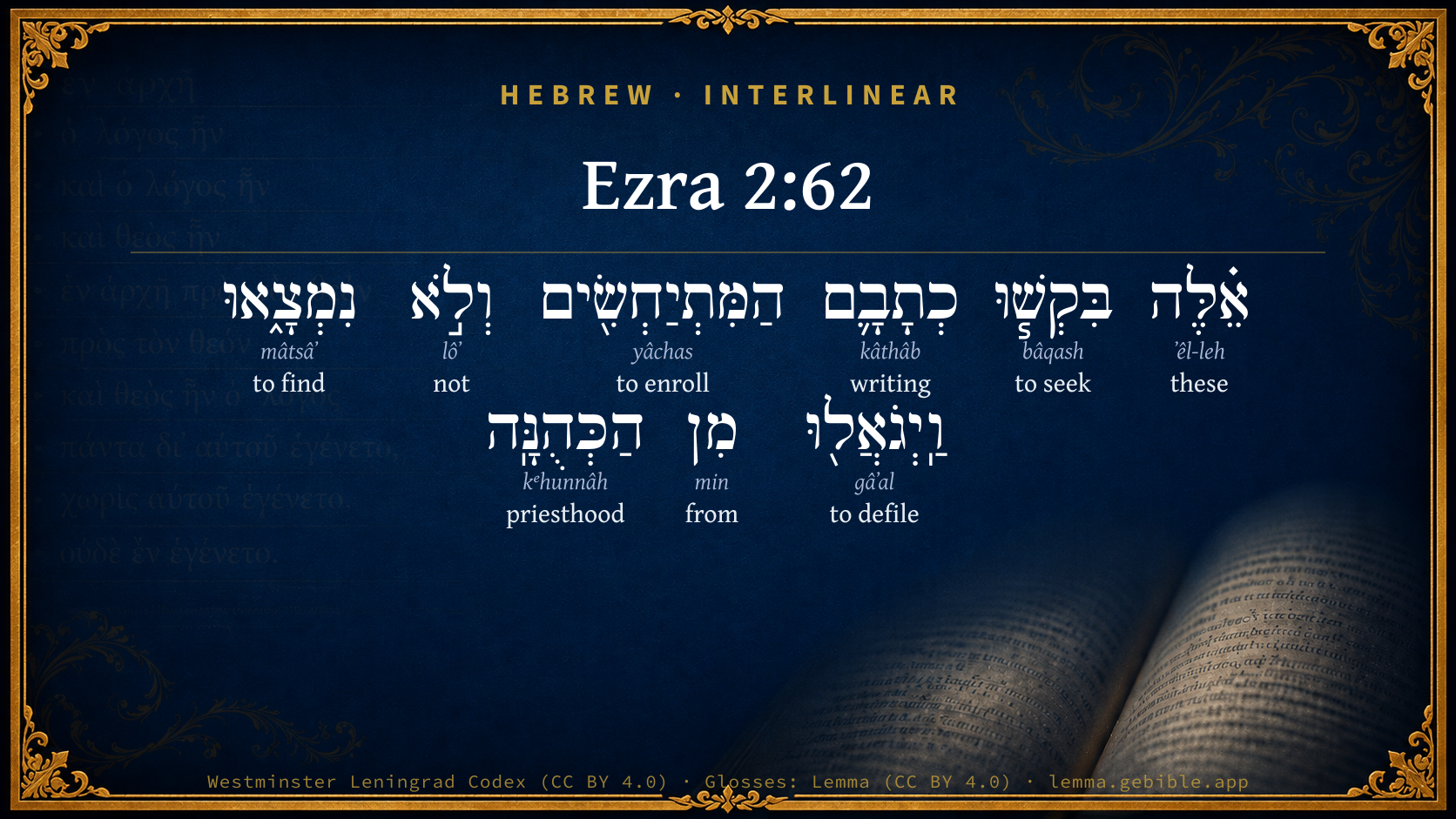
Hebrew (Westminster Leningrad Codex) Ezra 2:62 appears in the Hebrew Old Testament. The text above is from the Westminster Leningrad Codex. Each word links to its Strong’s number, a concise gloss, and parsing drawn from the Open Scriptures Hebrew Bible morphology. Click any word for its full Brown-Driver-Briggs (BDB) entry.
Download image
Cite this verse

Ezra 2:62 (World English Bible). Public Domain. Lemma interlinear Bible study tool, https://lemma.gebible.app/v/ezra/2/62.

Show BibTeX & RIS
BibTeX
RIS
English Translation
These sought their register [among] those who were reckoned by genealogy, but they were not found: therefore were they deemed polluted and put from the priesthood.
World English Bible · Public Domain
Highlights
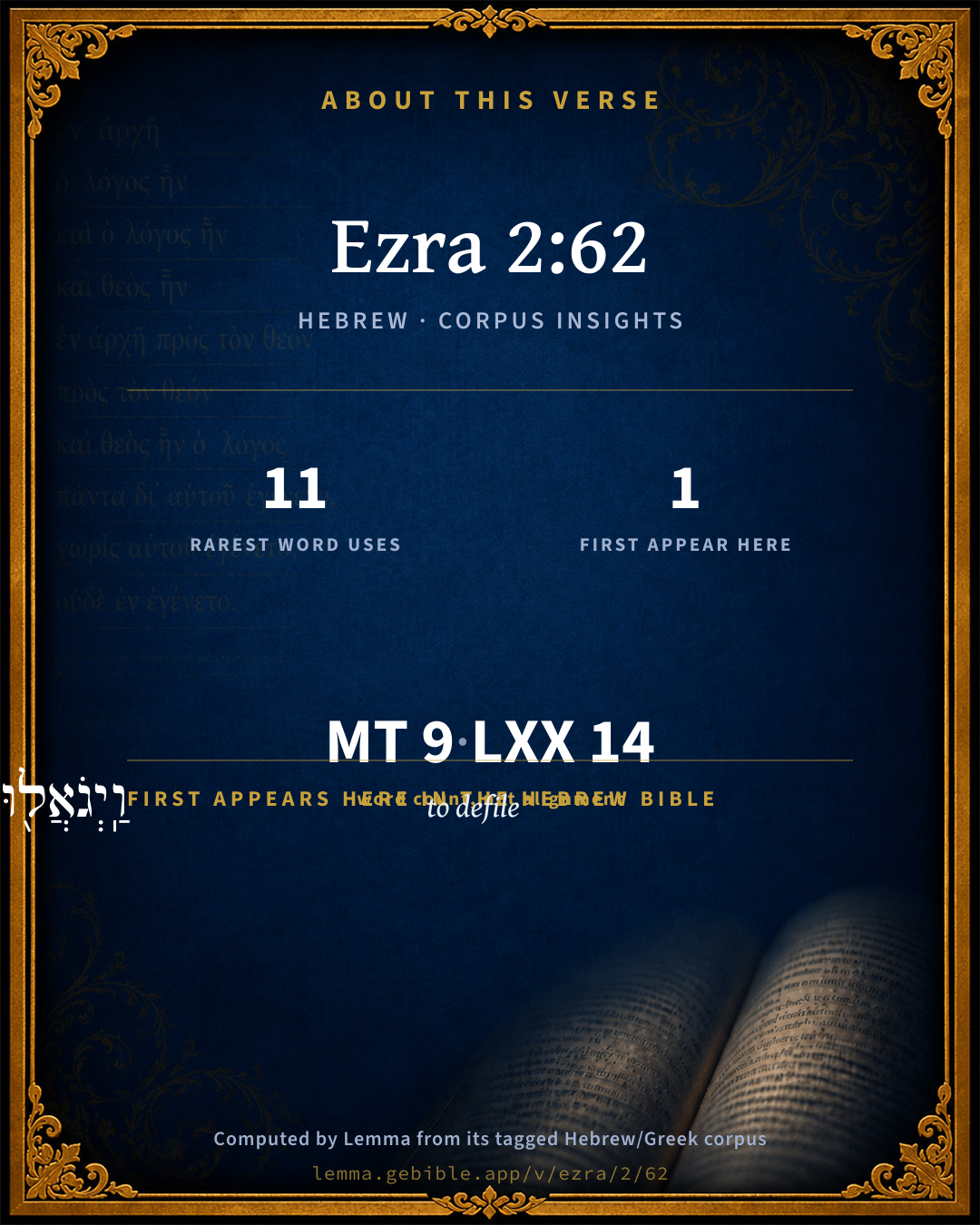
  • 1 first appearance in the Hebrew Bible
Full analysis ↓
Download a study sheet

One document with this verse’s original text, its word-by-word gloss line, the meaning frame, cross-references with their text, attributed commentary, and full source and license credits — printable, and it pastes into notes with its structure intact.

This verse Autodidact and up

Study sheet (.html) Plain text (.txt)

A passage Seminary Student

Up to 50 verses in one chapter. A passage sheet keeps up to 6 commentary sources and 12 cross-references per verse, in the order this page ranks them, and says so on the sheet whenever that leaves anything out. Ask for a single verse and you get the Autodidact verse sheet above.

Everything on this page stays free to read, with no account — the sheet is a download of what is already on screen, not access to it.

Want to remove ads? Support Godless Engineer
Compare translations 3

The same verse in 3 English versions, stacked beneath the original-language interlinear above. Click any original word for its lexicon entry.

Each is an independent rendering of the whole verse — the interlinear is not word-aligned to these translations.

Highlighted words mark where these versions differ — a whole-verse word diff, not a word-by-word alignment.

  • World English Bible Public Domain
    These sought their register [among] those who were reckoned by genealogy, but they were not found: therefore were they deemed polluted and put from the priesthood.
  • King James Version Public Domain
    These sought their register among those that were reckoned by genealogy, but they were not found: therefore were they, as polluted, put from the priesthood.
  • unfoldingWord Literal Text CC BY-SA 4.0
    These ones sought their record among the ones who were enrolled by genealogy, but they were not found. And they were desecrated from the priesthood.

unfoldingWord Literal Text — © unfoldingWord, licensed CC BY-SA 4.0. Word-aligned USFM3 via Door43 (git.door43.org/unfoldingWord/en_ult).

Versions to compare (up to 4)

3 of 4 selected

Show all 18 translations

Every available English version of this verse, each an independent rendering of the whole verse.

  • World English Bible Public Domain
    These sought their register [among] those who were reckoned by genealogy, but they were not found: therefore were they deemed polluted and put from the priesthood.
  • Berean Standard Bible Public Domain
    These men searched for their family records, but they could not find them and so were excluded from the priesthood as unclean.
  • Majority Standard Bible Public Domain
    These men searched for their family records, but they could not find them and so were excluded from the priesthood as unclean.
  • King James Version Public Domain
    These sought their register among those that were reckoned by genealogy, but they were not found: therefore were they, as polluted, put from the priesthood.
  • American Standard Version (1901) Public Domain
    These sought their register `among' those that were reckoned by genealogy, but they were not found: therefore were they deemed polluted and put from the priesthood.
  • Revised Version (1885) Public Domain
    These sought their register among those that were reckoned by genealogy, but they were not found: therefore were they deemed polluted and put from the priesthood.
  • Geneva Bible (1599) Public Domain
    These sought their writing of the genealogies, but they were not founde: therefore were they put from the Priesthood.
  • Douay-Rheims (1899) Public Domain
    These sought the writing of their genealogy, and found it not, and they were cast out of the priesthood.
  • Young's Literal Translation Public Domain
    these have sought their register among those reckoning themselves by genealogy, and they have not been found, and they are redeemed from the priesthood,
  • Literal Standard Version CC BY-SA 4.0
    these have sought their register among those reckoning themselves by genealogy, and they have not been found, and they are redeemed from the priesthood,
  • Unlocked Literal Bible CC BY-SA 4.0
    They searched for their genealogical records, but could not find them, so they were excluded from the priesthood as unclean.
  • unfoldingWord Literal Text CC BY-SA 4.0
    These ones sought their record among the ones who were enrolled by genealogy, but they were not found. And they were desecrated from the priesthood.
  • Darby Bible Public Domain
    These sought their genealogical register, but they were not found; therefore were they, as polluted, removed from the priesthood.
  • World Messianic Bible Public Domain
    These sought their place among those who were registered by genealogy, but they were not found; therefore they were deemed disqualified and removed from the priesthood.
  • Webster's Bible Public Domain
    These sought their register among those that were reckoned by genealogy, but they were not found: therefore were they, as polluted, put from the priesthood.
  • Free Bible Version CC BY-SA 4.0
    They searched for a record of them in the genealogies, but their names weren't found, so they were barred from serving as priests.
  • Bible in Basic English Public Domain
    They made search for their record among the lists of families, but their names were nowhere to be seen; so they were looked on as unclean and no longer priests.
  • JPS Tanakh (1917) Public Domain
    These sought their register, that is, the genealogy, but it was not found; therefore were they deemed polluted and put from the priesthood.

Literal Standard Version (2020), Covenant Press — licensed CC BY-SA 4.0. Text via the HelloAO Bible API (eBible.org). Unlocked Literal Bible (unfoldingWord) — licensed CC BY-SA 4.0. Text via the HelloAO Bible API (eBible.org). unfoldingWord Literal Text — © unfoldingWord, licensed CC BY-SA 4.0. Word-aligned USFM3 via Door43 (git.door43.org/unfoldingWord/en_ult). Free Bible Version, Dr. Jonathan Gallagher — licensed CC BY-SA 4.0. Text via the HelloAO Bible API (eBible.org).

Word by word

More ways to search: Search by grammar → Find every occurrence → Compare this word →

Practice this passage: Drill this verse → Learn its vocabulary →

וַֽיְגֹאֲל֖וּ
gâʼal
H1351
“and · to defile”
Conjunction + Verb, Pual, Sequential Imperfect, 3rd Person, Masculine, Plural
Part of Speech
Conjunction + Verb
Stem
Pual
Form
Sequential Imperfect
Person
3rd Person
Gender
Masculine
Number
Plural
Full BDB Definition

Origin: a primitive root

TWOT: 301

to defile, pollute, desecrate - (Niphal) to be defiled, be polluted - (Piel) to pollute, desecrate - (Pual) to be desecrated (of removal from priesthood) - (Hiphil) to pollute, stain - (Hithpael) to defile oneself
  1. אֵ֗לֶּה ʼêl-leh H428 “these” Pronoun, Demonstrative, Common, Plural
  2. בִּקְשׁ֧וּ bâqash H1245 “to seek” Verb, Piel, Perfect, 3rd Person, Common, Plural
  3. כְתָבָ֛ם kâthâb H3791 “writing · their” Noun, Common, Masculine, Singular, Construct + Suffix, Personal, 3rd Person, Masculine, Plural
  4. הַמִּתְיַחְשִׂ֖ים yâchas H3187 “the · enrolling” Particle, Definite Article + Verb, Hithpael, Participle Active, Masculine, Plural, Absolute
  5. וְלֹ֣א lôʼ H3808 “and · not” Conjunction + Particle, Negative
  6. נִמְצָ֑אוּ mâtsâʼ H4672 “to find” Verb, Niphal, Perfect, 3rd Person, Common, Plural
  7. מִן min H4480 “from” Preposition
  8. הַכְּהֻנָּֽה kᵉhunnâh H3550 “the · priesthood” Particle, Definite Article + Noun, Common, Feminine, Singular, Absolute

About this verse

These counts appear in no published source. They are computed here, from the morphology-tagged text and Lemma’s own curated glosses. What Lemma adds →

9
words
9
distinct lemmas
Historical
section

Notable vocabulary

The rarest word here is וַֽיְגֹאֲל֖וּ to defile H1351 — appearing just 11 times in the whole Hebrew Bible.

First appearance in Scripture

This word makes its first canonical appearance in the Hebrew Bible here:

  • וַֽיְגֹאֲל֖וּ to defile H1351

Shared distinctive vocabulary

וַֽיְגֹאֲל֖וּ to defile H1351 occurs in 9 verses of the Hebrew Bible. Also found in:

Grammatical profile

  • 4 verbs
  • 2 nouns
  • 1 pronoun
  • 1 preposition
  • 1 particle

Verb forms

  • בִּקְשׁ֧וּ Piel · Perfect
  • הַמִּתְיַחְשִׂ֖ים Hithpael · Participle Active
  • נִמְצָ֑אוּ Niphal · Perfect
  • וַֽיְגֹאֲל֖וּ Pual · Sequential Imperfect

Hebrew & Septuagint length

In English translation the verse runs 26 words from the Hebrew and 24 from the Septuagint (LXX English) — closely comparable.

A rough comparison of the two English renderings, which tokenize alike — not a word-level alignment.

Word counts can differ between the Hebrew and the Greek without any difference in meaning — e.g. the Hebrew direct-object marker אֵת has no separate Greek word, and Greek often adds the article ὁ.

In the original languages it is 9 Hebrew tokens and 14 Greek tokens — but the two are counted differently (Hebrew bundles its prefixes and suffixes into one token; the Greek is in lemma form), so that isn’t a like-for-like length.

Cross-references

5

Topical passages linked to Ezra 2:62 in the Treasury of Scripture Knowledge — connected by theme and wording, ordered by reader-vote popularity; previews shown in the World English Bible.

  • Numbers 3:10 You shall appoint Aaron and his sons, and they shall keep their priesthood. The stranger who comes near shall be put to death."
  • Numbers 16:39–40 Eleazar the priest took the brazen censers, which those who were burnt had offered; and they beat them out for a covering of the altar,
  • Leviticus 21:21–23 no man of the seed of Aaron the priest, who has a blemish, shall come near to offer the offerings of Yahweh made by fire. Since has a blemish, he shall not come near to offer the bread of his God.
  • Numbers 18:7 You and your sons with you shall keep your priesthood for everything of the altar, and for that within the veil; and you shall serve: I give you the priesthood as a service of gift: and the stranger who comes near shall be put to death.
  • Ezekiel 44:10–14 But the Levites who went far from me, when Israel went astray, who went astray from me after their idols, they shall bear their iniquity.

Cross-references courtesy of OpenBible.info (CC BY 4.0).

Hebrew and Greek witnesses Masoretic Hebrew ↔ Greek Septuagint

The same verse in the two great witnesses to the Old Testament, shown verse-for-verse.

These are two independent witnesses, not word-aligned to each other, and the Septuagint is shown in lemma (dictionary) form.

Hebrew Ezra 2:62 Masoretic · Westminster Leningrad Codex

אֵ֗לֶּה בִּקְשׁ֧וּ כְתָבָ֛ם הַמִּתְיַחְשִׂ֖ים וְלֹ֣א נִמְצָ֑אוּ וַֽיְגֹאֲל֖וּ מִן הַכְּהֻנָּֽה

These sought their register [among] those who were reckoned by genealogy, but they were not found: therefore were they deemed polluted and put from the priesthood.

World English Bible · Public Domain

Greek LXX Ezra 2:62 Septuagint · lemma form

οὗτος ζητέω γραφή αὐτός ὁ μεθωεσιμ καί οὐ εὑρίσκω καί ἀγχιστεύω ἀπό ὁ ἱερατεία

These sought their genealogy as though they had been reckoned, but they were not found; and they were removed, as polluted, from the priesthood.

LXX2012 (modern English Septuagint) · Public Domain

In the Septuagint this is one book — Esdras B (2 Esdras): Ezra is chapters 1–10, Nehemiah 11–23.

On this verse, The Cambridge Bible for Schools and Colleges discusses the Septuagint’s reading. Read the note in Commentary ↓

Hebrew: Westminster Leningrad Codex (CC BY 4.0). Greek: Septuagint (public domain); English from LXX2012 (modern English Septuagint) (Public Domain). How the Septuagint differs from the Hebrew →

Commentary

Notes on Ezra 2:62 from classic Christian and Jewish commentators (each source and its license shown beneath its notes). The classic Christian expositions comment on the surrounding passage and are grouped to its opening verse, so a note may address several verses; the Jewish commentaries on the Tanakh (Rashi and others) are per-verse, so they appear only where the commentator wrote on this verse.

Lemma curates 59 commentaries, every one of them public domain or Creative Commons licensed, each selected and text-cleaned for this edition rather than reprinted as found. About our sources →

Trapp's Complete Commentary

John Trapp

Ezr 2:62 These sought their register [among] those that were reckoned by genealogy, but they were not found: therefore were they, as polluted, put from the priesthood.

Ver. 62. But they were not found] They could not prove themselves to be of the seed of Aaron; and were therefore worthily turned off. So shall all be at the last day that are not written among the living in Jerusalem, that are not registered in the Lamb’s book of life, that have been ashamed of Christ and of his words, Mar 8:38.

John Trapp, A Commentary or Exposition upon All the Books of the Old and New Testament (1647–1656) — public domain. Text from a community e-Sword module.

The Biblical Illustrator

Joseph S. Exell

Ezr_2:62

These sought their register.

The importance of a clear spiritual pedigree

I. The doubtful pedigree amongst the people is an illustration of uncertainty as to our spiritual state.

1. This uncertainty may consist with association with the people of God (Ezr_2:59-60).

2. This uncertainty must involve spiritual loss.

(1) Of spiritual joy.

(2) Of spiritual usefulness.

Lacking Christian assurance our testimony for Christ would be likely to be deficient in clearness and attractiveness, in fervour and force; it would especially fail to set forth the joyful character of true religion.

II. The doubtful pedigree amongst the priests is an illustration of uncertainty as to our ministerial calling and condition.

1. A ministerial pedigree may be lost by reason of worldliness.

2. The loss of ministerial pedigree involves a corresponding loss of ministerial power and reward.

3. The final decision as to the standing of a minister of uncertain pedigree must be given by God Himself (Ezr_2:63). (William Jones.)

Melancholy records

Here is the picture of men seeking a register, and finding nothing in it; looking up old family papers, and their names are not found in the tender record. A man not known at home! He may have been born there, and have lived a good many years of his early life there; but to-day he has no record on the hearthstone, no place at the table, no portion in the family memory: it would be a breach of courtesy to name his name. Something must have happened. There is an ineffable sadness about this: all nature seems to be violated; instincts have been rooted out; natural affection seems to have been burned down and utterly destroyed. Consider the tremendous possibility of outliving ones natural rights, or forfeiting birthright, inheritance, paternal blessing, all the wealth of homes true love. Talk of falling from grace! What is this but an apostasy from the best grace--a fall from childhoods trust, the wilful obliteration of the name from the scroll whose meaning is nothing but love? Here is a child who is not named in the will. Consider what you have done. How infinite in detestation must have been the character which resulted in this issue! Take more general ground, and the principle still applies. Here is a man who is unknown in the community; his name may be written upon certain official papers, but it is not inscribed on the scroll of the heart, on the memory of gratitude; it is not to be found anywhere put up as a thing most prized and loved. He is but a figure in the community, but a tax-payer, but an occupier of a house; he is not a living presence in any sense of beneficence. When he is buried no one will miss him in the heart. His name is not written upon the register of trust, affection, or benevolent interest. Seeing that all these things are possible, there must be a reason for them: what is it? It is always a moral reason, where it touches any conception of general justice. At the last shall we go to the book of life and not find our names there? The answer is in our own lives. Sad to turn away from the record, saying, My name is not there! But, blessed be God, the humblest, least, vilest may, through the blood of the everlasting covenant, the whole mystery of the priesthood of Christ, have their names written in heaven. (J. Parker, D. D)

The Biblical Illustrator, edited by Joseph S. Exell (c. 1880s–1900s) — public domain. Text from a community e-Sword module.

Ellicott's Commentary for English Readers

(62) Their register among those that were reckoned by genealogy.—Better, their record, or the record of the Enregistered.

Polluted.—Levitically disqualified.

A Bible Commentary for English Readers, edited by Charles John Ellicott (1878–1897) — public domain. Text from a community e-Sword module.

The Cambridge Bible for Schools and Colleges

gen. ed. J. J. S. Perowne

62. these sought their register &c.] Literally ‘These sought their writing (LXX. γραφὴν αὐτῶν), the enrolled’, i.e. they searched for their genealogy in the priestly book, which went by the name of ‘The Enrolled’, or as we should now call it ‘The Register’. Compare ‘the writing (mrg. ‘register’) of the house of Israel’ in Eze_13:9, where the same word is used in the original.

therefore were they, as polluted, put from the priesthood] R.V. therefore were they deemed polluted and put from the priesthood. The margin Heb. ‘they were polluted from the priesthood’ gives the literal, rendering. To be declared polluted was equivalent to being excluded from any active part in the office and administration of the priesthood. They were to be accounted ‘polluted’, until their claim could be established.

The importance attached to the genealogical accuracy of the claims preferred to the priesthood is not only a symptom of the legal spirit which animated the Jews of the Return. It goes back to the abolition of the High Places firstly by Hezekiah and afterwards by Josiah, in consequence of which a sharp distinction was drawn between those who had ministered at the High Places and those who were engaged in the Temple worship at Jerusalem. This point is illustrated by the writings of Ezekiel, himself a priest, who writing during the Captivity distinguishes between ‘the priests the Levites that be of the seed of Zadok’ (Eze_43:19; cf. Eze_40:46, Eze_44:14, Eze_48:11) and the ‘Levites that went astray’ (Eze_44:10; Eze_44:13; Eze_44:15, Eze_48:11).

The Cambridge Bible for Schools and Colleges (gen. ed. J. J. S. Perowne; Cambridge University Press, 1878–1918) — public domain. Text from a community e-Sword module.

John Gill's Exposition

Besides their servants and their maids, of whom there were seven thousand three hundred thirty and seven,.... This shows that the greater part of those that returned were of the poorer sort, since there were so few servants that belonged unto them; these came not into the above account:

and there were among them two hundred singing men and singing women; among the servants, who were kept by persons of figure for their pleasure and recreation, see Ecc 2:8, for that these were such as were employed in sacred service is not so clear, especially the latter, though some conclude it from Ch1 25:5, but rather they were such as were employed at marriages, festivals, and funerals; though Jarchi thinks they were employed by the returning captives, to make them cheerful as they travelled along; see Gill on Isa 55:12.

John Gill's Exposition of the Whole Bible (1746–1763) — public domain (CC PDM 1.0). Text via the HelloAO Bible API.

Haydock's Catholic Bible Commentary

Priesthood. Those who cannot prove that they are priests, ought not to exercise the functions. (Worthington) --- The Jews were particularly careful to preserve their genealogical tables, and transcribed them again after any very troublesome times. (Josephus, contra Apion 1, and in his own Life.) --- The Rabbins falsely assert that only the mother’s side was examined, and that the children followed her condition. (Calmet)

George Leo Haydock (1774–1849), Haydock's Catholic Family Bible and Commentary, 1859 edition — public domain. Excludes Psalms (Douay-Rheims chapter numbering differs from Protestant) and Deuterocanonical books (Catholic canon only).

Matthew Poole's English Annotations

The Jews were generally very exact and careful in their genealogies, partly from their own choice and interest, that they might preserve the distinctions of the several tribes and families, which was necessary both to make out their claims or titles to offices or inheritances, which might belong to them by death, or otherwise, as here we see, and to govern themselves thereby in the matter of marriages, and some other things wherein the practice of some laws required the knowledge of these things; and partly by the special providence of God, that so it might be certainly known of what tribe and family the Messiah was born. For as they took care of all their families, so doubtless they took a more punctual and singular care about the royal family, upon which all their hopes depended.

Matthew Poole's English Annotations on the Holy Bible (1683–1685) — public domain. Text from a community e-Sword/MySword module.

Whedon's Commentary on the Bible

Daniel D. Whedon

62. These sought their register among those that were reckoned by genealogy — Literally, these sought their register — the enrolled. According to Bertheau, the enrolled was the title of their register. The English version, however, gives the sense with sufficient clearness.

As polluted, put from the priesthood — For, according to the law, no stranger might approach the altar to minister. Num_3:10; Num_16:40. All priests must be sons of Aaron.

Daniel D. Whedon (gen. ed.), Commentary on the Old and New Testaments (1874–1909) — public domain. Text from a community e-Sword module.

John Wesley's Explanatory Notes

Genealogy - The Jews were generally very exact in their genealogies from their own choice and interest, that they might preserve the distinctions of the several tribes and families, which was necessary both to make out their titles to offices or inheritances, and to govern themselves thereby in the matter of marriages, and from the special providence of God, that so it might be certainly known of what tribe and family the Messiah was born.

John Wesley, Explanatory Notes Upon the Whole Bible (1754–1765) — public domain. Text via the GEBible commentary corpus.

Rashi

Rabbi Shlomo Yitzchaki (Rashi)

These referring to the priests, who had to trace their lineage with that record, and who could not find the record of their lineage.

and they were disqualified Heb. וַיְגאַלוּ, for they were defiled and purged from the priesthood that they should no longer perform the service with the remaining priests, because their genealogical record was not found.

Rashi on the Tanakh — English translations: “The Judaica Press complete Tanach with Rashi, translated by A. J. Rosenberg” (CC BY 4.0); “Pentateuch with Rashi's commentary by M. Rosenbaum and A.M. Silbermann, 1929-1934” (public domain); “The Metsudah Tanach series, Lakewood, N.J” (CC BY 4.0); and “The Book of Joshua, Metsudah Publications, 1997” (CC BY 4.0). Text via Sefaria.

Lesson kit

Teaching starters — assembled from the data on this page, not authored interpretation. Every prompt links to the verse data it draws on. Edit before teaching.

Ezra, in the Historical, opens this verse with 9 words (9 distinct Hebrew lemmas). Its most distinctive word is gâʼal (“to defile”). A historical commentator’s framing appears above. Read the whole chapter for the surrounding context.

Discussion questions

  1. How does “to defile” (gâʼal) shape what this verse is saying?
  2. The word “to defile” first appears here in Scripture. What is being introduced at this debut?
  3. Nehemiah 7:64 shares the word «to defile» with this verse. How do the two illuminate each other?
  4. The translations on this page render this verse differently — a whole-verse word diff, not a word-by-word alignment. What might account for the different wordings?
  5. The verb «בִּקְשׁ֧וּ» is Piel Perfect. How does its form color the action?
  6. Reading how Trapp's Complete Commentary and The Biblical Illustrator read this verse, where do the two commentators agree and where do they part?

Things to notice

Reading settings

Reading text

Shown beneath each verse's original-language words.

Old Testament
Old Testament edition

Read the OT as the Masoretic Hebrew (MT) or the Greek Septuagint (LXX).

English shown for the Greek Septuagint (in the Hebrew ↔ Greek comparison).

Comparing translations? Open the Compare panel on any verse page to stack up to four side by side.