
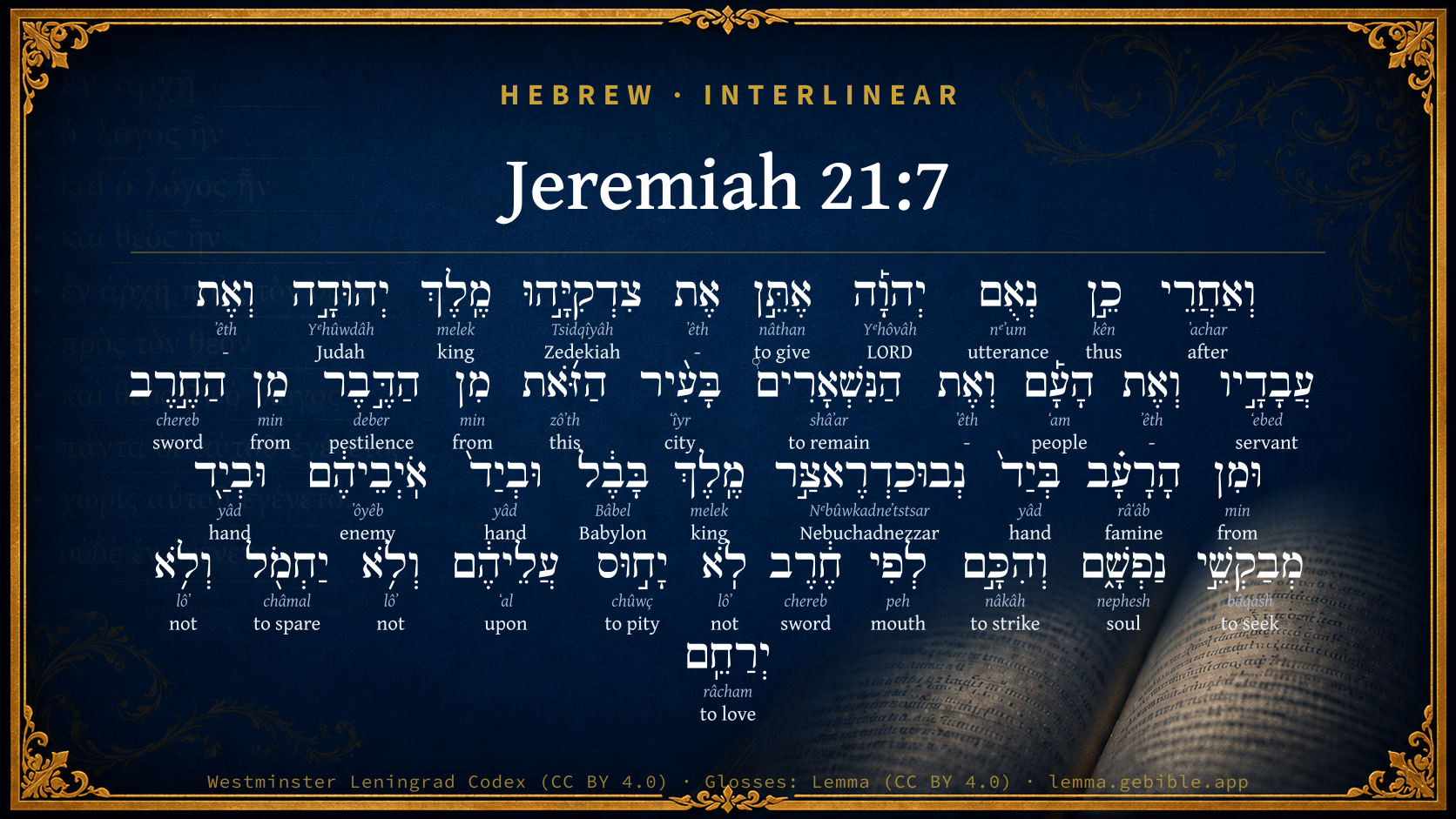
Jeremiah 21:7

Hebrew (Westminster Leningrad Codex) Jeremiah 21:7 appears in the Hebrew Old Testament. The text above is from the Westminster Leningrad Codex. Each word links to its Strong’s number, a concise gloss, and parsing drawn from the Open Scriptures Hebrew Bible morphology. Click any word for its full Brown-Driver-Briggs (BDB) entry.
Download image
Cite this verse

Jeremiah 21:7 (World English Bible). Public Domain. Lemma interlinear Bible study tool, https://lemma.gebible.app/v/jeremiah/21/7.

Show BibTeX & RIS
BibTeX
RIS
English Translation
Afterward, says Yahweh, I will deliver Zedekiah king of Judah, and his servants, and the people, even such as are left in this city from the pestilence, from the sword, and from the famine, into the hand of Nebuchadrezzar king of Babylon, and into the hand of their enemies, and into the hand of those who seek their life: and he shall strike them with the edge of the sword; he shall not spare them, neither have pity, nor have mercy.
World English Bible · Public Domain
Download a study sheet

One document with this verse’s original text, its word-by-word gloss line, the meaning frame, cross-references with their text, attributed commentary, and full source and license credits — printable, and it pastes into notes with its structure intact.

This verse Autodidact and up

Study sheet (.html) Plain text (.txt)

A passage Seminary Student

Up to 50 verses in one chapter. A passage sheet keeps up to 6 commentary sources and 12 cross-references per verse, in the order this page ranks them, and says so on the sheet whenever that leaves anything out. Ask for a single verse and you get the Autodidact verse sheet above.

Everything on this page stays free to read, with no account — the sheet is a download of what is already on screen, not access to it.

Want to remove ads? Support Godless Engineer
Compare translations 3

The same verse in 3 English versions, stacked beneath the original-language interlinear above. Click any original word for its lexicon entry.

Each is an independent rendering of the whole verse — the interlinear is not word-aligned to these translations.

Highlighted words mark where these versions differ — a whole-verse word diff, not a word-by-word alignment.

  • World English Bible Public Domain
    Afterward, says Yahweh, I will deliver Zedekiah king of Judah, and his servants, and the people, even such as are left in this city from the pestilence, from the sword, and from the famine, into the hand of Nebuchadrezzar king of Babylon, and into the hand of their enemies, and into the hand of those who seek their life: and he shall strike them with the edge of the sword; he shall not spare them, neither have pity, nor have mercy.
  • King James Version Public Domain
    And afterward, saith the LORD, I will deliver Zedekiah king of Judah, and his servants, and the people, and such as are left in this city from the pestilence, from the sword, and from the famine, into the hand of Nebuchadrezzar king of Babylon, and into the hand of their enemies, and into the hand of those that seek their life: and he shall smite them with the edge of the sword; he shall not spare them, neither have pity, nor have mercy.
  • unfoldingWord Literal Text CC BY-SA 4.0
    And afterward’—the declaration of Yahweh—‘I will give Zedekiah king of Judah and his servants and the people and the ones remaining in this city from the plague, from the sword, and from the famine, into the hand of Nebuchadnezzar king of Babylon and into the hand of their enemies and into the hand of the seekers of their life. And he will strike them to the mouth of the sword. He will not pity them, and he will not spare, and he will not have compassion.’

unfoldingWord Literal Text — © unfoldingWord, licensed CC BY-SA 4.0. Word-aligned USFM3 via Door43 (git.door43.org/unfoldingWord/en_ult).

Versions to compare (up to 4)

3 of 4 selected

Show all 18 translations

Every available English version of this verse, each an independent rendering of the whole verse.

  • World English Bible Public Domain
    Afterward, says Yahweh, I will deliver Zedekiah king of Judah, and his servants, and the people, even such as are left in this city from the pestilence, from the sword, and from the famine, into the hand of Nebuchadrezzar king of Babylon, and into the hand of their enemies, and into the hand of those who seek their life: and he shall strike them with the edge of the sword; he shall not spare them, neither have pity, nor have mercy.
  • Berean Standard Bible Public Domain
    ‘After that,’ declares the LORD, ‘I will hand over Zedekiah king of Judah, his officers, and the people in this city who survive the plague and sword and famine, to Nebuchadnezzar king of Babylon and to their enemies who seek their lives. He will put them to the sword; he will not spare them or show pity or compassion.’
  • Majority Standard Bible Public Domain
    ‘After that,’ declares the LORD, ‘I will hand over Zedekiah king of Judah, his officers, and the people in this city who survive the plague and sword and famine, to Nebuchadnezzar king of Babylon and to their enemies who seek their lives. He will put them to the sword; he will not spare them or show pity or compassion.’
  • King James Version Public Domain
    And afterward, saith the LORD, I will deliver Zedekiah king of Judah, and his servants, and the people, and such as are left in this city from the pestilence, from the sword, and from the famine, into the hand of Nebuchadrezzar king of Babylon, and into the hand of their enemies, and into the hand of those that seek their life: and he shall smite them with the edge of the sword; he shall not spare them, neither have pity, nor have mercy.
  • American Standard Version (1901) Public Domain
    And afterward, saith Jehovah, I will deliver Zedekiah king of Judah, and his servants, and the people, even such as are left in this city from the pestilence, from the sword, and from the famine, into the hand of Nebuchadrezzar king of Babylon, and into the hand of their enemies, and into the hand of those that seek their life: and he shall smite them with the edge of the sword; he shall not spare them, neither have pity, nor have mercy.
  • Revised Version (1885) Public Domain
    And afterward, saith the LORD, I will deliver Zedekiah king of Judah, and his servants, and the people, even such as are left in this city from the pestilence, from the sword, and from the famine, into the hand of Nebuchadrezzar king of Babylon, and into the hand of their enemies, and into the hand of those that seek their life: and he shall smite them with the edge of the sword; he shall not spare them, neither have pity, nor have mercy.
  • Geneva Bible (1599) Public Domain
    And after this, sayeth the Lord, I will deliuer Zedekiah the King of Iudah, and his seruants, and the people, and such as are left in this citie, from the pestilence, from the sworde and from the famine into the hande of Nebuchad-nezzar King of Babel, and into the hande of their enemies, and into the hande of those that seeke their liues, and he shall smite them with the edge of the sworde: he shall not spare them, neither haue pitie nor compassion.
  • Douay-Rheims (1899) Public Domain
    And after this, saith the Lord, I will give Sedecias the king of Juda, and his servants, and his people, and such as are left in this city from the pestilence, and the sword, and the famine, into the hand of Nabuchodonosor the king of Babylon, and into the hand of their enemies, and into the hand of them that seek their life, and he shall strike them with the edge of the sword, and he shall not be moved to pity, nor spare them, nor shew mercy on them.
  • Young's Literal Translation Public Domain
    And after this -- an affirmation of Jehovah, I give Zedekiah king of Judah, And his servants, and the people, And those left in this city, From the pestilence, from the sword, and from the famine, Into the hand of Nebuchadrezzar king of Babylon, And into the hand of their enemies, And into the hand of those seeking their life, And he hath smitten them by the mouth of the sword, He hath no pity on them, Nor doth he spare, nor hath he mercy.
  • Literal Standard Version CC BY-SA 4.0
    And after this,” || A declaration of YHWH, || “I give Zedekiah king of Judah, || And his servants, and the people, || And those left in this city, || From the pestilence, from the sword, and from the famine, || Into the hand of Nebuchadnezzar king of Babylon, || And into the hand of their enemies, || And into the hand of those seeking their life, || And he has struck them by the mouth of the sword, || He has no pity on them, || Nor does he spare, nor does he have mercy.”
  • Unlocked Literal Bible CC BY-SA 4.0
    After this—this is Yahweh's declaration—Zedekiah king of Judah, his servants, the people, and whoever remains in this city after the plague, the sword, and the famine, I will give them all into the hand of Nebuchadnezzar king of Babylon, and into the hand of their enemies, and into the hand of those seeking their life. Then he will kill them with the edge of the sword. He will not pity them, spare them, or have compassion.'
  • unfoldingWord Literal Text CC BY-SA 4.0
    And afterward’—the declaration of Yahweh—‘I will give Zedekiah king of Judah and his servants and the people and the ones remaining in this city from the plague, from the sword, and from the famine, into the hand of Nebuchadnezzar king of Babylon and into the hand of their enemies and into the hand of the seekers of their life. And he will strike them to the mouth of the sword. He will not pity them, and he will not spare, and he will not have compassion.’
  • Darby Bible Public Domain
    And afterwards, saith Jehovah, I will give Zedekiah king of Judah, and his servants, and the people, and such as are left in this city from the pestilence, from the sword, and from the famine, into the hand of Nebuchadrezzar the king of Babylon, and into the hand of their enemies, and into the hand of those that seek their life, and he shall smite them with the edge of the sword: he shall not spare them, neither have pity, nor have mercy.
  • World Messianic Bible Public Domain
    Afterward,” says the LORD, “I will deliver Zedekiah king of Judah, his servants, and the people, even those who are left in this city from the pestilence, from the sword, and from the famine, into the hand of Nebuchadnezzar king of Babylon, and into the hand of their enemies, and into the hand of those who seek their life. He will strike them with the edge of the sword. He will not spare them, have pity, or have mercy.”’
  • Webster's Bible Public Domain
    And afterward, saith the LORD, I will deliver Zedekiah king of Judah, and his servants, and the people, and such as are left in this city from the pestilence, from the sword, and from the famine, into the hand of Nebuchadnezzar king of Babylon, and into the hand of their enemies, and into the hand of those that seek their life; and he shall smite them with the edge of the sword; he shall not spare them, neither have pity, nor have mercy.
  • Free Bible Version CC BY-SA 4.0
    After that, declares the Lord, I'm going to hand you over, Zedekiah king of Judah, as well as your officers and the people who are left in this city after the plague and war and famine, to Nebuchadnezzar king of Babylon and to your enemies who want you dead. He will attack you; he won't spare you or show you any pity or mercy.
  • Bible in Basic English Public Domain
    And after that, says the Lord, I will give up Zedekiah, king of Judah, and his servants and his people, even those in the town who have not come to their end from the disease and the sword and from need of food, into the hands of Nebuchadrezzar, king of Babylon, and into the hands of their haters, and into the hands of those desiring their death: he will put them to the sword; he will not let anyone get away, he will have no pity or mercy.
  • JPS Tanakh (1917) Public Domain
    And afterward, saith the LORD, I will deliver Zedekiah king of Judah, and his servants, and the people, and such as are left in this city from the pestilence, from the sword, and from the famine, into the hand of Nebuchadrezzar king of Babylon, and into the hand of their enemies, and into the hand of those that seek their life; and he shall smite them with the edge of the sword; he shall not spare them, neither have pity, nor have compassion.

Literal Standard Version (2020), Covenant Press — licensed CC BY-SA 4.0. Text via the HelloAO Bible API (eBible.org). Unlocked Literal Bible (unfoldingWord) — licensed CC BY-SA 4.0. Text via the HelloAO Bible API (eBible.org). unfoldingWord Literal Text — © unfoldingWord, licensed CC BY-SA 4.0. Word-aligned USFM3 via Door43 (git.door43.org/unfoldingWord/en_ult). Free Bible Version, Dr. Jonathan Gallagher — licensed CC BY-SA 4.0. Text via the HelloAO Bible API (eBible.org).

Word by word

More ways to search: Search by grammar → Find every occurrence → Compare this word →

Practice this passage: Drill this verse → Learn its vocabulary →

יָח֣וּס
chûwç
H2347
“to pity”
Verb, Qal, Imperfect, 3rd Person, Masculine, Singular
Part of Speech
Verb
Stem
Qal
Form
Imperfect
Person
3rd Person
Gender
Masculine
Number
Singular
Full BDB Definition

Origin: a primitive root

TWOT: 626

(Qal) to pity, have compassion, spare, look upon with compassion
  1. וְאַחֲרֵי ʼachar H310 “and · after” Conjunction + Preposition
  2. כֵ֣ן kên H3651 “thus” Adverb
  3. נְאֻם nᵉʼum H5002 “utterance of” Noun, Common, Masculine, Singular, Construct
  4. יְהוָ֡ה Yᵉhôvâh H3068 “LORD” Noun, Proper
  5. אֶתֵּ֣ן nâthan H5414 “to give” Verb, Qal, Imperfect, 1st Person, Common, Singular
  6. אֶת ʼêth H853 “-” Particle, Direct Object
  7. צִדְקִיָּ֣הוּ Tsidqîyâh H6667 “Zedekiah” Noun, Proper
  8. מֶֽלֶךְ melek H4428 “king of” Noun, Common, Masculine, Singular, Construct
  9. יְהוּדָ֣ה Yᵉhûwdâh H3063 “Judah” Noun, Proper
  10. וְאֶת ʼêth H853 “and · -” Conjunction + Particle, Direct Object
  11. עֲבָדָ֣יו ʻebed H5650 “servants · his” Noun, Common, Masculine, Plural, Construct + Suffix, Personal, 3rd Person, Masculine, Singular
  12. וְאֶת ʼêth H853 “and · -” Conjunction + Particle, Direct Object
  13. הָעָ֡ם ʻam H5971 “the · people” Particle, Definite Article + Noun, Common, Masculine, Singular, Absolute
  14. וְאֶת ʼêth H853 “and · -” Conjunction + Particle, Direct Object
  15. הַנִּשְׁאָרִים֩ shâʼar H7604 “the · remaining” Particle, Definite Article + Verb, Niphal, Participle Active, Masculine, Plural, Absolute
  16. בָּעִ֨יר ʻîyr H5892 “in/at the · city” Preposition, Determined + Noun, Common, Feminine, Singular, Absolute
  17. הַזֹּ֜את zôʼth H2063 “the · this” Particle, Definite Article + Pronoun, Demonstrative, Feminine, Singular
  18. מִן min H4480 “from” Preposition
  19. הַדֶּ֣בֶר deber H1698 “the · pestilence” Particle, Definite Article + Noun, Common, Masculine, Singular, Absolute
  20. מִן min H4480 “from” Preposition
  21. הַחֶ֣רֶב chereb H2719 “the · sword” Particle, Definite Article + Noun, Common, Feminine, Singular, Absolute
  22. וּמִן min H4480 “and · from” Conjunction + Preposition
  23. הָרָעָ֗ב râʻâb H7458 “the · famine” Particle, Definite Article + Noun, Common, Masculine, Singular, Absolute
  24. בְּיַד֙ yâd H3027 “in/at · hand of” Preposition + Noun, Common, Both, Singular, Construct
  25. נְבוּכַדְרֶאצַּ֣ר Nᵉbûwkadneʼtstsar H5019 “Nebuchadnezzar” Noun, Proper
  26. מֶֽלֶךְ melek H4428 “king of” Noun, Common, Masculine, Singular, Construct
  27. בָּבֶ֔ל Bâbel H894 “Babylon” Noun, Proper
  28. וּבְיַד֙ yâd H3027 “and · in/at · hand of” Conjunction + Preposition + Noun, Common, Both, Singular, Construct
  29. אֹֽיְבֵיהֶ֔ם ʼôyêb H341 “enemy · them” Verb, Qal, Participle Active, Masculine, Plural, Construct + Suffix, Personal, 3rd Person, Masculine, Plural
  30. וּבְיַ֖ד yâd H3027 “and · in/at · hand of” Conjunction + Preposition + Noun, Common, Both, Singular, Construct
  31. מְבַקְשֵׁ֣י bâqash H1245 “seeking” Verb, Piel, Participle Active, Masculine, Plural, Construct
  32. נַפְשָׁ֑ם nephesh H5315 “soul · their” Noun, Common, Both, Singular, Construct + Suffix, Personal, 3rd Person, Masculine, Plural
  33. וְהִכָּ֣ם nâkâh H5221 “and · to strike · them” Conjunction + Verb, Hiphil, Sequential Perfect, 3rd Person, Masculine, Singular + Suffix, Personal, 3rd Person, Masculine, Plural
  34. לְפִי peh H6310 “to/for · mouth of” Preposition + Noun, Common, Masculine, Singular, Construct
  35. חֶ֔רֶב chereb H2719 “sword” Noun, Common, Feminine, Singular, Absolute
  36. לֹֽא lôʼ H3808 “not” Particle, Negative
  37. עֲלֵיהֶ֔ם ʻal H5921 “upon · them” Preposition + Suffix, Personal, 3rd Person, Masculine, Plural
  38. וְלֹ֥א lôʼ H3808 “and · not” Conjunction + Particle, Negative
  39. יַחְמֹ֖ל châmal H2550 “to spare” Verb, Qal, Imperfect, 3rd Person, Masculine, Singular
  40. וְלֹ֥א lôʼ H3808 “and · not” Conjunction + Particle, Negative
  41. יְרַחֵֽם râcham H7355 “to love” Verb, Piel, Imperfect, 3rd Person, Masculine, Singular

About this verse

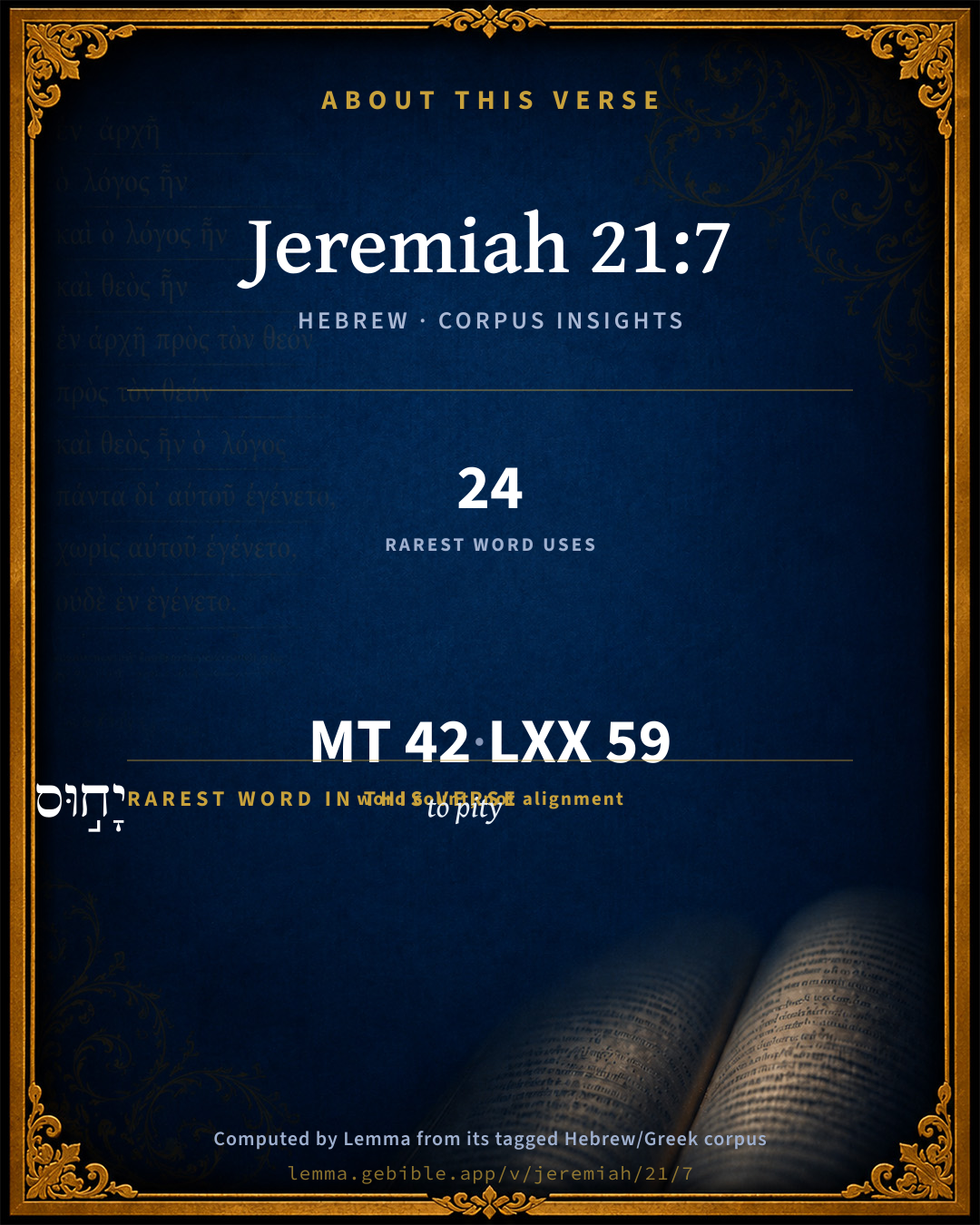
These counts appear in no published source. They are computed here, from the morphology-tagged text and Lemma’s own curated glosses. What Lemma adds →

42
words
31
distinct lemmas
Prophets
section

Notable vocabulary

The rarest word here is יָח֣וּס to pity H2347 — appearing just 24 times in the whole Hebrew Bible.

Shared distinctive vocabulary

יָח֣וּס to pity H2347 occurs in 24 verses of the Hebrew Bible. Also found in:

Grammatical profile

  • 8 verbs
  • 20 nouns
  • 1 pronoun
  • 5 prepositions
  • 1 adverb
  • 7 particles

Verb forms

  • אֶתֵּ֣ן Qal · Imperfect
  • הַנִּשְׁאָרִים֩ Niphal · Participle Active
  • אֹֽיְבֵיהֶ֔ם Qal · Participle Active
  • מְבַקְשֵׁ֣י Piel · Participle Active
  • וְהִכָּ֣ם Hiphil · Sequential Perfect
  • יָח֣וּס Qal · Imperfect
  • יַחְמֹ֖ל Qal · Imperfect
  • יְרַחֵֽם Piel · Imperfect

Repetition

Words recur within this verse — often emphatic in Hebrew:

  • בְּיַד֙ hand H3027 ×3
  • מֶֽלֶךְ king H4428 ×2
  • הַחֶ֣רֶב sword H2719 ×2
  • מִן from H4480 ×3
  • לֹֽא not H3808 ×3

Hebrew & Septuagint length

In the original languages it is 42 Hebrew tokens and 59 Greek tokens — but the two are counted differently (Hebrew bundles its prefixes and suffixes into one token; the Greek is in lemma form), so that isn’t a like-for-like length.

Cross-references

23

Topical passages linked to Jeremiah 21:7 in the Treasury of Scripture Knowledge — connected by theme and wording, ordered by reader-vote popularity; previews shown in the World English Bible.

  • Jeremiah 37:17 Then Zedekiah the king sent, and fetched him: and the king asked him secretly in his house, and said, Is there any word from Yahweh? Jeremiah said, There is. He said also, You shall be delivered into the hand of the king of Babylon.
  • 2 Kings 25:5–7 But the army of the Chaldeans pursued after the king, and overtook him in the plains of Jericho; and all his army was scattered from him.
  • Habakkuk 1:6–10 For, behold, I raise up the Chaldeans, that bitter and hasty nation, that march through the breadth of the earth, to possess dwelling places that are not theirs.
  • Ezekiel 7:9 My eye shall not spare, neither will I have pity: I will bring on you according to your ways; and your abominations shall be in the midst of you; and you shall know that I, Yahweh, do strike.
  • Ezekiel 17:20–21 I will spread my net on him, and he shall be taken in my snare, and I will bring him to Babylon, and will enter into judgment with him there for his trespass that he has trespassed against me.
  • Deuteronomy 28:50 a nation of fierce facial expressions, that shall not regard the person of the old, nor show favor to the young,
  • 2 Kings 25:18–21 The captain of the guard took Seraiah the chief priest, and Zephaniah the second priest, and the three keepers of the threshold:
  • Jeremiah 13:14 I will dash them one against another, even the fathers and the sons together, says Yahweh: I will not pity, nor spare, nor have compassion, that I should not destroy them.
  • Jeremiah 52:8–11 But the army of the Chaldeans pursued after the king, and overtook Zedekiah in the plains of Jericho; and all his army was scattered from him.
  • 2 Chronicles 36:17–20 Therefore he brought on them the king of the Chaldeans, who killed their young men with the sword in the house of their sanctuary, and had no compassion on young man or virgin, old man or gray-headed: he gave them all into his hand.
  • Isaiah 13:17–18 Behold, I will stir up the Medes against them, who shall not regard silver, and as for gold, they shall not delight in it.
  • Isaiah 27:11 When the boughs of it are withered, they shall be broken off; the women shall come, and set them on fire; for it is a people of no understanding: therefore he who made them will not have compassion on them, and he who formed them will show them no favor.
  • Isaiah 47:6 I was angry with my people, I profaned my inheritance, and gave them into your hand: you did show them no mercy; on the aged have you very heavily laid your yoke.
  • Jeremiah 24:8–10 As the bad figs, which can't be eaten, they are so bad, surely thus says Yahweh, So will I give up Zedekiah the king of Judah, and his princes, and the residue of Jerusalem, who remain in this land, and those who dwell in the land of Egypt,
  • Jeremiah 34:19–22 the princes of Judah, and the princes of Jerusalem, the eunuchs, and the priests, and all the people of the land, who passed between the parts of the calf;
  • Jeremiah 38:21–23 But if you refuse to go forth, this is the word that Yahweh has shown me:
  • Jeremiah 39:4–7 It happened that, when Zedekiah the king of Judah and all the men of war saw them, then they fled, and went forth out of the city by night, by the way of the king's garden, through the gate between the two walls; and he went out toward the Arabah.
  • Jeremiah 52:24–27 The captain of the guard took Seraiah the chief priest, and Zephaniah the second priest, and the three keepers of the threshold:
  • Ezekiel 8:18 Therefore will I also deal in wrath; my eye shall not spare, neither will I have pity; and though they cry in my ears with a loud voice, yet will I not hear them.
  • Ezekiel 9:5–6 To the others he said in my hearing, Go you through the city after him, and strike: don't let your eye spare, neither have you pity;
  • Ezekiel 9:10 As for me also, my eye shall not spare, neither will I have pity, but I will bring their way on their head.
  • Ezekiel 12:12–16 The prince who is among them shall bear on his shoulder in the dark, and shall go forth: they shall dig through the wall to carry out thereby: he shall cover his face, because he shall not see the land with his eyes.
  • Ezekiel 21:25–26 You, deadly wounded wicked one, the prince of Israel, whose day is come, in the time of the iniquity of the end,

Cross-references courtesy of OpenBible.info (CC BY 4.0).

Hebrew and Greek witnesses Masoretic Hebrew ↔ Greek Septuagint

The same verse in the two great witnesses to the Old Testament, shown verse-for-verse.

These are two independent witnesses, not word-aligned to each other, and the Septuagint is shown in lemma (dictionary) form.

Hebrew Jeremiah 21:7 Masoretic · Westminster Leningrad Codex

וְאַחֲרֵי כֵ֣ן נְאֻם יְהוָ֡ה אֶתֵּ֣ן אֶת צִדְקִיָּ֣הוּ מֶֽלֶךְ יְהוּדָ֣ה וְאֶת עֲבָדָ֣יו וְאֶת הָעָ֡ם וְאֶת הַנִּשְׁאָרִים֩ בָּעִ֨יר הַזֹּ֜את מִן הַדֶּ֣בֶר מִן הַחֶ֣רֶב וּמִן הָרָעָ֗ב בְּיַד֙ נְבוּכַדְרֶאצַּ֣ר מֶֽלֶךְ בָּבֶ֔ל וּבְיַד֙ אֹֽיְבֵיהֶ֔ם וּבְיַ֖ד מְבַקְשֵׁ֣י נַפְשָׁ֑ם וְהִכָּ֣ם לְפִי חֶ֔רֶב לֹֽא יָח֣וּס עֲלֵיהֶ֔ם וְלֹ֥א יַחְמֹ֖ל וְלֹ֥א יְרַחֵֽם

Afterward, says Yahweh, I will deliver Zedekiah king of Judah, and his servants, and the people, even such as are left in this city from the pestilence, from the sword, and from the famine, into the hand of Nebuchadrezzar king of Babylon, and into the hand of their enemies, and into the hand of those who seek their life: and he shall strike them with the edge of the sword; he shall not spare them, neither have pity, nor have mercy.

World English Bible · Public Domain

Greek LXX Structure differs

In the Septuagint, Jeremiah is about an eighth shorter than the Hebrew and arranges its material differently — the Oracles Against the Nations (Hebrew chapters 46–51) appear in the middle of the Greek book, after 25:13. Because the chapter and verse boundaries do not line up, a verse-for-verse comparison with the Hebrew is not shown.

A verse-for-verse comparison isn’t shown here because the chapters and verses don’t line up. Switch to the LXX edition with the MT / LXX toggle above to read the Greek directly.

On this verse, The Cambridge Bible for Schools and Colleges discusses the Septuagint’s reading. Read the note in Commentary ↓

Hebrew: Westminster Leningrad Codex (CC BY 4.0). Greek: Septuagint (public domain); English from a public-domain English Septuagint. How the Septuagint differs from the Hebrew →

Targum (Aramaic paraphrase)

1

The Targum is the ancient Jewish Aramaic paraphrase of the Hebrew Scriptures — an interpretive translation, not the Hebrew text itself. Onkelos (literal) and Pseudo-Jonathan (expansive) render the Torah, and Jonathan the Prophets. Coverage is partial: where no permissively-licensed English translation exists for a verse, only the Aramaic is shown. This is verse-level text, not a word-by-word alignment to the Hebrew.

  1. Targum Jonathan Prophets (Joshua–Malachi)
    וּבָתַר כֵּן אֲמַר יְיָ אֶמְסַר יַת צִדְקִיָה מְלַךְ שִׁבְטָא דְבֵית יְהוּדָה וְיַת עֲבְדוֹהִי וְיַת עַמָא וְיַת דְאִשְׁתָּאֲרוּ בְקַרְתָּא הָדָא מִן מוֹתָא וּמִן חַרְבָּא וּמִן כַּפְנָא בְּיַד נְבוּכַדְרֶאצַר מַלְכָּא דְבָבֶל וּבְיַד בַּעֲלֵי דְבָבֵיהוֹן וּבְיַד דְבָעָן לְמִקְטַלְהוֹן וְיִמְחִינוּן לְפִתְגָם דְחֶרֶב לָא יְחוּס עֲלֵיהוֹן וְלָא יַחְמוֹל וְלָא יְרַחֵם:

    (no public-domain English translation for this verse)

    Targum Jonathan — Aramaic: “Mikraot Gedolot” (public domain). English: “Sefaria Community Translation” (CC0 1.0 (public-domain dedication)); “London "Chaldee Paraphrase," 1871” (public domain). Text via Sefaria.

Commentary

Notes on Jeremiah 21:7 from classic Christian and Jewish commentators (each source and its license shown beneath its notes). The classic Christian expositions comment on the surrounding passage and are grouped to its opening verse, so a note may address several verses; the Jewish commentaries on the Tanakh (Rashi and others) are per-verse, so they appear only where the commentator wrote on this verse.

Lemma curates 59 commentaries, every one of them public domain or Creative Commons licensed, each selected and text-cleaned for this edition rather than reprinted as found. About our sources →

Trapp's Complete Commentary

John Trapp

Jer 21:7 And afterward, saith the LORD, I will deliver Zedekiah king of Judah, and his servants, and the people, and such as are left in this city from the pestilence, from the sword, and from the famine, into the hand of Nebuchadrezzar king of Babylon, and into the hand of their enemies, and into the hand of those that seek their life: and he shall smite them with the edge of the sword; he shall not spare them, neither have pity, nor have mercy.

Ver. 7. And afterward, saith the Lord.] This is noted by the Hebrew critics for a very long verse - as having in it forty-two words, which consist of one hundred and sixty letters - and it sounds very heavily all along, to the courtiers especially. Potentes potenter torquebuntur. Power torments powerfully.

John Trapp, A Commentary or Exposition upon All the Books of the Old and New Testament (1647–1656) — public domain. Text from a community e-Sword module.

The Biblical Illustrator

Joseph S. Exell

Jer_21:7

He shall not spare them, neither have pity, nor have mercy.

No mercy in war

The exploits of Surrey in Scotland are thus recorded in a letter of Wolsey: The Earl of Surrey so devastated and destroyed all Tweedale and March, that there is left neither house, fortress, village, tree, cattle, corn, nor other succour for man; insomuch that some of the people that fled from the same, afterward returning and finding no sustenance, were compelled to come into England begging bread, which oftentimes when they do eat they die incontinently for the hunger passed. And with no imprisonment, cutting off their ears, burning them in the faces, or otherwise, can be kept away. (Knights England.)

The Biblical Illustrator, edited by Joseph S. Exell (c. 1880s–1900s) — public domain. Text from a community e-Sword module.

Jamieson, Fausset & Brown

Robert Jamieson, A. R. Fausset & David Brown

the people, and such--rather, explanatory, "the people," namely, "such as are left."

seek their life--content with nothing short of their death; not content with plundering and enslaving them.

smite with . . . sword--This was the fate of Zedekiah's sons and many of the Jewish nobles. Zedekiah himself, though not put to a violent death, died of grief. Compare as to the accurate fulfilment, Jer 34:4; Eze 12:13; Kg2 25:6-7.

Jamieson, Fausset & Brown — Commentary Critical and Explanatory on the Whole Bible (1871) — public domain (CC PDM 1.0). Text via the HelloAO Bible API.

Adam Clarke's Commentary

Verse 7. Nebuchadrezzar] This name is spelt as above in twenty-six places of this book; and in ten places it is spelt Nebuchadnezzar, which is the common orthography. The difference is only a ר resh for a נ nun; but the MSS. are various on this point. It is the same person who is intended by both names; and here all the Versions, except the Arabic, which omits the name, have it in the usual form.

Adam Clarke's Commentary on the Bible (1810–1826) — public domain. Text from a community e-Sword/MySword module.

John Calvin's Commentaries

He then adds, And afterwards, that is, when the pestilence had in a great measure consumed them; I will give, or deliver, he says, Zedekiah the king of Judah, and his servants, into the hand of Nebuchadnezzer He intimates that though they might suffer with courage their wants, it, would be of no avail to them. It often happens that a siege is raised, when the obstinacy of the besieged is so great, that they overcome famine and thirst, and struggle against extreme want; for they who besiege them are led to think that they contend with furious wild beasts, and so depart from them. But God declares here that the event would be different as to the Jews, for after having been nearly consumed, they would still be delivered up into the power of their enemies. Thus he shows that, their endurance would be useless. It is indeed, a most deplorable thing, that when we have endured many grievous and distressing evils, the enemy should at length gain the ascendency, and possess over us the power of life and death. But God shows here that such a calamity awaited the Jews; I will deliver, he says, Zedekiah the king of Judah, etc. He doubtless intended to show how foolish their confidence was, when they thought that they were safe under the shadow of their king: “The king himself,” he says, “shall not exempt himself from danger; what then will it avail you to have a king?” And the king is expressly mentioned, that the Jews might not deceive themselves with the foolish notion, that they had a sufficient safeguard in their king.

He then adds, And his servants, that is, his counsellors or courtiers; for servants were those called who were the chief men and ministers of the king, “and his ministers.” There was a great deal of pride in these courtiers, and they were very hostile to the Prophets; for being blinded by their own foolish wisdom, they despised what the Prophets taught and all their warnings. For this reason the Prophet says that they would be delivered into the hand of the king of Babylon.

It is further said, And the people The last copulative is to be taken exegetically, even, ואת-הנשארים, veat enesharim, “even the residue;” for he refers to none but the people, but intimates what the people would be, even a small number, a remnant. Then the words are to be thus rendered, “even those who shall remain in the city.” But Jerusalem, when this discourse was delivered, was in a flourishing state, and had a large number of inhabitants, he therefore shews, that after God diminished and reduced the people to a small number, there would not yet be an end to their evils, but that a worse thing would still happen to them, for their life would be put in the power of their enemies; he therefore says, even those who shall remain in the city; and he alludes to the last verse, for he had said that many would perish through want; nor does he refer only to famine, but, also to the sword and to the pestilence, for he says, even those who shall remain from the pestilence, and from the sword, and from the famine The famine, as it is usual, produced pestilence; and then when their enemies attacked the city with their warlike instruments, many must have been killed, as they could not repulse their enemies from the walls without a conflict. Then God shows that the Jews would have to contend with want, pestilence, and the sword, until they were overcome, and the city taken by the Chaldeans.

It is afterwards added, into the hands of their enemies, into the hand of those who seek their life This repetition is not superfluous, for God intimates what is more fully and clearly expressed by Isaiah, — that the Chaldeans would not be satisfied with plunder, that they would make no account of silver and gold, for they would burn with rage, and their object would be to shed blood. (Isaiah 13:17.) So the meaning is here, when he mentions those who would seek their life; for they would be led by deadly hatred, so that their anger and cruelty would not be appeased until they destroyed them. Thus he shows that it would be a bloody victory, for the Jews would not only be led captives, because their conquerors would not think it worth their while to drag them away as worthless slaves, but their object would be wholly to destroy them.

Hence he says, He will smite them There is a change of number, and the reference is made to the king, and yet the whole army is included, he will smite them with the mouth of the sword, he will not spare, he will not forgive, (the words are synonymous,) and will shew no mercy God thus transferred his own inexorable wrath to the Chaldeans, who were his ministers, as though he had said, “Your enemies will be implacable, they will not be turned to mercy; for I have so commanded, and I will rouse them to execute my judgment.” Nor can this be deemed strange, because God had resolved in his implacable wrath to reduce the people to nothing. For we know how great was their perverseness in their sins.

Since then they had so often rejected the mercy of God, they had in a manner closed up the door of pardon. Hence it was that God resolved that the Chaldeans should thus rage against them without any feeling of humanity. It afterwards follows, —

John Calvin's Commentaries (1540-1563) — public domain. Text from the Calvin Translation Society English edition (1840s-50s) via the Christian Classics Ethereal Library (ccel.org). Calvin's coverage is partial (roughly two-thirds of the Bible); uncommented books and verses are honest gaps, never fabricated. The 19th-century editor's footnotes and remarks are omitted so the notes are faithfully Calvin's own voice.

Ellicott's Commentary for English Readers

(7) He shall smite them with the edge of the sword.—The words were bold words for the prophet to utter while the king was still on the throne, and urged on by his princes to defy the power of the Chaldæan king. In Jer_52:10; Jer_52:24-27 we find their literal fulfilment.

A Bible Commentary for English Readers, edited by Charles John Ellicott (1878–1897) — public domain. Text from a community e-Sword module.

The Cambridge Bible for Schools and Colleges

gen. ed. J. J. S. Perowne

7. The Hebrew form of the v. is evidently an expansion. The LXX read “from the famine into the hand of those that seek, etc.,” omitting the intermediate words.

the pestilence] This would be a natural consequence of the overcrowding of the city on account of the siege.

with the edge of the sword] lit. according to the mouth of the sword, i.e. relentlessly, without quarter.

The Cambridge Bible for Schools and Colleges (gen. ed. J. J. S. Perowne; Cambridge University Press, 1878–1918) — public domain. Text from a community e-Sword module.

John Gill's Exposition

And afterwards, saith the Lord God,.... After there should be so great a mortality among men and beasts:

I will deliver Zedekiah king of Judah, and his servants; the king himself shall not escape; though he shall not die by the pestilence, or famine, or sword, yet he shall fall into the hands of the Chaldeans, and also "his servants", his courtiers, and counsellors:

and the people, and such as are left in this city from the pestilence,

from the sword, and from the famine; such of the inhabitants of the city, as well as those at court, that died not by the sword, famine, and pestilence: these should be delivered

into the hand of Nebuchadnezzar king of Babylon; who was now with his army without the walls of the city besieging it:

and into the hand of their enemies, and into the hand of those that seek their life; the Chaldeans, who were their implacable enemies, and cruel, and whom nothing would satisfy but their lives:

he shall smite them with the edge of the sword; that is, Nebuchadnezzar king of Babylon, or, however, the army under his command; for what was done by the one is ascribed to the other: this is to be understood of such that fell into their hands upon taking the city, and who endeavoured to make their escape; see Jer 39:4;

he shall not spare them, neither have pity, nor have mercy; they had no regard to rank or figure, to age or sex; the sons of the king were slain before his eyes, and then his eyes were put out; princes were hanged up by the hand; and no compassion shown to old or young, man or maiden; see Jer 52:10. This verse is remarkably long.

John Gill's Exposition of the Whole Bible (1746–1763) — public domain (CC PDM 1.0). Text via the HelloAO Bible API.

Haydock's Catholic Bible Commentary

To them. This was verified, chap. lii., and 4 Kings xxiv.

George Leo Haydock (1774–1849), Haydock's Catholic Family Bible and Commentary, 1859 edition — public domain. Excludes Psalms (Douay-Rheims chapter numbering differs from Protestant) and Deuterocanonical books (Catholic canon only).

Matthew Poole's English Annotations

Afterward; after that many of the people of this city shall be destroyed, some by the enemy assaulting and skirmishing with them; others by the famine that shall be amongst them through a want of victuals, being all spent with the long siege; others by the pestilence. Zedekiah, who shall escape these three judgments, together with his courtiers, and the residue of the people, shall be delivered into the power of the king of Babylon, and into the power of such as will not be content with the plunder of their houses, but thirst after their blood; and these enemies (set on by Nebuchadnezzar) shall smite them with the sword, without showing them any mercy or pity. This is not to be understood of king Zedekiah himself, for God let him know, Jer 34:4, that he should not die by the sword, but in peace, as he did afterward in Babylon, though in prison; but it was true of his sons and courtiers, and a great part of the people, Jer 49:6,8; 52:10. Those who went into captivity were only such as had revolted during the siege, and many of those that were of the poor of the land, for the rest there was little pity had of them, or mercy showed to them, as may be seen, Jer 39; Jer 52; 2Ch 36:17.

Matthew Poole's English Annotations on the Holy Bible (1683–1685) — public domain. Text from a community e-Sword/MySword module.

Whedon's Commentary on the Bible

Daniel D. Whedon

7. Deliver — Not “from” but into the hand of their enemies.

King… servants… people, and such as are left — Such of them as “are left,” or escape with life from the “pestilence, sword, and famine.”

Daniel D. Whedon (gen. ed.), Commentary on the Old and New Testaments (1874–1909) — public domain. Text from a community e-Sword module.

The Pulpit Commentary

And such as are; rather, left which are left. (There has been an obvious error in the repetition of "and.")

The Pulpit Commentary (1880–1919), ed. H.D.M. Spence-Jones & Joseph S. Exell — public domain. Text from a community e-Sword module.

Lesson kit

Teaching starters — assembled from the data on this page, not authored interpretation. Every prompt links to the verse data it draws on. Edit before teaching.

Jeremiah, in the Prophets, opens this verse with 42 words (31 distinct Hebrew lemmas). Its most distinctive word is chûwç (“to pity”). A historical commentator’s framing appears above. Read the whole chapter for the surrounding context.

Discussion questions

  1. What does “to pity” (chûwç) contribute to the verse as a whole?
  2. How does Genesis 45:20, which shares the word «to pity», read alongside this verse?
  3. What does the repetition of “hand” (3× in this one verse) do in this verse?
  4. These translations render this verse differently. What is at stake in choosing one wording over another?
  5. «אֶתֵּ֣ן» is a Qal Imperfect verb. How does that grammatical form shape the action described?
  6. Compare how Trapp's Complete Commentary and The Biblical Illustrator read this verse. Where do they agree or differ?

Things to notice

Reading settings

Reading text

Shown beneath each verse's original-language words.

Old Testament
Old Testament edition

Read the OT as the Masoretic Hebrew (MT) or the Greek Septuagint (LXX).

English shown for the Greek Septuagint (in the Hebrew ↔ Greek comparison).

Comparing translations? Open the Compare panel on any verse page to stack up to four side by side.