
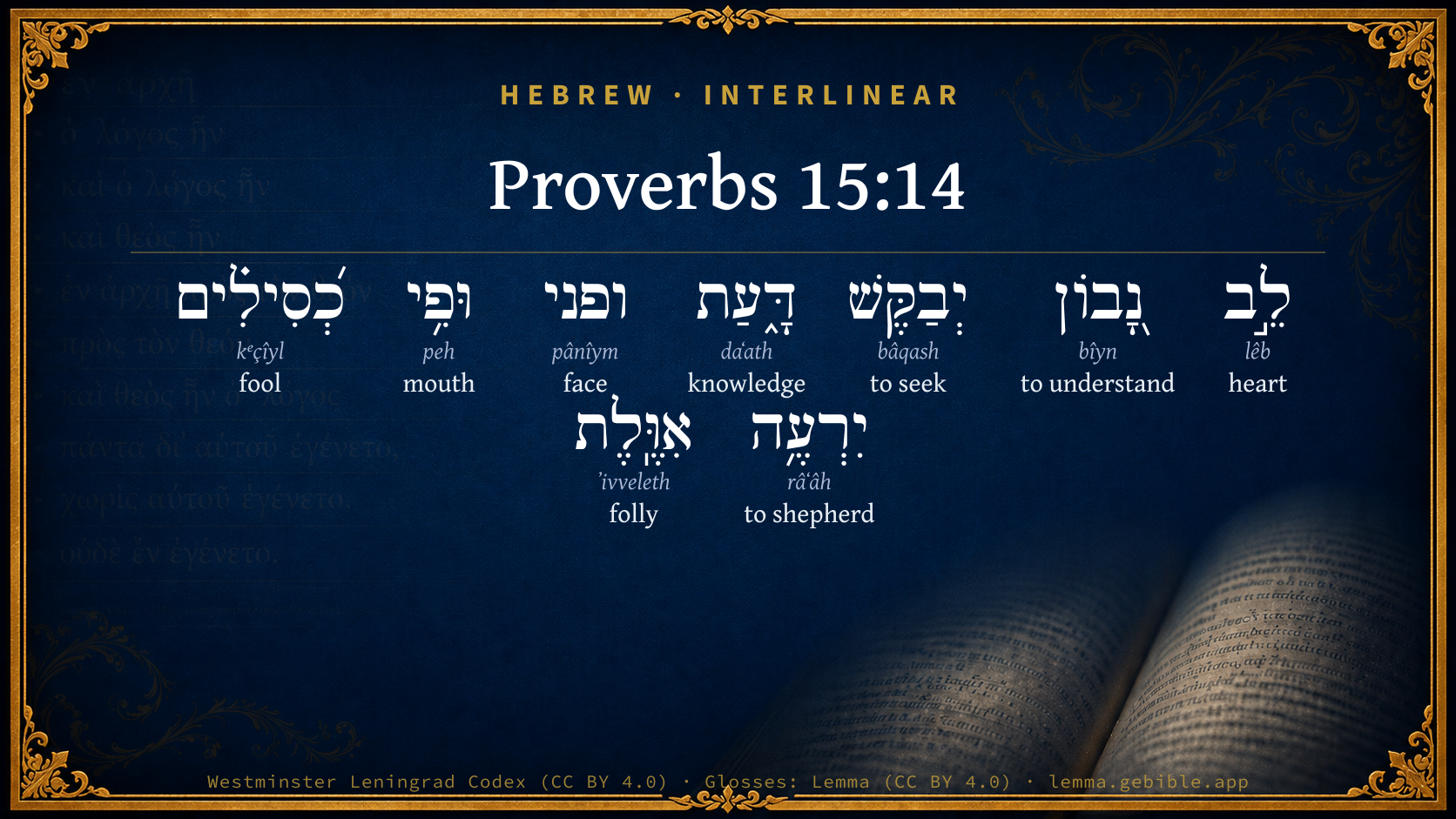
Proverbs 15:14

Hebrew (Westminster Leningrad Codex) Proverbs 15:14 appears in the Hebrew Old Testament. The text above is from the Westminster Leningrad Codex. Each word links to its Strong’s number, a concise gloss, and parsing drawn from the Open Scriptures Hebrew Bible morphology. Click any word for its full Brown-Driver-Briggs (BDB) entry.
Download image
Cite this verse

Proverbs 15:14 (World English Bible). Public Domain. Lemma interlinear Bible study tool, https://lemma.gebible.app/v/proverbs/15/14.

Show BibTeX & RIS
BibTeX
RIS
English Translation
The heart of one who has understanding seeks knowledge, But the mouths of fools feed on folly.
World English Bible · Public Domain
Download a study sheet

One document with this verse’s original text, its word-by-word gloss line, the meaning frame, cross-references with their text, attributed commentary, and full source and license credits — printable, and it pastes into notes with its structure intact.

This verse Autodidact and up

Study sheet (.html) Plain text (.txt)

A passage Seminary Student

Up to 50 verses in one chapter. A passage sheet keeps up to 6 commentary sources and 12 cross-references per verse, in the order this page ranks them, and says so on the sheet whenever that leaves anything out. Ask for a single verse and you get the Autodidact verse sheet above.

Everything on this page stays free to read, with no account — the sheet is a download of what is already on screen, not access to it.

Want to remove ads? Support Godless Engineer
Compare translations 3

The same verse in 3 English versions, stacked beneath the original-language interlinear above. Click any original word for its lexicon entry.

Each is an independent rendering of the whole verse — the interlinear is not word-aligned to these translations.

Highlighted words mark where these versions differ — a whole-verse word diff, not a word-by-word alignment.

  • World English Bible Public Domain
    The heart of one who has understanding seeks knowledge, But the mouths of fools feed on folly.
  • King James Version Public Domain
    The heart of him that hath understanding seeketh knowledge: but the mouth of fools feedeth on foolishness.
  • unfoldingWord Literal Text CC BY-SA 4.0
    The heart of the understanding one seeks knowledge, but the mouth of the stupid feeds on folly.

unfoldingWord Literal Text — © unfoldingWord, licensed CC BY-SA 4.0. Word-aligned USFM3 via Door43 (git.door43.org/unfoldingWord/en_ult).

Versions to compare (up to 4)

3 of 4 selected

Show all 18 translations

Every available English version of this verse, each an independent rendering of the whole verse.

  • World English Bible Public Domain
    The heart of one who has understanding seeks knowledge, But the mouths of fools feed on folly.
  • Berean Standard Bible Public Domain
    A discerning heart seeks knowledge, but the mouth of a fool feeds on folly.
  • Majority Standard Bible Public Domain
    A discerning heart seeks knowledge, but the mouth of a fool feeds on folly.
  • King James Version Public Domain
    The heart of him that hath understanding seeketh knowledge: but the mouth of fools feedeth on foolishness.
  • American Standard Version (1901) Public Domain
    The heart of him that hath understanding seeketh knowledge; But the mouth of fools feedeth on folly.
  • Revised Version (1885) Public Domain
    The heart of him that hath understanding seeketh knowledge: but the mouth of fools feedeth on folly.
  • Geneva Bible (1599) Public Domain
    The heart of him that hath vnderstanding, seeketh knowledge: but the mouth of the foole is fedde with foolishnes.
  • Douay-Rheims (1899) Public Domain
    The heart of the wise seeketh instruction: and the mouth of fools feedeth on foolishness.
  • Young's Literal Translation Public Domain
    The heart of the intelligent seeketh knowledge, And the mouth of fools enjoyeth folly.
  • Literal Standard Version CC BY-SA 4.0
    The heart of the intelligent seeks knowledge, || And the mouth of fools enjoys folly.
  • Unlocked Literal Bible CC BY-SA 4.0
    The heart of the discerning seeks knowledge, but the mouth of fools feeds on folly.
  • unfoldingWord Literal Text CC BY-SA 4.0
    The heart of the understanding one seeks knowledge, but the mouth of the stupid feeds on folly.
  • Darby Bible Public Domain
    The heart of an intelligent [man] seeketh knowledge; but the mouth of the foolish feedeth on folly.
  • World Messianic Bible Public Domain
    The heart of one who has understanding seeks knowledge, but the mouths of fools feed on folly.
  • Webster's Bible Public Domain
    The heart of him that hath understanding seeketh knowledge: but the mouth of fools feedeth on foolishness.
  • Free Bible Version CC BY-SA 4.0
    An insightful mind looks for knowledge, but stupid people feed on foolishness.
  • Bible in Basic English Public Domain
    The heart of the man of good sense goes in search of knowledge, but foolish things are the food of the unwise.
  • JPS Tanakh (1917) Public Domain
    The heart of him that hath discernment seeketh knowledge; but the mouth of fools feedeth on folly.

Literal Standard Version (2020), Covenant Press — licensed CC BY-SA 4.0. Text via the HelloAO Bible API (eBible.org). Unlocked Literal Bible (unfoldingWord) — licensed CC BY-SA 4.0. Text via the HelloAO Bible API (eBible.org). unfoldingWord Literal Text — © unfoldingWord, licensed CC BY-SA 4.0. Word-aligned USFM3 via Door43 (git.door43.org/unfoldingWord/en_ult). Free Bible Version, Dr. Jonathan Gallagher — licensed CC BY-SA 4.0. Text via the HelloAO Bible API (eBible.org).

Word by word

More ways to search: Search by grammar → Find every occurrence → Compare this word →

Practice this passage: Drill this verse → Learn its vocabulary →

About this verse

These counts appear in no published source. They are computed here, from the morphology-tagged text and Lemma’s own curated glosses. What Lemma adds →

9
words
9
distinct lemmas
Wisdom
section

Notable vocabulary

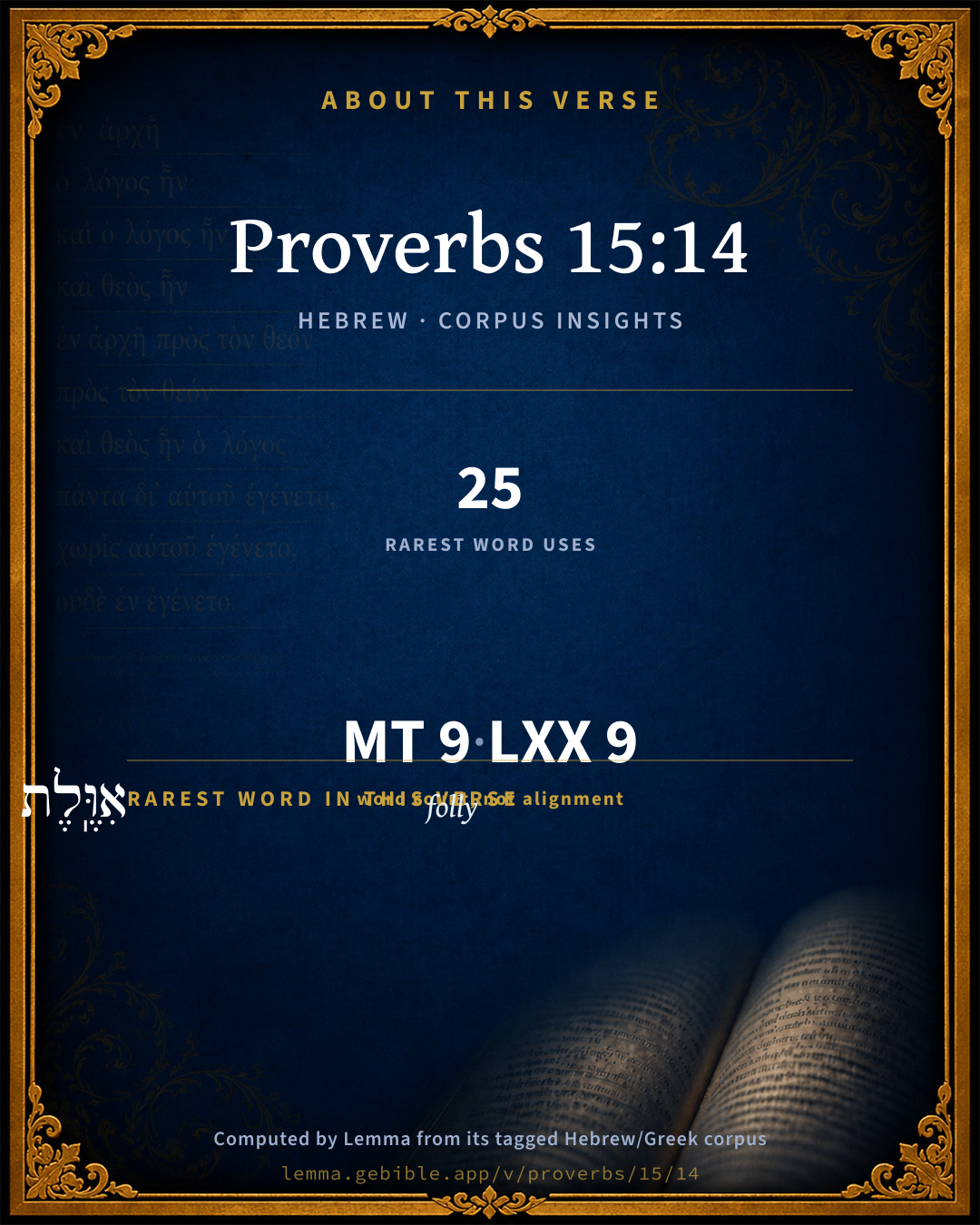
The rarest word here is אִוֶּֽלֶת folly H200 — appearing just 25 times in the whole Hebrew Bible.

Shared distinctive vocabulary

אִוֶּֽלֶת folly H200 occurs in 24 verses of the Hebrew Bible. Also found in:

Grammatical profile

  • 3 verbs
  • 5 nouns
  • 1 adjective

Verb forms

  • נָ֭בוֹן Niphal · Participle Active
  • יְבַקֶּשׁ Piel · Imperfect
  • יִרְעֶ֥ה Qal · Imperfect

Hebrew & Septuagint length

In English translation the verse runs 17 words from the Hebrew and 14 from the Septuagint (LXX English) — closely comparable.

A rough comparison of the two English renderings, which tokenize alike — not a word-level alignment.

Word counts can differ between the Hebrew and the Greek without any difference in meaning — e.g. the Hebrew direct-object marker אֵת has no separate Greek word, and Greek often adds the article ὁ.

In the original languages it is 9 Hebrew tokens and 9 Greek tokens — but the two are counted differently (Hebrew bundles its prefixes and suffixes into one token; the Greek is in lemma form), so that isn’t a like-for-like length.

Cross-references

12

Topical passages linked to Proverbs 15:14 in the Treasury of Scripture Knowledge — connected by theme and wording, ordered by reader-vote popularity; previews shown in the World English Bible.

  • Proverbs 9:9 Instruct a wise man, and he will be still wiser. Teach a righteous man, and he will increase in learning.
  • Proverbs 18:15 The heart of the discerning gets knowledge. The ear of the wise seeks knowledge.
  • Isaiah 30:10 who tell the seers, "Don't see;" and to the prophets, "Don't prophesy to us right things, speak to us smooth things, prophesy deceits,
  • Acts 17:11 Now these were more noble than those in Thessalonica, in that they received the word with all readiness of the mind, examining the Scriptures daily to see whether these things were so.
  • 2 Peter 3:18 But grow in the grace and knowledge of our Lord and Savior Jesus Christ. To him be the glory both now and forever. Amen.
  • Proverbs 1:5 That the wise man may hear, and increase in learning; That the man of understanding may attain to sound counsel:
  • 1 Kings 3:6–12 Solomon said, You have shown to your servant David my father great loving kindness, according as he walked before you in truth, and in righteousness, and in uprightness of heart with you; and you have kept for him this great loving kindness, that you have given him a son to sit on his throne, as it is this day.
  • Psalms 119:97 How love I your law! It is my meditation all day.
  • Psalms 119:100 I understand more than the aged, Because I have kept your precepts.
  • Isaiah 44:20 He feeds on ashes; a deceived heart has turned him aside; and he can't deliver his soul, nor say, Is there not a lie in my right hand?
  • Hosea 12:1 Ephraim feeds on wind, And chases the east wind. He continually multiplies lies and desolation. They make a covenant with Assyria, And oil is carried into Egypt.
  • Proverbs 12:23 A prudent man keeps his knowledge, But the hearts of fools proclaim foolishness.

Cross-references courtesy of OpenBible.info (CC BY 4.0).

Hebrew and Greek witnesses Masoretic Hebrew ↔ Greek Septuagint

The same verse in the two great witnesses to the Old Testament, shown verse-for-verse.

These are two independent witnesses, not word-aligned to each other, and the Septuagint is shown in lemma (dictionary) form.

Hebrew Proverbs 15:14 Masoretic · Westminster Leningrad Codex

לֵ֣ב נָ֭בוֹן יְבַקֶּשׁ דָּ֑עַת ופני וּפִ֥י כְ֝סִילִ֗ים יִרְעֶ֥ה אִוֶּֽלֶת

The heart of one who has understanding seeks knowledge, But the mouths of fools feed on folly.

World English Bible · Public Domain

Greek LXX Proverbs 15:14 Septuagint · lemma form

καρδία ὀρθός ζητέω αἴσθησις στόμα δέ ἀπαίδευτος γιγνώσκω κακός

An upright heart seeks discretion; but the mouth of the uninstructed will experience evils.

LXX2012 (modern English Septuagint) · Public Domain

On this verse, The Pulpit Commentary discusses the Septuagint’s reading. Read the note in Commentary ↓

Hebrew: Westminster Leningrad Codex (CC BY 4.0). Greek: Septuagint (public domain); English from LXX2012 (modern English Septuagint) (Public Domain). How the Septuagint differs from the Hebrew →

Commentary

Notes on Proverbs 15:14 from classic Christian and Jewish commentators (each source and its license shown beneath its notes). The classic Christian expositions comment on the surrounding passage and are grouped to its opening verse, so a note may address several verses; the Jewish commentaries on the Tanakh (Rashi and others) are per-verse, so they appear only where the commentator wrote on this verse.

Lemma curates 59 commentaries, every one of them public domain or Creative Commons licensed, each selected and text-cleaned for this edition rather than reprinted as found. About our sources →

Trapp's Complete Commentary

John Trapp

Pro 15:14 The heart of him that hath understanding seeketh knowledge: but the mouth of fools feedeth on foolishness.

Ver. 14. The heart of him that hath understanding seeketh knowledge.] As a hungry man seeks meat, or a covetous man gold, the more he hath, the more he desires. Moses was no sooner off the mount where he had seen God face to face, but he cries, "Lord, shew me thy glory." David, that knew more than his teachers, cries ever and anon, "Teach me thy statutes." Job prefers knowledge before his necessary food. {Pro 23:12} Chrysippus was so studious that he would not take time to eat his food, but had perished with hunger if his maid Melissa had not put food into his mouth. John ate the book that the angel gave him. {Rev 10:9} Jacobus de Voragine and Petrus Comestor had their names from devouring the Bible. Let fools feed on foolishness, as swine do on swill, as flies do on blotches, as carrion kites do on stinking carcases, as Tartars do on dead camels, asses, dogs, cats, &c. The wise man finds no such sweetness in the most delicate and dainty dishes, as in the search after divine knowledge. {Psa 119:103} Even Aristotle saith that a little knowledge, though conjectural, about heavenly things, is to be preferred above knowledge, though certain, about earthly things. And Agur saith, it is to "ascend into heaven." {Pro 30:4}

John Trapp, A Commentary or Exposition upon All the Books of the Old and New Testament (1647–1656) — public domain. Text from a community e-Sword module.

Tyndale Open Study Notes

Tyndale Open Resources

15:14 Whether we enjoy knowledge or trash reveals whether we are on the path of wisdom or of folly.

Tyndale Open Study Notes — © Tyndale Open Resources, licensed CC BY-SA 4.0. Text via the HelloAO Bible API.

Matthew Henry's Commentary

Here are two things to be wondered at: - 1. A wise man not satisfied with his wisdom, but still seeking the increase of it; the more he has the more he would have: The heart of him that has understanding, rejoices so in the knowledge it has attained to that it is still coveting more, and in the use of the means of knowledge is still labouring for more, growing in grace, and in the knowledge of Christ. Si dixisti, Sufficit, periisti - If you say, I have enough, you are undone. 2. A fool well satisfied with his folly and not seeking the cure of it. While a good man hungers after the solid satisfactions of grace, a carnal mind feasts on the gratifications of appetite and fancy. Vain mirth and sensual pleasures are its delight, and with these it can rest contented, flattering itself in these foolish ways.

Matthew Henry's Commentary on the Whole Bible (1708–1710) — public domain (CC PDM 1.0). Text via the HelloAO Bible API.

Jamieson, Fausset & Brown

Robert Jamieson, A. R. Fausset & David Brown

(Compare Pro 10:21-22). The wise grow wiser, the fools more foolish (Pro 9:9).

Jamieson, Fausset & Brown — Commentary Critical and Explanatory on the Whole Bible (1871) — public domain (CC PDM 1.0). Text via the HelloAO Bible API.

The Cambridge Bible for Schools and Colleges

gen. ed. J. J. S. Perowne

14. seeketh … feedeth on] The one delights in the active pursuit of knowledge, which ever creates in those who find it a craving for more; the other lies down like a satiated animal, and feeds and ruminates on the folly, which quenches all high desire.

The Cambridge Bible for Schools and Colleges (gen. ed. J. J. S. Perowne; Cambridge University Press, 1878–1918) — public domain. Text from a community e-Sword module.

John Gill's Exposition

The heart of him that hath understanding seeketh knowledge,.... He that has in his heart an understanding of divine and spiritual things, of the Gospel and of the truths of it, will seek earnestly and diligently in the use of proper means after more knowledge; as he will desire to know more of Christ, his person, offices, and grace, he will follow on to know him, and not be content with the present degree of knowledge he has attained unto; he will hear and read the word, and pray and meditate, in order to come to a more perfect knowledge of the son of God, and of those things which relate to his spiritual peace and eternal welfare;

but the mouth of fools feedeth on foolishness; on foolish talking and jesting; on foolish and unlearned questions; on foolish and false doctrines; on foolish and hurtful lusts; on wind and ashes, a deceived heart having turned them aside: they take pleasure and satisfaction in those things; feed their fancy with them and feast upon them, which shows what fools they are; and such all unregenerate men be.

John Gill's Exposition of the Whole Bible (1746–1763) — public domain (CC PDM 1.0). Text via the HelloAO Bible API.

Matthew Poole's English Annotations

Their hearts are set upon wickedness, which is meat and drink to them.

Matthew Poole's English Annotations on the Holy Bible (1683–1685) — public domain. Text from a community e-Sword/MySword module.

Whedon's Commentary on the Bible

Daniel D. Whedon

14. Seeketh knowledge — As a hungry man does food. Feedeth on (or relishes) foolishness — Only frivolous, vain, and unprofitable discourse. Zockler renders, from the various readings, “face of fools feedeth.” etc.

Daniel D. Whedon (gen. ed.), Commentary on the Old and New Testaments (1874–1909) — public domain. Text from a community e-Sword module.

The Pulpit Commentary

The heart of him that hath understanding seeketh knowledge. (Pro_18:15) The wise man knows that he knows nothing, and is always seeking to learn more. Sofia gar esti kai mayein o mh noeiv. "To learn what thou hast never thought is wisdom.

The mouth of fools. Another reading, is "the face of fools;" but the former is more suitable to what follows. Feedeth on foolishness. So the Vulgate and Septuagint, "The mouth of the undisciplined knoweth evil." The fool is always gaping and devouring every silly, or slanderous, or wicked word that comes in his way, and in his turn utters and disseminates it.

The Pulpit Commentary (1880–1919), ed. H.D.M. Spence-Jones & Joseph S. Exell — public domain. Text from a community e-Sword module.

John Wesley's Explanatory Notes

Foolishness - Wickedness is meat and drink to them.

John Wesley, Explanatory Notes Upon the Whole Bible (1754–1765) — public domain. Text via the GEBible commentary corpus.

Bridges on Proverbs

Charles Bridges

Observe the man of natural understanding. Every apprehension quickens the thirst to seek knowledge. He is ready to learn from any quarter, even from a child. He is all eye, all ear, all heart, for his object. Much more will spiritual understanding stimulate the desire. (Pro 1:5 ; Pro 9:9 .) Repress the appetite to be "wise above what is written." But make vigorous effort to be wise to the full extent of the Revelation. David, with his high attainments, was ever crying for Divine Teaching.†1 His wise son sought knowledge upon his knees,†2 and not less in the diligent habit of application.†3 The Queen of Sheba, "coming from the utmost parts of the earth;"†4 Nicodemus and Mary, "sitting at the feet of Jesus;"†5 the Eunuch, journeying to Jerusalem;†6 Cornelius and his company, drinking in the precious message of salvation;†7 the Bereans, carefully "searching the Scriptures"†8 — all these shew the understanding heart, seeking a larger interest in the blessing.

Invaluable, indeed, is the gift. Warm affections need the discipline of knowledge to form Christian consistency and completeness (Php 1:9 . Psa 119:66 ): seeking for wholesome food, not intoxicating draughts; not deeming novelty the most desirable thing; but rather, with the wise Sir M. Hale, desiring ’to be impressed and affected, and to have old and known truths reduced to experience and practice.’

But while the man of understanding is never satisfied with knowledge, the fool is fully satisfied with folly. His brutish taste feeds upon foolishness, as his meat and his drink. His spirit "is of the earth, earthy." Young people! guard against this folly at every turn. Avoid trifling amusements, frivolous reading, profane merriment. In religion, beware of preferring empty speculations and disputings on matters indifferent, to the rich pasture of the children of God. (Pro 15:21 ; Act 17:21 .) Let us all ponder the responsibility of "going on to perfection; that, being of full age, we may have our senses exercised to discern both good and evil." (Heb 6:1 ; Heb 5:14 .)

Footnotes:

†1 Psa 119:98-100, with Psa 119:33-34, &c.

†2 1Ki 3:5-10 .

†3 Ecc 12:9-10.

†4 1Ki 10:1 . Mat 12:42 .

†5 Joh 3:1-2. Luk 10:39 .

†6 Act 8:28.

†7 Act 10:33.

†8 Act 17:11.

Charles Bridges, An Exposition of the Book of Proverbs (1846) — public domain. Text from a community e-Sword module.

Kretzmann's Popular Commentary

Paul E. Kretzmann

v. 14. The heart of him that hath understanding seeketh knowledge, for he is anxious always to increase in true wisdom, as it applies to the various situations in life; but the mouth of fools feedeth on foolishness, literally, "the face of fools pastures on folly," delighting in it, as an animal eagerly feeds on grass in the pasture.

Paul E. Kretzmann, Popular Commentary of the Bible (1921–1924) — public domain. Text from a community e-Sword module.

Lesson kit

Teaching starters — assembled from the data on this page, not authored interpretation. Every prompt links to the verse data it draws on. Edit before teaching.

Proverbs, in the Wisdom, opens this verse with 9 words (9 distinct Hebrew lemmas). Its most distinctive word is ʼivveleth (“folly”). A historical commentator’s framing appears above. Read the whole chapter for the surrounding context.

Discussion questions

  1. What does “folly” (ʼivveleth) contribute to the verse as a whole?
  2. Psalms 38:5 shares the word «folly» with this verse. How do the two illuminate each other?
  3. These translations render this verse differently. What is at stake in choosing one wording over another?
  4. The verb «נָ֭בוֹן» is Niphal Participle Active. How does its form color the action?
  5. Reading how Trapp's Complete Commentary and Tyndale Open Study Notes read this verse, where do the two commentators agree and where do they part?

Things to notice

Reading settings

Reading text

Shown beneath each verse's original-language words.

Old Testament
Old Testament edition

Read the OT as the Masoretic Hebrew (MT) or the Greek Septuagint (LXX).

English shown for the Greek Septuagint (in the Hebrew ↔ Greek comparison).

Comparing translations? Open the Compare panel on any verse page to stack up to four side by side.