
Ezekiel 7:26

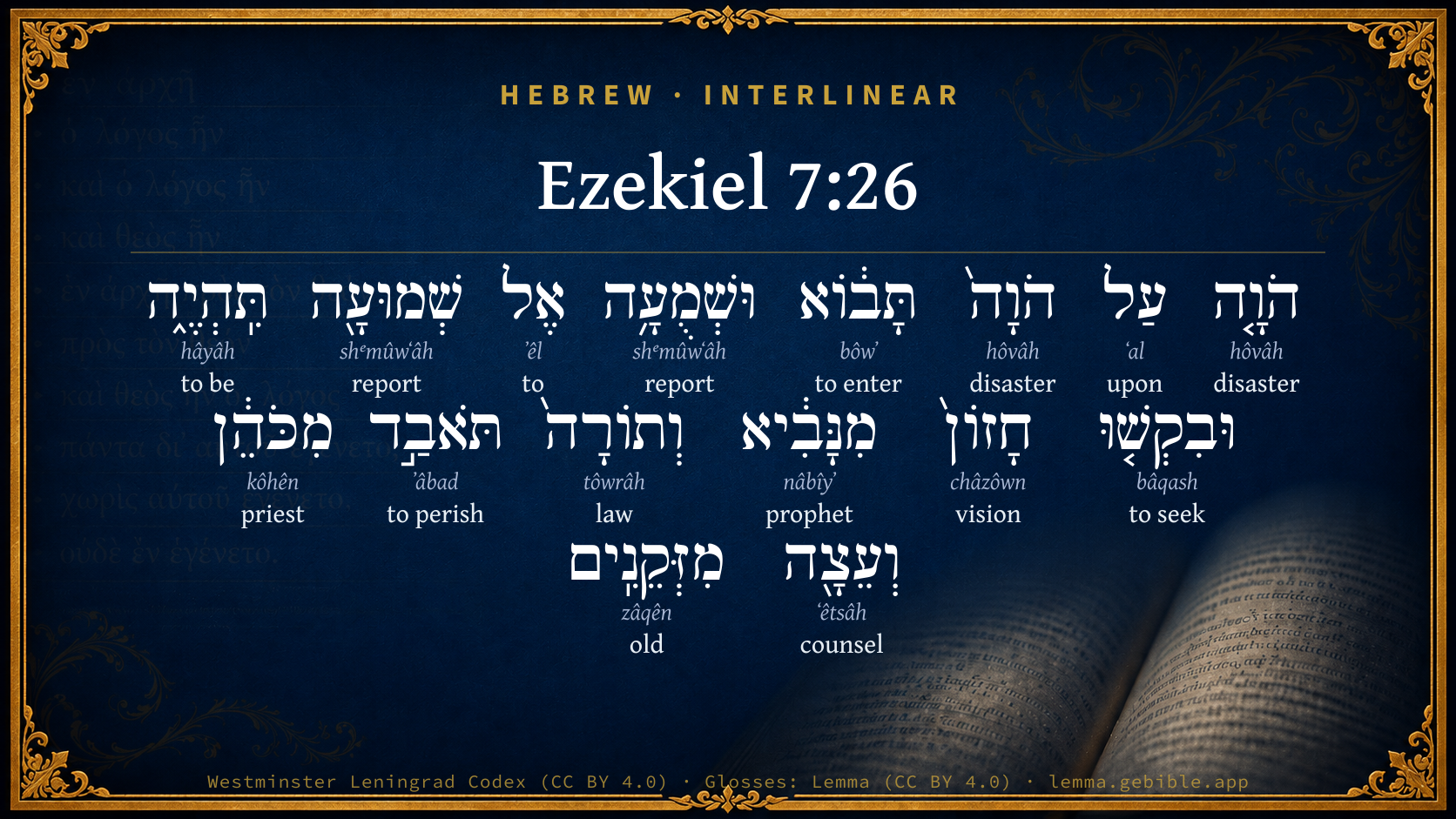
Hebrew (Westminster Leningrad Codex) Ezekiel 7:26 appears in the Hebrew Old Testament. The text above is from the Westminster Leningrad Codex. Each word links to its Strong’s number, a concise gloss, and parsing drawn from the Open Scriptures Hebrew Bible morphology. Click any word for its full Brown-Driver-Briggs (BDB) entry.
Download image
Cite this verse

Ezekiel 7:26 (World English Bible). Public Domain. Lemma interlinear Bible study tool, https://lemma.gebible.app/v/ezekiel/7/26.

Show BibTeX & RIS
BibTeX
RIS
English Translation
Mischief shall come on mischief, and rumor shall be on rumor; and they shall seek a vision of the prophet; but the law shall perish from the priest, and counsel from the elders.
World English Bible · Public Domain
Download a study sheet

One document with this verse’s original text, its word-by-word gloss line, the meaning frame, cross-references with their text, attributed commentary, and full source and license credits — printable, and it pastes into notes with its structure intact.

This verse Autodidact and up

Study sheet (.html) Plain text (.txt)

A passage Seminary Student

Up to 50 verses in one chapter. A passage sheet keeps up to 6 commentary sources and 12 cross-references per verse, in the order this page ranks them, and says so on the sheet whenever that leaves anything out. Ask for a single verse and you get the Autodidact verse sheet above.

Everything on this page stays free to read, with no account — the sheet is a download of what is already on screen, not access to it.

Want to remove ads? Support Godless Engineer
Compare translations 3

The same verse in 3 English versions, stacked beneath the original-language interlinear above. Click any original word for its lexicon entry.

Each is an independent rendering of the whole verse — the interlinear is not word-aligned to these translations.

Highlighted words mark where these versions differ — a whole-verse word diff, not a word-by-word alignment.

  • World English Bible Public Domain
    Mischief shall come on mischief, and rumor shall be on rumor; and they shall seek a vision of the prophet; but the law shall perish from the priest, and counsel from the elders.
  • King James Version Public Domain
    Mischief shall come upon mischief, and rumour shall be upon rumour; then shall they seek a vision of the prophet; but the law shall perish from the priest, and counsel from the ancients.
  • unfoldingWord Literal Text CC BY-SA 4.0
    Disaster upon disaster will come, and there will be rumor after rumor. Then they will seek a vision from the prophet, but the law will perish from the priest and advice from the elders.

unfoldingWord Literal Text — © unfoldingWord, licensed CC BY-SA 4.0. Word-aligned USFM3 via Door43 (git.door43.org/unfoldingWord/en_ult).

Versions to compare (up to 4)

3 of 4 selected

Show all 18 translations

Every available English version of this verse, each an independent rendering of the whole verse.

  • World English Bible Public Domain
    Mischief shall come on mischief, and rumor shall be on rumor; and they shall seek a vision of the prophet; but the law shall perish from the priest, and counsel from the elders.
  • Berean Standard Bible Public Domain
    Disaster upon disaster will come, and rumor after rumor. Then they will seek a vision from a prophet, but instruction from the priests will perish, as will counsel from the elders.
  • Majority Standard Bible Public Domain
    Disaster upon disaster will come, and rumor after rumor. Then they will seek a vision from a prophet, but instruction from the priests will perish, as will counsel from the elders.
  • King James Version Public Domain
    Mischief shall come upon mischief, and rumour shall be upon rumour; then shall they seek a vision of the prophet; but the law shall perish from the priest, and counsel from the ancients.
  • American Standard Version (1901) Public Domain
    Mischief shall come upon mischief, and rumor shall be upon rumor; and they shall seek a vision of the prophet; but the law shall perish from the priest, and counsel from the elders.
  • Revised Version (1885) Public Domain
    Mischief shall come upon mischief, and rumour shall be upon rumour; and they shall seek a vision of the prophet; but the law shall perish from the priest, and counsel from the ancients.
  • Geneva Bible (1599) Public Domain
    Calamitie shall come vpon calamitie, and rumour shall bee vpon rumour: then shall they seeke a vision of the Prophet: but the Lawe shall perish from the Priest, and counsel from the Ancient.
  • Douay-Rheims (1899) Public Domain
    Trouble shall come upon trouble, and rumour upon rumour, and they shall seek a vision of the prophet, and the law shall perish from the priest, and counsel from the ancients.
  • Young's Literal Translation Public Domain
    Mischief on mischief cometh, and report is on report, And they have sought a vision from a prophet, And law doth perish from the priest, And counsel from the elders,
  • Literal Standard Version CC BY-SA 4.0
    Disaster comes on disaster, and report is on report, || And they have sought a vision from a prophet, || And law perishes from [the] priest, || And counsel from [the] elderly,
  • Unlocked Literal Bible CC BY-SA 4.0
    Disaster upon disaster will come, and there will be rumor after rumor. Then they will seek a vision from the prophet, but the law will perish from the priest and advice from the elders.
  • unfoldingWord Literal Text CC BY-SA 4.0
    Disaster upon disaster will come, and there will be rumor after rumor. Then they will seek a vision from the prophet, but the law will perish from the priest and advice from the elders.
  • Darby Bible Public Domain
    Mischief shall come upon mischief, and rumour shall be upon rumour; and they shall seek a vision from a prophet; but the law shall perish from the priest, and counsel from the elders.
  • World Messianic Bible Public Domain
    Mischief will come on mischief, and rumor will be on rumor. They will seek a vision of the prophet; but the law will perish from the priest, and counsel from the elders.
  • Webster's Bible Public Domain
    Mischief shall come upon mischief, and rumor shall be upon rumor; then shall they seek a vision of the prophet; but the law shall perish from the priest, and counsel from the elders.
  • Free Bible Version CC BY-SA 4.0
    Disaster after disaster will come down on them, and rumor after rumor. They will ask for a vision from a prophet, but there won't be any, and there won't be any instructions from the priests or advice from the elders either.
  • Bible in Basic English Public Domain
    Destruction will come on destruction, and one story after another; and the vision of the prophet will be shamed, and knowledge of the law will come to an end among the priests, and wisdom among the old.
  • JPS Tanakh (1917) Public Domain
    Calamity shall come upon calamity, and rumour shall be upon rumour; and they shall seek a vision of the prophet, and instruction shall perish from the priest, and counsel from the elders.

Literal Standard Version (2020), Covenant Press — licensed CC BY-SA 4.0. Text via the HelloAO Bible API (eBible.org). Unlocked Literal Bible (unfoldingWord) — licensed CC BY-SA 4.0. Text via the HelloAO Bible API (eBible.org). unfoldingWord Literal Text — © unfoldingWord, licensed CC BY-SA 4.0. Word-aligned USFM3 via Door43 (git.door43.org/unfoldingWord/en_ult). Free Bible Version, Dr. Jonathan Gallagher — licensed CC BY-SA 4.0. Text via the HelloAO Bible API (eBible.org).

Word by word

More ways to search: Search by grammar → Find every occurrence → Compare this word →

Practice this passage: Drill this verse → Learn its vocabulary →

הֹוָ֤ה
hôvâh
H1943
“disaster”
Noun, Common, Feminine, Singular, Absolute
Part of Speech
Noun
Type
Common
Gender
Feminine
Number
Singular
State
Absolute
Full BDB Definition

Origin: another form for H1942

TWOT: 483c

ruin, disaster
  1. עַל ʻal H5921 “upon” Preposition
  2. הֹוָה֙ hôvâh H1943 “disaster” Noun, Common, Feminine, Singular, Absolute
  3. תָּב֔וֹא bôwʼ H935 “to enter” Verb, Qal, Imperfect, 3rd Person, Feminine, Singular
  4. וּשְׁמֻעָ֥ה shᵉmûwʻâh H8052 “and · report” Conjunction + Noun, Common, Feminine, Singular, Absolute
  5. אֶל ʼêl H413 “to” Preposition
  6. שְׁמוּעָ֖ה shᵉmûwʻâh H8052 “report” Noun, Common, Feminine, Singular, Absolute
  7. תִּֽהְיֶ֑ה hâyâh H1961 “to be” Verb, Qal, Imperfect, 3rd Person, Feminine, Singular
  8. וּבִקְשׁ֤וּ bâqash H1245 “and · to seek” Conjunction + Verb, Piel, Sequential Perfect, 3rd Person, Common, Plural
  9. חָזוֹן֙ châzôwn H2377 “vision” Noun, Common, Masculine, Singular, Absolute
  10. מִנָּבִ֔יא nâbîyʼ H5030 “from · prophet” Preposition + Noun, Common, Masculine, Singular, Absolute
  11. וְתוֹרָה֙ tôwrâh H8451 “and · law” Conjunction + Noun, Common, Feminine, Singular, Absolute
  12. תֹּאבַ֣ד ʼâbad H6 “to perish” Verb, Qal, Imperfect, 3rd Person, Feminine, Singular
  13. מִכֹּהֵ֔ן kôhên H3548 “from · priest” Preposition + Noun, Common, Masculine, Singular, Absolute
  14. וְעֵצָ֖ה ʻêtsâh H6098 “and · counsel” Conjunction + Noun, Common, Feminine, Singular, Absolute
  15. מִזְּקֵנִֽים zâqên H2205 “from · old” Preposition + Adjective, Adjective, Masculine, Plural, Absolute

About this verse

These counts appear in no published source. They are computed here, from the morphology-tagged text and Lemma’s own curated glosses. What Lemma adds →

16
words
14
distinct lemmas
Prophets
section

Notable vocabulary

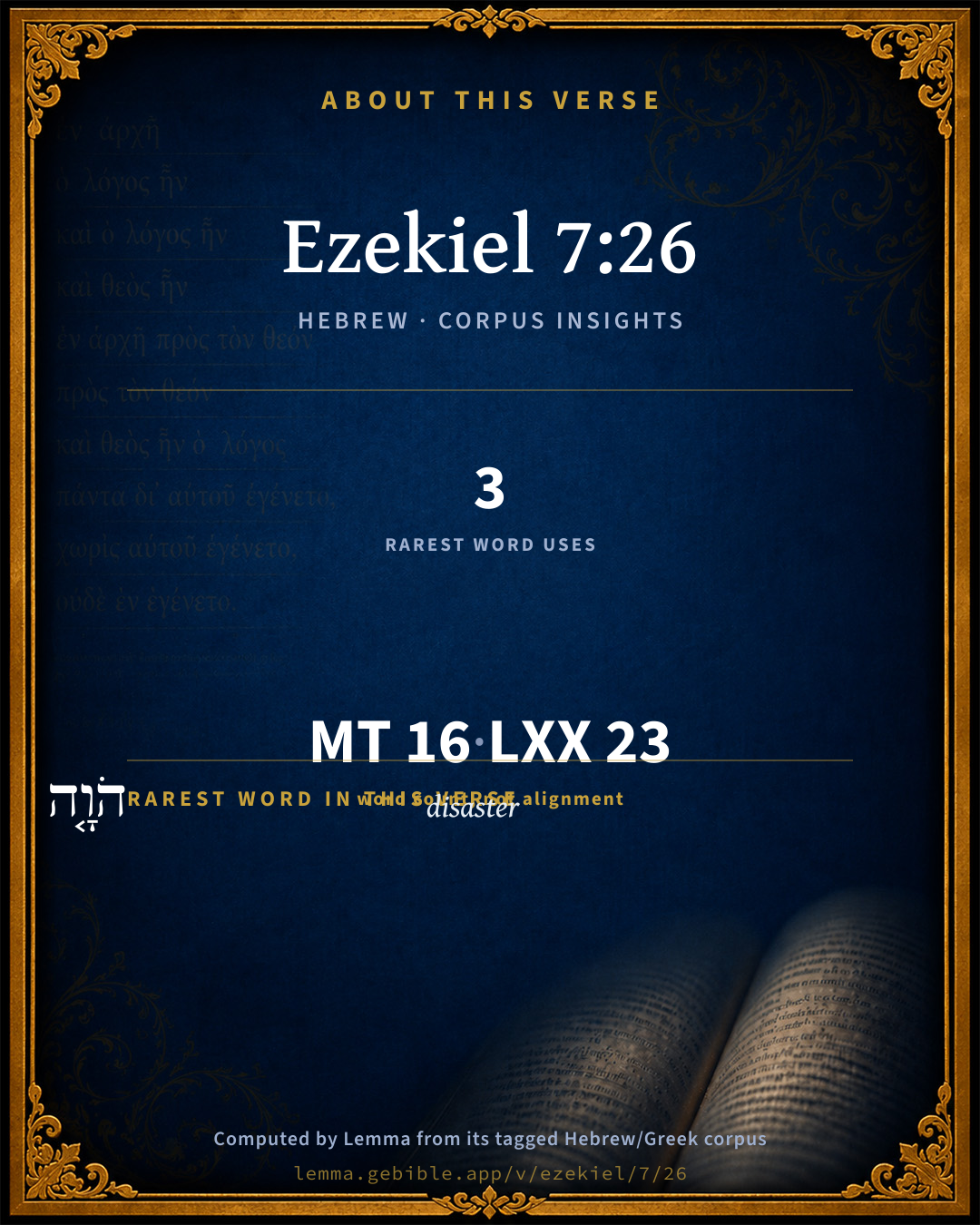
The rarest word here is הֹוָ֤ה disaster H1943 — appearing just 3 times in the whole Hebrew Bible.

Shared distinctive vocabulary

הֹוָ֤ה disaster H1943 occurs in 2 verses of the Hebrew Bible. Also found in:

Grammatical profile

  • 4 verbs
  • 9 nouns
  • 1 adjective
  • 2 prepositions

Verb forms

  • תָּב֔וֹא Qal · Imperfect
  • תִּֽהְיֶ֑ה Qal · Imperfect
  • וּבִקְשׁ֤וּ Piel · Sequential Perfect
  • תֹּאבַ֣ד Qal · Imperfect

Repetition

Words recur within this verse — often emphatic in Hebrew:

  • הֹוָ֤ה disaster H1943 ×2
  • וּשְׁמֻעָ֥ה report H8052 ×2

Hebrew & Septuagint length

In English translation the verse runs 33 words from the Hebrew and 35 from the Septuagint (LXX English) — closely comparable.

A rough comparison of the two English renderings, which tokenize alike — not a word-level alignment.

Word counts can differ between the Hebrew and the Greek without any difference in meaning — e.g. the Hebrew direct-object marker אֵת has no separate Greek word, and Greek often adds the article ὁ.

In the original languages it is 16 Hebrew tokens and 23 Greek tokens — but the two are counted differently (Hebrew bundles its prefixes and suffixes into one token; the Greek is in lemma form), so that isn’t a like-for-like length.

Cross-references

19

Topical passages linked to Ezekiel 7:26 in the Treasury of Scripture Knowledge — connected by theme and wording, ordered by reader-vote popularity; previews shown in the World English Bible.

  • Jeremiah 4:20 Destruction on destruction is cried; for the whole land is laid waste: suddenly are my tents destroyed, [and] my curtains in a moment.
  • Psalms 74:9 We see no miraculous signs. There is no longer any prophet, Neither is there among us anyone who knows how long.
  • Ezekiel 14:1 Then came certain of the elders of Israel to me, and sat before me.
  • Micah 3:6 "Therefore night is over you, with no vision, And it is dark to you, that you may not divine; And the sun will go down on the prophets, And the day will be black over them.
  • Jeremiah 18:18 Then said they, Come, and let us devise devices against Jeremiah; for the law shall not perish from the priest, nor counsel from the wise, nor the word from the prophet. Come, and let us strike him with the tongue, and let us not give heed to any of his words.
  • Jeremiah 21:2 Please inquire of Yahweh for us; for Nebuchadrezzar king of Babylon makes war against us: peradventure Yahweh will deal with us according to all his wondrous works, that he may go up from us.
  • Jeremiah 37:17 Then Zedekiah the king sent, and fetched him: and the king asked him secretly in his house, and said, Is there any word from Yahweh? Jeremiah said, There is. He said also, You shall be delivered into the hand of the king of Babylon.
  • Lamentations 2:9 Her gates are sunk into the ground; he has destroyed and broken her bars: Her king and her princes are among the nations where the law is not; Yes, her prophets find no vision from Yahweh.
  • Ezekiel 20:1–3 It happened in the seventh year, in the fifth [month], the tenth [day] of the month, that certain of the elders of Israel came to inquire of Yahweh, and sat before me.
  • Leviticus 26:18 "'If you in spite of these things will not listen to me, then I will chastise you seven times more for your sins.
  • Leviticus 26:21 "'If you walk contrary to me, and won't listen to me, then I will bring seven times more plagues on you according to your sins.
  • Leviticus 26:24 then I will also walk contrary to you; and I will strike you, even I, seven times for your sins.
  • Leviticus 26:28 then I will walk contrary to you in wrath; and I also will chastise you seven times for your sins.
  • Deuteronomy 32:23 I will heap evils on them; I will spend my arrows on them:
  • Isaiah 47:11 Therefore shall evil come on you; you shall not know the dawning of it: and mischief shall fall on you; you shall not be able to put it away: and desolation shall come on you suddenly, which you don't know.
  • Jeremiah 38:14–28 Then Zedekiah the king sent, and took Jeremiah the prophet to him into the third entry that is in the house of Yahweh: and the king said to Jeremiah, I will ask you a thing; hide nothing from me.
  • Ezekiel 8:1 It happened in the sixth year, in the sixth [month], in the fifth [day] of the month, as I sat in my house, and the elders of Judah sat before me, that the hand of the Lord Yahweh fell there on me.
  • Ezekiel 33:31 They come to you as the people comes, and they sit before you as my people, and they hear your words, but don't do them; for with their mouth they show much love, but their heart goes after their gain.
  • Amos 8:11–12 Behold, the days come," says the Lord Yahweh, "That I will send a famine in the land, Not a famine of bread, Nor a thirst for water, But of hearing the words of Yahweh.

Cross-references courtesy of OpenBible.info (CC BY 4.0).

Hebrew and Greek witnesses Masoretic Hebrew ↔ Greek Septuagint

The same verse in the two great witnesses to the Old Testament, shown verse-for-verse.

These are two independent witnesses, not word-aligned to each other, and the Septuagint is shown in lemma (dictionary) form.

Hebrew Ezekiel 7:26 Masoretic · Westminster Leningrad Codex

הֹוָ֤ה עַל הֹוָה֙ תָּב֔וֹא וּשְׁמֻעָ֥ה אֶל שְׁמוּעָ֖ה תִּֽהְיֶ֑ה וּבִקְשׁ֤וּ חָזוֹן֙ מִנָּבִ֔יא וְתוֹרָה֙ תֹּאבַ֣ד מִכֹּהֵ֔ן וְעֵצָ֖ה מִזְּקֵנִֽים

Mischief shall come on mischief, and rumor shall be on rumor; and they shall seek a vision of the prophet; but the law shall perish from the priest, and counsel from the elders.

World English Bible · Public Domain

Greek LXX Ezekiel 7:26 Septuagint · lemma form

οὐαί ἐπί οὐαί εἰμί καί ἀγγελία ἐπί ἀγγελία εἰμί καί ζητέω ὅρασις ἐκ προφήτης καί νόμος ἀποὀλλύω ἐκ ἱερεύς καί βουλή ἐκ πρεσβύτερος

There shall be woe upon woe, and there shall be message upon message; and a vision shall be sought from a prophet; but the law shall perish from the priest, and counsel from the elders.

LXX2012 (modern English Septuagint) · Public Domain

Hebrew: Westminster Leningrad Codex (CC BY 4.0). Greek: Septuagint (public domain); English from LXX2012 (modern English Septuagint) (Public Domain). How the Septuagint differs from the Hebrew →

Targum (Aramaic paraphrase)

1

The Targum is the ancient Jewish Aramaic paraphrase of the Hebrew Scriptures — an interpretive translation, not the Hebrew text itself. Onkelos (literal) and Pseudo-Jonathan (expansive) render the Torah, and Jonathan the Prophets. Coverage is partial: where no permissively-licensed English translation exists for a verse, only the Aramaic is shown. This is verse-level text, not a word-by-word alignment to the Hebrew.

  1. Targum Jonathan Prophets (Joshua–Malachi)
    תְּבַר עַל תְּבַר יֵיתִי וּכְסוֹרְתָּא עַל בְּסוֹרְתָּא תְּהֵי וְיִבְעוּן אוּלְפַן מִסָפֵר וְאוֹרָאָה תִּפְסוֹק מִכָּהֵן וּמְלַךְ מְחַכִּים:

    (no public-domain English translation for this verse)

    Targum Jonathan — Aramaic: “Mikraot Gedolot” (public domain). English: “Sefaria Community Translation” (CC0 1.0 (public-domain dedication)); “London "Chaldee Paraphrase," 1871” (public domain). Text via Sefaria.

Commentary

Notes on Ezekiel 7:26 from classic Christian and Jewish commentators (each source and its license shown beneath its notes). The classic Christian expositions comment on the surrounding passage and are grouped to its opening verse, so a note may address several verses; the Jewish commentaries on the Tanakh (Rashi and others) are per-verse, so they appear only where the commentator wrote on this verse.

Lemma curates 59 commentaries, every one of them public domain or Creative Commons licensed, each selected and text-cleaned for this edition rather than reprinted as found. About our sources →

Trapp's Complete Commentary

John Trapp

Eze 7:26 Mischief shall come upon mischief, and rumour shall be upon rumour; then shall they seek a vision of the prophet; but the law shall perish from the priest, and counsel from the ancients.

Ver. 26. Mischief shall come upon mischief.] Aliud ex alio malum; I will heap mischiefs upon them. {Deu 32:23} War is called "evil" or "mischief" by a specialty. {Isa 45:7}

And rumour shall be upon rumour,] sc., Of Nebuchadnezzar’s advance, acts, and achievements.

Then shall they seek a vision of the prophet.] As a drowning man catcheth at the sprig of a tree, which before he slighted.

But the law shall perish from the priest.] Not only prophecy, which is an extraordinary gift, shall fail them, but also the ordinary preaching of God’s Word, and all good advice and provision of human wisdom. And yet this foolish people were wont to soothe up themselves and say, The law shall not perish from the priest, nor wisdom from the ancient. {Jer 18:18}

John Trapp, A Commentary or Exposition upon All the Books of the Old and New Testament (1647–1656) — public domain. Text from a community e-Sword module.

The Biblical Illustrator

Joseph S. Exell

Eze_7:26

Mischief shall come upon mischief.

A succession of evils

1. When a people is under Divine displeasure there is a succession of evils for them, mischief after mischief; they may not expect a few, but many.

2. God proceeds by degrees and steps to severity of judgments. God pours not out all His wrath at once. First, some drops of a vial, then some little streams, after that the strength.

3. Wicked men in great straits will sue to them for help whom before they hated. They could seek for a vision from the prophet now they were in extremities, and they run from prophet to prophet to get some counsel and comfort.

4. They that will not hear Gods servants when they are at ease, shall not have help from them in time of their distress.

5. It is a dreadful evil when God takes away the signs of His presence.

6. Truths are not confined to any sort of men, not to prophets, priests, or ministers, in these or any days; the prophets should be without vision, the law should perish from the priests, and counsel from the elders.

7. God gives vision, law, counsel, and takes them away at His pleasure; He creates light and darkness. They shall seek vision of the prophets, and there shall be none.

8. Those who will not do what they know, shall not know what to do. (W. Greenhill, M. A.)

.

The Biblical Illustrator, edited by Joseph S. Exell (c. 1880s–1900s) — public domain. Text from a community e-Sword module.

Jamieson, Fausset & Brown

Robert Jamieson, A. R. Fausset & David Brown

Mischief . . . upon . . . mischief-- (Deu 32:23; Jer 4:20). This is said because the Jews were apt to fancy, at every abatement of suffering, that their calamities were about to cease; but God will accumulate woe on woe.

rumour--of the advance of the foe, and of his cruelty (Mat 24:6).

seek a vision--to find some way of escape from their difficulties (Isa 26:9). So Zedekiah consulted Jeremiah (Jer 37:17; Jer 38:14).

law shall perish--fulfilled (Eze 20:1, Eze 20:3; Psa 74:9; Lam 2:9; compare Amo 8:11); God will thus set aside the idle boast, "The law shall not perish from the priest" (Jer 18:18).

ancients--the ecclesiastical rulers of the people.

Jamieson, Fausset & Brown — Commentary Critical and Explanatory on the Whole Bible (1871) — public domain (CC PDM 1.0). Text via the HelloAO Bible API.

Adam Clarke's Commentary

Verse 26. Then shall they seek a vision] Vision shall perish from the prophet, the law from the priest, and counsel from the ancients. Previously to great national judgments, God restrains the influences of his Spirit. His word is not accompanied with the usual unction; and the wise men of the land, the senators and celebrated statesmen, devise foolish schemes; and thus, in endeavouring to avert it, they hasten on the national ruin. How true is the saying, Quem Deus vult perdere, prius dementat. "Those whom God designs to destroy, he first infatuates."

Adam Clarke's Commentary on the Bible (1810–1826) — public domain. Text from a community e-Sword/MySword module.

John Calvin's Commentaries

The Prophet here explains more at length the nature of that slaughter of which he was a herald. And again he deprives the Jews of all ground for hope, and shows that they should look around on all sides in vain, because God would deprive them of all help. This is the meaning of the passage. Hence he says, calamities shall come, and that some shall follow one portion, and others another. In this way he advises the Jews that they should catch at security in vain, as if, at the passing away of one evil, they were already free. For the wicked as soon as God with-draws his hand, think themselves escaped from all trouble, and so despise God more carelessly: for they fancy that God has done with them just like a debtor who has paid a small sum to his creditor, and thus has obtained a relaxation, is careless; so the reprobate harden themselves when God grants them some respite: for they think that they have an agreement with him that he should not trouble them more. But the Prophet denounces that there would be such a heap of evils that one calamity should have many companions, because God would not cease to add evils to evils. He adds, rumor upon rumor This is referred to the object of fear, because rumors of wars and of the cruelty of enemies would be spread abroad. Since, therefore, the Jews are deaf and stupid, the Prophet announces that God would continue exercising his vengeance, so that one calamity should be only the forerunner of another, until they should perish a hundred times rather than that God would suffer them to escape with impunity.

Afterwards he adds, they shall seek a vision Here the Prophet again shows that the Jews should be stripped bare of every help. For although they boldly despised God, yet we know that they wickedly abused his name. For they so threw aside all modesty that. they did not hesitate to ridicule God and all his gifts. Hence their last refuge in their calamities was to seek a vision, that is, to enquire what God was about to do. Hence he says, they shall seek a vision from the Prophet. It seems to me that the expression is too abrupt, that they shall seek a vision from a Prophet, because nothing is added except concerning the priest and elders. מ is sometimes taken negatively when words are united: I know not whether the language will properly bear our saying, they shall seek a vision, but there shall be no Prophet And yet the sense would flow better, if Ezekiel denied there should be any Prophets: for this is a sign of desertion, when no consolation occurs which assists us in our wars. Thus the Church complains in the Psalms, (Psalm 76:9,) that it was reduced to the greatest straits, and that no Prophet appeared: we do not see our signs, nor is there a Prophet among us. And, in truth, Ezekiel meant that the Jews would seek a Prophet in vain, because God would take away that gift from them. As far then as the sense is concerned there is no ambiguity, though the diction is, as I have said, rather obscure. The meaning is, when they think God so bound to them that he will never deprive them of visions which are prepared for their comfort, yet they are already deprived of this good, and since they are destitute nothing remains except that utter destruction which he has mentioned. We must leave the rest for to-morrow.

John Calvin's Commentaries (1540-1563) — public domain. Text from the Calvin Translation Society English edition (1840s-50s) via the Christian Classics Ethereal Library (ccel.org). Calvin's coverage is partial (roughly two-thirds of the Bible); uncommented books and verses are honest gaps, never fabricated. The 19th-century editor's footnotes and remarks are omitted so the notes are faithfully Calvin's own voice.

Ellicott's Commentary for English Readers

(26) Then shall they seek a vision.—Comp. Eze_20:1-3. The three chief sources of counsel, the prophets, the priests, and the elders, are all represented as applied to in vain. God had forsaken the people who had rejected Him. (Comp. Pro_1:28, and the story of Saul’s despair at his abandonment by God, 1Sa_28:15.) In the following verse the trouble is described as affecting all classes alike, the king, the prince, and the people of the land, and, further, as being the fitting consequence and retribution of their own chosen way.

Here closes the first series of Ezekiel’s prophecies, extending from the beginning of the fourth to the end of the seventh chapter. They were all uttered within the period of a year and two months. Like the following series (Ezekiel 8-19), they begin with a remarkable series of symbolic acts, or rather of descriptions of such acts, and are continued by plain prophecies. Ezekiel and his fellow-captives had now been between five and six years in exile, and they still looked to Jerusalem and the Temple as their pride and the strength of their nation, and doubtless many of them hoped to be able to return there to lead again their former lives. There could be no hope of affecting a thorough and lasting reformation among the people except by utterly dashing these hopes to the ground, and showing that the people must be led to repentance through a thorough humiliation and heavy punishment. Such is the purpose of these prophecies, and it is carried out with extraordinary vigour and power of language.

A Bible Commentary for English Readers, edited by Charles John Ellicott (1878–1897) — public domain. Text from a community e-Sword module.

The Cambridge Bible for Schools and Colleges

gen. ed. J. J. S. Perowne

26. Mischief … upon mischief] i.e. calamity upon calamity; and “rumour” of misfortune upon rumour. Jer_4:20; Isa_28:19.

but the law] and the law. It is implied in seeking a vision from the prophet that no vision is granted; and the law, i.e. decision or judgment, sought from the priest, ceases; neither can the elders give any counsel. The same three classes of advisers, viz. prophets, priests, and elders or wise men are spoken of Jer_18:18. All sources of revelation are dumb. Cf. Lam_2:9, The law is no more, her prophets also find no vision from the Lord. Psa_74:9; Mic_3:6.

The Cambridge Bible for Schools and Colleges (gen. ed. J. J. S. Perowne; Cambridge University Press, 1878–1918) — public domain. Text from a community e-Sword module.

John Gill's Exposition

The king shall mourn, and the prince shall be clothed with desolation,.... Meaning one and the same person, Zedekiah not being able to save himself and his people; and who falling into the hands of the king of Babylon, his children were slain before him; then his own eyes put out, and he bound in chains, and carried captive to Babylon, Jer 39:6;

and the hands of the people of the land shall be troubled; weakened through fear and distress; incapable of business, and unable to help themselves and others; and the more so, when they found their case desperate; which was manifest by the mourning and desolation of their king, in whom their confidence had been placed:

I will do unto them after their way; or, "for their way" (p); because of their evil ways and works:

and according to their deserts will I judge them; take vengeance on them, as the Targum: or, "in their judgments will I judge them" (q); the same measure they have meted out to others shall be measured out to them, Mat 7:1,

and they shall know that I am the Lord; the only Lord God, omnipotent, omniscient, omnipresent, true and faithful, holy, just, and good.

(p) "pro viis ipsorum", Calvin; "pro via ipsorum", Junius & Tremellius, Piscator, Polanus, (q) "et in", sive "pro judiciis eorum judicabo eos", Calvin, Polanus, Cocceius.

Next: Ezekiel Chapter 8

John Gill's Exposition of the Whole Bible (1746–1763) — public domain (CC PDM 1.0). Text via the HelloAO Bible API.

Haydock's Catholic Bible Commentary

Ancients. Priests shall afford no consolation, nor counsellors any advice. They shall be all confounded. (Calmet) --- During the captivity a few only were found to give instruction, Malachias ii. (Worthington)

George Leo Haydock (1774–1849), Haydock's Catholic Family Bible and Commentary, 1859 edition — public domain. Excludes Psalms (Douay-Rheims chapter numbering differs from Protestant) and Deuterocanonical books (Catholic canon only).

Matthew Poole's English Annotations

Mischief upon mischief; loss upon loss, one sorrow on the neck of another.

Rumour upon rumour; dreadful news one post after another of the enemies’ threats, preparations, marches, successes, and cruelties, wounding the heart of the stoutest. In this multiplied perplexity they will inquire, it is likely, of their false prophets, hating the true, whom if they consult, they will not like their answer. Or rather, there shall be no prophet, as Psa 74:9; no revelation from heaven for them.

But the law shall perish; Heb.

and, rather than

but. When they consult the priest, their ordinary director by the law, alas! if any remain, they are ignorant of the law, nor have they sacrifices to bring to them to offer unto God. Religious men can afford them no comfort, nor shall their senators know what to advise.

Matthew Poole's English Annotations on the Holy Bible (1683–1685) — public domain. Text from a community e-Sword/MySword module.

Whedon's Commentary on the Bible

Daniel D. Whedon

26. But the law shall perish — Literally, and instruction shall perish. Calamity follows calamity until at last even this idol-worshiping people are driven to seek a vision from Jehovah’s prophet, and when no vision comes they seek instruction from the priests and advice from the elders — but it is too late! Prophet, priest, and elder are all alike powerless to help (Jer_18:18; Lam_2:9; Psa_74:9; Mic_3:6).

Daniel D. Whedon (gen. ed.), Commentary on the Old and New Testaments (1874–1909) — public domain. Text from a community e-Sword module.

The Pulpit Commentary

Mischief turnout. The combination reminds us of the "wars and rumours of wars" of Mat_24:6. The floating uncertain reports of a time of invasion aggravate the actual misery. (comp. Isa_37:7; Jer_51:46; Oba_1:1) They shall seek a vision of the prophet, etc. The words paint a picture of political chaos and confusion. The people turn in their distress to the three representativtes of wisdom the prophet as the bearer of an immediate message from Jehovah, the priest as the interpreter of his Law, (Mal_2:7) the "ancients" or "elders" as those who had learnt the lessons of experience, and all alike in vain. (For illustrative facts, see Jer_5:31 Jer_6:13 Jer_21:2 Jer_23:21-40 Jer_27:9-18 Jer_28:1-9, and generally Mic_3:6; Amo_8:11; Lam_2:9)

Ver. 26 (first part). Rumour.

rumour shall be upon rumour." One element of the dark times of the destruction of Jerusalem is the constant accession of new and terrifying rumours one contradicting another, yet all presaging fearful events. This is always an accompaniment of times of unrest, and Christ referred to it in his picture of coming evils. (Mat_24:6) We may have seen some such thing in our own happier days; but the telegraph and the newspaper have done immense service in substituting authentic news for vague and floating rumour, so that it is difficult for us to understand the distress of less rapidly informed ages, which must have been far more the prey to uncorroborated reports and chance rumours.

1. THE MISCHIEF OF RUMOUR.

1. Rumour distresses by its prophecy of coming evil. There may be rumours of good, to cheer. But in the present instance we have only rumours of evil brought to our attention. Such reports cloud the present with dim visions of a possible dark future. It is hard enough to face the difficulties of today; add to these the portents of tomorrow, and the load may be crashing. "Sufficient unto the day is the evil thereof.

2. Rumour alarms by its vagueness. Rumour is not news, not the picture of the distant, but only its shadow. If we knew the worst, we might know how to prepare for it; but rumour comes with large, general adumbrations, leaving us to fill in the details with imaginary horrors.

3. Rumour confuses us by its contradictoriness. Rumour is to follow "upon rumour." There is to be a succession of reports. Possibly these might confirm one another. But general experience would suggest that they are more likely to conflict one with another. The result is a chaos of impressions and a paralysis of energy.

4. Rumour exaggerates evil. It is rarely, if ever, true to fact. It is like the snowball, that grows as it rolls.

II OUR DUTY IN REGARD TO RUMOUR.

1. We should be careful how we spread a rumour. First, it is necessary to ascertain that we receive it on good authority. Then it is important to guard against adding our reflections and impressions as parts of the original report. If the rumour be one calculated to do harm it may be well to keep it to ourselves. No good comes of scandalmongery. A vulgar sense of self-importance delights in telling shocking news; but the motive is a low one, and the action may be most unkind. Panics spring from rumour. When a thoughtless person cries "Fire!" in a public place, he cannot answer for the consequences of his rash and perhaps fatal folly. We need self-restraint to prevent the mischievous spread of rumour.

Rumour is a pipe Blown by surmises, jealousies, conjectures, And of so easy and so plain a stop, That the blunt monster with uncounted heads, The still-discordant wavering multitude, Can play upon it.

2. We should be on our guard against yielding to turnout. It wants courage and strength to resist this influence, especially when our neighbours are carried away by it. But past experience should teach caution. We have better than rumour to follow in seeking our highest interest. "We have not followed cunningly devised fables." We have "the more sure word of prophecy," and the inward personal experience of the soul with God. Christianity is not based on a rumour of ghost stories; it sends on the historical facts of gospel history and on Christian experience,

Ver. 26 (latter part). A vain search.

they shall seek a vision," etc. Ezekiel describes the vain search for the assistance of a prophet"s vision in the dark days of Israel"s overthrow, and the utter failure of that search, as one of the features of the dreadful time.

I THE SEARCH. The words of true prophecy were not much valued by the careless people in their hours of ease; but when trouble came natural anxiety and superstitious terror combined to drive them to the sacred oracles. The question arises What did they wish to learn from the prophets? There is no indication that they desired to know the will of God and to be directed back into his way. More probably they were simply consumed with a morbid curiosity as to their approaching doom. Was it certain that the nation must be scattered? Now, little good can come from such inquiries. A search into the deep mysteries of the future is not likely to give us any very helpful results. It is in God"s most merciful method of educating his children, to keep the future hidden, for the most part, and to give just so much light as is needed for the day. There is, however, a better side to this search. Trouble breaks through the thin crust of worldliness, and reveals the essentially spiritual character of man and his needs. Then it is not possible to be satisfied with things seen and temporal. The unseen world that has been slighted in prosperous times is felt to be supremely real and of profoundest interest. So the sorrow-stricken soul searches for some voice out of the darkness beyond.

II THE LOSS. The search proves to be vain and useless. The oracle is dumb; the prophet sees no vision; the Law perishes; counsel ceases. This is a disappointment for the boasting confidence of the people. (Jer_18:18)

1. There is no new inspiration. Revelation did not continue to come in an unbroken stream of light. There were periods of darkness in the history of Israel, when no new word of God was given. The completion of the Bible has put an and to this kind of revelation. Yet there is the inspiring guidance of God"s eternal Spirit and the opening of the eyes of spiritually minded men to a personal knowledge and to new aspects of truth. If this ceases, though the letter of revelation remains, the quickening spirit is lost.

2. The old written word is lost. Not only is there no prophet"s vision; even the ancient Law perishes from the priest. The ceremonial of the temple was stopped by Nebuchadnezzar"s destruction of Jerusalem. This was very different from the final cessation of it when the Jewish economy bad passed away. Now the loss of the Law was premature. It would be paralleled by our loss of the whole Bible and its guidance a thing that happened practically in the Middle Ages.

3. Tradition fails. This counsel of the ancients is lost in the confusion of the scattered people. There are floating beliefs and customs of religion that help and influence us unconsciously. In a broken, disordered condition even these advantages may be lost.

III THE SIN. The lamentable condition was part of the punishment of Israel"s sin. This was the abuse of Law and prophecy. The law of the ritual had been followed as a mere form, and trusted without moral obedience. (Isa_1:10-15) Such a desecration of religion may be justly punishedby the loss of its aid. Perhaps this would be the most merciful way to bring people to appreciate eternal verities, if all our Bibles were lost, should we value them more, and crave the recovery of them with a new relish? With Israel, prophecy was degraded till the popular prophets became mere echoes of popular, opinions. Then they were deceivers of the people, and not only did they deserve to be swept away, but the loss of them was a merciful deliverance to the deluded nation, There is a teaching which can be well spared, especially in view of a higher gospel.

Ring out the old, Ring in the new; Ring out the false, Ring in the true.

The prophetic vision dimmed, and the prophetic voice silenced.

In seasons of national calamity and disaster, evils abound which are apparent to every observer. Famine, pestilence, and slaughter, the ruin of industry and the cessation of trade, the breaking up of homes and the departure of national glory, such ills as these none can fail to notice and to appreciate. But the worst is not always what meets the eye. Beneath the surface, harm is wrought, and the very springs of the national life may perhaps be poisoned. Ezekiel, in predicting the disasters that shall come upon his countrymen, mentions as among them bonds, death, the destruction of city and temple, the overthrow of king and prince. But he does not fail to refer to what may perhaps strike the imagination less, but what may upon reflection appear to be an evil more lamentable and injurious. The time shall come when, in their distress, The smitten people shall turn for counsel and guidance, comfort and succour, to the priest, the prophet, the ancient, of the Lord. And then, to crown their sorrow, to deepen it into despondency, they shall find that the vision has perished, that "the oracle is dumb.

I THERE ARE IN A NATION MEN SPECIALLY QUALIFIED AND COMMISSIONED TO BE THE GUIDES OF THE PEOPLE, AND TO INSPIRE THEM TO A LIFE OF VIRTUE AND RELIGION. Among the Jews, the priests performed the sacrifices, and in this represented the nation before God; whilst the seers and prophets spake to the people of righteousness, temperance, and judgment to come, and in this represented God to the nations. Others, too, there were who lived and taught among their fellow countrymen as witnesses of God. In every community there are raised up by Divine Providence just and fearless servants of God, who testify to the law which a nation ought to obey, and who summon their fellow countrymen to obedience. There was doubtless what was special in the case of the religious leaders of the Jews, but the principle is the same wherever there exist soldiers of righteousness whose endeavour it is to lead the people in the holy war.

II IN THE TIME OF A NATION"S TROUBLE IT IS NATURAL THAT THE PEOPLE SHOULD HAVE RECOURSE TO THEIR RELIGIOUS AND MORAL TEACHERS AND LEADERS. It is with nations as with individuals; in time of prosperity and of that distraction which is produced by absorption in things of earth and sense, the soul"s interests are often neglected, and God himself is often forgotten. But let affliction befall either a man or a people, let earthly success come to an end, let earthly props be removed, let earthly visions be shattered, then it is seen that consolation and succour are sought in directions long forsaken and despised. The counsellor, whose warnings were formerly ridiculed, is now besought to guide and to help. The neglected oracle is sought unto. Unwonted petitions are presented for help. "Is there," is the cry, "is there a word from the Lord?

III IN SUCH SEASONS, AND IN SUCH CIRCUMSTANCES, IT MAY BE FOUND THAT APPLICATION FOR COUNSEL AND FOR SUCCOUR IS MADE TOO LATE. The prophet may be dead; he may be slain, the innocent with the guilty; he may share the fate of those whom he warned in vain. Or his voice may be judicially silenced; no word may be given him whereby to relieve anxiety or to encourage hope. And recourse may be had even to the proper quarter when it is too late to be of any service.

IV YET IT EVER REMAINS TRUE THAT AN APPEAL IS OPEN TO HIM WHO IS THE SOURCE OF ALL LIGHT AND CONSOLATION. God has not forgotten to be gracious. Certain opportunities which have been neglected may never recur; certain ministers of wisdom and sympathy, whose ministrations have been despised, may no more be available. But the Lord"s ear is not heavy that it cannot hear, nor his hand shortened that it cannot save. T.

The Pulpit Commentary (1880–1919), ed. H.D.M. Spence-Jones & Joseph S. Exell — public domain. Text from a community e-Sword module.

John Wesley's Explanatory Notes

Seek - But in vain. The priest - He shall have no words either of counsel or comfort to say to them. Ancients - Nor shall their senators know what to advise.

John Wesley, Explanatory Notes Upon the Whole Bible (1754–1765) — public domain. Text via the GEBible commentary corpus.

unfoldingWord translationNotes

Door43 World Missions Community

General Information:

These are Yahweh's words about Israel.

Disaster upon disaster will come

Disaster is spoken of as if it could move by itself. AT: "One disaster after another will happen" (See: Personification)

they will seek a vision from the prophet

"they will ask the prophets what visions they have seen"

the law will perish from the priest and advice from the elders

"The priests will not teach the law, and the elders will not be able to give good advice." This is because God will not give them wisdom.

the prince

Possible meanings are 1) "the king's son" or 2) every male member of the royal family except the king.

will dress in despair

Possible meanings are 1) clothing is a metonym for what a person feels, "will have no hope," or 2) "will dress in clothes that show he is mourning." (See: Idiom and Metonymy)

the hands of the people of the land will tremble in fear

The word "hands" is a synecdoche for the people. AT: "the people of the land will be so afraid that their hands will tremble" (See: Synecdoche)

translationWords

vision

law

perish

priest

advice

elder

king

prince

judge

unfoldingWord translationNotes — © Distant Shores Media and the Door43 World Missions Community, licensed CC BY-SA 4.0. Source: git.door43.org/Door43/en_tn.

Rashi

Rabbi Shlomo Yitzchaki (Rashi)

Happening upon happening Heb. הוָֹה עַל-הוָֹה, happening upon happening, being after being. Menachem (p. 70) associated it to a term for a breach.

and instruction will be lost from a priest who usually gave instruction, as is said (Mal. 2:7): “and teaching should be sought from his mouth.”

Rashi on the Tanakh — English translations: “The Judaica Press complete Tanach with Rashi, translated by A. J. Rosenberg” (CC BY 4.0); “Pentateuch with Rashi's commentary by M. Rosenbaum and A.M. Silbermann, 1929-1934” (public domain); “The Metsudah Tanach series, Lakewood, N.J” (CC BY 4.0); and “The Book of Joshua, Metsudah Publications, 1997” (CC BY 4.0). Text via Sefaria.

Lesson kit

Teaching starters — assembled from the data on this page, not authored interpretation. Every prompt links to the verse data it draws on. Edit before teaching.

Ezekiel, in the Prophets, opens this verse with 16 words (14 distinct Hebrew lemmas). Its most distinctive word is hôvâh (“disaster”). A historical commentator’s framing appears above. Read the whole chapter for the surrounding context.

Discussion questions

  1. What does “disaster” (hôvâh) contribute to the verse as a whole?
  2. Isaiah 47:11 shares the word «disaster» with this verse. How do the two illuminate each other?
  3. “disaster” occurs 2× in this one verse. What is the effect of the repetition?
  4. These translations render this verse differently; the difference is in the English rendering, not the original. What questions does that raise?
  5. The verb «תָּב֔וֹא» is Qal Imperfect. How does its form color the action?
  6. Reading how Trapp's Complete Commentary and The Biblical Illustrator read this verse, where do the two commentators agree and where do they part?

Things to notice

Reading settings

Reading text

Shown beneath each verse's original-language words.

Old Testament
Old Testament edition

Read the OT as the Masoretic Hebrew (MT) or the Greek Septuagint (LXX).

English shown for the Greek Septuagint (in the Hebrew ↔ Greek comparison).

Comparing translations? Open the Compare panel on any verse page to stack up to four side by side.