
Jeremiah 11:21

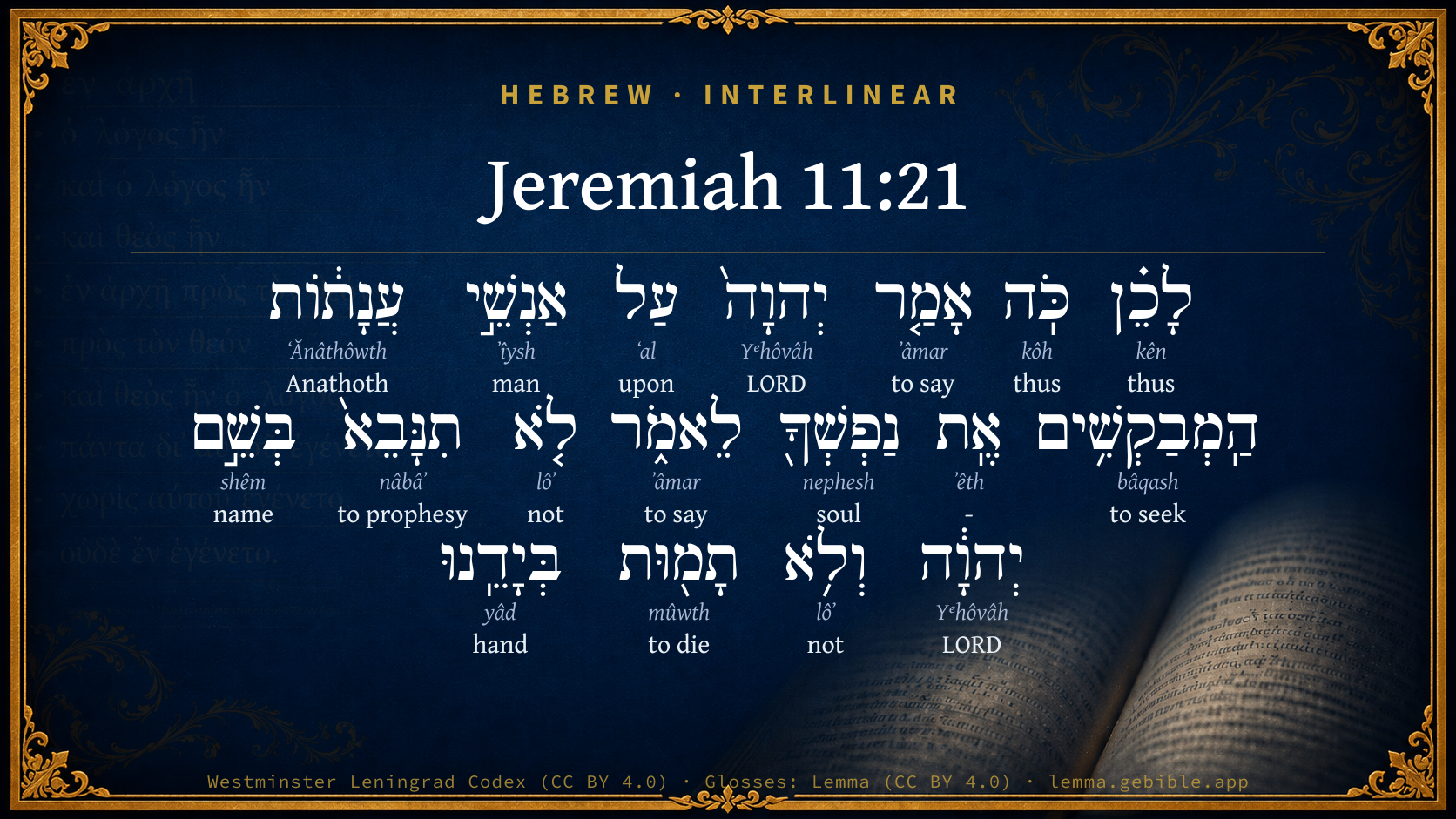
Hebrew (Westminster Leningrad Codex) Jeremiah 11:21 appears in the Hebrew Old Testament. The text above is from the Westminster Leningrad Codex. Each word links to its Strong’s number, a concise gloss, and parsing drawn from the Open Scriptures Hebrew Bible morphology. Click any word for its full Brown-Driver-Briggs (BDB) entry.
Download image
Cite this verse

Jeremiah 11:21 (World English Bible). Public Domain. Lemma interlinear Bible study tool, https://lemma.gebible.app/v/jeremiah/11/21.

Show BibTeX & RIS
BibTeX
RIS
English Translation
Therefore thus says Yahweh concerning the men of Anathoth, who seek your life, saying, You shall not prophesy in the name of Yahweh, that you not die by our hand;
World English Bible · Public Domain
Download a study sheet

One document with this verse’s original text, its word-by-word gloss line, the meaning frame, cross-references with their text, attributed commentary, and full source and license credits — printable, and it pastes into notes with its structure intact.

This verse Autodidact and up

Study sheet (.html) Plain text (.txt)

A passage Seminary Student

Up to 50 verses in one chapter. A passage sheet keeps up to 6 commentary sources and 12 cross-references per verse, in the order this page ranks them, and says so on the sheet whenever that leaves anything out. Ask for a single verse and you get the Autodidact verse sheet above.

Everything on this page stays free to read, with no account — the sheet is a download of what is already on screen, not access to it.

Want to remove ads? Support Godless Engineer
Compare translations 3

The same verse in 3 English versions, stacked beneath the original-language interlinear above. Click any original word for its lexicon entry.

Each is an independent rendering of the whole verse — the interlinear is not word-aligned to these translations.

Highlighted words mark where these versions differ — a whole-verse word diff, not a word-by-word alignment.

  • World English Bible Public Domain
    Therefore thus says Yahweh concerning the men of Anathoth, who seek your life, saying, You shall not prophesy in the name of Yahweh, that you not die by our hand;
  • King James Version Public Domain
    Therefore thus saith the LORD of the men of Anathoth, that seek thy life, saying, Prophesy not in the name of the LORD, that thou die not by our hand:
  • unfoldingWord Literal Text CC BY-SA 4.0
    Therefore thus says Yahweh concerning the men of Anathoth who seeking your life saying, “Do not prophesy in the name of Yahweh, and you will not die by our hand.”

unfoldingWord Literal Text — © unfoldingWord, licensed CC BY-SA 4.0. Word-aligned USFM3 via Door43 (git.door43.org/unfoldingWord/en_ult).

Versions to compare (up to 4)

3 of 4 selected

Show all 18 translations

Every available English version of this verse, each an independent rendering of the whole verse.

  • World English Bible Public Domain
    Therefore thus says Yahweh concerning the men of Anathoth, who seek your life, saying, You shall not prophesy in the name of Yahweh, that you not die by our hand;
  • Berean Standard Bible Public Domain
    Therefore this is what the LORD says concerning the people of Anathoth who are seeking your life and saying, “You must not prophesy in the name of the LORD, or you will die by our hand.”
  • Majority Standard Bible Public Domain
    Therefore this is what the LORD says concerning the people of Anathoth who are seeking your life and saying, “You must not prophesy in the name of the LORD, or you will die by our hand.”
  • King James Version Public Domain
    Therefore thus saith the LORD of the men of Anathoth, that seek thy life, saying, Prophesy not in the name of the LORD, that thou die not by our hand:
  • American Standard Version (1901) Public Domain
    Therefore thus saith Jehovah concerning the men of Anathoth, that seek thy life, saying, Thou shalt not prophesy in the name of Jehovah, that thou die not by our hand;
  • Revised Version (1885) Public Domain
    Therefore thus saith the LORD concerning the men of Anathoth, that seek thy life, saying, Thou shalt not prophesy in the name of the LORD, that thou die not by our hand:
  • Geneva Bible (1599) Public Domain
    The Lord therefore speaketh thus of the men of Anathoth, (that seeke thy life, and say, Prophecie not in the Name of the Lord, that thou die not by our hands)
  • Douay-Rheims (1899) Public Domain
    Therefore thus saith the Lord to the men of Anathoth, who seek thy life, and say: Thou shalt not prophesy in the name of the Lord, and thou shalt not die in our hands.
  • Young's Literal Translation Public Domain
    Therefore, thus said Jehovah concerning the men of Anathoth, who are seeking thy life, saying: Do not prophesy in the name of Jehovah, And thou dost not die by our hands.
  • Literal Standard Version CC BY-SA 4.0
    Therefore, thus said YHWH concerning the men of Anathoth, who are seeking your life, saying, “Do not prophesy in the Name of YHWH, and you do not die by our hands.”
  • Unlocked Literal Bible CC BY-SA 4.0
    Therefore Yahweh says this concerning the people of Anathoth who are seeking your life, “They say, 'You must not prophesy in the name of Yahweh, or you will die by our hand.'
  • unfoldingWord Literal Text CC BY-SA 4.0
    Therefore thus says Yahweh concerning the men of Anathoth who seeking your life saying, “Do not prophesy in the name of Yahweh, and you will not die by our hand.”
  • Darby Bible Public Domain
    Therefore thus saith Jehovah concerning the men of Anathoth, that seek thy life, saying, Prophesy not in the name of Jehovah, that thou die not by our hand,
  • World Messianic Bible Public Domain
    “Therefore the LORD says concerning the men of Anathoth, who seek your life, saying, ‘You shall not prophesy in the LORD’s name, that you not die by our hand’—
  • Webster's Bible Public Domain
    Therefore thus saith the LORD concerning the men of Anathoth, that seek thy life, saying, Prophesy not in the name of the LORD, that thou die not by our hand:
  • Free Bible Version CC BY-SA 4.0
    So this is what the Lord says about the people of Anathoth who are trying to kill you, telling you, “Don't prophesy in the name of the Lord, or we'll kill you.”
  • Bible in Basic English Public Domain
    So this is what the Lord of armies has said about the men of Anathoth who have made designs against your life, saying, You are not to be a prophet in the name of the Lord, or death will overtake you by our hands:
  • JPS Tanakh (1917) Public Domain
    Therefore thus saith the LORD concerning the men of Anathoth, that seek thy life, saying: 'Thou shalt not prophesy in the name of the LORD, that thou die not by our hand';

Literal Standard Version (2020), Covenant Press — licensed CC BY-SA 4.0. Text via the HelloAO Bible API (eBible.org). Unlocked Literal Bible (unfoldingWord) — licensed CC BY-SA 4.0. Text via the HelloAO Bible API (eBible.org). unfoldingWord Literal Text — © unfoldingWord, licensed CC BY-SA 4.0. Word-aligned USFM3 via Door43 (git.door43.org/unfoldingWord/en_ult). Free Bible Version, Dr. Jonathan Gallagher — licensed CC BY-SA 4.0. Text via the HelloAO Bible API (eBible.org).

Word by word

More ways to search: Search by grammar → Find every occurrence → Compare this word →

Practice this passage: Drill this verse → Learn its vocabulary →

עֲנָת֔וֹת
ʻĂnâthôwth
H6068
“Anathoth”
Noun, Proper
Part of Speech
Noun
Type
Proper
Full BDB Definition

Origin: pl. of H6067

TWOT: None

Anathoth = "answers to prayer" - son of Becher and grandson of Benjamin (noun proper masculine) - one of the heads of the people who signed the covenant with Nehemiah (noun proper masculine) - a city of Benjamin allotted to the priest; located approximately 3 miles (5 kilometers) from Jerusalem; birthplace of the prophet Jeremiah (noun proper locative)
  1. לָכֵ֗ן kên H3651 “to/for · thus” Preposition + Adverb
  2. כֹּֽה kôh H3541 “thus” Adverb
  3. אָמַ֤ר ʼâmar H559 “to say” Verb, Qal, Perfect, 3rd Person, Masculine, Singular
  4. יְהוָה֙ Yᵉhôvâh H3068 “LORD” Noun, Proper
  5. עַל ʻal H5921 “upon” Preposition
  6. אַנְשֵׁ֣י ʼîysh H376 “men of” Noun, Common, Masculine, Plural, Construct
  7. הַֽמְבַקְשִׁ֥ים bâqash H1245 “the · seeking” Particle, Definite Article + Verb, Piel, Participle Active, Masculine, Plural, Absolute
  8. אֶֽת ʼêth H853 “-” Particle, Direct Object
  9. נַפְשְׁךָ֖ nephesh H5315 “soul · your” Noun, Common, Both, Singular, Construct + Suffix, Personal, 2nd Person, Masculine, Singular
  10. לֵאמֹ֑ר ʼâmar H559 “to say” Preposition + Verb, Qal, Infinitive Construct
  11. לֹ֤א lôʼ H3808 “not” Particle, Negative
  12. תִנָּבֵא֙ nâbâʼ H5012 “to prophesy” Verb, Niphal, Imperfect, 2nd Person, Masculine, Singular
  13. בְּשֵׁ֣ם shêm H8034 “in/at · name of” Preposition + Noun, Common, Masculine, Singular, Construct
  14. יְהוָ֔ה Yᵉhôvâh H3068 “LORD” Noun, Proper
  15. וְלֹ֥א lôʼ H3808 “and · not” Conjunction + Particle, Negative
  16. תָמ֖וּת mûwth H4191 “to die” Verb, Qal, Imperfect, 2nd Person, Masculine, Singular
  17. בְּיָדֵֽנוּ yâd H3027 “in/at · hand · our” Preposition + Noun, Common, Both, Singular, Construct + Suffix, Personal, 1st Person, Common, Plural

About this verse

These counts appear in no published source. They are computed here, from the morphology-tagged text and Lemma’s own curated glosses. What Lemma adds →

18
words
15
distinct lemmas
Prophets
section

Notable vocabulary

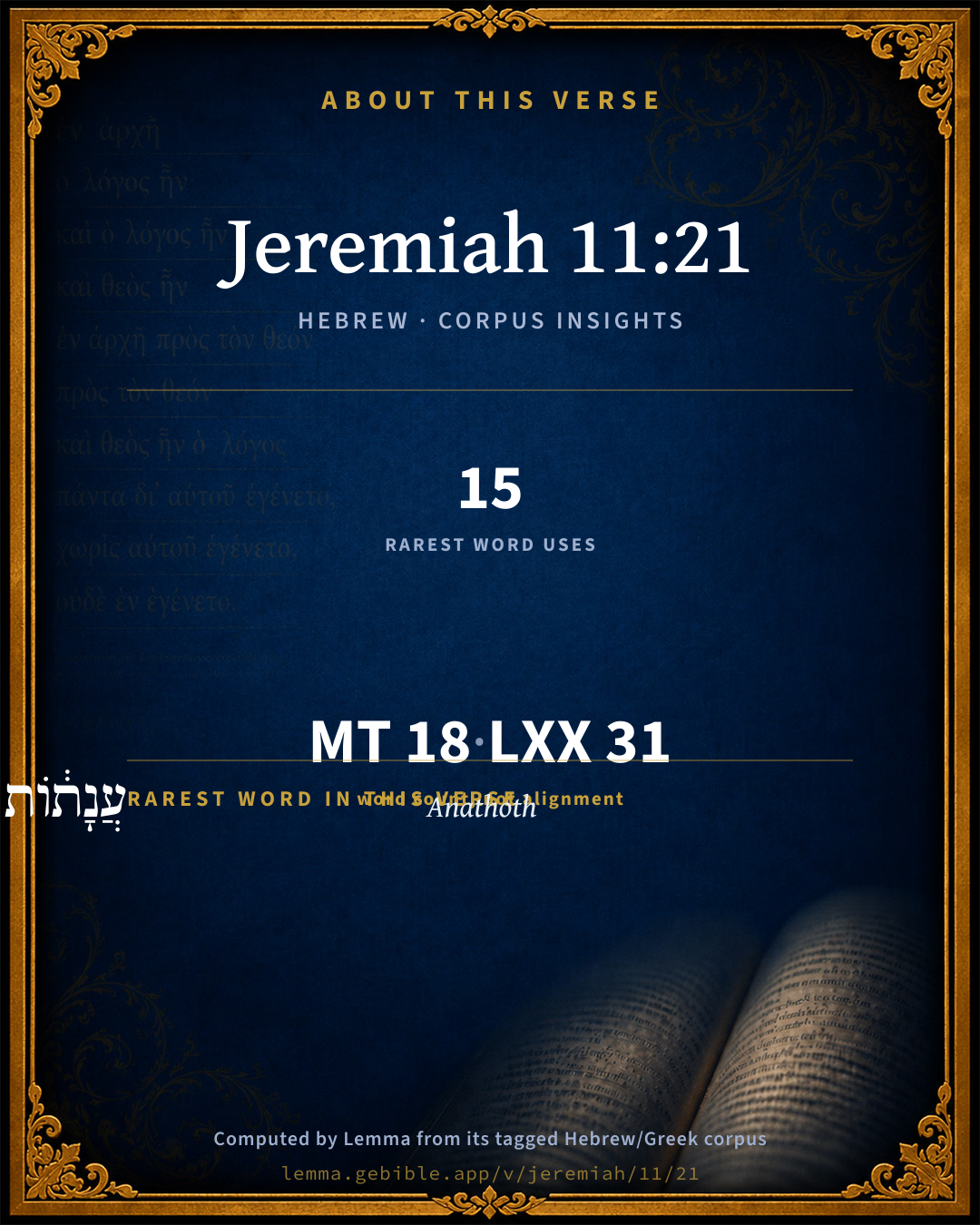
The rarest word here is עֲנָת֔וֹת Anathoth H6068 — appearing just 15 times in the whole Hebrew Bible.

Shared distinctive vocabulary

עֲנָת֔וֹת Anathoth H6068 occurs in 15 verses of the Hebrew Bible. Also found in:

Grammatical profile

  • 5 verbs
  • 7 nouns
  • 1 preposition
  • 2 adverbs
  • 3 particles

Verb forms

  • אָמַ֤ר Qal · Perfect
  • הַֽמְבַקְשִׁ֥ים Piel · Participle Active
  • לֵאמֹ֑ר Qal · Infinitive Construct
  • תִנָּבֵא֙ Niphal · Imperfect
  • תָמ֖וּת Qal · Imperfect

Repetition

Words recur within this verse — often emphatic in Hebrew:

  • אָמַ֤ר to say H559 ×2
  • יְהוָה֙ LORD H3068 ×2
  • לֹ֤א not H3808 ×2

Hebrew & Septuagint length

In the original languages it is 18 Hebrew tokens and 31 Greek tokens — but the two are counted differently (Hebrew bundles its prefixes and suffixes into one token; the Greek is in lemma form), so that isn’t a like-for-like length.

Cross-references

18

Topical passages linked to Jeremiah 11:21 in the Treasury of Scripture Knowledge — connected by theme and wording, ordered by reader-vote popularity; previews shown in the World English Bible.

  • Isaiah 30:10 who tell the seers, "Don't see;" and to the prophets, "Don't prophesy to us right things, speak to us smooth things, prophesy deceits,
  • Jeremiah 12:5–6 If you have run with the footmen, and they have wearied you, then how can you contend with horses? and though in a land of peace you are secure, yet how will you do in the pride of the Jordan?
  • Jeremiah 20:10 For I have heard the defaming of many, terror on every side. Denounce, and we will denounce him, [say] all my familiar friends, those who watch for my fall; peradventure he will be persuaded, and we shall prevail against him, and we shall take our revenge on him.
  • Amos 2:12 "But you gave the Nazirites wine to drink, And commanded the prophets, saying, 'Don't prophesy!'
  • Luke 13:33–34 Nevertheless I must go on my way today and tomorrow and the next day, for it can't be that a prophet perish outside of Jerusalem.'
  • Jeremiah 20:1–2 Now Pashhur, the son of Immer the priest, who was chief officer in the house of Yahweh, heard Jeremiah prophesying these things.
  • Jeremiah 26:8 It happened, when Jeremiah had made an end of speaking all that Yahweh had commanded him to speak to all the people, that the priests and the prophets and all the people laid hold on him, saying, You shall surely die.
  • Jeremiah 38:1–6 Shephatiah the son of Mattan, and Gedaliah the son of Pashhur, and Jucal the son of Shelemiah, and Pashhur the son of Malchijah, heard the words that Jeremiah spoke to all the people, saying,
  • Amos 7:13–16 but don't prophesy again any more at Bethel; for it is the king's sanctuary, and it is a royal house!"
  • Micah 2:6–11 "Don't you prophesy!" They prophesy. "Don't prophesy about these things. Disgrace won't overtake us."
  • Micah 7:6 For the son dishonors the father, The daughter rises up against her mother, The daughter-in-law against her mother-in-law; A man's enemies are the men of his own house.
  • Matthew 10:21 "Brother will deliver up brother to death, and the father his child. Children will rise up against parents, and cause them to be put to death.
  • Matthew 10:34–36 "Don't think that I came to send peace on the earth. I didn't come to send peace, but a sword.
  • Matthew 21:35 The farmers took his servants, beat one, killed another, and stoned another.
  • Matthew 22:6 and the rest grabbed his servants, and treated them shamefully, and killed them.
  • Matthew 23:34–37 Therefore, behold, I send to you prophets, wise men, and scribes. Some of them you will kill and crucify; and some of them you will scourge in your synagogues, and persecute from city to city;
  • Luke 4:24 He said, "Most assuredly I tell you, no prophet is acceptable in his hometown.
  • Acts 7:51–52 "You stiff-necked and uncircumcised in heart and ears, you always resist the Holy Spirit! As your fathers did, so you do.

Cross-references courtesy of OpenBible.info (CC BY 4.0).

Hebrew and Greek witnesses Masoretic Hebrew ↔ Greek Septuagint

The same verse in the two great witnesses to the Old Testament, shown verse-for-verse.

These are two independent witnesses, not word-aligned to each other, and the Septuagint is shown in lemma (dictionary) form.

Hebrew Jeremiah 11:21 Masoretic · Westminster Leningrad Codex

לָכֵ֗ן כֹּֽה אָמַ֤ר יְהוָה֙ עַל אַנְשֵׁ֣י עֲנָת֔וֹת הַֽמְבַקְשִׁ֥ים אֶֽת נַפְשְׁךָ֖ לֵאמֹ֑ר לֹ֤א תִנָּבֵא֙ בְּשֵׁ֣ם יְהוָ֔ה וְלֹ֥א תָמ֖וּת בְּיָדֵֽנוּ

Therefore thus says Yahweh concerning the men of Anathoth, who seek your life, saying, You shall not prophesy in the name of Yahweh, that you not die by our hand;

World English Bible · Public Domain

Greek LXX Structure differs

In the Septuagint, Jeremiah is about an eighth shorter than the Hebrew and arranges its material differently — the Oracles Against the Nations (Hebrew chapters 46–51) appear in the middle of the Greek book, after 25:13. Because the chapter and verse boundaries do not line up, a verse-for-verse comparison with the Hebrew is not shown.

A verse-for-verse comparison isn’t shown here because the chapters and verses don’t line up. Switch to the LXX edition with the MT / LXX toggle above to read the Greek directly.

Hebrew: Westminster Leningrad Codex (CC BY 4.0). Greek: Septuagint (public domain); English from a public-domain English Septuagint. How the Septuagint differs from the Hebrew →

Targum (Aramaic paraphrase)

1

The Targum is the ancient Jewish Aramaic paraphrase of the Hebrew Scriptures — an interpretive translation, not the Hebrew text itself. Onkelos (literal) and Pseudo-Jonathan (expansive) render the Torah, and Jonathan the Prophets. Coverage is partial: where no permissively-licensed English translation exists for a verse, only the Aramaic is shown. This is verse-level text, not a word-by-word alignment to the Hebrew.

  1. Targum Jonathan Prophets (Joshua–Malachi)
    בְכֵן כִּדְנַן אֲמַר יְיָ עַל אֱנָשֵׁי דְבָעָן לְמִקְטְלָךְ דְאָמְרִין לָא תִתְנַבֵּי בִּשְׁמָא דַייָ וְלָא תְמוּת בִּידָנָא:

    (no public-domain English translation for this verse)

    Targum Jonathan — Aramaic: “Mikraot Gedolot” (public domain). English: “Sefaria Community Translation” (CC0 1.0 (public-domain dedication)); “London "Chaldee Paraphrase," 1871” (public domain). Text via Sefaria.

Commentary

Notes on Jeremiah 11:21 from classic Christian and Jewish commentators (each source and its license shown beneath its notes). The classic Christian expositions comment on the surrounding passage and are grouped to its opening verse, so a note may address several verses; the Jewish commentaries on the Tanakh (Rashi and others) are per-verse, so they appear only where the commentator wrote on this verse.

Lemma curates 59 commentaries, every one of them public domain or Creative Commons licensed, each selected and text-cleaned for this edition rather than reprinted as found. About our sources →

Trapp's Complete Commentary

John Trapp

Jer 11:21 Therefore thus saith the LORD of the men of Anathoth, that seek thy life, saying, Prophesy not in the name of the LORD, that thou die not by our hand:

Ver. 21. Of the men of Anathoth that seek thy life.] Where shall a man find worse friends than at home? A prophet is nowhere so little set by as in his own country. {Mat 13:57} Probatissimuset optimus quisque peregre vivit, saith Ennius, in Cicero. {a}

Saying, Prophesy not in the name of the Lord.] A desperate speech, proceeding from a height of hatred, and coasting upon the unpardonable sin.

{a} Epist. Famil., lib. vii. cap. 6.

John Trapp, A Commentary or Exposition upon All the Books of the Old and New Testament (1647–1656) — public domain. Text from a community e-Sword module.

The Biblical Illustrator

Joseph S. Exell

Jer_11:21

Prophesy not in the name of the Lord, that thou die not by our hand.

Intimidating the prophet

Think of Bunyan when he is brought before the judge, and the judge says, You! a tinker! to go about preaching! Hold your tongue, sir! I cannot hold my tongue, says Bunyan. Then I must send you back to prison unless you promise never to preach again. If you put me in prison till the moss grows on my eyelids, I will preach again the first moment I get out, by the help of God. (Life of John Bunyan.)

Intimidators put to silence:--There is the story of a conversation between the burgomaster in Hamburg and holy Dr. Ducken when he first began to preach. The burgomaster said to him, Do you see that little finger, sir? While I can move that little finger, I will put the Baptists down. Mr. Ducken said, With all respect to your little finger, Mr. Burgomaster, I would ask you another question. Do you see that arm? No, I do not see it. Just so, said Mr. Ducken, but I do; and while that great arm moves, you cannot put us down, and if it comes to a conflict between your little finger and that great arm, I know how it will end. It was my great joy to see the burgomaster sitting in the chapel at Hamburg, among the audience that listened to my sermon at the opening of the new chapel. The little finger had willingly given up its opposition, and the great arm was made bare. (C. H. Spurgeon.)

.

The Biblical Illustrator, edited by Joseph S. Exell (c. 1880s–1900s) — public domain. Text from a community e-Sword module.

Joseph Benson's Commentary

Jer 11:21. Thus saith the Lord of the men that seek thy life — That are combined to kill thee; saying, Prophesy not in the name of the Lord —

The meaning is, that those men of Anathoth threatened that they would kill him if he did not cease to prophesy such things as he did in the name of the Lord, namely, concerning the destruction of Jerusalem, the desolation of Judea, and the carrying away of the people into captivity. For if he had spoken falsely in the name of the Lord, and promised them peace and prosperity, they would have heard him prophesy gladly: they were thus exasperated at him, and opposed his prophesying, because he told them those truths which they had no mind to hear. This passage sufficiently shows that Jeremiah is to be understood in the literal sense here, which, however, does not by any means forbid our considering him in this instance as a type of Christ, and prefiguring, by his sufferings, those of the Redeemer of mankind. It manifests also the usage which the prophets generally met with from their own countrymen, who became their enemies because they told them the truth. The people of their own towns, even their friends and relations, could not bear to hear the solemn warnings which they gave them, and the prediction of those judgments which were coming upon them for their sins.

Joseph Benson's Commentary on the Old and New Testaments (1811–1818) — public domain. Text from a community e-Sword module.

Tyndale Open Study Notes

Tyndale Open Resources

11:21-23 Jeremiah’s enemies even included family and relatives in his hometown of Anathoth, over whose fate he grieved (10:20). They demanded that he should stop prophesying in the Lord’s name. In line with the Lord’s promise to take care of him (1:19), the Lord told Jeremiah that even the families of his foes, including their boys and girls, would lose their lives when their time of punishment came.

Tyndale Open Study Notes — © Tyndale Open Resources, licensed CC BY-SA 4.0. Text via the HelloAO Bible API.

Geneva Bible (1599)

Geneva Bible translators

To wit, both the Priests and the rest of the people: for this town was the Priests, and they dwelt in it, read Jer. 1:1.

Not that they could not abide to hear God named: (for herein they would show themselves most holy) but because they could not abide to be sharply reproved, and therefore desired to be flattered, Isa. 30:10, and to be maintained in their pleasures, Mic. 2:11, and not to hear vice condemned, Amos 7:12.

Geneva Bible (1599) marginal notes — public domain. Text via Bolls.life.

Jamieson, Fausset & Brown

Robert Jamieson, A. R. Fausset & David Brown

Prophesy not-- (Isa 30:10; Amo 2:12; Mic 2:6). If Jeremiah had not uttered his denunciatory predictions, they would not have plotted against him. None were more bitter than his own fellow townsmen. Compare the conduct of the Nazarites towards Jesus of Nazareth (Luk 4:24-29).

Jamieson, Fausset & Brown — Commentary Critical and Explanatory on the Whole Bible (1871) — public domain (CC PDM 1.0). Text via the HelloAO Bible API.

John Calvin's Commentaries

The Prophet here expressly denounces vengeance on his own people: for we have seen at the beginning of this book that he belonged to the town of Anathoth. Now it appears from this passage, that the holy man had not only to contend with the king and his courtiers, and the priests, who were at Jerusalem; but that when he betook himself to a corner to live quietly with his own people, he had even there no friend, but that all persecuted him as an enemy. We hence see how miserable was the condition of the Prophet; for he had no rest, even when he sought retirement and fled to his own country. That he was not safe even there, is a proof to us how hardly God exercised and tried him for the many years in which he performed his prophetic office.

As the citizens of Anathoth had grievously sinned, so he denounces on them an especial calamity. It is indeed certain that the Prophet was not kindly received at Jerusalem; nay, he met there, as we shall hereafter see, with enemies the most cruel: but when he hoped for some rest and relaxation in his own country, he was even there received as we find here. This is the reason why God commanded him to threaten the citizens of Anathoth with destruction. I cannot finish the whole today.

John Calvin's Commentaries (1540-1563) — public domain. Text from the Calvin Translation Society English edition (1840s-50s) via the Christian Classics Ethereal Library (ccel.org). Calvin's coverage is partial (roughly two-thirds of the Bible); uncommented books and verses are honest gaps, never fabricated. The 19th-century editor's footnotes and remarks are omitted so the notes are faithfully Calvin's own voice.

Ellicott's Commentary for English Readers

(21) Thus saith the Lord.—The “men of Anathoth,” it would seem, had at first tried to stop the preaching of Jeremiah by threats, as Amaziah, the priest of Bethel, had tried to stop that of Amos (Amo_7:12-13). Failing in this, after the manner of the men of Nazareth in their attack on the Christ (Luk_4:28-29), and of the later Jews in their dealings with St. Paul, they conspired against his life (Act_9:23; Act_9:29; Act_14:19; Act_23:12).

A Bible Commentary for English Readers, edited by Charles John Ellicott (1878–1897) — public domain. Text from a community e-Sword module.

John Gill's Exposition

Therefore thus saith the Lord of hosts, behold, I will punish them,..... Or, visit "them" (r); look into this matter, try this cause, bring it to an issue, and pass sentence on them; which is as follows:

the young men shall die by the sword; by the sword of the Chaldeans, in the field, going out in battle against them; or rather when their town was taken and plundered, since they were the sons of priests:

their sons and their daughters shall die by famine; that is, their little ones, male and female; so that the famine, it seems, was not only in Jerusalem at the time of its siege, but in other parts also: no mention is made of the parents themselves.

(r) "visitans super eos", Montanus, Schmidt; "visito", Pagninus, Vatablus, Cocceius.

John Gill's Exposition of the Whole Bible (1746–1763) — public domain (CC PDM 1.0). Text via the HelloAO Bible API.

Haydock's Catholic Bible Commentary

Life. What precedes, was spoken concerning the prophet, though it regarded Christ also in a proper but more elevated sense. (Calmet)

George Leo Haydock (1774–1849), Haydock's Catholic Family Bible and Commentary, 1859 edition — public domain. Excludes Psalms (Douay-Rheims chapter numbering differs from Protestant) and Deuterocanonical books (Catholic canon only).

The Pulpit Commentary

Prophesy not, etc. The men of Anathoth tried first of all to effect their object by threatening. In the name of the Lord should be rather, by the name, etc. The phrase is exactly parallel to Psa_55:1, "Save me, O God, by thy Name, and judge me by thy strength." The Name of God is equivalent to his revealed presence or personality. Baal"s prophets prophesied "by Baal", (Jer_2:8) i.e. by an impulse thought to proceed from Baal; Jehovah"s by the consciousness of his revealed presence.

The Pulpit Commentary (1880–1919), ed. H.D.M. Spence-Jones & Joseph S. Exell — public domain. Text from a community e-Sword module.

unfoldingWord translationNotes

Door43 World Missions Community

Anathoth

This is the name of a special city where priests live. (See: How to Translate Names)

seeking your life

This phrase represents wanting or trying to kill someone. AT: "wanting to kill you" (See: Metaphor)

They say

"They say to me." The men are speaking to Jeremiah.

you will die by our hand

Here the men refer to their "hand" to emphasize that they plan to kill him themselves. AT: "we ourselves will kill you" (See: Synecdoche)

Yahweh of hosts says this

Jeremiah often uses these words to introduce an important message from Yahweh. See how you translated this in Jeremiah 6:6.

See

This word is used here to draw someone's attention to what is said next. AT: "Listen"

vigorous young men

men at the strongest time of their lives

will die by the sword

Here the "sword" represents battle. AT: "will die in battle" (See: Metonymy)

None of them will be left

This can be stated in active form. AT: "I will leave none of them" (See: Active or Passive)

a year of their punishment

The word "year" here is a idiom that describes a specific period of time that Yahweh decides. AT: "in the time of their punishment" or "for the time of their punishment is coming" (See: Idiom)

translationWords

prophet

die

hand

punish

sword

famine

unfoldingWord translationNotes — © Distant Shores Media and the Door43 World Missions Community, licensed CC BY-SA 4.0. Source: git.door43.org/Door43/en_tn.

Lesson kit

Teaching starters — assembled from the data on this page, not authored interpretation. Every prompt links to the verse data it draws on. Edit before teaching.

Jeremiah, in the Prophets, opens this verse with 18 words (15 distinct Hebrew lemmas). Its most distinctive word is ʻĂnâthôwth (“Anathoth”). A historical commentator’s framing appears above. Read the whole chapter for the surrounding context.

Discussion questions

  1. What does “Anathoth” (ʻĂnâthôwth) contribute to the verse as a whole?
  2. Joshua 21:18 shares the word «Anathoth» with this verse. How do the two illuminate each other?
  3. “to say” occurs 2× in this one verse. What is the effect of the repetition?
  4. These translations render this verse differently. What is at stake in choosing one wording over another?
  5. The verb «אָמַ֤ר» is Qal Perfect. How does its form color the action?
  6. Reading how Trapp's Complete Commentary and The Biblical Illustrator read this verse, where do the two commentators agree and where do they part?

Things to notice

Reading settings

Reading text

Shown beneath each verse's original-language words.

Old Testament
Old Testament edition

Read the OT as the Masoretic Hebrew (MT) or the Greek Septuagint (LXX).

English shown for the Greek Septuagint (in the Hebrew ↔ Greek comparison).

Comparing translations? Open the Compare panel on any verse page to stack up to four side by side.