
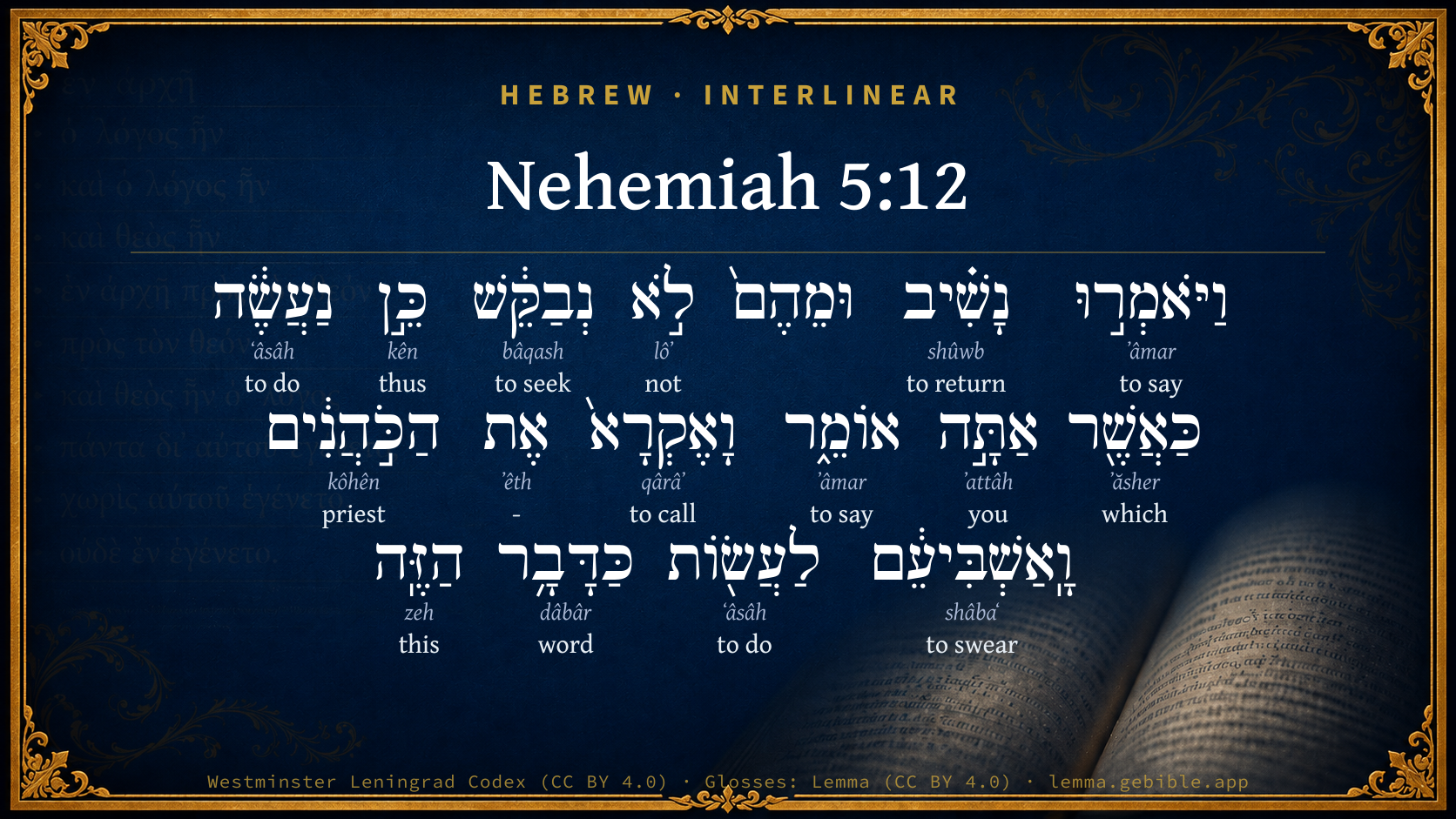
Nehemiah 5:12

Hebrew (Westminster Leningrad Codex) Nehemiah 5:12 appears in the Hebrew Old Testament. The text above is from the Westminster Leningrad Codex. Each word links to its Strong’s number, a concise gloss, and parsing drawn from the Open Scriptures Hebrew Bible morphology. Click any word for its full Brown-Driver-Briggs (BDB) entry.
Download image
Cite this verse

Nehemiah 5:12 (World English Bible). Public Domain. Lemma interlinear Bible study tool, https://lemma.gebible.app/v/nehemiah/5/12.

Show BibTeX & RIS
BibTeX
RIS
English Translation
Then said they, We will restore them, and will require nothing of them; so will we do, even as you say. Then I called the priests, and took an oath of them, that they would do according to this promise.
World English Bible · Public Domain
Download a study sheet

One document with this verse’s original text, its word-by-word gloss line, the meaning frame, cross-references with their text, attributed commentary, and full source and license credits — printable, and it pastes into notes with its structure intact.

This verse Autodidact and up

Study sheet (.html) Plain text (.txt)

A passage Seminary Student

Up to 50 verses in one chapter. A passage sheet keeps up to 6 commentary sources and 12 cross-references per verse, in the order this page ranks them, and says so on the sheet whenever that leaves anything out. Ask for a single verse and you get the Autodidact verse sheet above.

Everything on this page stays free to read, with no account — the sheet is a download of what is already on screen, not access to it.

Want to remove ads? Support Godless Engineer
Compare translations 3

The same verse in 3 English versions, stacked beneath the original-language interlinear above. Click any original word for its lexicon entry.

Each is an independent rendering of the whole verse — the interlinear is not word-aligned to these translations.

Highlighted words mark where these versions differ — a whole-verse word diff, not a word-by-word alignment.

  • World English Bible Public Domain
    Then said they, We will restore them, and will require nothing of them; so will we do, even as you say. Then I called the priests, and took an oath of them, that they would do according to this promise.
  • King James Version Public Domain
    Then said they, We will restore them, and will require nothing of them; so will we do as thou sayest. Then I called the priests, and took an oath of them, that they should do according to this promise.
  • unfoldingWord Literal Text CC BY-SA 4.0
    And they said, “We will return, and we will seek nothing from them. Thus we will do according to what you say.” And I called the priests, and I caused them to swear to do according to this word.

unfoldingWord Literal Text — © unfoldingWord, licensed CC BY-SA 4.0. Word-aligned USFM3 via Door43 (git.door43.org/unfoldingWord/en_ult).

Versions to compare (up to 4)

3 of 4 selected

Show all 18 translations

Every available English version of this verse, each an independent rendering of the whole verse.

  • World English Bible Public Domain
    Then said they, We will restore them, and will require nothing of them; so will we do, even as you say. Then I called the priests, and took an oath of them, that they would do according to this promise.
  • Berean Standard Bible Public Domain
    “We will restore it,” they replied, “and will require nothing more from them. We will do as you say.” So I summoned the priests and required of the nobles and officials an oath that they would do what they had promised.
  • Majority Standard Bible Public Domain
    “We will restore it,” they replied, “and will require nothing more from them. We will do as you say.” So I summoned the priests and required of the nobles and officials an oath that they would do what they had promised.
  • King James Version Public Domain
    Then said they, We will restore them, and will require nothing of them; so will we do as thou sayest. Then I called the priests, and took an oath of them, that they should do according to this promise.
  • American Standard Version (1901) Public Domain
    Then said they, We will restore them, and will require nothing of them; so will we do, even as thou sayest. Then I called the priests, and took an oath of them, that they would do according to this promise.
  • Revised Version (1885) Public Domain
    Then said they, We will restore them, and will require nothing of them; so will we do, even as thou sayest. Then I called the priests, and took an oath of them, that they should do according to this promise.
  • Geneva Bible (1599) Public Domain
    Then said they, We will restore it, and will not require it of them: we will doe as thou hast said. Then I called the Priestes, and caused them to sweare, that they shoulde doe according to this promise.
  • Douay-Rheims (1899) Public Domain
    And they said: We will restore, and we will require nothing of them: and we will do as thou sayest. And I called the priests and took an oath of them, to do according to what I had said.
  • Young's Literal Translation Public Domain
    And they say, `We give back, and of them we seek nothing; so we do as thou art saying.' And I call the priests, and cause them to swear to do according to this thing;
  • Literal Standard Version CC BY-SA 4.0
    And they say, “We give back, and we seek nothing from them; so we do as you are saying.” And I call the priests, and cause them to swear to do according to this thing;
  • Unlocked Literal Bible CC BY-SA 4.0
    Then they said, “We will return what we took from them, and will require nothing from them. We will do as you say.” Then I called the priests, and made them swear to do as they had promised.
  • unfoldingWord Literal Text CC BY-SA 4.0
    And they said, “We will return, and we will seek nothing from them. Thus we will do according to what you say.” And I called the priests, and I caused them to swear to do according to this word.
  • Darby Bible Public Domain
    And they said, We will restore [them], and will require nothing of them; so will we do, as thou hast said. And I called the priests, and took an oath of them, that they should do according to this promise.
  • World Messianic Bible Public Domain
    Then they said, “We will restore them, and will require nothing of them. We will do so, even as you say.” Then I called the priests, and took an oath of them, that they would do according to this promise.
  • Webster's Bible Public Domain
    Then said they, We will restore them, and will require nothing of them; so will we do as thou sayest. Then I called the priests, and took an oath of them, that they would do according to this promise.
  • Free Bible Version CC BY-SA 4.0
    “We will give it back,” they replied, “and we won't demand anything more from them. We'll do as you say.” So I summoned the priests and made the nobles and officials swear an oath that they'd do what they had promised.
  • Bible in Basic English Public Domain
    Then they said, We will give them back, and take nothing for them; we will do as you say. Then I sent for the priests and made them take an oath that they would keep this agreement.
  • JPS Tanakh (1917) Public Domain
    Then said they: 'We will restore them, and will require nothing of them; so will we do, even as thou sayest.' Then I called the priests, and took an oath of them, that they should do according to this promise.

Literal Standard Version (2020), Covenant Press — licensed CC BY-SA 4.0. Text via the HelloAO Bible API (eBible.org). Unlocked Literal Bible (unfoldingWord) — licensed CC BY-SA 4.0. Text via the HelloAO Bible API (eBible.org). unfoldingWord Literal Text — © unfoldingWord, licensed CC BY-SA 4.0. Word-aligned USFM3 via Door43 (git.door43.org/unfoldingWord/en_ult). Free Bible Version, Dr. Jonathan Gallagher — licensed CC BY-SA 4.0. Text via the HelloAO Bible API (eBible.org).

Word by word

More ways to search: Search by grammar → Find every occurrence → Compare this word →

Practice this passage: Drill this verse → Learn its vocabulary →

וָֽאַשְׁבִּיעֵ֔ם
shâbaʻ
H7650
“and · to swear · them”
Conjunction + Verb, Hiphil, Sequential Imperfect, 1st Person, Common, Singular + Suffix, Personal, 3rd Person, Masculine, Plural
Part of Speech
Conjunction + Verb
Stem
Hiphil
Form
Sequential Imperfect
Person
1st Person
Gender
Common
Number
Singular
Full BDB Definition

Origin: a primitive root

TWOT: 2318

to swear, adjure - (Qal) sworn (participle) - (Niphal) - to swear, take an oath - to swear (of Jehovah by Himself) - to curse - (Hiphil) - to cause to take an oath - to adjure
  1. וַיֹּאמְר֣וּ ʼâmar H559 “and · to say” Conjunction + Verb, Qal, Sequential Imperfect, 3rd Person, Masculine, Plural
  2. נָשִׁ֗יב shûwb H7725 “to return” Verb, Hiphil, Imperfect, 1st Person, Common, Plural
  3. לֹ֣א lôʼ H3808 “not” Particle, Negative
  4. נְבַקֵּ֔שׁ bâqash H1245 “to seek” Verb, Piel, Imperfect, 1st Person, Common, Plural
  5. כֵּ֣ן kên H3651 “thus” Particle, Demonstrative
  6. נַעֲשֶׂ֔ה ʻâsâh H6213 “to do” Verb, Qal, Imperfect, 1st Person, Common, Plural
  7. כַּאֲשֶׁ֖ר ʼăsher H834 “like/as · which” Preposition + Particle, Relative
  8. אַתָּ֣ה ʼattâh H859 “you” Pronoun, Personal, 2nd Person, Masculine, Singular
  9. אוֹמֵ֑ר ʼâmar H559 “saying” Verb, Qal, Participle Active, Masculine, Singular, Absolute
  10. וָאֶקְרָא֙ qârâʼ H7121 “and · to call” Conjunction + Verb, Qal, Sequential Imperfect, 1st Person, Common, Singular
  11. אֶת ʼêth H853 “-” Particle, Direct Object
  12. הַכֹּ֣הֲנִ֔ים kôhên H3548 “the · priests” Particle, Definite Article + Noun, Common, Masculine, Plural, Absolute
  13. לַעֲשׂ֖וֹת ʻâsâh H6213 “to do” Preposition + Verb, Qal, Infinitive Construct
  14. כַּדָּבָ֥ר dâbâr H1697 “like/as the · word” Preposition, Determined + Noun, Common, Masculine, Singular, Absolute
  15. הַזֶּֽה zeh H2088 “the · this” Particle, Definite Article + Pronoun, Demonstrative, Masculine, Singular

About this verse

These counts appear in no published source. They are computed here, from the morphology-tagged text and Lemma’s own curated glosses. What Lemma adds →

17
words
14
distinct lemmas
Historical
section

Grammatical profile

  • 8 verbs
  • 2 nouns
  • 2 pronouns
  • 1 preposition
  • 4 particles

Verb forms

  • וַיֹּאמְר֣וּ Qal · Sequential Imperfect
  • נָשִׁ֗יב Hiphil · Imperfect
  • נְבַקֵּ֔שׁ Piel · Imperfect
  • נַעֲשֶׂ֔ה Qal · Imperfect
  • אוֹמֵ֑ר Qal · Participle Active
  • וָאֶקְרָא֙ Qal · Sequential Imperfect
  • וָֽאַשְׁבִּיעֵ֔ם Hiphil · Sequential Imperfect
  • לַעֲשׂ֖וֹת Qal · Infinitive Construct

Repetition

Words recur within this verse — often emphatic in Hebrew:

  • וַיֹּאמְר֣וּ to say H559 ×2
  • נַעֲשֶׂ֔ה to do H6213 ×2

Cross-references

13

Topical passages linked to Nehemiah 5:12 in the Treasury of Scripture Knowledge — connected by theme and wording, ordered by reader-vote popularity; previews shown in the World English Bible.

  • Ezra 10:5 Then arose Ezra, and made the chiefs of the priests, the Levites, and all Israel, to swear that they would do according to this word. So they swore.
  • Jeremiah 34:8–10 The word that came to Jeremiah from Yahweh, after that the king Zedekiah had made a covenant with all the people who were at Jerusalem, to proclaim liberty to them;
  • 2 Kings 23:2–3 The king went up to the house of Yahweh, and all the men of Judah and all the inhabitants of Jerusalem with him, and the priests, and the prophets, and all the people, both small and great: and he read in their ears all the words of the book of the covenant which was found in the house of Yahweh.
  • 2 Chronicles 6:22–23 If a man sin against his neighbor, and an oath is laid on him to cause him to swear, and he comes and swears before your altar in this house;
  • 2 Chronicles 15:13–14 and that whoever would not seek Yahweh, the God of Israel, should be put to death, whether small or great, whether man or woman.
  • 2 Chronicles 28:14–15 So the armed men left the captives and the spoil before the princes and all the assembly.
  • Ezra 10:12 Then all the assembly answered with a loud voice, As you have said concerning us, so must we do.
  • Nehemiah 10:29 They joined with their brothers, their nobles, and entered into a curse, and into an oath, to walk in God's law, which was given by Moses the servant of God, and to observe and do all the commandments of Yahweh our Lord, and his ordinances and his statutes;
  • Nehemiah 10:31 and if the peoples of the land bring wares or any grain on the Sabbath day to sell, that we would not buy of them on the Sabbath, or on a holy day; and that we would forego the seventh year, and the exaction of every debt.
  • Nehemiah 13:25 I contended with them, and cursed them, and struck certain of them, and plucked off their hair, and made them swear by God, [saying], You shall not give your daughters to their sons, nor take their daughters for your sons, or for yourselves.
  • Matthew 19:21–22 Jesus said to him, "If you want to be perfect, go, sell what you have, and give to the poor, and you will have treasure in heaven; and come, follow me."
  • Matthew 26:63 But Jesus held his peace. The high priest answered him, "I adjure you by the living God, that you tell us whether you are the Christ, the Son of God."
  • Luke 19:8 Zacchaeus stood and said to the Lord, "Behold, Lord, half of my goods I give to the poor. If I have wrongfully exacted anything of anyone, I restore four times as much."

Cross-references courtesy of OpenBible.info (CC BY 4.0).

Hebrew and Greek witnesses Masoretic Hebrew ↔ Greek Septuagint

The same verse in the two great witnesses to the Old Testament, shown verse-for-verse.

These are two independent witnesses, not word-aligned to each other, and the Septuagint is shown in lemma (dictionary) form.

Hebrew Nehemiah 5:12 Masoretic · Westminster Leningrad Codex

וַיֹּאמְר֣וּ נָשִׁ֗יב וּמֵהֶם֙ לֹ֣א נְבַקֵּ֔שׁ כֵּ֣ן נַעֲשֶׂ֔ה כַּאֲשֶׁ֖ר אַתָּ֣ה אוֹמֵ֑ר וָאֶקְרָא֙ אֶת הַכֹּ֣הֲנִ֔ים וָֽאַשְׁבִּיעֵ֔ם לַעֲשׂ֖וֹת כַּדָּבָ֥ר הַזֶּֽה

Then said they, We will restore them, and will require nothing of them; so will we do, even as you say. Then I called the priests, and took an oath of them, that they would do according to this promise.

World English Bible · Public Domain

Greek LXX Structure differs

The Septuagint has no separate book of Nehemiah. Its Greek text is the second half of Esdras B (2 Esdras), chapters 11–23; Ezra is the first half (1–10).

A verse-for-verse comparison isn’t shown here because the chapters and verses don’t line up. Switch to the LXX edition with the MT / LXX toggle above to read the Greek directly.

Hebrew: Westminster Leningrad Codex (CC BY 4.0). Greek: Septuagint (public domain); English from a public-domain English Septuagint. How the Septuagint differs from the Hebrew →

Commentary

Notes on Nehemiah 5:12 from classic Christian and Jewish commentators (each source and its license shown beneath its notes). The classic Christian expositions comment on the surrounding passage and are grouped to its opening verse, so a note may address several verses; the Jewish commentaries on the Tanakh (Rashi and others) are per-verse, so they appear only where the commentator wrote on this verse.

Lemma curates 59 commentaries, every one of them public domain or Creative Commons licensed, each selected and text-cleaned for this edition rather than reprinted as found. About our sources →

Trapp's Complete Commentary

John Trapp

Neh 5:12 Then said they, We will restore [them], and will require nothing of them; so will we do as thou sayest. Then I called the priests, and took an oath of them, that they should do according to this promise.

Ver. 12. Then said they, We will restore them] This was well said; and Nehemiah took course it should be as well done, ne dicta factis erubescerent, as Tertullian phraseth it; that their saying and doing might he alike.

And will require nothing of them] But be of those that lend, looking for nothing again, no, not the principal, Luk 6:35.

So will we do as thou sayest] Denying ourselves, and all worldly lusts, that we may get and keep a good conscience, that most precious jewel that ever the heart of man was acquainted with.

Then I called the priests] As fittest to tender so solemn an oath, and to bear witness in a case of that nature.

And took an oath of them] That is, of them that had promised restitution; that they might not start back, nor repent them of their good resolutions. Our hearts are deceitful, and must be by all good means held up to duty, Quo teneas vultus mutantem Protea nodo? else they will slip collar, as those slippery Jews, Jer 34:10-11, retracted and repealed their vow. It was therefore well and wisely done of Nehemiah to bind them thus to the good behavior; as Asa and Josiah had done before him. An oath is a hedge which a man may not break; which yet that great deviate of Rome maketh a sport of. For when the cardinals meet to choose a new pope, they make him swear to certain articles. And Sleydan saith, that no sooner is he chosen but he breaks them all, and checks their insolencies, as if they went about to limit his power, to whom all power is given in heaven and earth. Is not this that ανομος, that lawless, yokeless, masterless monster St Paul speaketh of; 2Th 2:8.

John Trapp, A Commentary or Exposition upon All the Books of the Old and New Testament (1647–1656) — public domain. Text from a community e-Sword module.

Joseph Benson's Commentary

Neh 5:12. Then said they, We will restore them — Namely, the houses and lands; and require nothing — Demand no interest. Thus he got a promise from them, and proceeded afterward to bring them under the obligation of an oath to do as they had promised. Then I called the priests — As witnesses; that the oath being taken before the priests, who acted in God’s name, it might make the more deep and durable impression upon their consciences.

Joseph Benson's Commentary on the Old and New Testaments (1811–1818) — public domain. Text from a community e-Sword module.

Tyndale Open Study Notes

Tyndale Open Resources

5:12 made the nobles and officials swear: Both God and the community would hold them accountable.

Tyndale Open Study Notes — © Tyndale Open Resources, licensed CC BY-SA 4.0. Text via the HelloAO Bible API.

Ellicott's Commentary for English Readers

(12) We will restore.—The promise was given to restore the mortgaged property and to require no more interest. But Nehemiah required an oath to give legal validity to the procedure, and the priests’ presence gave it the highest religious sanction.

A Bible Commentary for English Readers, edited by Charles John Ellicott (1878–1897) — public domain. Text from a community e-Sword module.

The Cambridge Bible for Schools and Colleges

gen. ed. J. J. S. Perowne

12. Nehemiah’s audience comply with his request. ‘We will restore’ refers to the fields, vineyards, oliveyards and houses seized in default of payment or as pledges; ‘will require nothing’ refers to the usury, i.e. the interest already due upon the sums borrowed.

as thou sayest] R.V. even as thou sayest.

Then I called the priests, and took an oath of them] Nehemiah takes measures publicly to bind the money-lenders before the impression had passed away. He summoned the priests to administer the oath. Thus the engagement was undertaken in the presence of public witnesses. The presence of the priests added to the solemnity of the transaction, and was of additional importance, since the priests were entrusted with judicial functions and would have to decide questions between debtor and creditor. On the judicial functions of the priests and their duties outside the Temple cf. Neh_11:16; 1Ch_23:4; 1Ch_26:29.

took an oath of them] ‘Them’ refers not to the priests, but to the money-lenders. Nehemiah bound them by an oath which the priest solemnly administered, Ezr_10:5.

according to this promise] ‘Promise,’ as also in Neh_5:13; literally ‘this word.’ The Hebrew language has no distinct word for ‘promise,’ cf. 1Ki_8:56, ‘there hath not failed one word of all his good promise’ (lit. ‘good word’). Psa_105:42, ‘For he remembered his holy word’ (A.V. ‘promise’). In Psa_77:8, ‘Doth his promise fail for evermore?’ the expression used is different, and is more like our ‘saying’ or ‘utterance.’

The Cambridge Bible for Schools and Colleges (gen. ed. J. J. S. Perowne; Cambridge University Press, 1878–1918) — public domain. Text from a community e-Sword module.

John Gill's Exposition

Also I shook my lap,.... The fore skirts of his garment, shaking the dust out of them, as a symbol of what follows; a like rite was used in the case of peace and war, the choice of either, by the Romans, as proposed by their ambassadors to the Carthaginians, as having either in their bosom to shake out (l):

and said, so God shake out every man from his house, and from his labour; what he has got by his labour:

that performeth not his promise; confirmed by an oath:

even thus be he shaken out, and emptied; of all that he has in the world, and out of the world too, as Jarchi adds:

and all the congregation said, Amen; so let it be, even those that had taken pledges and usury, as well as others:

and praised the Lord; that had given them such a governor to direct, advise, and exhort them to their duty, and had inclined their hearts to attend thereunto:

and the people did according to this promise; they punctually kept it, and the oath they had sworn.

(l) Florus, l. 2. c. 6. Liv. l. 21. c. l8.

John Gill's Exposition of the Whole Bible (1746–1763) — public domain (CC PDM 1.0). Text via the HelloAO Bible API.

Haydock's Catholic Bible Commentary

Oath of them. Priests, in private, (Menochius) who were not innocent; (Tirinus) or these were witnesses of the oath taken by the rich. (Piscator)

George Leo Haydock (1774–1849), Haydock's Catholic Family Bible and Commentary, 1859 edition — public domain. Excludes Psalms (Douay-Rheims chapter numbering differs from Protestant) and Deuterocanonical books (Catholic canon only).

Matthew Poole's English Annotations

We will restore them, to wit, the lands and houses.

Will require nothing of them, for the hundredth part.

I called the priests; either,

1. As delinquents in that kind; or rather as witnesses, that the oath being taken before the priests, who acted in God’s name and stead, the oath might make the more deep and durable impression upon their consciences. See Num 5:19; 1Ki 1:8,31,32.

Took an oath of them; not of the priests last mentioned, for it doth not appear that any of them were guilty, and it is absurd to think that they only were guilty of this extortion, as they must be, if this them belongs to them only; but of all the persons who were before charged with this crime, Neh 5:3,4, whether priests or others, as is evident from the text, and from the nature of the thing.

Matthew Poole's English Annotations on the Holy Bible (1683–1685) — public domain. Text from a community e-Sword/MySword module.

Whedon's Commentary on the Bible

Daniel D. Whedon

12. We will… require nothing of them — They volunteer now not only to restore what they had taken unlawfully, but even to take no interest at all. They will try to make some amends for past wrongs by relinquishing all claims even for legal interest.

I called the priests — To witness the oath of the offenders, and also to give dignity and solemnity to the occasion.

Compare Deu_17:8-10; 2Ch_19:8-10.

Daniel D. Whedon (gen. ed.), Commentary on the Old and New Testaments (1874–1909) — public domain. Text from a community e-Sword module.

The Pulpit Commentary

Then they said, We will restore them. Nehemiah"s eloquence prevailed, and brought about a "day of sacrifices." The nobles, one and all, agreed not only to give back the interest that they had illegally received on the corn and money borrowed of them, but to restore the forfeited lands and houses, which must have been of far greater value, and to which they were by law fully entitled. "We will restore them," they said, and will (in future) require nothing of them, neither interest nor security, but will do as thou sayest." The promise was sweeping in its terms, and probably not insincere; but Nehemiah mistrusted all sudden impulses. He would have something more than a promise. Then called I the priests, and took an oath of them (the nobles), that they should do according to this promise. i.e. he swore the nobles, in the sacred presence of the priests, to the performance of the promise which they had made.

The Pulpit Commentary (1880–1919), ed. H.D.M. Spence-Jones & Joseph S. Exell — public domain. Text from a community e-Sword module.

John Wesley's Explanatory Notes

Require - For the hundredth part. Priests - As witnesses; that the oath being taken before the priests, who acted in God's name, the oath might make the more deep and durable impression upon their consciences.

John Wesley, Explanatory Notes Upon the Whole Bible (1754–1765) — public domain. Text via the GEBible commentary corpus.

unfoldingWord translationNotes

Door43 World Missions Community

Then they said

Here "they" refers to the Jewish leaders.

We will return what we took from them

The Jewish leaders are saying they will return the money which the poorer Jews paid in interest charges.

made them swear

Here the word "them" refers to the Jewish leaders.

Then I called

"I" refers to Nehemiah.

I shook out the fold of my robe

"I shook out the pockets of my robe." Many times in the Old Testament, oaths were physically demonstrated as a witness to what was promised. Nehemiah is demonstrating to the Jewish leaders what will happen if they break the promise they had made. (See: Symbolic Action)

So may God shake out of his house ... So may he be shaken out and emptied

Here Nehemiah speaks of God taking away all of a man's possessions as if God were shaking him out of his home and possessions like Nehemiah shook out his robe. AT: "So may God take away from every man who does not keep his promise all of his possessions and his home like I have taken everything out of the fold of my robe" (See: Metaphor)

translationWords

priest

oath

promise

robe

God

possess

promise

assembly

amen

praise

Yahweh

unfoldingWord translationNotes — © Distant Shores Media and the Door43 World Missions Community, licensed CC BY-SA 4.0. Source: git.door43.org/Door43/en_tn.

Rashi

Rabbi Shlomo Yitzchaki (Rashi)

And they said, “We shall return” And they said [that they were willing] to return and to relinquish all.

to do according to this promise that they too should relinquish.

Rashi on the Tanakh — English translations: “The Judaica Press complete Tanach with Rashi, translated by A. J. Rosenberg” (CC BY 4.0); “Pentateuch with Rashi's commentary by M. Rosenbaum and A.M. Silbermann, 1929-1934” (public domain); “The Metsudah Tanach series, Lakewood, N.J” (CC BY 4.0); and “The Book of Joshua, Metsudah Publications, 1997” (CC BY 4.0). Text via Sefaria.

Lesson kit

Teaching starters — assembled from the data on this page, not authored interpretation. Every prompt links to the verse data it draws on. Edit before teaching.

Nehemiah, in the Historical, opens this verse with 17 words (14 distinct Hebrew lemmas). Its most distinctive word is shâbaʻ (“to swear”). A historical commentator’s framing appears above. Read the whole chapter for the surrounding context.

Discussion questions

  1. The word shâbaʻ carries the sense “to swear.” How does it shape the verse?
  2. How does Ezra 10:5, which shares this passage’s theme, read alongside this verse?
  3. What does the repetition of “to say” (2× in this one verse) do in this verse?
  4. The translations on this page render this verse differently — a whole-verse word diff, not a word-by-word alignment. What might account for the different wordings?
  5. «וַיֹּאמְר֣וּ» is a Qal Sequential Imperfect verb. How does that grammatical form shape the action described?
  6. Compare how Trapp's Complete Commentary and Joseph Benson's Commentary read this verse. Where do they agree or differ?

Things to notice

Reading settings

Reading text

Shown beneath each verse's original-language words.

Old Testament
Old Testament edition

Read the OT as the Masoretic Hebrew (MT) or the Greek Septuagint (LXX).

English shown for the Greek Septuagint (in the Hebrew ↔ Greek comparison).

Comparing translations? Open the Compare panel on any verse page to stack up to four side by side.