
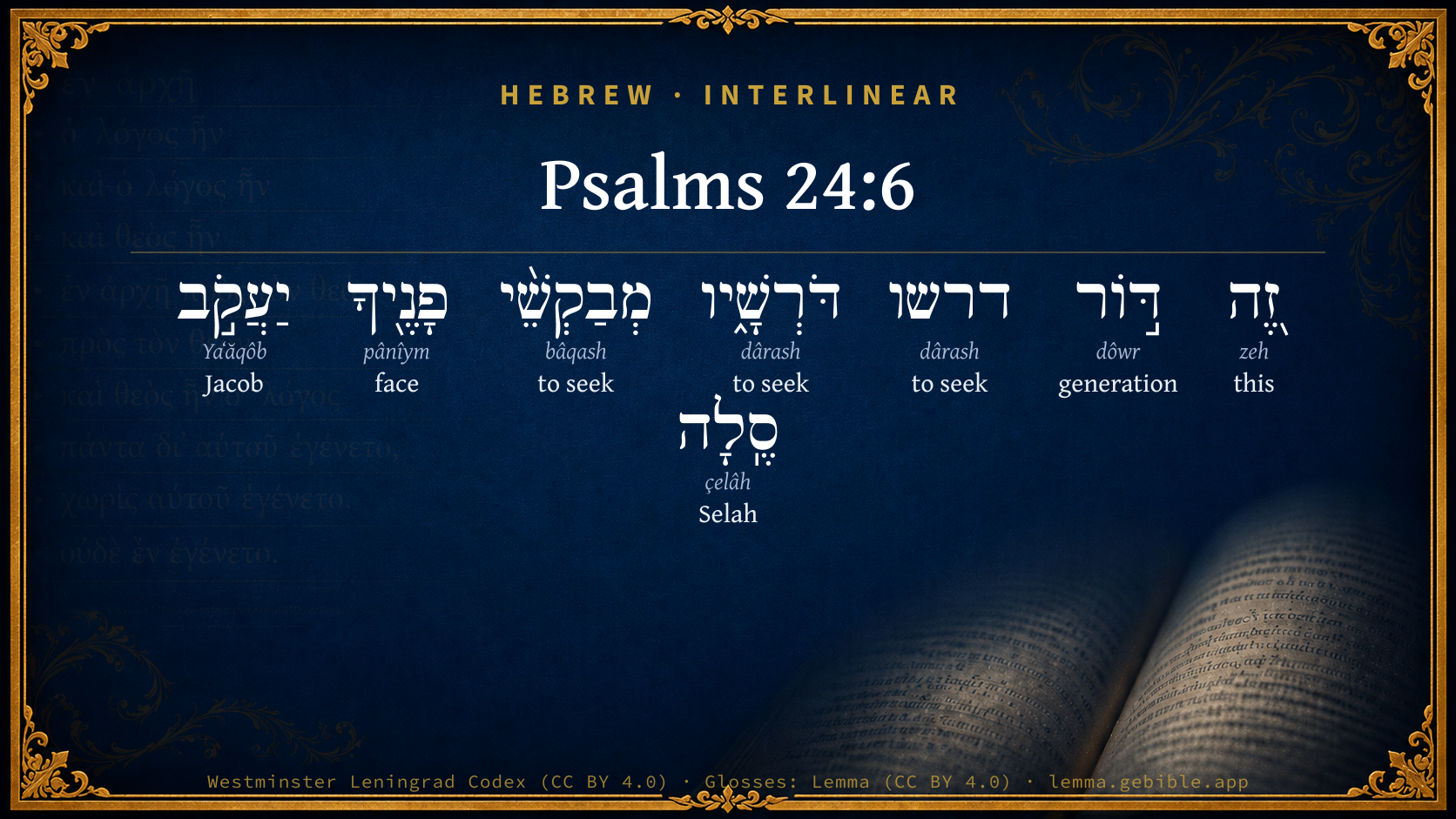
Psalms 24:6

Hebrew (Westminster Leningrad Codex) Psalms 24:6 appears in the Hebrew Old Testament. The text above is from the Westminster Leningrad Codex. Each word links to its Strong’s number, a concise gloss, and parsing drawn from the Open Scriptures Hebrew Bible morphology. Click any word for its full Brown-Driver-Briggs (BDB) entry.
Download image
Cite this verse

Psalms 24:6 (World English Bible). Public Domain. Lemma interlinear Bible study tool, https://lemma.gebible.app/v/psalms/24/6.

Show BibTeX & RIS
BibTeX
RIS
English Translation
This is the generation of those who seek Him, Who seek your face--even Jacob. Selah.
World English Bible · Public Domain
Download a study sheet

One document with this verse’s original text, its word-by-word gloss line, the meaning frame, cross-references with their text, attributed commentary, and full source and license credits — printable, and it pastes into notes with its structure intact.

This verse Autodidact and up

Study sheet (.html) Plain text (.txt)

A passage Seminary Student

Up to 50 verses in one chapter. A passage sheet keeps up to 6 commentary sources and 12 cross-references per verse, in the order this page ranks them, and says so on the sheet whenever that leaves anything out. Ask for a single verse and you get the Autodidact verse sheet above.

Everything on this page stays free to read, with no account — the sheet is a download of what is already on screen, not access to it.

Want to remove ads? Support Godless Engineer
Compare translations 3

The same verse in 3 English versions, stacked beneath the original-language interlinear above. Click any original word for its lexicon entry.

Each is an independent rendering of the whole verse — the interlinear is not word-aligned to these translations.

Highlighted words mark where these versions differ — a whole-verse word diff, not a word-by-word alignment.

  • World English Bible Public Domain
    This is the generation of those who seek Him, Who seek your face--even Jacob. Selah.
  • King James Version Public Domain
    This is the generation of them that seek him, that seek thy face, O Jacob. Selah.
  • unfoldingWord Literal Text CC BY-SA 4.0
    This the generation of the ones seeking him, the ones seeking your face, Jacob. Selah

unfoldingWord Literal Text — © unfoldingWord, licensed CC BY-SA 4.0. Word-aligned USFM3 via Door43 (git.door43.org/unfoldingWord/en_ult).

Versions to compare (up to 4)

3 of 4 selected

Show all 18 translations

Every available English version of this verse, each an independent rendering of the whole verse.

  • World English Bible Public Domain
    This is the generation of those who seek Him, Who seek your face--even Jacob. Selah.
  • Berean Standard Bible Public Domain
    Such is the generation of those who seek Him, who seek Your face, O God of Jacob. Selah
  • Majority Standard Bible Public Domain
    Such is the generation of those who seek Him, who seek Your face, O God of Jacob. Selah
  • King James Version Public Domain
    This is the generation of them that seek him, that seek thy face, O Jacob. Selah.
  • American Standard Version (1901) Public Domain
    This is the generation of them that seek after him, That seek thy face, `even' Jacob. Selah
  • Revised Version (1885) Public Domain
    This is the generation of them that seek after him, that seek thy face, O God of Jacob. Selah
  • Geneva Bible (1599) Public Domain
    This is the generation of them that seeke him, of them that seeke thy face, this is Iaakob. Selah.
  • Douay-Rheims (1899) Public Domain
    This is the generation of them that seek him, of them that seek the face of the God of Jacob.
  • Young's Literal Translation Public Domain
    This `is' a generation of those seeking Him. Seeking Thy face, O Jacob! Selah.
  • Literal Standard Version CC BY-SA 4.0
    This [is] a generation of those seeking Him. Seeking Your face, O Jacob! Selah.
  • Unlocked Literal Bible CC BY-SA 4.0
    Such is the generation of those who seek him, those who seek the face of the God of Jacob. Selah
  • unfoldingWord Literal Text CC BY-SA 4.0
    This the generation of the ones seeking him, the ones seeking your face, Jacob. Selah
  • Darby Bible Public Domain
    This is the generation of them that seek unto him, that seek thy face, O Jacob. Selah.
  • World Messianic Bible Public Domain
    This is the generation of those who seek Him, who seek your face—even Jacob. Selah.
  • Webster's Bible Public Domain
    This is the generation of them that seek him, that seek thy face, O Jacob. Selah.
  • Free Bible Version CC BY-SA 4.0
    These are the kind of people who may go to the Lord and worship before you, God of Jacob. Selah.
  • Bible in Basic English Public Domain
    This is the generation of those whose hearts are turned to you, even to your face, O God of Jacob. (Selah.)
  • JPS Tanakh (1917) Public Domain
    Such is the generation of them that seek after Him, that seek Thy face, even Jacob. Selah

Literal Standard Version (2020), Covenant Press — licensed CC BY-SA 4.0. Text via the HelloAO Bible API (eBible.org). Unlocked Literal Bible (unfoldingWord) — licensed CC BY-SA 4.0. Text via the HelloAO Bible API (eBible.org). unfoldingWord Literal Text — © unfoldingWord, licensed CC BY-SA 4.0. Word-aligned USFM3 via Door43 (git.door43.org/unfoldingWord/en_ult). Free Bible Version, Dr. Jonathan Gallagher — licensed CC BY-SA 4.0. Text via the HelloAO Bible API (eBible.org).

Word by word

More ways to search: Search by grammar → Find every occurrence → Compare this word →

Practice this passage: Drill this verse → Learn its vocabulary →

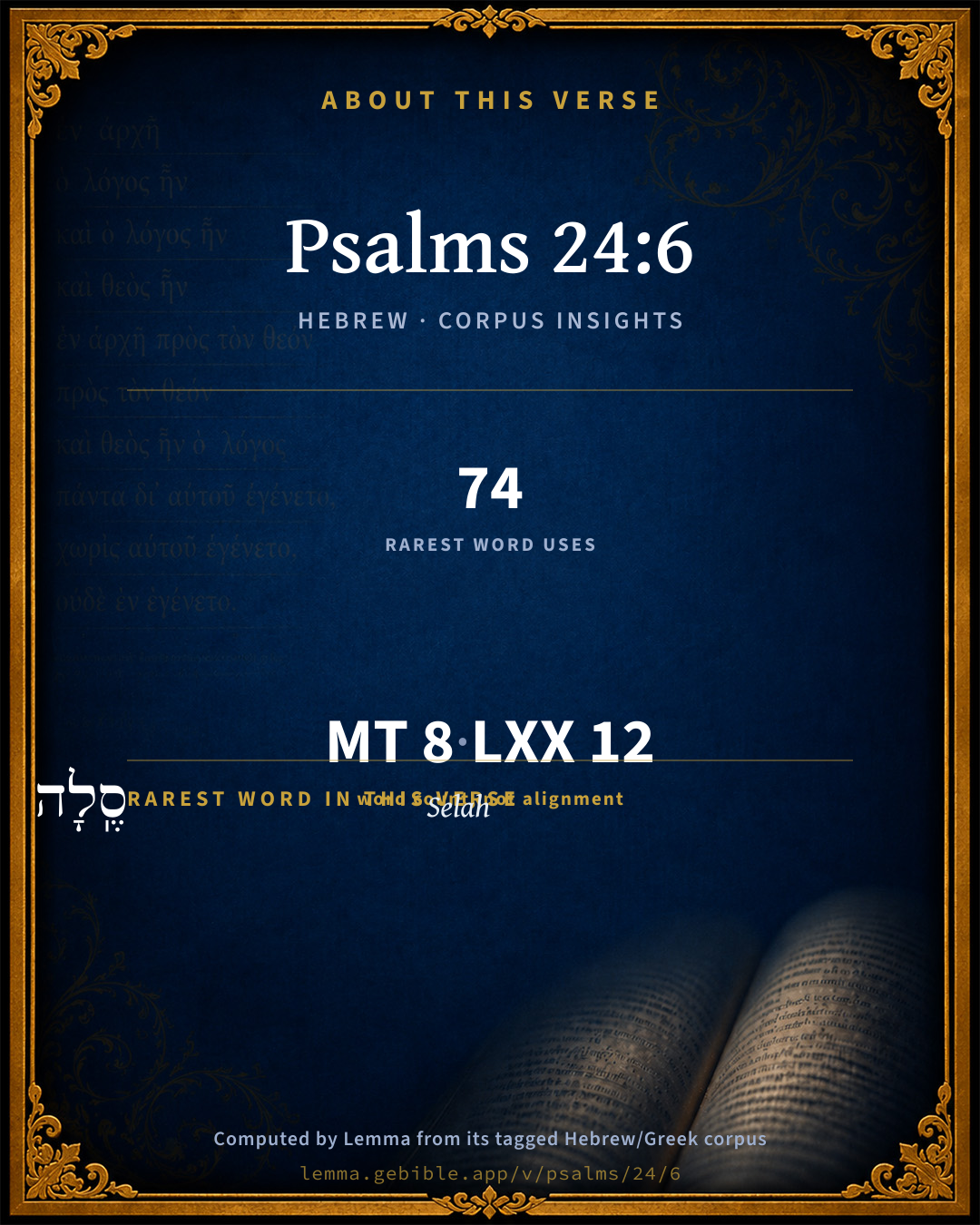
About this verse

These counts appear in no published source. They are computed here, from the morphology-tagged text and Lemma’s own curated glosses. What Lemma adds →

8
words
7
distinct lemmas
Wisdom
section

Grammatical profile

  • 3 verbs
  • 3 nouns
  • 1 pronoun
  • 1 particle

Verb forms

  • דרשו Qal · Participle Active
  • דֹּרְשָׁ֑יו Qal · Participle Active
  • מְבַקְשֵׁ֨י Piel · Participle Active

Repetition

A word recurs within this verse — often emphatic in Hebrew:

  • דרשו to seek H1875 ×2

Hebrew & Septuagint length

In English translation the verse runs 15 words from the Hebrew and 19 from the Septuagint (LXX English) — closely comparable.

A rough comparison of the two English renderings, which tokenize alike — not a word-level alignment.

Word counts can differ between the Hebrew and the Greek without any difference in meaning — e.g. the Hebrew direct-object marker אֵת has no separate Greek word, and Greek often adds the article ὁ.

In the original languages it is 8 Hebrew tokens and 12 Greek tokens — but the two are counted differently (Hebrew bundles its prefixes and suffixes into one token; the Greek is in lemma form), so that isn’t a like-for-like length.

Cross-references

8

Topical passages linked to Psalms 24:6 in the Treasury of Scripture Knowledge — connected by theme and wording, ordered by reader-vote popularity; previews shown in the World English Bible.

  • Psalms 27:8 When you said, "Seek my face," My heart said to you, "I will seek your face, Yahweh."
  • Psalms 105:4 Seek Yahweh and his strength. Seek his face forever more.
  • Psalms 22:30 Posterity shall serve him. Future generations shall be told about the Lord.
  • Psalms 73:15 If I had said, "I will speak thus;" Behold, I would have betrayed the generation of your children.
  • John 1:47 Jesus saw Nathanael coming to him, and said about him, "Behold, an Israelite indeed, in whom is no deceit!"
  • Romans 4:16 For this cause it is of faith, that it may be according to grace, to the end that the promise may be sure to all the seed, not to that only which is of the law, but to that also which is of the faith of Abraham, who is the father of us all.
  • Isaiah 53:10 Yet it pleased Yahweh to bruise him; he has put him to grief: when you shall make his soul an offering for sin, he shall see [his] seed, he shall prolong his days, and the pleasure of Yahweh shall prosper in his hand.
  • 1 Peter 2:9 But you are a chosen race, a royal priesthood, a holy nation, a people for God's own possession, that you may show forth the excellencies of him who called you out of darkness into his marvelous light:

Cross-references courtesy of OpenBible.info (CC BY 4.0).

Hebrew and Greek witnesses Masoretic Hebrew ↔ Greek Septuagint

The same verse in the two great witnesses to the Old Testament, shown verse-for-verse.

You’re reading Greek Psalm 23 (Hebrew Psalm 24). The Septuagint counts the superscription, so verse numbers can differ from the Hebrew — chapter-level alignment, not verse-by-verse. Numbering follows Rahlfs.

These are two independent witnesses, not word-aligned to each other, and the Septuagint is shown in lemma (dictionary) form.

Hebrew Psalms 24:6 Masoretic · Westminster Leningrad Codex

זֶ֭ה דּ֣וֹר דרשו דֹּרְשָׁ֑יו מְבַקְשֵׁ֨י פָנֶ֖יךָ יַעֲקֹ֣ב סֶֽלָה

This is the generation of those who seek Him, Who seek your face--even Jacob. Selah.

World English Bible · Public Domain

Greek LXX Greek Psalm 23:6 Septuagint · lemma form

οὗτος ὁ γενεά ζητέω αὐτός ζητέω ὁ πρόσωπον ὁ θεός ἰακώβ διάψαλμα

This is the generation of them that seek him, that seek the face of the God of Jacob. Pause.

LXX2012 (modern English Septuagint) · Public Domain

On this verse, Adam Clarke's Commentary discusses the Septuagint’s reading. Read the note in Commentary ↓

Hebrew: Westminster Leningrad Codex (CC BY 4.0). Greek: Septuagint (public domain); English from LXX2012 (modern English Septuagint) (Public Domain). How the Septuagint differs from the Hebrew →

Commentary

Notes on Psalms 24:6 from classic Christian and Jewish commentators (each source and its license shown beneath its notes). The classic Christian expositions comment on the surrounding passage and are grouped to its opening verse, so a note may address several verses; the Jewish commentaries on the Tanakh (Rashi and others) are per-verse, so they appear only where the commentator wrote on this verse.

Lemma curates 59 commentaries, every one of them public domain or Creative Commons licensed, each selected and text-cleaned for this edition rather than reprinted as found. About our sources →

Trapp's Complete Commentary

John Trapp

Psa 24:6 This [is] the generation of them that seek him, that seek thy face, O Jacob. Selah.

Ver. 6. This is the generation of them that seek him] These are the true seekers, far different from those that so style themselves today; being no better indeed than the Jesuits’ by-blows {bastards}, as one wittily calleth them, though they are not yet so wise as to know their own father (Mr Baxter). These are a generation too, but an evil and adulterous one, in these last and loosest times of abounding and abetted errors.

That seek thy face] i.e. Thy favour, that desire nothing more than to be in communion with thee and conformity unto thee.

O Jacob] Or, O God of Jacob. As the Church is called Christ, 1Co 12:12; so God is here called Jacob, such a near union there is between him and his people. Or, this is Jacob. So the true seekers are fitly called, first, because Israelites indeed, Joh 1:47 Rom 9:6; secondly, because they see God face to face, as Jacob did at Penuel, Gen 32:24; Gen 32:26; Gen 32:29-30; thirdly, because they also, as here, do bear away a blessing, Hos 12:4, even righteousness from the God of their salvation, as in the verse foregoing. Adiecitur Selah ut ostendatur quantopere haec sententia sit consideranda (Vatab.).

John Trapp, A Commentary or Exposition upon All the Books of the Old and New Testament (1647–1656) — public domain. Text from a community e-Sword module.

Joseph Benson's Commentary

Psa 24:6. This is the generation of them that seek him — The true progeny, which God regards, that make it their care and study to know him, and his mind and will, and to please and serve him. Whereby he reflects upon them who boasted of, and trusted in, their carnal descent from Abraham and the other patriarchs. That seek thy face, O Jacob — That is, O God of Jacob, that seek thy grace and favour, often called God’s face. Such ought the people to be who seek the presence of God, and approach to worship him in the sanctuary. And such ought they to be who celebrate the ascension of the Redeemer, and hope, one day, to follow him into those happy mansions which he is gone before to prepare for them.

Joseph Benson's Commentary on the Old and New Testaments (1811–1818) — public domain. Text from a community e-Sword module.

J. A. Alexander on Psalms

Joseph Addison Alexander

6. (Psa 24:6) This is the generation seeking him; the seekers of thy face (are) Jacob, i.e. the true Jacob, the true Israel. This refers to the description in Psa 24:6.—Seeking him (in the singular) is the reading in the text; the marginal reading is those seeking him, which amounts to the same thing. To seek God and to seek his face, i.e., his countenance or presence, are common phrases for the earnest endeavour to secure his favour, Psa 27:8; Psa 105:4, Hos 5:15, 2Sa 21:1. Our language does not furnish equivalents to the two Hebrew verbs employed to express this idea in the verse before us.—The connection of the last word with the rest of the sentence is obscure. Some make it a vocative: "who seek thy face, O Jacob!" i.e. who seek the countenance and friendship of God's people. Or, "who seek thy face, O (God of) Jacob!" a very harsh ellipsis, which could only be justified by exegetical necessity. The best sense is yielded by the construction first proposed, or by another, which differs from it only in dispensing with a verb and throwing all into one sentence "This is the generation seeking thee, those seeking thy face (O Jehovah), (the true) Israel." The sudden apostrophe to God himself makes the sentence more impressive without making it obscure.—The distinction here made between the nominal and real Israel was peculiarly necessary on occasions which were suited to flatter the natural pride of the chosen people, such as that of Jehovah's solemn entrance into Zion, as the peculiar God of Israel. To correct this abuse of their extraordinary privileges, two great doctrines are here set forth; that their God was the God of the whole earth; and, secondly, that he was holy, and required holiness as a term of admission to his presence. The idea of a true and false Israel reappears in the New Testament, and is propounded with peculiar distinctness and emphasis by Paul in Rom 9:6-7.

Joseph Addison Alexander, The Psalms Translated and Explained (1850) — public domain. Text from a community e-Sword module.

Geneva Bible (1599)

Geneva Bible translators

Though circumcision separate the carnal seed of Jacob, from the Gentiles, yet he that seeketh God, is the true Jacob and the very Israelite.

Geneva Bible (1599) marginal notes — public domain. Text via Bolls.life.

Jamieson, Fausset & Brown

Robert Jamieson, A. R. Fausset & David Brown

Jacob--By "Jacob," we may understand God's people (compare Isa 43:22; Isa 44:2, &c.), corresponding to "the generation," as if he had said, "those who seek Thy face are Thy chosen people."

Jamieson, Fausset & Brown — Commentary Critical and Explanatory on the Whole Bible (1871) — public domain (CC PDM 1.0). Text via the HelloAO Bible API.

Adam Clarke's Commentary

Verse 6. This is the generation] This is the description of people who are such as God can approve of, and delight in.

That seek thy face, O Jacob.] It is most certain that אלהי Elohey, O God, has been lost out of the Hebrew text in most MSS., but it is preserved in two of Kennicott's MSS., and also in the Syriac, Vulgate, Septuagint, AEthiopic, Arabic, and Anglo-Saxon. "Who seek thy face, O God of Jacob."

Selah.] That is, It is confirmed; it is true. The persons who abstain from every appearance of evil, and seek the approbation of God, are those in whom God will delight.

Adam Clarke's Commentary on the Bible (1810–1826) — public domain. Text from a community e-Sword/MySword module.

John Calvin's Commentaries

6. This is the generation. I have just now observed, that by the demonstrative pronoun this, the Psalmist erases from the catalogue of the servants of God all counterfeit Israelites, who, trusting only to their circumcision and the sacrifices of beasts, have no concern about offering themselves to God; and yet, at the same time, they rashly thrust themselves into the church. Such persons may pretend to have delight in the service of God, by often coming to his temple, but they have no other design than to withdraw themselves from him as far as they can. Now, as nothing was more common in the mouths of each of them than to say, that they all belonged to the holy seed, the Psalmist has limited the name of holy generation to the true observers of the law; as if he had said, All who have sprung from Abraham, according to the flesh, are not, on that account, his legitimate children. It is, no doubt, truly said in many other places, as we shall see in Psalm 27, that those sought the face of God who, to testify their godliness, exercised themselves in the ceremonies before the ark of the covenant; that is to say, if they were brought thither by a pure and holy affection. But as hypocrites seek God externally in a certain way, as well as true saints, while yet they shun him by their windings and false pretences, “Lequel toutesfois ils fuyent par leurs destours et faux semblans.” — Fr.

He first says, “That seek him,” and next, “That seek thy face.”

John Calvin's Commentaries (1540-1563) — public domain. Text from the Calvin Translation Society English edition (1840s-50s) via the Christian Classics Ethereal Library (ccel.org). Calvin's coverage is partial (roughly two-thirds of the Bible); uncommented books and verses are honest gaps, never fabricated. The 19th-century editor's footnotes and remarks are omitted so the notes are faithfully Calvin's own voice.

Ellicott's Commentary for English Readers

(6) O Jacob.—The address to Jacob is certainly wrong, and therefore many critics, following the LXX. and Syriac, rightly insert, as in our margin, the words “O God of.”

A Bible Commentary for English Readers, edited by Charles John Ellicott (1878–1897) — public domain. Text from a community e-Sword module.

The Cambridge Bible for Schools and Colleges

gen. ed. J. J. S. Perowne

6. generation] i.e. class, as in Psa_12:7; Psa_14:5; Psa_73:15.

that seek him] R.V., that seek after him. Two words for seek are used in this verse. Both may be used of the outward act of visiting the sanctuary; but both come to express the inward purpose of the heart as well. So far as the two words can be distinguished the first denotes the attitude of loving devotion, the second that of inquiry or supplication.

O Jacob] The A.V. marg. and R.V. rightly follow the LXX, Vulg., and Syr. in reading O God of Jacob. If the Massoretic text is retained, it must be rendered with R.V. marg., That seek thy face, even Jacob. These are the ideal Jacob, the true people of God. But the construction is harsh; a vocative is needed after thy face; and Jacob does not by itself convey this sense.

The Cambridge Bible for Schools and Colleges (gen. ed. J. J. S. Perowne; Cambridge University Press, 1878–1918) — public domain. Text from a community e-Sword module.

John Gill's Exposition

This is the generation of them that seek him,.... The persons above described are such, who in every age are the generation of the children of God, and are accounted by him for a generation; they are such that seek him, in the first place, with their whole hearts, and in Christ, where they find him;

that seek thy face, O Jacob. By the "face" of God is meant the favour of God, the discoveries of his love, the light of his countenance, than which nothing is more desirable to gracious souls, or more sought after by them; and by Jacob is meant the God of Jacob; and so Apollinarius has it in his metaphrase; see Psa 10:1; unless Christ should be intended, one of whose names is Israel, Isa 49:3; or the words may be supplied, as they are by some Jewish writers (m), "this is Jacob"; or the persons before described are the seed of Jacob, and who are called by his name: and it may be observed, that the church of God often bears the same name, Isa 43:1; and then the sense is, the persons whose characters are given above are fit to ascend, and stand in the holy hill of God, are Israelites indeed, in whom there is no guile.

Selah; on this word; see Gill on Psa 3:2.

(m) Aben Ezra, Kimchi, & Ben Melech in loc.

John Gill's Exposition of the Whole Bible (1746–1763) — public domain (CC PDM 1.0). Text via the HelloAO Bible API.

Albert Barnes' Notes on the Bible

This is the generation of them that seek him - This describes the race of those who seek Him; or, this is their character. The word “generation” here is used evidently in the sense of “race, people, or persons.” This is the character or description of the “persons” who seek His favor; or, this is the character of His true friends. The phrase “to seek God” is often used as descriptive of true piety: Psa 9:10; Psa 14:2; Psa 63:1; Pro 8:17; Mat 6:33; Mat 7:7. It indicates an earnest desire to know Him and to obtain His favor. It denotes also humility of mind, and a sense of dependence on God.

That seek thy face, O Jacob - Margin, O “God of” Jacob. DeWette understands this as meaning that they would seek the face of God among His people; or that they who belonged to the race of Jacob, and who were sincere, thus sought the face of God. There is supposed to be, according to this interpretation, a distinction between the true and the false Israel; between those who professed to be the people of God and those who really were His people (compare Rom 9:6-8). It seems to me that the word is not used here as it is in the margin to denote the “God of Jacob,” which would be a harsh and an unusual construction, but that it is in apposition with the preceding words, as denoting what constituted the true Jacob, or the true people of God. “This is the generation of them that seek him; this is the true Jacob, that seek thy face, O Lord.” That is, this is the characteristic of all who properly belong to the race of Jacob, or who properly belong to God as his true people. The sense, however, is not materially affected if we adopt the reading in the margin.

Albert Barnes' Notes on the Bible (1834–1885) — public domain. Text from a community e-Sword/MySword module.

Matthew Poole's English Annotations

The generation; the true progeny which God regards; whereby he reflects upon them, who boasted and trusted to their carnal generation or descent from Jacob.

That seek him, to wit, God, mentioned in the end of Psa 24:5, or his face, as it is more fully expressed in the next clause; i.e. that make it their care and study to know him, and his mind and will, and to please and serve him, as this phrase is usually understood.

Thy face, i.e. his face, by a familiar change of the person; of which many instances have been already noted; and his face, i. e. his grace and favour, which is oft called God’s face, as Gen 4:14; Exo 33:14,15; Psa 16:11; 27:2; 44:3. And so this phrase is used 2Ch 7:14; Psa 27:8; Hos 5:15. O Jacob; so the sense is, that seek the true church, here called Jacob; that desire the knowledge of it, and conversation with it; in which sense many are said to seek Solomon’s face, as the phrase is in the Hebrew, 1Ki 10:24; 2Ch 9:23, and the harlot to seek her lover’s face, Pro 7:15. And so this is by some expounded of the Gentiles, who inquired after the true church, and finding it in Jacob, were desirous to become proselytes, and to join themselves to the church of Jacob or Israel. But it must be remembered that the psalmist is not here speaking of the calling of the Gentiles, but only of the character or qualification of the true Jacobites or Israelites, who cannot conveniently be said to seek the face of Jacob, i.e. their own. And the phrase of seeking the face of Jacob, or of the church, is no where used in Scripture. Or, as it is in the margin, O God of Jacob. But that seems to be too large a supplement. Or, this is Jacob, the pronoun this being easily understood out of the beginning of the verse. Or, the generation (which may in the same manner be supplied) of Jacob, Jacob being here put not for the person, but for the posterity of Jacob, as it is Gen 49:7; Num 23:7,10,23; Deu 32:9; Psa 14:7; or for the church or people of God, which is oft called Jacob or Israel as Isa 14:1; 41:8; 44:1,5,21, &c. So the sense is, This and this only is the true Jacob or Israel, or church of God, and all others are so only in name and title, although they be descended lineally from him. Or, in Jacob, the particle in being here understood, as it is in Psa 2:12; 17:12, and in many other places. So the sense of the place is, This is the true generation of them that seek God’s face in Jacob, i.e. either in Jacob’s land or sanctuary, the only place where God was to be sought; or among the Jacobites or Israelites; by which he insinuates what is expressed Rom 9:6, that all are not Israel that are of Israel, and that all were not Israelites indeed that were sprung from Jacob, but only those of them who were such as he described, Psa 24:4. Compare Joh 1:47; Rom 2:28,29.

Matthew Poole's English Annotations on the Holy Bible (1683–1685) — public domain. Text from a community e-Sword/MySword module.

The Treasury of David

Charles H. Spurgeon

Ver. 6. This is the generation of them that seek him, that seek thy face, O Jacob. These are the regeneration, these are in the line of grace; these are the legitimate seed. Yet they are only seekers; hence learn that true seekers are very dear in God's esteem, and are entered upon his register.

Even seeking has a sanctifying influence; what a consecrating power must lie in finding and enjoying the Lord's face and favour! To desire communion with God is a purifying thing. Oh to hunger and thirst more and more after a clear vision of the face of God; this will lead us to purge ourselves from all filthiness, and to walk with heavenly circumspection. He who longs to see his friend when he passes takes care to clear the mist from the window, lest by any means his friend should go by unobserved. Really awakened souls seek the Lord above everything, and as this is not the usual desire of mankind, they constitute a generation by themselves; a people despised of men but beloved of God.

The expression O Jacob is a very difficult one, unless it be indeed true that the God of Jacob here condescends to be called Jacob, and takes upon himself the name of his chosen people. The preceding verses correct the inordinate boastings of those Jews who vaunted themselves as the favourites of heaven; they are told that their God is the God of all the earth, and that he is holy, and will admit none but holy ones into his presence. Let the mere professor as he reads these verses listen to the voice which saith, "without holiness no man shall see the Lord."

Selah. Lift up the harp and voice, for a nobler song is coming; a song of our Well beloved.

Ver. 6. This is the generation of them that seek him, that seek thy face. Christians must be seekers. This is the generation of seekers. All mankind, if ever they will come to heaven, they must be a generation of seekers. Heaven is a generation of finders, of possessors, of enjoyers, seekers of God. But here we are a generation of seekers. We want somewhat that we must seek. When we are at best, we want the accomplishment of our happiness. It is a state of seeking here, because it is a state of want; we want something alway. But to come more particularly to this seeking the face of God, or the presence of God...The presence of God meant here is, that presence that he shows in the time of need, and in his ordinances. He shows a presence in need and necessity, that is, a gracious presence to his children, a gracious face. As in want of direction, he shows his presence of light to direct them; in weakness he shows his strength; in trouble and perplexity he will show his gracious and comfortable presence to comfort them. In perplexity he shows his presence to set the heart at large, answerable to the necessity. So in need God is present with his children, to direct them, to comfort them, to strengthen them, if they need that. Richard Sibbes.

Ver. 6. This is the generation. By the demonstrative pronoun this, the psalmist erases from the catalogue of the servants of God all counterfeit Israelites, who, trusting only to their circumcision and the sacrifice of beasts, have no concern about offering themselves to God; and yet, at the same time, they rashly thrust themselves into the church. John Calvin.

Ver. 6. That seek thy face, O Jacob. In Pr 7:15, and Pr 29:26, we have "seeking the face of" in the sense of seeking the favour of, or showing delight in. Their delight is not in Esau, who got "the fatness of earth" Ge 27:39 as his portion. And those writers may be right, who consider Jacob as a name for Messiah, to whom belong the true birthright and blessing. Andrew A. Bonar.

Ver. 6. That seek thy face, O Jacob. He is "the seed of Jacob; " he is "the Holy One of Israel; ""the face of thine Anointed" is the face of him who is both God and man; for "we shall see him as he is." Isaac Williams.

Ver. 6. O Jacob, or O God of Jacob. As the church is called Christ 1Co 12:12, so God is here called "Jacob; " such a near union there is betwixt him and his people. Or, this is Jacob. So the true seekers are fitly called, first because Israelites indeed Joh 1:47 Ro 9:6; secondly, because they see God face to face, as Jacob did at Peniel Ge 32:24-30; thirdly, because they also, as he, do bear away a blessing Ho 12:4, even "righteousness from the God of their salvation, " as in the former verse. John Trapp.

Ver. 6. Those who truly seek fellowship with God.

Psalms 24:7*

Charles H. Spurgeon's The Treasury of David (1869–1885) — public domain. Psalms only. Text from a community e-Sword/MySword module.

Whedon's Commentary on the Bible

Daniel D. Whedon

6. This is the generation—Such persons as have just been described; these constitute a peculiar race, generation, or kind, separated from the world.

That seek thy face, O Jacob— “To seek the face” of any one is to seek his favour, to endeavour to secure those benefits which arise from an intimate relation to him, as 1Ki_10:24 : “And all the earth sought the face [margin] of Solomon, to hear his wisdom.” See Hos_5:15. To “seek the face of Jacob” is to seek fellowship with the people called by his name—the Israelites—and, by implication, to seek God.

Daniel D. Whedon (gen. ed.), Commentary on the Old and New Testaments (1874–1909) — public domain. Text from a community e-Sword module.

The Pulpit Commentary

This is the generation of them that seek him. Men with this character impressed upon them are the "generation," the stamp of men, whom God will recognize and accept as his worshippers, true seekers after him. That seek thy face, O Jacob. The LXX have, Zhtountwn to proswpon tou Yeou Iakwb , whence some suppose yhla to have fallen out of the Hebrew text. This, no doubt, is possible, and removes all difficulty. But it is better to loose a Gordian knot than to cut it. We may keep the present text, and obtain a satisfactory sense, by regarding "Jacob" as grammatically in apposition with "generation," and translating, "This is the generation of them that seek him that seek thy face even Jacob." All they are not Israel who are of Israel. (Rom_9:6) The true Jacob consisted of those Israelites who answered to the character described in ver. 4. Selah. A break, or pause, here occurred, while the procession of Levites advanced to the very gates of the sanctuary. Then the strain was resumed the choir being divided into two parts, which sang antiphonally.

The Pulpit Commentary (1880–1919), ed. H.D.M. Spence-Jones & Joseph S. Exell — public domain. Text from a community e-Sword module.

John Wesley's Explanatory Notes

The generation - The true progeny which God regards. Face - His grace and favour, which is often called God's face.

John Wesley, Explanatory Notes Upon the Whole Bible (1754–1765) — public domain. Text via the GEBible commentary corpus.

Rashi

Rabbi Shlomo Yitzchaki (Rashi)

This [generation,] whose deeds are such - this is the generation of those who seek him.

Rashi on the Tanakh — English translations: “The Judaica Press complete Tanach with Rashi, translated by A. J. Rosenberg” (CC BY 4.0); “Pentateuch with Rashi's commentary by M. Rosenbaum and A.M. Silbermann, 1929-1934” (public domain); “The Metsudah Tanach series, Lakewood, N.J” (CC BY 4.0); and “The Book of Joshua, Metsudah Publications, 1997” (CC BY 4.0). Text via Sefaria.

Radak

Rabbi David Kimhi (Radak)

This is the generation of them that seek Him: – Who shall ascend into the hill of the Lord and in His Holy Place, because he is clean of hand and pure of heart? This is the generation of the seekers of the Lord, and they are Israel. And this happened in the days of Solomon, who built the House. And the Kethib דרשו (him that seeks Him) corresponds to דּוֹר (generation), which is a collective term, singular; and the Keri דֹּרְשָׁיו (them that seek Him) corresponds to the individuals, who are many.

That seek Thy face, (even) Jacob: – The singer speaks as to God. These are they who seek Thy face in the Holy House, Jacob, and they are Israel; for all the seed of Jacob are called by the name Jacob, as (Jer. 30:10) “And thou fear not, O my servant Jacob” with other instances besides; And there is no need to supply seed of as the interpreters have done. And the word Selah I have interpreted in the third Psalm, and there is no need to interpret it in every place where it occurs.

Radak on the Tanakh — English translations: “Sefaria Community Translation” (CC0 1.0 (public-domain dedication)); “Eliyahu Munk, HaChut Hameshulash” (CC BY 4.0); “Rabbi Mike Feuer, Jerusalem Anthology” (CC BY 4.0); and “R. David Kimhi on the first book of Psalms, Translated by R.G. Finch, London, 1919” (public domain). Text via Sefaria.

Lesson kit

Teaching starters — assembled from the data on this page, not authored interpretation. Every prompt links to the verse data it draws on. Edit before teaching.

Psalms, in the Wisdom, opens this verse with 8 words (7 distinct Hebrew lemmas). Its most distinctive word is çelâh (“Selah”). A historical commentator’s framing appears above. Read the whole chapter for the surrounding context.

Discussion questions

  1. What does “Selah” (çelâh) contribute to the verse as a whole?
  2. Psalms 27:8 shares this passage’s theme. How do the two illuminate each other?
  3. “to seek” occurs 2× in this one verse. What is the effect of the repetition?
  4. These translations render this verse differently; the difference is in the English rendering, not the original. What questions does that raise?
  5. The verb «דרשו» is Qal Participle Active. How does its form color the action?
  6. Reading how Trapp's Complete Commentary and Joseph Benson's Commentary read this verse, where do the two commentators agree and where do they part?

Things to notice

Reading settings

Reading text

Shown beneath each verse's original-language words.

Old Testament
Old Testament edition

Read the OT as the Masoretic Hebrew (MT) or the Greek Septuagint (LXX).

English shown for the Greek Septuagint (in the Hebrew ↔ Greek comparison).

Comparing translations? Open the Compare panel on any verse page to stack up to four side by side.