
Jeremiah 46:26

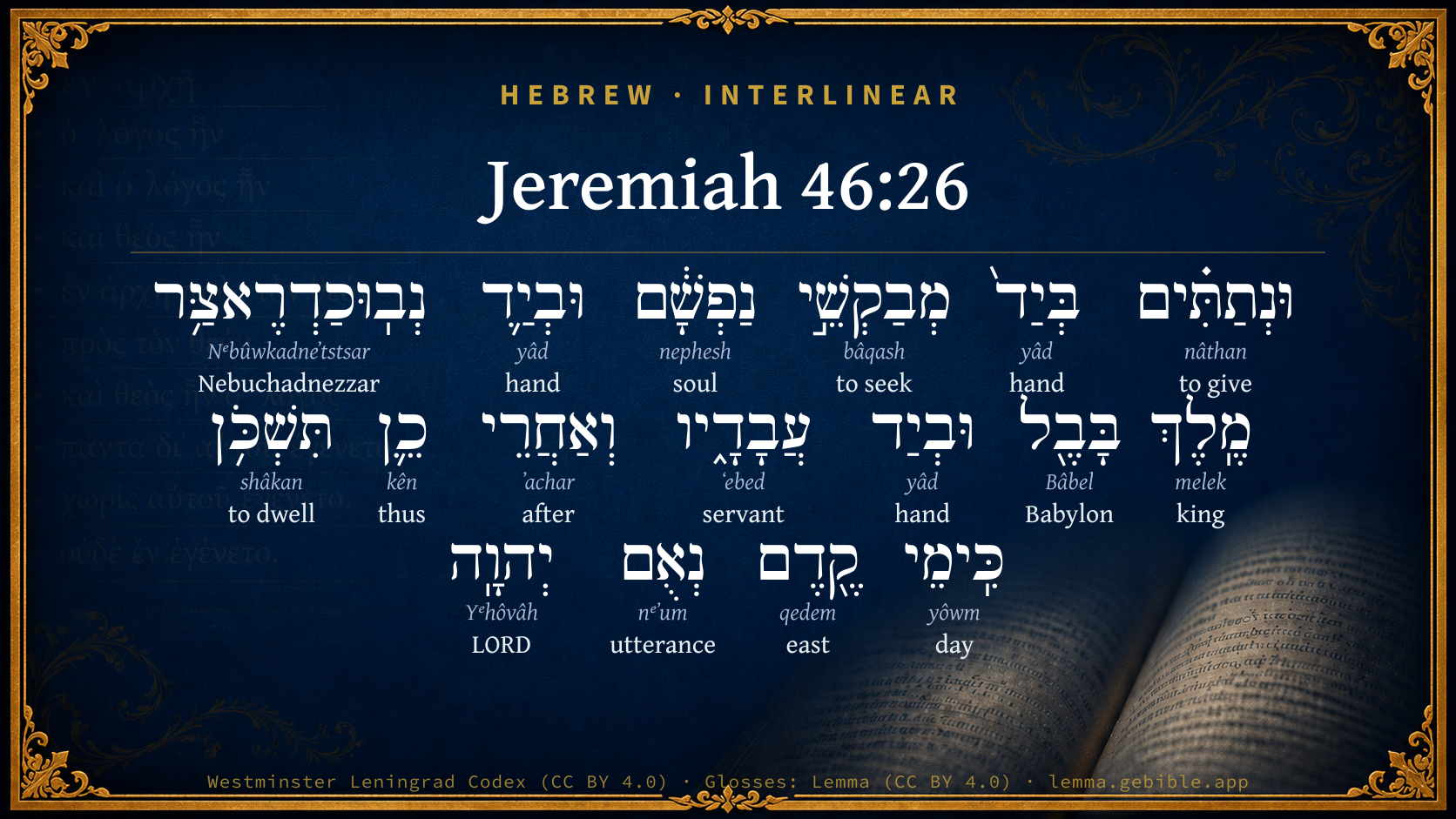
Hebrew (Westminster Leningrad Codex) Jeremiah 46:26 appears in the Hebrew Old Testament. The text above is from the Westminster Leningrad Codex. Each word links to its Strong’s number, a concise gloss, and parsing drawn from the Open Scriptures Hebrew Bible morphology. Click any word for its full Brown-Driver-Briggs (BDB) entry.
Download image
Cite this verse

Jeremiah 46:26 (World English Bible). Public Domain. Lemma interlinear Bible study tool, https://lemma.gebible.app/v/jeremiah/46/26.

Show BibTeX & RIS
BibTeX
RIS
English Translation
and I will deliver them into the hand of those who seek their lives, and into the hand of Nebuchadrezzar king of Babylon, and into the hand of his servants; and afterwards it shall be inhabited, as in the days of old, says Yahweh.
World English Bible · Public Domain
Download a study sheet

One document with this verse’s original text, its word-by-word gloss line, the meaning frame, cross-references with their text, attributed commentary, and full source and license credits — printable, and it pastes into notes with its structure intact.

This verse Autodidact and up

Study sheet (.html) Plain text (.txt)

A passage Seminary Student

Up to 50 verses in one chapter. A passage sheet keeps up to 6 commentary sources and 12 cross-references per verse, in the order this page ranks them, and says so on the sheet whenever that leaves anything out. Ask for a single verse and you get the Autodidact verse sheet above.

Everything on this page stays free to read, with no account — the sheet is a download of what is already on screen, not access to it.

Want to remove ads? Support Godless Engineer
Compare translations 3

The same verse in 3 English versions, stacked beneath the original-language interlinear above. Click any original word for its lexicon entry.

Each is an independent rendering of the whole verse — the interlinear is not word-aligned to these translations.

Highlighted words mark where these versions differ — a whole-verse word diff, not a word-by-word alignment.

  • World English Bible Public Domain
    and I will deliver them into the hand of those who seek their lives, and into the hand of Nebuchadrezzar king of Babylon, and into the hand of his servants; and afterwards it shall be inhabited, as in the days of old, says Yahweh.
  • King James Version Public Domain
    And I will deliver them into the hand of those that seek their lives, and into the hand of Nebuchadrezzar king of Babylon, and into the hand of his servants: and afterward it shall be inhabited, as in the days of old, saith the LORD.
  • unfoldingWord Literal Text CC BY-SA 4.0
    I am giving them into the hand of the ones seeking their lives, and into the hand of Nebuchadnezzar king of Babylon and his servants. Then after this Egypt will be inhabited as in previous days—this is Yahweh’s declaration.

unfoldingWord Literal Text — © unfoldingWord, licensed CC BY-SA 4.0. Word-aligned USFM3 via Door43 (git.door43.org/unfoldingWord/en_ult).

Versions to compare (up to 4)

3 of 4 selected

Show all 18 translations

Every available English version of this verse, each an independent rendering of the whole verse.

  • World English Bible Public Domain
    and I will deliver them into the hand of those who seek their lives, and into the hand of Nebuchadrezzar king of Babylon, and into the hand of his servants; and afterwards it shall be inhabited, as in the days of old, says Yahweh.
  • Berean Standard Bible Public Domain
    I will deliver them into the hands of those who seek their lives—of Nebuchadnezzar king of Babylon and his officers. But after this, Egypt will be inhabited as in days of old, declares the LORD.
  • Majority Standard Bible Public Domain
    I will deliver them into the hands of those who seek their lives—of Nebuchadnezzar king of Babylon and his officers. But after this, Egypt will be inhabited as in days of old, declares the LORD.
  • King James Version Public Domain
    And I will deliver them into the hand of those that seek their lives, and into the hand of Nebuchadrezzar king of Babylon, and into the hand of his servants: and afterward it shall be inhabited, as in the days of old, saith the LORD.
  • American Standard Version (1901) Public Domain
    and I will deliver them into the hand of those that seek their lives, and into the hand of Nebuchadrezzar king of Babylon, and into the hand of his servants; and afterwards it shall be inhabited, as in the days of old, saith Jehovah.
  • Revised Version (1885) Public Domain
    and I will deliver them into the hand of those that seek their lives, and into the hand of Nebuchadrezzar king of Babylon, and into the hand of his servants: and afterwards it shall be inhabited, as in the days of old, saith the LORD.
  • Geneva Bible (1599) Public Domain
    And I will deliuer them into the handes of those, that seeke their liues, and into the hand of Nebuchad-nezzar King of Babel, and into the handes of his seruants, and afterwarde she shall dwell as in the olde time, saith the Lord.
  • Douay-Rheims (1899) Public Domain
    And I will deliver them into the hand of them that seek their lives, into the hand of Nabuchodonosor king of Babylon, and into the hand of his servants: and afterwards it shall be inhabited, as in the days of old, saith the Lord.
  • Young's Literal Translation Public Domain
    And I have given them into the hand of those seeking their life, And into the hand of Nebuchadrezzar king of Babylon, And into the hand of his servants, And afterwards it is inhabited, As `in' days of old -- an affirmation of Jehovah.
  • Literal Standard Version CC BY-SA 4.0
    And I have given them into the hand of those seeking their life, || And into the hand of Nebuchadnezzar king of Babylon, || And into the hand of his servants, || And afterward it is inhabited, || As [in] days of old—a declaration of YHWH.
  • Unlocked Literal Bible CC BY-SA 4.0
    I am giving them into the hand of the ones seeking their lives, and into the hand of Nebuchadnezzar king of Babylon and his servants. Then after this Egypt will be inhabited as in previous days—this is Yahweh's declaration.
  • unfoldingWord Literal Text CC BY-SA 4.0
    I am giving them into the hand of the ones seeking their lives, and into the hand of Nebuchadnezzar king of Babylon and his servants. Then after this Egypt will be inhabited as in previous days—this is Yahweh’s declaration.
  • Darby Bible Public Domain
    And I will give them into the hand of those that seek their life, and into the hand of Nebuchadrezzar king of Babylon, and into the hand of his servants; but afterwards it shall be inhabited, as in the days of old, saith Jehovah.
  • World Messianic Bible Public Domain
    I will deliver them into the hand of those who seek their lives, and into the hand of Nebuchadnezzar king of Babylon, and into the hand of his servants. Afterwards it will be inhabited, as in the days of old,” says the LORD.
  • Webster's Bible Public Domain
    And I will deliver them into the hand of those that seek their lives, and into the hand of Nebuchadrezzar king of Babylon, and into the hand of his servants: and afterward it shall be inhabited, as in the days of old, saith the LORD.
  • Free Bible Version CC BY-SA 4.0
    I'm going to hand them over to those who want to kill them, to Nebuchadnezzar king of Babylon and his officers. But after all this happens, people will live in Egypt as they used to, declares the Lord.
  • Bible in Basic English Public Domain
    And I will give them up into the hands of those who will take their lives, and into the hands of Nebuchadrezzar, king of Babylon, and into the hands of his servants: and later, it will be peopled as in the past, says the Lord.
  • JPS Tanakh (1917) Public Domain
    and I will deliver them into the hand of those that seek their lives, and into the hand of Nebuchadrezzar king of Babylon, and into the hand of his servants; and afterwards it shall be inhabited, as in the days of old, saith the LORD.

Literal Standard Version (2020), Covenant Press — licensed CC BY-SA 4.0. Text via the HelloAO Bible API (eBible.org). Unlocked Literal Bible (unfoldingWord) — licensed CC BY-SA 4.0. Text via the HelloAO Bible API (eBible.org). unfoldingWord Literal Text — © unfoldingWord, licensed CC BY-SA 4.0. Word-aligned USFM3 via Door43 (git.door43.org/unfoldingWord/en_ult). Free Bible Version, Dr. Jonathan Gallagher — licensed CC BY-SA 4.0. Text via the HelloAO Bible API (eBible.org).

Word by word

More ways to search: Search by grammar → Find every occurrence → Compare this word →

Practice this passage: Drill this verse → Learn its vocabulary →

נְבֽוּכַדְרֶאצַּ֥ר
Nᵉbûwkadneʼtstsar
H5019
“Nebuchadnezzar”
Noun, Proper
Part of Speech
Noun
Type
Proper
Full BDB Definition

Origin: of foreign derivation

TWOT: None

Nebuchadnezzar or Nebuchadrezzar = "may Nebo protect the crown" - the great king of Babylon who captured Jerusalem and carried Judah captive
  1. וּנְתַתִּ֗ים nâthan H5414 “and · to give · them” Conjunction + Verb, Qal, Sequential Perfect, 1st Person, Common, Singular + Suffix, Personal, 3rd Person, Masculine, Plural
  2. בְּיַד֙ yâd H3027 “in/at · hand of” Preposition + Noun, Common, Both, Singular, Construct
  3. מְבַקְשֵׁ֣י bâqash H1245 “seeking” Verb, Piel, Participle Active, Masculine, Plural, Construct
  4. נַפְשָׁ֔ם nephesh H5315 “soul · their” Noun, Common, Both, Singular, Construct + Suffix, Personal, 3rd Person, Masculine, Plural
  5. וּבְיַ֛ד yâd H3027 “and · in/at · hand of” Conjunction + Preposition + Noun, Common, Both, Singular, Construct
  6. מֶֽלֶךְ melek H4428 “king of” Noun, Common, Masculine, Singular, Construct
  7. בָּבֶ֖ל Bâbel H894 “Babylon” Noun, Proper
  8. וּבְיַד yâd H3027 “and · in/at · hand of” Conjunction + Preposition + Noun, Common, Both, Singular, Construct
  9. עֲבָדָ֑יו ʻebed H5650 “servants · his” Noun, Common, Masculine, Plural, Construct + Suffix, Personal, 3rd Person, Masculine, Singular
  10. וְאַחֲרֵי ʼachar H310 “and · after” Conjunction + Preposition
  11. כֵ֛ן kên H3651 “thus” Adverb
  12. תִּשְׁכֹּ֥ן shâkan H7931 “to dwell” Verb, Qal, Imperfect, 3rd Person, Feminine, Singular
  13. כִּֽימֵי yôwm H3117 “like/as · days of” Preposition + Noun, Common, Masculine, Plural, Construct
  14. קֶ֖דֶם qedem H6924 “east” Noun, Common, Masculine, Singular, Absolute
  15. נְאֻם nᵉʼum H5002 “utterance of” Noun, Common, Masculine, Singular, Construct
  16. יְהוָֽה Yᵉhôvâh H3068 “LORD” Noun, Proper

About this verse

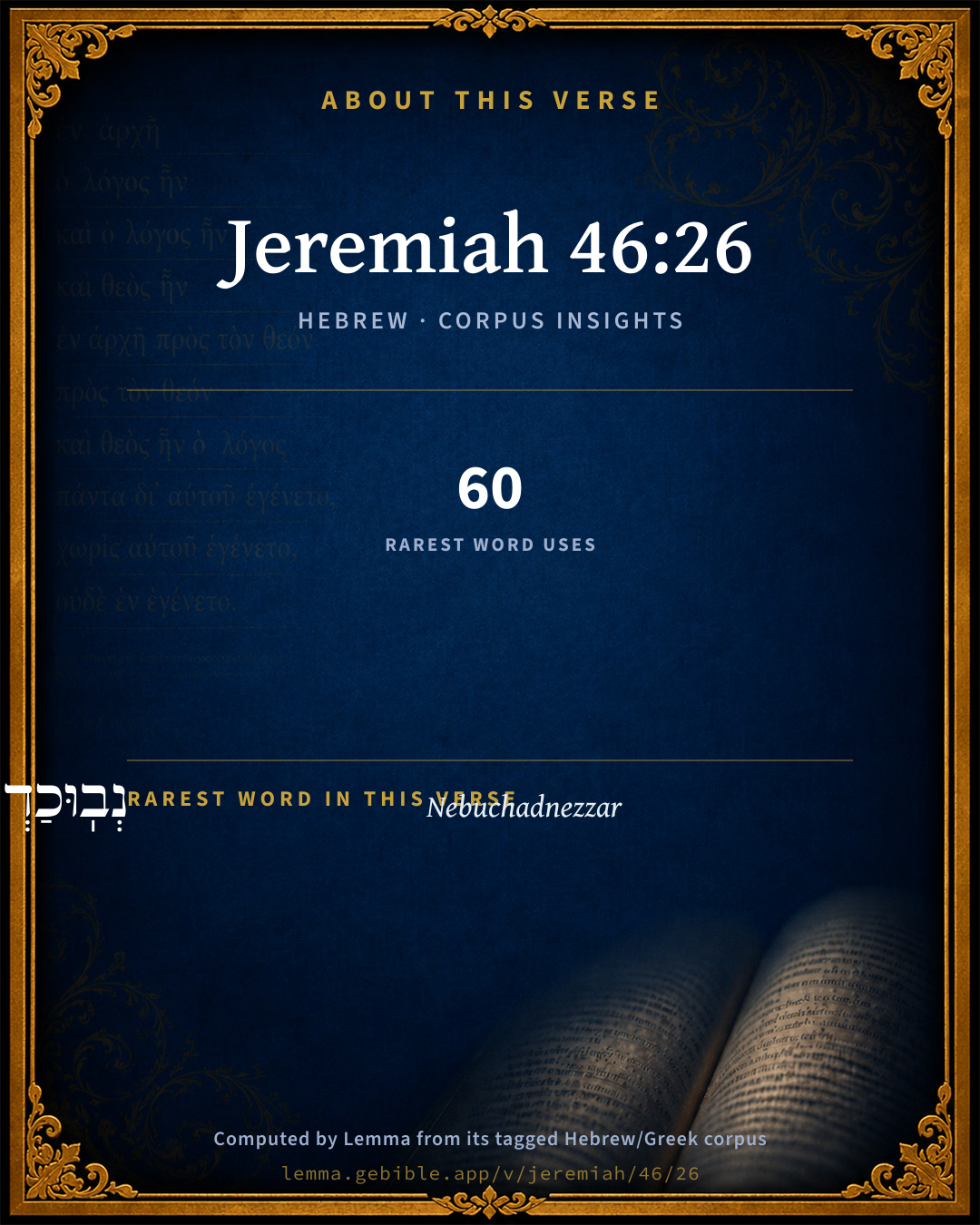
These counts appear in no published source. They are computed here, from the morphology-tagged text and Lemma’s own curated glosses. What Lemma adds →

17
words
15
distinct lemmas
Prophets
section

Shared distinctive vocabulary

נְבֽוּכַדְרֶאצַּ֥ר Nebuchadnezzar H5019 occurs in 58 verses of the Hebrew Bible. Also found in:

Grammatical profile

  • 3 verbs
  • 12 nouns
  • 1 preposition
  • 1 adverb

Verb forms

  • וּנְתַתִּ֗ים Qal · Sequential Perfect
  • מְבַקְשֵׁ֣י Piel · Participle Active
  • תִּשְׁכֹּ֥ן Qal · Imperfect

Repetition

A word recurs within this verse — often emphatic in Hebrew:

  • בְּיַד֙ hand H3027 ×3

Cross-references

5

Topical passages linked to Jeremiah 46:26 in the Treasury of Scripture Knowledge — connected by theme and wording, ordered by reader-vote popularity; previews shown in the World English Bible.

  • Jeremiah 44:30 Thus says Yahweh, Behold, I will give Pharaoh Hophra king of Egypt into the hand of his enemies, and into the hand of those who seek his life; as I gave Zedekiah king of Judah into the hand of Nebuchadrezzar king of Babylon, who was his enemy, and sought his life.
  • Ezekiel 32:11 For thus says the Lord Yahweh: The sword of the king of Babylon shall come on you.
  • Ezekiel 29:8–14 Therefore thus says the Lord Yahweh: Behold, I will bring a sword on you, and will cut off from you man and animal.
  • Jeremiah 48:47 Yet will I bring back the captivity of Moab in the latter days, says Yahweh. Thus far is the judgment of Moab.
  • Jeremiah 49:39 But it shall happen in the latter days, that I will bring back the captivity of Elam, says Yahweh.

Cross-references courtesy of OpenBible.info (CC BY 4.0).

Hebrew and Greek witnesses Masoretic Hebrew ↔ Greek Septuagint

The same verse in the two great witnesses to the Old Testament, shown verse-for-verse.

These are two independent witnesses, not word-aligned to each other, and the Septuagint is shown in lemma (dictionary) form.

Hebrew Jeremiah 46:26 Masoretic · Westminster Leningrad Codex

וּנְתַתִּ֗ים בְּיַד֙ מְבַקְשֵׁ֣י נַפְשָׁ֔ם וּבְיַ֛ד נְבֽוּכַדְרֶאצַּ֥ר מֶֽלֶךְ בָּבֶ֖ל וּבְיַד עֲבָדָ֑יו וְאַחֲרֵי כֵ֛ן תִּשְׁכֹּ֥ן כִּֽימֵי קֶ֖דֶם נְאֻם יְהוָֽה

and I will deliver them into the hand of those who seek their lives, and into the hand of Nebuchadrezzar king of Babylon, and into the hand of his servants; and afterwards it shall be inhabited, as in the days of old, says Yahweh.

World English Bible · Public Domain

Greek LXX Structure differs

In the Septuagint, Jeremiah is about an eighth shorter than the Hebrew and arranges its material differently — the Oracles Against the Nations (Hebrew chapters 46–51) appear in the middle of the Greek book, after 25:13. Because the chapter and verse boundaries do not line up, a verse-for-verse comparison with the Hebrew is not shown.

A verse-for-verse comparison isn’t shown here because the chapters and verses don’t line up. Switch to the LXX edition with the MT / LXX toggle above to read the Greek directly.

Hebrew: Westminster Leningrad Codex (CC BY 4.0). Greek: Septuagint (public domain); English from a public-domain English Septuagint. How the Septuagint differs from the Hebrew →

Targum (Aramaic paraphrase)

1

The Targum is the ancient Jewish Aramaic paraphrase of the Hebrew Scriptures — an interpretive translation, not the Hebrew text itself. Onkelos (literal) and Pseudo-Jonathan (expansive) render the Torah, and Jonathan the Prophets. Coverage is partial: where no permissively-licensed English translation exists for a verse, only the Aramaic is shown. This is verse-level text, not a word-by-word alignment to the Hebrew.

  1. Targum Jonathan Prophets (Joshua–Malachi)
    וְאֶמְסְרִינוּן בְּיַד דְבָעָן לְמִקְטַלְהוֹן וּבְיַד נְבוּכַדְרֶאצַר מַלְכָּא דְבָבֶל וּבְיַד עֲבְדוֹהִי וּבָתַר כֵּן תִּשְׁרֵי כְּיוֹמֵי קֶדֶם אֲמַר יְיָ:

    (no public-domain English translation for this verse)

    Targum Jonathan — Aramaic: “Mikraot Gedolot” (public domain). English: “Sefaria Community Translation” (CC0 1.0 (public-domain dedication)); “London "Chaldee Paraphrase," 1871” (public domain). Text via Sefaria.

Commentary

Notes on Jeremiah 46:26 from classic Christian and Jewish commentators (each source and its license shown beneath its notes). The classic Christian expositions comment on the surrounding passage and are grouped to its opening verse, so a note may address several verses; the Jewish commentaries on the Tanakh (Rashi and others) are per-verse, so they appear only where the commentator wrote on this verse.

Lemma curates 59 commentaries, every one of them public domain or Creative Commons licensed, each selected and text-cleaned for this edition rather than reprinted as found. About our sources →

Trapp's Complete Commentary

John Trapp

Jer 46:26 And I will deliver them into the hand of those that seek their lives, and into the hand of Nebuchadrezzar king of Babylon, and into the hand of his servants: and afterward it shall be inhabited, as in the days of old, saith the LORD.

Ver. 26. Behold, I will punish the multitude of No.] Called populous No, {Nah 3:8} populous as Nineveh; so Galilee of the Gentiles. Some render it nourishing No. {a}

And their kings.] Here Calvin conjectureth that Pharaoh had made many of his princes kings for his greater magnificence; but this came down soon after. A bulging wall is near unto a downfall.

And Pharaoh.] Hophra. {Jer 44:30}

And all them that trust in him.] As the Jews in Egypt did.

And afterward it shall be inhabited.] Forty years after {Eze 29:13} - sc., in the days of Amasis, whom Cambyses the Persian conquered, after which it remained subject to the Persian monarchs one hundred and fifty years, saith Eusebius, being but a base and tributary kingdom.

{a} Hodie dicitur Alexandria. Today it is called Alexandria.

John Trapp, A Commentary or Exposition upon All the Books of the Old and New Testament (1647–1656) — public domain. Text from a community e-Sword module.

Geneva Bible (1599)

Geneva Bible translators

Meaning, that after the space of forty years Egypt should be restored, Isa. 19:23; Ezek. 29:13.

Geneva Bible (1599) marginal notes — public domain. Text via Bolls.life.

Jamieson, Fausset & Brown

Robert Jamieson, A. R. Fausset & David Brown

afterward . . . inhabited--Under Cyrus forty years after the conquest of Egypt by Nebuchadnezzar, it threw off the Babylonian yoke but has never regained its former prowess (Jer 46:11; Eze 29:11-15).

Jamieson, Fausset & Brown — Commentary Critical and Explanatory on the Whole Bible (1871) — public domain (CC PDM 1.0). Text via the HelloAO Bible API.

Adam Clarke's Commentary

Verse 26. Afterward it shall be inhabited] That is, within forty years, as Ezekiel had predicted, Eze 29:13.

Adam Clarke's Commentary on the Bible (1810–1826) — public domain. Text from a community e-Sword/MySword module.

John Calvin's Commentaries

Jeremiah pursues the same subject, and continues to speak in God’s name, that he might more powerfully impress minds otherwise tardy; I will give them, he says, into the hand of enemies, and those deadly enemies; for we have said elsewhere that to “seek life” is not to spare it. Expressed here then is the cruelty of the Chaldean army, as though he had said that they would be deadly enemies to the Egyptians. And he explains himself more fully, and says, Into the hand of the king of Babylon, and into the hand of his servants, so that not only Nebuchadnezzar was to be victorious over Egypt, but also his servants, which was still more degrading.

A promise is at length added, not to shew favor to that heathen nation, but that God might shew that he would be so far merciful towards the Egyptians as not wholly to destroy them. It shall be inhabited, he says, as in ancient days. Ezekiel says that the kingdom would be small and humble or abject. (Ezekiel 29:14, 15.) But our Prophet seems to promise to Egypt the same prosperity as it had before its overthrow. We have already said that restoration was promised to the Egyptians, not because God was pacified towards them, but because his purpose was that his mercy should be made evident in the judgments he executed even on foreign nations; and further, it served to confirm prophecy, when to Egypt, after having been destroyed, was granted that restoration of which Jeremiah had prophesied. The truth, then, of what the Prophet had said became more evident through the two changes, than if he had only said, “God shall destroy Egypt.” We now, then, perceive why the Prophet spoke of the future condition of Egypt. It follows, —

John Calvin's Commentaries (1540-1563) — public domain. Text from the Calvin Translation Society English edition (1840s-50s) via the Christian Classics Ethereal Library (ccel.org). Calvin's coverage is partial (roughly two-thirds of the Bible); uncommented books and verses are honest gaps, never fabricated. The 19th-century editor's footnotes and remarks are omitted so the notes are faithfully Calvin's own voice.

Ellicott's Commentary for English Readers

(26) Afterward it shall be inhabited, as in the days . . .—As in the earlier utterance of Isaiah (Isa_19:21-25) and the contemporary prophecies of Ezekiel (Eze_29:11-16) there is a gleam of hope at the end of the vision of judgment. Egypt was to revive, though not again to take its place among the conquerors and tyrants of the world. (Comp. Jer_48:47; Jer_49:39.)

A Bible Commentary for English Readers, edited by Charles John Ellicott (1878–1897) — public domain. Text from a community e-Sword module.

The Cambridge Bible for Schools and Colleges

gen. ed. J. J. S. Perowne

26. The v. may be well suspected as a gloss by a scribe who desired in the latter part of it to soften the dismal forecast for Egypt, especially as words of corresponding comfort follow for his own people. Cp. Jer_48:47, Jer_49:6; Jer_49:39. Co., however, here (and in ch. 48) maintains the genuineness, comparing for the latter part Eze_29:13 f.

The Cambridge Bible for Schools and Colleges (gen. ed. J. J. S. Perowne; Cambridge University Press, 1878–1918) — public domain. Text from a community e-Sword module.

John Gill's Exposition

And I will deliver them into the hand of those that seek their lives,.... Into the hands of the Chaldeans; that is, the king of Egypt, and all his people, and those that trusted in him:

and into the hand of Nebuchadnezzar king of Babylon, and into the hand of his servants; his general officers, that commanded in his army under him. Berosus (s), the Chaldean, makes mention of Nebuchadnezzar's carrying the Egyptians captive into Babylon;

and afterwards it shall be inhabited, as in the days of old, saith the Lord; after forty years, as Ezekiel prophesied, Jer 29:13; not that it should rise to the same glory and dignity as before, for it would be but a base kingdom; but whereas it was desolate and uninhabited after this destruction, it should now be inhabited again.

(s) Apud Joseph. Antiqu. l. 10. c. 11. sect. 1. & contra Apion, l. 1. c. 19.

John Gill's Exposition of the Whole Bible (1746–1763) — public domain (CC PDM 1.0). Text via the HelloAO Bible API.

Albert Barnes' Notes on the Bible

Afterward ... - The invasion of Nebuchadnezzar is to be a passing calamity, the severity of which will be felt chiefly by the Jews, but no subjugation of Egypt is to be attempted, and after the Chaldaean army has withdrawn things will resume their former course.

Albert Barnes' Notes on the Bible (1834–1885) — public domain. Text from a community e-Sword/MySword module.

Haydock's Catholic Bible Commentary

Afterwards, forty years being expired (Ezechiel xxix. 14.) from the time when Apries made his unsuccessful attack on Cyrene, and his subjects revolted.

George Leo Haydock (1774–1849), Haydock's Catholic Family Bible and Commentary, 1859 edition — public domain. Excludes Psalms (Douay-Rheims chapter numbering differs from Protestant) and Deuterocanonical books (Catholic canon only).

Matthew Poole's English Annotations

The former part of this verse is but the same which the prophet hath often before said. The latter part is a promise for the restoration of Egypt to some degrees of its former prosperity and liberty. The determinate time for the fulfilling of this prophecy is told us, Eze 29:13,14, viz. at the end of forty years. This we are told by civil historians fell out in the time of Amasis, a king of Egypt coevous with Cyrus, who was overcome by Cyrus’s son Cambyses, who brought Egypt to be a province belonging to the Medes and Persians; by the fulfilling of which prophecy the truth both of Jeremiah’s and Ezekiel’s prophecies are justified.

Matthew Poole's English Annotations on the Holy Bible (1683–1685) — public domain. Text from a community e-Sword/MySword module.

The Pulpit Commentary

Afterward it shall be inhabited, etc. After all these gloomy vaticinations, Jeremiah (as elsewhere in this group of prophecies; see Jer_48:47 Jer_49:6, Jer_49:39) opens up a brighter prospect. "In the days of old," patriarchal and unmilitary, the fertile valley of the Nile offered a peaceful and a happy home to its teeming inhabitants; those times shall yet come again. To understand this, we must assume that during its period of depression Egypt has been but sparsely peopled, owing to the large numbers of its inhabitants carried away captive. Another explanation, "afterwards Egypt shall stay at home i.e, "be quiet," though equally justifiable item the point of view of the lexicon, (comp. Jud_1:5:17 Psa_55:7) seems less natural. Possibly Eze_29:13-16 is a development of our passage; it contains a promise of future remission of punishment, though a promise qualified in such a way as to be akin to a threat. The words, "And it shall no more be the confidence of the house of Israel", (Eze_29:16) seem like a comment on Jeremiah"s threat to "Pharaoh, and them that trust in him," in the preceding verse.

Punishment not destruction but purification and preservation.

In ver. 28, in Jer_48:21, and in Jer_49:6, Jer_49:39, we have similar assurances that "afterwards," when God"s judgments have done their work, the chastised and afflicted nations shall be restored. Such promise is here made to Egypt. It is repeated in Eze_29:8-14. And from this reiterated word concerning, not one people only, but so many, we gather the intent and purpose of God in regard to all his punishments which he sends upon men that they are not for men"s destruction, but for their purification and preservation, Note

I SOME OF THE BASES OF THIS BELIEF.

1. Such Scriptures as these now referred to.

2. The salutary results that have followed so much of human suffering. That suffering has shamed indolence, roused energy, stimulated invention, and the results have been safeguards to life and health and general well being, which would never have been thought of or sought after if suffering had not goaded men on. Hence we conclude that such results were intended and ever are by like causes.

3. The fact that God created man. It is incredible that he should create beings whose destiny is an eternity of sin and suffering. If it had been really better for any men that they had never been born, as in this case it undoubtedly would, and as for far less and altogether inadequate reasons we sometimes say it would concerning ourselves or others, then they never would have been born. Our Lord"s word concerning Judas is not to be literally pressed. It was a proverbial expression used concerning especially unhappy or ungodly men.

4. The very name of "Saviour." Christ either is or is not the Saviour of the world. If he be not, but only fain would be, then the name of "Saviour" cannot be truly his. We do not give the names of "deliverer," "saviour," "benefactor," to those who only desire to be such but are not such. We are forced to believe and with what thankfulness we would do so! that he who is called "the Lamb of God" does not merely in wish, but in fact, "take away the sins of the world.

5. The value of the great sacrifice. If it do not reconcile the world unto God, as St. Paul affirms it does, then it is less precious than men have thought. But it is inconceivable that such a sacrifice should fail to accomplish that for which it was especially designed.

6. The express declaration that the Son of God was manifested to destroy the works of the devil. But are not sin and suffering his work? If, then, they be eternal, how can they have been destroyed?

7. The necessity involved in the first and great command, "Thou shalt love the Lord thy God," etc. Now, it is not in the power of the human heart to love any being that it does not conceive as lovable or worthy of love. But a God who created men, knowing that they would eternally sin and suffer, is not lovable by the human heart. What do we say of men who do deeds which they know can only issue in misery and wrong? But is that righteous in God which we should denounce in men? Abhorrendum sit.

II CONCLUSION.

1. Not that there is no such thing as God"s punishment for sin.

2. Nor that that punishment is but a little thing. Ah, no! "It is a fearful thing" for an impenitent unbelieving man "to fall into the hands of the living God." He is a consuming fire to such, and the fire will burn on until all the dross and evil be burnt out. Wellington said, "There is only one thing worse than a great victory, and that is a great defeat." He knew at what cost victory is won. And so there may be only one thing worse than some men"s salvation, and that is that they should be eternally lost.

3. But that we should learn to "love and dread" God. Love him for his gracious purpose towards men, but dread lest we should compel him by our rejection of his gospel to lead us by sterner ways. For he will have all men to be saved and to come to the knowledge of the truth. C.

The Pulpit Commentary (1880–1919), ed. H.D.M. Spence-Jones & Joseph S. Exell — public domain. Text from a community e-Sword module.

Rashi

Rabbi Shlomo Yitzchaki (Rashi)

and after that At the end of forty years, as Ezekiel stated (29:1 3ff.).

Rashi on the Tanakh — English translations: “The Judaica Press complete Tanach with Rashi, translated by A. J. Rosenberg” (CC BY 4.0); “Pentateuch with Rashi's commentary by M. Rosenbaum and A.M. Silbermann, 1929-1934” (public domain); “The Metsudah Tanach series, Lakewood, N.J” (CC BY 4.0); and “The Book of Joshua, Metsudah Publications, 1997” (CC BY 4.0). Text via Sefaria.

Lesson kit

Teaching starters — assembled from the data on this page, not authored interpretation. Every prompt links to the verse data it draws on. Edit before teaching.

Jeremiah, in the Prophets, opens this verse with 17 words (15 distinct Hebrew lemmas). Its most distinctive word is Nᵉbûwkadneʼtstsar (“Nebuchadnezzar”). A historical commentator’s framing appears above. Read the whole chapter for the surrounding context.

Discussion questions

  1. The word Nᵉbûwkadneʼtstsar carries the sense “Nebuchadnezzar.” How does it shape the verse?
  2. How does 2 Kings 24:1, which shares the word «Nebuchadnezzar», read alongside this verse?
  3. What does the repetition of “hand” (3× in this one verse) do in this verse?
  4. These translations render this verse differently. What is at stake in choosing one wording over another?
  5. «וּנְתַתִּ֗ים» is a Qal Sequential Perfect verb. How does that grammatical form shape the action described?
  6. Compare how Trapp's Complete Commentary and Geneva Bible (1599) read this verse. Where do they agree or differ?

Things to notice

Reading settings

Reading text

Shown beneath each verse's original-language words.

Old Testament
Old Testament edition

Read the OT as the Masoretic Hebrew (MT) or the Greek Septuagint (LXX).

English shown for the Greek Septuagint (in the Hebrew ↔ Greek comparison).

Comparing translations? Open the Compare panel on any verse page to stack up to four side by side.