Isaiah 40:20

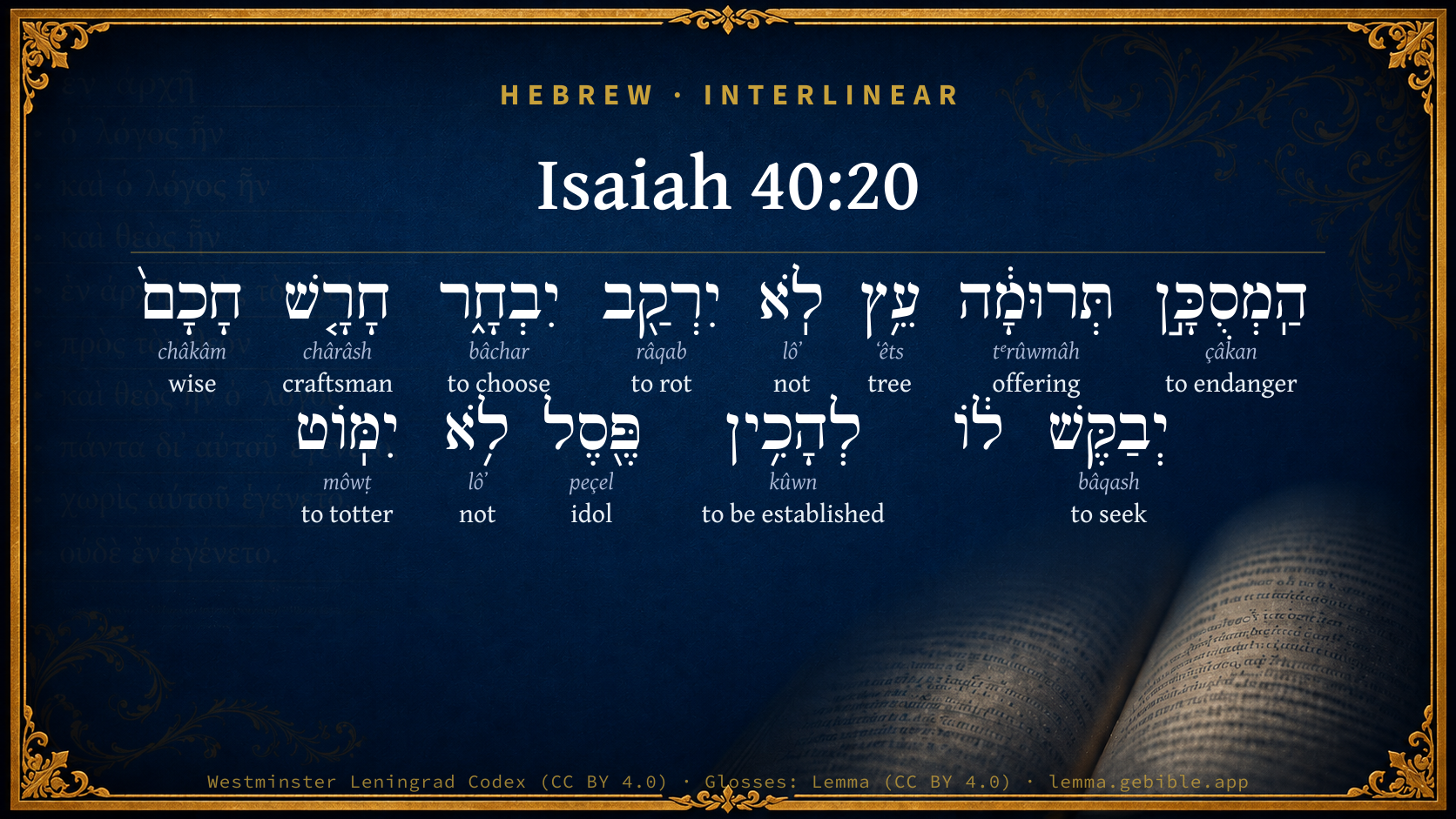
Hebrew (Westminster Leningrad Codex) Isaiah 40:20 appears in the Hebrew Old Testament. The text above is from the Westminster Leningrad Codex. Each word links to its Strong’s number, a concise gloss, and parsing drawn from the Open Scriptures Hebrew Bible morphology. Click any word for its full Brown-Driver-Briggs (BDB) entry.
Download image
Cite this verse

Isaiah 40:20 (World English Bible). Public Domain. Lemma interlinear Bible study tool, https://lemma.gebible.app/v/isaiah/40/20.

Show BibTeX & RIS
BibTeX
RIS
English Translation
He who is too impoverished for [such] an offering chooses a tree that will not rot; he seeks to him a skillful workman to set up an engraved image, that shall not be moved.
World English Bible · Public Domain
Download a study sheet

One document with this verse’s original text, its word-by-word gloss line, the meaning frame, cross-references with their text, attributed commentary, and full source and license credits — printable, and it pastes into notes with its structure intact.

This verse Autodidact and up

Study sheet (.html) Plain text (.txt)

A passage Seminary Student

Up to 50 verses in one chapter. A passage sheet keeps up to 6 commentary sources and 12 cross-references per verse, in the order this page ranks them, and says so on the sheet whenever that leaves anything out. Ask for a single verse and you get the Autodidact verse sheet above.

Everything on this page stays free to read, with no account — the sheet is a download of what is already on screen, not access to it.

Want to remove ads? Support Godless Engineer
Compare translations 3

The same verse in 3 English versions, stacked beneath the original-language interlinear above. Click any original word for its lexicon entry.

Each is an independent rendering of the whole verse — the interlinear is not word-aligned to these translations.

Highlighted words mark where these versions differ — a whole-verse word diff, not a word-by-word alignment.

  • World English Bible Public Domain
    He who is too impoverished for [such] an offering chooses a tree that will not rot; he seeks to him a skillful workman to set up an engraved image, that shall not be moved.
  • King James Version Public Domain
    He that is so impoverished that he hath no oblation chooseth a tree that will not rot; he seeketh unto him a cunning workman to prepare a graven image, that shall not be moved.
  • unfoldingWord Literal Text CC BY-SA 4.0
    The one impoverished a contribution chooses wood will not rot. He seeks for himself a skillful craftsman to set up an idol will not be moved. q1

unfoldingWord Literal Text — © unfoldingWord, licensed CC BY-SA 4.0. Word-aligned USFM3 via Door43 (git.door43.org/unfoldingWord/en_ult).

Versions to compare (up to 4)

3 of 4 selected

Show all 18 translations

Every available English version of this verse, each an independent rendering of the whole verse.

  • World English Bible Public Domain
    He who is too impoverished for [such] an offering chooses a tree that will not rot; he seeks to him a skillful workman to set up an engraved image, that shall not be moved.
  • Berean Standard Bible Public Domain
    To one bereft of an offering who chooses wood that will not rot, who seeks a skilled craftsman to set up an idol that will not topple?
  • Majority Standard Bible Public Domain
    One lacking such an offering chooses wood that will not rot. He seeks a skilled craftsman to set up an idol that will not topple.
  • King James Version Public Domain
    He that is so impoverished that he hath no oblation chooseth a tree that will not rot; he seeketh unto him a cunning workman to prepare a graven image, that shall not be moved.
  • American Standard Version (1901) Public Domain
    He that is too impoverished for `such' an oblation chooseth a tree that will not rot; he seeketh unto him a skilful workman to set up a graven image, that shall not be moved.
  • Revised Version (1885) Public Domain
    He that is too impoverished for such an oblation chooseth a tree that will not rot; he seeketh unto him a cunning workman to set up a graven image, that shall not be moved.
  • Geneva Bible (1599) Public Domain
    Doeth not the poore chuse out a tree that will not rot, for an oblation? he seeketh also vnto him a cunning workeman, to prepare an image, that shall not be moued.
  • Douay-Rheims (1899) Public Domain
    He hath chosen strong wood, and that will not rot: the skilful workman seeketh how he may set up an idol that may not be moved.
  • Young's Literal Translation Public Domain
    He who is poor `by' heave-offerings, A tree not rotten doth choose, A skilful artizan he seeketh for it, To establish a graven image -- not moved.
  • Literal Standard Version CC BY-SA 4.0
    He who is poor [by] raised-offerings, || Chooses a tree [that is] not rotten, || He seeks a skillful artisan for it, || To establish a carved image—not moved.
  • Unlocked Literal Bible CC BY-SA 4.0
    To make an offering one chooses a wood that will not rot; he seeks a skillful artisan to make an idol that will not fall over.
  • unfoldingWord Literal Text CC BY-SA 4.0
    The one impoverished a contribution chooses wood will not rot. He seeks for himself a skillful craftsman to set up an idol will not be moved. q1
  • Darby Bible Public Domain
    He that is impoverished, so that he hath no offering, chooseth a tree that doth not rot; he seeketh unto him a skilled workman to prepare a graven image that shall not be moved.
  • World Messianic Bible Public Domain
    He who is too impoverished for such an offering chooses a tree that will not rot. He seeks a skillful workman to set up a carved image for him that will not be moved.
  • Webster's Bible Public Domain
    He that is so impoverished that he hath no oblation chooseth a tree that will not rot; he seeketh for himself a skillful workman to prepare a graven image that shall not be moved.
  • Free Bible Version CC BY-SA 4.0
    Those who are too poor to pay for that choose wood that won't rot, then they look for a skilled wood-carver to make an idol that won't fall over.
  • Bible in Basic English Public Domain
    The wise workman makes selection of the mulberry-tree of the offering, a wood which will not become soft; so that the image may be fixed to it and not be moved.
  • JPS Tanakh (1917) Public Domain
    A holm-oak is set apart, he chooseth a tree that will not rot; he seeketh unto him a cunning craftsman to set up an image, that shall not be moved.

Literal Standard Version (2020), Covenant Press — licensed CC BY-SA 4.0. Text via the HelloAO Bible API (eBible.org). Unlocked Literal Bible (unfoldingWord) — licensed CC BY-SA 4.0. Text via the HelloAO Bible API (eBible.org). unfoldingWord Literal Text — © unfoldingWord, licensed CC BY-SA 4.0. Word-aligned USFM3 via Door43 (git.door43.org/unfoldingWord/en_ult). Free Bible Version, Dr. Jonathan Gallagher — licensed CC BY-SA 4.0. Text via the HelloAO Bible API (eBible.org).

Word by word

More ways to search: Search by grammar → Find every occurrence → Compare this word →

Practice this passage: Drill this verse → Learn its vocabulary →

הַֽמְסֻכָּ֣ן
çâkan
H5533
“the · endangered”
Particle, Definite Article + Verb, Pual, Participle Passive, Masculine, Singular, Absolute
Part of Speech
Particle + Verb
Stem
Pual
Form
Participle Passive
Gender
Masculine
Number
Singular
State
Absolute
Full BDB Definition

Origin: probably a denominative from H7915

TWOT: 1495 , 1496

to incur danger - (Niphal) to endanger oneself - to be poor - (Pual) to be impoverished
  1. תְּרוּמָ֔ה tᵉrûwmâh H8641 “offering” Noun, Common, Feminine, Singular, Absolute
  2. עֵ֥ץ ʻêts H6086 “tree” Noun, Common, Masculine, Singular, Absolute
  3. לֹֽא lôʼ H3808 “not” Particle, Negative
  4. יִרְקַ֖ב râqab H7537 “to rot” Verb, Qal, Imperfect, 3rd Person, Masculine, Singular
  5. יִבְחָ֑ר bâchar H977 “to choose” Verb, Qal, Imperfect, 3rd Person, Masculine, Singular
  6. חָרָ֤שׁ chârâsh H2796 “craftsman” Noun, Common, Masculine, Singular, Absolute
  7. חָכָם֙ châkâm H2450 “wise” Adjective, Adjective, Masculine, Singular, Absolute
  8. יְבַקֶּשׁ bâqash H1245 “to seek” Verb, Piel, Imperfect, 3rd Person, Masculine, Singular
  9. לְהָכִ֥ין kûwn H3559 “to be established” Preposition + Verb, Hiphil, Infinitive Construct
  10. פֶּ֖סֶל peçel H6459 “idol” Noun, Common, Masculine, Singular, Absolute
  11. לֹ֥א lôʼ H3808 “not” Particle, Negative
  12. יִמּֽוֹט môwṭ H4131 “to totter” Verb, Niphal, Imperfect, 3rd Person, Masculine, Singular

About this verse

These counts appear in no published source. They are computed here, from the morphology-tagged text and Lemma’s own curated glosses. What Lemma adds →

14
words
12
distinct lemmas
Prophets
section

Notable vocabulary

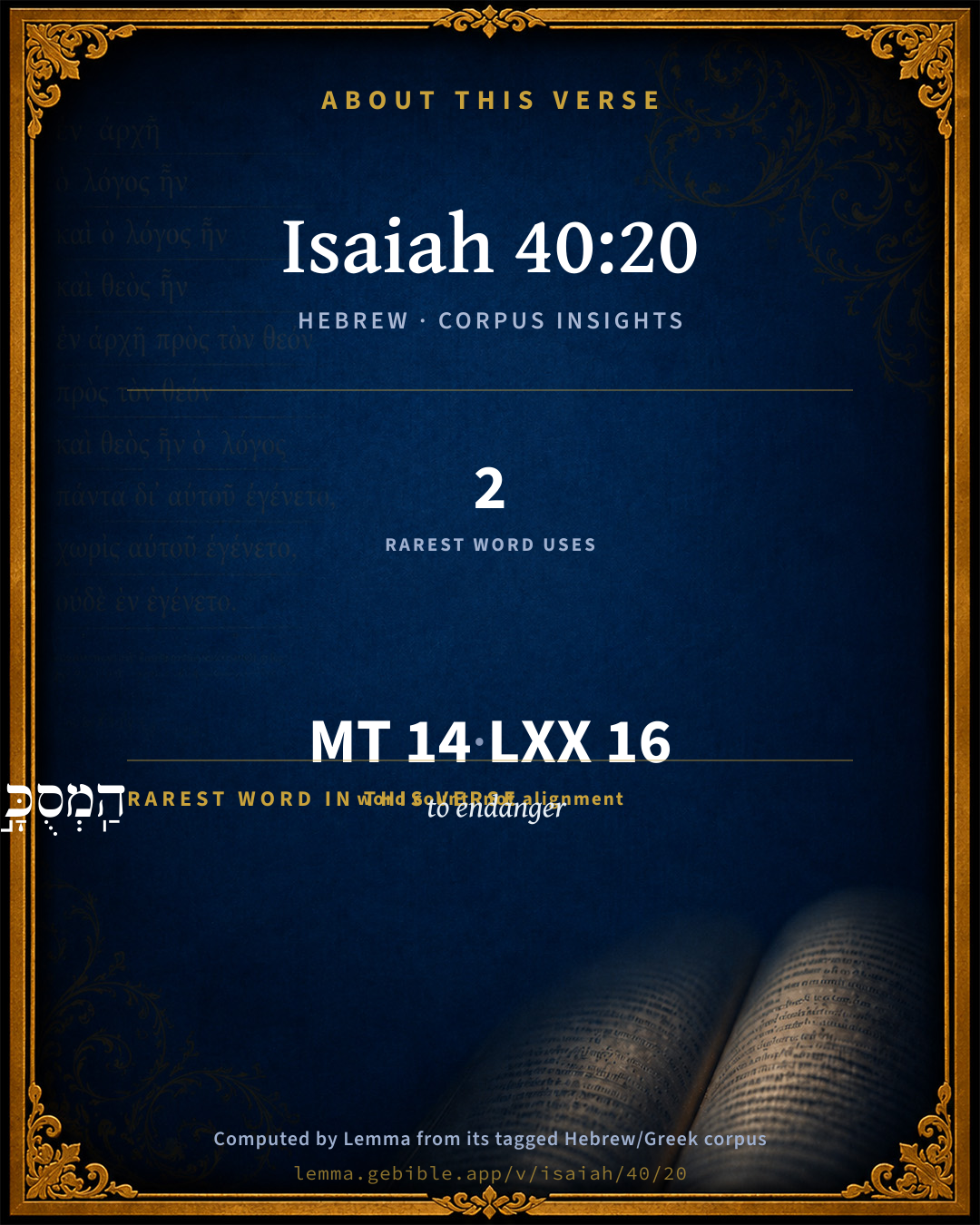
The rarest word here is הַֽמְסֻכָּ֣ן to endanger H5533 — appearing just 2 times in the whole Hebrew Bible.

Shared distinctive vocabulary

הַֽמְסֻכָּ֣ן to endanger H5533 occurs in 2 verses of the Hebrew Bible. Also found in:

Grammatical profile

  • 6 verbs
  • 4 nouns
  • 1 adjective
  • 1 preposition
  • 2 particles

Verb forms

  • הַֽמְסֻכָּ֣ן Pual · Participle Passive
  • יִרְקַ֖ב Qal · Imperfect
  • יִבְחָ֑ר Qal · Imperfect
  • יְבַקֶּשׁ Piel · Imperfect
  • לְהָכִ֥ין Hiphil · Infinitive Construct
  • יִמּֽוֹט Niphal · Imperfect

Repetition

A word recurs within this verse — often emphatic in Hebrew:

Hebrew & Septuagint length

In English translation the verse runs 34 words from the Hebrew and 31 from the Septuagint (LXX English) — closely comparable.

A rough comparison of the two English renderings, which tokenize alike — not a word-level alignment.

Word counts can differ between the Hebrew and the Greek without any difference in meaning — e.g. the Hebrew direct-object marker אֵת has no separate Greek word, and Greek often adds the article ὁ.

In the original languages it is 14 Hebrew tokens and 16 Greek tokens — but the two are counted differently (Hebrew bundles its prefixes and suffixes into one token; the Greek is in lemma form), so that isn’t a like-for-like length.

Cross-references

7

Topical passages linked to Isaiah 40:20 in the Treasury of Scripture Knowledge — connected by theme and wording, ordered by reader-vote popularity; previews shown in the World English Bible.

  • Isaiah 41:7 So the carpenter encourages the goldsmith, [and] he who smoothes with the hammer him who strikes the anvil, saying of the soldering, It is good; and he fastens it with nails, that is should not be moved.
  • Isaiah 46:7 They bear it on the shoulder, they carry it, and set it in its place, and it stands, from its place it shall not move: yes, one may cry to it, yet it can not answer, nor save him out of his trouble.
  • Jeremiah 10:3–4 For the customs of the peoples are vanity; for one cuts a tree out of the forest, the work of the hands of the workman with the axe.
  • Isaiah 2:8–9 Their land also is full of idols. They worship the work of their own hands, That which their own fingers have made.
  • Daniel 5:23 but have lifted up yourself against the Lord of heaven; and they have brought the vessels of his house before you, and you and your lords, your wives and your concubines, have drunk wine from them; and you have praised the gods of silver and gold, of brass, iron, wood, and stone, which don't see, nor hear, nor know; and the God in whose hand your breath is, and whose are all your ways, you have not glorified.
  • 1 Samuel 5:3–4 When they of Ashdod arose early on the next day, behold, Dagon was fallen on his face to the ground before the ark of Yahweh. They took Dagon, and set him in his place again.
  • Isaiah 44:13–19 The carpenter stretches out a line; he marks it out with a pencil; he shapes it with planes, and he marks it out with the compasses, and shapes it after the figure of a man, according to the beauty of a man, to dwell in a house.

Cross-references courtesy of OpenBible.info (CC BY 4.0).

Hebrew and Greek witnesses Masoretic Hebrew ↔ Greek Septuagint

The same verse in the two great witnesses to the Old Testament, shown verse-for-verse.

These are two independent witnesses, not word-aligned to each other, and the Septuagint is shown in lemma (dictionary) form.

Hebrew Isaiah 40:20 Masoretic · Westminster Leningrad Codex

הַֽמְסֻכָּ֣ן תְּרוּמָ֔ה עֵ֥ץ לֹֽא יִרְקַ֖ב יִבְחָ֑ר חָרָ֤שׁ חָכָם֙ יְבַקֶּשׁ ל֔וֹ לְהָכִ֥ין פֶּ֖סֶל לֹ֥א יִמּֽוֹט

He who is too impoverished for [such] an offering chooses a tree that will not rot; he seeks to him a skillful workman to set up an engraved image, that shall not be moved.

World English Bible · Public Domain

Greek LXX Isaiah 40:20 Septuagint · lemma form

ξύλον γάρ ἄσηπτος ἐκλέγω τέκτων καί σοφῶς ζητέω πῶς ἵστημι αὐτός εἰκών καί ἵνα μή σαλεύω

For the artificer chooses out a wood that will not rot, and will wisely enquire how he shall set up his image, and that so that it should not be moved.

LXX2012 (modern English Septuagint) · Public Domain

On this verse, The Cambridge Bible for Schools and Colleges discusses the Septuagint’s reading. Read the note in Commentary ↓

Hebrew: Westminster Leningrad Codex (CC BY 4.0). Greek: Septuagint (public domain); English from LXX2012 (modern English Septuagint) (Public Domain). How the Septuagint differs from the Hebrew →

Targum (Aramaic paraphrase)

1

The Targum is the ancient Jewish Aramaic paraphrase of the Hebrew Scriptures — an interpretive translation, not the Hebrew text itself. Onkelos (literal) and Pseudo-Jonathan (expansive) render the Torah, and Jonathan the Prophets. Coverage is partial: where no permissively-licensed English translation exists for a verse, only the Aramaic is shown. This is verse-level text, not a word-by-word alignment to the Hebrew.

  1. Targum Jonathan Prophets (Joshua–Malachi)
    אוֹרָן בָּרֵי אָעָא דְלָא אָחִיד בֵּיהּ רִקְבָא בָּחַר נַגַר אוּמַן בְּעֵי לֵיהּ לְאַתְקָנָא צְלַם דְלָא יִצְטְלֵי:

    He cuts a wild ash of the forest, which rottenness will seize; he procures a skilful artist to fix the image, that it be not moved.

    Targum Jonathan — Aramaic: “Mikraot Gedolot” (public domain). English: “Sefaria Community Translation” (CC0 1.0 (public-domain dedication)); “London "Chaldee Paraphrase," 1871” (public domain). Text via Sefaria.

Commentary

Notes on Isaiah 40:20 from classic Christian and Jewish commentators (each source and its license shown beneath its notes). The classic Christian expositions comment on the surrounding passage and are grouped to its opening verse, so a note may address several verses; the Jewish commentaries on the Tanakh (Rashi and others) are per-verse, so they appear only where the commentator wrote on this verse.

Lemma curates 59 commentaries, every one of them public domain or Creative Commons licensed, each selected and text-cleaned for this edition rather than reprinted as found. About our sources →

Trapp's Complete Commentary

John Trapp

Isa 40:20 He that [is] so impoverished that he hath no oblation chooseth a tree [that] will not rot; he seeketh unto him a cunning workman to prepare a graven image, [that] shall not be moved.

Ver. 20. He that is so impoverished - chooseth a tree.] Which therehence may well say, -

“ Olim truncus eram ficulnus, inutile lignum,

Cum faber incertus scamnum, faceretne Priapum,

Maluit esse Deum; Deus inde ego: ” --

He chooseth a tree that will not rot.] Which yet is hard to do; the cypress tree is most likely. But what goodly gods were those that could not keep themselves from rotting.

A cunning workman.] Somewhat better than he who made the ugly rood of Cockram, whereof when they complained to the Mayor of Doncaster, he advised them to clap a pair of horns on the head of it, and then instead of a god, it would make an excellent devil.

John Trapp, A Commentary or Exposition upon All the Books of the Old and New Testament (1647–1656) — public domain. Text from a community e-Sword module.

The Biblical Illustrator

Joseph S. Exell

Isa_40:20

A graven image

An image that will not totter

If an idol leant over or fell that was the very worst of omens; cf the case of Dagon.

(Prof. G. A. Smith, D. D.)

The absurdity of idolatry

A wooden image, planed smooth below and heavier than above, so as not to upset at every push, is to be a god! (F. Delitzsch, D. D.)

The helplessness of graven images

When John Knox was a prisoner in France, the officers brought to him a painted board, which they called Our Lady, and commanded him to kiss it. They violently thrust it into his face, and put it betwixt his hands, who, seeing the extremity, took the idol, and advisedly looking about, he cast it into the river and said, Let Our Lady now save herself; she is light enough; let her learn to swim! After that was no Scotsman urged with that idolatry. (Knox, History of the Reformation.)

The Biblical Illustrator, edited by Joseph S. Exell (c. 1880s–1900s) — public domain. Text from a community e-Sword module.

Keil & Delitzsch

C. F. Keil & F. Delitzsch

This is the origin of a metal idol. The wooden idol is described in Isa 40:20 : "The man who is impoverished in oblations, he chooseth a block of wood that will not rot; he seeketh for himself a skilful smith, to prepare an idol that will not shake." He who has fallen into such poverty that he can only offer to his God a poor oblation (terūmâh, accusative, according to Ewald, 284, c), has an idol cut for himself out of a block of wood. That sâkhan (Arab. sakana or sakuna)

(Note: Both forms occur in this sense, according to the evidence of original sources, with the common imperative yaskunu, the infinitive sukūne passed over by Freytag, the verbal substantive maskane, and the adjective miskin or meskin, primarily to be forced to inactivity through weakness, destitution, or outward influences, not to be able to move and exert one's self; or, more particularly, not to be able to defend one's self (as it were to be obliged to sit still or keep still). Hence more especially opibus et facultatibus carens, being in distress, destitute, poor.)

is an ancient word, is evident from Deu 8:9. The verb yimmōt, like yittōl in Isa 40:15, is a fut. niphal, to be made to shake. A wooden image, which is planed at the bottom, and made heavier below than above, to prevent its falling over with every shock, is to be a god! The thing carries its own satire, even when described with the greatest seriousness.

Keil & Delitzsch — Biblical Commentary on the Old Testament (1861–1891) — public domain (CC PDM 1.0). Text via the HelloAO Bible API. (Old Testament only.)

Tyndale Open Study Notes

Tyndale Open Resources

40:20 image that won’t fall down: This is a sarcastic remark; it would be embarrassing if the idol did not even have the power to remain standing (see 40:18; 41:7; 1 Sam 5:4).

Tyndale Open Study Notes — © Tyndale Open Resources, licensed CC BY-SA 4.0. Text via the HelloAO Bible API.

Geneva Bible (1599)

Geneva Bible translators

He showeth the rage of the idolaters, seeing that the poor that have not to suffice their own necessities, will defraud themselves to serve their idols.

Geneva Bible (1599) marginal notes — public domain. Text via Bolls.life.

Jamieson, Fausset & Brown

Robert Jamieson, A. R. Fausset & David Brown

impoverished--literally, "sunk" in circumstances.

no oblation--he who cannot afford to overlay his idol with gold and silver (Isa 40:19).

tree . . . not rot--the cedar, cypress, oak, or ash (Isa 44:14).

graven--of wood; not a molten one of metal.

not be moved--that shall be durable.

Jamieson, Fausset & Brown — Commentary Critical and Explanatory on the Whole Bible (1871) — public domain (CC PDM 1.0). Text via the HelloAO Bible API.

Adam Clarke's Commentary

Verse 20. Chooseth a tree that will not rot] For what? To make a god out of it! The rich we find made theirs of gold and silver; the poor man was obliged to put up with a wooden god! From the words "he that hath no oblation chooseth a tree," we may learn that the gold and silver necessary to make the graven image was first dedicated, and then formed into a god! How stupid is idolatry! Strange that these people did not perceive that there could be no help in these molten and wooden idols!

Adam Clarke's Commentary on the Bible (1810–1826) — public domain. Text from a community e-Sword/MySword module.

Ellicott's Commentary for English Readers

(20) He that is so impoverished . . .—The transition is abrupt, but the intention apparently is to represent idolatry at its opposite extremes of the elaborate art in which kings and princes delighted, and the rude rough image, hardly more than a fetiche, the inutile lignum of Horace, “which cannot be moved,” standing on its own wide base, so as not to fall.

A Bible Commentary for English Readers, edited by Charles John Ellicott (1878–1897) — public domain. Text from a community e-Sword module.

The Cambridge Bible for Schools and Colleges

gen. ed. J. J. S. Perowne

20. He that is so … oblation] R.V. He that is too impoverished for such an oblation (lit. impoverished with respect to an oblation). If the text be sound this seems the only possible interpretation, although the whole sense turns on the word “such” which is in no way expressed. Moreover the technical tìrûmâh (temple-oblation) has no appropriateness here. The LXX. appear to have read tìmûnâh (ὁμοίωμα), which looks more promising, but leaves the word for “impoverished” (מְסֻכָּן) more unintelligible than ever. Jerome gives the information that mìṣukkân is a durable kind of wood (see Vulg. “lignum imputribile”); and this has led some to connect it with an Assyrian word, musukkânu (= palm-tree). The Targ. gives “he cutteth down a laurel-tree,” apparently taking מסכן as a denominative from סַכִּין (= knife). This shews at least that there was no reliable Jewish tradition as to the meaning of the word. Duhm, combining the hints of the Targ. and the LXX., obtains a reading which is as good as any that can be suggested: “He who carves an image.” The transition from the metal to the wooden idol is thus more distinctly expressed.

a tree that will not rot] Such as those named in ch. Isa_44:14. A weak parody of Eternity!

that shall not be moved] that will not totter. See 1Sa_5:3-4; cf. Wisd. Sol. 13:15 f.

The Cambridge Bible for Schools and Colleges (gen. ed. J. J. S. Perowne; Cambridge University Press, 1878–1918) — public domain. Text from a community e-Sword module.

John Gill's Exposition

He that is so impoverished that he hath no oblation,.... Who is so poor that he cannot bring an offering to his God, yet he will have one; and though he cannot purchase a golden or silver one, or one that is gilt, and adorned with either; yet he will have a wooden one, as follows. Some render it, "he that is set over the oblation", which Aben Ezra mentions; that was over the treasury, where the oblations were; the Heathen priest, whose business it was from thence to procure idols to worship. Jerom takes the word to be the name of a tree that will not rot; and so the Targum renders it,

"he cuts down an ash:''

but the word is descriptive of an idol worshipper; and, according to Gussetius (x), signifies one that by custom and repeated acts has got skill in such things; and so Jarchi: hence

he chooseth a tree that will not rot: he goes to the forest, and chooses the best tree for his purpose he can find, even one that will not rot, as the cypress; and though he cannot get an idol made of metal, but is forced to have one of wood, yet he will get the best he can, that will last longest, an incorruptible deity, as he fancies:

he seeketh unto him a cunning workman, to prepare a graven image that shall not be moved: having decided upon his tree, and what sort of wood to make his god of, he looks out for an ingenious carpenter and carver, a good workman, to make it in the form of an image, and grave, or rather carve it, in the best manner he can, and then fasten it in a proper place, that it may not fall; a poor helpless deity, that cannot secure itself, and much less be of any service to its worshippers.

(x) Ebr Comment. p. 558.

John Gill's Exposition of the Whole Bible (1746–1763) — public domain (CC PDM 1.0). Text via the HelloAO Bible API.

Albert Barnes' Notes on the Bible

He that is so impoverished - So poor. So it is generally supposed that the word used here is to be understood, though interpreters have not been entirely agreed in regard to its signification. The Septuagint renders the phrase, ‘The carpenter chooseth a sound piece of wood.’ The Chaldee. ‘He cuts down an ash, a tree which will not rot.’ Vulgate, ‘Perhaps he chooses a tree which is incorruptible.’ Jarchi renders it, ‘He who is accustomed to examine, and to judge between the wood which is durable, and other wood.’ But the signification of the word (from סכן sâkan, “to dwell, to be familiar with anyone”) given to it by our translators, is probably the correct one, that of being too poor to make a costly oblation. This notion of poverty, Gesenius supposes, is derived from the notion of being seated; and thence of sinking down from languor or debility; and hence, from poverty or want.

That he hath no oblation - No offering; no sacrifice; no rich gift. He is too poor to make such an offering to his god as would be implied in an idol of brass or other metal, richly overlaid with plates of gold, and decorated with silver chains. In Isa 40:19, the design seems to have been to describe the more rich and costly idols that were made; in this, to describe those that were made by the poor who were unable to offer such as were made of brass and gold. The word ‘oblation,’ therefore, that is, offering, in this place, does not denote an offering made to the true God, but an offering made to an idol, such as an image was regarded to be. He could not afford a rich offering, and was constrained to make one of wood.

Chooseth a tree that will not rot - Wood that will be durable and permanent. Perhaps the idea is, that as he could not afford one of metal, he would choose that which would be the most valuable which he could make - a piece of wood that was durable, and that would thus show his regard for the god that he worshipped. Or possibly the sense may be, that he designed it should not be moved; that he expressed a fixed and settled determination to adhere to the worship of the idol; and that as he had no idea of changing his religion, the permanency and durability of the wood would be regarded as a somewhat more acceptable expression of his worship.

A cunning workman - Hebrew, ‘A wise artificer;’ a man skilled in the art of carving, and of making images.

A graven image - An image engraved or cut from wood, in contradistinction from one that is molten or made from metals.

That shall not be moved - That shall stand long, as the expression of his devotion to the service of the idol. The wood that was commonly employed for this purpose as being most durable, as we learn from Isa 44:14, was the cedar, the cypress, or the oak (see the note in that place). The phrase, ‘shall not be moved,’ does not refer so much to its being fixed in one place, as to its durability and permanency.

Albert Barnes' Notes on the Bible (1834–1885) — public domain. Text from a community e-Sword/MySword module.

Haydock's Catholic Bible Commentary

Wood. Hebrew hamsuccan, (Haydock) which Septuagint, Chaldean, and St. Jerome explain of a sort of wood used for idols. Moderns take it to be "a rich," or rather "a poor man. He who is mean in his offering, chooses wood that," &c. (Calmet) (Protestants)

George Leo Haydock (1774–1849), Haydock's Catholic Family Bible and Commentary, 1859 edition — public domain. Excludes Psalms (Douay-Rheims chapter numbering differs from Protestant) and Deuterocanonical books (Catholic canon only).

Matthew Poole's English Annotations

That he hath no oblation; that he can hardly procure money sufficient to buy the meanest sacrifice for his God.

He seeketh unto him a cunning workman; he is so mad upon his idols, that he will one way or other find money to procure the choicest materials, and the help of the best artist, to make his idol.

That shall not be moved; which after all this cost and art cannot stir one step out of its place to give you any help.

Matthew Poole's English Annotations on the Holy Bible (1683–1685) — public domain. Text from a community e-Sword/MySword module.

Whedon's Commentary on the Bible

Daniel D. Whedon

20. Chooseth a tree — Now for the wooden idol, and the most cunning workman sought for graver! See Isa_44:14.

Daniel D. Whedon (gen. ed.), Commentary on the Old and New Testaments (1874–1909) — public domain. Text from a community e-Sword module.

The Pulpit Commentary

He that is so impoverished, etc.; rather, he that can only make a poor offering, i.e. that cannot spend much on religion. Chooseth a tree; rather, chooseth wood goes to the carpenter, and selects a good sound block of wood, out of which his idol shall be made. After this he has to find a skilful workman, who will carve his image for him and set it up, so that it shall not shake. As Delitzsch observes, "The thing carries its own satire" in the mere plain description of it. Is such a thing comparable to God?

The distinguishing love of God.

"He calleth them all by names by the greatness of his might "for that he is strong in power." The infinitude of God is no argument at all against his observance of the individual and the minute; rightly regarded, it is a strong inference in favour of it. Because he is infinite in wisdom he compasses all that is most vast and extensive; and for the same reason, "by the greatness of his might, for that he is strong in power he has a perfect mastery over all the particulars of his creation. He not only summons the mighty armies of the skies and marshals the whole host of heaven, but he is familiar with each separate star: "He calleth them all by names." This individual attention applies to:

1. The inanimate creation (text).

2. The sentient, unintelligent creation: "Not a sparrow falls to the ground" etc.; and this fact constitutes a strong reason for forbearing from cruelty towards every living creature, and for treating all the members of the animal world with constant kindness.

3. The whole human world. Even if this doctrine were not true in other realms, it certainly must be in this. As we could not think and feel as we wish to do of the human father who failed to distinguish his children from each other, so also could we not reverence and love the heavenly Father if he failed to distinguish us. But he does not fail; "he mils us all by names;" he is the true and good Shepherd, who "calls his own sheep by name." Each one of us is:

(1) The object of his Divine thought and care. Every child of man can say, "The Lord thinketh on me.

(2) The object of his parental yearning. Away in the far country, each prodigal may be sure that there is a wronged, waiting, expectant Father, who is grieved concerning him, and who earnestly remembers him still.

(3) The object of his redeeming and self-sacrificing love. "He loved me, and gave himself for me," we can all say, after the apostle.

(4) The object of his disciplinary dealing. "Whom the Lord loves he chastens, and scourges every son," etc.

(5) The object of his desire that we should share his work and his glory. To each of his disciples he says, "Follow thou me; Go thou, and work in my vineyard. C.

The Pulpit Commentary (1880–1919), ed. H.D.M. Spence-Jones & Joseph S. Exell — public domain. Text from a community e-Sword module.

John Wesley's Explanatory Notes

He - That can hardly procure money to buy a sacrifice. Chuseth - He is so mad upon his idols, that he will find money to procure the choicest materials, and the best artist to make his idol. An image - Which after all this cost, cannot stir one step out of its place to give you any help.

John Wesley, Explanatory Notes Upon the Whole Bible (1754–1765) — public domain. Text via the GEBible commentary corpus.

J. A. Alexander on Isaiah

Joseph Addison Alexander

“(As for) the (man) impoverished (by) offering, a tree (that) will not rot he chooses, a wise carver he seeks for it, to set up an image (that) shall not be moved.” While the rich waste their gold and silver upon idols, the poor are equally extravagant in wood. To say that the poor man uses wood instead of gold and silver, is coherent and appropriate, but far less significant and striking than to say, that the man who has already reduced himself to want by lavish gifts to his idol, still continues his devotions, and as he no longer can afford an image of the precious metals, is resolved at least to have a durable wooden one. Thus understood, the verse adds to the general description a particular trait highly expressive of the folly of idolaters. ‘Wise’ is here used in what appears to be its primary meaning of artistically skilful. See note on "Isa 3:3".

Joseph Addison Alexander, The Prophecies of Isaiah (1846–1847; New York: Scribner, 1870–1878) — public domain. Text from a community e-Sword module.

Rashi

Rabbi Shlomo Yitzchaki (Rashi)

He who is accustomed to select הַמְסֻכָּן תְּרוּמָה. Or, if he comes to make it of wood, one who is accustomed to discern between a durable tree and other trees, chooses a tree that does not decay quickly.

He who is accustomed Heb. הַמְסֻכָּן. Comp. (Num. 22:30) “Have I been accustomed (הַהַסְכֵּן הִסְכַּנְתִּי)?”

to select Heb. תְּרוּמָה, separation, selection of the trees.

Rashi on the Tanakh — English translations: “The Judaica Press complete Tanach with Rashi, translated by A. J. Rosenberg” (CC BY 4.0); “Pentateuch with Rashi's commentary by M. Rosenbaum and A.M. Silbermann, 1929-1934” (public domain); “The Metsudah Tanach series, Lakewood, N.J” (CC BY 4.0); and “The Book of Joshua, Metsudah Publications, 1997” (CC BY 4.0). Text via Sefaria.

Ibn Ezra

Rabbi Abraham ibn Ezra

המסכן תרומה Some explain מסכן to be identical with סוכן treasurer (22:15), and supply מסכן: the treasurer, namely, the treasurer of the oblation. According to others מסכן is an adjective; That which is stored up, namely the oblation, of which to make an image;

the third person in יבחר he chooseth is explained by them to refer to the owner of the oblation.

To prepare a graven image that shall not be moved. To fasten it with nails.

Ibn Ezra on the Tanakh — English translations: “Sefaria Community Translation” (CC0 1.0 (public-domain dedication)); “Yalkut, Sifsei Chachomim Chumash, Metsudah Publications, 2009” (CC BY 4.0); and “Commentary of Ibn Ezra on Isaiah - trans. by M. Friedlander, 1873” (public domain). Text via Sefaria.

Lesson kit

Teaching starters — assembled from the data on this page, not authored interpretation. Every prompt links to the verse data it draws on. Edit before teaching.

Isaiah, in the Prophets, opens this verse with 14 words (12 distinct Hebrew lemmas). Its most distinctive word is çâkan (“to endanger”). A historical commentator’s framing appears above. Read the whole chapter for the surrounding context.

Discussion questions

  1. How does “to endanger” (çâkan) shape what this verse is saying?
  2. How does Ecclesiastes 10:9, which shares the word «to endanger», read alongside this verse?
  3. What does the repetition of “not” (2× in this one verse) do in this verse?
  4. These translations render this verse differently. What is at stake in choosing one wording over another?
  5. «הַֽמְסֻכָּ֣ן» is a Pual Participle Passive verb. How does that grammatical form shape the action described?
  6. Compare how Trapp's Complete Commentary and The Biblical Illustrator read this verse. Where do they agree or differ?

Things to notice

Reading settings

Reading text

Shown beneath each verse's original-language words.

Old Testament
Old Testament edition

Read the OT as the Masoretic Hebrew (MT) or the Greek Septuagint (LXX).

English shown for the Greek Septuagint (in the Hebrew ↔ Greek comparison).

Comparing translations? Open the Compare panel on any verse page to stack up to four side by side.