Ecclesiastes 7:28

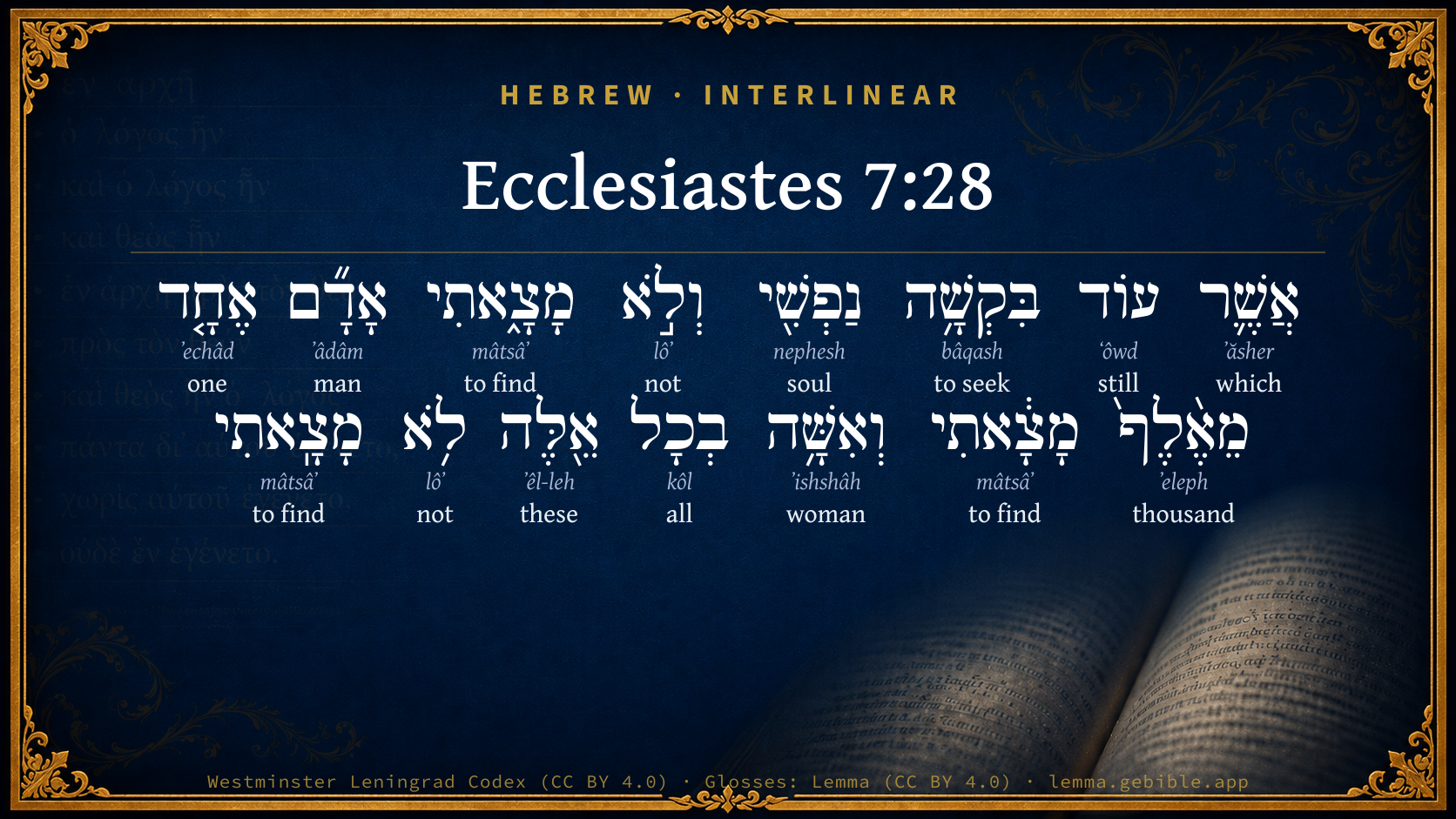
Hebrew (Westminster Leningrad Codex) Ecclesiastes 7:28 appears in the Hebrew Old Testament. The text above is from the Westminster Leningrad Codex. Each word links to its Strong’s number, a concise gloss, and parsing drawn from the Open Scriptures Hebrew Bible morphology. Click any word for its full Brown-Driver-Briggs (BDB) entry.
Download image
Cite this verse

Ecclesiastes 7:28 (World English Bible). Public Domain. Lemma interlinear Bible study tool, https://lemma.gebible.app/v/ecclesiastes/7/28.

Show BibTeX & RIS
BibTeX
RIS
English Translation
which my soul still seeks; but I have not found: one man among a thousand have I found; but a woman among all those have I not found.
World English Bible · Public Domain
Download a study sheet

One document with this verse’s original text, its word-by-word gloss line, the meaning frame, cross-references with their text, attributed commentary, and full source and license credits — printable, and it pastes into notes with its structure intact.

This verse Autodidact and up

Study sheet (.html) Plain text (.txt)

A passage Seminary Student

Up to 50 verses in one chapter. A passage sheet keeps up to 6 commentary sources and 12 cross-references per verse, in the order this page ranks them, and says so on the sheet whenever that leaves anything out. Ask for a single verse and you get the Autodidact verse sheet above.

Everything on this page stays free to read, with no account — the sheet is a download of what is already on screen, not access to it.

Want to remove ads? Support Godless Engineer
Compare translations 3

The same verse in 3 English versions, stacked beneath the original-language interlinear above. Click any original word for its lexicon entry.

Each is an independent rendering of the whole verse — the interlinear is not word-aligned to these translations.

Highlighted words mark where these versions differ — a whole-verse word diff, not a word-by-word alignment.

  • World English Bible Public Domain
    which my soul still seeks; but I have not found: one man among a thousand have I found; but a woman among all those have I not found.
  • King James Version Public Domain
    Which yet my soul seeketh, but I find not: one man among a thousand have I found; but a woman among all those have I not found.
  • unfoldingWord Literal Text CC BY-SA 4.0
    while still my soul sought, but I have not found: One man from a thousand I found, but a woman among all of these, I did not find.

unfoldingWord Literal Text — © unfoldingWord, licensed CC BY-SA 4.0. Word-aligned USFM3 via Door43 (git.door43.org/unfoldingWord/en_ult).

Versions to compare (up to 4)

3 of 4 selected

Show all 18 translations

Every available English version of this verse, each an independent rendering of the whole verse.

  • World English Bible Public Domain
    which my soul still seeks; but I have not found: one man among a thousand have I found; but a woman among all those have I not found.
  • Berean Standard Bible Public Domain
    While my soul was still searching but not finding, among a thousand I have found one upright man, but among all these I have not found one such woman.
  • Majority Standard Bible Public Domain
    While my soul was still searching but not finding, among a thousand I have found one upright man, but among all these I have not found one such woman.
  • King James Version Public Domain
    Which yet my soul seeketh, but I find not: one man among a thousand have I found; but a woman among all those have I not found.
  • American Standard Version (1901) Public Domain
    which my soul still seeketh, but I have not found: one man among a thousand have I found; but a woman among all those have I not found.
  • Revised Version (1885) Public Domain
    which my soul still seeketh, but I have not found: one man among a thousand have I found; but a woman among all those have I not found.
  • Geneva Bible (1599) Public Domain
    And I finde more bitter then death the woman whose heart is as nettes and snares, and her handes, as bands: he that is good before God, shalbe deliuered from her, but the sinner shall be taken by her.
  • Douay-Rheims (1899) Public Domain
    Lo this have I found, said Ecclesiastes, weighing one thing after another, that I might find out the account,
  • Young's Literal Translation Public Domain
    (that still my soul had sought, and I had not found), One man, a teacher, I have found, and a woman among all these I have not found.
  • Literal Standard Version CC BY-SA 4.0
    (that still my soul had sought, and I had not found), || One man, a teacher, I have found, and a woman among all these I have not found.
  • Unlocked Literal Bible CC BY-SA 4.0
    This is what I am still looking for, but I have not found it. I did find one righteous man among a thousand, but a woman among all those I did not find.
  • unfoldingWord Literal Text CC BY-SA 4.0
    while still my soul sought, but I have not found: One man from a thousand I found, but a woman among all of these, I did not find.
  • Darby Bible Public Domain
    which my soul yet seeketh, and I have not found: one man among a thousand have I found, but a woman among all those have I not found.
  • World Messianic Bible Public Domain
    which my soul still seeks, but I have not found. I have found one man among a thousand, but I have not found a woman among all those.
  • Webster's Bible Public Domain
    Which yet my soul seeketh, but I find not: one man among a thousand have I found; but a woman among all those have I not found.
  • Free Bible Version CC BY-SA 4.0
    Although I really searched, I didn't find what I was looking for. People say, “I found one man among a thousand, but not one woman.”
  • Bible in Basic English Public Domain
    For which my soul is still searching, but I have it not; one man among a thousand have I seen; but a woman among all these I have not seen.
  • JPS Tanakh (1917) Public Domain
    which yet my soul sought, but I found not; one man among a thousand have I found; but a woman among all those have I not found.

Literal Standard Version (2020), Covenant Press — licensed CC BY-SA 4.0. Text via the HelloAO Bible API (eBible.org). Unlocked Literal Bible (unfoldingWord) — licensed CC BY-SA 4.0. Text via the HelloAO Bible API (eBible.org). unfoldingWord Literal Text — © unfoldingWord, licensed CC BY-SA 4.0. Word-aligned USFM3 via Door43 (git.door43.org/unfoldingWord/en_ult). Free Bible Version, Dr. Jonathan Gallagher — licensed CC BY-SA 4.0. Text via the HelloAO Bible API (eBible.org).

Word by word

More ways to search: Search by grammar → Find every occurrence → Compare this word →

Practice this passage: Drill this verse → Learn its vocabulary →

בִּקְשָׁ֥ה
bâqash
H1245
“to seek”
Verb, Piel, Perfect, 3rd Person, Feminine, Singular
Part of Speech
Verb
Stem
Piel
Form
Perfect
Person
3rd Person
Gender
Feminine
Number
Singular
Full BDB Definition

Origin: a primitive root

TWOT: 276

to seek, require, desire, exact, request - (Piel) - to seek to find - to seek to secure - to seek the face - to desire, demand - to require, exact - to ask, request - (Pual) to be sought
  1. אֲשֶׁ֛ר ʼăsher H834 “which” Particle, Relative
  2. עוֹד ʻôwd H5750 “still” Adverb
  3. נַפְשִׁ֖י nephesh H5315 “soul · my” Noun, Common, Both, Singular, Construct + Suffix, Personal, 1st Person, Common, Singular
  4. וְלֹ֣א lôʼ H3808 “and · not” Conjunction + Particle, Negative
  5. מָצָ֑אתִי mâtsâʼ H4672 “to find” Verb, Qal, Perfect, 1st Person, Common, Singular
  6. אָדָ֞ם ʼâdâm H120 “man” Noun, Common, Masculine, Singular, Absolute
  7. אֶחָ֤ד ʼechâd H259 “one” Adjective, Cardinal number, Masculine, Singular, Absolute
  8. מֵאֶ֨לֶף֙ ʼeleph H505 “from · thousand” Preposition + Adjective, Cardinal number, Both, Singular, Absolute
  9. מָצָ֔אתִי mâtsâʼ H4672 “to find” Verb, Qal, Perfect, 1st Person, Common, Singular
  10. וְאִשָּׁ֥ה ʼishshâh H802 “and · woman” Conjunction + Noun, Common, Feminine, Singular, Absolute
  11. בְכָל kôl H3605 “in/at · all of” Preposition + Noun, Common, Masculine, Singular, Construct
  12. אֵ֖לֶּה ʼêl-leh H428 “these” Pronoun, Demonstrative, Common, Plural
  13. לֹ֥א lôʼ H3808 “not” Particle, Negative
  14. מָצָֽאתִי mâtsâʼ H4672 “to find” Verb, Qal, Perfect, 1st Person, Common, Singular

About this verse

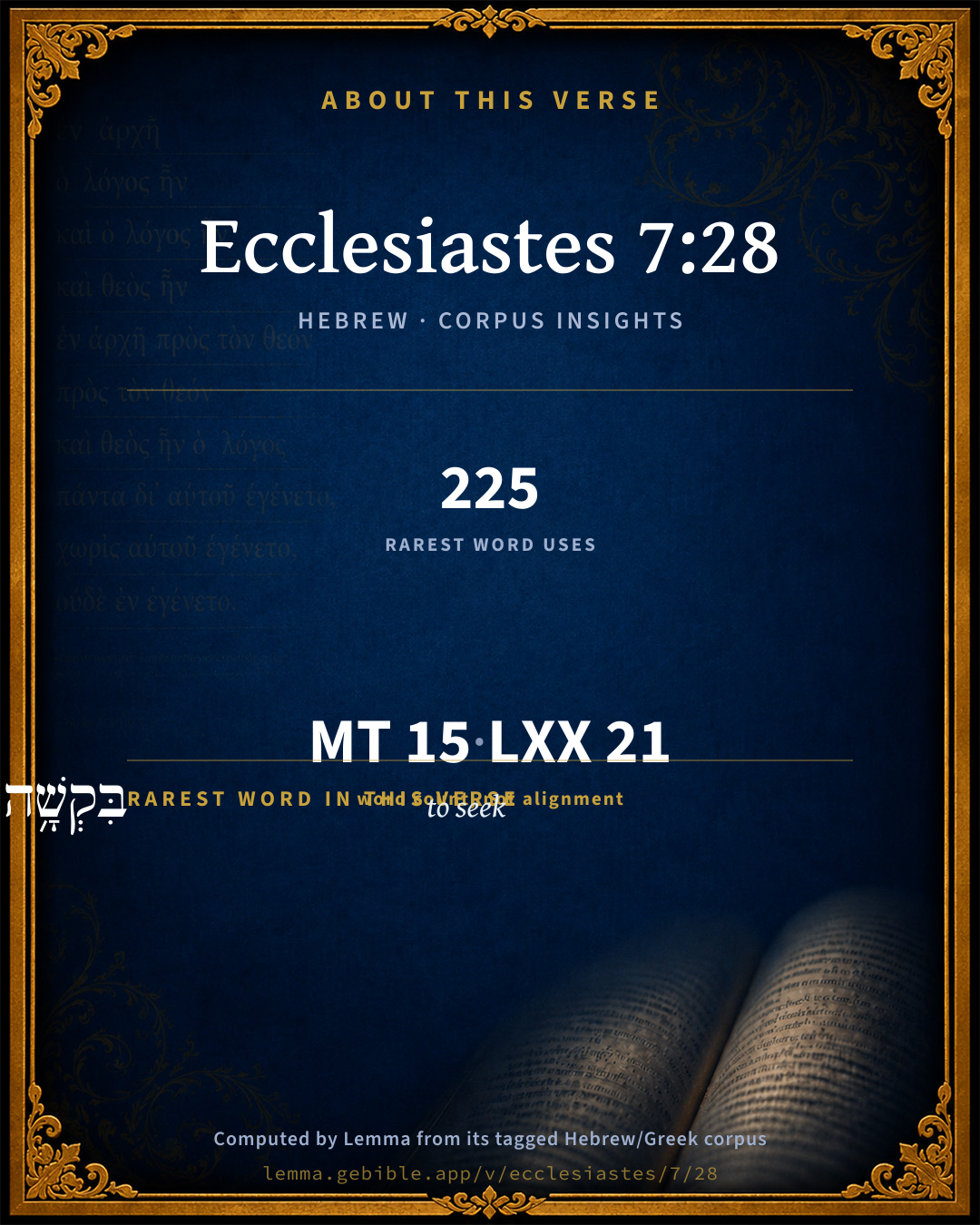
These counts appear in no published source. They are computed here, from the morphology-tagged text and Lemma’s own curated glosses. What Lemma adds →

15
words
12
distinct lemmas
Wisdom
section

Grammatical profile

  • 4 verbs
  • 4 nouns
  • 2 adjectives
  • 1 pronoun
  • 1 adverb
  • 3 particles

Verb forms

  • בִּקְשָׁ֥ה Piel · Perfect
  • מָצָ֑אתִי Qal · Perfect
  • מָצָ֔אתִי Qal · Perfect
  • מָצָֽאתִי Qal · Perfect

Repetition

Words recur within this verse — often emphatic in Hebrew:

  • מָצָ֑אתִי to find H4672 ×3
  • וְלֹ֣א not H3808 ×2

Hebrew & Septuagint length

In English translation the verse runs 28 words from the Hebrew and 19 from the Septuagint (LXX English) — the Septuagint runs noticeably shorter here. See the side-by-side →

A rough comparison of the two English renderings, which tokenize alike — not a word-level alignment.

Word counts can differ between the Hebrew and the Greek without any difference in meaning — e.g. the Hebrew direct-object marker אֵת has no separate Greek word, and Greek often adds the article ὁ.

In the original languages it is 15 Hebrew tokens and 21 Greek tokens — but the two are counted differently (Hebrew bundles its prefixes and suffixes into one token; the Greek is in lemma form), so that isn’t a like-for-like length.

Cross-references

5

Topical passages linked to Ecclesiastes 7:28 in the Treasury of Scripture Knowledge — connected by theme and wording, ordered by reader-vote popularity; previews shown in the World English Bible.

  • Job 33:23 "If there is beside him an angel, An interpreter, one among a thousand, To show to man what is right for him;
  • Psalms 12:1 Help, Yahweh; for the godly man ceases. For the faithful fail from among the children of men.
  • 1 Kings 11:1–3 Now king Solomon loved many foreign women, together with the daughter of Pharaoh, women of the Moabites, Ammonites, Edomites, Sidonians, and Hittites;
  • Ecclesiastes 7:23–24 All this have I proved in wisdom. I said, "I will be wise;" but it was far from me.
  • Isaiah 26:9 With my soul have I desired you in the night; yes, with my spirit within me will I seek you earnestly: for when your judgments are in the earth, the inhabitants of the world learn righteousness.

Cross-references courtesy of OpenBible.info (CC BY 4.0).

Hebrew and Greek witnesses Masoretic Hebrew ↔ Greek Septuagint

The same verse in the two great witnesses to the Old Testament, shown verse-for-verse.

Here the Septuagint runs noticeably shorter than the Hebrew — LXX2012 (modern English Septuagint) 19 words vs World English Bible 28. A rough length comparison of the two English translations, not a word-level alignment — read both below.

These are two independent witnesses, not word-aligned to each other, and the Septuagint is shown in lemma (dictionary) form.

Hebrew Ecclesiastes 7:28 Masoretic · Westminster Leningrad Codex

אֲשֶׁ֛ר עוֹד בִּקְשָׁ֥ה נַפְשִׁ֖י וְלֹ֣א מָצָ֑אתִי אָדָ֞ם אֶחָ֤ד מֵאֶ֨לֶף֙ מָצָ֔אתִי וְאִשָּׁ֥ה בְכָל אֵ֖לֶּה לֹ֥א מָצָֽאתִי

which my soul still seeks; but I have not found: one man among a thousand have I found; but a woman among all those have I not found.

World English Bible · Public Domain

Greek LXX Ecclesiastes 7:28 Septuagint · lemma form

ὅς ἔτι ζητέω ὁ ψυχή ἐγώ καί οὐ εὑρίσκω ἄνθρωπος εἷς ἀπό χίλιοι εὑρίσκω καί γυνή ἐν πᾶς οὗτος οὐ εὑρίσκω

Behold, this have I found, said the Preacher, seeking by one at a time to find out the account,

LXX2012 (modern English Septuagint) · Public Domain

On this verse, The Pulpit Commentary discusses the Septuagint’s reading. Read the note in Commentary ↓

Hebrew: Westminster Leningrad Codex (CC BY 4.0). Greek: Septuagint (public domain); English from LXX2012 (modern English Septuagint) (Public Domain). How the Septuagint differs from the Hebrew →

Commentary

Notes on Ecclesiastes 7:28 from classic Christian and Jewish commentators (each source and its license shown beneath its notes). The classic Christian expositions comment on the surrounding passage and are grouped to its opening verse, so a note may address several verses; the Jewish commentaries on the Tanakh (Rashi and others) are per-verse, so they appear only where the commentator wrote on this verse.

Lemma curates 59 commentaries, every one of them public domain or Creative Commons licensed, each selected and text-cleaned for this edition rather than reprinted as found. About our sources →

Trapp's Complete Commentary

John Trapp

Ecc 7:28 Which yet my soul seeketh, but I find not: one man among a thousand have I found; but a woman among all those have I not found.

Ver. 28. Which yet my soul seeketh, but I find not.] There is a place in Wiltshire called Stonhenge, for various great stones lying and standing there together: of which stones it is said, {a} that though a man number them "one by one" never so carefully, yet that he cannot find the true number of them, but that every time he numbers them he finds a different number from that he found before. This may well show, as one well applies it, the erring of man’s labour in seeking the acconnt of wisdom and knowledge; for, though his diligence be never so great in making the reckoning, he will always be out, and not able to find it out.

One man among a thousand.] Haud facile iuvenies multis e milibus unum. There is a very great scarcity of good people. These are as Gideon’s three hundred, when the wicked, as the Midianites, lie "like grasshoppers for multitude upon the earth," {Jdg 7:7; Jdg 7:12} and as those Syrians, {1Ki 20:27} they fill the country, they darken the air, as the swarms did the land of Egypt; and there is plenty of such dust heaps in every corner.

But a woman among all those have I not found,] i.e., Among all my wives and concubines, which made him ready to sing, Femina nulla bona est. There is no good woman. But that there are, and ever have been, many gracious women, see, besides the Scriptures, the writings of many learned men, De illustribus feminis. Concerning Illustrious Women. It is easy to observe, saith one, that the New Testament affords more store of good wives than the Old. And I can say, as Jerome does, Novi ego multas ad omne opus bonum promptas, I know many Tabithas full of good works. But in respect of the discovery of hearts and natures, whether in good or evil, it is harder to find out thoroughly the perfect disposition of a woman than of men; and that I take to be the meaning of this text.

{a} Camden.

John Trapp, A Commentary or Exposition upon All the Books of the Old and New Testament (1647–1656) — public domain. Text from a community e-Sword module.

The Biblical Illustrator

Joseph S. Exell

Ecc_7:28

A woman among all those have I not found.

Solomons estimate of woman

This sentence of Solomon has been often quoted to show the utter worthlessness of the female character. It is, however, an entirely worthless conclusion as regards woman when placed in her legitimate and appropriate sphere as the one sole companion of mans life in love, cares and labours. As well might the tyrant who, by cruelty, has alienated his subjects, complain that he has failed to find loyal men, as the debauchee, who has subjected hundreds to his lust, that he had found no noble, virtuous woman. It is not thus that the commerce of love is carried on. Pearls are not to be exchanged for pebbles. The law of love which God has established is heart for heart; and the affections that are dissipated among a thousand objects must ever be without return of that which yet the soul seeks--the undivided love. Of this fact Solomon seems to have had a dim perception when he gives those never-to-be-forgotten advises to the young man, to avoid the strange woman whose steps take hold on hell, and to live joyfully with the wife of his youth. It was not given to Solomon, wise as he was, to limn the picture of the virtuous woman, but to another king whose wisdom was derived from the inspiration of his mother. The words of Lemuel are well worthy of our attention, both as neutralizing the false impression produced by Solomons philosophy, and as showing what the true woman is (Pro_31:10-31). (J. Bennet.)

The Biblical Illustrator, edited by Joseph S. Exell (c. 1880s–1900s) — public domain. Text from a community e-Sword module.

Tyndale Open Study Notes

Tyndale Open Resources

7:28 The NLT adds the phrase is virtuous (based on 7:29) to give the sense of the verse. Virtue is extremely rare: In his own experience, the Teacher found only a few men, and no women, with that quality.

Tyndale Open Study Notes — © Tyndale Open Resources, licensed CC BY-SA 4.0. Text via the HelloAO Bible API.

Jamieson, Fausset & Brown

Robert Jamieson, A. R. Fausset & David Brown

Rather, referring to his past experience, "Which my soul sought further, but I found not."

one man--that is, worthy of the name, "man," "upright"; not more than one in a thousand of my courtiers (Job 33:23; Psa 12:1). Jesus Christ alone of men fully realizes the perfect ideal of "man." "Chiefest among ten thousand" (Sol 5:10). No perfect "woman" has ever existed, not even the Virgin Mary. Solomon, in the word "thousand," alludes to his three hundred wives and seven hundred concubines. Among these it was not likely that he should find the fidelity which one true wife pays to one husband. Connected with Ecc 7:26, not an unqualified condemnation of the sex, as Pro 12:4; Pro 31:10, &c., prove.

Jamieson, Fausset & Brown — Commentary Critical and Explanatory on the Whole Bible (1871) — public domain (CC PDM 1.0). Text via the HelloAO Bible API.

Ellicott's Commentary for English Readers

(28) One man among a thousand.—See Job_9:3; Job_33:23. The disparaging estimate of the female sex here expressed is common in countries where polygamy is practised. (See Sir_25:24; Sir_42:13.) It is credible enough that Solomon, with his thousand wives, did not find a good one among them; but see Pro_18:22; Pro_19:14; Pro_31:10.

A Bible Commentary for English Readers, edited by Charles John Ellicott (1878–1897) — public domain. Text from a community e-Sword module.

The Cambridge Bible for Schools and Colleges

gen. ed. J. J. S. Perowne

28. one man among a thousand have I found] We have, in the absence of an adjective, to supply the thought “a man such as he ought to be, truthful and righteous.” The form in which the rare exceptional discovery is given is as an echo from Job_9:3; Job_33:23. It represents we cannot doubt the capacity of the writer for a warm and earnest friendship. It shews that he had found one such friend. But what the seeker found among men, he sought in vain among women. Corruption there was, from his point of view, absolutely without exception. The interesting parallelism of Heine’s language has been noticed in the Introduction, ch. iii. The words may be received as recording the writer’s personal experience of the corrupt social state under the government of Persian or Egyptian kings. One commentator (Hitzig) has even ventured to identify the “woman more bitter than death” with a historical character, Agathoclea, the mistress of Ptolemy Philopator. Justin (xxx. 1) describes the King’s life “Meretricis illecebris capitur … noctes in stupris, dies in conviviis consumit.”

Here also we have an echo of the darker side of Greek thought. The Debater catches the tone of the woman-hater Euripides.

ἀλλʼ ὡς τὸ μῶρον ἀνδράσιν μὲν οὐκ ἔνι,

γυναιξὶ δʼ ἐμπέφυκεν.

“But folly does not find its home with men,

But roots in women’s hearts.”

Eurip. Hippol. 920.

So a later Rabbinic proverb gives a like judgment: “woe to the age whose leader is a woman” (Dukes, Rabbin. Blumenl. No. 32).

The Cambridge Bible for Schools and Colleges (gen. ed. J. J. S. Perowne; Cambridge University Press, 1878–1918) — public domain. Text from a community e-Sword module.

John Gill's Exposition

Which yet my soul seeketh, but I find not,.... He was very earnest and diligent in his inquiry; he took a great deal of pains, and was exceedingly solicitous; he sought with great intenseness of mind, and with an eager desire, to find out a chaste and virtuous woman among them all, but could not;

one man among a thousand have I found; it is a great rarity to find a good man (n), truly wise and gracious; there are many that walk in the broad way, and but few that find the strait gate and narrow way, and are saved; they are but as one to a thousand; see Jer 5:1. Or rather, by this one of a thousand, is meant the, Messiah, the Wisdom of God, he sought for, Ecc 7:25; and now says he found; to whom he looked for peace, pardon, and atonement, under a sense of his sins; who is the messenger, an interpreter, one among a thousand; yea, who is the chiefest among ten thousands, Job 33:23; who is superior to angels and men, in the dignity of his person; in the perfection, purity, and holiness of his nature; in the excellency of his names; in his offices and relations; and in his concern in the affairs of grace and salvation; and who is to be found by every truly wise and gracious soul that seeks him early and earnestly, in the word and ordinances, under the illumination and direction of the blessed Spirit. If it is to be understood of a mere man, I should think the sense was this; of all the men that have been ensnared and taken by an adulterous woman, but one of a thousand have I observed, and perhaps Solomon has respect to himself, that was ever recovered out of her hands;

but a woman among all those have I not found; that is, among all the harlots and adulterous women I ever knew or heard of, I never knew nor heard of one that was ever reclaimed from her evil ways, and reformed or became a chaste and virtuous woman: he may have respect to the thousand women that were either his wives and concubines, and, among all these, he found not one that deserved the above character; for this is not to be understood of women in general, for Solomon must have known that there have been good women in all ages, and perhaps more than men; and that there were many in his days, though those with whom his more intimate acquaintance was were not such, which was his unhappiness; and his criminal conversation with them is what he lamented and repented of. It may be interpreted thus, One man, the Messiah, among all the sons of men, have I found, free from original sin; but one woman, among all the daughters of Eve, I have not found clear of it. The Targum is,

"there is another thing which yet my soul seeketh, and I have not found; a man perfect and innocent, without corruption, from the days of Adam, till Abraham the righteous was born; who was found faithful and just among the thousand kings who were gathered together to build the tower of Babel; and a woman among all the wives of those kings, as Sarah, I found not.''

(n) "Vir bonus et sapiens, qualem vix reperit unum, millibus e multio hominum, consultus Apollo." Auson. Idyll. 16. v. 1, 2.

John Gill's Exposition of the Whole Bible (1746–1763) — public domain (CC PDM 1.0). Text via the HelloAO Bible API.

Albert Barnes' Notes on the Bible

One man - One whose good qualities quite satisfy our expectation. Compare the expression “one among a thousand” (marginal reference).

A woman - The number of Solomon’s wives and concubines 1Ki 11:3 was a thousand.

Albert Barnes' Notes on the Bible (1834–1885) — public domain. Text from a community e-Sword/MySword module.

Matthew Poole's English Annotations

My soul seeketh; it seemed so wonderful to me, that I suspected I had not made a sufficient inquiry, and therefore I returned to search again with more earnestness and accurateness.

I find not; that it was so he found out, as he now said, Ecc 7:27 but the whole truth and reason of the thing he could not find out.

One man; one worthy of the name of a man; a wise and virtuous man. Man is put for a worthy or good man, as name is put for a good name, above, Ecc 7:1, and wife for a good wife, as was noted before.

Among a thousand, with whom I have conversed. He is supposed to mention this number in allusion to his thousand wives and concubines, as they are numbered by parcels, 1Ki 11:3.

A woman; one worthy of that name; one who is not a dishonour to her kind and sex, who is not brutish in her disposition and conversation.

Among all those in that thousand whom I have taken into intimate society with myself; whereby he also passeth a severe censure upon himself that he had associated himself with such persons, and not with the virtuous women, which doubtless there were in his time, as appears from Pr 31. It is not Solomon’s design to disparage this sex, nor to make a general comparison between men and women in all places and ages, but only to suggest his own experience concerning it.

Matthew Poole's English Annotations on the Holy Bible (1683–1685) — public domain. Text from a community e-Sword/MySword module.

Whedon's Commentary on the Bible

Daniel D. Whedon

28. Which yet my soul seeketh, etc. — That is, The investigation is not yet concluded, so that the result may yet be altered.

One… a thousand — A very beggarly proportion, to say the least, of pure, true, and good men!

It is not strange that where men are so bad, and the best of them thought so ill of women, they were no better. What was to make them better? If, as some have thought, the thousand women reviewed were the three hundred wives and seven hundred concubines of the Solomonic harem, no wonder if the poor things were no better! Mohammed said, that only four good women had ever lived: the wife of Pharaoh, the mother of Jesus, and his own wife and daughter. Koheleth would get better figures today, both absolutely and proportionally.

Daniel D. Whedon (gen. ed.), Commentary on the Old and New Testaments (1874–1909) — public domain. Text from a community e-Sword module.

The Pulpit Commentary

Which yet my soul seeketh, but I find not; or, which my soul hath still sought, but I have not found. The conclusion at which he did arrive was something utterly different from what he had hoped to achieve. The soul and the ego are separately regarded (comp. ver. 25); the whole intellectual faculties were absorbed in the search, and the composite individual gives his consequent experience. One man (Adam) among a thousand have I found . He found only one man among a thousand that reached his standard of excellence the ideal that he had formed for himself, who could be rightly called by the noble name of man. The phrase, "one of a thousand," occurs in Job_9:3 Job_33:23; Ecc_6:6 (eiv ajpown, as in the Septuagint here). Adam, the generic term, is used here instead of ish, the individual, to emphasize the antithetical ishah, woman," in the following clause, or to lead the thought to the original perfection of man"s nature. So in Greek anqrwpov is sometimes used for ajnhr, though generally the distinction between the two is sufficiently marked, as we find in Herodotus, 7:210, Oti polloi megoi de andrev. But a woman among all those have I not found; i.e. not one woman in a thousand who was what a woman ought to be. Says the Son of Sirach, "All wickedness is but little to the wickedness of a woman; let the portion of a sinner fall upon her" (Ecc 25:19). So the Greek gnome

Qalassa kai pur kai gunh kakaa.

Three evils are there sea, fire, and woman.

Solomon had a thousand wives and concubines, and his experience might well have been that mentioned in this passage.

The Pulpit Commentary (1880–1919), ed. H.D.M. Spence-Jones & Joseph S. Exell — public domain. Text from a community e-Sword module.

John Wesley's Explanatory Notes

Yet seeketh - I returned to search again with more earnestness. I find not - That it was so, he found, but the reason of the thing he could not find out. One man - A wise and virtuous man. A woman - One worthy of that name; one who is not a dishonour to her sex. Among - In that thousand whom I have taken into intimate society with myself.

John Wesley, Explanatory Notes Upon the Whole Bible (1754–1765) — public domain. Text via the GEBible commentary corpus.

Rashi

Rabbi Shlomo Yitzchaki (Rashi)

which my soul sought yet In addition to those stated above, which I sought and did not find, my soul sought a proper one among women, but I did not find [one], because they are all lightheaded.”

one man out of a thousand I found It is customary in the world that [out of] a thousand who enter [a school] to learn Scripture, only one hundred emerge from them to succeed to be fit for Mishnah, and [of] those hundred who enter to [learn] Mishnah, only ten emerge from them to [learn] Gemara, and of those ten who enter to [learn] Gemara, only one emerges who is capable of giving religious instruction, the result being one out of a thousand.

but a woman among all these even in a thousand. Therefore, you must be cautious with her.

Rashi on the Tanakh — English translations: “The Judaica Press complete Tanach with Rashi, translated by A. J. Rosenberg” (CC BY 4.0); “Pentateuch with Rashi's commentary by M. Rosenbaum and A.M. Silbermann, 1929-1934” (public domain); “The Metsudah Tanach series, Lakewood, N.J” (CC BY 4.0); and “The Book of Joshua, Metsudah Publications, 1997” (CC BY 4.0). Text via Sefaria.

Lesson kit

Teaching starters — assembled from the data on this page, not authored interpretation. Every prompt links to the verse data it draws on. Edit before teaching.

Ecclesiastes, in the Wisdom, opens this verse with 15 words (12 distinct Hebrew lemmas). Its most distinctive word is bâqash (“to seek”). The Greek Septuagint runs shorter here. A historical commentator’s framing appears above. Read the whole chapter for the surrounding context.

Discussion questions

  1. How does “to seek” (bâqash) shape what this verse is saying?
  2. How does Job 33:23, which shares this passage’s theme, read alongside this verse?
  3. What does the repetition of “to find” (3× in this one verse) do in this verse?
  4. The Septuagint runs shorter here than the Hebrew. What might account for the difference?
  5. These translations render this verse differently. What is at stake in choosing one wording over another?
  6. «בִּקְשָׁ֥ה» is a Piel Perfect verb. How does that grammatical form shape the action described?
  7. Compare how Trapp's Complete Commentary and The Biblical Illustrator read this verse. Where do they agree or differ?

Things to notice

Reading settings

Reading text

Shown beneath each verse's original-language words.

Old Testament
Old Testament edition

Read the OT as the Masoretic Hebrew (MT) or the Greek Septuagint (LXX).

English shown for the Greek Septuagint (in the Hebrew ↔ Greek comparison).

Comparing translations? Open the Compare panel on any verse page to stack up to four side by side.