
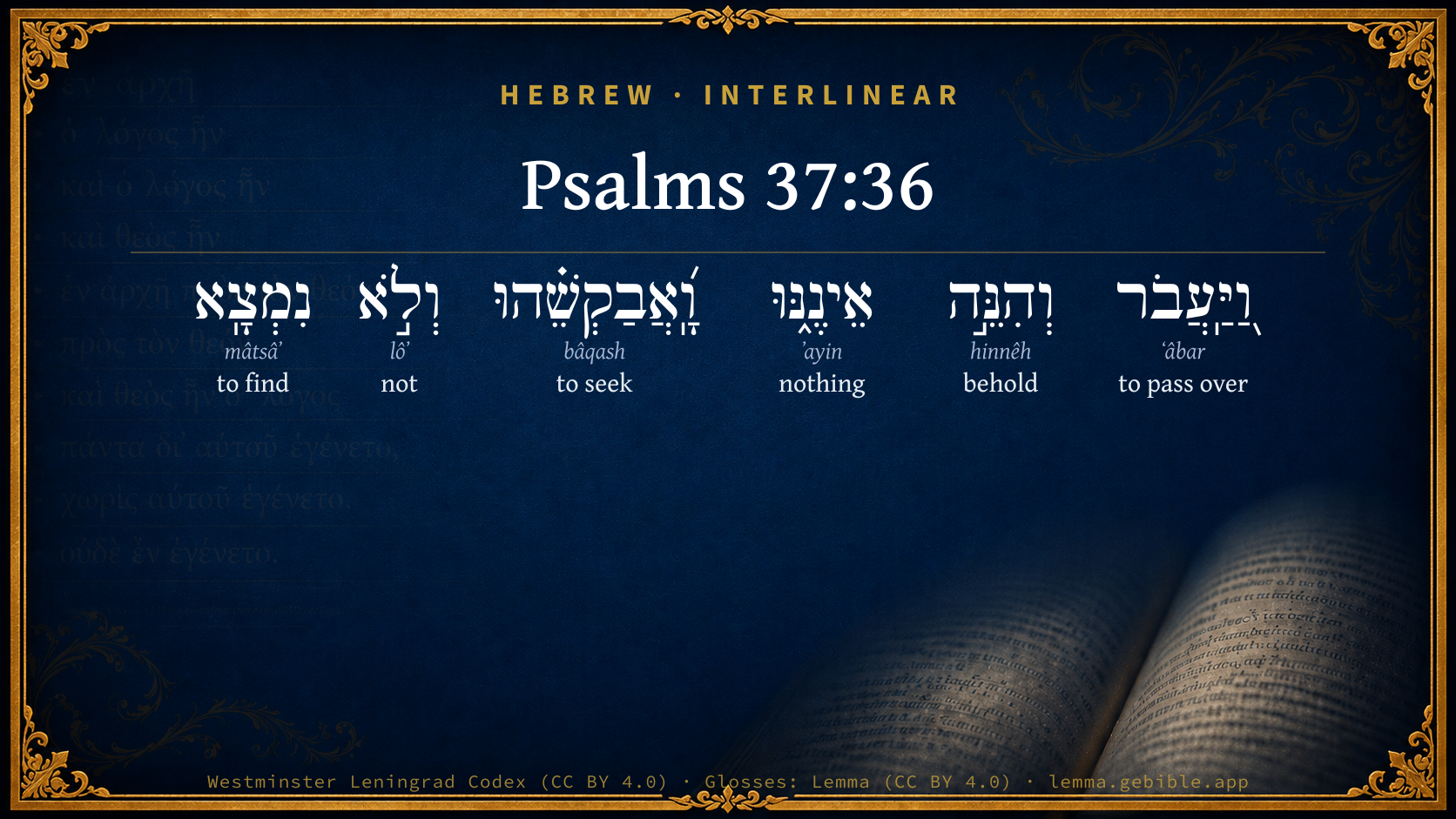
Psalms 37:36

Hebrew (Westminster Leningrad Codex) Psalms 37:36 appears in the Hebrew Old Testament. The text above is from the Westminster Leningrad Codex. Each word links to its Strong’s number, a concise gloss, and parsing drawn from the Open Scriptures Hebrew Bible morphology. Click any word for its full Brown-Driver-Briggs (BDB) entry.
Download image
Cite this verse

Psalms 37:36 (World English Bible). Public Domain. Lemma interlinear Bible study tool, https://lemma.gebible.app/v/psalms/37/36.

Show BibTeX & RIS
BibTeX
RIS
English Translation
But he passed away, and, behold, he was not. Yes, I sought him, but he could not be found.
World English Bible · Public Domain
Download a study sheet

One document with this verse’s original text, its word-by-word gloss line, the meaning frame, cross-references with their text, attributed commentary, and full source and license credits — printable, and it pastes into notes with its structure intact.

This verse Autodidact and up

Study sheet (.html) Plain text (.txt)

A passage Seminary Student

Up to 50 verses in one chapter. A passage sheet keeps up to 6 commentary sources and 12 cross-references per verse, in the order this page ranks them, and says so on the sheet whenever that leaves anything out. Ask for a single verse and you get the Autodidact verse sheet above.

Everything on this page stays free to read, with no account — the sheet is a download of what is already on screen, not access to it.

Want to remove ads? Support Godless Engineer
Compare translations 3

The same verse in 3 English versions, stacked beneath the original-language interlinear above. Click any original word for its lexicon entry.

Each is an independent rendering of the whole verse — the interlinear is not word-aligned to these translations.

Highlighted words mark where these versions differ — a whole-verse word diff, not a word-by-word alignment.

  • World English Bible Public Domain
    But he passed away, and, behold, he was not. Yes, I sought him, but he could not be found.
  • King James Version Public Domain
    Yet he passed away, and, lo, he was not: yea, I sought him, but he could not be found.
  • unfoldingWord Literal Text CC BY-SA 4.0
    And he passed away, and behold, he was not, and I sought him, and he was not found.

unfoldingWord Literal Text — © unfoldingWord, licensed CC BY-SA 4.0. Word-aligned USFM3 via Door43 (git.door43.org/unfoldingWord/en_ult).

Versions to compare (up to 4)

3 of 4 selected

Show all 18 translations

Every available English version of this verse, each an independent rendering of the whole verse.

  • World English Bible Public Domain
    But he passed away, and, behold, he was not. Yes, I sought him, but he could not be found.
  • Berean Standard Bible Public Domain
    yet he passed away and was no more; though I searched, he could not be found.
  • Majority Standard Bible Public Domain
    yet he passed away and was no more; though I searched, he could not be found.
  • King James Version Public Domain
    Yet he passed away, and, lo, he was not: yea, I sought him, but he could not be found.
  • American Standard Version (1901) Public Domain
    But one passed by, and, lo, he was not: Yea, I sought him, but he could not be found.
  • Revised Version (1885) Public Domain
    But one passed by, and, lo, he was not: yea, I sought him, but he could not be found.
  • Geneva Bible (1599) Public Domain
    Yet he passed away, and loe, he was gone, and I sought him, but he could not be founde.
  • Douay-Rheims (1899) Public Domain
    And I passed by, and lo, he was not: and I sought him and his place was not found.
  • Young's Literal Translation Public Domain
    And he passeth away, and lo, he is not, And I seek him, and he is not found!
  • Literal Standard Version CC BY-SA 4.0
    And he passes away, and behold, he is not, || And I seek him, and he is not found!
  • Unlocked Literal Bible CC BY-SA 4.0
    But when I passed by again, he was not there. I looked for him, but he could not be found.
  • unfoldingWord Literal Text CC BY-SA 4.0
    And he passed away, and behold, he was not, and I sought him, and he was not found.
  • Darby Bible Public Domain
    but he passed away, and behold, he was not; and I sought him, but he was not found.
  • World Messianic Bible Public Domain
    But he passed away, and behold, he was not. Yes, I sought him, but he could not be found.
  • Webster's Bible Public Domain
    Yet he passed away, and lo, he was not: yes, I sought him, but he could not be found.
  • Free Bible Version CC BY-SA 4.0
    But when I passed that way the next time, they were gone. I searched for them but couldn't find them.
  • Bible in Basic English Public Domain
    But he came to an end, and there was no sign of him; I made a search for him and he was not there.
  • JPS Tanakh (1917) Public Domain
    But one passed by, and, lo, he was not; yea, I sought him, but he could not be found.

Literal Standard Version (2020), Covenant Press — licensed CC BY-SA 4.0. Text via the HelloAO Bible API (eBible.org). Unlocked Literal Bible (unfoldingWord) — licensed CC BY-SA 4.0. Text via the HelloAO Bible API (eBible.org). unfoldingWord Literal Text — © unfoldingWord, licensed CC BY-SA 4.0. Word-aligned USFM3 via Door43 (git.door43.org/unfoldingWord/en_ult). Free Bible Version, Dr. Jonathan Gallagher — licensed CC BY-SA 4.0. Text via the HelloAO Bible API (eBible.org).

Word by word

More ways to search: Search by grammar → Find every occurrence → Compare this word →

Practice this passage: Drill this verse → Learn its vocabulary →

וָֽ֝אֲבַקְשֵׁ֗הוּ
bâqash
H1245
“and · to seek · him”
Conjunction + Verb, Piel, Sequential Imperfect, 1st Person, Common, Singular + Suffix, Personal, 3rd Person, Masculine, Singular
Part of Speech
Conjunction + Verb
Stem
Piel
Form
Sequential Imperfect
Person
1st Person
Gender
Common
Number
Singular
Full BDB Definition

Origin: a primitive root

TWOT: 276

to seek, require, desire, exact, request - (Piel) - to seek to find - to seek to secure - to seek the face - to desire, demand - to require, exact - to ask, request - (Pual) to be sought
  1. וַ֭יַּֽעֲבֹר ʻâbar H5674 “and · to pass over” Conjunction + Verb, Qal, Sequential Imperfect, 3rd Person, Masculine, Singular
  2. וְהִנֵּ֣ה hinnêh H2009 “and · behold” Conjunction + Particle, Demonstrative
  3. אֵינֶ֑נּוּ ʼayin H369 “nothing · him” Particle, Negative + Suffix, Personal, 3rd Person, Masculine, Singular
  4. וְלֹ֣א lôʼ H3808 “and · not” Conjunction + Particle, Negative
  5. נִמְצָֽא mâtsâʼ H4672 “to find” Verb, Niphal, Perfect, 3rd Person, Masculine, Singular

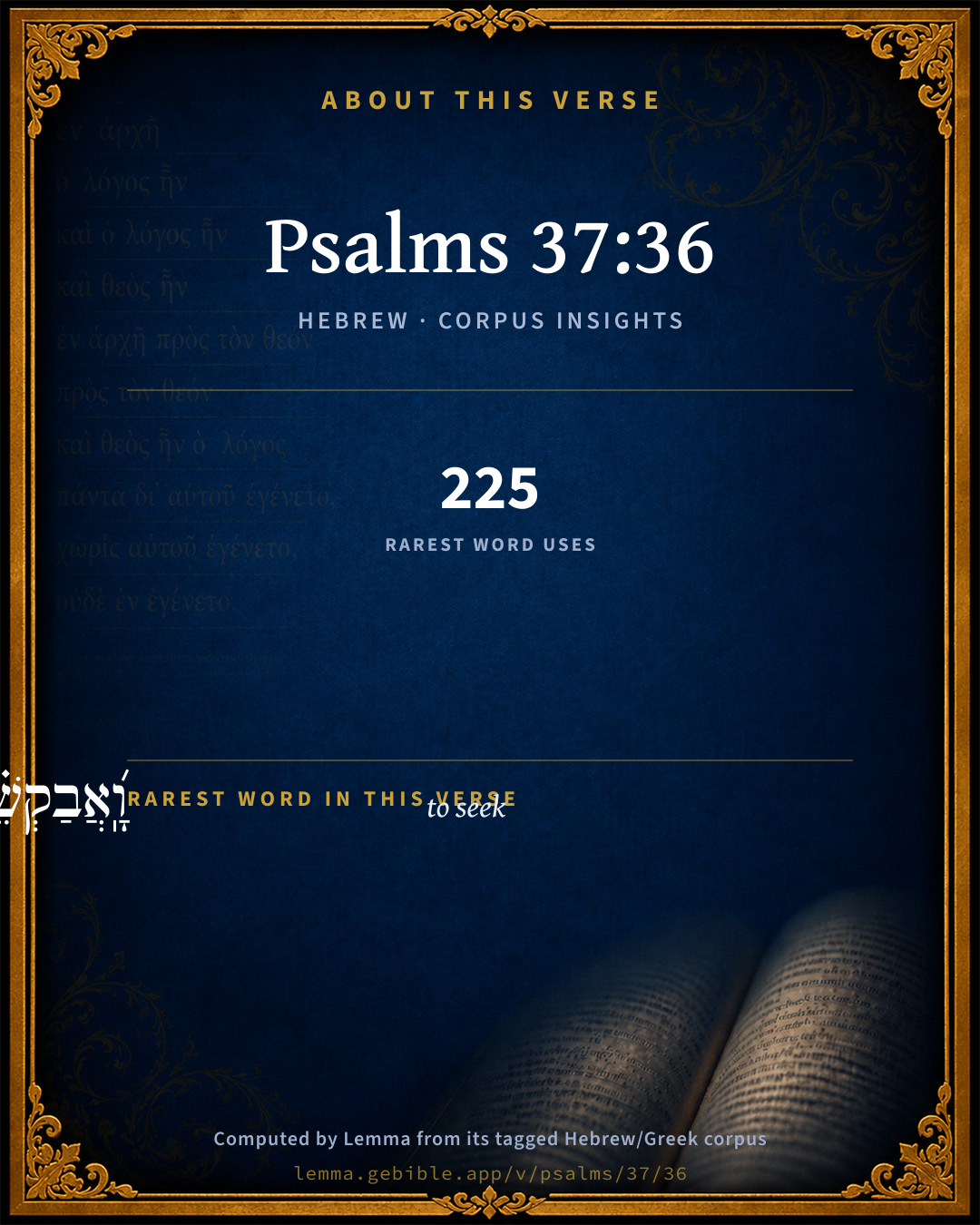
About this verse

These counts appear in no published source. They are computed here, from the morphology-tagged text and Lemma’s own curated glosses. What Lemma adds →

6
words
6
distinct lemmas
Wisdom
section

Grammatical profile

  • 3 verbs
  • 3 particles

Verb forms

  • וַ֭יַּֽעֲבֹר Qal · Sequential Imperfect
  • וָֽ֝אֲבַקְשֵׁ֗הוּ Piel · Sequential Imperfect
  • נִמְצָֽא Niphal · Perfect

Hebrew & Septuagint length

In English translation the verse runs 19 words from the Hebrew and 19 from the Septuagint (LXX English) — the same length.

A rough comparison of the two English renderings, which tokenize alike — not a word-level alignment.

Word counts can differ between the Hebrew and the Greek without any difference in meaning — e.g. the Hebrew direct-object marker אֵת has no separate Greek word, and Greek often adds the article ὁ.

Cross-references

7

Topical passages linked to Psalms 37:36 in the Treasury of Scripture Knowledge — connected by theme and wording, ordered by reader-vote popularity; previews shown in the World English Bible.

  • Psalms 37:10 For yet a little while, and the wicked will be no more. Yes, though you look for his place, he isn't there.
  • Acts 12:22–23 The people shouted, "The voice of a god, and not of a man!"
  • Exodus 15:19 For the horses of Pharaoh went in with his chariots and with his horsemen into the sea, and Yahweh brought back the waters of the sea on them; but the children of Israel walked on dry land in the midst of the sea.
  • Isaiah 10:16–19 Therefore will the Lord, Yahweh of Hosts, send among his fat ones leanness; and under his glory there shall be kindled a burning like the burning of fire.
  • Isaiah 10:33–34 Behold, the Lord, Yahweh of Hosts, will lop the boughs with terror: and the high of stature shall be hewn down, and the lofty shall be brought low.
  • Exodus 15:9–10 The enemy said, 'I will pursue, I will overtake, I will divide the spoil. My desire shall be satisfied on them. I will draw my sword, my hand shall destroy them.'
  • Job 20:5–29 That the triumphing of the wicked is short, The joy of the godless but for a moment?

Cross-references courtesy of OpenBible.info (CC BY 4.0).

Hebrew and Greek witnesses Masoretic Hebrew ↔ Greek Septuagint

The same verse in the two great witnesses to the Old Testament, shown verse-for-verse.

You’re reading Greek Psalm 36 (Hebrew Psalm 37). The Septuagint counts the superscription, so verse numbers can differ from the Hebrew — chapter-level alignment, not verse-by-verse. Numbering follows Rahlfs.

These are two independent witnesses, not word-aligned to each other, and the Septuagint is shown in lemma (dictionary) form.

Hebrew Psalms 37:36 Masoretic · Westminster Leningrad Codex

וַ֭יַּֽעֲבֹר וְהִנֵּ֣ה אֵינֶ֑נּוּ וָֽ֝אֲבַקְשֵׁ֗הוּ וְלֹ֣א נִמְצָֽא

But he passed away, and, behold, he was not. Yes, I sought him, but he could not be found.

World English Bible · Public Domain

Greek LXX Greek Psalm 36:36 Septuagint · lemma form

καί παραἔρχομαι καί ἰδού οὐ εἰμί καί ζητέω αὐτός καί οὐ εὑρίσκω ὁ τόπος αὐτός

Yet I passed by, and behold! he was not: and I sought him, but his place was not found.

LXX2012 (modern English Septuagint) · Public Domain

On this verse, Ellicott's Commentary for English Readers discusses the Septuagint’s reading. Read the note in Commentary ↓

Hebrew: Westminster Leningrad Codex (CC BY 4.0). Greek: Septuagint (public domain); English from LXX2012 (modern English Septuagint) (Public Domain). How the Septuagint differs from the Hebrew →

Commentary

Notes on Psalms 37:36 from classic Christian and Jewish commentators (each source and its license shown beneath its notes). The classic Christian expositions comment on the surrounding passage and are grouped to its opening verse, so a note may address several verses; the Jewish commentaries on the Tanakh (Rashi and others) are per-verse, so they appear only where the commentator wrote on this verse.

Lemma curates 59 commentaries, every one of them public domain or Creative Commons licensed, each selected and text-cleaned for this edition rather than reprinted as found. About our sources →

Trapp's Complete Commentary

John Trapp

Psa 37:36 Yet he passed away, and, lo, he [was] not: yea, I sought him, but he could not be found.

Ver. 36. Yet he passed away, &c.] The Greek and Latin have it, I passed by. See Psa 37:10. How soon and utterly withered and wasted the fig tree Christ cursed! so forcible is his curse.

John Trapp, A Commentary or Exposition upon All the Books of the Old and New Testament (1647–1656) — public domain. Text from a community e-Sword module.

The Treasury of David

Charles H. Spurgeon

Ver. 36. Yet he passed away. Tree and man both gone, the son of man as surely as the child of the forest. What clean sweeps death makes! And, lo, he was not. To the surprise of all men the great man was gone, his estates sold, his business bankrupt, his house alienated, his name forgotten, and all in a few months. Yea, I sought him, but he could not be found. Moved by curiosity, if we enquire for the ungodly, they have left no trace; like birds of ill omen none desire to remember them. Some of the humblest of the godly are immortalized, their names are imperishably fragrant in the church, while of the ablest of infidels and blasphemers hardly their names are remembered beyond a few years. Men who were in everybody's mouths but yesterday are forgotten tomorrow, for only virtue is immortal.

Ver. 36-37. The hawk flies high, and is as highly prized, being set upon a perch, vervelled with the jingling bells of encouragement, and carried on his master's fist; but being once dead and picked over the perch, is cast upon the dunghill as good for nothing. The hen scrapes in the dust, not anything rewarded when she is alive, but being dead, is brought as a choice dish to her master's table. Thus wicked men are commonly set in high places, and prosper in this life; and good men lie grovelling with their mouths in the dust, as the very underlings of the world; but being once dead, the one is cast into the dungeon of hell, the other advanced to the kingdom of heaven: the one is into Abraham's bosom, whilst the other is tormented with the devil and his angels. Thomas Westfield, D.D., 1644.

Ver. 36-37. See Psalms on "Ps 37:36" for further information.

Charles H. Spurgeon's The Treasury of David (1869–1885) — public domain. Psalms only. Text from a community e-Sword/MySword module.

J. A. Alexander on Psalms

Joseph Addison Alexander

36. (Psa 37:36) And he passed (away), and lo! an expression always implying something unexpected, he was not, he wasno more, there was no longer such a person. See above, on Psa 37:10. And I sought him. I looked round as if to see what was become of him, and he was not found, or as we might say, to be found. This, verse may be referred to the tree, it passed away, I looked for it, and it could not be found. But as the tree is only introduced in the preceding verse as a comparison, it is better to regard the wicked man as the subject of both sentences.

Joseph Addison Alexander, The Psalms Translated and Explained (1850) — public domain. Text from a community e-Sword module.

Geneva Bible (1599)

Geneva Bible translators

So that the prosperity of the wicked is but as a cloud, which vanisheth away in a moment.

Geneva Bible (1599) marginal notes — public domain. Text via Bolls.life.

Jamieson, Fausset & Brown

Robert Jamieson, A. R. Fausset & David Brown

he was not--(Compare Psa 37:10).

Jamieson, Fausset & Brown — Commentary Critical and Explanatory on the Whole Bible (1871) — public domain (CC PDM 1.0). Text via the HelloAO Bible API.

Adam Clarke's Commentary

Verse 36. Yet he passed away] Both Nebuchadnezzar and his wicked successor, Belshazzar; and on the destruction of the latter, when God had weighed him in the balance, and found him wanting, numbered his days, and consigned him to death, his kingdom was delivered to the Medes and Persians; and thus the Babylonian empire was destroyed.

Adam Clarke's Commentary on the Bible (1810–1826) — public domain. Text from a community e-Sword/MySword module.

Ellicott's Commentary for English Readers

(36) Yet he passed away.—This should be, And there went one by, &c. LXX. and Vulg. have, “And I passed by.” (Comp. Prayer Book version.)

A Bible Commentary for English Readers, edited by Charles John Ellicott (1878–1897) — public domain. Text from a community e-Sword module.

The Cambridge Bible for Schools and Colleges

gen. ed. J. J. S. Perowne

36. Yet he passed away] R.V. But one passed by. Better, with LXX, Vulg., Syr., Jer.; And I passed by.

The Cambridge Bible for Schools and Colleges (gen. ed. J. J. S. Perowne; Cambridge University Press, 1878–1918) — public domain. Text from a community e-Sword module.

John Gill's Exposition

Mark the perfect man,.... None are so in themselves, not the most holy man upon earth; for though all grace is implanted at once in regeneration, the seed of grace of every kind is cast into the heart at once; yet it opens and spreads, and gradually increases; nor is any grace in its exercise perfect; not faith, nor hope, nor love: sin is in the best of men, and all stand in need of fresh supplies of grace. None of the saints ever affirmed that they had arrived to perfection, but have disclaimed it: one saint may indeed attain to a greater degree of grace and knowledge than another, and in a comparative sense be perfect; and there is a perfection of parts, though not of degrees, in all; the new man is formed in all its parts, though these are not grown to their full perfection: and whereas perfection often denotes truth and sincerity, such may be said to be perfect, that is, sincere, who have received the grace of God in truth, have the, truth and root of the matter in them; so Noah, Job, and others, are said to be perfect men; but not simply and absolutely in themselves, but as in Christ Jesus; who has obtained complete redemption, perfectly fulfilled the law for them, fully expiated their sins, procured the entire pardon of them, and brought in an everlasting righteousness, by which they are justified from all sin, and are perfectly comely, and a perfection of beauty, through the comeliness of Christ put upon them;

and behold the upright; the man that is upright in heart and conversation, who has a right spirit renewed in him, and the uprightness of Christ showed unto him; or, in other words, who has the truth of grace within him, and the righteousness of Christ upon him: such men are to be marked, observed, viewed, and considered, as rare and uncommon men; and to be imitated and followed in the exercise of grace and discharge of duty; and especially the end of such persons is to be marked and beheld, as follows;

for the end of that man is peace: such a man now enjoys a conscience peace, which passes the understanding of worldly men; and which he possesses in Christ, and from him, amidst a variety of tribulations, arising from a view of interest in his blood and righteousness; and, generally speaking, goes off the stage of life, if not triumphing, yet resigned to the will of God, and in a serene and tranquil frame of spirit, and even desiring to be gone, and to be with Christ, and to have leave, with good old Simeon, to depart in peace; and as soon as they are departed they enter into peace, into the joy of their Lord, into his presence, where is fulness of joy, and pleasures for evermore; see Num 23:10.

John Gill's Exposition of the Whole Bible (1746–1763) — public domain (CC PDM 1.0). Text via the HelloAO Bible API.

Albert Barnes' Notes on the Bible

Yet he passed away - Compare the notes at Job 20:5. The allusion here, of course, is to the man, and not to the tree, though the grammatical construction might refer to either. The idea is that he passed out of view - “he was gone;” he had no permanent abode on earth, but with all his pomp and splendor he had disappeared. Neither his prosperity, his greatness, nor his wealth, could secure him a permanent abode on earth. It might be said, also, in reply to this, that the good man passes away and is not. That is true. But the meaning here is, that this occurs “so much more frequently” in the case of a wicked man, or that wickedness is followed so often in this life by the judgment of God in cutting him off, as to show that there is a moral government, and that that government is administered in favor of the righteous, or that it is an advantage in this life to be righteous. It cannot be meant that this is “universally” so here, but that this is the “general” rule, and that it is so constant as to show that God is on the side of virtue and religion.

And lo, he was not - He was no more; there was no longer any such person: The word “lo” implies that there was some degree of surprise, or that what had occurred was not looked for or expected. The observer had seen him in great power, flourishing, rich, honored; and, to his astonishment, he soon passed entirely away.

Yea, I sought him, but he could not be found - This is intended to “confirm” what had been just said, or to show how completely he had disappeared. It might be supposed, perhaps, that his removal was only temporary - that he was still somewhere upon the earth; but the psalmist says that after the most diligent search, he could not find him. He had disappeared entirely from among men.

Albert Barnes' Notes on the Bible (1834–1885) — public domain. Text from a community e-Sword/MySword module.

Matthew Poole's English Annotations

He was gone in an instant, like a tree blasted and blown down, or cut off and rooted out, and carried away in a moment. There was no monument nor remainder of him left.

Matthew Poole's English Annotations on the Holy Bible (1683–1685) — public domain. Text from a community e-Sword/MySword module.

The Pulpit Commentary

Yet he passed away, and lo, he was not. (cf. Job_20:5 Psa_73:19, Psa_73:20) Yea, I sought him, but he could not be found. The sudden disappearance of an imposing personality astonishes and confuses us. We cannot believe that one who has played so prominent a part in our drama of life is gone altogether. We look about for him; we expect him to reappear at any moment. We cannot realize the fact that he is vanished for ever. We ask ourselves, "Where is he?". (Job_20:7)

The Pulpit Commentary (1880–1919), ed. H.D.M. Spence-Jones & Joseph S. Exell — public domain. Text from a community e-Sword module.

John Wesley's Explanatory Notes

Yet - He was gone in an instant. But - There was no monument or remainder of him left.

John Wesley, Explanatory Notes Upon the Whole Bible (1754–1765) — public domain. Text via the GEBible commentary corpus.

Lesson kit

Teaching starters — assembled from the data on this page, not authored interpretation. Every prompt links to the verse data it draws on. Edit before teaching.

Psalms, in the Wisdom, opens this verse with 6 words (6 distinct Hebrew lemmas). Its most distinctive word is bâqash (“to seek”). A historical commentator’s framing appears above. Read the whole chapter for the surrounding context.

Discussion questions

  1. What does “to seek” (bâqash) contribute to the verse as a whole?
  2. How does Psalms 37:10, which shares this passage’s theme, read alongside this verse?
  3. The translations on this page render this verse differently — a whole-verse word diff, not a word-by-word alignment. What might account for the different wordings?
  4. «וַ֭יַּֽעֲבֹר» is a Qal Sequential Imperfect verb. How does that grammatical form shape the action described?
  5. Compare how Trapp's Complete Commentary and The Treasury of David read this verse. Where do they agree or differ?

Things to notice

Reading settings

Reading text

Shown beneath each verse's original-language words.

Old Testament
Old Testament edition

Read the OT as the Masoretic Hebrew (MT) or the Greek Septuagint (LXX).

English shown for the Greek Septuagint (in the Hebrew ↔ Greek comparison).

Comparing translations? Open the Compare panel on any verse page to stack up to four side by side.