Song of Solomon 3:2

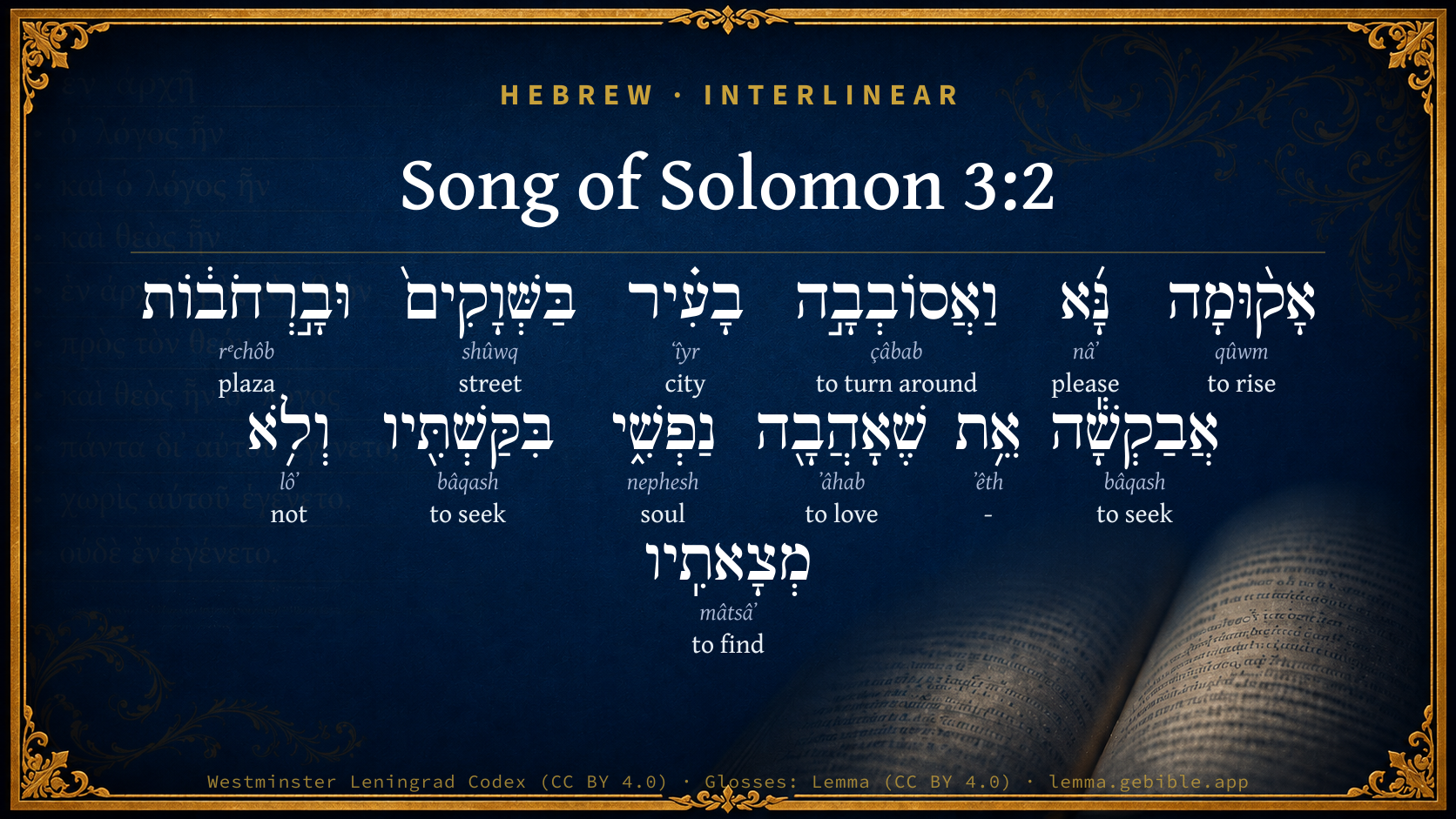
Hebrew (Westminster Leningrad Codex) Song of Solomon 3:2 appears in the Hebrew Old Testament. The text above is from the Westminster Leningrad Codex. Each word links to its Strong’s number, a concise gloss, and parsing drawn from the Open Scriptures Hebrew Bible morphology. Click any word for its full Brown-Driver-Briggs (BDB) entry.
Download image
Cite this verse

Song of Solomon 3:2 (World English Bible). Public Domain. Lemma interlinear Bible study tool, https://lemma.gebible.app/v/song-of-solomon/3/2.

Show BibTeX & RIS
BibTeX
RIS
English Translation
I will get up now, and go about the city; In the streets and in the squares I will seek him whom my soul loves. I sought him, but I didn't find him.
World English Bible · Public Domain
Download a study sheet

One document with this verse’s original text, its word-by-word gloss line, the meaning frame, cross-references with their text, attributed commentary, and full source and license credits — printable, and it pastes into notes with its structure intact.

This verse Autodidact and up

Study sheet (.html) Plain text (.txt)

A passage Seminary Student

Up to 50 verses in one chapter. A passage sheet keeps up to 6 commentary sources and 12 cross-references per verse, in the order this page ranks them, and says so on the sheet whenever that leaves anything out. Ask for a single verse and you get the Autodidact verse sheet above.

Everything on this page stays free to read, with no account — the sheet is a download of what is already on screen, not access to it.

Want to remove ads? Support Godless Engineer
Compare translations 3

The same verse in 3 English versions, stacked beneath the original-language interlinear above. Click any original word for its lexicon entry.

Each is an independent rendering of the whole verse — the interlinear is not word-aligned to these translations.

Highlighted words mark where these versions differ — a whole-verse word diff, not a word-by-word alignment.

  • World English Bible Public Domain
    I will get up now, and go about the city; In the streets and in the squares I will seek him whom my soul loves. I sought him, but I didn't find him.
  • King James Version Public Domain
    I will rise now, and go about the city in the streets, and in the broad ways I will seek him whom my soul loveth: I sought him, but I found him not.
  • unfoldingWord Literal Text CC BY-SA 4.0
    I will get up now and go about in the city, in the streets and in the squares; I will seek him whom my soul loves. I sought him, but I did not find him.

unfoldingWord Literal Text — © unfoldingWord, licensed CC BY-SA 4.0. Word-aligned USFM3 via Door43 (git.door43.org/unfoldingWord/en_ult).

Versions to compare (up to 4)

3 of 4 selected

Show all 18 translations

Every available English version of this verse, each an independent rendering of the whole verse.

  • World English Bible Public Domain
    I will get up now, and go about the city; In the streets and in the squares I will seek him whom my soul loves. I sought him, but I didn't find him.
  • Berean Standard Bible Public Domain
    I will arise now and go about the city, through the streets and squares. I will seek the one I love. So I sought him but did not find him.
  • Majority Standard Bible Public Domain
    I will arise now and go about the city, through the streets and squares. I will seek the one I love. So I sought him but did not find him.
  • King James Version Public Domain
    I will rise now, and go about the city in the streets, and in the broad ways I will seek him whom my soul loveth: I sought him, but I found him not.
  • American Standard Version (1901) Public Domain
    `I said', I will rise now, and go about the city; In the streets and in the broad ways I will seek him whom my soul loveth: I sought him, but I found him not.
  • Revised Version (1885) Public Domain
    I said, I will rise now, and go about the city, in the streets and in the broad ways, I will seek him whom my soul loveth: I sought him, but I found him not.
  • Geneva Bible (1599) Public Domain
    I will rise therefore nowe, and goe about in the citie, by the streetes and by the open places, and wil seeke him that my soule loueth: I sought him, but I found him not.
  • Douay-Rheims (1899) Public Domain
    I will rise, and will go about the city: in the streets and the broad ways I will seek him whom my soul loveth: I sought him, and I found him not.
  • Young's Literal Translation Public Domain
    -- Pray, let me rise, and go round the city, In the streets and in the broad places, I seek him whom my soul hath loved! -- I sought him, and I found him not.
  • Literal Standard Version CC BY-SA 4.0
    Now let me rise, and go around the city, || In the streets and in the broad places, || I seek him whom my soul has loved! I sought him, and I did not find him.
  • Unlocked Literal Bible CC BY-SA 4.0
    I said to myself, “I will get up and go through the city, through the streets and squares; I will search for him whom my soul loves.” I searched for him, but I did not find him.
  • unfoldingWord Literal Text CC BY-SA 4.0
    I will get up now and go about in the city, in the streets and in the squares; I will seek him whom my soul loves. I sought him, but I did not find him.
  • Darby Bible Public Domain
    I will rise now, and go about the city; In the streets and in the broadways Will I seek him whom my soul loveth: I sought him, but I found him not.
  • World Messianic Bible Public Domain
    I will get up now, and go about the city; in the streets and in the squares I will seek him whom my soul loves. I sought him, but I didn’t find him.
  • Webster's Bible Public Domain
    I will rise now, and go about the city in the streets, and in the broad ways I will seek him whom my soul loveth: I sought him, but I found him not.
  • Free Bible Version CC BY-SA 4.0
    So I said to myself, “I will get up now and go through the city, looking in its streets and squares for the one I love.” I looked for him but I didn't find him.
  • Bible in Basic English Public Domain
    I will get up now and go about the town, in the streets and in the wide ways I will go after him who is the love of my soul: I went after him, but I did not see him.
  • JPS Tanakh (1917) Public Domain
    'I will rise now, and go about the city, in the streets and in the broad ways, I will seek him whom my soul loveth.' I sought him, but I found him not.

Literal Standard Version (2020), Covenant Press — licensed CC BY-SA 4.0. Text via the HelloAO Bible API (eBible.org). Unlocked Literal Bible (unfoldingWord) — licensed CC BY-SA 4.0. Text via the HelloAO Bible API (eBible.org). unfoldingWord Literal Text — © unfoldingWord, licensed CC BY-SA 4.0. Word-aligned USFM3 via Door43 (git.door43.org/unfoldingWord/en_ult). Free Bible Version, Dr. Jonathan Gallagher — licensed CC BY-SA 4.0. Text via the HelloAO Bible API (eBible.org).

Word by word

More ways to search: Search by grammar → Find every occurrence → Compare this word →

Practice this passage: Drill this verse → Learn its vocabulary →

בַּשְּׁוָקִים֙
shûwq
H7784
“in/at the · streets”
Preposition, Determined + Noun, Common, Masculine, Plural, Absolute
Part of Speech
Preposition + Noun
Type
Common
Gender
Masculine
Number
Plural
State
Absolute
Full BDB Definition

Origin: from H7783

TWOT: 2350b

street
  1. אָק֨וּמָה qûwm H6965 “to rise” Verb, Qal, Cohortative, 1st Person, Common, Singular
  2. נָּ֜א nâʼ H4994 “please” Particle, Interjection
  3. וַאֲסוֹבְבָ֣ה çâbab H5437 “and · to turn around” Conjunction + Verb, Poel, Cohortative, 1st Person, Common, Singular
  4. בָעִ֗יר ʻîyr H5892 “in/at the · city” Preposition, Determined + Noun, Common, Feminine, Singular, Absolute
  5. וּבָ֣רְחֹב֔וֹת rᵉchôb H7339 “and · in/at the · plazas” Conjunction + Preposition, Determined + Noun, Common, Feminine, Plural, Absolute
  6. אֲבַקְשָׁ֕ה bâqash H1245 “to seek” Verb, Piel, Cohortative, 1st Person, Common, Singular
  7. אֵ֥ת ʼêth H853 “-” Particle, Direct Object
  8. שֶׁאָהֲבָ֖ה ʼâhab H157 “who/which · to love” Particle, Relative + Verb, Qal, Perfect, 3rd Person, Feminine, Singular
  9. נַפְשִׁ֑י nephesh H5315 “soul · my” Noun, Common, Both, Singular, Construct + Suffix, Personal, 1st Person, Common, Singular
  10. בִּקַּשְׁתִּ֖יו bâqash H1245 “to seek · him” Verb, Piel, Perfect, 1st Person, Common, Singular + Suffix, Personal, 3rd Person, Masculine, Singular
  11. וְלֹ֥א lôʼ H3808 “and · not” Conjunction + Particle, Negative
  12. מְצָאתִֽיו mâtsâʼ H4672 “to find · him” Verb, Qal, Perfect, 1st Person, Common, Singular + Suffix, Personal, 3rd Person, Masculine, Singular

About this verse

These counts appear in no published source. They are computed here, from the morphology-tagged text and Lemma’s own curated glosses. What Lemma adds →

13
words
12
distinct lemmas
Wisdom
section

Notable vocabulary

The rarest word here is בַּשְּׁוָקִים֙ street H7784 — appearing just 4 times in the whole Hebrew Bible.

Shared distinctive vocabulary

בַּשְּׁוָקִים֙ street H7784 occurs in 4 verses of the Hebrew Bible. Also found in:

Grammatical profile

  • 6 verbs
  • 4 nouns
  • 3 particles

Verb forms

  • אָק֨וּמָה Qal · Cohortative
  • וַאֲסוֹבְבָ֣ה Poel · Cohortative
  • אֲבַקְשָׁ֕ה Piel · Cohortative
  • שֶׁאָהֲבָ֖ה Qal · Perfect
  • בִּקַּשְׁתִּ֖יו Piel · Perfect
  • מְצָאתִֽיו Qal · Perfect

Repetition

A word recurs within this verse — often emphatic in Hebrew:

  • אֲבַקְשָׁ֕ה to seek H1245 ×2

Hebrew & Septuagint length

In English translation the verse runs 33 words from the Hebrew and 34 from the Septuagint (LXX English) — closely comparable.

A rough comparison of the two English renderings, which tokenize alike — not a word-level alignment.

Word counts can differ between the Hebrew and the Greek without any difference in meaning — e.g. the Hebrew direct-object marker אֵת has no separate Greek word, and Greek often adds the article ὁ.

Cross-references

16

Topical passages linked to Song of Solomon 3:2 in the Treasury of Scripture Knowledge — connected by theme and wording, ordered by reader-vote popularity; previews shown in the World English Bible.

  • Romans 13:11 Do this, knowing the time, that it is already time for you to awaken out of sleep, for salvation is now nearer to us than when we first believed.
  • Ephesians 5:14 Therefore he says, "Awake, you who sleep, and arise from the dead, and Christ will shine on you."
  • Psalms 22:1–2 My God, my God, why have you forsaken me? Why are you so far from helping me, and from the words of my groaning?
  • Psalms 42:7–9 Deep calls to deep at the noise of your waterfalls. All your waves and your billows have swept over me.
  • Psalms 43:2–5 For you are the God of my strength. Why have you rejected me? Why do I go mourning because of the oppression of the enemy?
  • Psalms 77:7–10 "Will the Lord reject us forever? Will he be favorable no more?
  • Proverbs 1:20–21 Wisdom calls aloud in the street. She utters her voice in the public squares.
  • Proverbs 8:2–3 On the top of high places by the way, Where the paths meet, she stands.
  • Proverbs 8:34 Blessed is the man who hears me, Watching daily at my gates, Waiting at my door posts.
  • Song of Solomon 5:5 I rose up to open for my beloved. My hands dripped with myrrh, My fingers with liquid myrrh, On the handles of the lock.
  • Isaiah 64:7 There is none who calls on your name, who stirs up himself to take hold of you; for you have hid your face from us, and have consumed us by means of our iniquities.
  • Jeremiah 5:1 Run you back and forth through the streets of Jerusalem, and see now, and know, and seek in the broad places of it, if you can find a man, if there are any who does justly, who seeks truth; and I will pardon her.
  • Matthew 26:40–41 He came to the disciples, and found them sleeping, and said to Peter, "What, couldn't you watch with me for one hour?
  • Luke 14:21–23 "That servant came, and told his lord these things. Then the master of the house, being angry, said to his servant, 'Go out quickly into the streets and lanes of the city, and bring in the poor, maimed, blind, and lame.'
  • John 1:6 There came a man, sent from God, whose name was John.
  • 1 Corinthians 15:34 Wake up righteously, and don't sin, for some have no knowledge of God. I say this to your shame.

Cross-references courtesy of OpenBible.info (CC BY 4.0).

Hebrew and Greek witnesses Masoretic Hebrew ↔ Greek Septuagint

The same verse in the two great witnesses to the Old Testament, shown verse-for-verse.

These are two independent witnesses, not word-aligned to each other, and the Septuagint is shown in lemma (dictionary) form.

Hebrew Song of Solomon 3:2 Masoretic · Westminster Leningrad Codex

אָק֨וּמָה נָּ֜א וַאֲסוֹבְבָ֣ה בָעִ֗יר בַּשְּׁוָקִים֙ וּבָ֣רְחֹב֔וֹת אֲבַקְשָׁ֕ה אֵ֥ת שֶׁאָהֲבָ֖ה נַפְשִׁ֑י בִּקַּשְׁתִּ֖יו וְלֹ֥א מְצָאתִֽיו

I will get up now, and go about the city; In the streets and in the squares I will seek him whom my soul loves. I sought him, but I didn't find him.

World English Bible · Public Domain

Greek LXX Song of Solomon 3:2 Septuagint · lemma form

ἀναἵστημι δή καί κυκλόω ἐν ὁ πόλις ἐν ὁ ἀγορά καί ἐν ὁ πλατύς καί ζητέω ὅς ἀγαπάω ὁ ψυχή ἐγώ ζητέω αὐτός καί οὐ εὑρίσκω αὐτός

I will rise now, and go about in the city, in the marketplaces, and in the streets, and I will seek him whom my soul loves: I sought him, but I found him not.

LXX2012 (modern English Septuagint) · Public Domain

Hebrew: Westminster Leningrad Codex (CC BY 4.0). Greek: Septuagint (public domain); English from LXX2012 (modern English Septuagint) (Public Domain). How the Septuagint differs from the Hebrew →

Commentary

Notes on Song of Solomon 3:2 from classic Christian and Jewish commentators (each source and its license shown beneath its notes). The classic Christian expositions comment on the surrounding passage and are grouped to its opening verse, so a note may address several verses; the Jewish commentaries on the Tanakh (Rashi and others) are per-verse, so they appear only where the commentator wrote on this verse.

Lemma curates 59 commentaries, every one of them public domain or Creative Commons licensed, each selected and text-cleaned for this edition rather than reprinted as found. About our sources →

Trapp's Complete Commentary

John Trapp

Son 3:2 I will rise now, and go about the city in the streets, and in the broad ways I will seek him whom my soul loveth: I sought him, but I found him not.

Ver. 2. I will rise now, and go about the city, &c.] The holy city Jerusalem, whither "the tribes went up, the tribes of the Lord, unto the testimony of Israel." {Psa 122:4} There was the likeliest place to find Christ; there his parents found him once, after three days’ search, {Luk 2:46} sitting in the temple; there he dwelt among men; there he gave gifts unto men, and therehence he went forth abroad the whole world, "conquering, and to conquer." {Rev 6:2} Here, therefore, the spouse seeks him among the people of God, and in his word and ordinances. She knew well that he fed his flock among those lilies, used to go down into that his garden of spices {Son 6:1-2} to take a turn amidst those golden candlesticks, {Rev 1:13} to take a view of his wedding guests, {Mat 22:11} yea, to eat and drink in their presence, and to teach in their streets. {Luk 13:26} Abroad she gets, therefore, and that presently.

I will rise now.] Saith she, lest I lose mine opportunity; for if so, I may seek it with tears, and go without it with sorrow. Men may purpose, promise, and expect a time of healing and curing, when they shall be deceived, and find a time of trouble. {Jer 14:17} "Many, I say unto you, shall seek to enter, and shall not be able," {Luk 13:24} yea, "they shall go with their flocks, and with their herds, to seek the Lord; but they shall not find him: he hath withdrawn himself from them." {Hos 5:6} They came too late, belike; they sought not the Lord while he was to be found ( vel sero, vel certe non serlo qucerebant); they called not upon him while he was near; they stayed till he was out of call; {Pro 1:28} till he was resolved to return either no answer at all, or such a sad answer as the Jews had from him, because they stood out their day of grace: "Ye shall seek me, and shall not find me: and where I am, thither ye cannot come." {Joh 7:34} And again, "I go my way, and ye shall seek me, and shall die in your sins." {Joh 8:21} Oh, dreadful sentence! The Church herself here, though never so dear to Christ, seems to some to be guilty of sloth and slackness in seeking after Christ, and doing it in her bed (as loath at first to disease herself), or in holding him while she had him, if, while she was sleeping, he slipped away from her side. The wise virgins also were napping and nodding, {Mat 25:1-46} and holy Augustine {a} confesseth that he could not answer that clear text, whereby he was called out of his sinful course. "Awake, thou that sleepest, and stand up from the dead," &c., but only by that wish of the sluggard, Modo et ecce modo, Sinite paululum, &c. A little more sleeps, a little more slumbers, &c.; little, and yet sleeps, in the plural. Thus, Modo et modo non habent modum, et Sinite paululum ibit in Iongum, as that father hath it. Somewhat it was, surely, that makes the Church resolve, as here, "I will rise now," or "Let me rise now"; I will stir up the gift of God that is in me; I will stir up myself to take better hold of Christ. Here is a tacit taxing herself for some former slackness, after her former enjoyments and familiar intercourse with Christ. We are too ready, after we have run well, to lie down and take cold, which may cause a consumption; to please ourselves in unlawful liberties, when we have pleased the Lord in lawful duties. Hezekiah, after his notable service, both of prayer and thanksgiving, fondly over-shoots himself to the Babylonish ambassadors. Jonah, after his embassage, faithfully discharged, to the Ninevites, breaks forth into anger against the Lord. Peter, being commended by Christ for the profession of his faith, fell presently so far wide, that he heard, "Get thee behind me, Satan." {Mat 16:1-28}

I sought him, but I found him not.] For trial and exercise of her faith and constance. "Then shall ye know, if ye follow on to know the Lord." {Hos 6:3} So then shall we find, if we follow on to seek Christ, fetching him out of his hidingplace, as the woman of Canaan did. For he would have hid himself, saith the text, but he could not, for a certain woman, &c. {Mar 7:24-25} And as she set him out, so she followed him close, refusing to be either said nay, or sit down with silence or sad answers. The like did Jacob. {Gen 32:1-32} He wrestled with might and slight. He would have a blessing whether God would or no, as we may say with reverence. "Let me go," saith God. No, thou shalt not, saith Jacob. "Let me alone, that I may destroy this people." No, by no means, saith Moses. In seeking of Christ, faith is not only importunate, but even impudent, {Luk 11:8} {b} and threatens heaven, as Nazianzen said of his sister Gorgonia. If he have lost his mercy, she will find it for him. {Isa 63:15} If he look strange and stern, she will both know him, and claim him amidst all his austerities. Isa 63:16, "Art not thou our father?" If he be gone never so far, she will "follow hard after him," {Psa 63:8} so David’s phrase is; even as hard as her old legs will carry, as Father Latimer said; with "Return, for thy servant’s sake. We are thine." {Isa 63:17; Isa 63:19} O Lord, saith the Church in Habakkuk, "Art not thou from everlasting, my God, and mine Holy One?" It was a bold question, but God assents to it in a gracious answer, ere he went further. We shall not die, say they abruptly. {Hab 1:12} Nay, "after two days" - for so long, it may be, he will hold us off, to try how we will hold out seeking - "he will revive us; in the third day he will raise us up, and we shall live in his sight." {Hos 6:2} Or if we should die in this waiting condition, and in a spiritual desertion, yet we could not miss heaven, because he hath said, "Blessed are all they that wait for him." {Isa 30:18}

{a} Confess., lib. viii. cap. 5.

{b} αναιδειαν propter improbitatem.

John Trapp, A Commentary or Exposition upon All the Books of the Old and New Testament (1647–1656) — public domain. Text from a community e-Sword module.

Joseph Benson's Commentary

Son 3:2. I will rise now — I will immediately apply myself to seek him, without whom my bed can give me no rest, nor comfort; and go about the city — The city of God, the church in which Christ resides. And in the broad ways — Not finding him in private prayer and meditation, I sought him in the places of public assemblies and ordinances; but I found him not — He saw fit still to delay the discoveries of his grace.

Joseph Benson's Commentary on the Old and New Testaments (1811–1818) — public domain. Text from a community e-Sword module.

Tyndale Open Study Notes

Tyndale Open Resources

3:2 The poem is partly about a lover’s being willing and able to overcome all obstacles in order to be with the beloved. • Since the women of Jerusalem are mentioned frequently (3:5), the city is probably Jerusalem. Searching in all its streets and squares was an ambitious effort. • The king of Israel would probably not be outside in the city at night, and if he had his sixty-man entourage with him (3:7-8), she would find him easily. Rather, the woman appears to be looking for a common man in common places.

Tyndale Open Study Notes — © Tyndale Open Resources, licensed CC BY-SA 4.0. Text via the HelloAO Bible API.

Geneva Bible (1599)

Geneva Bible translators

Showing that although we be not heard at the first, yet we must still continue in prayer, till we feel comfort.

Geneva Bible (1599) marginal notes — public domain. Text via Bolls.life.

The Cambridge Bible for Schools and Colleges

gen. ed. J. J. S. Perowne

2. R.V. rightly inserts I said at the beginning of the verse. It is a vivid presentment of what happened, when her hope of her lover’s presence was disappointed. She said in her dream not I will rise now, but Come let me arise and let me go about in the city. The hortative forms of the verb beautifully express the energy, and perhaps the anxiety, with which she seemed in her dream to seek for him whom her soul loved.

the city] Not necessarily a ‘city’ in our sense of the word, but any place of any size which had defences, as distinct from the mere village. Cp. 2Ki_17:9, “They built them high places in all their cities, from the tower of the watchmen to the fenced city,” where ‘cities’ must include the tower of the watchmen. Consequently, Jerusalem need not here be intended; more probably it is either Shulam or some place in the neighbourhood where her lover resided. Thither she had travelled in her dream.

in the streets and in the broad ways] Better, in the streets and in the open spaces. In ancient cities in Palestine the streets were exceedingly narrow, but just within the gates there were wider spaces, as also where the streets began, and where they crossed each other. These all would be called rìchôbôth. As the mention of the watchmen indicates that even for the dreamer the search takes place at night, the streets and squares cannot be referred to as places of public resort. The refrain, but I found him not, expresses well that feeling of distress at the frustration of our efforts which is the chief pain of dreams.

The Cambridge Bible for Schools and Colleges (gen. ed. J. J. S. Perowne; Cambridge University Press, 1878–1918) — public domain. Text from a community e-Sword module.

Matthew Poole's English Annotations

I will rise now; I will immediately apply myself to seek him, without whom my bed can give me no rest nor comfort.

The city; the city of God, the church, in which Christ resides.

In the streets, and in the broad ways: not finding him in private prayer and meditation, I sought him in the places of public assemblies and ordinances; for the people frequently met together in the streets, not only for civil, but for religious ends, 2Ch 32:6; Neh 8:1,3,16; Pr 1:20,21; Lu 13:26.

I found him not; he saw fit still to delay the discoveries of his grace, partly, to chastise my former folly; partly, to try my sincerity and constancy; and partly, that he might be more welcome when he came to me.

Matthew Poole's English Annotations on the Holy Bible (1683–1685) — public domain. Text from a community e-Sword/MySword module.

Whedon's Commentary on the Bible

Daniel D. Whedon

2. I will rise — A plainer connexion would be made by placing, I said to myself, at the beginning of the verse. The emotions of the Enamoured have become intolerable. About the city, suggests an unusual effort at search, as her home was evidently in the suburbs. Tidings of him at night will more likely be found in the streets of the town and the broad thoroughfares leading to it, than in the fields. Or it may be, that as Palestine has always been infested by robbers, the inhabitants, even of the rural districts, sought the safety of the town by night. Such is the prevailing usage at this time.

Daniel D. Whedon (gen. ed.), Commentary on the Old and New Testaments (1874–1909) — public domain. Text from a community e-Sword module.

The Pulpit Commentary

(I said) I will rise now, and go about the city, in the streets and in the broad ways; I will seek him whom my soul loveth: I sought him, but I found him not. Delitzsch renders, "So I will arise, then." The words of the maiden are quite inconsistent with the hypothesis of a shepherd lover, for in that case she would seek him, not in the streets, but outside the city. Some think the city referred to is Jerusalem, with its markets and streets the royal city. (cf. Pro_7:11) If it is a dream, it will be unnecessary to decide to what city the words refer. The idea of the speaker would seem to be either that she was at the time within the walls of the city referred to, or that she was in some dwelling near. But a dream is not always consistent with the real circumstances of the dreamer. Taking it as a reminiscence of first love, it seems better to understand the city as only imaginary, or some neighbouring town in the north.

Vers. 2-4. The soul"s guest rewarded.

The romantic incident here poetically related has usually been regarded as a picture of the experiences through which many a soul is permitted to pass during this state of probation and Divine discipline.

I THE SOUL"S SEARCH.

1. The appreciation of Christ involved in this quest. Men seek for gold because they value it; they dive for pearls and dig for precious stones. Multitudes are indifferent to the Saviour because they know him not; because their spiritual susceptibilities are not awakened. But those to whom he is chief among ten thousand cannot be satisfied until they possess him and enjoy his fellowship.

2. The quest may be both earnest and prolonged. The desire for highest good is amongst the noblest and purest of all human characteristics. And seeking is good, even though finding be better. A search which is sincere and patient is in a sense its own reward. And there are those whose spiritual experience can only thus be justly described. It is a low view of human nature which looks upon such high quest with contempt; which takes for its motto, Nil admirari to desire or admire." The young and ardent will do well to make the search after God"s truth, after God himself, the occupation of their life.

II THE SOUL"S DISTRESS.

1. Seeking does not always issue in speedy finding. The soul may seek with a mistaken purpose, or in the wrong way, or with a misguided aim, or at the wrong time, i.e. too late.

2. The absence of the sought Saviour is the cause of distress and complaint. "This is the way I long had sought, And mourned because I found it not.

There is no repose for the heart until Christ be found. "Cor nostrum inquietum est, donec requiescat in te," says St. Augustine heart is restless till it rests in thee." There is something of mystery in the providential arrangement that the lot of man should so often be one of seemingly fruitless search and disappointed endeavour. Yet this is discipline for which many have had reason to give thanks; it has called forth courage, it has braced to patience, it has stimulated aspiration, it has sweetened success.

III THE SOUL"S DISCOVERY.

1. A delayed discovery. The soul has followed hard after him. The moment of revelation has been again and again deferred. The call has been loud, but has met with no answer but the echo.

2. A promised discovery. The word has gone forth from heaven, "Seek ye the Lord while he may be found." The promise has been proclaimed by Christ himself, "Seek, and ye shall find." He does not say, "Seek ye my face in vain.

3. A gracious discovery. "I found him whom my soul loveth." How condescending the revelation! How joyful the sight, the apprehension, the hope"s fulfilment!

4. A discovery which the soul uses for its own lasting satisfaction. As the bride in the poem "held" her spouse, grasped him by the arm in the fulness of her joy, and "brought him into the house," there to enjoy his society, so when the soul finds Christ it finds in him One who satisfies every deep craving of its nature. And to find him is to retain him, not as a wayfaring man who tarrieth for a night, but as an inmate never to be displaced from the heart, a friend to go no more out forever. T.

The Pulpit Commentary (1880–1919), ed. H.D.M. Spence-Jones & Joseph S. Exell — public domain. Text from a community e-Sword module.

John Wesley's Explanatory Notes

The city - The city of God, the church in which Christ resides. Broadways - Not finding him in private prayer, and meditation, I sought him in the places of public assemblies and ordinances. Found not - He saw fit still to delay the discoveries of his grace.

John Wesley, Explanatory Notes Upon the Whole Bible (1754–1765) — public domain. Text via the GEBible commentary corpus.

Rashi

Rabbi Shlomo Yitzchaki (Rashi)

I will arise now, etc., I will seek (Exod. 32:11): “And Moses prayed”; (ibid. verse 30): “I will go up to the Lord.”

Rashi on the Tanakh — English translations: “The Judaica Press complete Tanach with Rashi, translated by A. J. Rosenberg” (CC BY 4.0); “Pentateuch with Rashi's commentary by M. Rosenbaum and A.M. Silbermann, 1929-1934” (public domain); “The Metsudah Tanach series, Lakewood, N.J” (CC BY 4.0); and “The Book of Joshua, Metsudah Publications, 1997” (CC BY 4.0). Text via Sefaria.

Lesson kit

Teaching starters — assembled from the data on this page, not authored interpretation. Every prompt links to the verse data it draws on. Edit before teaching.

Song of Solomon, in the Wisdom, opens this verse with 13 words (12 distinct Hebrew lemmas). Its most distinctive word is shûwq (“street”). A historical commentator’s framing appears above. Read the whole chapter for the surrounding context.

Discussion questions

  1. The word shûwq carries the sense “street.” How does it shape the verse?
  2. Proverbs 7:8 shares the word «street» with this verse. How do the two illuminate each other?
  3. “to seek” occurs 2× in this one verse. What is the effect of the repetition?
  4. These translations render this verse differently. What is at stake in choosing one wording over another?
  5. The verb «אָק֨וּמָה» is Qal Cohortative. How does its form color the action?
  6. Reading how Trapp's Complete Commentary and Joseph Benson's Commentary read this verse, where do the two commentators agree and where do they part?

Things to notice

Reading settings

Reading text

Shown beneath each verse's original-language words.

Old Testament
Old Testament edition

Read the OT as the Masoretic Hebrew (MT) or the Greek Septuagint (LXX).

English shown for the Greek Septuagint (in the Hebrew ↔ Greek comparison).

Comparing translations? Open the Compare panel on any verse page to stack up to four side by side.