
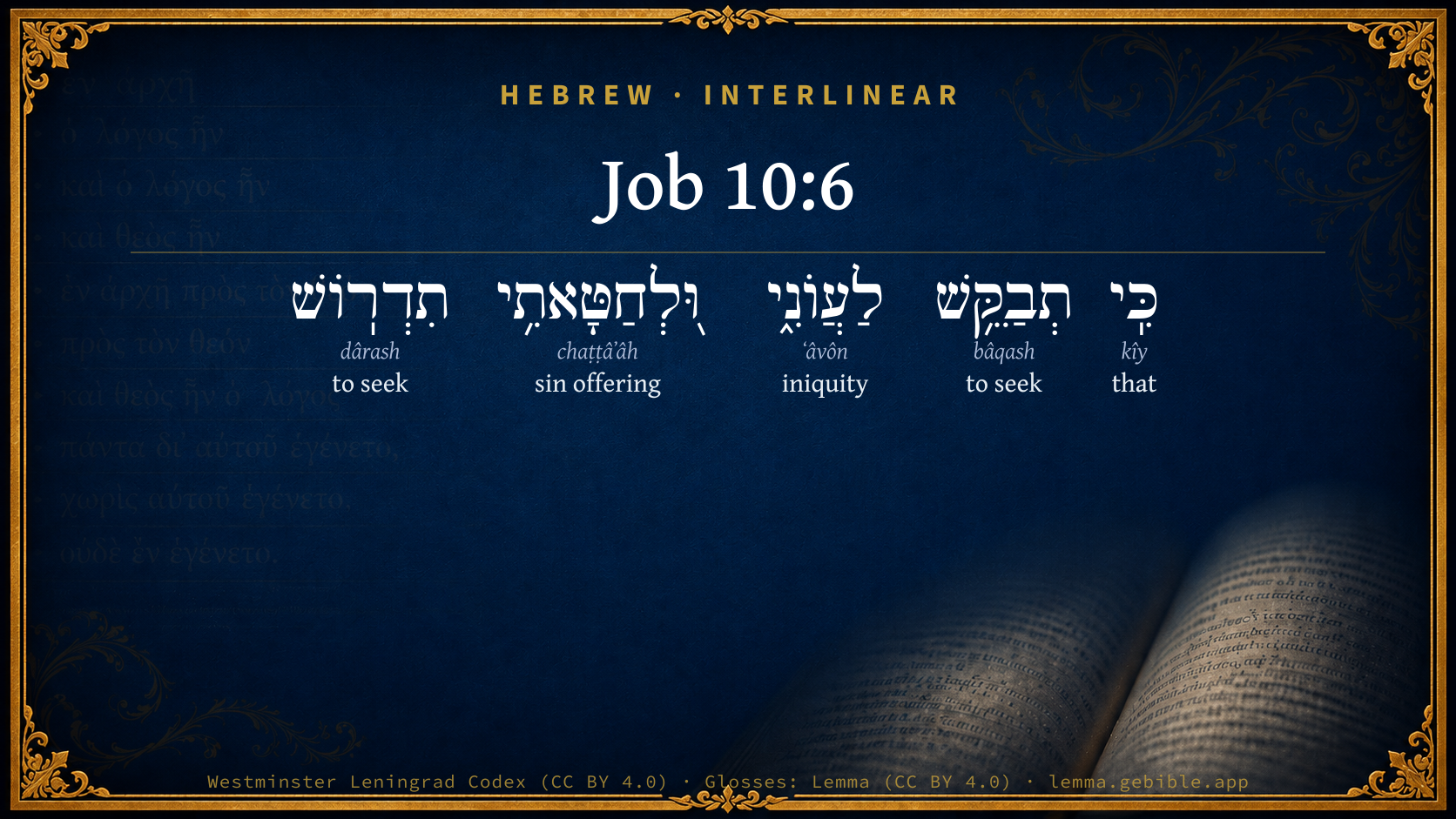
Job 10:6

Hebrew (Westminster Leningrad Codex) Job 10:6 appears in the Hebrew Old Testament. The text above is from the Westminster Leningrad Codex. Each word links to its Strong’s number, a concise gloss, and parsing drawn from the Open Scriptures Hebrew Bible morphology. Click any word for its full Brown-Driver-Briggs (BDB) entry.
Download image
Cite this verse

Job 10:6 (World English Bible). Public Domain. Lemma interlinear Bible study tool, https://lemma.gebible.app/v/job/10/6.

Show BibTeX & RIS
BibTeX
RIS
English Translation
That you inquire after my iniquity, And search after my sin?
World English Bible · Public Domain
Download a study sheet

One document with this verse’s original text, its word-by-word gloss line, the meaning frame, cross-references with their text, attributed commentary, and full source and license credits — printable, and it pastes into notes with its structure intact.

This verse Autodidact and up

Study sheet (.html) Plain text (.txt)

A passage Seminary Student

Up to 50 verses in one chapter. A passage sheet keeps up to 6 commentary sources and 12 cross-references per verse, in the order this page ranks them, and says so on the sheet whenever that leaves anything out. Ask for a single verse and you get the Autodidact verse sheet above.

Everything on this page stays free to read, with no account — the sheet is a download of what is already on screen, not access to it.

Want to remove ads? Support Godless Engineer
Compare translations 3

The same verse in 3 English versions, stacked beneath the original-language interlinear above. Click any original word for its lexicon entry.

Each is an independent rendering of the whole verse — the interlinear is not word-aligned to these translations.

Highlighted words mark where these versions differ — a whole-verse word diff, not a word-by-word alignment.

  • World English Bible Public Domain
    That you inquire after my iniquity, And search after my sin?
  • King James Version Public Domain
    That thou enquirest after mine iniquity, and searchest after my sin?
  • unfoldingWord Literal Text CC BY-SA 4.0
    that you seek for my iniquity and for my sin you search,

unfoldingWord Literal Text — © unfoldingWord, licensed CC BY-SA 4.0. Word-aligned USFM3 via Door43 (git.door43.org/unfoldingWord/en_ult).

Versions to compare (up to 4)

3 of 4 selected

Show all 18 translations

Every available English version of this verse, each an independent rendering of the whole verse.

  • World English Bible Public Domain
    That you inquire after my iniquity, And search after my sin?
  • Berean Standard Bible Public Domain
    that You should seek my iniquity and search out my sin—
  • Majority Standard Bible Public Domain
    that You should seek my iniquity and search out my sin—
  • King James Version Public Domain
    That thou enquirest after mine iniquity, and searchest after my sin?
  • American Standard Version (1901) Public Domain
    That thou inquirest after mine iniquity, And searchest after my sin,
  • Revised Version (1885) Public Domain
    That thou inquirest after mine iniquity, and searchest after my sin,
  • Geneva Bible (1599) Public Domain
    That thou inquirest of mine iniquitie, and searchest out my sinne?
  • Douay-Rheims (1899) Public Domain
    That thou shouldst inquire after my iniquity, and search after my sin?
  • Young's Literal Translation Public Domain
    That Thou inquirest for mine iniquity, And for my sin seekest?
  • Literal Standard Version CC BY-SA 4.0
    That You inquire for my iniquity, || And seek for my sin?
  • Unlocked Literal Bible CC BY-SA 4.0
    that you inquire after my iniquity and search after my sin,
  • unfoldingWord Literal Text CC BY-SA 4.0
    that you seek for my iniquity and for my sin you search,
  • Darby Bible Public Domain
    That thou searchest after mine iniquity, and inquirest into my sin;
  • World Messianic Bible Public Domain
    that you inquire after my iniquity, and search after my sin?
  • Webster's Bible Public Domain
    That thou inquirest after my iniquity, and searchest after my sin?
  • Free Bible Version CC BY-SA 4.0
    that you have to examine my wrongs and investigate my sins?
  • Bible in Basic English Public Domain
    That you take note of my sin, searching after my wrongdoing,
  • JPS Tanakh (1917) Public Domain
    That Thou inquirest after mine iniquity, and searchest after my sin,

Literal Standard Version (2020), Covenant Press — licensed CC BY-SA 4.0. Text via the HelloAO Bible API (eBible.org). Unlocked Literal Bible (unfoldingWord) — licensed CC BY-SA 4.0. Text via the HelloAO Bible API (eBible.org). unfoldingWord Literal Text — © unfoldingWord, licensed CC BY-SA 4.0. Word-aligned USFM3 via Door43 (git.door43.org/unfoldingWord/en_ult). Free Bible Version, Dr. Jonathan Gallagher — licensed CC BY-SA 4.0. Text via the HelloAO Bible API (eBible.org).

Word by word

More ways to search: Search by grammar → Find every occurrence → Compare this word →

Practice this passage: Drill this verse → Learn its vocabulary →

תִדְרֽוֹשׁ
dârash
H1875
“to seek”
Verb, Qal, Imperfect, 2nd Person, Masculine, Singular
Part of Speech
Verb
Stem
Qal
Form
Imperfect
Person
2nd Person
Gender
Masculine
Number
Singular
Full BDB Definition

Origin: a primitive root

TWOT: 455

to resort to, seek, seek with care, enquire, require - (Qal) - to resort to, frequent (a place), (tread a place) - to consult, enquire of, seek - of God - of heathen gods, necromancers - to seek deity in prayer and worship - God - heathen deities - to seek (with a demand), demand, require - to investigate, enquire - to ask for, require, demand - to practice, study, follow, seek with application - to seek with care, care for - (Niphal) - to allow oneself to be enquired of, consulted (only of God) - to be sought, be sought out - to be required (of blood)
  1. כִּֽי kîy H3588 “that” Conjunction
  2. תְבַקֵּ֥שׁ bâqash H1245 “to seek” Verb, Piel, Imperfect, 2nd Person, Masculine, Singular
  3. לַעֲוֺנִ֑י ʻâvôn H5771 “to/for · iniquity · my” Preposition + Noun, Common, Both, Singular, Construct + Suffix, Personal, 1st Person, Common, Singular
  4. וּ֭לְחַטָּאתִ֥י chaṭṭâʼâh H2403 “and · to/for · sin offering · my” Conjunction + Preposition + Noun, Common, Feminine, Singular, Construct + Suffix, Personal, 1st Person, Common, Singular

About this verse

These counts appear in no published source. They are computed here, from the morphology-tagged text and Lemma’s own curated glosses. What Lemma adds →

5
words
5
distinct lemmas
Wisdom
section

Grammatical profile

  • 2 verbs
  • 2 nouns
  • 1 conjunction

Verb forms

  • תְבַקֵּ֥שׁ Piel · Imperfect
  • תִדְרֽוֹשׁ Qal · Imperfect

Hebrew & Septuagint length

In English translation the verse runs 11 words from the Hebrew and 12 from the Septuagint (LXX English) — closely comparable.

A rough comparison of the two English renderings, which tokenize alike — not a word-level alignment.

Word counts can differ between the Hebrew and the Greek without any difference in meaning — e.g. the Hebrew direct-object marker אֵת has no separate Greek word, and Greek often adds the article ὁ.

Cross-references

8

Topical passages linked to Job 10:6 in the Treasury of Scripture Knowledge — connected by theme and wording, ordered by reader-vote popularity; previews shown in the World English Bible.

  • Job 14:16 But now you number my steps. Don't you watch over my sin?
  • Psalms 10:15 Break the arm of the wicked. As for the evil man, seek out his wickedness until you find none.
  • Psalms 44:21 Won't God search this out? For he knows the secrets of the heart.
  • Jeremiah 2:34 Also in your skirts is found the blood of the souls of the innocent poor: you did not find them breaking in; but it is because of all these things.
  • Zephaniah 1:12 It will happen at that time, that I will search Jerusalem with lamps, and I will punish the men who are settled on their dregs, who say in their heart, "Yahweh will not do good, neither will he do evil."
  • Job 10:14–17 If I sin, then you mark me. You will not acquit me from my iniquity.
  • John 2:24–25 But Jesus didn't trust himself to them, because he knew everyone,
  • 1 Corinthians 4:5 Therefore judge nothing before the time, until the Lord comes, who will both bring to light the hidden things of darkness, and reveal the counsels of the hearts. Then each man will get his praise from God.

Cross-references courtesy of OpenBible.info (CC BY 4.0).

Hebrew and Greek witnesses Masoretic Hebrew ↔ Greek Septuagint

The same verse in the two great witnesses to the Old Testament, shown verse-for-verse.

These are two independent witnesses, not word-aligned to each other, and the Septuagint is shown in lemma (dictionary) form.

Hebrew Job 10:6 Masoretic · Westminster Leningrad Codex

כִּֽי תְבַקֵּ֥שׁ לַעֲוֺנִ֑י וּ֭לְחַטָּאתִ֥י תִדְרֽוֹשׁ

That you inquire after my iniquity, And search after my sin?

World English Bible · Public Domain

Greek LXX Job 10:6 Septuagint · lemma form

ὅτι ἀναζητέω ὁ ἀνομία ἐγώ καί ὁ ἁμαρτία ἐγώ ἐξιχνίαζω

that you have enquired into my iniquity, and searched out my sins?

LXX2012 (modern English Septuagint) · Public Domain

Hebrew: Westminster Leningrad Codex (CC BY 4.0). Greek: Septuagint (public domain); English from LXX2012 (modern English Septuagint) (Public Domain). How the Septuagint differs from the Hebrew →

Commentary

Notes on Job 10:6 from classic Christian and Jewish commentators (each source and its license shown beneath its notes). The classic Christian expositions comment on the surrounding passage and are grouped to its opening verse, so a note may address several verses; the Jewish commentaries on the Tanakh (Rashi and others) are per-verse, so they appear only where the commentator wrote on this verse.

Lemma curates 59 commentaries, every one of them public domain or Creative Commons licensed, each selected and text-cleaned for this edition rather than reprinted as found. About our sources →

Trapp's Complete Commentary

John Trapp

Job 10:6 That thou enquirest after mine iniquity, and searchest after my sin?

Ver. 6. That thou inquirest after mine iniquity, &c.] viz. By strong pains and mighty terrors, as judges sometimes make inquisition by torture, to find out treason or other heinous offences. What, wouldest thou that I should confess myself a wicked person?

John Trapp, A Commentary or Exposition upon All the Books of the Old and New Testament (1647–1656) — public domain. Text from a community e-Sword module.

Joseph Benson's Commentary

Job 10:6-7. That thou inquirest, &c., and searchest after my sin — Keeping me so long upon the rack, to compel me to accuse myself. Thou knowest I am not wicked — That is a hypocrite, or an ungodly man, as my friends account me. There is none that can deliver, &c. — Thou art the supreme ruler of the world; therefore I must wait thy time, and throw myself on thy mercy, in submission to thy sovereign will. “It would be injurious to the character of Job,” says Mr. Peters, “should we interpret in a severe and rigorous sense, as it is certain his friends too often did, his frequent protestations of his innocence, and his bold appeals to the supreme Judge to prove and try him; for where he is thus strenuous in asserting his integrity, it is only in opposition to the notion which those mistaken friends had entertained of him, namely, that he had been guilty of some gross sins, which he had the art to hide from the world, but that he was in reality a wicked man, and a hypocrite in his behaviour. This is what Job utterly denies and disclaims, though he nowhere arrogates to himself perfect innocence or freedom from sin.”

Joseph Benson's Commentary on the Old and New Testaments (1811–1818) — public domain. Text from a community e-Sword module.

Adam Clarke's Commentary

Verse 6. That thou inquirest] Is it becoming thy infinite dignity to concern thyself so much with the affairs or transgressions of a despicable mortal? A word spoken in the heart of most sinners.

Adam Clarke's Commentary on the Bible (1810–1826) — public domain. Text from a community e-Sword/MySword module.

John Gill's Exposition

That thou enquirest after mine iniquity, and searchest after my sin? Narrowly examined every action of his life, to find something amiss in them; and took notice of every weakness and infirmity, and aggravated it, to make it appear as sinful as it could be, and watched every halting and failing, that he might have something against him as a reason why he afflicted him; dealing with him as if there was no Messiah, no Mediator, Redeemer, and Saviour, provided, appointed, and promised; and as if there was no forgiveness of sin, through him, for him: sin pardoned for his sake is covered, that when it is sought for it shall not be found; so that when it is not pardoned, or not thought to be so, it lies open, and upon inquiry to be found, charged, and punished for; see Job 7:21; this search and inquiry seems to have been made by afflictions; at least Job imagined that the design of God in them was to put him upon the rack, and bring him to a confession of sin, find in this way find an occasion against him: now such a method as this, Job thought, was unbecoming the greatness, majesty, and perfections of God; and was quite needless, since his eyes were not human nor shortsighted, that obliged him to pore and pry into things, but were omniscient, and could see at once whether there was any evil way in him or not; nor was he as men, short lived, which obliged him to make use of his time while he had it, to get an advantage of another; and besides, such a method of acting seemed to him very extraordinary, when he full well knew he was an innocent person, as follows.

; this search and inquiry seems to have been made by afflictions; at least Job imagined that the design of God in them was to put him upon the rack, and bring him to a confession of sin, find in this way find an occasion against him: now such a method as this, Job thought, was unbecoming the greatness, majesty, and perfections of God; and was quite needless, since his eyes were not human nor shortsighted, that obliged him to pore and pry into things, but were omniscient, and could see at once whether there was any evil way in him or not; nor was he as men, short lived, which obliged him to make use of his time while he had it, to get an advantage of another; and besides, such a method of acting seemed to him very extraordinary, when he full well knew he was an innocent person, as follows.

Job 10:7

job 10:7

job 10:7

job 10:7Thou knowest that I am not wicked,.... Or "in", or "upon thy knowledge (a) it is that I am not wicked"; it is a thing well known, quite clear, and manifest, without making such a search and inquiry: not that he thought himself without sin, and could appeal to the omniscience of God for the truth of that; for he had confessed before that he was a sinner, and wicked, as to his nature and birth, and the many infirmities of life; see Job 7:20; but that he was not that wicked person, and an hypocrite, as his friends took him to be, and as might be concluded from the sore afflictions that were upon him; he did not live in sin, nor indulge himself in a vicious course of life; sin had not the dominion over him, and he had not secretly cherished any reigning iniquity, and lived in the commission of it: and for the truth of this he could appeal to the searcher of hearts; and yet he so closely pursued, and so strictly examined him, as if he suspected he was thus guilty:

and there is none that can deliver out of thine hand; that is, out of his afflicting hand, until he please to release him from it himself; for this is not to be understood of deliverance from the avenging hand of justice, from hell and wrath, and everlasting destruction; for there is one that can and does deliver his people from sin and Satan; from the world, the law, its curses and condemnation, and from wrath to come; and from the hands of justice, having made full satisfaction to it: but what Job observes that God knew was, that neither he himself, nor any angel, nor man, nor any creature, could take him out of his hand in which be was; and therefore suggests, not only that his condition was extremely bad, distressed, and miserable, but that there was no necessity for God to he so quick upon him, and so strict in his inquiry into him; nor of enclosing him about on all hands with afflictions, since, there was no danger of his escaping from him, or of others assisting him in and facilitating such an attempt: and this he full well knew; for so the words are connection with the preceding: "and thou knowest that there is none", &c. (b), as well as with what follows, as some think.

(a) "in notitia tua est", Junius & Tremellius, Piscator, Beza; so Michaelis. (b) So Bolducius, Drusius, Schmidt, Michaelis, and Bar Tzemach.

John Gill's Exposition of the Whole Bible (1746–1763) — public domain (CC PDM 1.0). Text via the HelloAO Bible API.

Albert Barnes' Notes on the Bible

That thou inquirest after mine iniquity - Art thou governed by hu man passions and prejudices, that thou dost thus seem to search out every little obliquity and error? Job here evidently refers to the conduct of man in strictly marking faults, and in being unwilling to forgive; and he asks whether it is possible that God could be governed by such feelings as these.

Albert Barnes' Notes on the Bible (1834–1885) — public domain. Text from a community e-Sword/MySword module.

Matthew Poole's English Annotations

Keeping me so long as it were upon the rack to compel me to accuse myself, as men sometimes do.

Matthew Poole's English Annotations on the Holy Bible (1683–1685) — public domain. Text from a community e-Sword/MySword module.

Whedon's Commentary on the Bible

Daniel D. Whedon

6. Thou inquirest — The idea of Ewald, that Job conceives of God as some mighty monarch who, like those on earth, puts the unhappy one to the rack that he may constrain a confession, is not justified by the text. The real idea is not so high-coloured. Job means, if there be insufficient time to leave sin to its own development, then God is right in making such hasty inquisition after man’s iniquity; otherwise there is no need of seeking occasion against him and slaying him before his time.

Daniel D. Whedon (gen. ed.), Commentary on the Old and New Testaments (1874–1909) — public domain. Text from a community e-Sword module.

The Pulpit Commentary

That thou inquirest after mine iniquity, and searchest after my sin. It seems to Job that God must have been "extreme to mark what he has done amiss", (Psa_130:3) must have searched into every corner of Ms life, and hunted out all his sins and shortcomings, to have been able to bring together against him a total commensurate or even approximately commensurate, with the punishment wherewith he has visited him.

The Pulpit Commentary (1880–1919), ed. H.D.M. Spence-Jones & Joseph S. Exell — public domain. Text from a community e-Sword module.

John Wesley's Explanatory Notes

Searchest - Keeping me so long upon the rack, to compel me to accuse myself.

John Wesley, Explanatory Notes Upon the Whole Bible (1754–1765) — public domain. Text via the GEBible commentary corpus.

Lesson kit

Teaching starters — assembled from the data on this page, not authored interpretation. Every prompt links to the verse data it draws on. Edit before teaching.

Job, in the Wisdom, opens this verse with 5 words (5 distinct Hebrew lemmas). Its most distinctive word is dârash (“to seek”). A historical commentator’s framing appears above. Read the whole chapter for the surrounding context.

Discussion questions

  1. How does “to seek” (dârash) shape what this verse is saying?
  2. Job 14:16 shares this passage’s theme. How do the two illuminate each other?
  3. These translations render this verse differently; the difference is in the English rendering, not the original. What questions does that raise?
  4. The verb «תְבַקֵּ֥שׁ» is Piel Imperfect. How does its form color the action?
  5. Reading how Trapp's Complete Commentary and Joseph Benson's Commentary read this verse, where do the two commentators agree and where do they part?

Things to notice

Reading settings

Reading text

Shown beneath each verse's original-language words.

Old Testament
Old Testament edition

Read the OT as the Masoretic Hebrew (MT) or the Greek Septuagint (LXX).

English shown for the Greek Septuagint (in the Hebrew ↔ Greek comparison).

Comparing translations? Open the Compare panel on any verse page to stack up to four side by side.