
Psalms 122:9

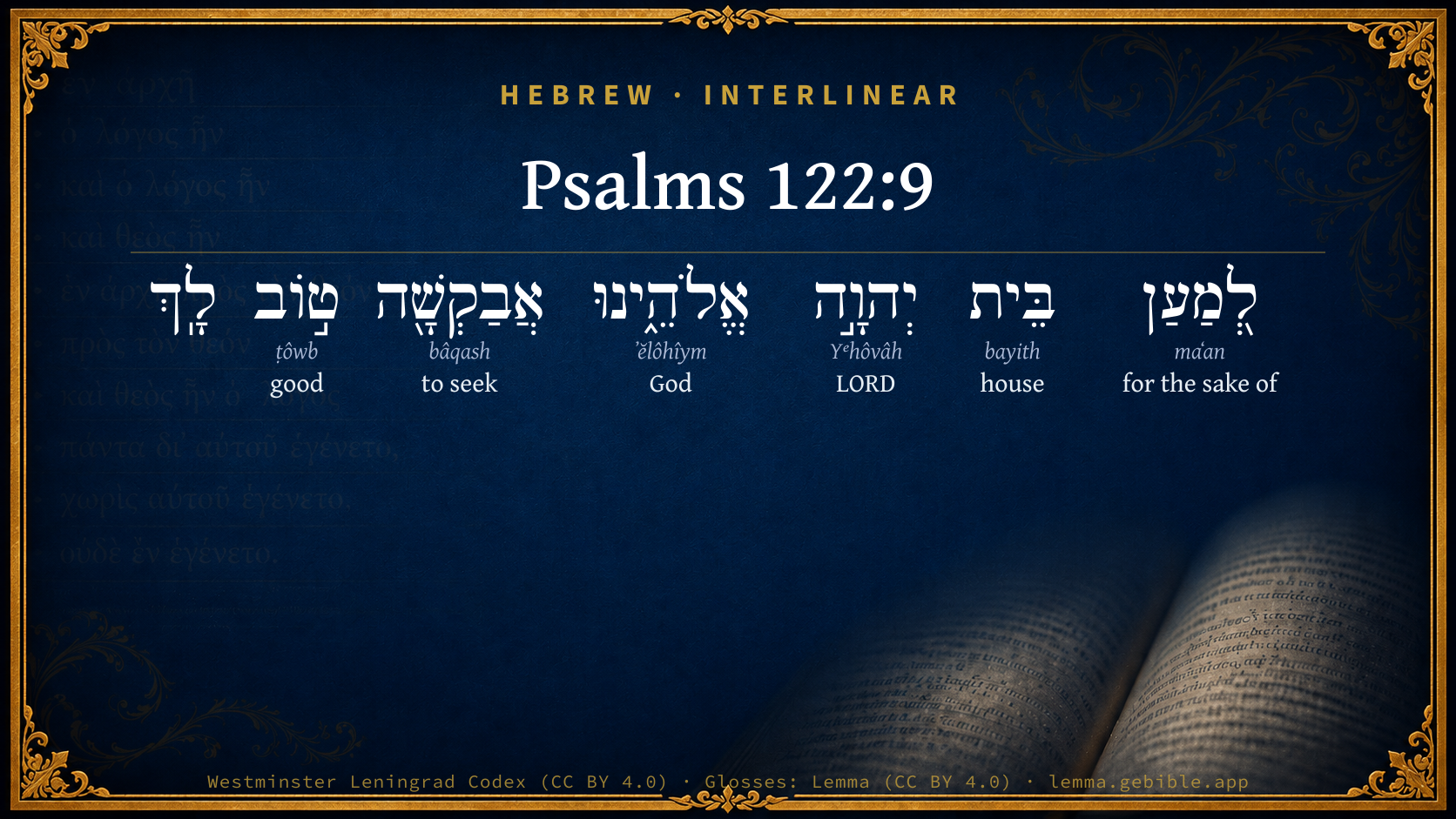
Hebrew (Westminster Leningrad Codex) Psalms 122:9 appears in the Hebrew Old Testament. The text above is from the Westminster Leningrad Codex. Each word links to its Strong’s number, a concise gloss, and parsing drawn from the Open Scriptures Hebrew Bible morphology. Click any word for its full Brown-Driver-Briggs (BDB) entry.
Download image
Cite this verse

Psalms 122:9 (World English Bible). Public Domain. Lemma interlinear Bible study tool, https://lemma.gebible.app/v/psalms/122/9.

Show BibTeX & RIS
BibTeX
RIS
English Translation
For the sake of the house of Yahweh our God, I will seek your good.
World English Bible · Public Domain
Download a study sheet

One document with this verse’s original text, its word-by-word gloss line, the meaning frame, cross-references with their text, attributed commentary, and full source and license credits — printable, and it pastes into notes with its structure intact.

This verse Autodidact and up

Study sheet (.html) Plain text (.txt)

A passage Seminary Student

Up to 50 verses in one chapter. A passage sheet keeps up to 6 commentary sources and 12 cross-references per verse, in the order this page ranks them, and says so on the sheet whenever that leaves anything out. Ask for a single verse and you get the Autodidact verse sheet above.

Everything on this page stays free to read, with no account — the sheet is a download of what is already on screen, not access to it.

Want to remove ads? Support Godless Engineer
Compare translations 3

The same verse in 3 English versions, stacked beneath the original-language interlinear above. Click any original word for its lexicon entry.

Each is an independent rendering of the whole verse — the interlinear is not word-aligned to these translations.

Highlighted words mark where these versions differ — a whole-verse word diff, not a word-by-word alignment.

  • World English Bible Public Domain
    For the sake of the house of Yahweh our God, I will seek your good.
  • King James Version Public Domain
    Because of the house of the LORD our God I will seek thy good.
  • unfoldingWord Literal Text CC BY-SA 4.0
    For the sake of the house of Yahweh our God, let me seek good for you.

unfoldingWord Literal Text — © unfoldingWord, licensed CC BY-SA 4.0. Word-aligned USFM3 via Door43 (git.door43.org/unfoldingWord/en_ult).

Versions to compare (up to 4)

3 of 4 selected

Show all 17 translations

Every available English version of this verse, each an independent rendering of the whole verse.

  • World English Bible Public Domain
    For the sake of the house of Yahweh our God, I will seek your good.
  • Berean Standard Bible Public Domain
    For the sake of the house of the LORD our God, I will seek your prosperity.
  • Majority Standard Bible Public Domain
    For the sake of the house of the LORD our God, I will seek your prosperity.
  • King James Version Public Domain
    Because of the house of the LORD our God I will seek thy good.
  • American Standard Version (1901) Public Domain
    For the sake of the house of Jehovah our God I will seek thy good. Psalm 123 A Song of Ascents.
  • Revised Version (1885) Public Domain
    For the sake of the house of the LORD our God I will seek thy good.
  • Geneva Bible (1599) Public Domain
    Because of the House of the Lord our God, I will procure thy wealth.
  • Young's Literal Translation Public Domain
    For the sake of the house of Jehovah our God, I seek good for thee!
  • Literal Standard Version CC BY-SA 4.0
    For the sake of the house of our God YHWH, || I seek good for you!
  • Unlocked Literal Bible CC BY-SA 4.0
    For the sake of the house of Yahweh our God, I will seek good for you.
  • unfoldingWord Literal Text CC BY-SA 4.0
    For the sake of the house of Yahweh our God, let me seek good for you.
  • Darby Bible Public Domain
    Because of the house of Jehovah our God I will seek thy good.
  • World Messianic Bible Public Domain
    For the sake of the house of the LORD our God, I will seek your good.
  • Webster's Bible Public Domain
    Because of the house of the LORD our God I will seek thy good.
  • Free Bible Version CC BY-SA 4.0
    On behalf of the house of the Lord our God, I pray that everything goes well for you.
  • Bible in Basic English Public Domain
    Because of the house of the Lord our God, I will be working for your good.
  • JPS Tanakh (1917) Public Domain
    For the sake of the house of the LORD our God I will seek thy good.

Literal Standard Version (2020), Covenant Press — licensed CC BY-SA 4.0. Text via the HelloAO Bible API (eBible.org). Unlocked Literal Bible (unfoldingWord) — licensed CC BY-SA 4.0. Text via the HelloAO Bible API (eBible.org). unfoldingWord Literal Text — © unfoldingWord, licensed CC BY-SA 4.0. Word-aligned USFM3 via Door43 (git.door43.org/unfoldingWord/en_ult). Free Bible Version, Dr. Jonathan Gallagher — licensed CC BY-SA 4.0. Text via the HelloAO Bible API (eBible.org).

Word by word

More ways to search: Search by grammar → Find every occurrence → Compare this word →

Practice this passage: Drill this verse → Learn its vocabulary →

אֲבַקְשָׁ֖ה
bâqash
H1245
“to seek”
Verb, Piel, Cohortative, 1st Person, Common, Singular
Part of Speech
Verb
Stem
Piel
Form
Cohortative
Person
1st Person
Gender
Common
Number
Singular
Full BDB Definition

Origin: a primitive root

TWOT: 276

to seek, require, desire, exact, request - (Piel) - to seek to find - to seek to secure - to seek the face - to desire, demand - to require, exact - to ask, request - (Pual) to be sought
  1. לְ֭מַעַן maʻan H4616 “for the sake of” Preposition
  2. בֵּית bayith H1004 “house of” Noun, Common, Masculine, Singular, Construct
  3. יְהוָ֣ה Yᵉhôvâh H3068 “LORD” Noun, Proper
  4. אֱלֹהֵ֑ינוּ ʼĕlôhîym H430 “God(s) · our” Noun, Common, Masculine, Plural, Construct + Suffix, Personal, 1st Person, Common, Plural
  5. ט֣וֹב ṭôwb H2896 “good” Adjective, Adjective, Masculine, Singular, Absolute

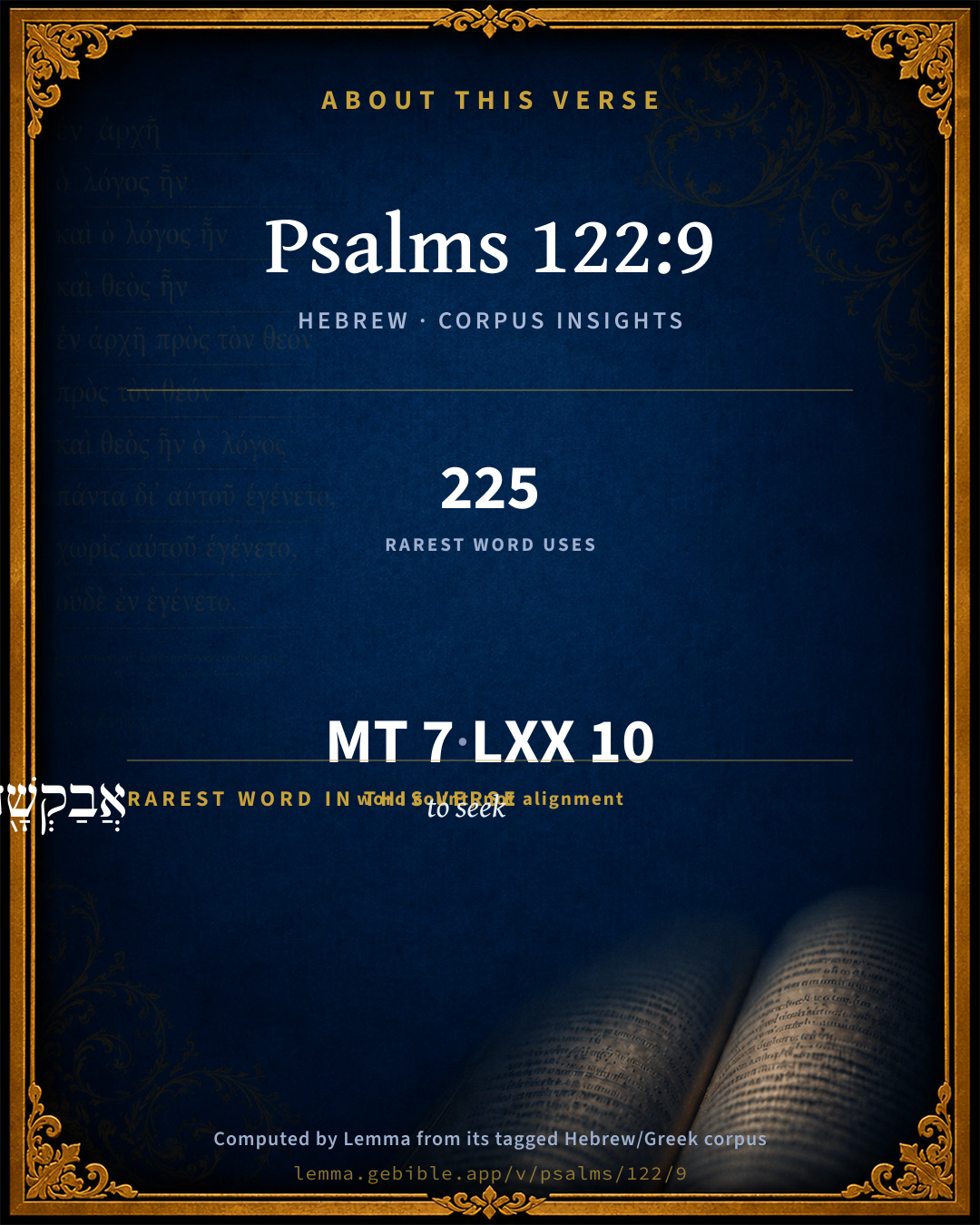
About this verse

These counts appear in no published source. They are computed here, from the morphology-tagged text and Lemma’s own curated glosses. What Lemma adds →

7
words
6
distinct lemmas
Wisdom
section

Grammatical profile

  • 1 verb
  • 3 nouns
  • 1 adjective
  • 2 prepositions

Verb forms

  • אֲבַקְשָׁ֖ה Piel · Cohortative

Hebrew & Septuagint length

In English translation the verse runs 15 words from the Hebrew and 15 from the Septuagint (LXX English) — the same length.

A rough comparison of the two English renderings, which tokenize alike — not a word-level alignment.

Word counts can differ between the Hebrew and the Greek without any difference in meaning — e.g. the Hebrew direct-object marker אֵת has no separate Greek word, and Greek often adds the article ὁ.

In the original languages it is 7 Hebrew tokens and 10 Greek tokens — but the two are counted differently (Hebrew bundles its prefixes and suffixes into one token; the Greek is in lemma form), so that isn’t a like-for-like length.

Cross-references

11

Topical passages linked to Psalms 122:9 in the Treasury of Scripture Knowledge — connected by theme and wording, ordered by reader-vote popularity; previews shown in the World English Bible.

  • Nehemiah 2:10 When Sanballat the Horonite, and Tobiah the servant, the Ammonite, heard of it, it grieved them exceedingly, because a man had come to seek the welfare of the children of Israel.
  • Psalms 84:10 For a day in your courts is better than a thousand. I would rather be a doorkeeper in the house of my God, Than to dwell in the tents of wickedness.
  • 1 Chronicles 29:3 In addition, because I have set my affection on the house of my God, seeing that I have a treasure of my own of gold and silver, I give it to the house of my God, over and above all that I have prepared for the holy house,
  • Nehemiah 13:14 Remember me, my God, concerning this, and don't wipe out my good deeds that I have done for the house of my God, and for the observances of it.
  • Esther 10:3 For Mordecai the Jew was next to king Ahasuerus, and great among the Jews, and accepted of the multitude of his brothers, seeking the good of his people, and speaking peace to all his seed.
  • Psalms 26:8 Yahweh, I love the habitation of your house, The place where your glory dwells.
  • Psalms 69:9 For the zeal of your house consumes me. The reproaches of those who reproach you have fallen on me.
  • Psalms 84:1–2 How lovely are your dwellings, Yahweh of Hosts!
  • John 2:17 His disciples remembered that it was written, "Zeal for your house will eat me up."
  • Psalms 102:13–14 You will arise and have mercy on Zion; For it is time to have pity on her. Yes, the set time has come.
  • Psalms 137:5–6 If I forget you, Jerusalem, Let my right hand forget its skill.

Cross-references courtesy of OpenBible.info (CC BY 4.0).

Hebrew and Greek witnesses Masoretic Hebrew ↔ Greek Septuagint

The same verse in the two great witnesses to the Old Testament, shown verse-for-verse.

You’re reading Greek Psalm 121 (Hebrew Psalm 122). The Septuagint counts the superscription, so verse numbers can differ from the Hebrew — chapter-level alignment, not verse-by-verse. Numbering follows Rahlfs.

These are two independent witnesses, not word-aligned to each other, and the Septuagint is shown in lemma (dictionary) form.

Hebrew Psalms 122:9 Masoretic · Westminster Leningrad Codex

לְ֭מַעַן בֵּית יְהוָ֣ה אֱלֹהֵ֑ינוּ אֲבַקְשָׁ֖ה ט֣וֹב לָֽךְ

For the sake of the house of Yahweh our God, I will seek your good.

World English Bible · Public Domain

Greek LXX Greek Psalm 121:9 Septuagint · lemma form

ἕνεκα ὁ οἶκος κύριος ὁ θεός ἐγώ ἐκζητέω ἀγαθός σύ

Because of the house of the Lord our God, I have diligently sought your good.

LXX2012 (modern English Septuagint) · Public Domain

Hebrew: Westminster Leningrad Codex (CC BY 4.0). Greek: Septuagint (public domain); English from LXX2012 (modern English Septuagint) (Public Domain). How the Septuagint differs from the Hebrew →

Commentary

Notes on Psalms 122:9 from classic Christian and Jewish commentators (each source and its license shown beneath its notes). The classic Christian expositions comment on the surrounding passage and are grouped to its opening verse, so a note may address several verses; the Jewish commentaries on the Tanakh (Rashi and others) are per-verse, so they appear only where the commentator wrote on this verse.

Lemma curates 59 commentaries, every one of them public domain or Creative Commons licensed, each selected and text-cleaned for this edition rather than reprinted as found. About our sources →

Trapp's Complete Commentary

John Trapp

Psa 122:9 Because of the house of the LORD our God I will seek thy good.

Ver. 9. Because of the house of the Lord our God] Where David’s heart was, and wherein he held it a happiness to be but a doorkeeper, Psa 84:10, so much endeared unto him was God’s sincere service. O pass we into the likeness of this heavenly pattern.

I will seek thy good] I will both pray it and promote it.

John Trapp, A Commentary or Exposition upon All the Books of the Old and New Testament (1647–1656) — public domain. Text from a community e-Sword module.

The Biblical Illustrator

Joseph S. Exell

Psa_122:9

Because of the house of the Lord our God I will seek thy good.

Christian patriotism

I. The Christians patriotic vow.

1. He will honour the King.

2. He will obey the laws, not merely for wrath, but for conscience sake.

3. He will use his influence to promote obedience in others.

4. He will personally contribute with cheerfulness to the support of the government by which he is protected.

5. He will discountenance to the utmost all those arts of evasion by which the revenue is defrauded and diminished.

6. He will unite with those who sigh and cry for the abominations of the lands.

7. If Providence should call, he will fight as well as pray.

II. The motive to this vow.

1. It is our native land.

2. The excellence of its constitution.

3. We have a life-interest in our country.

4. We should aim to do justice to the memory of our ancestors, by transmitting, unimpaired, to our posterity, the invaluable treasure of civil and religious liberties which we ourselves enjoy.

5. The house of the Lord is the glory of the land. The ark of the covenant is with us. Our privileges as Christians are great and many. And this consideration will preponderate over all others in the minds of those who truly love our Saviours name. (W. Newman, D. D.)

The house of the Lord

I. Gods Church as His house.

1. It is reared by Himself.

(1) The wisdom of the Architect.

(2) The firmness of the foundation.

(3) The suitableness of the materials.

(4) The efficiency of the work. The power is all His own.

2. Gods house is essentially spiritual. There are spiritual capacities, spiritual desires, spiritual purposes, spiritual exercises.

3. The house of God is intended for His own use.

(1) His dwelling-house.

(2) His banqueting-house.

(3) A house of births.

(4) A house of sacrifice.

(5) A house of prayer.

(6) A house of praise.

II. Our individual membership therein. Real godliness is kept up and maintained by secret communion with God, spiritual intercourse with the Most High, under the movings of the Holy Ghost, in the name and for the merits of the Lord Jesus, by sweet, familiar, filial addresses to God the Father. Yea, you want more? The Fathers love-tokens in reply, the Saviours kind word in support, and the influence of the Spirit, as green olive trees in the house of the Lord.

III. Devotedness to the house of the Lord. Seek her extension, her peace, and her privileges. (J. Irons.)

.

Psa_123:1-4

The Biblical Illustrator, edited by Joseph S. Exell (c. 1880s–1900s) — public domain. Text from a community e-Sword module.

J. A. Alexander on Psalms

Joseph Addison Alexander

9. (Psa 122:9) For the sake of the house of Jehovah our God, I will seek thy good. The house of God is here the sanctuary and all the interests of which it was the local centre. Jehovah our God, our patron and protector, our peculiar covenant God. Seek includes every form of effort to promote it; but the prominent idea is that of intercession.

Joseph Addison Alexander, The Psalms Translated and Explained (1850) — public domain. Text from a community e-Sword module.

Adam Clarke's Commentary

Verse 9. Because of the house of the Lord our God] Particularly will I wish thee well, because thou art the seat of religion, the place where our merciful God has condescended to dwell.

To the captives in Babylon the Prophet Jeremiah had given this charge, Jer 29:7: "And seek שלום shalom, the prosperity of the city, whither I have caused you to be carried captives, and pray unto the Lord for it; for in the prosperity thereof ye shall have prosperity."

Was this a duty for the captives? Yes. And is it the duty of every man for his own country? God, nature, common sense, and self-interest say, YES! And what must we think of the wretches who not only do not thus pray, but labour to destroy the public peace, to subvert the government of their country, to raise seditions, and to destroy all its civil and religious institutions? Think of them! Why, that hemp would be disgraced by hanging them.

There is a fine picture given us here of the state of Jerusalem after the restoration of the Jews. The walls were finished, the city rebuilt, beautiful, strong, and regular, the temple and its worship were restored, the courts of justice were re-established, the constituted authorities in Church and state were doing their duty; and God was pouring out his blessing upon all. Who could see this without praying, May God increase thy peace, and establish thy prosperity for ever!

ANALYSIS OF THE HUNDRED AND TWENTY-SECOND PSALM

The psalmist, in the person of the people, -

I. Expresses his joy that he might join with the Church in God's service, Ps 122:1-2.

II. Commends the Church, under the name of Jerusalem, for her unity, Ps 122:3; religious worship, Ps 122:4; civil and ecclesiastical policy, Ps 122:5.

III. Exhorts all to pray for its peace and prosperity, Ps 122:6; and puts the form of prayer into their mouths, Ps 122:7.

IV. Shows his own readiness to do this, and offers up his supplications, Ps 122:8-9.

I. The psalmist congratulates himself and the people on the restoration of God's worship: -

1. He expresses his own joy: "I was glad."

2. To hear of the unanimity of the people mutually exhorting each other to it: "When they said unto me."

3. "Let us go into the house of the Lord." Let us all go, hear his word, give him thanks, and make prayers and supplications to him.

II. He commends Jerusalem three ways: -

1. For its unity: it was compact together; it was united in itself; and united, both in politics and religion, in its inhabitants.

2. For its being the place of God's worship: 1. For "thither the tribes go up" thrice in the year, as was ordained, Ex 23:14, to celebrate their deliverance from Egypt, in keeping the passover. 2. The giving of the law, in the feast of pentecost. 3. Their preservation in the wilderness, in the feast of tabernacles.

These tribes are "the tribes of the Lord." A very honourable title.

"Unto the testimony of Israel." To the ark of the covenant, the pledge of the covenant between God and the people.

The end for which they went up: "To give thanks unto the name of the Lord."

3. He commends Jerusalem for its civil and ecclesiastical policy: 1. "For there are set thrones of judgment." The tribunals and courts of justice are there. 2. "The thrones of the house of David." The court and throne of a legitimate sovereign.

III. He exhorts the tribes to pray for a continuance of its present happy state.

1. "Pray for the peace," c. It is our duty to pray for the prosperity of the nation and of the Church of God.

2. "They shall prosper that love thee." Those who love both are blessed, those who do not are cursed.

3. And that we may know the prayer that God will hear, he puts one in our mouth, "Peace be within thy walls, and prosperity within thy palaces." It is well to join peace and prosperity together. Peace without prosperity is but a secure possession of misery and prosperity without peace is but a dubious and uncertain felicity.

1. "Peace be within thy walls." Not only thy fortifications, civil and religious institutions, but also among all thy officers, soldiers, and inhabitants, for they constitute the strength and safety of the kingdom.

2. "And prosperity within thy palaces." In the king's house, his family, his ministers; if there be dissensions there, ruin will soon follow.

IV. The psalmist shows his own readiness to do this.

1. "I will now say, Peace be within thee." So should all the ministers of religion pray.

2. "I will seek thy good." So should the king and every officer of state resolve. All should be united in so good a work. They should not seek their own good, but the good, not the goods, of the people.

For this the psalmist gives these reasons: -

1. "For my brethren and companions' sakes." We are not only subjects of one king, citizens of the same city, but we have all one God and Father.

2. "Because of the house of the Lord." For the maintenance of true religion. If religion fail, the kingdom will fail; prosperity will be at an end; the nation will be divided, distracted, destroyed. Religion, the true religion in a country, is the consolation of the good, and the bridle that holds in the jaws of the wicked. Let us all pray for the prosperity of pure and undefiled religion, and the prosperity of the state!

Adam Clarke's Commentary on the Bible (1810–1826) — public domain. Text from a community e-Sword/MySword module.

John Calvin's Commentaries

9. Because of the house of Jehovah our God, etc. In this verse he adds a second reason why he cared for the Church — that he did so, because the worship of God so far from remaining entire would go to ruin unless Jerusalem continued standing. If then the salvation of our brethren is regarded by us as an object of importance, if religion is with us a matter of heart-work, we ought, at the same time, as much as in us lies, to take an interest in the prosperity of the Church. Whence it follows, that such are indifferent about her condition, are no less cruel than impious; for if she is “the pillar and foundation of truth,” the inevitable consequence of her destruction must be the extinction of true piety. And if the body is destroyed, how can each of the members fail to be involved in destruction? Farther, this passage teaches us that the Church is not an empty title, but must be sought for where the true religion prevails. Whence it appears, how foolish the Papists are, who, notwithstanding their having rejected and overthrown the doctrine of the Gospel, yet mightily boast of the name of the Church.

John Calvin's Commentaries (1540-1563) — public domain. Text from the Calvin Translation Society English edition (1840s-50s) via the Christian Classics Ethereal Library (ccel.org). Calvin's coverage is partial (roughly two-thirds of the Bible); uncommented books and verses are honest gaps, never fabricated. The 19th-century editor's footnotes and remarks are omitted so the notes are faithfully Calvin's own voice.

Ellicott's Commentary for English Readers

(9) Because . . .—Now for the first time the religious motive of the pilgrimage appears, rendered all the more emphatic by being kept for the concluding verse.

A Bible Commentary for English Readers, edited by Charles John Ellicott (1878–1897) — public domain. Text from a community e-Sword module.

The Cambridge Bible for Schools and Colleges

gen. ed. J. J. S. Perowne

9. For the sake of the house &c.] Dear as Jerusalem is to him as the centre of the nation’s civil life, it is yet dearer as the centre of the national religion.

I will (Let me) seek thy good] So Neh_2:10, “a man to seek the good of the children of Israel.”

The Cambridge Bible for Schools and Colleges (gen. ed. J. J. S. Perowne; Cambridge University Press, 1878–1918) — public domain. Text from a community e-Sword module.

Albert Barnes' Notes on the Bible

Because of the house of the Lord our God I will seek thy good - Because of the sanctuary within thee; because that is the place where God is worshipped. The principal attraction in thee is the fact that in thee is the place where the worship of God is celebrated. It is this which gives its main importance in my view to the place; it is for this, and because I desire its influence to be perpetuated and extended, that I seek thy prosperity. This expresses a deep feeling in the mind of a pious man. To him the church of God is the most important of all objects, gives the principal interest to a place, and is everywhere to him the chief attraction. The church does more to adorn a place than anything else; it is that which exerts the best influence on a place, and sends the best influence abroad; it is that which to him is the source of chief comfort and delight. His heart is there; his main delight is there; his arrangements will be made so as best to enjoy the privileges of the sanctuary; and his plans of life will all contemplate the welfare, the extension, and the influence of the church of God. It is religion which in his view is the chief ornament of a place; religion which in any community is the principal fountain of its happiness and prosperity; religion which is the central and controlling influence on the private dwellings, and the public institutions, of a nation.

Albert Barnes' Notes on the Bible (1834–1885) — public domain. Text from a community e-Sword/MySword module.

Matthew Poole's English Annotations

The house of the Lord our God; which is now fixed in this city.

Matthew Poole's English Annotations on the Holy Bible (1683–1685) — public domain. Text from a community e-Sword/MySword module.

The Treasury of David

Charles H. Spurgeon

Ver. 9. Because of the house of the LORD our God I will seek thy good. He prays for Jerusalem because of Zion. How the church salts and savours all around it. The presence of Jehovah, our God, endears to us every place wherein he reveals his glory. Well may we seek her good within whose walls there dwells God who alone is good. We are to live for God's cause, and to be ready to die for it. First we love it (Ps 122:6) and then we labour for it, as in this passage: we see its good, and then seek its good. If we can do nothing else we can intercede for it. Our covenant relation to Jehovah as our God binds us to pray for his people, they are "the house of the Lord our God." If we honour our God we desire the prosperity of the church which he has chosen for his indwelling.

Thus is the poet glad of an invitation to join with others in the Lord's service. He goes with them and rejoices, and then he turns his delight into devotion, and intercedes for the city of the great King. O church of the living God, we hail thine assemblies, and on bended knee we pray that thou mayest have peace and felicity. May our Jehovah so send it. Amen.

Ver. 9. Because of the house of the Lord. The city that was the scene of so immense assemblies had necessarily a peculiar character of its own. It existed for them, it lived by them. There were priests needed for the conduct of the worship, twenty four courses of them and 20,000 men. There were Levites, their servants, in immense numbers, needed to watch, maintain, clean the templeto do the menial and ministering work necessary to its elaborate service and stupendous acts of worship. There were scribes needed for the interpretation of the law, men skilled in the Scriptures and tradition, with names like Gamaliel, so famed for wisdom as to draw young men like Saul from distant Tarsus, or Apollos from rich Alexandria. There were synagogues, 480 of them at least, where the rabbis read and the people heard the word which God had in past times spoken unto the fathers by the prophets. The city was indeed in a sense the religion of Israel, incorporated and localized, and the man who loved the one turned daily his face toward the other, saying, "My soul longeth, yea, even fainteth for the courts of Jahveh." A. M. Fairbairn, in "Studies in the Life of Christ, "1881.

Ver. 9. I will seek thy good. It is not a cold wish; it is not a careless, loose seeking after it, that is the phrase in my text "I will seek thy good." It is not a careless, loose seeking after it, almost as indifferently as a woman seeks after a pin which she has dropped; no, no; effort is implied. "I will seek"; I will throw my energies into it; my powers, my faculties, my property, my time, my influence, my connections, my family, my house, all that I have under my command shall, as far as I have power to command, and as far as God gives me ability to turn them to such a use, be employed in an effort to promote the interests of Zion. Joseph Irons, 1786-1852.

Ver. 9. I will seek thy good.

1. By prayer for the church.

2. By service in the church.

3. By bringing others to attend.

4. By keeping the peace.

5. By living so as to commend religion.

In "Chandler's Life of David, "vol. 2. pp. 131-4, there is an Exposition of this Psalm.

Ecclesia Triumphans: That is, the Joy of the English Church, for the Happie Coronation of the most vertuous and pious Prince

IAMES by the grace of God King of England, Scotland, France, and Ireland... With a briefe Exposition of the 122. Psalme, and fit application to the time... The second edition. By ANDREW WILLETT.] Printed by IOHN LEGAT, Printer to the Vniuersitie of Cambridge, 1614. Folio. This Exposition is generally to be found bound up with Willett's "Harmonie vpon the First Booke of Samuel."]

Charles H. Spurgeon's The Treasury of David (1869–1885) — public domain. Psalms only. Text from a community e-Sword/MySword module.

Whedon's Commentary on the Bible

Daniel D. Whedon

9. Because of the house of the Lord—As in the previous verse the psalmist’s love of the brethren led him to wish peace to the city, so now the love of the house of God shows the love of God to be his leading motive. With a true Hebrew, religion underlaid patriotism. This alone could give the highest love of country, and offer the surest stability to government. Throughout this psalm the warmest piety and patriotism prevail, and a true spiritual and evangelical meaning lies beneath the letter. According to the common method of the Hebrews in expressing their spiritual faith and feelings, the language and metaphor seem to present only a secular garb; but the reader will do himself and the psalmist the highest injustice if he fails to trace a New Testament type of piety throughout. On “house,” as it bears on the question whether the temple was standing at this time, see on Psa_122:1 and the reference there.

Daniel D. Whedon (gen. ed.), Commentary on the Old and New Testaments (1874–1909) — public domain. Text from a community e-Sword module.

The Pulpit Commentary

Because of the house of the Lord our God I will seek thy good. The tabernacle set up by David in Jerusalem is called "the house of the Lord" in Psa_5:7 Psa_27:4 Psa_52:8; and Psa_55:14. God "dwelt there," as he dwelt in the tabernacle of Moses in the wilderness (Exo_40:34, Exo_40:35) and in the temple of Solomon subsequently. (2Ch_5:13, 2Ch_5:14) The good of Jerusalem was to be sought for two reasons:

(1) because God"s people were there; and

(2) because God"s house was there (see Calvin, ad loc.).

Piety blessing national life.

"Yea, because of the house of the Lord our God, I will seek to do thee good" (Prayer-book Version). Piety is seen in the tender, almost pathetic, interest the man has in the temple, where the worship of God is conducted; the temple which is so rich with hallowed associations. That interest fills the psalmist with admiration for the city, and concern for the well-being of those who dwell in it, and the nation of which they all form parts. There is a possible injurious selfishness of piety, which all sectarianism tends to nourish. It localizes and narrows the interest; encourages a kind of tribal jealousy. The sect should never be permitted to take our concern from the nation, whose moral and spiritual well-being should ever be the subject of our prayer and our service. The psalmist "prays for Jerusalem because of Zion. How the Church salts and savours all around it! The presence of Jehovah our God endears to us every place wherein he reveals his glory.

I PIETY GOES WITH GOOD CITIZENSHIP, AND THAT BLESSES NATIONAL LIFE. Character is power in city and in national life, and even the higher possibilities of human character belong to the religious life. The peace-loving and peace-seeking citizens are the truly religions. Those who plead for righteousness in business relations, and charity in human relations, are the truly religious. The examples of good citizenship not of noisy citizenship are the truly pious. Of old the blessing of a nation was conceived to be its numbers; we know better than that now. "Righteousness exalteth a nation," and righteousness depends on righteous men, and righteous men are they who have the fear and love of God before their eyes. The heavenly citizens are the best earthly ones.

II PIETY GOES WITH SACRIFICING MINISTRY, AND THAT BLESSES NATIONAL LIFE. It should never be lost sight of that the two key-notes of Christianity are righteousness and service. A Christian cannot be content without doing good. And so the Christian citizen is an active force for good. Wherever he is, he is doing some good, lifting some burden, helping some struggler, and his ministry therefore becomes a national benediction. R.T.

The Pulpit Commentary (1880–1919), ed. H.D.M. Spence-Jones & Joseph S. Exell — public domain. Text from a community e-Sword module.

Lesson kit

Teaching starters — assembled from the data on this page, not authored interpretation. Every prompt links to the verse data it draws on. Edit before teaching.

Psalms, in the Wisdom, opens this verse with 7 words (6 distinct Hebrew lemmas). Its most distinctive word is bâqash (“to seek”). A historical commentator’s framing appears above. Read the whole chapter for the surrounding context.

Discussion questions

  1. How does “to seek” (bâqash) shape what this verse is saying?
  2. Nehemiah 2:10 shares this passage’s theme. How do the two illuminate each other?
  3. These translations render this verse differently; the difference is in the English rendering, not the original. What questions does that raise?
  4. The verb «אֲבַקְשָׁ֖ה» is Piel Cohortative. How does its form color the action?
  5. Reading how Trapp's Complete Commentary and The Biblical Illustrator read this verse, where do the two commentators agree and where do they part?

Things to notice

Reading settings

Reading text

Shown beneath each verse's original-language words.

Old Testament
Old Testament edition

Read the OT as the Masoretic Hebrew (MT) or the Greek Septuagint (LXX).

English shown for the Greek Septuagint (in the Hebrew ↔ Greek comparison).

Comparing translations? Open the Compare panel on any verse page to stack up to four side by side.