
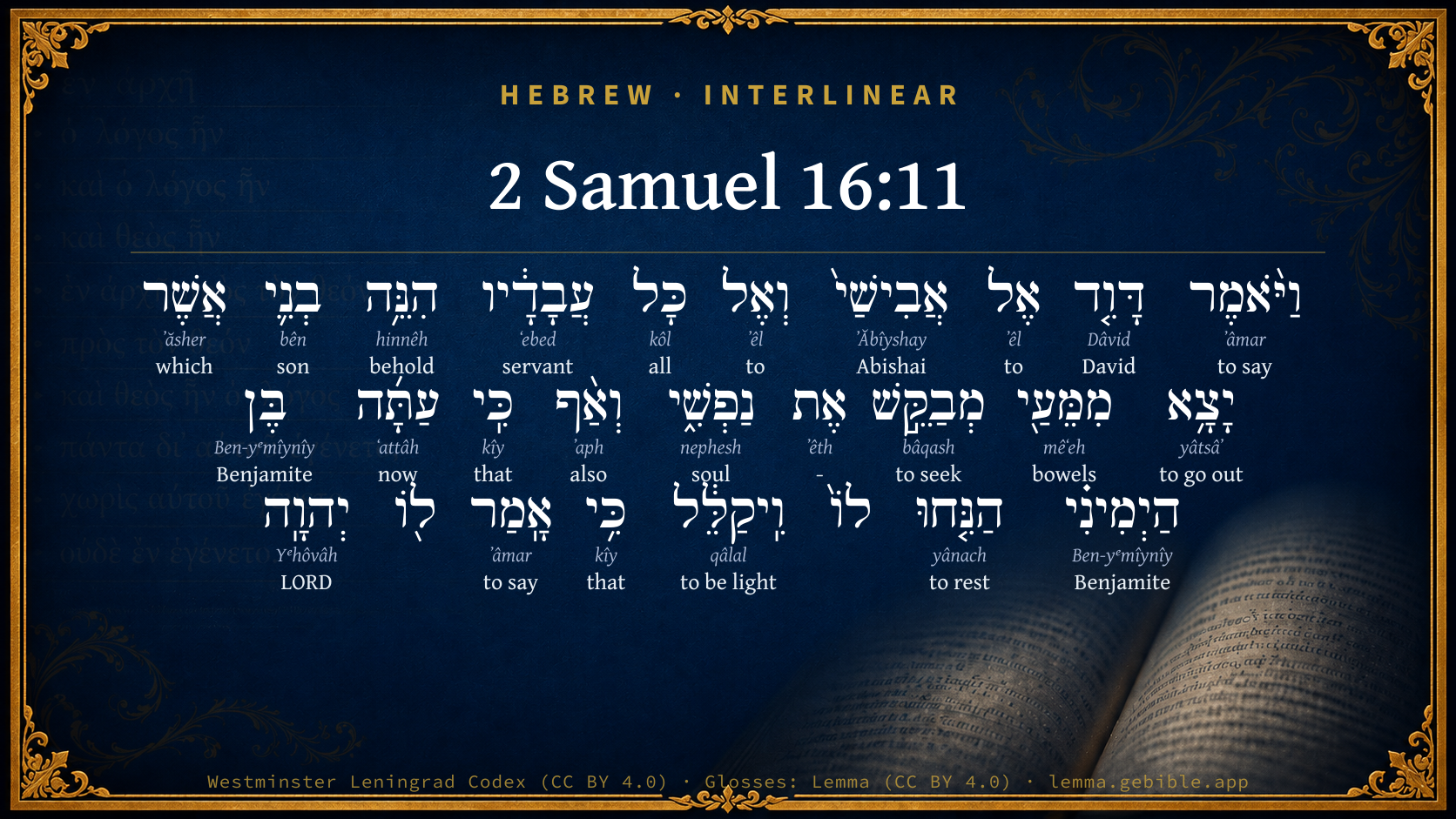
2 Samuel 16:11

Hebrew (Westminster Leningrad Codex) 2 Samuel 16:11 appears in the Hebrew Old Testament. The text above is from the Westminster Leningrad Codex. Each word links to its Strong’s number, a concise gloss, and parsing drawn from the Open Scriptures Hebrew Bible morphology. Click any word for its full Brown-Driver-Briggs (BDB) entry.
Download image
Cite this verse

2 Samuel 16:11 (World English Bible). Public Domain. Lemma interlinear Bible study tool, https://lemma.gebible.app/v/2-samuel/16/11.

Show BibTeX & RIS
BibTeX
RIS
English Translation
David said to Abishai, and to all his servants, Behold, my son, who came forth from my bowels, seeks my life: how much more [may] this Benjamite now [do it]? let him alone, and let him curse; for Yahweh has invited him.
World English Bible · Public Domain
Download a study sheet

One document with this verse’s original text, its word-by-word gloss line, the meaning frame, cross-references with their text, attributed commentary, and full source and license credits — printable, and it pastes into notes with its structure intact.

This verse Autodidact and up

Study sheet (.html) Plain text (.txt)

A passage Seminary Student

Up to 50 verses in one chapter. A passage sheet keeps up to 6 commentary sources and 12 cross-references per verse, in the order this page ranks them, and says so on the sheet whenever that leaves anything out. Ask for a single verse and you get the Autodidact verse sheet above.

Everything on this page stays free to read, with no account — the sheet is a download of what is already on screen, not access to it.

Want to remove ads? Support Godless Engineer
Compare translations 3

The same verse in 3 English versions, stacked beneath the original-language interlinear above. Click any original word for its lexicon entry.

Each is an independent rendering of the whole verse — the interlinear is not word-aligned to these translations.

Highlighted words mark where these versions differ — a whole-verse word diff, not a word-by-word alignment.

  • World English Bible Public Domain
    David said to Abishai, and to all his servants, Behold, my son, who came forth from my bowels, seeks my life: how much more [may] this Benjamite now [do it]? let him alone, and let him curse; for Yahweh has invited him.
  • King James Version Public Domain
    And David said to Abishai, and to all his servants, Behold, my son, which came forth of my bowels, seeketh my life: how much more now may this Benjamite do it? let him alone, and let him curse; for the LORD hath bidden him.
  • unfoldingWord Literal Text CC BY-SA 4.0
    And David said to Abishai and to all of his servants, “Behold, my son, who came out from my belly, is seeking my life. And how much more that now a Benjaminite! Leave him alone and let him curse, if Yahweh has spoken to him.

unfoldingWord Literal Text — © unfoldingWord, licensed CC BY-SA 4.0. Word-aligned USFM3 via Door43 (git.door43.org/unfoldingWord/en_ult).

Versions to compare (up to 4)

3 of 4 selected

Show all 18 translations

Every available English version of this verse, each an independent rendering of the whole verse.

  • World English Bible Public Domain
    David said to Abishai, and to all his servants, Behold, my son, who came forth from my bowels, seeks my life: how much more [may] this Benjamite now [do it]? let him alone, and let him curse; for Yahweh has invited him.
  • Berean Standard Bible Public Domain
    Then David said to Abishai and to all his servants, “Behold, my own son, my own flesh and blood, seeks my life. How much more, then, this Benjamite! Leave him alone and let him curse me, for the LORD has told him so.
  • Majority Standard Bible Public Domain
    Then David said to Abishai and to all his servants, “Behold, my own son, my own flesh and blood, seeks my life. How much more, then, this Benjamite! Leave him alone and let him curse me, for the LORD has told him so.
  • King James Version Public Domain
    And David said to Abishai, and to all his servants, Behold, my son, which came forth of my bowels, seeketh my life: how much more now may this Benjamite do it? let him alone, and let him curse; for the LORD hath bidden him.
  • American Standard Version (1901) Public Domain
    And David said to Abishai, and to all his servants, Behold, my son, who came forth from my bowels, seeketh my life: how much more `may' this Benjamite now `do it'? let him alone, and let him curse; for Jehovah hath bidden him.
  • Revised Version (1885) Public Domain
    And David said to Abishai, and to all his servants, Behold, my son, which came forth of my bowels, seeketh my life: how much more may this Benjamite now do it? let him alone, and let him curse; for the LORD hath bidden him.
  • Geneva Bible (1599) Public Domain
    And Dauid sayd to Abishai, and to all his seruants, Beholde, my sonne which came out of mine owne bowels, seeketh my life: then howe much more now may this sonne of Iemini? Suffer him to curse: for the Lord hath bidden him.
  • Douay-Rheims (1899) Public Domain
    And the king said to Abisai, and to all his servants: Behold my son, who came forth from my bowels, seeketh my life: how much more now a son of Jemini? let him alone that he may curse as the Lord hath bidden him.
  • Young's Literal Translation Public Domain
    And David saith unto Abishai, and unto all his servants, `Lo, my son who came out of my bowels is seeking my life, and also surely now the Benjamite; leave him alone, and let him revile, for Jehovah hath said `so' to him;
  • Literal Standard Version CC BY-SA 4.0
    And David says to Abishai, and to all his servants, “Behold, my son who came out of my bowels is seeking my life, and also surely now the Benjamite; leave him alone, and let him revile, for YHWH has commanded [so] to him;
  • Unlocked Literal Bible CC BY-SA 4.0
    So David said to Abishai and to all his servants, “Look, my son, who was born from my body, wants to take my life. How much more may this Benjamite now desire my ruin? Leave him alone and let him curse, for Yahweh has commanded him to do it.
  • unfoldingWord Literal Text CC BY-SA 4.0
    And David said to Abishai and to all of his servants, “Behold, my son, who came out from my belly, is seeking my life. And how much more that now a Benjaminite! Leave him alone and let him curse, if Yahweh has spoken to him.
  • Darby Bible Public Domain
    And David said to Abishai, and to all his servants, Behold, my son, who came forth of my bowels, seeks my life: how much more now a Benjaminite? let him alone and let him curse; for Jehovah has bidden him.
  • World Messianic Bible Public Domain
    David said to Abishai and to all his servants, “Behold, my son, who came out of my bowels, seeks my life. How much more this Benjamite, now? Leave him alone, and let him curse; for the LORD has invited him.
  • Webster's Bible Public Domain
    And David said to Abishai, and to all his servants, Behold, my son, who came forth from my bowels, seeketh my life: how much more now may this Benjaminite do it? let him alone, and let him curse; for the LORD hath bidden him.
  • Free Bible Version CC BY-SA 4.0
    David said to Abishai and to all his officers, “Look, if my very own son is trying to kill me, why shouldn't this Benjamite want to even more! Leave him alone; let him curse me, for the Lord told him to.
  • Bible in Basic English Public Domain
    And David said to Abishai and to all his servants, You see how my son, the offspring of my body, has made designs against my life: how much more then may this Benjamite do so? Let him be, and let him go on cursing; for the Lord has given him orders.
  • JPS Tanakh (1917) Public Domain
    And David said to Abishai, and to all his servants: 'Behold, my son, who came forth of my body, seeketh my life; how much more this Benjamite now? let him alone, and let him curse; for the LORD hath bidden him.

Literal Standard Version (2020), Covenant Press — licensed CC BY-SA 4.0. Text via the HelloAO Bible API (eBible.org). Unlocked Literal Bible (unfoldingWord) — licensed CC BY-SA 4.0. Text via the HelloAO Bible API (eBible.org). unfoldingWord Literal Text — © unfoldingWord, licensed CC BY-SA 4.0. Word-aligned USFM3 via Door43 (git.door43.org/unfoldingWord/en_ult). Free Bible Version, Dr. Jonathan Gallagher — licensed CC BY-SA 4.0. Text via the HelloAO Bible API (eBible.org).

Word by word

More ways to search: Search by grammar → Find every occurrence → Compare this word →

Practice this passage: Drill this verse → Learn its vocabulary →

בֶּן
Ben-yᵉmîynîy
H1145
“Benjamite”
Noun, Gentilic, Masculine, Singular, Construct
Part of Speech
Noun
Type
Gentilic
Gender
Masculine
Number
Singular
State
Construct
Full BDB Definition

Origin: sometimes (with article inserted) Ben-ha-y@miniy ben-hah-yem-ee-nee'with H376 inserted ( H1 ">1) Sa H9 :1) Ben-'iysh Y@miyniy ben-eesh' yem-ee-nee'

TWOT: adj

Benjamite = "son of the right hand" - one of the tribe of Benjamin
  1. וַיֹּ֨אמֶר ʼâmar H559 “and · to say” Conjunction + Verb, Qal, Sequential Imperfect, 3rd Person, Masculine, Singular
  2. דָּוִ֤ד Dâvid H1732 “David” Noun, Proper
  3. אֶל ʼêl H413 “to” Preposition
  4. אֲבִישַׁי֙ ʼĂbîyshay H52 “Abishai” Noun, Proper
  5. וְאֶל ʼêl H413 “and · to” Conjunction + Preposition
  6. כָּל kôl H3605 “all of” Noun, Common, Masculine, Singular, Construct
  7. עֲבָדָ֔יו ʻebed H5650 “servants · his” Noun, Common, Masculine, Plural, Construct + Suffix, Personal, 3rd Person, Masculine, Singular
  8. הִנֵּ֥ה hinnêh H2009 “behold” Particle, Demonstrative
  9. בְנִ֛י bên H1121 “son · my” Noun, Common, Masculine, Singular, Construct + Suffix, Personal, 1st Person, Common, Singular
  10. אֲשֶׁר ʼăsher H834 “which” Particle, Relative
  11. יָצָ֥א yâtsâʼ H3318 “to go out” Verb, Qal, Perfect, 3rd Person, Masculine, Singular
  12. מִמֵּעַ֖י mêʻeh H4578 “from · bowels · my” Preposition + Noun, Common, Masculine, Plural, Construct + Suffix, Personal, 1st Person, Common, Singular
  13. מְבַקֵּ֣שׁ bâqash H1245 “seeking” Verb, Piel, Participle Active, Masculine, Singular, Absolute
  14. אֶת ʼêth H853 “-” Particle, Direct Object
  15. נַפְשִׁ֑י nephesh H5315 “soul · my” Noun, Common, Both, Singular, Construct + Suffix, Personal, 1st Person, Common, Singular
  16. וְאַ֨ף ʼaph H637 “and · also” Conjunction + Adverb
  17. כִּֽי kîy H3588 “that” Conjunction
  18. עַתָּ֜ה ʻattâh H6258 “now” Adverb
  19. הַיְמִינִ֗י Ben-yᵉmîynîy H1145 “the · Benjamite” Particle, Definite Article + Noun, Gentilic, Masculine, Singular, Absolute
  20. הַנִּ֤חוּ yânach H3240 “rest” Verb, Hiphil, Imperative, 2nd Person, Masculine, Plural
  21. וִֽיקַלֵּ֔ל qâlal H7043 “and · to be light” Conjunction + Verb, Piel, Imperfect, 3rd Person, Masculine, Singular
  22. כִּ֥י kîy H3588 “that” Conjunction
  23. אָֽמַר ʼâmar H559 “to say” Verb, Qal, Perfect, 3rd Person, Masculine, Singular
  24. יְהוָֽה Yᵉhôvâh H3068 “LORD” Noun, Proper

About this verse

These counts appear in no published source. They are computed here, from the morphology-tagged text and Lemma’s own curated glosses. What Lemma adds →

27
words
21
distinct lemmas
Historical
section

Notable vocabulary

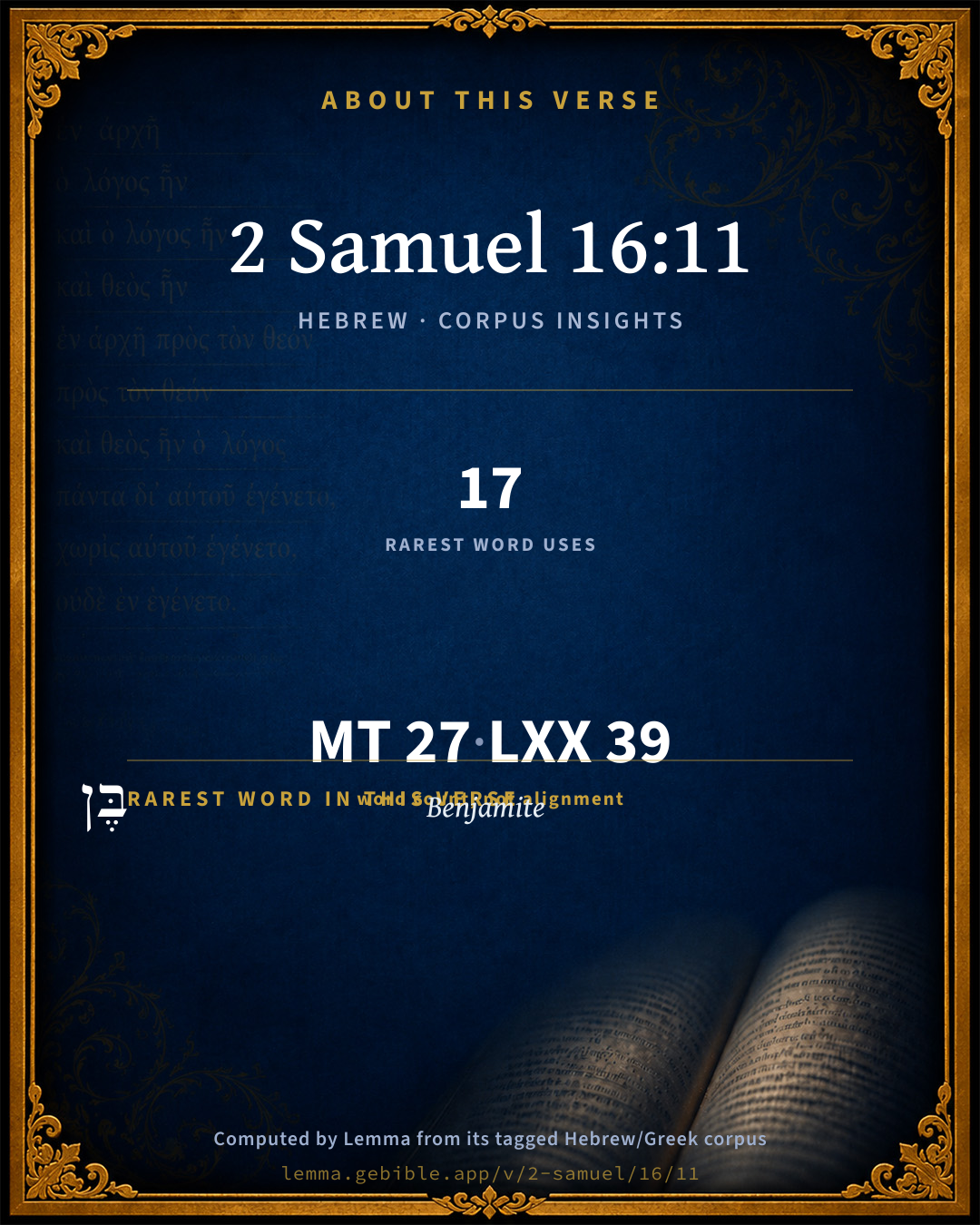
The rarest word here is בֶּן Benjamite H1145 — appearing just 17 times in the whole Hebrew Bible.

Shared distinctive vocabulary

בֶּן Benjamite H1145 occurs in 9 verses of the Hebrew Bible. Also found in:

Grammatical profile

  • 6 verbs
  • 10 nouns
  • 4 prepositions
  • 2 conjunctions
  • 2 adverbs
  • 3 particles

Verb forms

  • וַיֹּ֨אמֶר Qal · Sequential Imperfect
  • יָצָ֥א Qal · Perfect
  • מְבַקֵּ֣שׁ Piel · Participle Active
  • הַנִּ֤חוּ Hiphil · Imperative
  • וִֽיקַלֵּ֔ל Piel · Imperfect
  • אָֽמַר Qal · Perfect

Repetition

Words recur within this verse — often emphatic in Hebrew:

  • וַיֹּ֨אמֶר to say H559 ×2
  • בֶּן Benjamite H1145 ×2
  • אֶל to H413 ×2
  • כִּֽי that H3588 ×2

Hebrew & Septuagint length

In English translation the verse runs 42 words from the Hebrew and 40 from the Septuagint (LXX English) — closely comparable.

A rough comparison of the two English renderings, which tokenize alike — not a word-level alignment.

Word counts can differ between the Hebrew and the Greek without any difference in meaning — e.g. the Hebrew direct-object marker אֵת has no separate Greek word, and Greek often adds the article ὁ.

In the original languages it is 27 Hebrew tokens and 39 Greek tokens — but the two are counted differently (Hebrew bundles its prefixes and suffixes into one token; the Greek is in lemma form), so that isn’t a like-for-like length.

Cross-references

11

Topical passages linked to 2 Samuel 16:11 in the Treasury of Scripture Knowledge — connected by theme and wording, ordered by reader-vote popularity; previews shown in the World English Bible.

  • Genesis 15:4 Behold, the word of Yahweh came to him, saying, "This man will not be your heir, but he who will come forth out of your own body will be your heir."
  • Genesis 45:5 Now don't be grieved, nor angry with yourselves, that you sold me here, for God sent me before you to preserve life.
  • 2 Samuel 12:11–12 This is what Yahweh says: 'Behold, I will raise up evil against you out of your own house; and I will take your wives before your eyes, and give them to your neighbor, and he will lie with your wives in the sight of this sun.
  • 2 Kings 19:37 It happened, as he was worshipping in the house of Nisroch his god, that Adrammelech and Sharezer struck him with the sword: and they escaped into the land of Ararat. Esar Haddon his son reigned in his place.
  • 2 Chronicles 32:21 Yahweh sent an angel, who cut off all the mighty men of valor, and the leaders and captains, in the camp of the king of Assyria. So he returned with shame of face to his own land. When he was come into the house of his god, those who came forth from his own bowels killed him there with the sword.
  • Isaiah 10:5–7 Ho Assyrian, the rod of my anger, the staff in whose hand is my indignation!
  • Ezekiel 14:9 If the prophet be deceived and speak a word, I, Yahweh, have deceived that prophet, and I will stretch out my hand on him, and will destroy him from the midst of my people Israel.
  • Ezekiel 20:25 Moreover also I gave them statutes that were not good, and ordinances in which they should not live;
  • Matthew 10:21 "Brother will deliver up brother to death, and the father his child. Children will rise up against parents, and cause them to be put to death.
  • 2 Samuel 17:1–4 Moreover Ahithophel said to Absalom, Let me now choose out twelve thousand men, and I will arise and pursue after David this night:
  • 2 Samuel 7:2 that the king said to Nathan the prophet, See now, I dwell in a house of cedar, but the ark of God dwells within curtains.

Cross-references courtesy of OpenBible.info (CC BY 4.0).

Hebrew and Greek witnesses Masoretic Hebrew ↔ Greek Septuagint

The same verse in the two great witnesses to the Old Testament, shown verse-for-verse.

These are two independent witnesses, not word-aligned to each other, and the Septuagint is shown in lemma (dictionary) form.

Hebrew 2 Samuel 16:11 Masoretic · Westminster Leningrad Codex

וַיֹּ֨אמֶר דָּוִ֤ד אֶל אֲבִישַׁי֙ וְאֶל כָּל עֲבָדָ֔יו הִנֵּ֥ה בְנִ֛י אֲשֶׁר יָצָ֥א מִמֵּעַ֖י מְבַקֵּ֣שׁ אֶת נַפְשִׁ֑י וְאַ֨ף כִּֽי עַתָּ֜ה בֶּן הַיְמִינִ֗י הַנִּ֤חוּ לוֹ֙ וִֽיקַלֵּ֔ל כִּ֥י אָֽמַר ל֖וֹ יְהוָֽה

David said to Abishai, and to all his servants, Behold, my son, who came forth from my bowels, seeks my life: how much more [may] this Benjamite now [do it]? let him alone, and let him curse; for Yahweh has invited him.

World English Bible · Public Domain

Greek LXX 2 Samuel 16:11 Septuagint · lemma form

καί εἶπον δαυίδ πρός αβεσσα καί πρός πᾶς ὁ παῖς αὐτός ἰδού ὁ υἱός ἐγώ ὁ ἐκἔρχομαι ἐκ ὁ κοιλία ἐγώ ζητέω ὁ ψυχή ἐγώ καί προσέτι νῦν ὁ υἱός ὁ ιεμινι ἀποἵημι αὐτός καταἀράομαι ὅτι εἶπον αὐτός κύριος

And David said to Abessa and to all his servants, Behold, my son who came forth out of my bowels seeks my life; still more now may the son of Benjamin: let him curse, because the Lord has told him.

LXX2012 (modern English Septuagint) · Public Domain

Hebrew: Westminster Leningrad Codex (CC BY 4.0). Greek: Septuagint (public domain); English from LXX2012 (modern English Septuagint) (Public Domain). How the Septuagint differs from the Hebrew →

Targum (Aramaic paraphrase)

1

The Targum is the ancient Jewish Aramaic paraphrase of the Hebrew Scriptures — an interpretive translation, not the Hebrew text itself. Onkelos (literal) and Pseudo-Jonathan (expansive) render the Torah, and Jonathan the Prophets. Coverage is partial: where no permissively-licensed English translation exists for a verse, only the Aramaic is shown. This is verse-level text, not a word-by-word alignment to the Hebrew.

  1. Targum Jonathan Prophets (Joshua–Malachi)
    וַאֲמַר דָוִד לַאֲבִישַׁי וּלְכָל עַבְדוֹהִי הָא בְּרִי דְאוֹלֵידִית בָּעֵי לְמִקְטְלִי וְאַף אֲרֵי כְעַן בַּר שֵׁבֶט בִּנְיָמִן שְׁבוּקוּ מִינֵיהּ וִילַטֵט אֲרֵי אָמַר לֵיהּ יְיָ:

    (no public-domain English translation for this verse)

    Targum Jonathan — Aramaic: “Mikraot Gedolot” (public domain). English: “Sefaria Community Translation” (CC0 1.0 (public-domain dedication)); “London "Chaldee Paraphrase," 1871” (public domain). Text via Sefaria.

Commentary

Notes on 2 Samuel 16:11 from classic Christian and Jewish commentators (each source and its license shown beneath its notes). The classic Christian expositions comment on the surrounding passage and are grouped to its opening verse, so a note may address several verses; the Jewish commentaries on the Tanakh (Rashi and others) are per-verse, so they appear only where the commentator wrote on this verse.

Lemma curates 59 commentaries, every one of them public domain or Creative Commons licensed, each selected and text-cleaned for this edition rather than reprinted as found. About our sources →

Trapp's Complete Commentary

John Trapp

2Sa 16:11 And David said to Abishai, and to all his servants, Behold, my son, which came forth of my bowels, seeketh my life: how much more now [may this] Benjamite [do it]? let him alone, and let him curse; for the LORD hath bidden him.

Ver. 11. Behold, my son, which came forth of my bowels.] If we can therefore suffer because we have suffered, as David did from Shimei, but first from Absalom, then we have profited by our afflictions: then "patience hath her perfect work." {Jas 1:4} A weak heart faints with every addition of succeeding sorrow: the strong re-collecteth itself, and, like an old beaten porter to the cross, tolerare mavult guam deplorare, rather carrieth it, than crieth out of it. See Job 23:2. {See Trapp on "Job 23:2"}

Seeketh my life.] Not only is he sick of my long life - as Adolphus Egmondanus lately was of his father Arnold’s, duke of Geldria, whom he kept prisoner six years for living so long - but seeketh to destroy it: as did Tullia, Nero, Solymus, Amidas, &c. {a}

For the Lord hath bidden him.] It is he who hath turned this dead dog loose upon me. This seeing of God in crosses as the chief agent, whatever the instrument be, is an excellent help to true patience. If a man meet a prince, and know him not, he will not give him due reverence: so if we see not God in our sufferings we shall not so well submit to him; David, for instance, when he went against Nabal.

{a} Cominaeus.

John Trapp, A Commentary or Exposition upon All the Books of the Old and New Testament (1647–1656) — public domain. Text from a community e-Sword module.

The Biblical Illustrator

Joseph S. Exell

2Sa_16:11-12

Let him alone, let him curse, for the Lord hath bidden him.

The grounds of Davids forbearance towards Shimei

David, in his adversity, receives from Shimei an undeserved, cruel, and most irritating provocation; he reviles him, and curses him, and casts stones at him; but the afflicted monarch bears all his insults with silent meekness; he, forgives and protects his railing enemy; and here in the text he discloses to his wondering attendants the feelings which actuated his conduct towards him. His words evidently direct our attention to the grounds of his forbearance towards Shimei; and they convince us at once that this forbearance did not proceed from a want of feeling. Some men appear to bear provocations, as a stone may be said to bear them: they excite no resentment, for they give no pain. But this insensibility is not Christian meekness. We must feel before we can forgive; and that forgiveness is the most exalted in its nature, which is accompanied with the keenest sense of the injuries it pardons. Neither was this insensibility the meekness of David. His was one of the warmest hearts that ever beat in a human breast. Every act of kindness had power to move it, and he himself tells us that reproach could almost break it.

I. His forbearance must be traced partly to the softening influence of affliction. David here reminds his servants of the trials under which he was suffering; and intimates to them that the father, who had to bear with the cruelty of a beloved son, could find but little difficulty in pardoning the insults of a reviling enemy; that the greater affliction had prepared his mind for the less, and enabled him to be submissive under it. Tribulation, says the apostle, worketh patience. It calls the patience of the Christian into exercise, and consequently strengthens it. Who are the proud and revengeful among mankind? They who have known but little of the calamities of life, and been tossed by few of its storms.

II. David was assisted in overcoming his resentment by tracing the persecution he received to god. The ill-treatment of the ungodly, as well as the natural evils of life, must be ascribed, in some degree, to a chastising God. The malice and cruelty of the world are no less the instruments of working his will than the diseases which assail our bodies, or the storms which lay waste our dwellings.

III. Hence the forbearance of David may be ascribed also to a sense of sin. He says nothing indeed of his sinfulness, but the abrupt language which he uses evidently implies that it was in his mind. And what provocation is there which a deep sense of guilt will not enable us to bear? Go to the man whom a heavenly instructor has made acquainted with the hidden depravity of his nature; who is day by day retiring to his closet to mourn over his sins, and who often waters his couch with tears by night as he thinks of his transgressions--try the patience of the stricken penitent by insults and revilings; and what is the result? Says the wounded Christian, I am a sinner, and wrath must not lodge in a sinners heart. I may be reviled, but what a miracle of mercy is it that I am not consumed! Men may reproach me, but how ought I to wonder that my God forbears to curse and destroy me!

IV. The forbearance of David proceeded from an humble expectation of a recompense from god. Though he had sinned against him and was suffering under his righteous displeasure, he knew that the Lord had not utterly taken away his loving-kindness from trim. What a powerful motive to forbearance and patience! When we are persecuted, the Lord looks on our afflictions. He knows our reproach, and our shame, and our dishonour; our adversaries are all before him. In conclusion:

1. David was not of a revengeful disposition. A mind so softened by affliction, so fixed on God, so full of contrition and faith, could not be revengeful.

2. We may infer also from the text, the reason why so much importance is attached in thee Scriptures to a forgiving spirit. (C. Bradley, M. A.)

No resentment

Sir Matthew Hale, the celebrated judge, had so completely gained the government of his passions that, though naturally of a quick temper, he was never seen in a passion, nor did he ever resent injuries. One day a person who had clone him a great injury came to him for his advice in the settlement of his estate, which he very readily gave him, but would accept no fee for it. When he was asked how be could behave so kindly to a man wire bad wronged him so much, his answer was, I thank God I have learned to forgive and forget injuries. (Quiver.)

Tracing trouble to its fountain head

As children will thank the tailor, and think they owe their new clothes to him rather than to their parents bounty, so we look to the next hand, and set up that instead of God. Second causes must never be made to stand before the first cause. Friends and helpers are all very well as servants of our Father, but our Father must have all our praise. There is a like evil in the matter of trouble. We are apt to be angry with the instrument of our affliction, instead of seeing the hand of God over all, and meekly bowing before it. It was a great help to David in bearing wits railing Shimei, when he saw that God had appointed this provocation as a chastisement. He would not suffer his hasty captains to take the scoffers head, but meekly said, Let him alone and let him curse, for the Lord hath bidden him. A dog when he is struck will bite the stick; if he were wise, he would observe that the stick only moves as the hand directs it. When we discern God in our tribulations we are helped to be quiet, and endure with patience. Let us not act like silly children, but trace matters to their fountain-head, and act accordingly. (C. H. Spurgeon.)

The Biblical Illustrator, edited by Joseph S. Exell (c. 1880s–1900s) — public domain. Text from a community e-Sword module.

Joseph Benson's Commentary

2Sa 16:11. Behold, my son seeketh my life — Which is a much greater mischief than to reproach me with words. How much more may this Benjamite do it? — One of that tribe and family from which God hath taken away the kingdom, and given it to me. Let him curse — Do not now hinder him by violence from doing it, nor punish him for it. It is meet I should bear the indignation of the Lord, and submit to his pleasure. For the Lord hath bidden him — Not by the word of his precept, or by any powerful influence upon his mind impelling him to it; but by the word of his providence, placing me in such circumstances that he conceives he can curse me with impunity, and by suffering the malignity of his heart to take its natural course, and work without restraint.

Joseph Benson's Commentary on the Old and New Testaments (1811–1818) — public domain. Text from a community e-Sword module.

Tyndale Open Study Notes

Tyndale Open Resources

16:11-12 even more reason: David understood why a supporter of Saul might hate him.

Tyndale Open Study Notes — © Tyndale Open Resources, licensed CC BY-SA 4.0. Text via the HelloAO Bible API.

Adam Clarke's Commentary

Verse 11. Let him curse; for the Lord hath bidden him.] No soul of man can suppose that ever God bade one man to curse another, much less that he commanded such a wretch as Shimei to curse such a man as David; but this is a peculiarity of the Hebrew language, which does not always distinguish between permission and commandment. Often the Scripture attributes to God what he only permits to be done; or what in the course of his providence he does not hinder. David, however, considers all this as being permitted of God for his chastisement and humiliation. I cannot withhold from my readers a very elegant poetic paraphrase of this passage, from the pen of the Rev. Charles Wesley, one of the first of Christian poets: -

"Pure from the blood of Saul in vain,

He dares not to the charge reply:

Uriah's doth the charge maintain,

Uriah's doth against him cry!

Let Shimei curse: the rod he bears

For sins which mercy had forgiven:

And in the wrongs of man reveres

The awful righteousness of heaven.

Lord, I adore thy righteous will,

Through every instrument of ill

My Father's goodness see;

Accept the complicated wrong

Of Shimei's hand and Shimei's tongue

As kind rebukes from THEE."

Adam Clarke's Commentary on the Bible (1810–1826) — public domain. Text from a community e-Sword/MySword module.

Ellicott's Commentary for English Readers

(11) How much more now may this Benjamite.—The “Benjamite” is in contrast to his own son, because he represents the adherent of another and rival dynasty. It is noticeable that David accuses Absalom not only of seeking his throne, but his life.

A Bible Commentary for English Readers, edited by Charles John Ellicott (1878–1897) — public domain. Text from a community e-Sword module.

The Cambridge Bible for Schools and Colleges

gen. ed. J. J. S. Perowne

11. this Benjamite] Who has some plausible ground for spite against a king who has succeeded to the honours once held by his family.

the Lord hath bidden him] David recognises Shimei as the divinely appointed instrument for his chastisement, and therefore he can say, “the Lord hath bidden him.” But Shimei’s cursing was on his part sinful, and God commands no man to sin. God makes use of the evil passions of men to work out His purposes, but those evil passions are not thereby excused or justified. See for example, Gen_45:5; Act_2:23. Since He is the Author and Cause of all things, and in a certain sense nothing can be done without His Will, He is sometimes said to do what He permits to be done, to command what He does not forbid. See note on 1Sa_26:19 : and 2Sa_24:1.

The Cambridge Bible for Schools and Colleges (gen. ed. J. J. S. Perowne; Cambridge University Press, 1878–1918) — public domain. Text from a community e-Sword module.

John Gill's Exposition

And David said to Abishai, and all his servants,.... In order to make them easy, and reconcile them to this usage of him:

behold, my son, which came forth of my bowels, seeketh my life; meaning Absalom:

how much more now may this Benjamite do it? who was not only of the same tribe that Saul was, but of the same family, and so bore an ill will to David because of his succession in the throne:

let him alone, and let him curse; do nothing to restrain him, not even by words, and much less by any violent actions, and still less by taking away his life:

for the Lord hath bidden him; in the sense explained in Sa2 16:10.

John Gill's Exposition of the Whole Bible (1746–1763) — public domain (CC PDM 1.0). Text via the HelloAO Bible API.

John Wesley's Explanatory Notes

My life - Which is a greater mischief, than to reproach me with words. Benjamites - Of that tribe and family from which God hast taken away the kingdom, and given it to me. Let him - Do not now hinder him violently from it, nor punish him for it. It is meet I should bear the indignation of the Lord, and submit to his pleasure.

John Wesley, Explanatory Notes Upon the Whole Bible (1754–1765) — public domain. Text via the GEBible commentary corpus.

Keil & Delitzsch

C. F. Keil & F. Delitzsch

David said still further to Abishai and all his servants: "Behold, my own son seeketh after my life; how much more then the Benjaminite! (who belongs to a hostile race.) Let him curse, for Jehovah hath bidden him. Perhaps Jehovah will look upon my guilt, and Jehovah will requite me good for the curse which befals me this day." בּעוני (Chethib) has been altered by the Masoretes into בּעיני o, "upon mine eye," probably in the sense of "upon my tears;" and קללתי into קללתו, - from pure misapprehension. בּעוני does not mean "upon my misery," for עון never has this meaning, but upon the guilt which really belongs to me, in contrast with that with which Shimei charges me; and קללתי is the curse that has come upon me. Although David had committed no murder upon the house of Saul, and therefore Shimei's cursing was nothing but malicious blasphemy, he felt that it came upon him because of his sins, though not for the sin imputed to him. He therefore forbade their putting the blasphemer to death, and said Jehovah had commanded him to curse; regarding the cursing as the consequence of the wrath of God that was bringing him low (comp. the remarks on Sa1 26:19). But this consciousness of guilt also excited the assurance that the Lord would look upon his sin. When God looks upon the guilt of a humble sinner, He will also, as a just and merciful God, avert the evil, and change the suffering into a blessing. David founded upon this the hope, that the Lord would repay him with good for the curse with which Shimei was pursuing him now.

Keil & Delitzsch — Biblical Commentary on the Old Testament (1861–1891) — public domain (CC PDM 1.0). Text via the HelloAO Bible API. (Old Testament only.)

unfoldingWord translationNotes

Door43 World Missions Community

my son, who was born from my body

David describes his son this way to emphasize the close bond between a father and his son. AT: "my own son" or "my dear son" (See: Assumed Knowledge and Implicit Information)

wants to take my life

This is a polite way to refer to killing someone. AT: "wants to kill me" (See: Euphemism)

How much more may this Benjamite now desire my ruin?

David uses this rhetorical question to express that he is not surprised that the man wants to kill him. This can be written as a statement. AT: "Of course this Benjamite desires my ruin!" or "I am not surprised this Benjamite desires my ruin as well!" (See: Rhetorical Question)

desire my ruin

Here David describes the man's desire to kill him as if David were something that the man wanted to ruin. AT: "desire me to be killed" or "desire to kill me" (See: Metaphor)

Leave him alone and let him curse

Here the phrase "leave him alone" means to not stop him from what he is doing. AT: "Do not stop him from cursing me" (See: Idiom)

will look at

Here "looking" means "considering." AT: "will consider" (See: Idiom)

the misery unleashed on me

Here David speaks of misery as if it were a dangerous animal that the Benjamite unleashed on him. (See: Personification)

translationWords

servant

body

life

Benjamin

ruin

command

good

unfoldingWord translationNotes — © Distant Shores Media and the Door43 World Missions Community, licensed CC BY-SA 4.0. Source: git.door43.org/Door43/en_tn.

Lesson kit

Teaching starters — assembled from the data on this page, not authored interpretation. Every prompt links to the verse data it draws on. Edit before teaching.

2 Samuel, in the Historical, opens this verse with 27 words (21 distinct Hebrew lemmas). Its most distinctive word is Ben-yᵉmîynîy (“Benjamite”). A historical commentator’s framing appears above. Read the whole chapter for the surrounding context.

Discussion questions

  1. How does “Benjamite” (Ben-yᵉmîynîy) shape what this verse is saying?
  2. Judges 3:15 shares the word «Benjamite» with this verse. How do the two illuminate each other?
  3. “to say” occurs 2× in this one verse. What is the effect of the repetition?
  4. These translations render this verse differently. What is at stake in choosing one wording over another?
  5. The verb «וַיֹּ֨אמֶר» is Qal Sequential Imperfect. How does its form color the action?
  6. Reading how Trapp's Complete Commentary and The Biblical Illustrator read this verse, where do the two commentators agree and where do they part?

Things to notice

Reading settings

Reading text

Shown beneath each verse's original-language words.

Old Testament
Old Testament edition

Read the OT as the Masoretic Hebrew (MT) or the Greek Septuagint (LXX).

English shown for the Greek Septuagint (in the Hebrew ↔ Greek comparison).

Comparing translations? Open the Compare panel on any verse page to stack up to four side by side.