
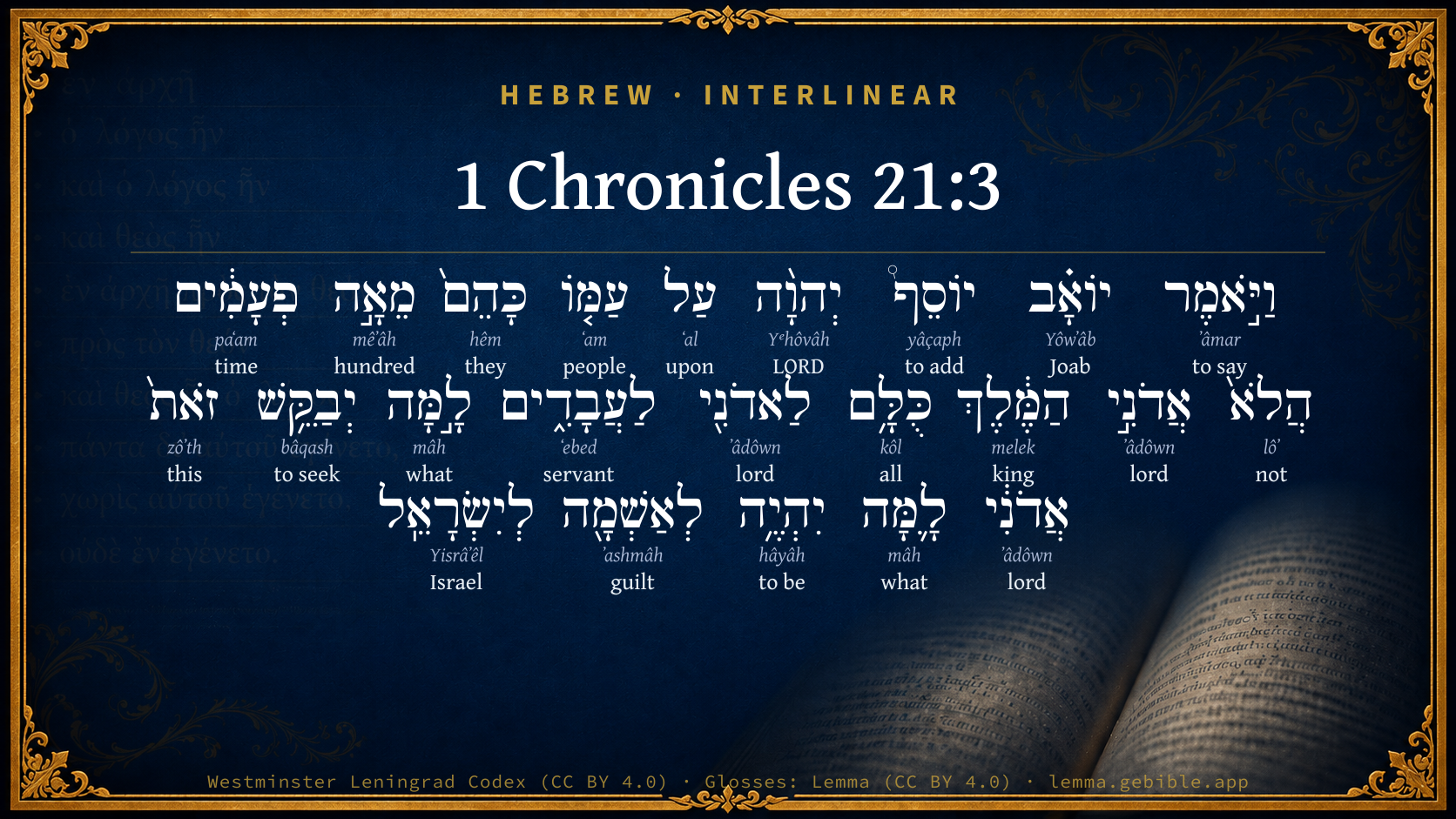
1 Chronicles 21:3

Hebrew (Westminster Leningrad Codex) 1 Chronicles 21:3 appears in the Hebrew Old Testament. The text above is from the Westminster Leningrad Codex. Each word links to its Strong’s number, a concise gloss, and parsing drawn from the Open Scriptures Hebrew Bible morphology. Click any word for its full Brown-Driver-Briggs (BDB) entry.
Download image
Cite this verse

1 Chronicles 21:3 (World English Bible). Public Domain. Lemma interlinear Bible study tool, https://lemma.gebible.app/v/1-chronicles/21/3.

Show BibTeX & RIS
BibTeX
RIS
English Translation
Joab said, Yahweh make his people a hundred times as many as they are: but, my lord the king, aren't they all my lord's servants? why does my lord require this thing? why will he be a cause of guilt to Israel?
World English Bible · Public Domain
Download a study sheet

One document with this verse’s original text, its word-by-word gloss line, the meaning frame, cross-references with their text, attributed commentary, and full source and license credits — printable, and it pastes into notes with its structure intact.

This verse Autodidact and up

Study sheet (.html) Plain text (.txt)

A passage Seminary Student

Up to 50 verses in one chapter. A passage sheet keeps up to 6 commentary sources and 12 cross-references per verse, in the order this page ranks them, and says so on the sheet whenever that leaves anything out. Ask for a single verse and you get the Autodidact verse sheet above.

Everything on this page stays free to read, with no account — the sheet is a download of what is already on screen, not access to it.

Want to remove ads? Support Godless Engineer
Compare translations 3

The same verse in 3 English versions, stacked beneath the original-language interlinear above. Click any original word for its lexicon entry.

Each is an independent rendering of the whole verse — the interlinear is not word-aligned to these translations.

Highlighted words mark where these versions differ — a whole-verse word diff, not a word-by-word alignment.

  • World English Bible Public Domain
    Joab said, Yahweh make his people a hundred times as many as they are: but, my lord the king, aren't they all my lord's servants? why does my lord require this thing? why will he be a cause of guilt to Israel?
  • King James Version Public Domain
    And Joab answered, The LORD make his people an hundred times so many more as they be: but, my lord the king, are they not all my lord's servants? why then doth my lord require this thing? why will he be a cause of trespass to Israel?
  • unfoldingWord Literal Text CC BY-SA 4.0
    And Joab said, “May Yahweh add to his people like them 100 times. My lord the king, not all of them servants to my lord? Why does my lord seek this? Why should it be for guilt to Israel?”

unfoldingWord Literal Text — © unfoldingWord, licensed CC BY-SA 4.0. Word-aligned USFM3 via Door43 (git.door43.org/unfoldingWord/en_ult).

Versions to compare (up to 4)

3 of 4 selected

Show all 18 translations

Every available English version of this verse, each an independent rendering of the whole verse.

  • World English Bible Public Domain
    Joab said, Yahweh make his people a hundred times as many as they are: but, my lord the king, aren't they all my lord's servants? why does my lord require this thing? why will he be a cause of guilt to Israel?
  • Berean Standard Bible Public Domain
    But Joab replied, “May the LORD multiply His troops a hundred times over. My lord the king, are they not all servants of my lord? Why does my lord want to do this? Why should he bring guilt on Israel?”
  • Majority Standard Bible Public Domain
    But Joab replied, “May the LORD multiply His troops a hundred times over. My lord the king, are they not all servants of my lord? Why does my lord want to do this? Why should he bring guilt on Israel?”
  • King James Version Public Domain
    And Joab answered, The LORD make his people an hundred times so many more as they be: but, my lord the king, are they not all my lord's servants? why then doth my lord require this thing? why will he be a cause of trespass to Israel?
  • American Standard Version (1901) Public Domain
    And Joab said, Jehovah make his people a hundred times as many as they are: but, my lord the king, are they not all my lord's servants? why doth my lord require this thing? why will he be a cause of guilt unto Israel?
  • Revised Version (1885) Public Domain
    And Joab said, The LORD make his people an hundred times so many more as they be: but, my lord the king, are they not all my lord’s servants? why doth my lord require this thing? why will he be a cause of guilt unto Israel?
  • Geneva Bible (1599) Public Domain
    And Ioab answered, The Lord increase his people an hundreth times so many as they be, O my lord the King: are they not all my lords seruats? wherefore doeth my lord require this thing? why should he be a cause of trespasse to Israel?
  • Douay-Rheims (1899) Public Domain
    And Joab answered: The Lord make his people a hundred times more than they are: but, my lord the king, are they not all thy servants: why doth my lord seek this thing, which may be imputed as a sin to Israel?
  • Young's Literal Translation Public Domain
    And Joab saith, `Jehovah doth add to His people as they are a hundred times; are they not, my lord, O king, all of them to my lord for servants? why doth my lord seek this? why is he for a cause of guilt to Israel?'
  • Literal Standard Version CC BY-SA 4.0
    And Joab says, “YHWH adds to His people as they are one hundred times; are they not, my lord, O king, all of them for servants to my lord? Why does my lord seek this? Why is he for a cause of guilt to Israel?”
  • Unlocked Literal Bible CC BY-SA 4.0
    Joab said, “May Yahweh make his army a hundred times greater than it is. But my master the king, do they not all serve my master? Why does my master want this? Why bring guilt on Israel?”
  • unfoldingWord Literal Text CC BY-SA 4.0
    And Joab said, “May Yahweh add to his people like them 100 times. My lord the king, not all of them servants to my lord? Why does my lord seek this? Why should it be for guilt to Israel?”
  • Darby Bible Public Domain
    And Joab said, Jehovah add to his people, how many soever they be, a hundredfold: are they not all, my lord O king, my lord's servants? why does my lord require this thing? why should he become a trespass to Israel?
  • World Messianic Bible Public Domain
    Joab said, “May the LORD make his people a hundred times as many as they are. But, my lord the king, aren’t they all my lord’s servants? Why does my lord require this thing? Why will he be a cause of guilt to Israel?”
  • Webster's Bible Public Domain
    And Joab answered, the LORD make his people a hundred times more numerous than they are: but, my lord the king, are they not all my lord's servants? why then doth my lord require this thing? why will he be a cause of trespass to Israel?
  • Free Bible Version CC BY-SA 4.0
    But Joab replied, “May the Lord multiply his people a hundred times over. Your Majesty, aren't they all your subjects? Why do you want to do this? Why should you make Israel guilty?”
  • Bible in Basic English Public Domain
    And Joab said, May the Lord make his people a hundred times more in number than they are; but, my lord king, are they not all my lord's servants? why would my lord have this done? why will he become a cause of sin to Israel?
  • JPS Tanakh (1917) Public Domain
    And Joab said: 'The LORD make His people a hundred times so many more as they are; but, my lord the king, are they not all my lord's servants? why doth my lord require this thing? why will he be a cause of guilt unto Israel?'

Literal Standard Version (2020), Covenant Press — licensed CC BY-SA 4.0. Text via the HelloAO Bible API (eBible.org). Unlocked Literal Bible (unfoldingWord) — licensed CC BY-SA 4.0. Text via the HelloAO Bible API (eBible.org). unfoldingWord Literal Text — © unfoldingWord, licensed CC BY-SA 4.0. Word-aligned USFM3 via Door43 (git.door43.org/unfoldingWord/en_ult). Free Bible Version, Dr. Jonathan Gallagher — licensed CC BY-SA 4.0. Text via the HelloAO Bible API (eBible.org).

Word by word

More ways to search: Search by grammar → Find every occurrence → Compare this word →

Practice this passage: Drill this verse → Learn its vocabulary →

לְאַשְׁמָ֖ה
ʼashmâh
H819
“to/for · guilt”
Preposition + Noun, Common, Feminine, Singular, Absolute
Part of Speech
Preposition + Noun
Type
Common
Gender
Feminine
Number
Singular
State
Absolute
Full BDB Definition

Origin: from H817

TWOT: 180c

guiltiness, guilt, offense, sin, wrong-doing - doing wrong, committing a trespass or offense - becoming guilty, guilt - bringing a guilt-offering
  1. וַיֹּ֣אמֶר ʼâmar H559 “and · to say” Conjunction + Verb, Qal, Sequential Imperfect, 3rd Person, Masculine, Singular
  2. יוֹאָ֗ב Yôwʼâb H3097 “Joab” Noun, Proper
  3. יוֹסֵף֩ yâçaph H3254 “to add” Verb, Hiphil, Jussive, 3rd Person, Masculine, Singular
  4. יְהוָ֨ה Yᵉhôvâh H3068 “LORD” Noun, Proper
  5. עַל ʻal H5921 “upon” Preposition
  6. עַמּ֤וֹ ʻam H5971 “people · his” Noun, Common, Masculine, Singular, Construct + Suffix, Personal, 3rd Person, Masculine, Singular
  7. כָּהֵם֙ hêm H1992 “like/as · they” Preposition + Pronoun, Personal, 3rd Person, Masculine, Plural
  8. מֵאָ֣ה mêʼâh H3967 “hundred” Adjective, Cardinal number, Both, Singular, Absolute
  9. פְעָמִ֔ים paʻam H6471 “times” Noun, Common, Feminine, Plural, Absolute
  10. הֲלֹא֙ lôʼ H3808 “not” Particle, Interrogative + Particle, Negative
  11. אֲדֹנִ֣י ʼâdôwn H113 “lord · my” Noun, Common, Masculine, Singular, Construct + Suffix, Personal, 1st Person, Common, Singular
  12. הַמֶּ֔לֶךְ melek H4428 “the · king” Particle, Definite Article + Noun, Common, Masculine, Singular, Absolute
  13. כֻּלָּ֥ם kôl H3605 “all · their” Noun, Common, Masculine, Singular, Construct + Suffix, Personal, 3rd Person, Masculine, Plural
  14. לַאדֹנִ֖י ʼâdôwn H113 “to/for · lord · my” Preposition + Noun, Common, Masculine, Singular, Construct + Suffix, Personal, 1st Person, Common, Singular
  15. לַעֲבָדִ֑ים ʻebed H5650 “to/for · servants” Preposition + Noun, Common, Masculine, Plural, Absolute
  16. לָ֣מָּה mâh H4100 “to/for · what” Preposition + Particle, Interrogative
  17. יְבַקֵּ֥שׁ bâqash H1245 “to seek” Verb, Piel, Imperfect, 3rd Person, Masculine, Singular
  18. זֹאת֙ zôʼth H2063 “this” Pronoun, Demonstrative, Feminine, Singular
  19. אֲדֹנִ֔י ʼâdôwn H113 “lord · my” Noun, Common, Masculine, Singular, Construct + Suffix, Personal, 1st Person, Common, Singular
  20. לָ֛מָּה mâh H4100 “to/for · what” Preposition + Particle, Interrogative
  21. יִהְיֶ֥ה hâyâh H1961 “to be” Verb, Qal, Imperfect, 3rd Person, Masculine, Singular
  22. לְיִשְׂרָאֵֽל Yisrâʼêl H3478 “to/for · Israel” Preposition + Noun, Proper

About this verse

These counts appear in no published source. They are computed here, from the morphology-tagged text and Lemma’s own curated glosses. What Lemma adds →

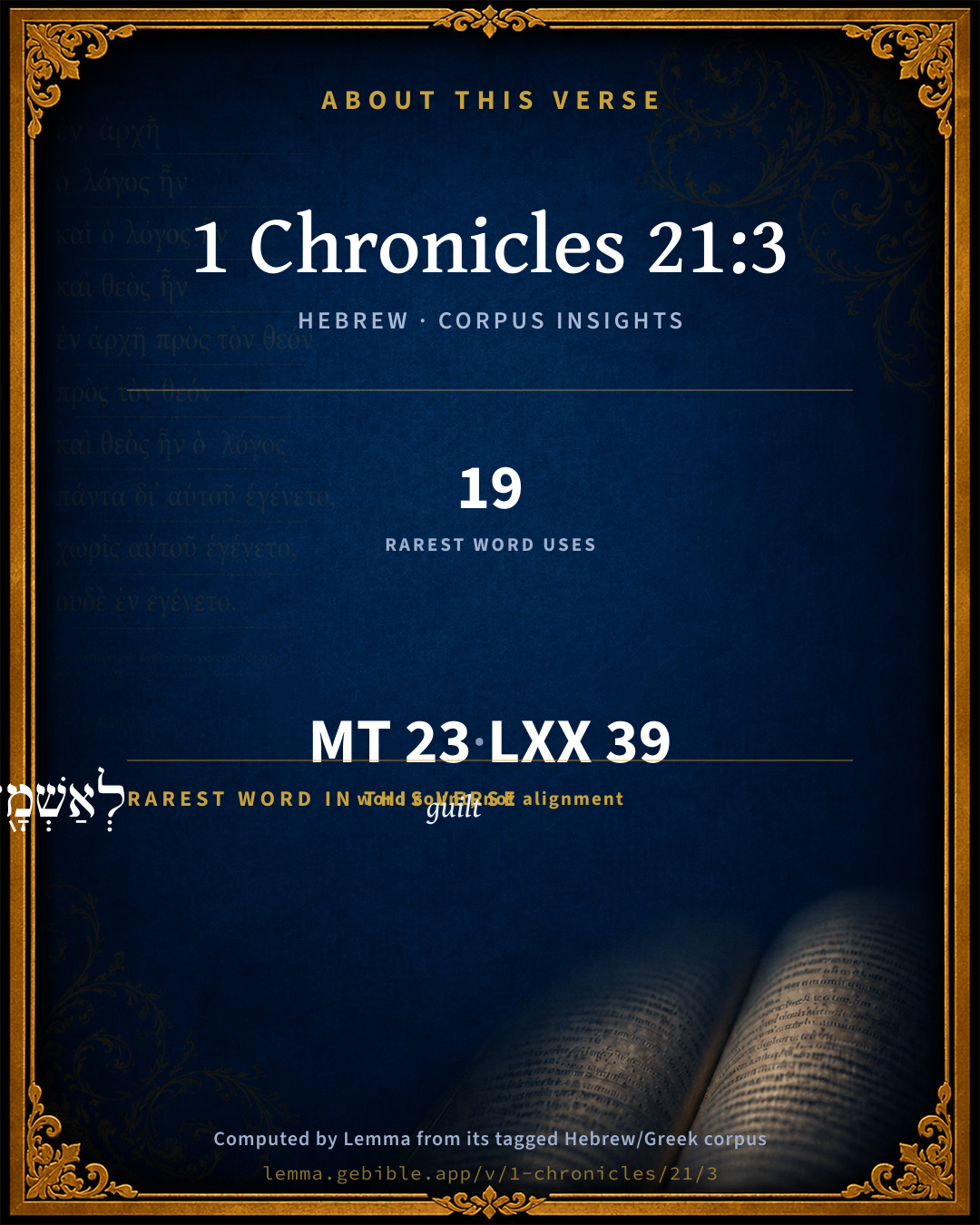
23
words
20
distinct lemmas
Historical
section

Notable vocabulary

The rarest word here is לְאַשְׁמָ֖ה guilt H819 — appearing just 19 times in the whole Hebrew Bible.

Shared distinctive vocabulary

לְאַשְׁמָ֖ה guilt H819 occurs in 17 verses of the Hebrew Bible. Also found in:

Grammatical profile

  • 4 verbs
  • 12 nouns
  • 1 adjective
  • 2 pronouns
  • 1 preposition
  • 3 particles

Verb forms

  • וַיֹּ֣אמֶר Qal · Sequential Imperfect
  • יוֹסֵף֩ Hiphil · Jussive
  • יְבַקֵּ֥שׁ Piel · Imperfect
  • יִהְיֶ֥ה Qal · Imperfect

Repetition

Words recur within this verse — often emphatic in Hebrew:

  • אֲדֹנִ֣י lord H113 ×3
  • לָ֣מָּה what H4100 ×2

Hebrew & Septuagint length

In English translation the verse runs 42 words from the Hebrew and 52 from the Septuagint (LXX English) — closely comparable.

A rough comparison of the two English renderings, which tokenize alike — not a word-level alignment.

Word counts can differ between the Hebrew and the Greek without any difference in meaning — e.g. the Hebrew direct-object marker אֵת has no separate Greek word, and Greek often adds the article ὁ.

In the original languages it is 23 Hebrew tokens and 39 Greek tokens — but the two are counted differently (Hebrew bundles its prefixes and suffixes into one token; the Greek is in lemma form), so that isn’t a like-for-like length.

Cross-references

11

Topical passages linked to 1 Chronicles 21:3 in the Treasury of Scripture Knowledge — connected by theme and wording, ordered by reader-vote popularity; previews shown in the World English Bible.

  • Deuteronomy 1:11 Yahweh, the God of your fathers, make you a thousand times as many as you are, and bless you, as he has promised you!
  • Genesis 20:9 Then Abimelech called Abraham, and said to him, "What have you done to us? How have I sinned against you, that you have brought on me and on my kingdom a great sin? You have done deeds to me that ought not to be done!"
  • Exodus 32:21 Moses said to Aaron, "What did these people do to you, that you have brought a great sin on them?"
  • Numbers 32:9–10 For when they went up to the valley of Eshcol, and saw the land, they discouraged the heart of the children of Israel, that they should not go into the land which Yahweh had given them.
  • 1 Samuel 2:24 No, my sons; for it is no good report that I hear: you make Yahweh's people to disobey.
  • 1 Kings 14:16 He will give Israel up because of the sins of Jeroboam, which he has sinned, and with which he has made Israel to sin.
  • 1 Chronicles 19:13 Be of good courage, and let us play the man for our people, and for the cities of our God: and Yahweh do that which seems him good.
  • Psalms 115:14 May Yahweh increase you more and more, You and your children.
  • Proverbs 14:28 In the multitude of people is the king's glory, But in the lack of people is the destruction of the prince.
  • Isaiah 26:15 You have increased the nation, O Yahweh, you have increased the nation; you are glorified; you have enlarged all the borders of the land.
  • Isaiah 48:19 your seed also had been as the sand, and the offspring of your loins like the grains of it: his name would not be cut off nor destroyed from before me.

Cross-references courtesy of OpenBible.info (CC BY 4.0).

Hebrew and Greek witnesses Masoretic Hebrew ↔ Greek Septuagint

The same verse in the two great witnesses to the Old Testament, shown verse-for-verse.

These are two independent witnesses, not word-aligned to each other, and the Septuagint is shown in lemma (dictionary) form.

Hebrew 1 Chronicles 21:3 Masoretic · Westminster Leningrad Codex

וַיֹּ֣אמֶר יוֹאָ֗ב יוֹסֵף֩ יְהוָ֨ה עַל עַמּ֤וֹ כָּהֵם֙ מֵאָ֣ה פְעָמִ֔ים הֲלֹא֙ אֲדֹנִ֣י הַמֶּ֔לֶךְ כֻּלָּ֥ם לַאדֹנִ֖י לַעֲבָדִ֑ים לָ֣מָּה יְבַקֵּ֥שׁ זֹאת֙ אֲדֹנִ֔י לָ֛מָּה יִהְיֶ֥ה לְאַשְׁמָ֖ה לְיִשְׂרָאֵֽל

Joab said, Yahweh make his people a hundred times as many as they are: but, my lord the king, aren't they all my lord's servants? why does my lord require this thing? why will he be a cause of guilt to Israel?

World English Bible · Public Domain

Greek LXX 1 Chronicles 21:3 Septuagint · lemma form

καί εἶπον ιωαβ προςτίθημι κύριος ἐπί ὁ λαός αὐτός ὡς αὐτός ἑκατονταπλασίως καί ὁ ὀφθαλμός κύριος ἐγώ ὁ βασιλεύς βλέπω πᾶς ὁ κύριος ἐγώ παῖς ἵνα τίς ζητέω ὁ κύριος ἐγώ οὗτος ἵνα μή γίγνομαι εἰς ἁμαρτία ὁ ἰσραήλ

And Joab said, May the Lord add to his people, one hundred-fold as many as they are, and let the eyes of my lord the king see it: all are the servants of my lord. Why does my lord seek this thing? do it not, lest it become a sin to Israel.

LXX2012 (modern English Septuagint) · Public Domain

Hebrew: Westminster Leningrad Codex (CC BY 4.0). Greek: Septuagint (public domain); English from LXX2012 (modern English Septuagint) (Public Domain). How the Septuagint differs from the Hebrew →

Commentary

Notes on 1 Chronicles 21:3 from classic Christian and Jewish commentators (each source and its license shown beneath its notes). The classic Christian expositions comment on the surrounding passage and are grouped to its opening verse, so a note may address several verses; the Jewish commentaries on the Tanakh (Rashi and others) are per-verse, so they appear only where the commentator wrote on this verse.

Lemma curates 59 commentaries, every one of them public domain or Creative Commons licensed, each selected and text-cleaned for this edition rather than reprinted as found. About our sources →

Trapp's Complete Commentary

John Trapp

1Ch 21:3 And Joab answered, The LORD make his people an hundred times so many more as they [be]: but, my lord the king, [are] they not all my lord’s servants? why then doth my lord require this thing? why will he be a cause of trespass to Israel?

Ver. 3. Why then doth my lord require this thing?] Or, Delight in this thing? which showeth that David was somewhat tickled and taken with the multitude of his people. See on 2Sa 24:3.

John Trapp, A Commentary or Exposition upon All the Books of the Old and New Testament (1647–1656) — public domain. Text from a community e-Sword module.

Joseph Benson's Commentary

1Ch 21:3. Why will he be — Or, why should this be; a cause of trespass — Or, an occasion of punishment; (Hebrew words, which signify sin, being often used for the punishment of sin,) to, or against Israel? — Why wilt thou provoke God by this sin to punish Israel? He speaks thus because God commonly punishes the people for the sins of their rulers, the people being for the most part guilty of their rulers’ sins, in one kind or other.

Joseph Benson's Commentary on the Old and New Testaments (1811–1818) — public domain. Text from a community e-Sword module.

Geneva Bible (1599)

Geneva Bible translators

It was a thing indifferent and usual to number the people, but because he did it of an ambitious mind, as though his strength stood in his people, God punished him.

Geneva Bible (1599) marginal notes — public domain. Text via Bolls.life.

Jamieson, Fausset & Brown

Robert Jamieson, A. R. Fausset & David Brown

why will he be a cause of trespass to Israel?--or bring an occasion of punishment on Israel. In Hebrew, the word "sin" is often used synonymously with the punishment of sin. In the course of Providence, the people frequently suffer for the misconduct of their rulers.

Jamieson, Fausset & Brown — Commentary Critical and Explanatory on the Whole Bible (1871) — public domain (CC PDM 1.0). Text via the HelloAO Bible API.

Ellicott's Commentary for English Readers

(3) Answered.—Hebrew, said.

The Lord . . . as they be.—Literally, Jehovah add upon his people like them an hundred times, an

abridged form of what is read in Samuel.

But, my lord the king, are they not . . .?—Instead of this, Samuel records another wish, “And may the eyes of my lord the king be seeing,” that is, living (Gen_16:13).

Why then doth my lord require this thing?—So Samuel, in slightly different terms: “And my lord the king, why desireth he this proposal?”

Why will he be (why should he become) a cause of trespass to Israel?—Not in Samuel. It is an explanatory addition by the chronicler.

A Bible Commentary for English Readers, edited by Charles John Ellicott (1878–1897) — public domain. Text from a community e-Sword module.

The Cambridge Bible for Schools and Colleges

gen. ed. J. J. S. Perowne

3. moe] Cp. 1Ch_14:3, note.

are they not all my lord’s servants?] Joab foresees some disaster to the people, and asks why David should destroy his own.

why will he be a cause of guilt to Israel?] Cp. Lev_4:3, “if the anointed priest shall sin so as to bring guilt on the people” (R.V.).

The Cambridge Bible for Schools and Colleges (gen. ed. J. J. S. Perowne; Cambridge University Press, 1878–1918) — public domain. Text from a community e-Sword module.

Haydock's Catholic Bible Commentary

Israel, who will be severely punished. (Calmet) --- Sin is often used in this sense. (Vatable)

George Leo Haydock (1774–1849), Haydock's Catholic Family Bible and Commentary, 1859 edition — public domain. Excludes Psalms (Douay-Rheims chapter numbering differs from Protestant) and Deuterocanonical books (Catholic canon only).

Matthew Poole's English Annotations

Or, why will he be, or why should this be, a trespass, or a cause of trespass, or an occasion of punishment, (for Hebrew words signifying sin are oft used to note the punishment of sin,) or a desolation, or a cause of desolation or destruction, (for the verb whence this noun proceeds is oft used in that sense,) to or against Israel? Why wilt thou provoke God by this sin to punish Israel? Thus he speaks, because God commonly punisheth the people for the sins of their rulers, because they are for the most part guilty of their sins in one kind or other; or at least God takes this occasion to punish people for all their sins.

Matthew Poole's English Annotations on the Holy Bible (1683–1685) — public domain. Text from a community e-Sword/MySword module.

The Pulpit Commentary

But my lord the king, are they not all my lord"s servants? The place of this perfectly intelligible sentence, indicating that Joab discerned the object of David in desiring the numbering of the people, is occupied in the Book of Samuel by the words, "And that the eyes of my lord the king may see it;" which some for no very evident reason prefer. It was, no doubt, a very radical element of David"s sin in this matter that he was thinking of the nation too much as his own servants, instead of as the servants of his one Master. The Lord ever knoweth who are his, and numbereth not only them and their names, but their every sigh, tear, prayer. A cause of trespass. This clause may be explained as though trespass was equivalent to the consequences, i.e. the punishment of trespass. This. however, rather tends to explain away than to explain a phrase. More probably the deeper meaning is that, in the fact of the numbering, nation and king would become one in act, and would become involved together in indisputable sin. Though there were no unfeigned assent and consent in the great body of the nation to the numbering, yet they would become participators in the wrong-doing. It would further seem evident, from Joab addressing these words to the king, that it was a thing familiarly known and thoroughly understood that the course David was now bent on following was one virtually, if not actually, prohibited, and not one merely likely to be displeasing to God on account of any individual disposition in David to be boastful or self-confident. Otherwise it would be scarcely within the province of Joab either to express or suppose this of his royal master.

The spirit that refuses good advice.

Joab was not always a good adviser. More than once he had led David into difficulties. But he was a skilful and bold statesman. He looked rather to the consequences and ultimate influences of political actions than to the maintenance of high political principles. In this case he feared more the penalty that would follow than the sin itself. But his advice was good. We may not say that even good advice is necessarily to be taken. Our judgment concerning it should be exercised, and our decisions upon it should be made. That which is absolutely good, or in a general way good, may not be the best thing at a particular time, or for a particular individual.

I Good ADVICE MAY BE UNACCEPTABLE IN ITSELF. It may demand hard things or unpleasant things. It may be difficult to discern the grounds on which it is based. It may involve humiliations and confessions of mistake. It may bring heavy responsibilities. It may unduly strain feeling. It may be quite different from the advice we expected. It may seem, to our judgment, anything but good.

II GOOD ADVICE MAY BE UNACCEPTABLE THROUGH THE PERSON WHO GIVES IT. We estimate the value of advice by the giver. Our confidence in him gives quality to his advice. Probably David was at this time so annoyed with Joab that his eyes were blinded, and he could not see how wise his counsel was. To judge advice by the giver is, as a rule, quite safe; but care is needed lest prejudice should prevent our recognizing the good in the counsel of those we dislike, and lest undue affection should prevent our seeing the error in the advice of those whom we may personally esteem. "Faithful are the wounds of a friend," etc.

III GOOD ADVICE MAY BE UNACCEPTABLE THROUGH THE STATE OF MIND OF THE PERSON WHO RECEIVES IT. There may be a proud unwillingness to receive advice at all; an over and undue self-reliance. There may be a strong purpose and resolve against which the advice goes, as in David"s case.

So we learn that to be proper recipients of good advice from our fellowmen, or from God"s Word, we need to win and to keep the humble, open heart. R.T.

The Pulpit Commentary (1880–1919), ed. H.D.M. Spence-Jones & Joseph S. Exell — public domain. Text from a community e-Sword module.

John Wesley's Explanatory Notes

Why, &c. - Or, why should this be a cause of trespass, or an occasion of punishment to Israel? God commonly punishes the people for the sins of their rulers, because they are for the most part guilty of their sins in one kind or other; or at least God takes this occasion to punish people for all their sins.

John Wesley, Explanatory Notes Upon the Whole Bible (1754–1765) — public domain. Text via the GEBible commentary corpus.

Lesson kit

Teaching starters — assembled from the data on this page, not authored interpretation. Every prompt links to the verse data it draws on. Edit before teaching.

1 Chronicles, in the Historical, opens this verse with 23 words (20 distinct Hebrew lemmas). Its most distinctive word is ʼashmâh (“guilt”). A historical commentator’s framing appears above. Read the whole chapter for the surrounding context.

Discussion questions

  1. The word ʼashmâh carries the sense “guilt.” How does it shape the verse?
  2. How does Leviticus 4:3, which shares the word «guilt», read alongside this verse?
  3. What does the repetition of “lord” (3× in this one verse) do in this verse?
  4. The translations on this page render this verse differently — a whole-verse word diff, not a word-by-word alignment. What might account for the different wordings?
  5. «וַיֹּ֣אמֶר» is a Qal Sequential Imperfect verb. How does that grammatical form shape the action described?
  6. Compare how Trapp's Complete Commentary and Joseph Benson's Commentary read this verse. Where do they agree or differ?

Things to notice

Reading settings

Reading text

Shown beneath each verse's original-language words.

Old Testament
Old Testament edition

Read the OT as the Masoretic Hebrew (MT) or the Greek Septuagint (LXX).

English shown for the Greek Septuagint (in the Hebrew ↔ Greek comparison).

Comparing translations? Open the Compare panel on any verse page to stack up to four side by side.