
1 Samuel 23:25

Hebrew (Westminster Leningrad Codex) 1 Samuel 23:25 appears in the Hebrew Old Testament. The text above is from the Westminster Leningrad Codex. Each word links to its Strong’s number, a concise gloss, and parsing drawn from the Open Scriptures Hebrew Bible morphology. Click any word for its full Brown-Driver-Briggs (BDB) entry.
Download image
Cite this verse

1 Samuel 23:25 (World English Bible). Public Domain. Lemma interlinear Bible study tool, https://lemma.gebible.app/v/1-samuel/23/25.

Show BibTeX & RIS
BibTeX
RIS
English Translation
Saul and his men went to seek him. They told David: why he came down to the rock, and abode in the wilderness of Maon. When Saul heard [that], he pursued after David in the wilderness of Maon.
World English Bible · Public Domain
Download a study sheet

One document with this verse’s original text, its word-by-word gloss line, the meaning frame, cross-references with their text, attributed commentary, and full source and license credits — printable, and it pastes into notes with its structure intact.

This verse Autodidact and up

Study sheet (.html) Plain text (.txt)

A passage Seminary Student

Up to 50 verses in one chapter. A passage sheet keeps up to 6 commentary sources and 12 cross-references per verse, in the order this page ranks them, and says so on the sheet whenever that leaves anything out. Ask for a single verse and you get the Autodidact verse sheet above.

Everything on this page stays free to read, with no account — the sheet is a download of what is already on screen, not access to it.

Want to remove ads? Support Godless Engineer
Compare translations 3

The same verse in 3 English versions, stacked beneath the original-language interlinear above. Click any original word for its lexicon entry.

Each is an independent rendering of the whole verse — the interlinear is not word-aligned to these translations.

Highlighted words mark where these versions differ — a whole-verse word diff, not a word-by-word alignment.

  • World English Bible Public Domain
    Saul and his men went to seek him. They told David: why he came down to the rock, and abode in the wilderness of Maon. When Saul heard [that], he pursued after David in the wilderness of Maon.
  • King James Version Public Domain
    Saul also and his men went to seek him. And they told David; wherefore he came down into a rock, and abode in the wilderness of Maon. And when Saul heard that, he pursued after David in the wilderness of Maon.
  • unfoldingWord Literal Text CC BY-SA 4.0
    And Saul and his men went to seek. And they declared to David, and he went down a crag and stayed in the wilderness of Maon. And Saul heard, and he pursued after David in the wilderness of Maon.

unfoldingWord Literal Text — © unfoldingWord, licensed CC BY-SA 4.0. Word-aligned USFM3 via Door43 (git.door43.org/unfoldingWord/en_ult).

Versions to compare (up to 4)

3 of 4 selected

Show all 18 translations

Every available English version of this verse, each an independent rendering of the whole verse.

  • World English Bible Public Domain
    Saul and his men went to seek him. They told David: why he came down to the rock, and abode in the wilderness of Maon. When Saul heard [that], he pursued after David in the wilderness of Maon.
  • Berean Standard Bible Public Domain
    and Saul and his men went to seek him. When David was told about it, he went down to the rock and stayed in the Wilderness of Maon. And when Saul heard of this, he pursued David there.
  • Majority Standard Bible Public Domain
    and Saul and his men went to seek him. When David was told about it, he went down to the rock and stayed in the Wilderness of Maon. And when Saul heard of this, he pursued David there.
  • King James Version Public Domain
    Saul also and his men went to seek him. And they told David; wherefore he came down into a rock, and abode in the wilderness of Maon. And when Saul heard that, he pursued after David in the wilderness of Maon.
  • American Standard Version (1901) Public Domain
    And Saul and his men went to seek him. And they told David: wherefore he came down to the rock, and abode in the wilderness of Maon. And when Saul heard `that', he pursued after David in the wilderness of Maon.
  • Revised Version (1885) Public Domain
    And Saul and his men went to seek him. And they told David: wherefore he came down to the rock, and abode in the wilderness of Maon. And when Saul heard that, he pursued after David in the wilderness of Maon.
  • Geneva Bible (1599) Public Domain
    Saul also and his men went to seeke him, and they told Dauid: wherefore he came downe vnto a rocke, and abode in the wildernesse of Maon. And when Saul heard that, he folowed after Dauid in the wildernes of Maon.
  • Douay-Rheims (1899) Public Domain
    Then Saul and his men went to seek him: and it was told David, and forthwith he went down to the rock, and abode in the wilderness of Maon: and when Saul had heard of it he pursued after David in the wilderness of Maon.
  • Young's Literal Translation Public Domain
    And Saul and his men go to seek, and they declare to David, and he goeth down the rock, and abideth in the wilderness of Maon; and Saul heareth, and pursueth after David `to' the wilderness of Maon.
  • Literal Standard Version CC BY-SA 4.0
    And Saul and his men go to seek, and they declare [it] to David, and he goes down the rock, and abides in the wilderness of Maon; and Saul hears, and pursues after David [to] the wilderness of Maon.
  • Unlocked Literal Bible CC BY-SA 4.0
    Saul and his men went to seek him. But David was told of it, so he went down to a rocky hill and lived in the wilderness of Maon. When Saul heard it, he chased David in the wilderness of Maon.
  • unfoldingWord Literal Text CC BY-SA 4.0
    And Saul and his men went to seek. And they declared to David, and he went down a crag and stayed in the wilderness of Maon. And Saul heard, and he pursued after David in the wilderness of Maon.
  • Darby Bible Public Domain
    And Saul and his men went to seek [him]. And they told David; and he came down from the rock, and abode in the wilderness of Maon. And Saul heard [that], and he pursued after David in the wilderness of Maon.
  • World Messianic Bible Public Domain
    Saul and his men went to seek him. When David was told, he went down to the rock, and stayed in the wilderness of Maon. When Saul heard that, he pursued David in the wilderness of Maon.
  • Webster's Bible Public Domain
    Saul also and his men went to seek him. And they told David: wherefore he came down into a rock, and abode in the wilderness of Maon. And when Saul heard that, he pursued after David in the wilderness of Maon.
  • Free Bible Version CC BY-SA 4.0
    Saul and his men started hunting for him. When David found out, he went down to the rock, and stayed in the Desert of Maon. When Saul heard this, he chased after David in the Desert of Maon.
  • Bible in Basic English Public Domain
    And Saul and his men went in search of him. And David had word of it, so he came down to the rock in the waste land of Maon. And Saul, hearing of this, went after David into the waste land of Maon.
  • JPS Tanakh (1917) Public Domain
    And Saul and his men went to seek him. And they told David; wherefore he came down to the rock, and abode in the wilderness of Maon. And when Saul heard that, he pursued after David in the wilderness of Maon.

Literal Standard Version (2020), Covenant Press — licensed CC BY-SA 4.0. Text via the HelloAO Bible API (eBible.org). Unlocked Literal Bible (unfoldingWord) — licensed CC BY-SA 4.0. Text via the HelloAO Bible API (eBible.org). unfoldingWord Literal Text — © unfoldingWord, licensed CC BY-SA 4.0. Word-aligned USFM3 via Door43 (git.door43.org/unfoldingWord/en_ult). Free Bible Version, Dr. Jonathan Gallagher — licensed CC BY-SA 4.0. Text via the HelloAO Bible API (eBible.org).

Word by word

More ways to search: Search by grammar → Find every occurrence → Compare this word →

Practice this passage: Drill this verse → Learn its vocabulary →

מָע֑וֹן
Mâʻôwn
H4584
“Maon”
Noun, Proper
Part of Speech
Noun
Type
Proper
Full BDB Definition

Origin: the same as H4583

TWOT: None

Maon or Maonites = "habitation" - a man of Judah (noun proper masculine) - the inhabitants of the city of Maon (noun proper masculine) - a city of Judah located 8 miles south of Hebron (noun proper locative)
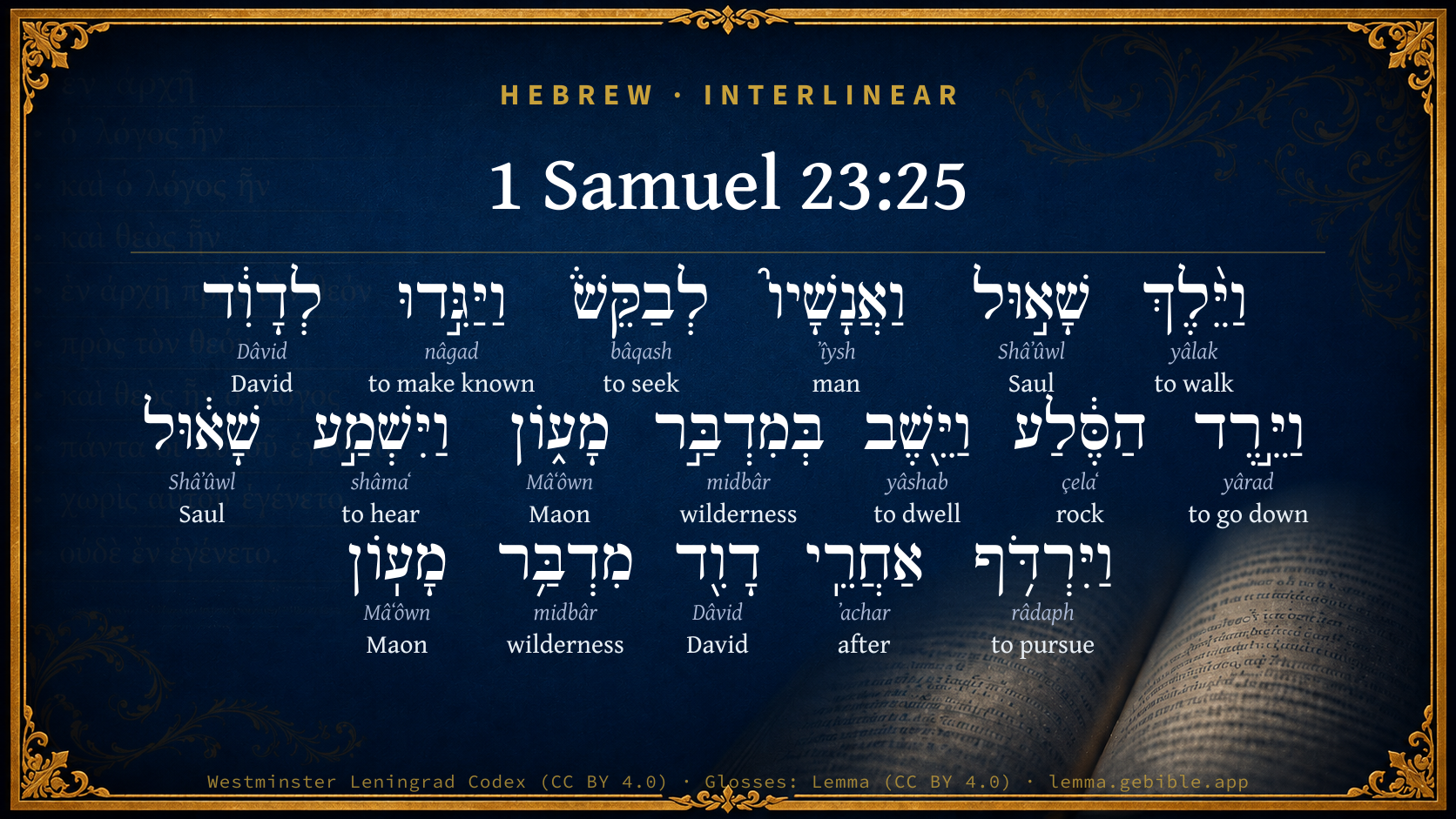
  1. וַיֵּ֨לֶךְ yâlak H3212 “and · to walk” Conjunction + Verb, Qal, Sequential Imperfect, 3rd Person, Masculine, Singular
  2. שָׁא֣וּל Shâʼûwl H7586 “Saul” Noun, Proper
  3. וַאֲנָשָׁיו֮ ʼîysh H376 “and · men · his” Conjunction + Noun, Common, Masculine, Plural, Construct + Suffix, Personal, 3rd Person, Masculine, Singular
  4. לְבַקֵּשׁ֒ bâqash H1245 “to seek” Preposition + Verb, Piel, Infinitive Construct
  5. וַיַּגִּ֣דוּ nâgad H5046 “and · to make known” Conjunction + Verb, Hiphil, Sequential Imperfect, 3rd Person, Masculine, Plural
  6. לְדָוִ֔ד Dâvid H1732 “to/for · David” Preposition + Noun, Proper
  7. וַיֵּ֣רֶד yârad H3381 “and · to go down” Conjunction + Verb, Qal, Sequential Imperfect, 3rd Person, Masculine, Singular
  8. הַסֶּ֔לַע çelaʻ H5553 “the · rock” Particle, Definite Article + Noun, Common, Masculine, Singular, Absolute
  9. וַיֵּ֖שֶׁב yâshab H3427 “and · to dwell” Conjunction + Verb, Qal, Sequential Imperfect, 3rd Person, Masculine, Singular
  10. בְּמִדְבַּ֣ר midbâr H4057 “in/at · wilderness of” Preposition + Noun, Common, Masculine, Singular, Construct
  11. וַיִּשְׁמַ֣ע shâmaʻ H8085 “and · to hear” Conjunction + Verb, Qal, Sequential Imperfect, 3rd Person, Masculine, Singular
  12. שָׁא֔וּל Shâʼûwl H7586 “Saul” Noun, Proper
  13. וַיִּרְדֹּ֥ף râdaph H7291 “and · to pursue” Conjunction + Verb, Qal, Sequential Imperfect, 3rd Person, Masculine, Singular
  14. אַחֲרֵֽי ʼachar H310 “after” Preposition
  15. דָוִ֖ד Dâvid H1732 “David” Noun, Proper
  16. מִדְבַּ֥ר midbâr H4057 “wilderness of” Noun, Common, Masculine, Singular, Construct
  17. מָעֽוֹן Mâʻôwn H4584 “Maon” Noun, Proper

About this verse

These counts appear in no published source. They are computed here, from the morphology-tagged text and Lemma’s own curated glosses. What Lemma adds →

18
words
14
distinct lemmas
Historical
section

Notable vocabulary

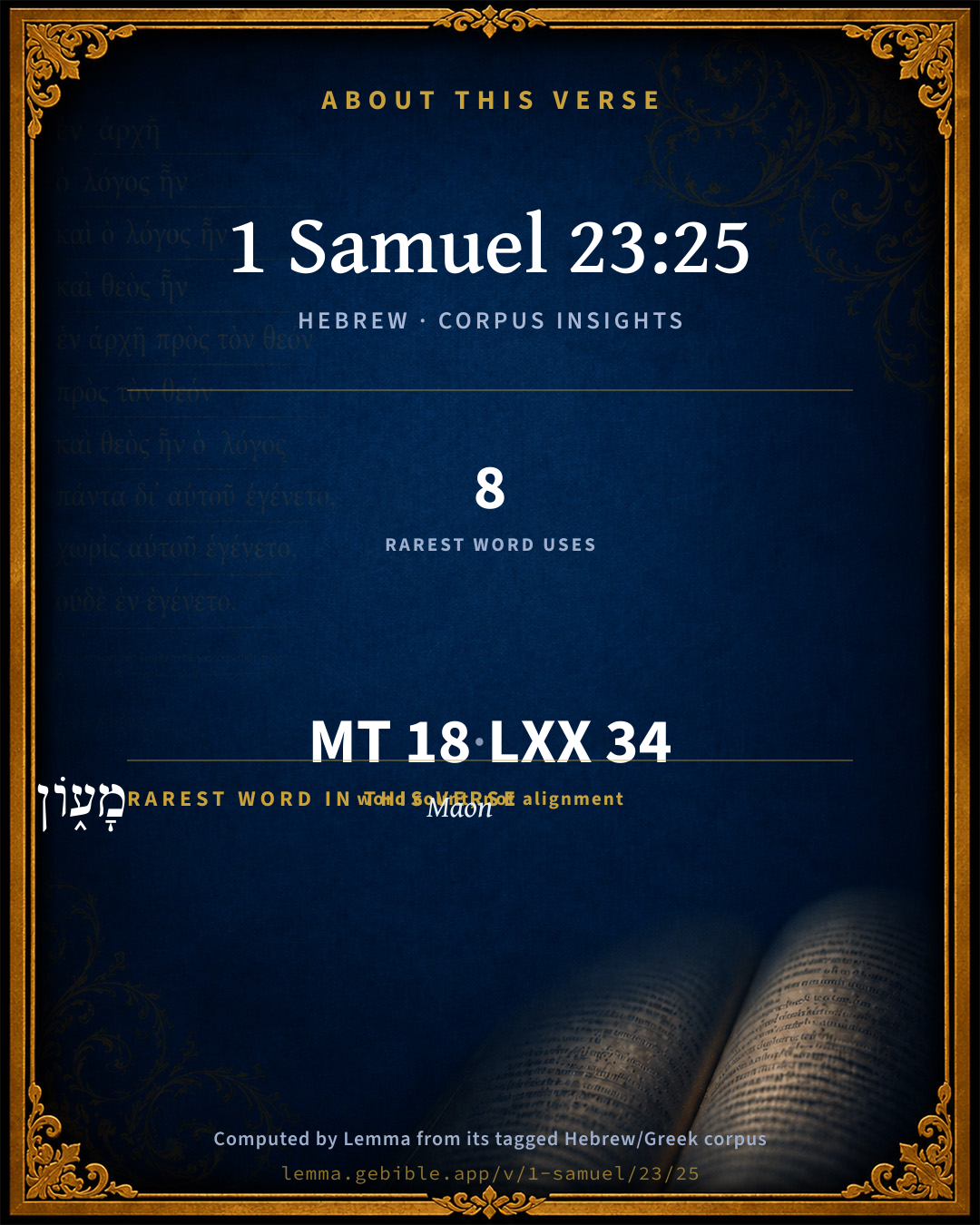
The rarest word here is מָע֑וֹן Maon H4584 — appearing just 8 times in the whole Hebrew Bible.

Shared distinctive vocabulary

מָע֑וֹן Maon H4584 occurs in 6 verses of the Hebrew Bible. Also found in:

Grammatical profile

  • 7 verbs
  • 10 nouns
  • 1 preposition

Verb forms

  • וַיֵּ֨לֶךְ Qal · Sequential Imperfect
  • לְבַקֵּשׁ֒ Piel · Infinitive Construct
  • וַיַּגִּ֣דוּ Hiphil · Sequential Imperfect
  • וַיֵּ֣רֶד Qal · Sequential Imperfect
  • וַיֵּ֖שֶׁב Qal · Sequential Imperfect
  • וַיִּשְׁמַ֣ע Qal · Sequential Imperfect
  • וַיִּרְדֹּ֥ף Qal · Sequential Imperfect

Repetition

Words recur within this verse — often emphatic in Hebrew:

  • שָׁא֣וּל Saul H7586 ×2
  • לְדָוִ֔ד David H1732 ×2
  • בְּמִדְבַּ֣ר wilderness H4057 ×2
  • מָע֑וֹן Maon H4584 ×2

Hebrew & Septuagint length

In English translation the verse runs 38 words from the Hebrew and 41 from the Septuagint (LXX English) — closely comparable.

A rough comparison of the two English renderings, which tokenize alike — not a word-level alignment.

Word counts can differ between the Hebrew and the Greek without any difference in meaning — e.g. the Hebrew direct-object marker אֵת has no separate Greek word, and Greek often adds the article ὁ.

In the original languages it is 18 Hebrew tokens and 34 Greek tokens — but the two are counted differently (Hebrew bundles its prefixes and suffixes into one token; the Greek is in lemma form), so that isn’t a like-for-like length.

Cross-references

2

Topical passages linked to 1 Samuel 23:25 in the Treasury of Scripture Knowledge — connected by theme and wording, ordered by reader-vote popularity; previews shown in the World English Bible.

  • Judges 15:8 He struck them hip and thigh with a great slaughter: and he went down and lived in the cleft of the rock of Etam.
  • 1 Samuel 23:28 So Saul returned from pursuing after David, and went against the Philistines: therefore they called that place Sela Hammahlekoth.

Cross-references courtesy of OpenBible.info (CC BY 4.0).

Hebrew and Greek witnesses Masoretic Hebrew ↔ Greek Septuagint

The same verse in the two great witnesses to the Old Testament, shown verse-for-verse.

These are two independent witnesses, not word-aligned to each other, and the Septuagint is shown in lemma (dictionary) form.

Hebrew 1 Samuel 23:25 Masoretic · Westminster Leningrad Codex

וַיֵּ֨לֶךְ שָׁא֣וּל וַאֲנָשָׁיו֮ לְבַקֵּשׁ֒ וַיַּגִּ֣דוּ לְדָוִ֔ד וַיֵּ֣רֶד הַסֶּ֔לַע וַיֵּ֖שֶׁב בְּמִדְבַּ֣ר מָע֑וֹן וַיִּשְׁמַ֣ע שָׁא֔וּל וַיִּרְדֹּ֥ף אַחֲרֵֽי דָוִ֖ד מִדְבַּ֥ר מָעֽוֹן

Saul and his men went to seek him. They told David: why he came down to the rock, and abode in the wilderness of Maon. When Saul heard [that], he pursued after David in the wilderness of Maon.

World English Bible · Public Domain

Greek LXX 1 Samuel 23:25 Septuagint · lemma form

καί πορεύομαι σαούλ καί ὁ ἀνήρ αὐτός ζητέω αὐτός καί ἀποἀγγέλλω ὁ δαυίδ καί καταβαίνω εἰς ὁ πέτρα ὁ ἐν ὁ ἔρημος μααν καί ἀκούω σαούλ καί καταδιώκω ὀπίσω δαυίδ εἰς ὁ ἔρημος μααν

And Saul and his men went to seek him: and they brought word to David, and he went down to the rock that was in the wilderness of Maon: and Saul heard, and followed after David to the wilderness of Maon.

LXX2012 (modern English Septuagint) · Public Domain

Hebrew: Westminster Leningrad Codex (CC BY 4.0). Greek: Septuagint (public domain); English from LXX2012 (modern English Septuagint) (Public Domain). How the Septuagint differs from the Hebrew →

Targum (Aramaic paraphrase)

1

The Targum is the ancient Jewish Aramaic paraphrase of the Hebrew Scriptures — an interpretive translation, not the Hebrew text itself. Onkelos (literal) and Pseudo-Jonathan (expansive) render the Torah, and Jonathan the Prophets. Coverage is partial: where no permissively-licensed English translation exists for a verse, only the Aramaic is shown. This is verse-level text, not a word-by-word alignment to the Hebrew.

  1. Targum Jonathan Prophets (Joshua–Malachi)
    וַאֲזַל שָׁאוּל וְגַבְרוֹהִי לְמִבְעֵי וְחַוִיאוּ לְדָוִד וּנְחַת לְכֵיפָא וִיתֵיב בְּמַדְבְּרָא דְמָעוֹן וּשְׁמַע שָׁאוּל וּרְדַף בָּתַר דָוִד בְּמַדְבְּרָא דְמָעוֹן:

    (no public-domain English translation for this verse)

    Targum Jonathan — Aramaic: “Mikraot Gedolot” (public domain). English: “Sefaria Community Translation” (CC0 1.0 (public-domain dedication)); “London "Chaldee Paraphrase," 1871” (public domain). Text via Sefaria.

Commentary

Notes on 1 Samuel 23:25 from classic Christian and Jewish commentators (each source and its license shown beneath its notes). The classic Christian expositions comment on the surrounding passage and are grouped to its opening verse, so a note may address several verses; the Jewish commentaries on the Tanakh (Rashi and others) are per-verse, so they appear only where the commentator wrote on this verse.

Lemma curates 59 commentaries, every one of them public domain or Creative Commons licensed, each selected and text-cleaned for this edition rather than reprinted as found. About our sources →

Trapp's Complete Commentary

John Trapp

1Sa 23:25 Saul also and his men went to seek [him]. And they told David: wherefore he came down into a rock, and abode in the wilderness of Maon. And when Saul heard [that], he pursued after David in the wilderness of Maon.

Ver. 25. He pursued after David.] Hunting him up and down as a partridge in the mountains this made him so tender, as we see he was. {1Sa 24:5}

John Trapp, A Commentary or Exposition upon All the Books of the Old and New Testament (1647–1656) — public domain. Text from a community e-Sword module.

Geneva Bible (1599)

Geneva Bible translators

Which was also in the tribe of Judah, Josh. 15:55.

Geneva Bible (1599) marginal notes — public domain. Text via Bolls.life.

Jamieson, Fausset & Brown

Robert Jamieson, A. R. Fausset & David Brown

David . . . came down into a rock, and abode in the wilderness of Maon--Tell Main, the hillock on which was situated the ancient Maon (Jos 15:55), and from which the adjoining wilderness took its name, is one mile north, ten east from Carmel. The mountain plateau seems here to end. It is true the summit ridge of the southern hills runs out a long way further towards the southwest; but towards the southeast the ground sinks more and more down to a tableland of a lower level, which is called "the plain to the right hand [that is, to the south] of the wilderness" [VAN DE VELDE].

Jamieson, Fausset & Brown — Commentary Critical and Explanatory on the Whole Bible (1871) — public domain (CC PDM 1.0). Text via the HelloAO Bible API.

Adam Clarke's Commentary

Verse 25. The wilderness of Maon.] Maon was a mountainous district in the most southern parts of Judah. Calmet supposes it to be the city of Menois, which Eusebius places in the vicinity of Gaza; and the Maenaemi Castrum, which the Theodosian code places near to Beersheba.

Adam Clarke's Commentary on the Bible (1810–1826) — public domain. Text from a community e-Sword/MySword module.

The Cambridge Bible for Schools and Colleges

gen. ed. J. J. S. Perowne

25. into a rock] To the rock, or, cliff, which was afterwards called “the rock of divisions” (1Sa_23:28). The Sept. reads “which is in the wilderness of Maon” in place of “and abode in the wilderness of Maon,” perhaps rightly.

The Cambridge Bible for Schools and Colleges (gen. ed. J. J. S. Perowne; Cambridge University Press, 1878–1918) — public domain. Text from a community e-Sword module.

John Gill's Exposition

And Saul also and his men went to seek him,.... Whether the Ziphites returned to him with better intelligence, or sent him word where David was, is not said, however Saul with his army came out in search of him:

and they told David; or it was told him, that Saul was come in quest of him:

wherefore he came down into a rock; either into a cave in it, or he came down from the hill Hachilah to a plain or valley, in order to go up to a rock, the same with the mountain in Sa1 23:26,

and abode in the wilderness of Maon; in which was the rock or mountain he came to:

and when Saul heard that, he pursued after David in the wilderness of Maon; for upon the intelligence of the Ziphites, he came out to seek for him in the wilderness of Ziph, but hearing that he was removed to the wilderness of Maon, he pursued him there.

John Gill's Exposition of the Whole Bible (1746–1763) — public domain (CC PDM 1.0). Text via the HelloAO Bible API.

Matthew Poole's English Annotations

Into a rock, i. e. into a cave which was in the rock; or which might, be called a rock, not for the height, but the strength of its situation; where at first he might think to hide himself, but upon further intelligence or consideration he removed from thence upon Saul’s approach. Or, he came down from the rock, i. e. either, first, From the mountain mentioned in the next verse, whence he came down, that so he might get out of Saul’s sight and reach. Or, secondly, From the hill of Hachilah, where David hid himself, which is said to be on the south of Jeshimon, 1Sa 23:19, as this place where he now was is also described, 1Sa 23:24, only that speaks of the plain, and this of the rock or hill adjoining to it, or in the midst of it. Or, he came down to Selah, as the Syriac and Arabic translate it; a place so called from the many rocks or stones which were in it, or near it.

Matthew Poole's English Annotations on the Holy Bible (1683–1685) — public domain. Text from a community e-Sword/MySword module.

Whedon's Commentary on the Bible

Daniel D. Whedon

25. He came down into a rock — Literally, he went down the rock. The margin gives the meaning, he went down from the rock. The rock was probably the summit of the hill Main, which is two hundred feet high, and from which there is a wide prospect over the country around.

Daniel D. Whedon (gen. ed.), Commentary on the Old and New Testaments (1874–1909) — public domain. Text from a community e-Sword module.

The Pulpit Commentary

Vers. 25, 26. He came down into a rock. Hebrew, sela", a cliff or precipice. In the next verse it is described as a mountain, on one side of which was David and his men, in full view of Saul and his army on the other. But as Saul"s forces were much more numerous, they were preparing to separate, and so enclose David, while he made haste. The word expresses anxiety and fear, and may be translated, "And David sought anxiously to go from before the face of Saul." Conder"s description of the spot ("Tent Work," 2:91) sets the whole scene most vividly before us. It is as follows: the ridge of El Kolah (the ancient hill of Hachilah) and the neighbourhood of Maon there is a great gorge called "the Valley of Rocks," a narrow but deep chasm, impassable except by a detour of many miles, so that Saul might have stood within sight of David, yet quite unable to overtake his enemy; and to this "cliff of division" the name Malaky now applies, a word closely approaching the Hebrew Mahlekoth. The neighbourhood is seamed with many torrent beds, but there is no other place near Maon where cliffs such as are to be inferred from the word sela can be found. It seems to me pretty safe, therefore, to look on this gorge as the scene of the wonderful escape of David, due to a sudden Philistine invasion, which terminated the history of his hair-breadth escapes in the south country." This cliff in ver. 28 is called Sela-Hammahlekoth, "the cliff of divisions," or "of separations," ham representing the Hebrew article. Many other derivations have been suggested, but the above, which alone agrees with the ordinary meaning of the Hebrew verb, is proved to be right by Mr. Conder"s researches. They enable us also to correct some small errors. Thus David did not come down into a rock, but "to the cliff," the sela or precipitous gorge described above. Nor did he "descend the rock" (Erdmann) "in order to conceal himself in the low land, or in the caves at its base," but he went to it as being an impassable barrier between him and his pursuers. But "he hasted anxiously to get away" (ver. 26), because Saul would divide his army into two parts, and so David would only have the advantage of the few miles of detour which Saul must make. But for the news of the Philistine invasion his final escape would have been almost hopeless. The ordinary notion that David and his men were concealed from the sight of Saul by an intervening mountain is disproved, not only by no such mountain existing, but also by the clause, "Saul and his men were surrounding David and his men" (ver. 28). They had them in sight, and were forming in two divisions, so as to pass the gorge at the two ends and close upon the flanks of David"s small band of followers.

Verse 29 belongs to the next chapter.

The Pulpit Commentary (1880–1919), ed. H.D.M. Spence-Jones & Joseph S. Exell — public domain. Text from a community e-Sword module.

John Wesley's Explanatory Notes

A rock - That is, into a cave which was in the rock; where at first he might think to hide himself, but upon farther consideration he removed from thence upon Saul's approach.

John Wesley, Explanatory Notes Upon the Whole Bible (1754–1765) — public domain. Text via the GEBible commentary corpus.

Keil & Delitzsch

C. F. Keil & F. Delitzsch

Having been informed of the arrival of Saul and his men (warriors), David went down the rock, and remained in the desert of Maon. "The rock" is probably the conical mountain of Main (Maon), the top of which is now surrounded with ruins, probably remains of a tower (Robinson, Pal. ii. p. 194), as the rock from which David came down can only have been the mountain (Sa1 23:26), along one side of which David went with his men whilst Saul and his warriors went on the other, namely when Saul pursued him into the desert of Maon.

Keil & Delitzsch — Biblical Commentary on the Old Testament (1861–1891) — public domain (CC PDM 1.0). Text via the HelloAO Bible API. (Old Testament only.)

Lesson kit

Teaching starters — assembled from the data on this page, not authored interpretation. Every prompt links to the verse data it draws on. Edit before teaching.

1 Samuel, in the Historical, opens this verse with 18 words (14 distinct Hebrew lemmas). Its most distinctive word is Mâʻôwn (“Maon”). A historical commentator’s framing appears above. Read the whole chapter for the surrounding context.

Discussion questions

  1. The word Mâʻôwn carries the sense “Maon.” How does it shape the verse?
  2. Joshua 15:55 shares the word «Maon» with this verse. How do the two illuminate each other?
  3. “Saul” occurs 2× in this one verse. What is the effect of the repetition?
  4. These translations render this verse differently; the difference is in the English rendering, not the original. What questions does that raise?
  5. The verb «וַיֵּ֨לֶךְ» is Qal Sequential Imperfect. How does its form color the action?
  6. Reading how Trapp's Complete Commentary and Geneva Bible (1599) read this verse, where do the two commentators agree and where do they part?

Things to notice

Reading settings

Reading text

Shown beneath each verse's original-language words.

Old Testament
Old Testament edition

Read the OT as the Masoretic Hebrew (MT) or the Greek Septuagint (LXX).

English shown for the Greek Septuagint (in the Hebrew ↔ Greek comparison).

Comparing translations? Open the Compare panel on any verse page to stack up to four side by side.