
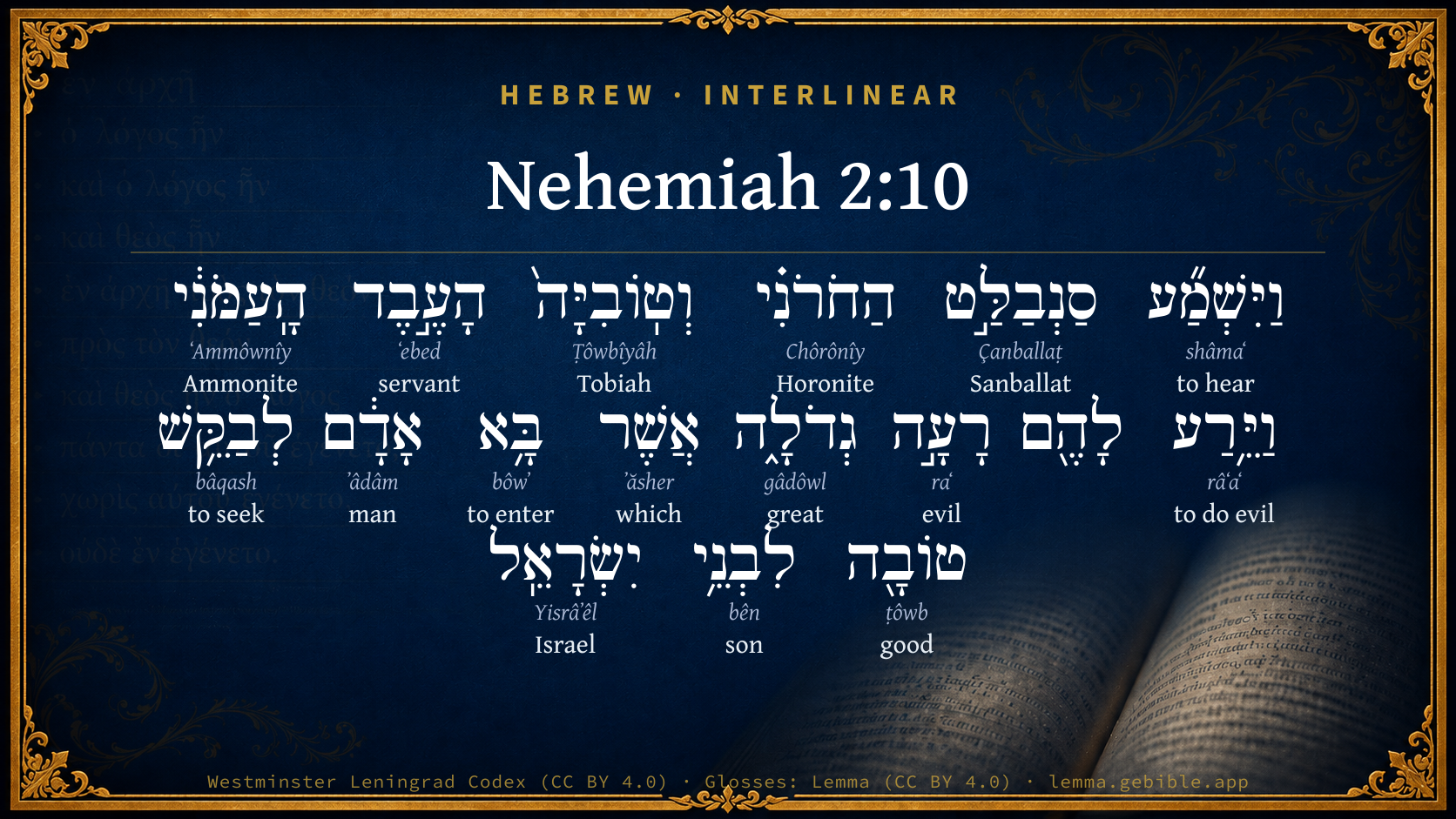
Nehemiah 2:10

Hebrew (Westminster Leningrad Codex) Nehemiah 2:10 appears in the Hebrew Old Testament. The text above is from the Westminster Leningrad Codex. Each word links to its Strong’s number, a concise gloss, and parsing drawn from the Open Scriptures Hebrew Bible morphology. Click any word for its full Brown-Driver-Briggs (BDB) entry.
Download image
Cite this verse

Nehemiah 2:10 (World English Bible). Public Domain. Lemma interlinear Bible study tool, https://lemma.gebible.app/v/nehemiah/2/10.

Show BibTeX & RIS
BibTeX
RIS
English Translation
When Sanballat the Horonite, and Tobiah the servant, the Ammonite, heard of it, it grieved them exceedingly, because a man had come to seek the welfare of the children of Israel.
World English Bible · Public Domain
Highlights
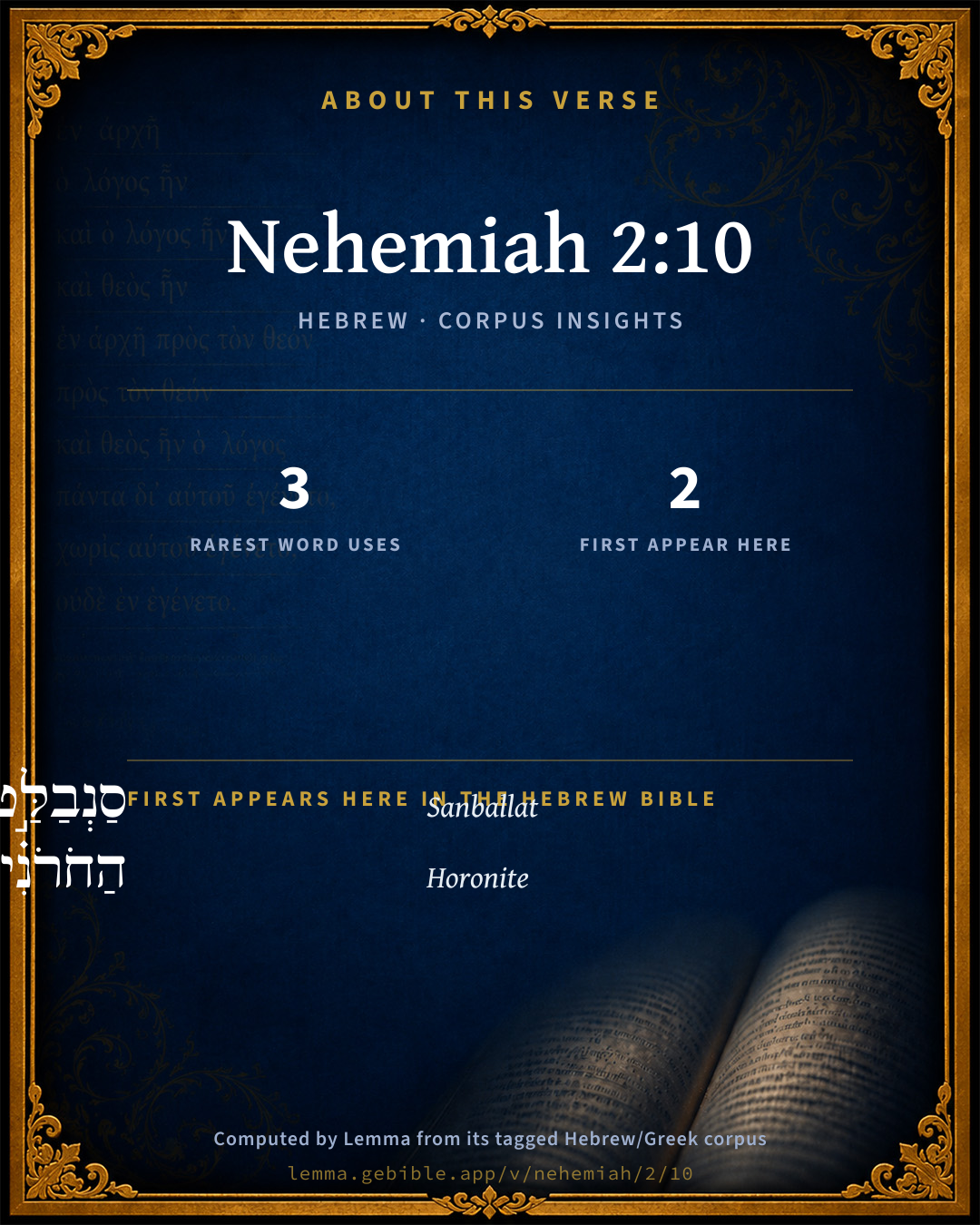
  • 2 first appearances in the Hebrew Bible
Full analysis ↓
Download a study sheet

One document with this verse’s original text, its word-by-word gloss line, the meaning frame, cross-references with their text, attributed commentary, and full source and license credits — printable, and it pastes into notes with its structure intact.

This verse Autodidact and up

Study sheet (.html) Plain text (.txt)

A passage Seminary Student

Up to 50 verses in one chapter. A passage sheet keeps up to 6 commentary sources and 12 cross-references per verse, in the order this page ranks them, and says so on the sheet whenever that leaves anything out. Ask for a single verse and you get the Autodidact verse sheet above.

Everything on this page stays free to read, with no account — the sheet is a download of what is already on screen, not access to it.

Want to remove ads? Support Godless Engineer
Compare translations 3

The same verse in 3 English versions, stacked beneath the original-language interlinear above. Click any original word for its lexicon entry.

Each is an independent rendering of the whole verse — the interlinear is not word-aligned to these translations.

Highlighted words mark where these versions differ — a whole-verse word diff, not a word-by-word alignment.

  • World English Bible Public Domain
    When Sanballat the Horonite, and Tobiah the servant, the Ammonite, heard of it, it grieved them exceedingly, because a man had come to seek the welfare of the children of Israel.
  • King James Version Public Domain
    When Sanballat the Horonite, and Tobiah the servant, the Ammonite, heard of it, it grieved them exceedingly that there was come a man to seek the welfare of the children of Israel.
  • unfoldingWord Literal Text CC BY-SA 4.0
    And Sanballat the Horonite and Tobiah, the servant, the Ammonite, heard. And it was evil to them, a great evil, that someone had come to seek good for the sons of Israel.

unfoldingWord Literal Text — © unfoldingWord, licensed CC BY-SA 4.0. Word-aligned USFM3 via Door43 (git.door43.org/unfoldingWord/en_ult).

Versions to compare (up to 4)

3 of 4 selected

Show all 18 translations

Every available English version of this verse, each an independent rendering of the whole verse.

  • World English Bible Public Domain
    When Sanballat the Horonite, and Tobiah the servant, the Ammonite, heard of it, it grieved them exceedingly, because a man had come to seek the welfare of the children of Israel.
  • Berean Standard Bible Public Domain
    But when Sanballat the Horonite and Tobiah the Ammonite official heard about this, they were deeply disturbed that someone had come to seek the well-being of the Israelites.
  • Majority Standard Bible Public Domain
    But when Sanballat the Horonite and Tobiah the Ammonite official heard about this, they were deeply disturbed that someone had come to seek the well-being of the Israelites.
  • King James Version Public Domain
    When Sanballat the Horonite, and Tobiah the servant, the Ammonite, heard of it, it grieved them exceedingly that there was come a man to seek the welfare of the children of Israel.
  • American Standard Version (1901) Public Domain
    And when Sanballat the Horonite, and Tobiah the servant, the Ammonite, heard of it, it grieved them exceedingly, for that there was come a man to seek the welfare of the children of Israel.
  • Revised Version (1885) Public Domain
    And when Sanballat the Horonite, and Tobiah the servant, the Ammonite, heard of it, it grieved them exceedingly, for that there was come a man to seek the welfare of the children of Israel.
  • Geneva Bible (1599) Public Domain
    But Sanballat the Horonite, and Tobiah a seruant an Ammonite heard it, and it grieued them sore, that there was come a man which sought the wealth of the children of Israel.
  • Douay-Rheims (1899) Public Domain
    And Sanaballat the Horonite, and Tobias the servant, the Ammonite, heard it, and it grieved them exceedingly, that a man was come, who sought the prosperity of the children of Israel.
  • Young's Literal Translation Public Domain
    and Sanballat the Horonite heareth, and Tobiah the servant, the Ammonite, and it is evil to them -- a great evil -- that a man hath come in to seek good for the sons of Israel.
  • Literal Standard Version CC BY-SA 4.0
    and Sanballat the Horonite hears, and Tobiah the servant, the Ammonite, and it is evil to them—a great evil—that a man has come to seek good for the sons of Israel.
  • Unlocked Literal Bible CC BY-SA 4.0
    When Sanballat the Horonite and Tobiah the Ammonite servant heard this, they were greatly displeased that someone had come who was seeking to help the people of Israel.
  • unfoldingWord Literal Text CC BY-SA 4.0
    And Sanballat the Horonite and Tobiah, the servant, the Ammonite, heard. And it was evil to them, a great evil, that someone had come to seek good for the sons of Israel.
  • Darby Bible Public Domain
    And when Sanballat the Horonite, and Tobijah the servant, the Ammonite, heard [of it], it grieved them exceedingly that there had come a man to seek the welfare of the children of Israel.
  • World Messianic Bible Public Domain
    When Sanballat the Horonite and Tobiah the Ammonite servant heard of it, it grieved them exceedingly, because a man had come to seek the welfare of the children of Israel.
  • Webster's Bible Public Domain
    When Sanballat the Horonite, and Tobiah the servant, the Ammonite, heard of it, it grieved them exceedingly that there had come a man to seek the welfare of the children of Israel.
  • Free Bible Version CC BY-SA 4.0
    But when Sanballat the Horonite and Tobiah the Ammonite official heard about this, they were upset. For them this was a total disaster—that someone had arrived to help out the Israelites.
  • Bible in Basic English Public Domain
    And Sanballat the Horonite and Tobiah the servant, the Ammonite, hearing of it, were greatly troubled because a man had come to the help of the children of Israel.
  • JPS Tanakh (1917) Public Domain
    And when Sanballat the Horonite, and Tobiah the servant, the Ammonite, heard of it, it grieved them exceedingly, for that there was come a man to seek the welfare of the children of Israel.

Literal Standard Version (2020), Covenant Press — licensed CC BY-SA 4.0. Text via the HelloAO Bible API (eBible.org). Unlocked Literal Bible (unfoldingWord) — licensed CC BY-SA 4.0. Text via the HelloAO Bible API (eBible.org). unfoldingWord Literal Text — © unfoldingWord, licensed CC BY-SA 4.0. Word-aligned USFM3 via Door43 (git.door43.org/unfoldingWord/en_ult). Free Bible Version, Dr. Jonathan Gallagher — licensed CC BY-SA 4.0. Text via the HelloAO Bible API (eBible.org).

Word by word

More ways to search: Search by grammar → Find every occurrence → Compare this word →

Practice this passage: Drill this verse → Learn its vocabulary →

הַחֹרֹנִ֗י
Chôrônîy
H2772
“the · Horonite”
Particle, Definite Article + Noun, Gentilic, Masculine, Singular, Absolute
Part of Speech
Particle + Noun
Type
Gentilic
Gender
Masculine
Number
Singular
State
Absolute
Full BDB Definition

Origin: from H2773

TWOT: None

Horonite = "native of Horonaim" - an inhabitant of Horonaim in Moab - the designation of Sanballat, the opponent of Nehemiah
  1. וַיִּשְׁמַ֞ע shâmaʻ H8085 “and · to hear” Conjunction + Verb, Qal, Sequential Imperfect, 3rd Person, Masculine, Singular
  2. סַנְבַלַּ֣ט Çanballaṭ H5571 “Sanballat” Noun, Proper
  3. וְטֽוֹבִיָּה֙ Ṭôwbîyâh H2900 “and · Tobiah” Conjunction + Noun, Proper
  4. הָעֶ֣בֶד ʻebed H5650 “the · servant” Particle, Definite Article + Noun, Common, Masculine, Singular, Absolute
  5. הָֽעַמֹּנִ֔י ʻAmmôwnîy H5984 “the · Ammonite” Particle, Definite Article + Noun, Gentilic, Masculine, Singular, Absolute
  6. וַיֵּ֥רַע râʻaʻ H7489 “and · to do evil” Conjunction + Verb, Qal, Sequential Imperfect, 3rd Person, Masculine, Singular
  7. רָעָ֣ה raʻ H7451 “evil” Noun, Common, Feminine, Singular, Absolute
  8. גְדֹלָ֑ה gâdôwl H1419 “great” Adjective, Adjective, Feminine, Singular, Absolute
  9. אֲשֶׁר ʼăsher H834 “which” Particle, Relative
  10. בָּ֥א bôwʼ H935 “to enter” Verb, Qal, Perfect, 3rd Person, Masculine, Singular
  11. אָדָ֔ם ʼâdâm H120 “man” Noun, Common, Masculine, Singular, Absolute
  12. לְבַקֵּ֥שׁ bâqash H1245 “to seek” Preposition + Verb, Piel, Infinitive Construct
  13. טוֹבָ֖ה ṭôwb H2896 “good” Adjective, Adjective, Feminine, Singular, Absolute
  14. לִבְנֵ֥י bên H1121 “to/for · sons of” Preposition + Noun, Common, Masculine, Plural, Construct
  15. יִשְׂרָאֵֽל Yisrâʼêl H3478 “Israel” Noun, Proper

About this verse

These counts appear in no published source. They are computed here, from the morphology-tagged text and Lemma’s own curated glosses. What Lemma adds →

17
words
16
distinct lemmas
Historical
section

Notable vocabulary

The rarest word here is הַחֹרֹנִ֗י Horonite H2772 — appearing just 3 times in the whole Hebrew Bible.

First appearance in Scripture

These words make their first canonical appearance in the Hebrew Bible here:

  • סַנְבַלַּ֣ט Sanballat H5571
  • הַחֹרֹנִ֗י Horonite H2772

Shared distinctive vocabulary

הַחֹרֹנִ֗י Horonite H2772 occurs in 3 verses of the Hebrew Bible. Also found in:

Grammatical profile

  • 4 verbs
  • 9 nouns
  • 2 adjectives
  • 1 preposition
  • 1 particle

Verb forms

  • וַיִּשְׁמַ֞ע Qal · Sequential Imperfect
  • וַיֵּ֥רַע Qal · Sequential Imperfect
  • בָּ֥א Qal · Perfect
  • לְבַקֵּ֥שׁ Piel · Infinitive Construct

Cross-references

22

Topical passages linked to Nehemiah 2:10 in the Treasury of Scripture Knowledge — connected by theme and wording, ordered by reader-vote popularity; previews shown in the World English Bible.

  • Nehemiah 2:19 But when Sanballat the Horonite, and Tobiah the servant, the Ammonite, and Geshem the Arabian, heard it, they ridiculed us, and despised us, and said, What is this thing that you do? will you rebel against the king?
  • Nehemiah 4:7 But it happened that when Sanballat, Tobiah, the Arabians, the Ammonites, and the Ashdodites heard that the repairing of the walls of Jerusalem went forward, [and] that the breaches began to be stopped, then they were very angry;
  • Nehemiah 6:1 Now it happened, when it was reported to Sanballat and Tobiah, and to Geshem the Arabian, and to the rest of our enemies, that I had built the wall, and that there was no breach left therein; (though even to that time I had not set up the doors in the gates;)
  • Nehemiah 13:4 Now before this, Eliashib the priest, who was appointed over the chambers of the house of our God, being allied to Tobiah,
  • Proverbs 27:4 Wrath is cruel, And anger is overwhelming; But who is able to stand before jealousy?
  • Ezekiel 25:6–8 For thus says the Lord Yahweh: Because you have clapped your hands, and stamped with the feet, and rejoiced with all the despite of your soul against the land of Israel;
  • Acts 19:26–27 You see and hear, that not at Ephesus alone, but almost throughout all Asia, this Paul has persuaded and turned away many people, saying that they are no gods, that are made with hands.
  • Numbers 22:3–4 Moab was sore afraid of the people, because they were many: and Moab was distressed because of the children of Israel.
  • Nehemiah 4:1–3 But it happened that when Sanballat heard that we were building the wall, he was angry, and took great indignation, and mocked the Jews.
  • Psalms 112:10 The wicked will see it, and be grieved. He shall gnash with his teeth, and melt away. The desire of the wicked will perish.
  • Psalms 122:6–9 Pray for the peace of Jerusalem. Those who love you will prosper.
  • Ezra 4:4–23 Then the people of the land weakened the hands of the people of Judah, and troubled them in building,
  • Nehemiah 13:1 On that day they read in the book of Moses in the audience of the people; and therein was found written, that an Ammonite and a Moabite should not enter into the assembly of God forever,
  • Proverbs 30:22 For a servant when he is king; A fool when he is filled with food;
  • Ecclesiastes 10:7 I have seen servants on horses, and princes walking like servants on the earth.
  • Isaiah 15:5 My heart cries out for Moab; her nobles [flee] to Zoar, to Eglath Shelishiyah: for by the ascent of Luhith with weeping they go up; for in the way of Horonaim they raise up a cry of destruction.
  • Jeremiah 48:5 For by the ascent of Luhith with continual weeping shall they go up; for at the descent of Horonaim they have heard the distress of the cry of destruction.
  • Jeremiah 48:34 From the cry of Heshbon even to Elealeh, even to Jahaz have they uttered their voice, from Zoar even to Horonaim, to Eglath Shelishiyah: for the waters of Nimrim also shall become desolate.
  • Micah 7:9–10 I will bear the indignation of Yahweh, Because I have sinned against him, Until he pleads my case, and executes judgment for me. He will bring me forth to the light. I will see his righteousness.
  • Micah 7:16–17 The nations will see and be ashamed of all their might. They will lay their hand on their mouth. Their ears will be deaf.
  • Acts 4:2 being upset because they taught the people and proclaimed in Jesus the resurrection from the dead.
  • Acts 5:24 Now when the high priest, the captain of the temple, and the chief priests heard these words, they were very perplexed about them and what might become of this.

Cross-references courtesy of OpenBible.info (CC BY 4.0).

Hebrew and Greek witnesses Masoretic Hebrew ↔ Greek Septuagint

The same verse in the two great witnesses to the Old Testament, shown verse-for-verse.

These are two independent witnesses, not word-aligned to each other, and the Septuagint is shown in lemma (dictionary) form.

Hebrew Nehemiah 2:10 Masoretic · Westminster Leningrad Codex

וַיִּשְׁמַ֞ע סַנְבַלַּ֣ט הַחֹרֹנִ֗י וְטֽוֹבִיָּה֙ הָעֶ֣בֶד הָֽעַמֹּנִ֔י וַיֵּ֥רַע לָהֶ֖ם רָעָ֣ה גְדֹלָ֑ה אֲשֶׁר בָּ֥א אָדָ֔ם לְבַקֵּ֥שׁ טוֹבָ֖ה לִבְנֵ֥י יִשְׂרָאֵֽל

When Sanballat the Horonite, and Tobiah the servant, the Ammonite, heard of it, it grieved them exceedingly, because a man had come to seek the welfare of the children of Israel.

World English Bible · Public Domain

Greek LXX Structure differs

The Septuagint has no separate book of Nehemiah. Its Greek text is the second half of Esdras B (2 Esdras), chapters 11–23; Ezra is the first half (1–10).

A verse-for-verse comparison isn’t shown here because the chapters and verses don’t line up. Switch to the LXX edition with the MT / LXX toggle above to read the Greek directly.

On this verse, The Cambridge Bible for Schools and Colleges discusses the Septuagint’s reading. Read the note in Commentary ↓

Hebrew: Westminster Leningrad Codex (CC BY 4.0). Greek: Septuagint (public domain); English from a public-domain English Septuagint. How the Septuagint differs from the Hebrew →

Commentary

Notes on Nehemiah 2:10 from classic Christian and Jewish commentators (each source and its license shown beneath its notes). The classic Christian expositions comment on the surrounding passage and are grouped to its opening verse, so a note may address several verses; the Jewish commentaries on the Tanakh (Rashi and others) are per-verse, so they appear only where the commentator wrote on this verse.

Lemma curates 59 commentaries, every one of them public domain or Creative Commons licensed, each selected and text-cleaned for this edition rather than reprinted as found. About our sources →

Trapp's Complete Commentary

John Trapp

Neh 2:10 When Sanballat the Horonite, and Tobiah the servant, the Ammonite, heard [of it], it grieved them exceedingly that there was come a man to seek the welfare of the children of Israel.

10. When Sanballat the Horonite] That is, the Moabite, Isa 15:4 Jer 48:3; Jer 48:5; Jer 48:34. His name signifieth, saith one, a pure enemy; he was come of that spiteful people, who were anciently irked because of Israel, Num 22:3-4, or did inwardly fret and vex at them, as Exo 1:12, who yet were allied unto them, and did them no harm in their passage by them, yea, had done them good by the slaughter of the Amorites, their encroaching neighbours.

And Tobiah the servant] A servant or bondslave once he had been, though now a Toparch, a lieutenant to the king of Persia. Now such are most troublesome, Pro 30:22.

Asperlus nihil est humili, cum surgit in altum.

Aφορητος εστιν ευτυχων μαστιγιας.

Heard it] As they might soon do by means of their wives, who were Jewesses. And the Jews to this day are generally found the most nimble and mercurial wits in the world. Every vizier and bashaw of state among the Turks useth to keep a Jew of his private counsel; whose malice, wit, and experience of Christendom, with their continual intelligence, is thought to advise most of that mischief which the Turk puts in execution against us.

It grieved them exceedingly] Heb. It seemed to them an evil, a great evil; it displeased them sore, and vexed them at the very heart, such was their spleen and spite. Envy is a deadly mischief; and because it cannot feed upon other men’s hearts, it feedeth upon its own, drinking up the most part of its own venom. The envious man is not like the maid in Avicen, who, feeding upon poison, was herself healthy, yet infected others with her venomous breath; but like the serpent Porphyrius, which is full of poison, but, wanting teeth, hurteth none but himself; or as the hill Aetna, &c.

That there was come a man to seek the welfare, &c.] This they looked upon with an evil eye, and were vexed, Invidia Siculi, &c. Who can stand before envy? Pro 27:4. It espieth with great grief the smallest things the good man doth or hath, and is, therefore, absolutely the best thing to clear the eyesight, said Actius Sincerus, a nobleman, to King Frederick.

John Trapp, A Commentary or Exposition upon All the Books of the Old and New Testament (1647–1656) — public domain. Text from a community e-Sword module.

Joseph Benson's Commentary

Neh 2:10. Sanballat the Horonite — So called either from the place of his birth or residence, which is supposed to have been Horonaim, an eminent city of Moab. This Sanballat was the person who afterward instigated Alexander the Great to build the temple of Gerizim, in order to occasion a division among the Jews. Tobiah the servant, the Ammonite — So called, probably, from the condition from which he had been advanced to his present power and dignity; which also may be mentioned as one reason why he now carried himself so insolently, it being usual for persons suddenly raised from a low state so to demean themselves. It grieved them exceedingly that there was come a man — With such authority from the king, and in such favour with him, as appeared by the letters he brought with him, and the guard that attended him, and the diligence of the several governors, through whose provinces he passed, to serve him.

Joseph Benson's Commentary on the Old and New Testaments (1811–1818) — public domain. Text from a community e-Sword module.

Scofield Reference Notes

C. I. Scofield

Tobiah

Two Tobiahs are distinguished by many:

(1) "Tobiah the servant, the Ammonite," Neh 2:10; Neh 2:19; Neh 4:3; Neh 4:7 Neh 6:1; Neh 6:12; Neh 6:14.

(2) A Jew, unable to prove his genealogy. But the reference to the latter (Neh 7:62) indicates that he was already dead. But one Tobiah, and he the Ammonite, is active in this book.

The Scofield Reference Bible (1917 edition), notes by C. I. Scofield — public domain. Text from a community e-Sword module.

The Expositor's Bible

ON GUARD

Neh_2:10; Neh_2:19; Nehemiah 4

ALL his arrangements for rebuilding the walls of Jerusalem show that Nehemiah was awake to the dangers with which he was surrounded. The secrecy of his night ride was evidently intended to prevent a premature revelation of his plans. The thorough organisation, the mapping out of the whole line of the wall, and the dividing of the building operations among forty-two bands of workpeople secured equal and rapid progress on all sides. Evidently the idea was to "rush" the work, and to have it fairly well advanced, so as to afford a real protection for the citizens, before any successful attempts to frustrate it could be carried out. Even with all these precautions, Nehemiah was harassed and hindered for a time by the malignant devices of his enemies. It was only to be expected that he would meet with opposition. But a few years before all the Syrian colonists had united in extracting an order from Artaxerxes for the arrest of the earlier work of building the walls, because the Jews had made themselves intensely obnoxious to their neighbours by sending back the wives they had married from among the Gentile peoples. The jealousy of Samaria, which had taken the lead in Palestine so long as Jerusalem was in evidence, envenomed this animosity still more. Was it likely then that her watchful foes would hear with equanimity of the revival of the hated city-a city which must have seemed to them the very embodiment of the anti-social spirit?

Now, however, since a favourite servant of the Great King had been appointed governor of Jerusalem, the Satrap of the Syrian provinces could scarcely be expected to interfere. Therefore the initiative fell into the hands of smaller men, who found it necessary to abandon the method of direct hostility, and to proceed by means of intrigues and ambuscades. There were three who made themselves notorious in this undignified course of procedure. Two of them are mentioned in connection with the journey of Nehemiah up to Jerusalem. {Neh_2:10} The first, the head of the whole opposition, is Sanballat, who is called the Horonite, seemingly because he is a native of one of the Beth-horons, and who appears to be the governor of the city of Samaria, although this is not stated. Throughout the history he comes before us repeatedly as the foe of the rival governor of Jerusalem. Next to him comes Tobiah, a chief of the little trans-Jordanic tribe of the Ammonites, some of whom had got into Samaria in the strange mixing up of peoples after the Babylonian conquest. He is called the servant, possibly because he once held some post at court, and if so he may have been personally jealous of Nehemiahs promotion.

Sanbaltat and his supporter Tobiah were subsequently joined by an Arabian Emir named Geshem. His presence in the group of conspirators would be surprising if we had not been unexpectedly supplied with the means of accounting for it in the recently deciphered inscription which tells how Sargon imported an Arabian colony into Samaria. The Arab would scent prey in the project of a warlike expedition

The opposition proceeded warily. At first we are only told that when Sanballat and his friend Tobiah heard of the coming of Nehemiah, "grieved them exceedingly that there was come a man to seek the welfare of the children of Israel." {Neh_2:10} In writing these caustic words Nehemiah implies that the jealous men had no occasion to fear that he meant any harm to them, and that they knew this. It seems very hard to him, then, that they should begrudge any alleviation of the misery of the poor citizens of Jerusalem. What was that to them? Jealousy might foresee the possibility of future loss from the recovery of the rival city, and in this they might find the excuse for their action, an excuse for not anticipating which so fervent a patriot as Nehemiah may be forgiven; nevertheless the most greedy sense of self-interest on the part of these men is lost sight of in the virulence of their hatred to the Jews. This is always the case with that cruel infatuation-the Anti-Semitic rage. Here it is that hatred passes beyond mere anger. Hatred is actually pained at the welfare of its object. It suffers from a Satanic misery. The venom which it fails to plant in its victim rankles in its own breast.

At first we only hear of this odious distress of the jealous neighbours. But the prosecutions of Nehemiahs designs immediately lead to a manifestation of open hostility-verbal in the beginning. No sooner had the Jews made it evident that they were responsive to their leaders appeal and intended to rise and build, than they were assailed with mockery. The Samaritan and Ammonite leaders were now joined by the Arabian, and together they sent a message of scorn and contempt, asking the handful of poor Jews whether they were fortifying the city in order to rebel against the king. The charge of a similar intention had been the cause of stopping the work on the previous occasion. {Ezr_4:13} Now that Artaxerxes favourite cup-bearer was at the head of affairs, any suspicion of treason was absurd, but since hatred is singularly blind-far more blind than love-it is barely possible that the malignant mockers hoped to raise a suspicion. On the other hand, there is no evidence to show that they followed the example of the previous opposition and reported to headquarters. For the present they seem to have contented themselves with bitter raillery. This is a weapon before which weak men too often give way. But Nehemiah was not so foolish as to succumb beneath a shower of poor, ill-natured jokes.

His answer is firm and dignified. {Neh_2:20} It contains three assertions. The first is the most important. Nehemiah is not ashamed to confess the faith which is the source of all his confidence. In the eyes of men the Jews may appear but a feeble folk, quite unequal to the task of holding their ground in the midst of a swarm of angry foes. If Nehemiah had only taken account of the political and military aspects of affairs, he might have shrunk from proceeding. But it is just the mark of his true greatness that he always has his eye fixed on a Higher Power. He knows that God is in the project, and therefore he is sure that it must prosper. When a man can reach this conviction, mockery and insult do not move him. He has climbed to a serene altitude, from which he can look down with equanimity on the boiling clouds that are now far beneath his feet. Having this sublime ground of confidence, Nehemiah is able to proceed to his second point-his assertion of the determination of the Jews to arise and build. This is quite positive and absolute. The brave man states it, too, in the clearest possible language. Now the work is about to begin there is to be no subterfuge or disguise. Nehemiahs unflinching determination is based on the religious confession that precedes it. The Jews are Gods servants, they are engaged in His work, they know He will prosper them, therefore they most certainly will not stay their hand for all the gibes and taunts of their neighbours. Lastly, Nehemiah contemptuously repudiates the claim of these impertinent intruders to interfere in the work of the Jews, he tells them that they have no excuse for their meddling, for they own no property in Jerusalem, they have no right of citizenship or of control from without, and there are no tombs of their ancestors in the sacred city.

In this message of Nehemiahs we seem to hear an echo of the old words with which the temple-builders rejected the offer of assistance from the Samaritans, and which were the beginning of the whole course of jealous antagonism on the part of the irritated neighbours. But the circumstances are entirely altered. It is not a friendly offer of co-operation, but its very opposite, a hostile and insulting message designed to hinder the Jews, that is here so proudly resented. In the reply of Nehemiah we hear the church refusing to bend to the will of the world, because the world has no right to trespass on her territory. Gods work is not to be tampered with by insolent meddlers. Jewish exclusiveness is painfully narrow, at least in our estimation of it, when it refuses to welcome strangers or to recognise the good that lies outside the sacred enclosure, but this same characteristic becomes a noble quality, with high ethical and religious aims, when it firmly refuses to surrender its duty to God at the bidding of the outside world. The Christian can scarcely imitate Nehemiahs tone and temper in this matter, and yet if he is loyal to his God he will feel that he must be equally decided and uncompromising in declining to give up any part of what he believes to be his service of Christ to please men who unhappily as yet have "no part, or right, or memorial" in the New Jerusalem, although, unlike the Jew of old, he will be only too glad that all men should come in and share his privileges.

After receiving an annoying answer it was only natural that the antagonistic neighbours of the Jews should be still more embittered in their animosity. At the first news of his coming to befriend the children of Israel, as Nehemiah says, Sanballat and Tobiah were grieved, but when the building operations were actually in process the Samaritan leader passed from vexation to rage-"he was wroth and took great indignation." {Neh_4:1} This man now assumed the lead in opposition to the Jews. His mockery became more bitter and insulting. In this he was joined by his friend the Ammonite, who declared that if only one of the foxes that prowl on the neighbouring hills were to jump upon the wall the creature would break it down. {Neh_4:3} Perhaps he had received a hint from some of his spies that the new work that had been so hastily pressed forward was not any too solid. The "Palestine Exploration Fund" has brought to light the foundations of what is believed to be a part of Nehemiahs wall at Ophel, and the base of it is seen to be of rubble, not founded on the rock, but built on the clay above, so that it has been possible to drive a mine under it from one side to the other-a rough piece of work, very different from the beautifully finished temple walls.

Nehemiah met the renewed shower of insults in a startling manner. He cursed his enemies. {Neh_4:4} Deploring before God the contempt that was heaped on the Jews, he prayed that the reproach of the enemies might be turned on their own head, devoted them to the horrors of a new captivity, and even went so far as to beg that no atonement might be found for their iniquity, that their sin might not be blotted out. In a word, instead of himself forgiving his enemies, he besought that they might not be forgiven by God. We shudder as we read his terrible words. This is not the Christ spirit. It is even contrary to the less merciful spirit of the Old Testament. Yet, to be just to Nehemiah, we must consider the whole case. It is most unfair to tear his curse out of the history and gibbet it as a specimen of Jewish piety. Even strong men who will not give way before ridicule may feel its stabs-for strength is not inconsistent with sensitiveness. Evidently Nehemiah was irritated, but then he was much provoked. For the moment he lost his self-possession. We must remember that the strain of his great undertaking was most exhausting, and we must be patient with the utterances of one so sorely tried. If lethargic people criticise adversely the hasty utterances of a more intense nature, they forget that, though they may never lose their self-control, neither do they ever rouse themselves to the daring energy of the man whose failings they blame. Then it was not any personal insults hurled against himself that Nehemiah resented so fiercely. It was his work that the Samaritans were trying to hinder. This he believed to be really Gods work, so that the insults offered to the Jews were also directed against God, who must have been angry also. We cannot justify the curse by the standard of the Christian law, but it is not reasonable to apply that standard to it. We must set it by the side of the Maledictory Psalms. From the standpoint of its author it can be fully accounted for. To say that even in this way it can be defended, however, is to go too far. We have no occasion to persuade ourselves that any of the Old Testament saints were immaculate, even in the light of Judaism. Nehemiah was a great and good man, yet he was not an Old Testament Christ.

But now more serious opposition was to be encountered. Such enemies as those angry men of Samaria were not likely to be content with venting their spleen in idle mockery. When they saw that the keenest shafts of their wit failed to stop the work of the citizens of Jerusalem, Sanballat and his friends found it necessary to proceed to more active measures, and accordingly they entered into a conspiracy for the double purpose of carrying on actual warfare and of intriguing with disaffected citizens of Jerusalem-"to cause confusion therein." {Neh_4:8; Neh_4:11} Nehemiah was too observant and penetrating a statesman not to become aware of what was going on, the knowledge that the plots existed revealed the extent of his danger, and compelled him to make active preparations for thwarting them. We may notice several important points in the process of the defence.

1. Prayer.- This was the first, and in Nehemiahs mind the most essential defensive measure. We find him resorting to it in every important juncture of his life. It is his sheet-anchor. But now "he uses the plural number. Hitherto we have met only with his private prayers." In the present case he says, "We made our prayer unto our God." {Neh_4:9} Had the infection of his prayerful spirit reached his fellow-citizens, so that they now shared it? Was it that the imminence of fearful danger drove to prayer men who under ordinary circumstances forgot their need of God? Or were both influences at work? However it was brought about, this association in prayer of some of the Jews with their governor must have been the greatest comfort to him, as it was the best ground for the hope that God would not now let them fall into the hands of the enemy. Hitherto there had been a melancholy solitariness about the earnest devotion of Nehemiah. The success of his mission began to show itself when the citizens began to participate in the same spirit of devotion.

2. Watchfulness.- Nehemiah was not the fanatic to blunder into the delusion that prayer was a substitute for duty, instead of being its inspiration. All that followed the prayer was really based upon it. The calmness, hope, and courage won in the high act of communion with God made it possible to take the necessary steps in the outer world. Since the greatest danger was not expected as an open assault, it was most necessary that an unbroken watch should be maintained, day and night. Nehemiah had spies out in the surrounding country, who reported to him every planned attack. So thorough was this system of espionage, that though no less than ten plots were concocted by the enemy, they were all discovered to Nehemiah, and all frustrated by him.

3. Encouragement.- The Jews were losing heart. The men of Judah came to Nehemiah with the complaint that the labourers who were at work on the great heaps of rubbish were suffering from exhaustion. The reduction in the numbers of workmen, owing to the appointment of the guard, would have still further increased the strain of those who were left to toil among the mounds. But it would have been fatal to draw back at this juncture. That would have been to invite the enemy to rush in and complete the discomfiture of the Jews. On Nehemiah came the obligation of cheering the dispirited citizens. Even the leading men who should have rallied the people, like officers at the head of their troops, shared the general depression. Nehemiah was again alone-or at best supported by the silent sympathy of his companions in prayer, There was very nearly a panic, and for one man to stand out under such circumstances as these in solitary courage, not only resisting the strong contagion of fear, but stemming the tide ant counteracting its movement, this would be indeed the sublimity of heroism. It was a severe test for Nehemiah, and he came out of it triumphant. His faith was the inspiration of his own courage, and it became the ground for the encouragement of others. He addressed the people and their nobles in a spirited appeal. First, he exhorted them to banish fear. The very tone of his voice must have been reassuring; the presence of one brave man in a crowd of cowards often shames them out of their weakness. But Nehemiah proceeded to give reasons for his encouragement. Let the men remember their God Jehovah, how great and terrible He is! The cause is His, and His might and terror will defend it. Let them think of their people and their families, and fight for brethren and children, for wives and homes! Cowardice is unbelief and selfishness combined. Trust in God and a sense of duty to others will master the weakness.

4. Arms.- Nehemiah gave the first place to the spiritual and moral defences of Jerusalem. Yet his material defences were none the less thorough on account of his prayers to God or his eloquent exhortation of the people and their leaders. They were most complete.

His arrangements for the military protection of Jerusalem converted the whole city into an armed camp. Half the citizens in turn were to leave their work, and stand at arms with swords and spears and bows. Even in the midst of the building operations the clatter of weapons was heard among the stones, because the masons at work on the walls and the labourers while they poised on their heads baskets full of rubbish from the excavations had swords attached to their sashes. Residents of the suburbs were required to stay in the city instead of returning home for the night, and no man could put off a single article of clothing when he lay down to sleep. Nor was this martial array deemed sufficient without some special provision against a surprise. Nehemiah therefore went about with a trumpeter, ready to summon all hands to any point of danger on the first alarm.

Still, though the Jews were hampered with these preparations for battle, tired with toil and watching, and troubled by dreadful apprehensions, the work went on. This is a great proof of the excellency of Nehemiahs generalship. He did not sacrifice the building to the fighting. The former was itself designed to produce a permanent defence, while the arms were only for temporary use. When the walls were up the citizens could give the laugh back to their foes. But in itself the very act of working was reassuring. Idleness is a prey to fears which industry has no time to entertain. Every man who tries to do his duty as a servant of God is unconsciously building a wall about himself that will be his shelter in the hour of peril.

William Robertson Nicoll, ed., The Expositor's Bible (London: Hodder & Stoughton, 1887–1910) — public domain. 65 of 66 books (1 Corinthians is not separately keyed, as that volume carries no machine-parseable verse references); section-level commentary keyed to the opening verse. Introductory and overview sections not keyed to a specific passage are excluded.

Tyndale Open Study Notes

Tyndale Open Resources

2:10 Some of the local, non-Jewish officials were very displeased because rebuilding the walls of Jerusalem would change the balance of political power in favor of the Jews. • Sanballat was the main leader of opposition to Nehemiah’s rebuilding efforts. • the Horonite: He was probably from Upper or Lower Horon (Beth-horon, Josh 16:3), approximately 12 miles (19 kilometers) northwest of Jerusalem. Sanballat’s name might indicate that he was a descendant of the Assyrian people imported by Sargon II after the fall of Samaria (2 Kgs 17:24). A document discovered in Egypt indicates that he eventually became governor of Samaria in 408 BC.

Tyndale Open Study Notes — © Tyndale Open Resources, licensed CC BY-SA 4.0. Text via the HelloAO Bible API.

Geneva Bible (1599)

Geneva Bible translators

These were great enemies to the Jews, and labored always both by force and subtlety to overcome them, and Tobiah, because his wife was a Jewess, had advertisement ever of their affairs, and so wrought them great trouble.

Geneva Bible (1599) marginal notes — public domain. Text via Bolls.life.

Jamieson, Fausset & Brown

Robert Jamieson, A. R. Fausset & David Brown

Sanballat the Horonite--Horonaim being a town in Moab, this person, it is probable, was a Moabite.

Tobiah the servant, the Ammonite--The term used indicates him to have been a freed slave, elevated to some official dignity. These were district magistrates under the government of the satrap of Syria; and they seem to have been leaders of the Samaritan faction.

Jamieson, Fausset & Brown — Commentary Critical and Explanatory on the Whole Bible (1871) — public domain (CC PDM 1.0). Text via the HelloAO Bible API.

Adam Clarke's Commentary

Verse 10. Sanballat the Horonite] Probably a native of Horonaim, a Moabite by birth, and at this time governor of the Samaritans under the king of Persia.

Tobiah the servant] He was an Ammonite; and here, under the Persian king, joint governor with Sanballat. Some suppose that the Sanballat here mentioned was the same who persuaded Alexander to build a temple on Mount Gerizim in favour of the Samaritans. Pelagius thinks there were two governors of this name.

Adam Clarke's Commentary on the Bible (1810–1826) — public domain. Text from a community e-Sword/MySword module.

Ellicott's Commentary for English Readers

(10) Sanballat the Horonite.—Satrap of Samaria under the Persians, whose secretary or minister was “Tobiah the servant, the Ammonite.” Sanballat was from one of the Beth-horons, which had been in Ephraim, and were now in the kingdom of Samaria. His name is seemingly Babylonian, while that of Tobiah is Hebrew. The revival of Jerusalem would be a blow to the recent ascendency of Samaria.

A Bible Commentary for English Readers, edited by Charles John Ellicott (1878–1897) — public domain. Text from a community e-Sword module.

The Cambridge Bible for Schools and Colleges

gen. ed. J. J. S. Perowne

10. When] R.V. And when.

This is the first mention of the opposition which Nehemiah encountered. The news of his mission quickly spread, although its precise object was not known (cf. Neh_2:12; Neh_2:16).

Sanballat and Tobiah appear throughout the book as the bitterest foes he had to encounter. ‘Sanballat,’ or, as perhaps it should be called, Saneballat (LXX. Σαναβαλλὰτ, Josephus Σαναβαλλέτης) is probably an Assyrian name, meaning ‘Sin (the moon-god of the Assyrians) giveth life,’ just as Nabubalitanni means ‘Nebo giveth the life.’ The name of the moon-god appears also in Sennacherib = ‘Sin gives many brothers.’ Sanballat is distinguished as ‘the Horonite,’ by which is probably meant ‘dweller in Beth-horon,’ a town on the borders of Ephraim (Jos_16:3; Jos_16:5; Jos_18:13; Jos_21:22; 2Ch_8:5; 2Ch_25:13), about 18 miles N.W. of Jerusalem, upon the main road leading to the plain of the coast. Beth-horon commanded the pass into the mountains. Strategically it was a place of great importance. It is famous for its connexion with the victories of Joshua (Jos_10:10), of Judas Maccabeus (1Ma_3:15; 1Ma_7:39), and as the scene of the overthrow of Cestius Gallus (Joseph. Bell. J. ii. 19. 8).

Sanballat was evidently one of the leaders of the Samaritan community (see on Neh_4:2). Some scholars imagine from the frequent conjunction of his name with that of Tobiah the Ammonite, that Sanballat must have been a Moabite, and that the title ‘Horonite’ denotes a dweller in ‘Horonaim,’ a town in Southern Moab, mentioned in Isa_15:5; Jer_48:3; Jer_48:5; Jer_48:34, and twice in the Inscription of the Moabite Stone.

Tobiah the servant, the Ammonite] Why Tobiah is called ‘the servant’ is not clear. It may denote that he once held some position under the Persian governor or under the king. Rawlinson’s suggestion that he was Sanballat’s secretary and councillor, and had originally been an Ammonite slave, is less probable. He is generally mentioned on an equality with Sanballat, and in Neh_6:12; Neh_6:14, his name stands first. Frequent mention is made of Tobiah’s intrigues against the work and authority of Nehemiah. According to some, the termination ‘-jah’ shows him to have been a renegade Jew: cf. Ezr_2:60; Zec_6:10, where the same name occurs. His son’s name, Jehohanan (Neh_6:18), is also compounded of the Jewish Sacred Name.

The race-hatred between the Jews and the Ammonites and Moabites (see Neh_13:1-2) may explain in some degree Tobiah’s hostility. But in all probability the Samaritans and the neighbouring nations (Moabites, Ammonites, Arabians, &c.) were combined in the desire to foil any effort made to reinstate Jerusalem in her old position of being the most powerful town in Palestine. The policy of Nehemiah would weaken the neighbouring tribes in proportion as it would strengthen the Jews.

Tobiah may have in some way represented the Ammonites, possibly as governor of their small community, having received the position from the court where he had been a slave (cf. Ecc_10:6; Lam_5:8, ‘servants rule over us’).

it grieved them exceedingly] Cf. the same phrase in Jon_4:1.

that there was come a man] R.V. for that, &c.

a man] Contemptuous reference to Nehemiah. His office and position as ‘pekhah’ not referred to. The Hebrew ‘adam,’ not ‘ish,’ is used. For the difference when both occur together, cf. Psa_49:2 (‘both low and high’), Psa_62:9; Isa_2:9; Isa_5:15.

to seek the welfare of] Literally, ‘to seek good for.’ The phrase is not common; it is the antithesis of’ to seek the hurt’ (Est_9:2). In Jer_38:4, ‘this man seeketh not the welfare of this people, but the hurt,’ the word rendered ‘welfare’ is ‘shalom’ or ‘peace,’ here it is ‘tôbh,’ the good or prosperity.

The Cambridge Bible for Schools and Colleges (gen. ed. J. J. S. Perowne; Cambridge University Press, 1878–1918) — public domain. Text from a community e-Sword module.

John Gill's Exposition

When Sanballat the Horonite,.... Who either presided at Horonaim, or sprung from thence, a city of Moab, Isa 15:5

and Tobiah the servant, the Ammonite; who was formerly a slave, but now raised, from a low mean estate, to be governor in the land of Ammon, though still a vassal of the king of Persia:

heard of it, it grieved them exceedingly that there came a man to seek the welfare of the children of Israel; to which the Moabites and Ammonites were always averse, and ever bore an hatred to Israel, and envied everything that tended to their happiness.

John Gill's Exposition of the Whole Bible (1746–1763) — public domain (CC PDM 1.0). Text via the HelloAO Bible API.

Albert Barnes' Notes on the Bible

The name Sanballat is probably Babylonian the first element being the same which commences “Sennacherib,” namely, “Sin,” the moon-God, and the second balatu, “eminent” (?),which is found in the Assyrian name, Bel-balatu. As a Horonite, he was probably a native of one of the Bethhorons, the upper or the lower (see Jos 16:3, Jos 16:5; 2Ch 8:5), and therefore born within the limits of the old kingdom of Samaria. Tobiah seems to have been an Ammonite slave, high in the favor of Sanballat, whom he probably served as secretary Neh 6:17-19 and chief adviser.

It grieved them - Compare Ezra 4:4-24; Ezr 5:6-17. The revival of Jerusalem as a great and strong city, which was Nehemiah’s aim, was likely to interfere with the prosperity, or at any rate the eminence, of Samaria.

Albert Barnes' Notes on the Bible (1834–1885) — public domain. Text from a community e-Sword/MySword module.

Haydock's Catholic Bible Commentary

Horonite, a native, not (Calmet) a petty king (Grotius) of Horonaim, in the country of Moab, Jeremias xlviii. 3. He must have been very old, if he lived till the temple was built at Garizim: (Josephus and Scaliger) but Petau supposes that there were two of the name. --- Servant; an officer appointed over the Samaritans, as well as Sanaballat. The Persian monarchs styled all their subjects servants or slaves. (Calmet) --- Grieved. Thus unbelievers repine when any one endeavours to propagate the truth, (Haydock) or to establish the Church. (Worthington)

George Leo Haydock (1774–1849), Haydock's Catholic Family Bible and Commentary, 1859 edition — public domain. Excludes Psalms (Douay-Rheims chapter numbering differs from Protestant) and Deuterocanonical books (Catholic canon only).

Matthew Poole's English Annotations

Sanballat the Horonite; so called, either from his family, or from the place of his birth or rule, which is supposed to be Horonaim, an eminent city of Moab, Isa 15:5; Jer 48:3.

Tobiah the servant; so called probably from his servile original or condition, from which he was advanced to his present power and dignity; which also may be mentioned as one reason why he now carried himself so insolently and perversely towards the Jews, it being usual for persons suddenly raised from a mean to a high estate so to demean themselves.

Matthew Poole's English Annotations on the Holy Bible (1683–1685) — public domain. Text from a community e-Sword/MySword module.

Whedon's Commentary on the Bible

Daniel D. Whedon

10. Sanballat the Horonite — This noted man seems to have been an officer of the Persian government, holding a military command at Samaria. Compare Neh_4:2. He is conspicuous in this history solely from his bitter hostility to the Jews. The Horonite designates him as a native of Horonaim, in the land of Moab: (see Isa_15:5; Jer_48:3; Jer_48:5; Jer_48:34 :) and his Moabite origin may partly account for his hostility towards Israel.

Tobiah the servant — What gave him this title of the servant is not clear. Perhaps he had been a slave and had gained his freedom, but never lost the title and associations of his former servitude; and in such a case a Jewish writer would naturally emphasize the opprobrious epithet. His own and his son’s marriage with the daughter of a Jew created family relationships which proved a source of trouble, (Neh_6:17-19,) and being allied to the high priest Eliashib (Neh_13:4) he secured a chamber in the courts of the temple, from which Nehemiah finally cast out all his household stuff. Neh_13:7-8. He is here designated as the Ammonite, having sprung from that hated race; and, perhaps, his bitterness towards the Jews was owing largely to Ezra’s recent legislation in requiring all Jews to put away their foreign wives, (Ezra 10,) for they had intermarried with the Ammonites and Moabites. Ezr_9:1. And these two men, Sanballat and Tobiah, were fit representatives of the ancient and hereditary hatred of their respective races towards Israel.

Daniel D. Whedon (gen. ed.), Commentary on the Old and New Testaments (1874–1909) — public domain. Text from a community e-Sword module.

The Pulpit Commentary

Sanballat. According to Josephus, Sanballat was "satrap of Samaria" under the Persians, and by descent a Cuthaean. ("Ant. Jud:," 11:7, He was probably included among the governors to whom Nehemiah had brought letters, and learnt the fact that "a man was come to seek the welfare of the children of Israel" by the delivery of the letters to him. The Horonite, Born, i.e. , at one of the two Beth-horons, the upper or the lower, mentioned in Joshua (Jos_16:3, Jos_16:5) as belonging to Ephraim, and now under Samaria. Tobiah the servant, the Ammonite. It has been usual to regard Tobiah as a native chief of the Ammonites, who, after having been a page or other servant at the Persian court, had been made head of the nation. But it seems to be quite as likely that he was a servant of Sanballat"s, who stood high in his favour, gave him counsel, and was perhaps his secretary. (Neh_6:17, Neh_6:19) It grieved them exceedingly. From the time that Zerub-babel rejected the co-operation of the Samaritans in the rebuilding of the temple, (Ezr_4:3) an enmity set in between the two peoples which continued till the destruction of Jerusalem by Titus. The two capitals were too near not to be rivals; and the greater (general) prosperity of Jerusalem made Samaria the bitterer adversary.

Seeking the welfare of the Church.

"There was a man come to seek the welfare of the children of Israel." Thus, with some contempt, Sanballat and Tobiah thought and spoke of the coming of Nehemiah to Palestine. But if meant as a scoff, it may be accepted as an eulogium: like" a friend of publicans and sinners." Nehemiah is correctly described in the words. They set before us conduct to be imitated by citizens and statesmen in respect to the general community, by Christians in respect to the Church, and to the world at large.

I TO SEEK THE WELFARE OF THE CHURCH OF CHRIST IS INCUMBENT ON ALL CHRISTIANS. The maintenance of religions ordinances, the spread of Christianity, the increase and prosperity of the Church, the benefit of its individual members, are the concern of every Christian, and ought not to be left to a few. The efforts of all are needed; each can do something, and should do it heartily and cheerfully. The great motives to zeal apply to all, as really as to the few who feel their power. When the many can be described as those who with all their might "seek the welfare" of the Church and kingdom of God, a new era in the history of Christianity will begin.

1. How we should seek the welfare of the Church. By our exertions, gifts, prayers.

2. Why we are bound to do so. The nature of our religion, which is love; the purpose of our calling as Christians to be "lights in the world;" the express commands of our Lord; the Divine examples and many human; the blessings we have received from the gospel and the Church; the blessings we may impart; the nobleness of the unselfish spirit and pursuits, and the increase they secure to the true wealth and blessedness of our own being all are powerful reasons why we should interest ourselves in the good of the Church, and so of the world, and do all we can to promote it.

II IT IS ESPECIALLY INCUMBENT ON THOSE WHO HAVE SPECIAL TALENTS. All talents can find employment in this service; all should be consecrated to it. The more we have of faculty and aptitude, the more we are bound to employ them. Bodily energy, mental power and culture, spiritual attainments, wealth, social position and influence, should all be cheerfully devoted to Christ and the good of men. "Unto whomsoever much is given, of him shall be much required.

III THE PUBLIC SPIRIT SHOWN BY ANY WHO ARE SPECIALLY QUALIFIED TO DO GOOD SHOULD AWAKEN THANKFULNESS, AND THEIR SERVICES BE GLADLY ACCEPTED. Because such men are greatly needed, and if well supported can do much more good than ordinary men; and because the number of such is comparatively small, so strong are the temptations to a lower style of life. Yet even in a time of depression, the appearance on the scene of a man of unusual ability and resources, willing to devote himself to the general good, is not always welcomed by all. Not only, outside, the Sanballats and Tobiahs are grieved and angry, but within are found some who feel their own importance in the community threatened, and allow jealousy, envy, and uncharitableness, culminating perhaps in open hostility, to prevail over such faint love for Christ, his cause and people, as they may possess.

IV THE MISSION AND WORK OF NEHEMIAH MAY WELL REMIND US OF HIS WHO IN LOVING SERVICE IS "HIGHER THAN THE HIGHEST." He came "to seek the welfare" not of "the children of Israel" only, but of the world. He came with the commission not of an earthly monarch, but of the Father in heaven. His personal qualifications were not simply those of an excellent and able man, but of perfect humanity united to perfect Deity. His compassion for men was that of incarnate love. His toils and sufferings, ending in a death of agony and shame, surpass incalculably all that the best men have ever endured in serving their fellows. His resources are those of the universe power in heaven and earth." The benefits he confers are of corresponding magnitude and duration. Yet men viewed him with hate and envy, and still turn away from him; and his people render him a love and co-operation miserably small, far inferior to what Nehemiah received from his fellow Jews. Let us be careful to receive him with hearty faith and submission for our own salvation; and then consecrate our all to his service, counting nothing too great to do for him, no sacrifice too painful to make in promoting his designs for the present and eternal welfare of men.

HOMILIES BY R.A. REDFORD Vers. 10-20. True work Divinely succeeded.

Here is the enterprise briefly sketched out: the ruin to be built up; the surrounding sea of scorn, hatred, and opposition to be kept back; the cooperation of rulers and people to be maintained. One man evidently to be the life and soul of the whole work. "I told not a man what my God had put in my heart to do for Jerusalem.

I All truly religious work should be accomplished in the spirit of UNCOMPROMISING FAITHFULNESS.

1. Complete independence of those who have no heart to "seek the welfare of the children of Israel.

2. Fearlessness of opposition whether open or treacherous.

3. Wise discretion in the use of methods. The less confident must be held up by the men of stronger faith. It is well sometimes to commit the energies of good men to a worthy enterprise before they calculate too much, lest their hearts should misgive them.

4. The true leader must not wait for others. Promptitude is the soul of activity and the seal of success. Nehemiah begins with his night expedition of survey: "I and some few men with me.

II REALITY AND TRUTH is the basis of all faith and zeal for God. Look at the facts. "Ye see the distress." Jerusalem lying waste; its gates burned with fire; actual reproach on the people of God. Whatever we attempt to build up, whether the edifice of our own religious life, or the prosperity of the Church, or the structure of Christian evidence, let us be sure that we understand the real state of the case; what is in ruins, what remains unshaken, what will be expected of us, what is the reproach which has to be wiped away; we must neither extenuate nor exaggerate.

III FELLOWSHIP and CO-OPERATION the hope of a revived Church. Come and let us build. " However needful that good men should, in some respects and for a time, work alone (Nehemiah told nothing at first to the Jews nobles rulers and the rest"), when the great effort has to be made, it should be made in the spirit of union and brotherly love. "I told them." "And they said, Let us rise up and build." The true co-operation will not be a mere association of individuals, but a spiritual brotherhood, a covenant with God and with one another, recognising the "hand of God," and the "good work," and the Divinely-appointed ministry, and the special guidance and grace, both already bestowed and promised.

IV ALL SUCCESS, as against the world and its enmity, in face of scorn, contumely, falsehood, and evil devices, MUST COME OUT OF THE HARMONY BETWEEN GOD"S PURPOSES AND OUR WILL. He will prosper. We will arise and build. We must look to it that our portion, our right, our memorial are in Jerusalem. There are the three great supports to every earnest worker"s confidence and hope. He has cast in his lot with God"s people; he has entered into covenant relation with God, and has therefore a right in Jerusalem; it is the seat and fountain of his most blessed memories. "There his best friends, his kindred dwell; there God his Saviour reigns." All happy, successful work in the Church of Christ will be work done by spiritual men, actuated by spiritual motives, and depending on spiritual strength. The greatest hindrance to the progress of true religion has been the meddling with its operations by those who "have no portion, nor right, nor memorial in Jerusalem. R.

The Pulpit Commentary (1880–1919), ed. H.D.M. Spence-Jones & Joseph S. Exell — public domain. Text from a community e-Sword module.

John Wesley's Explanatory Notes

Horonite - So called either, from the place of his birth or rule, which is supposed to be Horonaim, an eminent city of Moab. The servant - So called probably from the condition from which he was advanced to his present power and dignity: which also may be mentioned as one reason why he now carried himself so insolently, it being usual for persons suddenly raised from a low state, so to demean themselves.

John Wesley, Explanatory Notes Upon the Whole Bible (1754–1765) — public domain. Text via the GEBible commentary corpus.

Keil & Delitzsch

C. F. Keil & F. Delitzsch

When Sanballat the Horonite and Tobiah the Ammonite heard of his coming, it caused them great annoyance (להם ירע is strengthened by גּדולה רעה, as in Jon 4:1) that a man (as Nehemiah expresses himself ironically from their point of view) was come to seek the welfare of the children of Israel. Sanballat is called the Horonite either after his birthplace or place of residence, yet certainly not from Horonaim in Moab, as older expositors imagined (Isa 15:5; Jer 48:34), since he would then have been called a Moabite, but from either the upper or nether Beth-horon, formerly belonging to the tribe of Ephraim (Jos 16:3, Jos 16:5; Jos 18:13), and therefore in the time of Nehemiah certainly appertaining to the region of the Samaritans (Berth.). Tobiah the Ammonite is called העבד, the servant, probably as being a servant or official of the Persian king. These two individuals were undoubtedly influential chiefs of the neighbouring hostile nations of Samaritans and Ammonites, and sought by alliances with Jewish nobles (Neh 6:17; Neh 13:4, Neh 13:28) to frustrate, whether by force or stratagem, the efforts of Ezra and Nehemiah for the internal and external security of Judah. Nehemiah mentions thus early their annoyance at his arrival, by way of hinting beforehand at their subsequent machinations to delay the fortifying of Jerusalem.

Keil & Delitzsch — Biblical Commentary on the Old Testament (1861–1891) — public domain (CC PDM 1.0). Text via the HelloAO Bible API. (Old Testament only.)

Rashi

Rabbi Shlomo Yitzchaki (Rashi)

Now Sanballat etc., heard When they heard that I had come to request good for Israel and to build the walls of Jerusalem it displeased them greatly, for they were the adversaries of Judah and Benjamin.

Rashi on the Tanakh — English translations: “The Judaica Press complete Tanach with Rashi, translated by A. J. Rosenberg” (CC BY 4.0); “Pentateuch with Rashi's commentary by M. Rosenbaum and A.M. Silbermann, 1929-1934” (public domain); “The Metsudah Tanach series, Lakewood, N.J” (CC BY 4.0); and “The Book of Joshua, Metsudah Publications, 1997” (CC BY 4.0). Text via Sefaria.

Lesson kit

Teaching starters — assembled from the data on this page, not authored interpretation. Every prompt links to the verse data it draws on. Edit before teaching.

Nehemiah, in the Historical, opens this verse with 17 words (16 distinct Hebrew lemmas). Its most distinctive word is Chôrônîy (“Horonite”). A historical commentator’s framing appears above. Read the whole chapter for the surrounding context.

Discussion questions

  1. The word Chôrônîy carries the sense “Horonite.” How does it shape the verse?
  2. 2 words here appear for the first time in Scripture. What is being introduced at this debut?
  3. Nehemiah 2:19 shares the word «Horonite» with this verse. How do the two illuminate each other?
  4. These translations render this verse differently; the difference is in the English rendering, not the original. What questions does that raise?
  5. The verb «וַיִּשְׁמַ֞ע» is Qal Sequential Imperfect. How does its form color the action?
  6. Reading how Trapp's Complete Commentary and Joseph Benson's Commentary read this verse, where do the two commentators agree and where do they part?

Things to notice

Reading settings

Reading text

Shown beneath each verse's original-language words.

Old Testament
Old Testament edition

Read the OT as the Masoretic Hebrew (MT) or the Greek Septuagint (LXX).

English shown for the Greek Septuagint (in the Hebrew ↔ Greek comparison).

Comparing translations? Open the Compare panel on any verse page to stack up to four side by side.