Proverbs 23:35

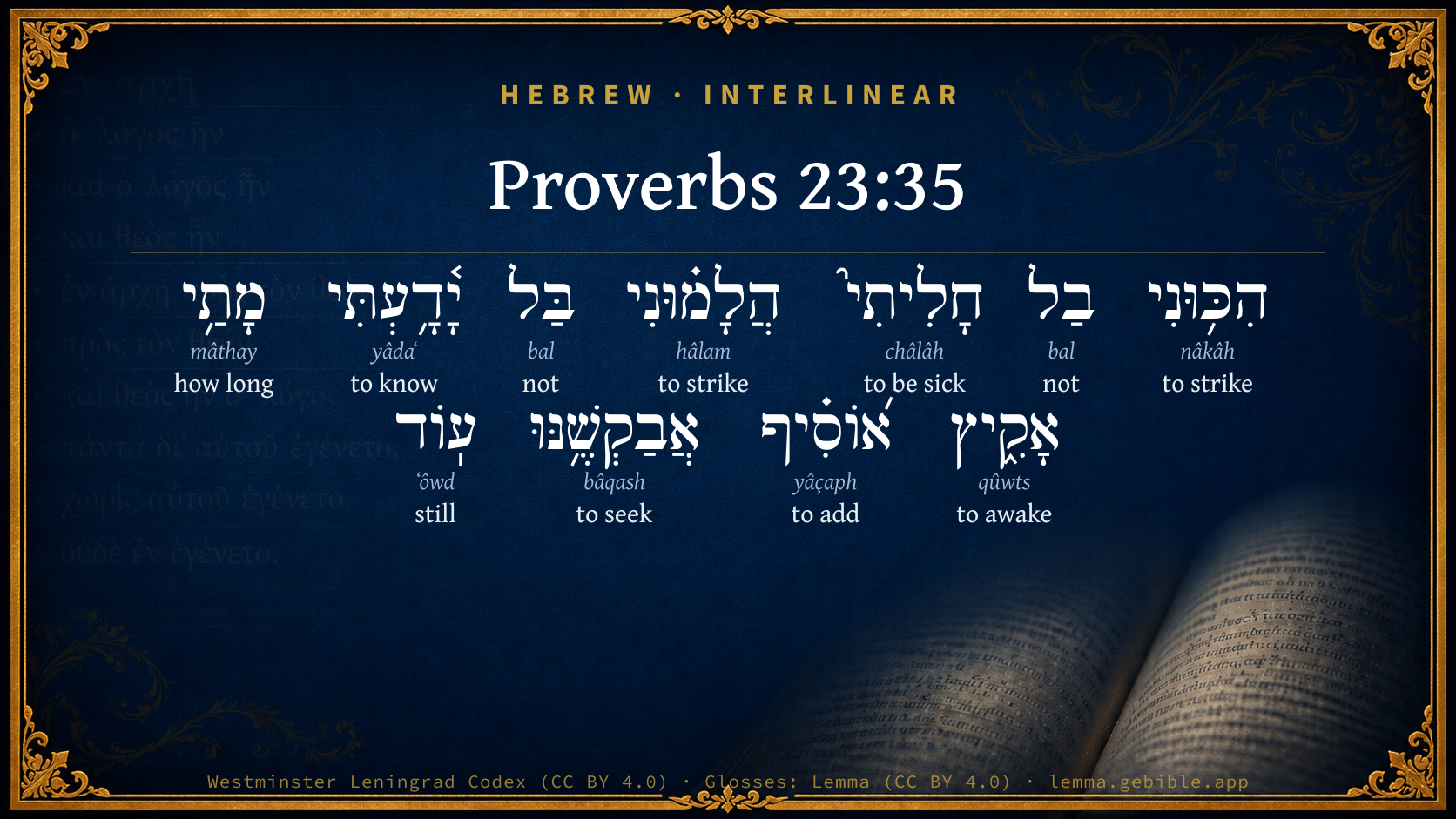
Hebrew (Westminster Leningrad Codex) Proverbs 23:35 appears in the Hebrew Old Testament. The text above is from the Westminster Leningrad Codex. Each word links to its Strong’s number, a concise gloss, and parsing drawn from the Open Scriptures Hebrew Bible morphology. Click any word for its full Brown-Driver-Briggs (BDB) entry.
Download image
Cite this verse

Proverbs 23:35 (World English Bible). Public Domain. Lemma interlinear Bible study tool, https://lemma.gebible.app/v/proverbs/23/35.

Show BibTeX & RIS
BibTeX
RIS
English Translation
"They hit me, and I was not hurt; They beat me, and I don't feel it! When will I wake up? I can do it again. I can find another."
World English Bible · Public Domain
Download a study sheet

One document with this verse’s original text, its word-by-word gloss line, the meaning frame, cross-references with their text, attributed commentary, and full source and license credits — printable, and it pastes into notes with its structure intact.

This verse Autodidact and up

Study sheet (.html) Plain text (.txt)

A passage Seminary Student

Up to 50 verses in one chapter. A passage sheet keeps up to 6 commentary sources and 12 cross-references per verse, in the order this page ranks them, and says so on the sheet whenever that leaves anything out. Ask for a single verse and you get the Autodidact verse sheet above.

Everything on this page stays free to read, with no account — the sheet is a download of what is already on screen, not access to it.

Want to remove ads? Support Godless Engineer
Compare translations 3

The same verse in 3 English versions, stacked beneath the original-language interlinear above. Click any original word for its lexicon entry.

Each is an independent rendering of the whole verse — the interlinear is not word-aligned to these translations.

Highlighted words mark where these versions differ — a whole-verse word diff, not a word-by-word alignment.

  • World English Bible Public Domain
    "They hit me, and I was not hurt; They beat me, and I don't feel it! When will I wake up? I can do it again. I can find another."
  • King James Version Public Domain
    They have stricken me, shalt thou say, and I was not sick; they have beaten me, and I felt it not: when shall I awake? I will seek it yet again.
  • unfoldingWord Literal Text CC BY-SA 4.0
    “They struck me. I was not hurt. They beat me. I did not know. When will I awake? I will add, I will seek it again.”

unfoldingWord Literal Text — © unfoldingWord, licensed CC BY-SA 4.0. Word-aligned USFM3 via Door43 (git.door43.org/unfoldingWord/en_ult).

Versions to compare (up to 4)

3 of 4 selected

Show all 18 translations

Every available English version of this verse, each an independent rendering of the whole verse.

  • World English Bible Public Domain
    "They hit me, and I was not hurt; They beat me, and I don't feel it! When will I wake up? I can do it again. I can find another."
  • Berean Standard Bible Public Domain
    “They struck me, but I feel no pain! They beat me, but I did not know it! When can I wake up to search for another drink?”
  • Majority Standard Bible Public Domain
    “They struck me, but I feel no pain! They beat me, but I did not know it! When can I wake up to search for another drink?”
  • King James Version Public Domain
    They have stricken me, shalt thou say, and I was not sick; they have beaten me, and I felt it not: when shall I awake? I will seek it yet again.
  • American Standard Version (1901) Public Domain
    They have stricken me, `shalt thou say', and I was not hurt; They have beaten me, and I felt it not: When shall I awake? I will seek it yet again.
  • Revised Version (1885) Public Domain
    They have stricken me, shalt thou say, and I was not hurt; they have beaten me, and I felt it not: when shall I awake? I will seek it yet again.
  • Geneva Bible (1599) Public Domain
    They haue stricken mee, shalt thou say, but I was not sicke: they haue beaten mee, but I knew not, when I awoke: therefore will I seeke it yet still.
  • Douay-Rheims (1899) Public Domain
    And thou shalt say: They have beaten me, but I was not sensible of pain: they drew me, and I felt not: when shall I awake, and find wine again?
  • Young's Literal Translation Public Domain
    `They smote me, I have not been sick, They beat me, I have not known. When I awake -- I seek it yet again!'
  • Literal Standard Version CC BY-SA 4.0
    “They struck me, I have not been sick, || They beat me, I have not known. When I awake—I seek it yet again!”
  • Unlocked Literal Bible CC BY-SA 4.0
    “They hit me,” you will say, “but I was not hurt. They beat me, but I did not feel it. When will I wake up? I will seek another drink.”
  • unfoldingWord Literal Text CC BY-SA 4.0
    “They struck me. I was not hurt. They beat me. I did not know. When will I awake? I will add, I will seek it again.”
  • Darby Bible Public Domain
    -- ''They have smitten me, [and] I am not sore; they have beaten me, [and] I knew it not. When shall I awake? I will seek it yet again.''
  • World Messianic Bible Public Domain
    “They hit me, and I was not hurt! They beat me, and I don’t feel it! When will I wake up? I can do it again. I will look for more.”
  • Webster's Bible Public Domain
    They have stricken me, wilt thou say, and I was not sick; they have beaten me, and I felt it not: when shall I awake? I will seek it yet again.
  • Free Bible Version CC BY-SA 4.0
    “People punched me, but it didn't hurt me; they beat me, but I didn't feel a thing. I've got to get up because I need another drink.”
  • Bible in Basic English Public Domain
    They have overcome me, you will say, and I have no pain; they gave me blows without my feeling them: when will I be awake from my wine? I will go after it again.
  • JPS Tanakh (1917) Public Domain
    'They have struck me, and I felt it not, they have beaten me, and I knew it not; when shall I awake? I will seek it yet again.'

Literal Standard Version (2020), Covenant Press — licensed CC BY-SA 4.0. Text via the HelloAO Bible API (eBible.org). Unlocked Literal Bible (unfoldingWord) — licensed CC BY-SA 4.0. Text via the HelloAO Bible API (eBible.org). unfoldingWord Literal Text — © unfoldingWord, licensed CC BY-SA 4.0. Word-aligned USFM3 via Door43 (git.door43.org/unfoldingWord/en_ult). Free Bible Version, Dr. Jonathan Gallagher — licensed CC BY-SA 4.0. Text via the HelloAO Bible API (eBible.org).

Word by word

More ways to search: Search by grammar → Find every occurrence → Compare this word →

Practice this passage: Drill this verse → Learn its vocabulary →

הֲלָמ֗וּנִי
hâlam
H1986
“to strike · me”
Verb, Qal, Perfect, 3rd Person, Common, Plural + Suffix, Personal, 1st Person, Common, Singular
Part of Speech
Verb
Stem
Qal
Form
Perfect
Person
3rd Person
Gender
Common
Number
Plural
Full BDB Definition

Origin: a primitive root

TWOT: 502

(Qal) to smite, strike, hammer, strike down
  1. הִכּ֥וּנִי nâkâh H5221 “to strike · me” Verb, Hiphil, Perfect, 3rd Person, Common, Plural + Suffix, Personal, 1st Person, Common, Singular
  2. בַל bal H1077 “not” Particle, Negative
  3. חָלִיתִי֮ châlâh H2470 “to be sick” Verb, Qal, Perfect, 1st Person, Common, Singular
  4. בַּל bal H1077 “not” Particle, Negative
  5. יָ֫דָ֥עְתִּי yâdaʻ H3045 “to know” Verb, Qal, Perfect, 1st Person, Common, Singular
  6. מָתַ֥י mâthay H4970 “how long” Particle, Interrogative
  7. אָקִ֑יץ qûwts H6974 “to awake” Verb, Hiphil, Imperfect, 1st Person, Common, Singular
  8. א֝וֹסִ֗יף yâçaph H3254 “to add” Verb, Hiphil, Imperfect, 1st Person, Common, Singular
  9. אֲבַקְשֶׁ֥נּוּ bâqash H1245 “to seek · him” Verb, Piel, Imperfect, 1st Person, Common, Singular + Suffix, Personal, 3rd Person, Masculine, Singular
  10. עֽוֹד ʻôwd H5750 “still” Adverb

About this verse

These counts appear in no published source. They are computed here, from the morphology-tagged text and Lemma’s own curated glosses. What Lemma adds →

11
words
10
distinct lemmas
Wisdom
section

Notable vocabulary

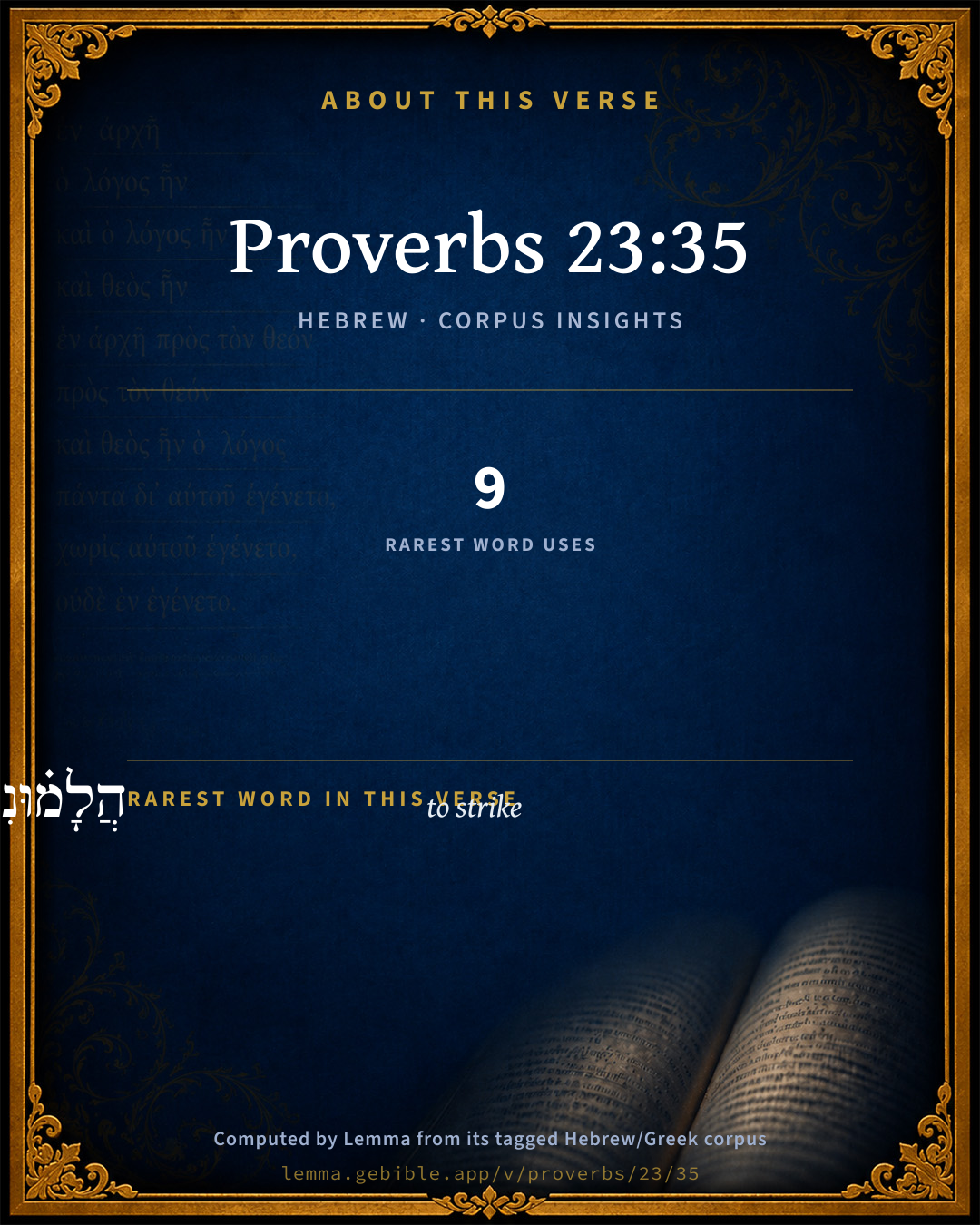
The rarest word here is הֲלָמ֗וּנִי to strike H1986 — appearing just 9 times in the whole Hebrew Bible.

Shared distinctive vocabulary

הֲלָמ֗וּנִי to strike H1986 occurs in 9 verses of the Hebrew Bible. Also found in:

Grammatical profile

  • 7 verbs
  • 1 adverb
  • 3 particles

Verb forms

  • הִכּ֥וּנִי Hiphil · Perfect
  • חָלִיתִי֮ Qal · Perfect
  • הֲלָמ֗וּנִי Qal · Perfect
  • יָ֫דָ֥עְתִּי Qal · Perfect
  • אָקִ֑יץ Hiphil · Imperfect
  • א֝וֹסִ֗יף Hiphil · Imperfect
  • אֲבַקְשֶׁ֥נּוּ Piel · Imperfect

Repetition

A word recurs within this verse — often emphatic in Hebrew:

Hebrew & Septuagint length

In English translation the verse runs 30 words from the Hebrew and 40 from the Septuagint (LXX English) — closely comparable.

A rough comparison of the two English renderings, which tokenize alike — not a word-level alignment.

Word counts can differ between the Hebrew and the Greek without any difference in meaning — e.g. the Hebrew direct-object marker אֵת has no separate Greek word, and Greek often adds the article ὁ.

Cross-references

10

Topical passages linked to Proverbs 23:35 in the Treasury of Scripture Knowledge — connected by theme and wording, ordered by reader-vote popularity; previews shown in the World English Bible.

  • Isaiah 56:12 Come you, [say they], I will get wine, and we will fill ourselves with strong drink; and tomorrow shall be as this day, [a day] great beyond measure.
  • Jeremiah 5:3 O Yahweh, don't your eyes look on truth? you have stricken them, but they were not grieved; you have consumed them, but they have refused to receive correction: they have made their faces harder than a rock; they have refused to return.
  • Proverbs 26:11 As a dog that returns to his vomit, So is a fool who repeats his folly.
  • Proverbs 27:22 Though you grind a fool in a mortar with a pestle along with grain, Yet his foolishness will not be removed from him.
  • 1 Corinthians 15:32–34 If I fought with animals at Ephesus for human purposes, what does it profit me? If the dead are not raised, then "let us eat and drink, for tomorrow we die."
  • 2 Peter 2:22 But it has happened to them according to the true proverb, "The dog turns to his own vomit again," and "the sow that had washed to wallowing in the mire."
  • Deuteronomy 29:19 and it happen, when he hears the words of this curse, that he bless himself in his heart, saying, I shall have peace, though I walk in the stubbornness of my heart, to destroy the moist with the dry.
  • Isaiah 22:13 and behold, joy and gladness, killing oxen and killing sheep, eating flesh and drinking wine: let us eat and drink, for tomorrow we shall die.
  • Jeremiah 31:18 I have surely heard Ephraim bemoaning himself [thus], You have chastised me, and I was chastised, as a calf unaccustomed [to the yoke]: turn you me, and I shall be turned; for you are Yahweh my God.
  • Ephesians 4:19 who having become callous gave themselves up to lust, to work all uncleanness with greediness.

Cross-references courtesy of OpenBible.info (CC BY 4.0).

Hebrew and Greek witnesses Masoretic Hebrew ↔ Greek Septuagint

The same verse in the two great witnesses to the Old Testament, shown verse-for-verse.

These are two independent witnesses, not word-aligned to each other, and the Septuagint is shown in lemma (dictionary) form.

Hebrew Proverbs 23:35 Masoretic · Westminster Leningrad Codex

הִכּ֥וּנִי בַל חָלִיתִי֮ הֲלָמ֗וּנִי בַּל יָ֫דָ֥עְתִּי מָתַ֥י אָקִ֑יץ א֝וֹסִ֗יף אֲבַקְשֶׁ֥נּוּ עֽוֹד

"They hit me, and I was not hurt; They beat me, and I don't feel it! When will I wake up? I can do it again. I can find another."

World English Bible · Public Domain

Greek LXX Proverbs 23:35 Septuagint · lemma form

εἶπον δέ τύπτω ἐγώ καί οὐ πονέω καί ἐνπαίζω ἐγώ ἐγώ δέ οὐ οἶδα πότε ὄρθρος εἰμί ἵνα ἔρχομαι ζητέω μετά ὅς συνἔρχομαι

And you shall say, They struck me, and I was not pained; and they mocked me, and I knew it not: when will it be morning, that I may go and seek those with whom I may go in company?

LXX2012 (modern English Septuagint) · Public Domain

On this verse, The Cambridge Bible for Schools and Colleges discusses the Septuagint’s reading. Read the note in Commentary ↓

Hebrew: Westminster Leningrad Codex (CC BY 4.0). Greek: Septuagint (public domain); English from LXX2012 (modern English Septuagint) (Public Domain). How the Septuagint differs from the Hebrew →

Commentary

Notes on Proverbs 23:35 from classic Christian and Jewish commentators (each source and its license shown beneath its notes). The classic Christian expositions comment on the surrounding passage and are grouped to its opening verse, so a note may address several verses; the Jewish commentaries on the Tanakh (Rashi and others) are per-verse, so they appear only where the commentator wrote on this verse.

Lemma curates 59 commentaries, every one of them public domain or Creative Commons licensed, each selected and text-cleaned for this edition rather than reprinted as found. About our sources →

Trapp's Complete Commentary

John Trapp

Pro 23:35 They have stricken me, [shalt thou say, and] I was not sick; they have beaten me, [and] I felt [it] not: when shall I awake? I will seek it yet again.

Ver. 35. They have stricken me.] A drunken man, we say, takes no hurt, feels no smart, is turned into a very stock. Dionysius the Heracleot felt not needles thrust into his fat belly. Pliny mentioneth certain bears, that being sound asleep, cannot be wakened with the sharpest prickles. Mathiolus {a} reports of the asses of Etruria, that, feeding upon henbane, {b} they fall into such a dead sleep, that being taken for dead, they are half hideled, {c} ere they can be aroused. Lo, such is the drunkard’s lethargy; neither is he more insensible than sensual and irrecoverable.

{a} Mathiol. in Dioscorid.

{b} The common name of the annual plant Hyoscyamus niger, a native of Europe and northern Asia, growing on waste ground, having dull yellow flowers streaked with purple, viscid stem and leaves, unpleasant smell, and narcotic and poisonous properties; also extended to the genus as a whole.

{c} [?Skinned.]

John Trapp, A Commentary or Exposition upon All the Books of the Old and New Testament (1647–1656) — public domain. Text from a community e-Sword module.

The Biblical Illustrator

Joseph S. Exell

Pro_23:35

They have beaten me and I felt it not: when shall I awake?

I will seek it yet again.

Satans anesthetic

1. The application of anaesthetics to surgery is one of the most beneficent discoveries of the present age. One shudders at the very thought of the surgical operations of the olden days, executed without the merciful drug that makes the patient unconscious of his agony. But almost every good thing in the kingdom of God is travestied in the kingdom of Satan. Satan has therefore his own anodyne which he uses to the ruin of the bodies and souls of men. It is evident from the proverb that alcohol was known to be an anaesthetic three thousand years ago. Modern science corroborates the ancient saying. Most people know that a man in liquor often appears insensible to wounds which otherwise would cause intense pain. Medical men occasionally use alcohol as an anesthetic when chloroform is inadmissible. The practical result of this property of alcohol is that the intemperate man--and many a regular moderate drinker, too--is unconscious of the gradual deterioration of his bodily frame. The vital organs are becoming diseased and their functions deranged; but meanwhile the process is most rapidly going on in the brain. Hence all the perceptions are dulled, and the painful sensations, that otherwise would give timely warning of the growing mischief, are to some extent unfelt. One of the purposes of pain is to sound a warning note, to give a signal that something is wrong, that some part of the complex mechanism of the body is out of gear. Our duty is, therefore, not to be contented with allaying the pain, but if possible to cure the disease which causes the pain.

2. The moral anaesthesia to which alcohol gives rise is even more terrible than the physical. Acting as a subtle brain-poison, it works sad havoc with the moral perceptions. All delicacy of conscience is quickly lost, the distinctions between right and wrong become blurred, and the man once honoured and trusted becomes a liar, a thief, and an ingrate. The loving, dutiful son becomes selfish, morose, and attacks his mother with murderous violence. Now, in such cases as these (which are, alas! only too common) we cannot believe that the honest man wilfully takes to lying, the affectionate father wilfully becomes the savage brute, or the dutiful son is filled wilfully with a fierce hatred of his mother. Evidently the mind, conscience, and will become diseased. Alcohol not only dulls the sense of pain in the physical system; it is an ansesthetic that dulls the mind so as to produce unconsciousness of the moral havoc that is being made. The unhappy being loses his power of truthfulness, and yet is hardly conscious that he is a liar. It should be remembered that absolute drunkenness is not always necessary to produce such results. The free and regular use of alcoholic beverages, though stopping short of intoxication, will assuredly produce more or less injury to the body and degradation of the mind and will, both in the drinker and in his children. Let us beware lest we even in the least degree impair these God-like qualities with which we have been endowed.

3. The last words of the text express what we are accustomed to call the drink crave. When intoxication is over, and all the misery and depression that are the after-results of excess are felt, then the unhappy victim of the drink-habit says in effect, if not in the actual words of the text, I will seek it yet again. The man who is always strictly moderate in his use of alcohol then steps in and says, But why are you so foolish as to seek it again? Has it not done you enough harm already? Why not leave it alone? But if he knew into what a state the poor drunkard had fallen--a state of both physical and mental degradation--he would not talk so glibly. First of all, the drink-crave has a physical basis. Certain of the vital organs are so affected and in such distress that the overpowering crave for drink is as natural, under the circumstances, as the craving of an excessively hungry man for food. Inebriety becomes, in fact, an actual and terrible bodily disease, not easily to be cured. Further than that, the mind of the inebriate is so obscured that he does not realise his fall as do those about him. The horror of his position does not appear to him. Strange and sad to say, this mental blindness, often extends to the near relatives.

4. Probably many moderate drinkers would agree with what has been said, and would give thanks that they are not as other men are. Yes, by all means let them give thanks for Gods protecting grace. But let them also ask themselves whether their example as moderate drinkers is helpful to their family and friends, whether the edifying spectacle of their self-restraint is likely to diminish the number of drunkards or to lessen the peril to which so many are exposed. (J. E. Crawshaw.)

.

The Biblical Illustrator, edited by Joseph S. Exell (c. 1880s–1900s) — public domain. Text from a community e-Sword module.

Joseph Benson's Commentary

Pro 23:35. They have stricken me, shalt thou say, &c. — “And to complete thy misery, shouldst thou be not only mocked and abused, but beaten also, thou thyself wilt confess afterward, that it made no impression on thee:

nay, shouldst thou be most lamentably bruised, thou wilt neither know who did it, nor at all regard it; but, as if no harm had befallen thee, no sooner wilt thou open thine eyes, but thou wilt stupidly seek an occasion to be drunk and beaten again.” — Bishop Patrick.

Joseph Benson's Commentary on the Old and New Testaments (1811–1818) — public domain. Text from a community e-Sword module.

Geneva Bible (1599)

Geneva Bible translators

Though drunkenness make them more insensible than beasts, yet can they not refrain.

Geneva Bible (1599) marginal notes — public domain. Text via Bolls.life.

Jamieson, Fausset & Brown

Robert Jamieson, A. R. Fausset & David Brown

awake--that is, from drunkenness (Gen 9:24). This is the language rather of acts than of the tongue.

Next: Proverbs Chapter 24

Jamieson, Fausset & Brown — Commentary Critical and Explanatory on the Whole Bible (1871) — public domain (CC PDM 1.0). Text via the HelloAO Bible API.

Adam Clarke's Commentary

Verse 35. They have stricken me] Though beat and abused, full of pain, and exhibiting a frightful figure; yet so drunk was he, as to be insensible who had struck him: still, after all this abuse and disgrace, he purposes to embrace the next opportunity of repeating his excesses! SIN makes a man contemptible in life, miserable in death, and wretched to all eternity. Is it not strange, then, that men should LOVE it?

Adam Clarke's Commentary on the Bible (1810–1826) — public domain. Text from a community e-Sword/MySword module.

Ellicott's Commentary for English Readers

(35) They have stricken me, and I was not sick.—The drunken man feels no blows or ill usage.

When shall I awake?—He longs to rouse himself from his slumber that he may return to his debauch.

A Bible Commentary for English Readers, edited by Charles John Ellicott (1878–1897) — public domain. Text from a community e-Sword module.

The Cambridge Bible for Schools and Colleges

gen. ed. J. J. S. Perowne

35. sick] Rather, hurt, R.V. or pained; ἐπόνεσα, LXX.; dolui, Vulg. Both the physical and moral insensibility of the drunkard to the consequences of his vice are perhaps pointed at.

awake] i.e. shake off completely the stupor from which he is beginning to rouse himself. His first thought on regaining consciousness is to repeat his fault.

it] the wine which though it has not been mentioned since Pro_23:31, is uppermost in his thoughts. The whole description is strikingly vivid.

The Cambridge Bible for Schools and Colleges (gen. ed. J. J. S. Perowne; Cambridge University Press, 1878–1918) — public domain. Text from a community e-Sword module.

John Gill's Exposition

They have stricken me, shalt thou say, and I was not sick,.... Or "grieved not" (x); or was not wounded or skin broken (y); see Jer 5:3. The drunken man is here represented as saying, that though his companions, with whom he quarrelled and fought in his drunken frolics, beat him very much, yet he was not sensible of the pain and smart; and it had left no sickness nor disorder upon him; he did not find himself much the worse for it;

they have beaten me; as with hammers (z); battered and bruised him terribly, laying very hard and heavy strokes upon him;

and I felt it not; or "knew it not" (a); did not perceive it, was not sensible of it, when the blows were given, or who gave them; and thus feeling no more, and coming off so well, as he thinks, he is so far from being reclaimed from this vice, that he is more strengthened in it, and desirous of it;

when shall I awake? I will seek it yet again: that is, the wine and his boon companions, though he has been so used. So the Vulgate Latin version, "when shall I awake, and again find wines?" being heavy with sleep through intemperance, and yet thirsty, is desirous of shaking off his sleep, that he may get to drinking again, and "add drunkenness to thirst", Deu 29:19; so the Septuagint version,

"when will it be morning, that going I may seek with whom I may meet?''

(x) "non dolui", Tigurine version, Michaelis. (y) Schultens Orig. Heb. l. 1. c. 9. s. 20. (z) "contuderunt me, velut malleis", Michaelis; so Grotius. (a) "non cognovi", Pagninus, Montanus; "non novi", Cocceius.

Next: Proverbs Chapter 24

John Gill's Exposition of the Whole Bible (1746–1763) — public domain (CC PDM 1.0). Text via the HelloAO Bible API.

Haydock's Catholic Bible Commentary

Drew. Chaldean, "plundered." Septuagint, "mocked at me." --- Again. This is the woeful effect of drunkenness, that men are not deterred from it, though they be sensible of its dreadful consequences. (Menochius)

George Leo Haydock (1774–1849), Haydock's Catholic Family Bible and Commentary, 1859 edition — public domain. Excludes Psalms (Douay-Rheims chapter numbering differs from Protestant) and Deuterocanonical books (Catholic canon only).

Matthew Poole's English Annotations

They have stricken me; I cannot deny that I exposed myself by my drunkenness to manifold abuses and injuries.

I was not sick; I was not then sensible of it, neither do I now find any great hurt by it; it was but the effect of a present frolic, at which I have no cause to be much troubled.

When shall I awake? I will seek it yet again; at present I find some inconvenience, and my condition requires sleep to settle myself, and when I am composed and refreshed, I purpose to return to my former course. But that which Solomon here expresseth, seems rather to be the language of their hearts or lives than of their tongues. Compare Pro 1:11.

Matthew Poole's English Annotations on the Holy Bible (1683–1685) — public domain. Text from a community e-Sword/MySword module.

Whedon's Commentary on the Bible

Daniel D. Whedon

35. Stricken me… beaten me — The drunkard, in his sottish stupidity, soliloquizes, apparently unconscious of any evil effects from his indulgence, and is urged by the strength of his appetite and habits to pursue his old vice. The last two clauses, perhaps, would be better read thus: “When I awake I will seek it yet again;” that is, after the effect of the debauch has been slept off. The man seems to be longing for the time when he shall be able to renew his potations.

We close with Miller’s spirited translation of this remarkable passage: —

“‘Who has woe? who has wretchedness?

Who has strife? who has complaining?

Who has fierceness of eyes?

They who are late over wine,

They who go for being curious in mixed drinks.

Look not on the wine because it is red;

Because it shows its bead in the cup;

Because it goes right well,

As its after effect, it bites like a serpent,

And stings like an adder.

Thine eyes see strange things,

And thine heart speaks subversive things.

And thou dost become like one lying in the open sea,

Or like one lying at the masthead.

They have beaten me, and I felt no pain;

They have struck me: I knew nothing;

When I awake, I will seek it yet again.’”

It is to be observed on these verses, (29-35,) how intimate is the association between licentiousness and drunkenness. They are generally found in company.

Daniel D. Whedon (gen. ed.), Commentary on the Old and New Testaments (1874–1909) — public domain. Text from a community e-Sword module.

The Pulpit Commentary

The drunkard is represented as speaking to himself. The LXX inserts, "and thou shelf say" as the Authorized Version does: They have stricken me, shall thou say, and I was not sick; or, I was not hurt. The drunken man has been beaten (perhaps there is a reference to the "contentions," ver. 29), but the blows did not pain him; his condition has rendered him insensible to pain. He has some vague idea the he has suffered certain rough treatment at the hands of his companions, but it has made no impression on him. They have beaten me, and I felt it not; did not even know it. Far from recognizing his degradation and profiting by the merzed chastisement which he has incurred, he is represented as looking forward with pleasure to a renewal of his debauch, when his drunken sleep shall be over. When shall I awake? I will seek it (wine) yet again. Some take ytm (mathai) as the relative conjunctive: "When I awake I will seek it again;" but it is always used interrogatively, and the expression thus becomes more animated, as Delitzsch observes. It is as though the drunkard has to yield to the effects of his excess and sleep off his intoxication, but he is. as it were, all the time longing to be able to rouse himself and recommence his orgies. We have had words put into the mouth of the sluggard. (Pro_6:10) The whole verse is rendered by the LXX thus: "Thou shalt say, They smote me, and I was not pained, and they mocked me, and I knew it not. When will it be morning, that I may go and seek those with whom I may consort?" The author of the "Tractutus de Conscientia" appended to St. Bernard"s works, applies this paragraph to the cuss of an evil conscience indurated by wicked habits and insensible to correction.

The Pulpit Commentary (1880–1919), ed. H.D.M. Spence-Jones & Joseph S. Exell — public domain. Text from a community e-Sword module.

John Wesley's Explanatory Notes

Sick - I was not sensible of it. Again - At present my condition requires sleep to settle myself, and when I am composed, I purpose to return to my former course.

John Wesley, Explanatory Notes Upon the Whole Bible (1754–1765) — public domain. Text via the GEBible commentary corpus.

Kretzmann's Popular Commentary

Paul E. Kretzmann

v. 35. They have stricken me, shalt thou say, the language of the drunken man being well imitated, and I was not sick, he did not feel the pain of it; they have beaten me, and I felt it not, he was not aware of it; when shall I awake? He is anxious to get over the effect of the present debauch. I will seek it yet again; for he who is addicted to the vice of intemperance is bound as with chains, he is a willing slave. The entire description is remarkably true to life and is intended to fill the reader with the deepest aversion and loathing for the sin of drunkenness, which changes men into brute beasts and often degrades them even below the level of animals.

Paul E. Kretzmann, Popular Commentary of the Bible (1921–1924) — public domain. Text from a community e-Sword module.

Rashi

Rabbi Shlomo Yitzchaki (Rashi)

“They struck me but I did not become ill, etc.” When he sobers himself up from his wine, he does not feel any of the evils that passed over him, and he drinks again.

Rashi on the Tanakh — English translations: “The Judaica Press complete Tanach with Rashi, translated by A. J. Rosenberg” (CC BY 4.0); “Pentateuch with Rashi's commentary by M. Rosenbaum and A.M. Silbermann, 1929-1934” (public domain); “The Metsudah Tanach series, Lakewood, N.J” (CC BY 4.0); and “The Book of Joshua, Metsudah Publications, 1997” (CC BY 4.0). Text via Sefaria.

Lesson kit

Teaching starters — assembled from the data on this page, not authored interpretation. Every prompt links to the verse data it draws on. Edit before teaching.

Proverbs, in the Wisdom, opens this verse with 11 words (10 distinct Hebrew lemmas). Its most distinctive word is hâlam (“to strike”). A historical commentator’s framing appears above. Read the whole chapter for the surrounding context.

Discussion questions

  1. The word hâlam carries the sense “to strike.” How does it shape the verse?
  2. Judges 5:22 shares the word «to strike» with this verse. How do the two illuminate each other?
  3. “not” occurs 2× in this one verse. What is the effect of the repetition?
  4. These translations render this verse differently. What is at stake in choosing one wording over another?
  5. The verb «הִכּ֥וּנִי» is Hiphil Perfect. How does its form color the action?
  6. Reading how Trapp's Complete Commentary and The Biblical Illustrator read this verse, where do the two commentators agree and where do they part?

Things to notice

Reading settings

Reading text

Shown beneath each verse's original-language words.

Old Testament
Old Testament edition

Read the OT as the Masoretic Hebrew (MT) or the Greek Septuagint (LXX).

English shown for the Greek Septuagint (in the Hebrew ↔ Greek comparison).

Comparing translations? Open the Compare panel on any verse page to stack up to four side by side.