
Proverbs 21:6

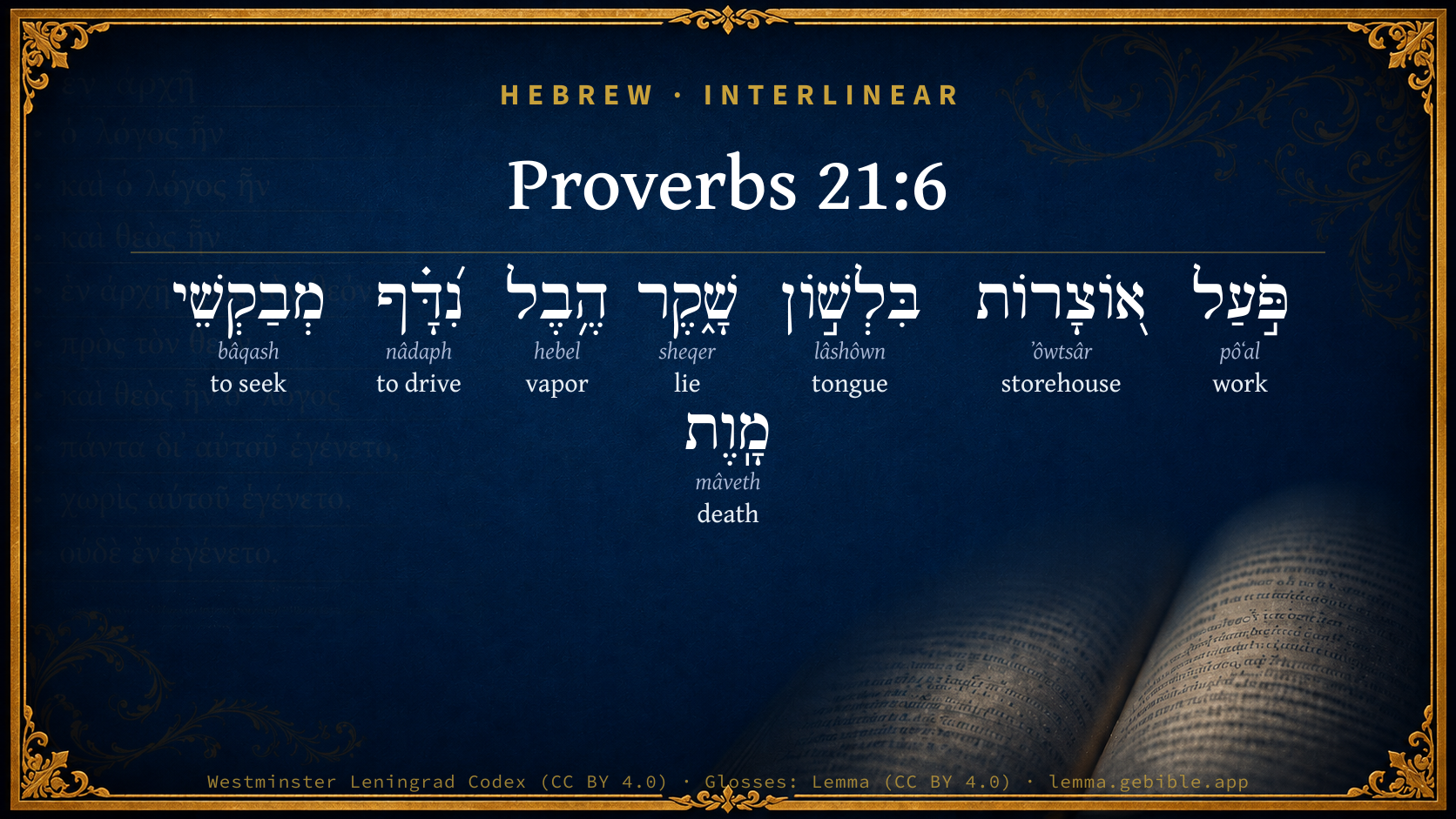
Hebrew (Westminster Leningrad Codex) Proverbs 21:6 appears in the Hebrew Old Testament. The text above is from the Westminster Leningrad Codex. Each word links to its Strong’s number, a concise gloss, and parsing drawn from the Open Scriptures Hebrew Bible morphology. Click any word for its full Brown-Driver-Briggs (BDB) entry.
Download image
Cite this verse

Proverbs 21:6 (World English Bible). Public Domain. Lemma interlinear Bible study tool, https://lemma.gebible.app/v/proverbs/21/6.

Show BibTeX & RIS
BibTeX
RIS
English Translation
Getting treasures by a lying tongue Is a fleeting vapor for those who seek death.
World English Bible · Public Domain
Download a study sheet

One document with this verse’s original text, its word-by-word gloss line, the meaning frame, cross-references with their text, attributed commentary, and full source and license credits — printable, and it pastes into notes with its structure intact.

This verse Autodidact and up

Study sheet (.html) Plain text (.txt)

A passage Seminary Student

Up to 50 verses in one chapter. A passage sheet keeps up to 6 commentary sources and 12 cross-references per verse, in the order this page ranks them, and says so on the sheet whenever that leaves anything out. Ask for a single verse and you get the Autodidact verse sheet above.

Everything on this page stays free to read, with no account — the sheet is a download of what is already on screen, not access to it.

Want to remove ads? Support Godless Engineer
Compare translations 3

The same verse in 3 English versions, stacked beneath the original-language interlinear above. Click any original word for its lexicon entry.

Each is an independent rendering of the whole verse — the interlinear is not word-aligned to these translations.

Highlighted words mark where these versions differ — a whole-verse word diff, not a word-by-word alignment.

  • World English Bible Public Domain
    Getting treasures by a lying tongue Is a fleeting vapor for those who seek death.
  • King James Version Public Domain
    The getting of treasures by a lying tongue is a vanity tossed to and fro of them that seek death.
  • unfoldingWord Literal Text CC BY-SA 4.0
    The making of treasures by a tongue of falsehood scattered vapor, seekers of death.

unfoldingWord Literal Text — © unfoldingWord, licensed CC BY-SA 4.0. Word-aligned USFM3 via Door43 (git.door43.org/unfoldingWord/en_ult).

Versions to compare (up to 4)

3 of 4 selected

Show all 18 translations

Every available English version of this verse, each an independent rendering of the whole verse.

  • World English Bible Public Domain
    Getting treasures by a lying tongue Is a fleeting vapor for those who seek death.
  • Berean Standard Bible Public Domain
    Making a fortune by a lying tongue is a vanishing mist, a deadly pursuit.
  • Majority Standard Bible Public Domain
    Making a fortune by a lying tongue is a vanishing mist, a deadly pursuit.
  • King James Version Public Domain
    The getting of treasures by a lying tongue is a vanity tossed to and fro of them that seek death.
  • American Standard Version (1901) Public Domain
    The getting of treasures by a lying tongue Is a vapor driven to and fro by them that seek death.
  • Revised Version (1885) Public Domain
    The getting of treasures by a lying tongue is a vapour driven to and fro; they that seek them seek death.
  • Geneva Bible (1599) Public Domain
    The gathering of treasures by a deceitfull tongue is vanitie tossed to and from of them that seeke death.
  • Douay-Rheims (1899) Public Domain
    He that gathereth treasures by a lying tongue, is vain and foolish, and shall stumble upon the snares of death.
  • Young's Literal Translation Public Domain
    The making of treasures by a lying tongue, `Is' a vanity driven away of those seeking death.
  • Literal Standard Version CC BY-SA 4.0
    The making of treasures by a lying tongue, || [Is] a vanity driven away of those seeking death.
  • Unlocked Literal Bible CC BY-SA 4.0
    Acquiring riches by a lying tongue is a fleeting vapor and a snare that kills.
  • unfoldingWord Literal Text CC BY-SA 4.0
    The making of treasures by a tongue of falsehood scattered vapor, seekers of death.
  • Darby Bible Public Domain
    The getting of treasures by a lying tongue is a fleeting breath of them that seek death.
  • World Messianic Bible Public Domain
    Getting treasures by a lying tongue is a fleeting vapor for those who seek death.
  • Webster's Bible Public Domain
    The getting of treasures by a lying tongue is a vanity tossed to and fro by them that seek death.
  • Free Bible Version CC BY-SA 4.0
    Money made by lies is like smoke in the wind—a chase that ends in death.
  • Bible in Basic English Public Domain
    He who gets stores of wealth by a false tongue, is going after what is only breath, and searching for death.
  • JPS Tanakh (1917) Public Domain
    The getting of treasures by a lying tongue is a vapour driven to and fro; they that seek them seek death.

Literal Standard Version (2020), Covenant Press — licensed CC BY-SA 4.0. Text via the HelloAO Bible API (eBible.org). Unlocked Literal Bible (unfoldingWord) — licensed CC BY-SA 4.0. Text via the HelloAO Bible API (eBible.org). unfoldingWord Literal Text — © unfoldingWord, licensed CC BY-SA 4.0. Word-aligned USFM3 via Door43 (git.door43.org/unfoldingWord/en_ult). Free Bible Version, Dr. Jonathan Gallagher — licensed CC BY-SA 4.0. Text via the HelloAO Bible API (eBible.org).

Word by word

More ways to search: Search by grammar → Find every occurrence → Compare this word →

Practice this passage: Drill this verse → Learn its vocabulary →

About this verse

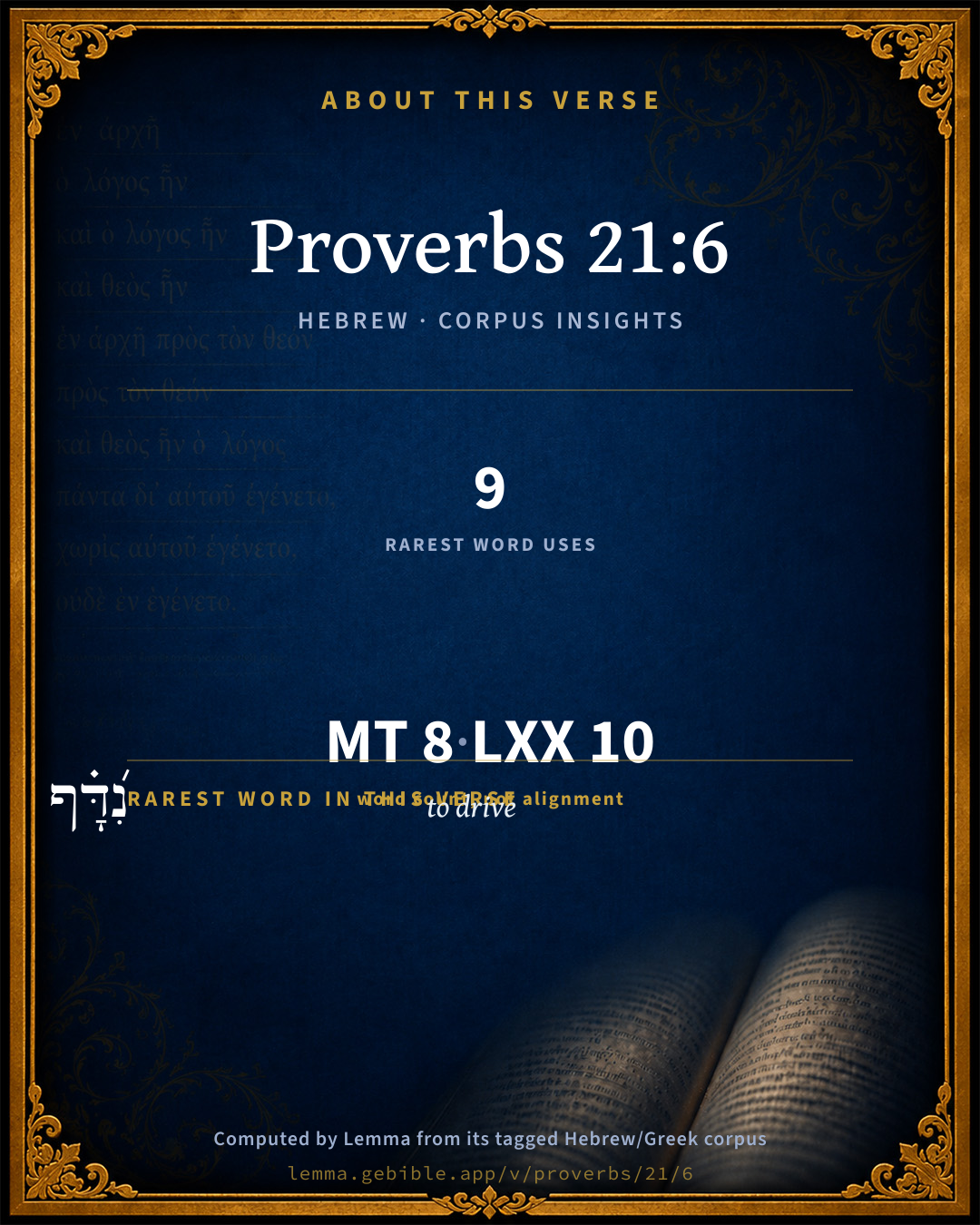
These counts appear in no published source. They are computed here, from the morphology-tagged text and Lemma’s own curated glosses. What Lemma adds →

8
words
8
distinct lemmas
Wisdom
section

Notable vocabulary

The rarest word here is נִ֝דָּ֗ף to drive H5086 — appearing just 9 times in the whole Hebrew Bible.

Shared distinctive vocabulary

נִ֝דָּ֗ף to drive H5086 occurs in 8 verses of the Hebrew Bible. Also found in:

Grammatical profile

  • 2 verbs
  • 6 nouns

Verb forms

  • נִ֝דָּ֗ף Niphal · Participle Active
  • מְבַקְשֵׁי Piel · Participle Active

Hebrew & Septuagint length

In English translation the verse runs 15 words from the Hebrew and 16 from the Septuagint (LXX English) — closely comparable.

A rough comparison of the two English renderings, which tokenize alike — not a word-level alignment.

Word counts can differ between the Hebrew and the Greek without any difference in meaning — e.g. the Hebrew direct-object marker אֵת has no separate Greek word, and Greek often adds the article ὁ.

In the original languages it is 8 Hebrew tokens and 10 Greek tokens — but the two are counted differently (Hebrew bundles its prefixes and suffixes into one token; the Greek is in lemma form), so that isn’t a like-for-like length.

Cross-references

11

Topical passages linked to Proverbs 21:6 in the Treasury of Scripture Knowledge — connected by theme and wording, ordered by reader-vote popularity; previews shown in the World English Bible.

  • Proverbs 13:11 Wealth gained dishonestly dwindles away, But he who gathers by hand makes it grow.
  • Proverbs 10:2 Treasures of wickedness profit nothing, But righteousness delivers from death.
  • Proverbs 20:21 An inheritance quickly gained at the beginning, Won't be blessed in the end.
  • Jeremiah 17:11 As the partridge that sits on [eggs] which she has not laid, so is he who gets riches, and not by right; in the midst of his days they shall leave him, and at his end he shall be a fool.
  • Proverbs 8:36 But he who sins against me wrongs his own soul. All those who hate me love death."
  • 1 Timothy 6:9–10 But those who are determined to be rich fall into a temptation and a snare and many foolish and harmful lusts, such as drown men in ruin and destruction.
  • Proverbs 20:14 "It's no good, it's no good," says the buyer; But when he is gone his way, then he boasts.
  • Proverbs 22:8 He who sows wickedness reaps trouble, And the rod of his fury will be destroyed.
  • Proverbs 30:8 Remove far from me falsehood and lies. Give me neither poverty nor riches. Feed me with the food that is needful for me;
  • 2 Peter 2:3 In covetousness they will exploit you with deceptive words: whose sentence now from of old doesn't linger, and their destruction will not slumber.
  • Titus 1:11 whose mouths must be stopped; men who overthrow whole houses, teaching things which they ought not, for dishonest gain's sake.

Cross-references courtesy of OpenBible.info (CC BY 4.0).

Hebrew and Greek witnesses Masoretic Hebrew ↔ Greek Septuagint

The same verse in the two great witnesses to the Old Testament, shown verse-for-verse.

These are two independent witnesses, not word-aligned to each other, and the Septuagint is shown in lemma (dictionary) form.

Hebrew Proverbs 21:6 Masoretic · Westminster Leningrad Codex

פֹּ֣עַל א֭וֹצָרוֹת בִּלְשׁ֣וֹן שָׁ֑קֶר הֶ֥בֶל נִ֝דָּ֗ף מְבַקְשֵׁי מָֽוֶת

Getting treasures by a lying tongue Is a fleeting vapor for those who seek death.

World English Bible · Public Domain

Greek LXX Proverbs 21:6 Septuagint · lemma form

ὁ ἐνἐργέω θησαύρισμα γλῶσσα ψευδής μάταιος διώκω ἐπί παγίς θάνατος

He that gathers treasures with a lying tongue pursues vanity on to the snares of death.

LXX2012 (modern English Septuagint) · Public Domain

On this verse, Adam Clarke's Commentary discusses the Septuagint’s reading. Read the note in Commentary ↓

Hebrew: Westminster Leningrad Codex (CC BY 4.0). Greek: Septuagint (public domain); English from LXX2012 (modern English Septuagint) (Public Domain). How the Septuagint differs from the Hebrew →

Commentary

Notes on Proverbs 21:6 from classic Christian and Jewish commentators (each source and its license shown beneath its notes). The classic Christian expositions comment on the surrounding passage and are grouped to its opening verse, so a note may address several verses; the Jewish commentaries on the Tanakh (Rashi and others) are per-verse, so they appear only where the commentator wrote on this verse.

Lemma curates 59 commentaries, every one of them public domain or Creative Commons licensed, each selected and text-cleaned for this edition rather than reprinted as found. About our sources →

Trapp's Complete Commentary

John Trapp

Pro 21:6 The getting of treasures by a lying tongue [is] a vanity tossed to and fro of them that seek death.

Ver. 6. The getting of treasures by a lying tongue.] As do seducers, sycophants, flatterers, corrupt judges, that say with shame, "Give ye"; mercenary pleaders, that sell both their tongues and silence, and help their clients’ causes, as the wolf did the sheep of his cough, by sucking his blood; witnesses of the post that can lend an oath, as Jezebel’s hired rake hells did, and will not stick to swear (if they may be well paid for it) that their friend or foe was at Rome and at Interamna both at once; false chapmen, that say the best of their worst commodities, and cheat the unwary buyer. These, and the like, though for a while they may thrive and ruffle, yet in the end they prosper not, but perish with their wealth, as the toad doth with his mouth full of earth. God blows upon their cursed hoards of evil gotten goods, scattering them as chaff before the wind. Destruction also dogs them at the heels, both temporal and eternal. This they are said to seek, scil., eventually, though not intentionally. They seek it, because they not only walk in the way to it, but run and flee with post haste, as if they were afraid that they should come too late, or that hell should be full before they got there. Thus Balaam’s ass never carries him fast enough after the wages of wickedness. Set but a wedge of gold before Achan, and Joshua, that could stop the sun in his course, cannot stay him from the fingering of it. Judas, in selling his Master, what he doth doth "quickly." But with what issue? What got Balaam but a sword in his ribs? Achan, but the stones about his ears? Judas, but the halter about his neck? besides a worse thing in another world. Thus many a wretched worldling spins a fair thread to strangle himself both temporally and eternally. By covetousness they not only kill others, {Pro 1:19} but desperately "drown themselves in perdition and destruction." {1Ti 6:9} Fuge ergo, dives, eiusmodi exitum - as St Ambrose concludes the stroy of Ahab’s and Jezebel’s fearful end - sed fugies eiusmondi exitum si fugeris huiusmodi flagitium, - Flee, O rich miser, such an end. Such an end you shall avoid, if you carefully flee from such sinful courses.

John Trapp, A Commentary or Exposition upon All the Books of the Old and New Testament (1647–1656) — public domain. Text from a community e-Sword module.

The Biblical Illustrator

Joseph S. Exell

Pro_21:6-7

The getting of treasures by a lying tongue is a vanity.

Dishonesty

I. The evil of dishonesty.

1. A breach of the law of God.

2. An invasion of the Divine right of property.

3. An encouragement to indolence. The workshop is one of the finest fields for human development.

4. A certain development of selfishness.

5. A weapon for the destruction of mutual confidence. Men cannot trust those who are watching for opportunities to defraud them.

6. An incentive to other sins (Jer_7:8; Joh_12:6; Mat_26:15).

II. The remedy for dishonesty.

1. A renewed nature. The Spirit of truth dwelling in a man will make war against all dishonesty.

2. A sensitive conscience. Petty pilfering will deaden conscience with respect to this and all other sins (1Ti_4:2).

3. A realisation of the dignity of labour.

4. A due estimate of the value of human possessions.

5. A consciousness of the Divine presence and oversight.

6. A remembrance of the damaging nature of property dishonestly acquired (Pro_21:7). An act of theft often destroys self-respect, peace of mind, bodily health, and the soul itself. (H. Thorne.)

The Biblical Illustrator, edited by Joseph S. Exell (c. 1880s–1900s) — public domain. Text from a community e-Sword module.

Matthew Henry's Commentary

This shows the folly of those that hope to enrich themselves by dishonest practices, by oppressing and over-reaching those with whom they deal, by false-witness-bearing, or by fraudulent contracts, of those that make no scruples of lying when there is any thing to be got by it. They may perhaps heap up treasures by these means, that which they make their treasure; but, 1. They will not meet with the satisfaction they expect. It is a vanity tossed to and fro; it will be disappointment and vexation of spirit to them; they will not have the comfort of it, nor can they put any confidence in it, but will be perpetually uneasy. It will be tossed to and fro by their own consciences, and by the censures of men; let them expect to be in a constant hurry. 2. They will meet with destruction they do not expect. While they are seeking wealth by such unlawful practices they are really seeking death; they lay themselves open to the envy and ill-will of men by the treasures they get, and to the wrath and curse of God, by the lying tongue wherewith they get them, which he will make to fall upon themselves and sink them to hell.

Matthew Henry's Commentary on the Whole Bible (1708–1710) — public domain (CC PDM 1.0). Text via the HelloAO Bible API.

Jamieson, Fausset & Brown

Robert Jamieson, A. R. Fausset & David Brown

The getting--or, "what is obtained" (compare Job 7:2; Jer 22:13, Hebrew).

vanity . . . to and fro--as fleeting as chaff or stubble in the wind (compare Pro 20:17-21; Psa 62:10). Such gettings are unsatisfactory.

them . . . death--act as if they did (Pro 8:36; Pro 17:19).

Jamieson, Fausset & Brown — Commentary Critical and Explanatory on the Whole Bible (1871) — public domain (CC PDM 1.0). Text via the HelloAO Bible API.

Adam Clarke's Commentary

Verse 6. Of them that seek death] Instead of מבקשי mebakshey, "them that seek," several MSS., some ancient editions, with Symmachus, the Septuagint, Vulgate, and Arabic, have מקשי mokeshey, the snares. He who gets treasures by a lying tongue, pursues vanity into the snares of death. Our common translation may be as good. But he who, by the snares of his tongue, endeavours to buy and sell to the best advantage, is pursuing what is empty in itself; and he is ensnared by death, while he is attempting to ensnare others.

Adam Clarke's Commentary on the Bible (1810–1826) — public domain. Text from a community e-Sword/MySword module.

Ellicott's Commentary for English Readers

(6) Is a vanity tossed to and fro of them that seek death.—Rather, is (as) the driven (fleeting) breath of those who are seeking death. They are seeking in reality not riches, but death, and these riches will vanish like their own breath. (Comp. Wis_5:14; Psa_68:2).

A Bible Commentary for English Readers, edited by Charles John Ellicott (1878–1897) — public domain. Text from a community e-Sword module.

The Cambridge Bible for Schools and Colleges

gen. ed. J. J. S. Perowne

6. a vanity &c.] Lit. a vapour dispersed; seekers of death. Thus in the abrupt, sententious style of the wisdom of the East the end is described both of the treasures so sought, and of those who so seek them. “A vapour dispersed,” unsubstantial and vanishing away are the treasures gotten by a lying tongue; “seekers of death,” men whose pursuit will end in their own destruction, are those who so acquire them. By the change of a letter in the Heb. word the LXX., Vulgate, and R.V. marg. have snạres (instead of seekers) of death.

The Cambridge Bible for Schools and Colleges (gen. ed. J. J. S. Perowne; Cambridge University Press, 1878–1918) — public domain. Text from a community e-Sword module.

John Gill's Exposition

The getting of treasures by a lying tongue,.... By telling lies in trade; by bearing false witness in a court of judicature; or by preaching false doctrines in the church of God:

is a vanity tossed to and fro of them that seek death: such treasures, though ever so great, are like any light thing, smoke or vapour, straw, stubble, chaff, or a feather, tossed about the wind; which is expressive of the instability uncertainty of riches ill gotten; they do not last long, but are taken away and carried off by one providence or another; and they are likewise harmful and pernicious; they issue in death: and those that seek after them, and obtain them in a bad way, are said to "seek death": not intentionally, but eventually; this they certainly find, if grace prevent not; see Pro 8:36. Jarchi reads it, they are the "snares of death" to him; and so the Septuagint version.

John Gill's Exposition of the Whole Bible (1746–1763) — public domain (CC PDM 1.0). Text via the HelloAO Bible API.

Albert Barnes' Notes on the Bible

Vanity - Or, “a breath driven to and fro of those that are seeking death.” Another reading of the last words is: “of the snares of death” (compare 1Ti 6:9). Some commentators have suggested that the “vapor” or “mist” is the mirage of the desert, misleading those who follow it, and becoming a “net of death.”

Albert Barnes' Notes on the Bible (1834–1885) — public domain. Text from a community e-Sword/MySword module.

Haydock's Catholic Bible Commentary

Death. Their injustice shall be punished.

George Leo Haydock (1774–1849), Haydock's Catholic Family Bible and Commentary, 1859 edition — public domain. Excludes Psalms (Douay-Rheims chapter numbering differs from Protestant) and Deuterocanonical books (Catholic canon only).

Matthew Poole's English Annotations

By a lying tongue; by false witness-hearing, or by any other false or deceitful words or actions, whereby many men get riches.

Is a vanity tossed to and fro; is like the chaff or smoke driven away by the wind; it is neither satisfactory nor durable, but quickly vanisheth away, as hath been frequently observed of estates ill gotten.

That seek death; not designedly, but eventually, that take those courses which will bring death or destruction upon them or theirs.

Matthew Poole's English Annotations on the Holy Bible (1683–1685) — public domain. Text from a community e-Sword/MySword module.

Whedon's Commentary on the Bible

Daniel D. Whedon

6. Getting of treasures — This is a difficult verse. I suggest this reading: The acquiring of treasure by a lying tongue is as transient vapour. They (who thus acquire) are seeking death; or, they (the treasures) are death. Instead of מבקשׁי, (mebhakske,) the seekers, or, they are seeking, several manuscripts and ancient editions read מקשׁי, (mokshe,) snares. Should this reading be thought preferable, the last clause would run: They (treasures thus gotten) are snares of death — deadly snares. Compare Pro_10:2; Pro_13:11.

Daniel D. Whedon (gen. ed.), Commentary on the Old and New Testaments (1874–1909) — public domain. Text from a community e-Sword module.

The Pulpit Commentary

The getting of treasures by a lying tongue the acquisition of wealth by fraud and falsehoodis a vanity tossed to and fro of them that seek death. The latter clause is variously rendered and interpreted. The Hebrew is literally, a fleeting breath, those seeking death. The Revised Version makes the last words a separate proposition, "They that seek them seek death." But this seems unnecessary, and somewhat opposed to the gnomic style, which often combines two predicates in one construction; and there is no reason why we should not render the words, as in the Authorized Version, "of seekers of death." Such a mode of obtaining wealth is as evanescent and unstable as the very breath, and ends in death, which is practically the result of their quest. Thus RAPC Wis 5:14, "The hope of the ungodly is like dust that is blown away with the wind; like a thin froth that is driven away with the storm; like as the smoke which is dispersed here and there with the tempest, and passeth away. as the remembrance of a guest that tarrieth but a day." Some think that the comparison regards the mirage of the desert, which deceives travellers with the phantasms of cool waters and refreshing shade. Such an allusion is found in Isa_35:7. The Talmud enjoins, "Speak no word that accords not with the truth, that thy honour may not vanish as the waters of a brook." The Septuagint and Vulgate have followed a different reading (twmAyv qwm), and render thus: Vulgate, Vanus et excors est, et impingetur ad laqueos mortis, "He is vain and foolish, and will be taken in the snares of death;" Septuagint, "pursues vain things unto the snares of death (epi pagidav )". (Pro_13:14 Pro_14:27) So St. Paul says, (1Ti_6:9) "They that desire to be rich fall into a temptation and a snare (pagida ), and many foolish and hurtful lusts, such as drown men in destruction and perdition.

Vers. 6-8. Marks of sin.

Here we have four marks of that many-sided evil which God condemns as sin.

I ITS MANIFOLDNESS OF FORM. Of its varied developments we have four forms here specified.

1. Falsehood, with a view to temporal enrichment, or the sin of cheating a crime which has dishonoured the markets and counting houses of every land.

2. Violence, with the same end in view the breaking into the neighbour"s treasury, or the assault committed on his person.

3. Injustice, or the sin of withholding from our neighbour that which we know is his due; whether it be a weekly wage, (Jam_5:4) or whether it be the appointment to which he is entitled by his merit, or the honour he has gained by his services.

4. Perversity, or frowardness the attitude of wanton and determined rebelliousness against God"s rule, or in submission to his claim, or disobedience of his particular commandment.

II THE UNSUBSTANTIAL NATURE OF ITS SUCCESS. Enrichment by falsehood is "a vanity or, "a vapour tossed to and fro." It is proverbial that wealth that is ill-gotten is quickly lost; this is to be accounted for by the action of God"s righteous punitive laws apart from the doctrine that sin commands his condemnation. Independently of this, it is certain that the satisfaction which comes from sin is short-lived and continually declines. Sin allures its victims with fine promises, but it breaks every one of them; its bread may be sweet for a moment, hut "afterwards the mouth is filled with gravel". (Pro_20:17) The hope of the sinner is very fair, but soon comes the strong wind of penal law, and its castle is on the ground; it is "swept away" (ver. 7, Revised Version).

III ITS SUICIDAL CHARACTER. These guilty ones are "of them that seek death." "Death is the wages of sin," and those who consciously live in sin and those (more especially) who know that this is so may be fitly spoken of as "seeking death." Suicide is not confined to those who deliberately take away their life with the pistol shot, or the cup of poison, or the fatal plunge. It is a folly and a crime that is being committed day by day at the hearth and at the table, in the office and in the study. Men are transgressing those known laws of God on the observance of which life as well as health depends. They who live in conscious wrong doing are determinately travelling toward death, and are guiltily "seeking" it.

IV ITS DEEP AND WIDE DEPARTURE FROM THE HOLY PURPOSE OF GOD. The way of (the) man (of whom we are speaking) is "strange" (ver. 8). It is quite foreign to the thought and contrary to the will of God. He is saying, "Go not along this path; turn from it, and pass away." It is sin which has cut this path for the feet of the human traveller, and it is one which lies quite outside the King"s highway. So strange is it to him, so alien to his purpose, so far from his l)resent desire, that he is ever saying to his erring children, "Return, return!" And he has made, in the gospel of his Son, a way of return and restoration. Indeed, it is his Son Jesus Christ who is "the Way." To know him and to love and serve him is to have our feet planted in "the path of life. C.

The Pulpit Commentary (1880–1919), ed. H.D.M. Spence-Jones & Joseph S. Exell — public domain. Text from a community e-Sword module.

John Wesley's Explanatory Notes

Lying tongue - By any false or deceitful words or actions. Is tossed - Is like the chaff or smoak driven away by the wind. Of them - That take those courses which will bring destruction upon them.

John Wesley, Explanatory Notes Upon the Whole Bible (1754–1765) — public domain. Text via the GEBible commentary corpus.

Keil & Delitzsch

C. F. Keil & F. Delitzsch

6 The gaining of treasures by a lying tongue

Is a fleeting breath of such as seek death.

One may, at any rate, after the free manner of gnomic resemblances and comparisons, regard "fleeting breath" and "such as seek death" as two separated predicates: such gain is fleeting breath, so those who gain are seeking death (Caspari's Beitrge zu Jes. p. 53). But it is also syntactically admissible to interpret the words rendered "seekers of death" as gen.; for such interruptions of the st. constr., as here by נדּף [fleeting], frequently occur, e.g., Isa 28:1; Isa 32:13; Ch1 9:13; and that an idea, in spite of such interruption, may be thought of as gen., is seen from the Arab.

(Note: Vid., Friedr. Philippi's Status constructus, p. 17, Anm. 3; and cf. therewith such constructions as (Arab.) mân'u faḍlah âlmanhtâji, i.e., a refuser of the needy, his beneficence = one who denies to the needy his beneficence.)

But the text is unsettled. Symmachus, Syr., Targ., the Venet., and Luther render the phrase מבקשׁי [seekers]; but the lxx and Jerome read מוקשׁי [snares] (cf. Ti1 6:9); this word Rashi also had before him (vid., Norzi), and Kennicott found it in several Codd. Bertheau prefers it, for he translates: ...is fleeting breath, snares of death; Ewald and Hitzig go further, for, after the lxx, they change the whole proverb into: מות (בּמוקשׁי) הבל רדף אל־מוקשׁי, with פּעל in the first line. But διώκει of the lxx is an incorrect rendering of נדף, which the smuggling in of the ἐπὶ (παγίδας θανάτου) drew after it, without our concluding therefrom that אל־מוקשׁי, or למוקשׁי (Lagarde), lay before the translators; on the contrary, the word which (Cappellus) lay before them, מוקשׁי, certainly deserves to be preferred to מבקשׁי: the possession is first, in view of him who has gotten it, compared to a fleeting (נדּף, as Isa 42:2) breath (cf. e.g., smoke, Psa 68:3), and then, in view of the inheritance itself and its consequences, is compared to the snares of death (Pro 13:14; Pro 14:27); for in פּעל (here equivalent to עשׂות, acquisitio, Gen 31:1; Deu 8:17) lie together the ideas of him who procures and of the thing that is procured or effected (vid., at Pro 20:11).

Keil & Delitzsch — Biblical Commentary on the Old Testament (1861–1891) — public domain (CC PDM 1.0). Text via the HelloAO Bible API. (Old Testament only.)

Bridges on Proverbs

Charles Bridges

A graphical picture of the hasty spirit — its own crooked ways tending to want. Treasures may be gotten by lying; but they become vanity. They are "put into a bag with holes" (Hag 1:6 ), and sink away. They are like a ball tossed to and fro by a withering blast, or dust and chaff before the wind.†1 Unrighteous gain is a dear bargain. The wrath of God mingles gall and bitterness with the wages of iniquity.†2 Eagerly did Judas desire to get rid of his ill-gotten treasure as an intolerable curse. Yet he could not fly from his torturing conscience. He sought death, and he found it. (Mat 27:5 .)

Indeed it is with the ungodly, as if they sought death as their reward. So fondly do they love the way of eternal death! Meanwhile their own sin is the seed of destruction. Their robbery virtually destroys them.†3 And whom can they blame but themselves? It is not ignorance or inconsideration, but willfulness, that destroys, because they refuse to do judgment. "Know ye not that the unrighteous shall not inherit the kingdom of God" (1Co 6:9 )? that "the wages of sin," invariably, inevitably — "is death"? (Rom 6:23 .) What else did the robbery of Achan and Gehazi bring to them?†4 Short indeed was the enjoyment of Ananias and Sapphira in "the part of the price kept back" at the expense of a lying tongue. Sudden and everlasting destruction was their doom — a beacon to worldly, half-hearted, self-deceiving professors.†5

Footnotes:

†1 Pro 10:2; Pro 22:8 . Jer 17:11 .

†2 Zec 5:4. Compare Isa 1:23-24 . Jer 7:9-11, Jer 7:15 . Eze 22:13-14 . Hab 2:6-8 .

†3 Pro 1:11, Pro 1:18-19 ; Pro 22:22-23 . Hab 2:10-13 .

†4 Jos 7:21-26. 2Ki 5:20-27 .

†5 Pro 12:19. Act 5:1-10 . The marginal reading seems to imply aggravated destruction, probably with shame. Compare 2Sa 12:31 . Heb 11:37 . Also, Luk 12:46 . ’Search your chests; search your hearts, all ye that hear me this day; and if any of you find any of this adulterated gold among your heaps, away with it. As you love yourselves, away with it. Else know, that (as Chrysostom wittily says) ’You have locked up a thief in your counting-house, which shall carry away all; and — if ye look not to it the sooner — your soul with it." — Bishop Hall’s Sermon on the Righteous Mammon. Works, v. 109, 110.

Charles Bridges, An Exposition of the Book of Proverbs (1846) — public domain. Text from a community e-Sword module.

Kretzmann's Popular Commentary

Paul E. Kretzmann

v. 6. The getting of treasures by a lying tongue, by means of misrepresentations and concealment of the truth, is a vanity tossed to and fro of them that seek death, like a fleeting breath, a vanishing haze; for their prosperity has no sound foundation, leading them, instead, to destruction.

Paul E. Kretzmann, Popular Commentary of the Bible (1921–1924) — public domain. Text from a community e-Sword module.

Rashi

Rabbi Shlomo Yitzchaki (Rashi)

Gathering treasures to increase wealth.

with a lying tongue is like a driven vapor, etc. They are snares of death (seekers of death) for him.

Rashi on the Tanakh — English translations: “The Judaica Press complete Tanach with Rashi, translated by A. J. Rosenberg” (CC BY 4.0); “Pentateuch with Rashi's commentary by M. Rosenbaum and A.M. Silbermann, 1929-1934” (public domain); “The Metsudah Tanach series, Lakewood, N.J” (CC BY 4.0); and “The Book of Joshua, Metsudah Publications, 1997” (CC BY 4.0). Text via Sefaria.

Lesson kit

Teaching starters — assembled from the data on this page, not authored interpretation. Every prompt links to the verse data it draws on. Edit before teaching.

Proverbs, in the Wisdom, opens this verse with 8 words (8 distinct Hebrew lemmas). Its most distinctive word is nâdaph (“to drive”). A historical commentator’s framing appears above. Read the whole chapter for the surrounding context.

Discussion questions

  1. The word nâdaph carries the sense “to drive.” How does it shape the verse?
  2. Leviticus 26:36 shares the word «to drive» with this verse. How do the two illuminate each other?
  3. The translations on this page render this verse differently — a whole-verse word diff, not a word-by-word alignment. What might account for the different wordings?
  4. The verb «נִ֝דָּ֗ף» is Niphal Participle Active. How does its form color the action?
  5. Reading how Trapp's Complete Commentary and The Biblical Illustrator read this verse, where do the two commentators agree and where do they part?

Things to notice

Reading settings

Reading text

Shown beneath each verse's original-language words.

Old Testament
Old Testament edition

Read the OT as the Masoretic Hebrew (MT) or the Greek Septuagint (LXX).

English shown for the Greek Septuagint (in the Hebrew ↔ Greek comparison).

Comparing translations? Open the Compare panel on any verse page to stack up to four side by side.