
Daniel 1:20

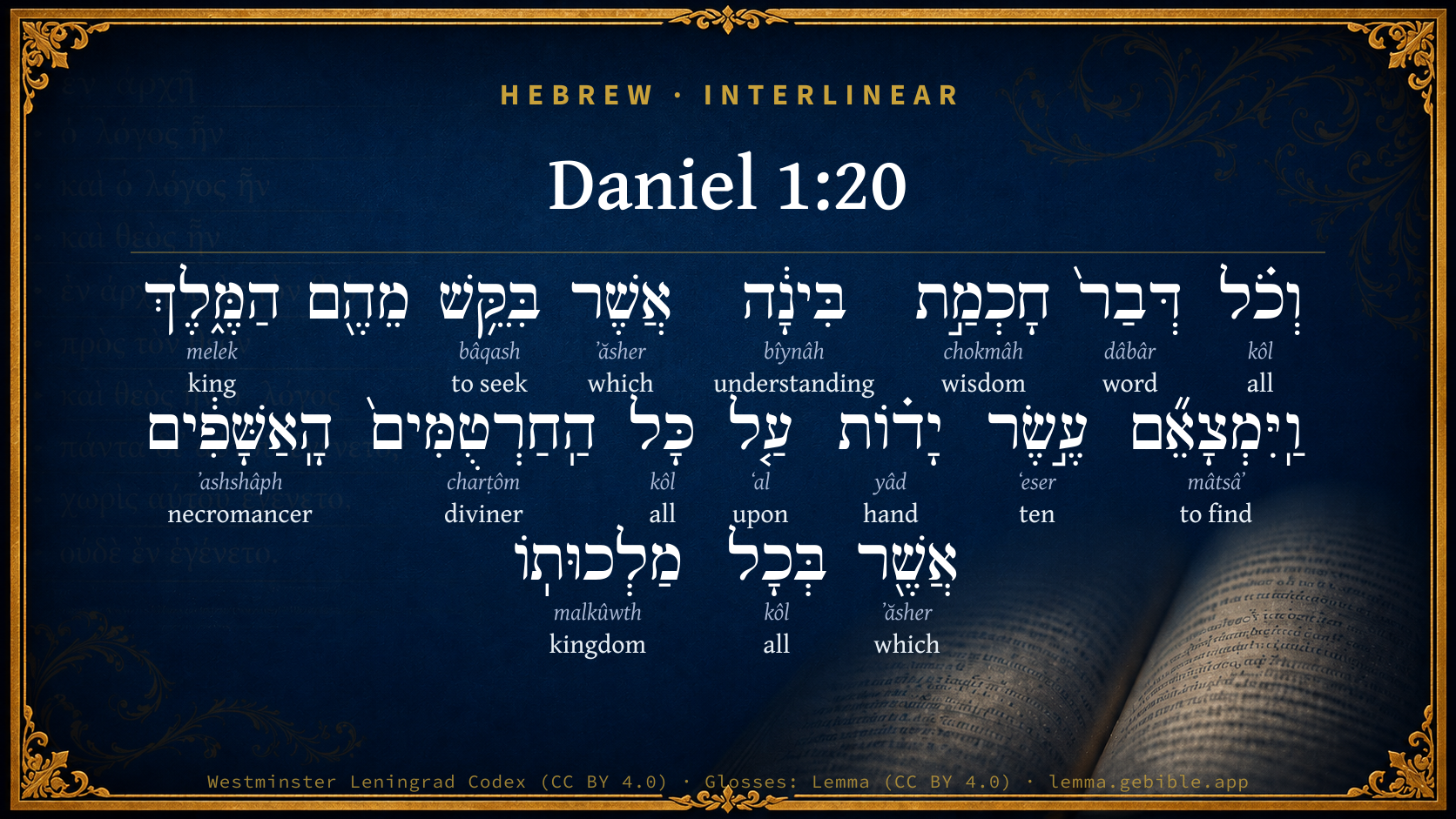
Hebrew (Westminster Leningrad Codex) Daniel 1:20 appears in the Hebrew Old Testament. The text above is from the Westminster Leningrad Codex. Each word links to its Strong’s number, a concise gloss, and parsing drawn from the Open Scriptures Hebrew Bible morphology. Click any word for its full Brown-Driver-Briggs (BDB) entry.
Download image
Cite this verse

Daniel 1:20 (World English Bible). Public Domain. Lemma interlinear Bible study tool, https://lemma.gebible.app/v/daniel/1/20.

Show BibTeX & RIS
BibTeX
RIS
English Translation
In every matter of wisdom and understanding, concerning which the king inquired of them, he found them ten times better than all the magicians and enchanters who were in all his realm.
World English Bible · Public Domain
Highlights
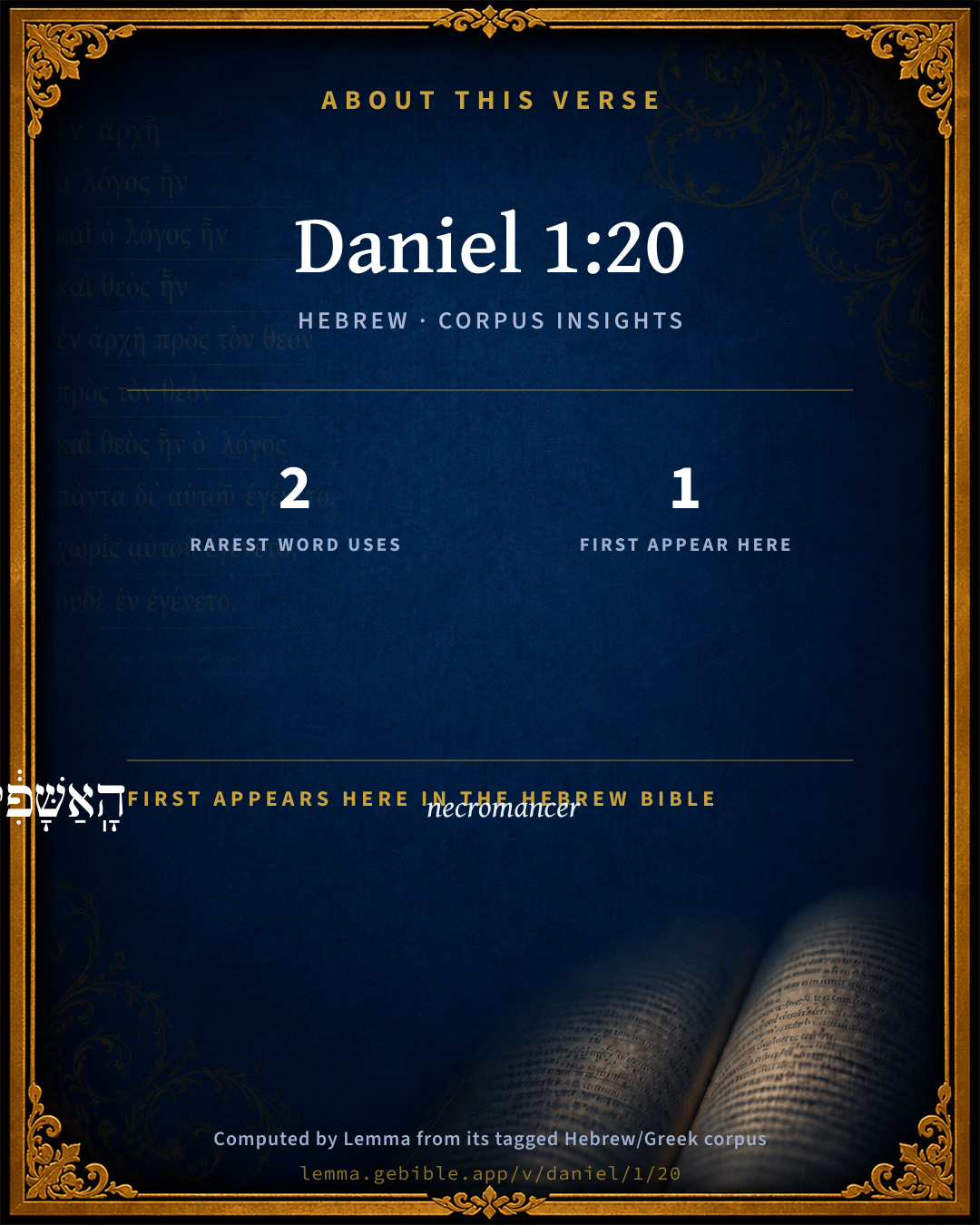
  • 1 first appearance in the Hebrew Bible
Full analysis ↓
Download a study sheet

One document with this verse’s original text, its word-by-word gloss line, the meaning frame, cross-references with their text, attributed commentary, and full source and license credits — printable, and it pastes into notes with its structure intact.

This verse Autodidact and up

Study sheet (.html) Plain text (.txt)

A passage Seminary Student

Up to 50 verses in one chapter. A passage sheet keeps up to 6 commentary sources and 12 cross-references per verse, in the order this page ranks them, and says so on the sheet whenever that leaves anything out. Ask for a single verse and you get the Autodidact verse sheet above.

Everything on this page stays free to read, with no account — the sheet is a download of what is already on screen, not access to it.

Want to remove ads? Support Godless Engineer
Compare translations 3

The same verse in 3 English versions, stacked beneath the original-language interlinear above. Click any original word for its lexicon entry.

Each is an independent rendering of the whole verse — the interlinear is not word-aligned to these translations.

Highlighted words mark where these versions differ — a whole-verse word diff, not a word-by-word alignment.

  • World English Bible Public Domain
    In every matter of wisdom and understanding, concerning which the king inquired of them, he found them ten times better than all the magicians and enchanters who were in all his realm.
  • King James Version Public Domain
    And in all matters of wisdom and understanding, that the king enquired of them, he found them ten times better than all the magicians and astrologers that were in all his realm.
  • unfoldingWord Literal Text CC BY-SA 4.0
    In every matter of wisdom and understanding about which the king inquired of them, he found them ten times better than all the magicians and enchanters, who were in his entire kingdom.

unfoldingWord Literal Text — © unfoldingWord, licensed CC BY-SA 4.0. Word-aligned USFM3 via Door43 (git.door43.org/unfoldingWord/en_ult).

Versions to compare (up to 4)

3 of 4 selected

Show all 18 translations

Every available English version of this verse, each an independent rendering of the whole verse.

  • World English Bible Public Domain
    In every matter of wisdom and understanding, concerning which the king inquired of them, he found them ten times better than all the magicians and enchanters who were in all his realm.
  • Berean Standard Bible Public Domain
    In every matter of wisdom and understanding about which the king consulted them, he found them ten times better than all the magicians and enchanters in his entire kingdom.
  • Majority Standard Bible Public Domain
    In every matter of wisdom and understanding about which the king consulted them, he found them ten times better than all the magicians and enchanters in his entire kingdom.
  • King James Version Public Domain
    And in all matters of wisdom and understanding, that the king enquired of them, he found them ten times better than all the magicians and astrologers that were in all his realm.
  • American Standard Version (1901) Public Domain
    And in every matter of wisdom and understanding, concerning which the king inquired of them, he found them ten times better than all the magicians and enchanters that were in all his realm.
  • Revised Version (1885) Public Domain
    And in every matter of wisdom and understanding, concerning which the king inquired of them, he found them ten times better than all the magicians and enchanters that were in all his realm.
  • Geneva Bible (1599) Public Domain
    And in all matters of wisedome, and vnderstanding that the King enquired of them, hee founde them tenne times better then all the inchanters and astrologians, that were in all his realme.
  • Douay-Rheims (1899) Public Domain
    And in all matters of wisdom and understanding, that the king inquired of them, he found them ten times better than all the diviners, and wise men, that were in all his kingdom.
  • Young's Literal Translation Public Domain
    and `in' any matter of wisdom `and' understanding that the king hath sought of them, he findeth them ten hands above all the scribes, the enchanters, who `are' in all his kingdom.
  • Literal Standard Version CC BY-SA 4.0
    and [in] any matter of wisdom [and] understanding that the king has sought of them, he finds them ten hands above all the enchanters, the conjurers, who [are] in all his kingdom.
  • Unlocked Literal Bible CC BY-SA 4.0
    In every question of wisdom and understanding that the king asked them, he found them ten times better than all the magicians and those who claimed to speak with the dead, who were in his entire kingdom.
  • unfoldingWord Literal Text CC BY-SA 4.0
    In every matter of wisdom and understanding about which the king inquired of them, he found them ten times better than all the magicians and enchanters, who were in his entire kingdom.
  • Darby Bible Public Domain
    And in all matters of judicious wisdom, as to which the king enquired of them, he found them ten times better than all the scribes [and] magicians that were in all his realm.
  • World Messianic Bible Public Domain
    In every matter of wisdom and understanding concerning which the king inquired of them, he found them ten times better than all the magicians and enchanters who were in all his realm.
  • Webster's Bible Public Domain
    And in all matters of wisdom and understanding, that the king inquired of them, he found them ten times superior to all the magicians and astrologers that were in all his realm.
  • Free Bible Version CC BY-SA 4.0
    Whatever subject the king asked them about, everything that required wisdom of understanding, he found them ten times better than all the magicians and enchanters in his whole kingdom.
  • Bible in Basic English Public Domain
    And in any business needing wisdom and good sense, about which the king put questions to them, he saw that they were ten times better than all the wonder-workers and users of secret arts in all his kingdom.
  • JPS Tanakh (1917) Public Domain
    And in all matters of wisdom and understanding, that the king inquired of them, he found them ten times better than all the magicians and enchanters that were in all his realm.

Literal Standard Version (2020), Covenant Press — licensed CC BY-SA 4.0. Text via the HelloAO Bible API (eBible.org). Unlocked Literal Bible (unfoldingWord) — licensed CC BY-SA 4.0. Text via the HelloAO Bible API (eBible.org). unfoldingWord Literal Text — © unfoldingWord, licensed CC BY-SA 4.0. Word-aligned USFM3 via Door43 (git.door43.org/unfoldingWord/en_ult). Free Bible Version, Dr. Jonathan Gallagher — licensed CC BY-SA 4.0. Text via the HelloAO Bible API (eBible.org).

Word by word

More ways to search: Search by grammar → Find every occurrence → Compare this word →

Practice this passage: Drill this verse → Learn its vocabulary →

הָֽאַשָּׁפִ֔ים
ʼashshâph
H825
“the · necromancers”
Particle, Definite Article + Noun, Common, Masculine, Plural, Absolute
Part of Speech
Particle + Noun
Type
Common
Gender
Masculine
Number
Plural
State
Absolute
Full BDB Definition

Origin: from an unused root (probably meaning to lisp, i.e. practice enchantment)

TWOT: 181

necromancer, conjurer - (TWOT) astrologer, enchanter, exorcist
  1. וְכֹ֗ל kôl H3605 “and · all of” Conjunction + Noun, Common, Masculine, Singular, Construct
  2. דְּבַר֙ dâbâr H1697 “word of” Noun, Common, Masculine, Singular, Construct
  3. חָכְמַ֣ת chokmâh H2451 “wisdom of” Noun, Common, Feminine, Singular, Construct
  4. בִּינָ֔ה bîynâh H998 “understanding” Noun, Common, Feminine, Singular, Absolute
  5. אֲשֶׁר ʼăsher H834 “which” Particle, Relative
  6. בִּקֵּ֥שׁ bâqash H1245 “to seek” Verb, Piel, Perfect, 3rd Person, Masculine, Singular
  7. הַמֶּ֑לֶךְ melek H4428 “the · king” Particle, Definite Article + Noun, Common, Masculine, Singular, Absolute
  8. וַֽיִּמְצָאֵ֞ם mâtsâʼ H4672 “and · to find · them” Conjunction + Verb, Qal, Sequential Imperfect, 3rd Person, Masculine, Singular + Suffix, Personal, 3rd Person, Masculine, Plural
  9. עֶ֣שֶׂר ʻeser H6235 “ten” Adjective, Cardinal number, Feminine, Singular, Absolute
  10. יָד֗וֹת yâd H3027 “hands” Noun, Common, Both, Plural, Absolute
  11. עַ֤ל ʻal H5921 “upon” Preposition
  12. כָּל kôl H3605 “all of” Noun, Common, Masculine, Singular, Construct
  13. הַֽחַרְטֻמִּים֙ charṭôm H2748 “the · diviners” Particle, Definite Article + Noun, Common, Masculine, Plural, Absolute
  14. אֲשֶׁ֖ר ʼăsher H834 “which” Particle, Relative
  15. בְּכָל kôl H3605 “in/at · all of” Preposition + Noun, Common, Masculine, Singular, Construct
  16. מַלְכוּתֽוֹ malkûwth H4438 “kingdom · his” Noun, Common, Feminine, Singular, Construct + Suffix, Personal, 3rd Person, Masculine, Singular

About this verse

These counts appear in no published source. They are computed here, from the morphology-tagged text and Lemma’s own curated glosses. What Lemma adds →

18
words
14
distinct lemmas
Prophets
section

Notable vocabulary

The rarest word here is הָֽאַשָּׁפִ֔ים necromancer H825 — appearing just 2 times in the whole Hebrew Bible.

First appearance in Scripture

This word makes its first canonical appearance in the Hebrew Bible here:

  • הָֽאַשָּׁפִ֔ים necromancer H825

Shared distinctive vocabulary

הָֽאַשָּׁפִ֔ים necromancer H825 occurs in 2 verses of the Hebrew Bible. Also found in:

Grammatical profile

  • 2 verbs
  • 11 nouns
  • 1 adjective
  • 2 prepositions
  • 2 particles

Verb forms

  • בִּקֵּ֥שׁ Piel · Perfect
  • וַֽיִּמְצָאֵ֞ם Qal · Sequential Imperfect

Repetition

Words recur within this verse — often emphatic in Hebrew:

  • וְכֹ֗ל all H3605 ×3
  • אֲשֶׁר which H834 ×2

Hebrew & Septuagint length

In English translation the verse runs 32 words from the Hebrew and 31 from the Septuagint (LXX English) — closely comparable.

A rough comparison of the two English renderings, which tokenize alike — not a word-level alignment.

Word counts can differ between the Hebrew and the Greek without any difference in meaning — e.g. the Hebrew direct-object marker אֵת has no separate Greek word, and Greek often adds the article ὁ.

Cross-references

23

Topical passages linked to Daniel 1:20 in the Treasury of Scripture Knowledge — connected by theme and wording, ordered by reader-vote popularity; previews shown in the World English Bible.

  • Exodus 8:19 Then the magicians said to Pharaoh, "This is the finger of God:" and Pharaoh's heart was hardened, and he didn't listen to them; as Yahweh had spoken.
  • 1 Kings 4:29–34 God gave Solomon wisdom and understanding exceeding much, and very great understanding, even as the sand that is on the sea-shore.
  • Isaiah 47:12–14 Stand now with your enchantments, and with the multitude of your sorceries, in which you have labored from your youth; if so be you shall be able to profit, if so be you may prevail.
  • Genesis 41:8 It happened in the morning that his spirit was troubled, and he sent and called for all the magicians of Egypt, and all the wise men of it. Pharaoh told them his dream, but there was no one who could interpret them to Pharaoh.
  • Genesis 31:7 Your father has deceived me, and changed my wages ten times, but God didn't allow him to hurt me.
  • Exodus 7:22 The magicians of Egypt did in like manner with their enchantments; and Pharaoh's heart was hardened, and he didn't listen to them; as Yahweh had spoken.
  • Exodus 8:7 The magicians did in like manner with their enchantments, and brought up frogs on the land of Egypt.
  • Numbers 14:22 because all those men who have seen my glory, and my signs, which I worked in Egypt and in the wilderness, yet have tempted me these ten times, and have not listened to my voice;
  • 1 Kings 10:1–3 When the queen of Sheba heard of the fame of Solomon concerning the name of Yahweh, she came to prove him with hard questions.
  • 1 Kings 10:23–24 So king Solomon exceeded all the kings of the earth in riches and in wisdom.
  • Nehemiah 4:12 It happened that when the Jews who lived by them came, they said to us ten times from all places, You must return to us.
  • Job 19:3 You have reproached me ten times. You aren't ashamed that you attack me.
  • Isaiah 19:3 The spirit of Egypt shall fail in the midst of it; and I will destroy the counsel of it: and they shall seek to the idols, and to the charmers, and to those who have familiar spirits, and to the wizards.
  • Exodus 7:11–12 Then Pharaoh also called for the wise men and the sorcerers. They also, the magicians of Egypt, did in like manner with their enchantments.
  • Psalms 119:99 I have more understanding than all my teachers, For your testimonies are my meditation.
  • Daniel 2:2–11 Then the king commanded to call the magicians, and the enchanters, and the sorcerers, and the Chaldeans, to tell the king his dreams. So they came in and stood before the king.
  • Daniel 2:13 So the decree went forth, and the wise men were to be slain; and they sought Daniel and his companions to be slain.
  • Daniel 2:21 He changes the times and the seasons; he removes kings, and sets up kings; he gives wisdom to the wise, and knowledge to those who have understanding;
  • Daniel 2:27–28 Daniel answered before the king, and said, The secret which the king has demanded can neither wise men, enchanters, magicians, nor soothsayers, show to the king;
  • Daniel 4:7–18 Then came in the magicians, the enchanters, the Chaldeans, and the soothsayers; and I told the dream before them; but they did not make known to me the interpretation of it.
  • Daniel 5:7–8 The king cried aloud to bring in the enchanters, the Chaldeans, and the soothsayers. The king spoke and said to the wise men of Babylon, Whoever shall read this writing, and show me the interpretation of it, shall be clothed with purple, and have a chain of gold about his neck, and shall be the third ruler in the kingdom.
  • Daniel 5:17 Then Daniel answered before the king, Let your gifts be to yourself, and give your rewards to another; nevertheless I will read the writing to the king, and make known to him the interpretation.
  • 2 Timothy 3:8–9 Even as Jannes and Jambres opposed Moses, so do these also oppose the truth; men corrupted in mind, reprobate concerning the faith.

Cross-references courtesy of OpenBible.info (CC BY 4.0).

Hebrew and Greek witnesses Masoretic Hebrew ↔ Greek Septuagint

The same verse in the two great witnesses to the Old Testament, shown verse-for-verse.

These are two independent witnesses, not word-aligned to each other, and the Septuagint is shown in lemma (dictionary) form.

Hebrew Daniel 1:20 Masoretic · Westminster Leningrad Codex

וְכֹ֗ל דְּבַר֙ חָכְמַ֣ת בִּינָ֔ה אֲשֶׁר בִּקֵּ֥שׁ מֵהֶ֖ם הַמֶּ֑לֶךְ וַֽיִּמְצָאֵ֞ם עֶ֣שֶׂר יָד֗וֹת עַ֤ל כָּל הַֽחַרְטֻמִּים֙ הָֽאַשָּׁפִ֔ים אֲשֶׁ֖ר בְּכָל מַלְכוּתֽוֹ

In every matter of wisdom and understanding, concerning which the king inquired of them, he found them ten times better than all the magicians and enchanters who were in all his realm.

World English Bible · Public Domain

Greek LXX Daniel 1:20 Septuagint · lemma form

καί ἐν πᾶς λόγος καί σύνεσις καί παιδεία ὅσος ζητέω παρά αὐτός ὁ βασιλεύς καταλαμβάνω αὐτός σοφός δεκαπλασίως ὑπέρ ὁ σοφιστής καί ὁ φιλόσοφος ὁ ἐν πᾶς ὁ βασιλεία αὐτός καί δοξάζω αὐτός ὁ βασιλεύς καί καταἵστημι αὐτός ἄρχων καί ἀναδεικνύω αὐτός σοφός παρά πᾶς ὁ αὐτός ἐν πρᾶγμα ἐν πᾶς ὁ γῆ αὐτός καί ἐν ὁ βασιλεία αὐτός

And in every matter of wisdom and knowledge wherein the king questioned them, he found them ten times wiser than all the enchanters and sorcerers that were in all his kingdom.

LXX2012 (modern English Septuagint) · Public Domain

On this verse, Albert Barnes' Notes on the Bible discusses the Septuagint’s reading. Read the note in Commentary ↓

Hebrew: Westminster Leningrad Codex (CC BY 4.0). Greek: Septuagint (public domain); English from LXX2012 (modern English Septuagint) (Public Domain). How the Septuagint differs from the Hebrew →

Commentary

Notes on Daniel 1:20 from classic Christian and Jewish commentators (each source and its license shown beneath its notes). The classic Christian expositions comment on the surrounding passage and are grouped to its opening verse, so a note may address several verses; the Jewish commentaries on the Tanakh (Rashi and others) are per-verse, so they appear only where the commentator wrote on this verse.

Lemma curates 59 commentaries, every one of them public domain or Creative Commons licensed, each selected and text-cleaned for this edition rather than reprinted as found. About our sources →

Trapp's Complete Commentary

John Trapp

Dan 1:20 And in all matters of wisdom [and] understanding, that the king enquired of them, he found them ten times better than all the magicians [and] astrologers that [were] in all his realm.

Ver. 20. And in all matters of wisdom.] God will honour them that honour him: his gifts and graces he giveth to pure souls, and according to their study of purity, as to Daniel chiefly.

He found them ten times better.] Masters of knowledge, skilled usque ad apices literarum, right up to the very peak of learning, {a} and therefore highly favoured by the king, who was himself a great philosopher. Daniel was a leviathan of learning, both divine and human, as one saith of Archbishop Ussher; Unicum istius cetatis miraculum et musarum delicium, as Erasmus saith of Alciat, the miracle of his age, and the muse’s darling - one that better deserved, for his learning, to be called Magnus Great than ever Albertus did. The perfection even of human arts is to be found in the Church. See my Common Place of "Arts."

{a} Mr Fuller.

John Trapp, A Commentary or Exposition upon All the Books of the Old and New Testament (1647–1656) — public domain. Text from a community e-Sword module.

Albert Barnes' Notes on the Bible

And in all matters of wisdom and understanding - Margin, “of.” The Hebrew is, “Everything of wisdom of understanding.” The Greek, “In all things of wisdom “and” knowledge.” The meaning is, in everything which required peculiar wisdom to understand and explain it. The points submitted were such as would appropriately come before the minds of the sages and magicians who were employed as counselors at court.

He found them ten times better - Better counselors, better informed. Hebrew, “ten “hands” above the magicians;” that is, ten “times,” or “many” times. In this sense the word “ten” is used in Gen 31:7, Gen 31:41; Num 14:22; Neh 4:12; Job 19:3. They greatly surpassed them.

Than all the magicians - Greek, τοὺς ἐπαοιδοὺς tous epaoidous. The Greek word means, “those singing to;” then those who propose to heal the sick by singing; then those who practice magical arts or incantations - particularly with the idea of charming with songs; and then those who accomplish anything surpassing human power by mysterious and supernatural means. - Passow. The Hebrew word (הרטמים chareṭummı̂ym), occurs only in the following places in the Scriptures, in all of which it is rendered “magicians:” - Gen 41:8, Gen 41:24; Exo 7:11, Exo 7:22; Exo 8:7 (3), 18 (14), 19 (15); Exo 9:11; Dan 1:20; Dan 2:2. From this it appears that it applied only to the magicians in Egypt and in Babylon, and doubtless substantially the same class of persons is referred to. It is found only in the plural number, “perhaps” implying that they formed companies, or that they were always associated together, so that different persons performed different parts in their incantations.

The word is defined by Gesenius to mean, “Sacred scribes, skilled in the sacred writings or hieroglyphics - ἱερογραμματεῖς hierogrammateis - a class of Egyptian priests.” It is, according to him (Lex.), of Hebrew origin, and is derived from חרט chereṭ, “stylus” - an instrument of writing, and the formative מ (m). It is not improbable, he suggests, that the Hebrews with these letters imitated a similar Egyptian word. Prof. Stuart (in loc.) says that the word would be correctly translated “pen-men,” and supposes that it originally referred to those who were “busied with books and writing, and skilled in them.” It is evident that the word is not of Persian origin, since it was used in Egypt long before it occurs in Daniel. A full and very interesting account of the Magians and their religion may be found in Creuzer, “Mythologie und Symbolik,” i. pp. 187-234. Herodotus mentions the “Magi” as a distinct people, i. 101.

The word “Mag” or “Mog” (from the μάγοι magoi of the Greeks, and the “magi” of the Romans) means, properly, a “priest;” and at a very early period the names “Chaldeans” and “Magi” were interchangeable, and both were regarded as of the same class. - Creuzer, i. 187, note. They were doubtless, at first, a class of priests among the Medes and Persians, who were employed, among other things, in the search for wisdom; who were connected with pagan oracles; who claimed acquaintance with the will of the gods, and who professed to have the power, therefore, of making known future events, by explaining dreams, visions, preternatural appearances, etc. The Magi formed one of the six tribes into which the Medes were formerly divided (Herodotus, i. 101), but on the downfall of the Median empire they continued to retain at the court of the conqueror a great degree of power and authority. “The learning of the Magi was connected with astrology and enchantment, in which they were so celebrated that their name was applied to all orders of magicians and enchanters.” - Anthon, “Class. Dic.” These remarks may explain the reason why the word “magician” comes to be applied to this class of men, though we are not to suppose that the persons referred to in Genesis and Exodus, under the appellation of the Hebrew name there given to them (הרטמים chareṭummı̂ym), or those found in Babylon, referred to in the passage before us, to whom the same name is applied, were of that class of priests.

The name “magi,” or “magician,” was so extended as to embrace “all” who made pretensions to the kind of knowledge for which the magi were distinguished, and hence, came also to be synonymous with the “Chaldeans,” who were also celebrated for this. Compare the notes at Dan 2:2. In the passage before us it cannot be determined with certainty, that the persons were of “Magian” origin, though it is possible, as in Dan 2:2, they are distinguished from the Chaldeans. All that is certainly meant is, that they were persons who laid claim to the power of diving into future events; of explaining mysteries; of interpreting dreams; of working by enchantments, etc.

And astrologers - - האשׁפים hâ'ashâpı̂ym. This word is rendered by the Septuagint, μάγους magous, “magians.” So also in the Vulgate, “magos.” The English word “astrologer” denotes “one who professes to foretell future events by the aspects and situation of the stars.” - Webster. The Hebrew word - אשׁפים 'ashâpı̂ym - according to Gesenius, means “enchanters, magicians.” It is derived, probably, from the obsolete root אשׁף 'âshap, “to cover,” “to conceal,” and refers to those who were devoted to the practice of occult arts, and to the cultivation of recondite and cabalistic sciences. It is supposed by some philologists to have given rise, by dropping the initial א to the Greek σοφος sophos, “wise, wise man,” and the Persian sophi, an epithet of equivalent import. See Gesenius on the word, and compare Bush on Dan 2:2. The word is found only in Daniel, Dan 1:20; Dan 2:2, Dan 2:10, Dan 2:27; Dan 4:7 (4); Dan 5:7, Dan 5:11, Dan 5:15, in every instance rendered “astrologer” and “astrologers.” There is no evidence, however, that the science of astrology enters into the meaning of the word, or that the persons referred to attempted to pracrise divination by the aid of the stars. It is to be regretted that the term “astrologer” should have been employed in our translation, as it conveys an intimation which is not found in the original. It is, indeed, in the highest degree probable, that a part of their pretended wisdom consisted in their ability to cast the fates of men by the conjunctions and opposition of the stars, but this is not necessarily implied in the word. Prof. Stuart renders it “enchanters.”

In all his realm - Not only in the capital, but throughout the kingdom. These arts were doubtless practiced extensively elsewhere, but it is probable that the most skillful in them would be assembled at the capital.

Albert Barnes' Notes on the Bible (1834–1885) — public domain. Text from a community e-Sword/MySword module.

Tyndale Open Study Notes

Tyndale Open Resources

1:20 The magicians were a class of soothsayer priests who could also interpret dreams (cp. Gen 44:1-15) and do wonders (cp. Exod 7:11). The term enchanters (Hebrew ’ashap), found only in Daniel, comes from an Akkadian term for people who uttered spells.

Tyndale Open Study Notes — © Tyndale Open Resources, licensed CC BY-SA 4.0. Text via the HelloAO Bible API.

Ibn Ezra

Rabbi Abraham ibn Ezra

[Daniel 1:20] Ve-chol (וְכֹל - And every): This indicates that Nebuchadnezzar [himself] knew wisdom, and he found each one of these four knew ten measures/times (eser yadot - עֶשֶׂר יָדוֹת) [more] than every magician (chartom - חַרְטֹם) and exorcist/astrologer (ashshaf - אַשָּׁף). And it is possible that ten (eser) is [treated linguistically as] a plural term, like [in the phrase] “than ten rulers” (me-asarah shallitim - מֵעֲשָׂרָה שַׁלִּיטִים) [Ecclesiastes 7:19], because ten is a sum total/complete count (sach cheshbon - סָךְ חֶשְׁבּוֹן). And the author of Sefer Yetzirah said: “Ten Sefirot of Nothingness” (eser sefirot blimah - עֶשֶׂר סְפִירוֹת בְּלִי מָה) [Sefer Yetzirah 1:4]. And the magicians (chartummim - חַרְטֻמִּים) are not the exorcists/astrologers (ashshafim - אַשָּׁפִים), because behold, it is written [elsewhere]: “to call the magicians (chartummim) and the exorcists/astrologers (ashshafim)” [Daniel 2:2, listing them separately]. And there [in the commentary on that verse] I will explain them.

Ibn Ezra on the Tanakh — English translations: “Sefaria Community Translation” (CC0 1.0 (public-domain dedication)); “Yalkut, Sifsei Chachomim Chumash, Metsudah Publications, 2009” (CC BY 4.0); and “Commentary of Ibn Ezra on Isaiah - trans. by M. Friedlander, 1873” (public domain). Text via Sefaria.

Jamieson, Fausset & Brown

Robert Jamieson, A. R. Fausset & David Brown

ten times--literally, "ten hands."

magicians--properly, "sacred scribes, skilled in the sacred writings, a class of Egyptian priests" [GESENIUS]; from a Hebrew root, "a pen." The word in our English Version, "magicians," comes from mag, that is, "a priest." The Magi formed one of the six divisions of the Medes.

astrologers--Hebrew, "enchanters," from a root, "to conceal," pactisers of the occult arts.

Jamieson, Fausset & Brown — Commentary Critical and Explanatory on the Whole Bible (1871) — public domain (CC PDM 1.0). Text via the HelloAO Bible API.

Adam Clarke's Commentary

Verse 20. Magicians and astrologers] Probably the same as philosophers and astronomers among us.

Adam Clarke's Commentary on the Bible (1810–1826) — public domain. Text from a community e-Sword/MySword module.

The Cambridge Bible for Schools and Colleges

gen. ed. J. J. S. Perowne

20. The king found further, upon putting to them difficult questions, that in a knowledge of the technicalities of their science the four Jewish youths excelled even the wise men of Babylon themselves.

and in every particular of reasoned wisdom] lit. wisdom of understanding, i.e. wisdom determined or regulated by understanding, ‘wisdom’ having the same concrete sense of ‘science’ which it has in Dan_1:17. Marti, however, following Theod., reads ‘wisdom and understanding.’

magicians] ḥarṭummim, recurring in Dan_2:2; Dan_2:10; Dan_2:27, Dan_4:7; Dan_4:9, Dan_5:7, probably of Egyptian origin (though not at present known to occur in Egyptian inscriptions), used otherwise only of the ‘magicians’ of Egypt (Gen_41:8; Gen_41:24; Exo_7:11; Exo_7:22; Exo_8:7; Exo_8:18-19; Exo_9:11), and no doubt borrowed from the Pent. by the author of Daniel. The precise sense of the term is difficult to fix. It is not improbable that originally it denoted the sacred scribes (ἱερογραμματεῖς)[186] of Egypt; but, even if this opinion be accepted, it is doubtful how far the idea was consciously present to the Hebrews who in later times used the word. In Gen. the ḥarṭummim appear as interpreters of dreams (LXX. ἐξηγηταί), in Ex. as men able to work magic (LXX. ἐπαοιδοί, in Dan_9:11 φαρπακοί): Theod. in Dan. renders by ἐπαοιδοί. Probably the word was used by the author of Daniel in the sense of men acquainted with occult arts in general, so that the rendering ‘magician’ may be allowed to stand.

[186] Clem. Alex. Strom. vi. 36; cf. Ebers, Aeg. u. die Bb. Mose’s, pp. 343, 347. On the functions of these sacred scribes, and the nature of the literature with which they had to deal (which included a knowledge of magic and charms), see Brugsch, Aegyptologie (1891), pp. 77, 85, 149–159.

astrologers] enchanters, Heb. ’ashshâph, Aram. ’âshaph, found only in the Book of Daniel (Dan_2:2; Dan_2:10; Dan_2:27, Dan_4:4, Dan_5:7; Dan_5:11; Dan_5:15), the Assyrian ashipu (Schrader, KAT[187][188] ad loc), which passed also into Syriac, where it is used specially of the charmers of serpents.

[187] AT. Eb. Schrader, Die Keilinschriften und das A. T., ed. 2, 1883 (translated under the title The Cuneiform Inscriptions and the O.T. 1885, 1888). The references are to the pagination of the original, which is given on the margin of the English translation.

[188] Eb. Schrader, Die Keilinschriften und das A. T., ed. 2, 1883 (translated under the title The Cuneiform Inscriptions and the O.T. 1885, 1888). The references are to the pagination of the original, which is given on the margin of the English translation.

The Cambridge Bible for Schools and Colleges (gen. ed. J. J. S. Perowne; Cambridge University Press, 1878–1918) — public domain. Text from a community e-Sword module.

John Gill's Exposition

And in all matters of wisdom and understanding that the king inquired of them,.... At the time of their examination before him, when he put questions to them, which they gave a ready, pertinent, and solid answer to: and afterwards, when he had occasion to consult them on any affair,

he found them ten times, or ten hands (g) better than all the magicians and astrologers that were in all his realm; than all the magi and sophies, the enchanters, diviners, soothsayers, and such who pretended to judicial astrology, and to judge of and foretell things by the position of the stars; these young men were able to give more pertinent answers to questions put to them, and better advice and counsel when asked of them, than all the persons before described, throughout the king's dominions.

(g) "decem manibus", Montanus.

John Gill's Exposition of the Whole Bible (1746–1763) — public domain (CC PDM 1.0). Text via the HelloAO Bible API.

Haydock's Catholic Bible Commentary

Diviners, or fortune-tellers. --- Wise men. Septuagint, "philosophers." (Calmet) --- Hebrew, Ashaphim, may come from the Greek sophoi. (Grotius) --- They had been educated three years. (ver. 5) (Haydock)

George Leo Haydock (1774–1849), Haydock's Catholic Family Bible and Commentary, 1859 edition — public domain. Excludes Psalms (Douay-Rheims chapter numbering differs from Protestant) and Deuterocanonical books (Catholic canon only).

Matthew Poole's English Annotations

This is a further confirmation of the king’s noble endowments of mind, and of his great care whom he chose to be in offices of trust; namely, persons excellently qualified to serve him in the great affairs of the kingdom, not to serve his lusts by them for base jobs, for which men of no abilities or honour are usually chosen.

Matthew Poole's English Annotations on the Holy Bible (1683–1685) — public domain. Text from a community e-Sword/MySword module.

The Pulpit Commentary

And in all matters of wisdom and understanding, that the king inquired of them, he found them ten times better than all the magicians and astrologers that were in all his realm. The Septuagint rendering here has a considerable addition, which really means, as it seems to us, the coalescence of two readings. It reads thus: "And in all learning (logw, a literal rendering of rb; d; dabhar, "a word" or "thing"), and knowledge and education (paideia) whatsoever the king asked of them, he found them ten times wiser than all the wise and learned men in all his kingdom." Thus far the verse is a rendering, almost slavishly close, of the Massoretic text; while the translator has recognized that the sentence is incomplete as it stands, and has inserted sofwterouv, and translated l (al) by uJper. But the translation proceeds, "And the king honoured them, and appointed them rulers." This seems to have been due to a various reading. The sentence here translated was probably, in an old recension of the text, all that stood here, and some scribe, finding it, inserted it here to complete the sentence. The translation, however, proceeds yet further, "And constituted (ajnedeixen) them wiser than all those of his in affairs in all his land and in his kingdom." This sentence has all the appearance of an attempt to render into Greek a piece of Hebrew that the translator imperfectly understood. As we find that ajnadeiknumi, represents occasionally dwh, and as the Syriac vav and the old Hebrew were almost identical in shape, dyO (yoda,) might be read as hwOdy evidently the translator has read (hacmeem) instead of ( hartummeem), and has transferred the al col from before hartummeem to before the next word, which seems to have read, not ashshapheem, but hartzo, the relative seems to have been omitted, and the second col, "all." This great variety of reading suggests suspicions of the verse altogether, which the content of the verse rather strengthens. Theodotion is in strict agreement with the Massoretic text. The Peshitta also is at one with it in this, but these are late compared with the Septuagint. It has been tea,sued that the Book of Daniel is a story modelled on the history of Joseph, and the presence of harlummeem here is regarded as a proof of this quasi Egyptian origin. (see Gen_41:8; Exo_7:11, etc.) One thing is clear, that the word whatever it was was unknown in Alexandria, where this translation was made; hartummeern, as occurring in the Pentateuch, the earliest part of the Old Testament translated, was certain to be known: how did the word here happen not to be known? We can understand the phenomenon if some word, probably of Babylonian origin, and unknown in Egypt and Palestine, occupied the place and was modified into a more intelligible shape by being turned into hartummeem. As the verse stands, hartummeem is grammatically placed in apposition to the following word, ashshapheem, as there is no conjunction to unite the two words. It is acknowledged by Professor Bevan that the latter word has an Assyrian origin; it is not inconceivable that hartummeem is really the explanatory word, though the arrangement of the words is decidedly against this view. It is to be observed here that ashshapheem has been naturalized in Eastern Aramaic, but has not found a lodgment in Western, save in Daniel. We cannot help feeling a little suspicion of the authenticity of this verse. This phrase, "ten times better," has all the look of that exaggeration which became the prevailing vice of later Judaism. As we have indicated, the variations in regard to the precise reading deepen this suspicion. If, however, the reference here is really to Daniel"s revelation to the king of his dream, then the statement in the text is less objectionable. This was such a marvellous feat, and one that so put Daniel,boys all the wise men of Babylon, that the language of the verse before us is rather rhetorical than exaggerated.

The Pulpit Commentary (1880–1919), ed. H.D.M. Spence-Jones & Joseph S. Exell — public domain. Text from a community e-Sword module.

John Wesley's Explanatory Notes

The king inquired - This is a farther confirmation of the king's noble endowments, and of his great care whom he chose to be in offices of trust, namely persons excellently qualified to serve him in the great affairs of the kingdom. And thus did God pour contempt upon the pride of the Chaldeans, and put honour on the low estate of his people.

John Wesley, Explanatory Notes Upon the Whole Bible (1754–1765) — public domain. Text via the GEBible commentary corpus.

Rashi

Rabbi Shlomo Yitzchaki (Rashi)

the necromancers These are the ones who inquire of טִימֵי מֵתִים, the bones of the dead, as you say, “May his bones be crushed,” שְּׁחִיק טַמַיָא.

the astrologers These are the ones who “press” the constellation. So it is explained in Tanhuma (Miketz 2, Buber, Miketz 4).

Rashi on the Tanakh — English translations: “The Judaica Press complete Tanach with Rashi, translated by A. J. Rosenberg” (CC BY 4.0); “Pentateuch with Rashi's commentary by M. Rosenbaum and A.M. Silbermann, 1929-1934” (public domain); “The Metsudah Tanach series, Lakewood, N.J” (CC BY 4.0); and “The Book of Joshua, Metsudah Publications, 1997” (CC BY 4.0). Text via Sefaria.

Lesson kit

Teaching starters — assembled from the data on this page, not authored interpretation. Every prompt links to the verse data it draws on. Edit before teaching.

Daniel, in the Prophets, opens this verse with 18 words (14 distinct Hebrew lemmas). Its most distinctive word is ʼashshâph (“necromancer”). A historical commentator’s framing appears above. Read the whole chapter for the surrounding context.

Discussion questions

  1. How does “necromancer” (ʼashshâph) shape what this verse is saying?
  2. The word “necromancer” first appears here in Scripture. What is being introduced at this debut?
  3. Daniel 2:2 shares the word «necromancer» with this verse. How do the two illuminate each other?
  4. “all” occurs 3× in this one verse. What is the effect of the repetition?
  5. These translations render this verse differently. What is at stake in choosing one wording over another?
  6. The verb «בִּקֵּ֥שׁ» is Piel Perfect. How does its form color the action?
  7. Reading how Trapp's Complete Commentary and Albert Barnes' Notes on the Bible read this verse, where do the two commentators agree and where do they part?

Things to notice

  • 1 word makes its first canonical appearance in Scripture here.
  • These translations choose different wording for 14 words in this verse.
  • “all” occurs 3× in this single verse.
  • 14 distinct Hebrew lemmas span 18 words in this verse.

Reading settings

Reading text

Shown beneath each verse's original-language words.

Old Testament
Old Testament edition

Read the OT as the Masoretic Hebrew (MT) or the Greek Septuagint (LXX).

English shown for the Greek Septuagint (in the Hebrew ↔ Greek comparison).

Comparing translations? Open the Compare panel on any verse page to stack up to four side by side.