
Esther 2:23

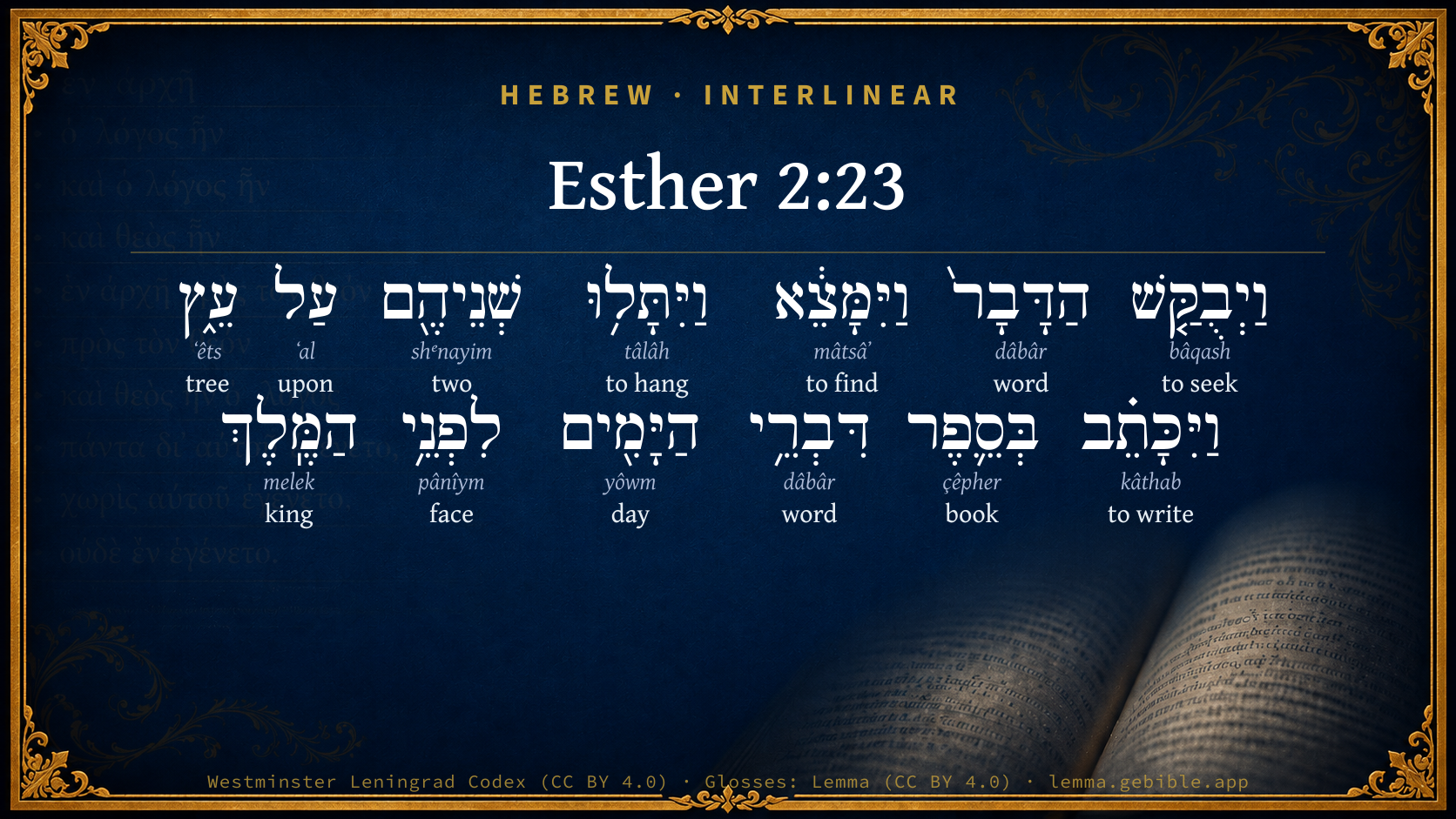
Hebrew (Westminster Leningrad Codex) Esther 2:23 appears in the Hebrew Old Testament. The text above is from the Westminster Leningrad Codex. Each word links to its Strong’s number, a concise gloss, and parsing drawn from the Open Scriptures Hebrew Bible morphology. Click any word for its full Brown-Driver-Briggs (BDB) entry.
Download image
Cite this verse

Esther 2:23 (World English Bible). Public Domain. Lemma interlinear Bible study tool, https://lemma.gebible.app/v/esther/2/23.

Show BibTeX & RIS
BibTeX
RIS
English Translation
When inquisition was made of the matter, and it was found to be so, they were both hanged on a tree: and it was written in the book of the chronicles before the king.
World English Bible · Public Domain
Download a study sheet

One document with this verse’s original text, its word-by-word gloss line, the meaning frame, cross-references with their text, attributed commentary, and full source and license credits — printable, and it pastes into notes with its structure intact.

This verse Autodidact and up

Study sheet (.html) Plain text (.txt)

A passage Seminary Student

Up to 50 verses in one chapter. A passage sheet keeps up to 6 commentary sources and 12 cross-references per verse, in the order this page ranks them, and says so on the sheet whenever that leaves anything out. Ask for a single verse and you get the Autodidact verse sheet above.

Everything on this page stays free to read, with no account — the sheet is a download of what is already on screen, not access to it.

Want to remove ads? Support Godless Engineer
Compare translations 3

The same verse in 3 English versions, stacked beneath the original-language interlinear above. Click any original word for its lexicon entry.

Each is an independent rendering of the whole verse — the interlinear is not word-aligned to these translations.

Highlighted words mark where these versions differ — a whole-verse word diff, not a word-by-word alignment.

  • World English Bible Public Domain
    When inquisition was made of the matter, and it was found to be so, they were both hanged on a tree: and it was written in the book of the chronicles before the king.
  • King James Version Public Domain
    And when inquisition was made of the matter, it was found out; therefore they were both hanged on a tree: and it was written in the book of the chronicles before the king.
  • unfoldingWord Literal Text CC BY-SA 4.0
    And the matter was sought out and was found out, and the two of them were hanged on a pole. And it was written in the book of the events of days before the face of the king.

unfoldingWord Literal Text — © unfoldingWord, licensed CC BY-SA 4.0. Word-aligned USFM3 via Door43 (git.door43.org/unfoldingWord/en_ult).

Versions to compare (up to 4)

3 of 4 selected

Show all 17 translations

Every available English version of this verse, each an independent rendering of the whole verse.

  • World English Bible Public Domain
    When inquisition was made of the matter, and it was found to be so, they were both hanged on a tree: and it was written in the book of the chronicles before the king.
  • Berean Standard Bible Public Domain
    After the report had been investigated and verified, both officials were hanged on the gallows. And all this was recorded in the Book of the Chronicles in the presence of the king.
  • Majority Standard Bible Public Domain
    After the report had been investigated and verified, both officials were hanged on the gallows. And all this was recorded in the Book of the Chronicles in the presence of the king.
  • King James Version Public Domain
    And when inquisition was made of the matter, it was found out; therefore they were both hanged on a tree: and it was written in the book of the chronicles before the king.
  • American Standard Version (1901) Public Domain
    And when inquisition was made of the matter, and it was found to be so, they were both hanged on a tree: and it was written in the book of the chronicles before the king.
  • Revised Version (1885) Public Domain
    And when inquisition was made of the matter, and it was found to be so, they were both hanged on a tree: and it was written in the book of the chronicles before the king.
  • Douay-Rheims (1899) Public Domain
    It was inquired into, and found out: and they were both hanged on a gibbet. And it was put in the histories, and recorded in the chronicles before the king.
  • Young's Literal Translation Public Domain
    and the thing is sought out, and found, and they are hanged both of them on a tree, and it is written in the book of the Chronicles before the king.
  • Literal Standard Version CC BY-SA 4.0
    and the thing is sought out, and found, and both of them are hanged on a tree, and it is written in the scroll of the Chronicles before the king.
  • Unlocked Literal Bible CC BY-SA 4.0
    The report was investigated and confirmed, and both the men were hanged from a gallows. This account was written in the book of the chronicles in the presence of the king.
  • unfoldingWord Literal Text CC BY-SA 4.0
    And the matter was sought out and was found out, and the two of them were hanged on a pole. And it was written in the book of the events of days before the face of the king.
  • Darby Bible Public Domain
    And the matter was investigated and found out; and they were both hanged on a tree. And it was written in the book of the chronicles before the king.
  • World Messianic Bible Public Domain
    When this matter was investigated, and it was found to be so, they were both hanged on a gallows; and it was written in the book of the chronicles in the king’s presence.
  • Webster's Bible Public Domain
    And when inquisition was made of the matter, it was discovered; therefore they were both hanged on a tree: and it was written in the book of the chronicles before the king.
  • Free Bible Version CC BY-SA 4.0
    When the plot was investigated and found to be true, both men were impaled on poles. This was recorded in the official Book of Records by order of the king.
  • Bible in Basic English Public Domain
    And when the thing had been looked into, it was seen to be true, and the two of them were put to death by hanging on a tree: and it was put down in the records before the king.
  • JPS Tanakh (1917) Public Domain
    And when inquisition was made of the matter, and it was found to be so, they were both hanged on a tree; and it was written in the book of the chronicles before the king.

Literal Standard Version (2020), Covenant Press — licensed CC BY-SA 4.0. Text via the HelloAO Bible API (eBible.org). Unlocked Literal Bible (unfoldingWord) — licensed CC BY-SA 4.0. Text via the HelloAO Bible API (eBible.org). unfoldingWord Literal Text — © unfoldingWord, licensed CC BY-SA 4.0. Word-aligned USFM3 via Door43 (git.door43.org/unfoldingWord/en_ult). Free Bible Version, Dr. Jonathan Gallagher — licensed CC BY-SA 4.0. Text via the HelloAO Bible API (eBible.org).

Word by word

More ways to search: Search by grammar → Find every occurrence → Compare this word →

Practice this passage: Drill this verse → Learn its vocabulary →

וַיִּתָּל֥וּ
tâlâh
H8518
“and · to hang”
Conjunction + Verb, Niphal, Sequential Imperfect, 3rd Person, Masculine, Plural
Part of Speech
Conjunction + Verb
Stem
Niphal
Form
Sequential Imperfect
Person
3rd Person
Gender
Masculine
Number
Plural
Full BDB Definition

Origin: a primitive root

TWOT: 2512

to hang - (Qal) - to hang - to hang up (any object) - to put to death by hanging - (Niphal) to be hanged - (Piel) to hang, hang up (for display)
  1. וַיְבֻקַּ֤שׁ bâqash H1245 “and · to seek” Conjunction + Verb, Pual, Sequential Imperfect, 3rd Person, Masculine, Singular
  2. הַדָּבָר֙ dâbâr H1697 “the · word” Particle, Definite Article + Noun, Common, Masculine, Singular, Absolute
  3. וַיִּמָּצֵ֔א mâtsâʼ H4672 “and · to find” Conjunction + Verb, Niphal, Sequential Imperfect, 3rd Person, Masculine, Singular
  4. שְׁנֵיהֶ֖ם shᵉnayim H8147 “two · their” Adjective, Cardinal number, Masculine, Dual, Construct + Suffix, Personal, 3rd Person, Masculine, Plural
  5. עַל ʻal H5921 “upon” Preposition
  6. עֵ֑ץ ʻêts H6086 “tree” Noun, Common, Masculine, Singular, Absolute
  7. וַיִּכָּתֵ֗ב kâthab H3789 “and · to write” Conjunction + Verb, Niphal, Sequential Imperfect, 3rd Person, Masculine, Singular
  8. בְּסֵ֛פֶר çêpher H5612 “in/at · book of” Preposition + Noun, Common, Masculine, Singular, Construct
  9. דִּבְרֵ֥י dâbâr H1697 “words of” Noun, Common, Masculine, Plural, Construct
  10. הַיָּמִ֖ים yôwm H3117 “the · days” Particle, Definite Article + Noun, Common, Masculine, Plural, Absolute
  11. לִפְנֵ֥י pânîym H6440 “to/for · face(s) of” Preposition + Noun, Common, Both, Plural, Construct
  12. הַמֶּֽלֶךְ melek H4428 “the · king” Particle, Definite Article + Noun, Common, Masculine, Singular, Absolute

About this verse

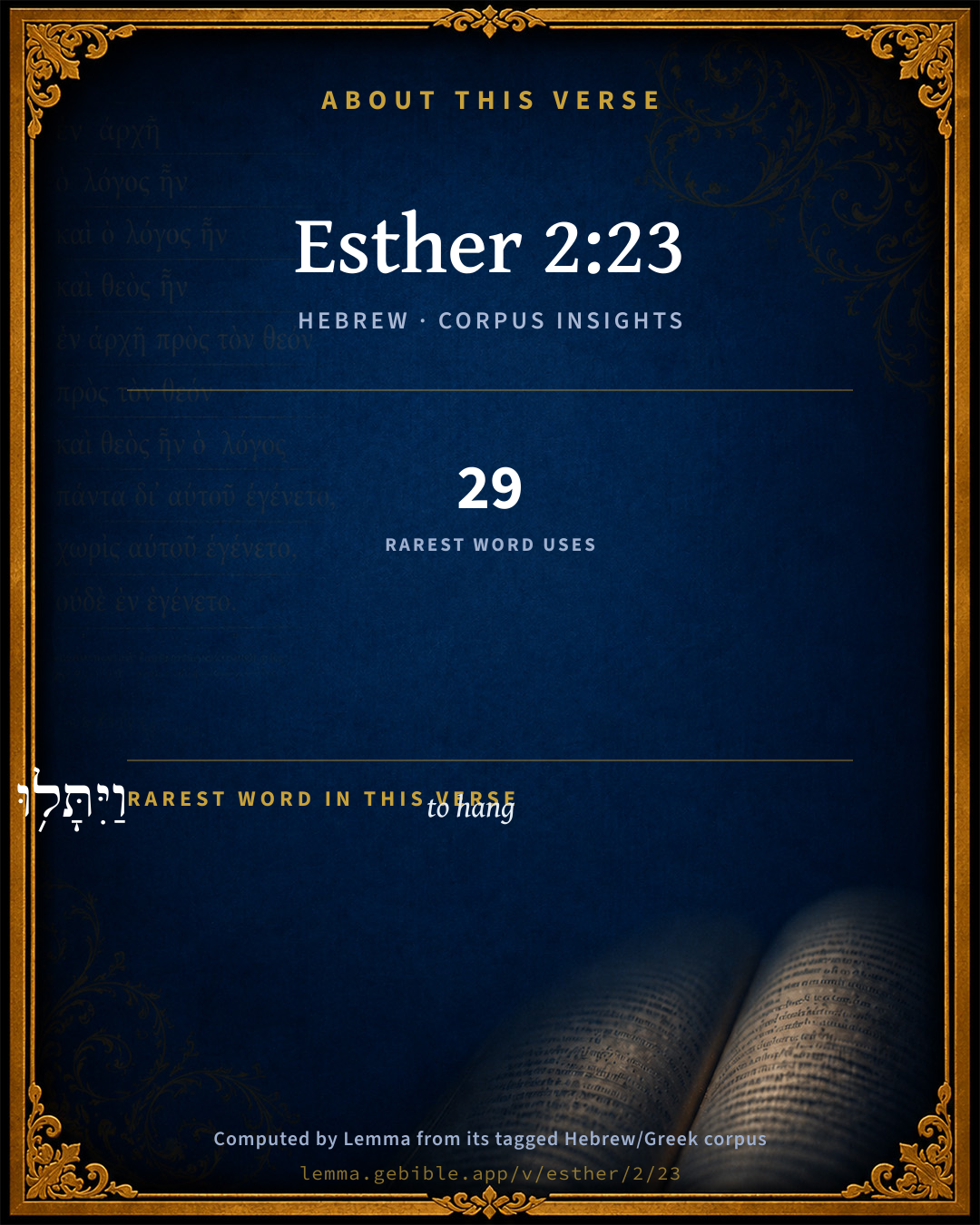
These counts appear in no published source. They are computed here, from the morphology-tagged text and Lemma’s own curated glosses. What Lemma adds →

13
words
12
distinct lemmas
Historical
section

Shared distinctive vocabulary

וַיִּתָּל֥וּ to hang H8518 occurs in 27 verses of the Hebrew Bible. Also found in:

Grammatical profile

  • 4 verbs
  • 7 nouns
  • 1 adjective
  • 1 preposition

Verb forms

  • וַיְבֻקַּ֤שׁ Pual · Sequential Imperfect
  • וַיִּמָּצֵ֔א Niphal · Sequential Imperfect
  • וַיִּתָּל֥וּ Niphal · Sequential Imperfect
  • וַיִּכָּתֵ֗ב Niphal · Sequential Imperfect

Repetition

A word recurs within this verse — often emphatic in Hebrew:

  • הַדָּבָר֙ word H1697 ×2

Hebrew & Septuagint length

In English translation the verse runs 34 words from the Hebrew and 35 from the Septuagint (LXX English) — closely comparable.

A rough comparison of the two English renderings, which tokenize alike — not a word-level alignment.

Word counts can differ between the Hebrew and the Greek without any difference in meaning — e.g. the Hebrew direct-object marker אֵת has no separate Greek word, and Greek often adds the article ὁ.

Cross-references

8

Topical passages linked to Esther 2:23 in the Treasury of Scripture Knowledge — connected by theme and wording, ordered by reader-vote popularity; previews shown in the World English Bible.

  • Genesis 40:19 Within three more days, Pharaoh will lift up your head from off you, and will hang you on a tree; and the birds will eat your flesh from off you."
  • Genesis 40:22 but he hanged the chief baker, as Joseph had interpreted to them.
  • Esther 10:2 All the acts of his power and of his might, and the full account of the greatness of Mordecai, whereunto the king advanced him, aren't they written in the book of the chronicles of the kings of Media and Persia?
  • Deuteronomy 21:22–23 If a man have committed a sin worthy of death, and he be put to death, and you hang him on a tree;
  • Joshua 8:29 The king of Ai he hanged on a tree until the evening: and at the going down of the sun Joshua commanded, and they took his body down from the tree, and cast it at the entrance of the gate of the city, and raised thereon a great heap of stones, to this day.
  • Esther 5:14–6:2 Then said Zeresh his wife and all his friends to him, Let a gallows be made fifty cubits high, and in the morning speak you to the king that Mordecai may be hanged thereon: then go you in merrily with the king to the banquet. The thing pleased Haman; and he caused the gallows to be made.
  • Esther 7:10 So they hanged Haman on the gallows that he had prepared for Mordecai. Then was the king's wrath pacified.
  • Malachi 3:16 Then those who feared Yahweh spoke one with another; and Yahweh listened, and heard, and a book of memory was written before him, for those who feared Yahweh, and who honored his name.

Cross-references courtesy of OpenBible.info (CC BY 4.0).

Hebrew and Greek witnesses Masoretic Hebrew ↔ Greek Septuagint

The same verse in the two great witnesses to the Old Testament, shown verse-for-verse.

These are two independent witnesses, not word-aligned to each other, and the Septuagint is shown in lemma (dictionary) form.

Hebrew Esther 2:23 Masoretic · Westminster Leningrad Codex

וַיְבֻקַּ֤שׁ הַדָּבָר֙ וַיִּמָּצֵ֔א וַיִּתָּל֥וּ שְׁנֵיהֶ֖ם עַל עֵ֑ץ וַיִּכָּתֵ֗ב בְּסֵ֛פֶר דִּבְרֵ֥י הַיָּמִ֖ים לִפְנֵ֥י הַמֶּֽלֶךְ

When inquisition was made of the matter, and it was found to be so, they were both hanged on a tree: and it was written in the book of the chronicles before the king.

World English Bible · Public Domain

Greek LXX Esther 2:23 Septuagint · lemma form

ὁ δέ βασιλεύς ἐτάζω ὁ δύο εὐνοῦχος καί κρεμάζω αὐτός καί προςτάσσω ὁ βασιλεύς καταχωρίζω εἰς μνημόσυνον ἐν ὁ βασιλικός βιβλιοθήκη ὑπέρ ὁ εὔνοια μαρδοχαῖος ἐν ἐγκώμιον

And the king examined the two chamberlains, and hanged them: and the king gave orders to make a note for a memorial in the royal records of the good offices of Mardochaeus, as a commendation.

LXX2012 (modern English Septuagint) · Public Domain

On this verse, Adam Clarke's Commentary discusses the Septuagint’s reading. Read the note in Commentary ↓

Hebrew: Westminster Leningrad Codex (CC BY 4.0). Greek: Septuagint (public domain); English from LXX2012 (modern English Septuagint) (Public Domain). How the Septuagint differs from the Hebrew →

Commentary

Notes on Esther 2:23 from classic Christian and Jewish commentators (each source and its license shown beneath its notes). The classic Christian expositions comment on the surrounding passage and are grouped to its opening verse, so a note may address several verses; the Jewish commentaries on the Tanakh (Rashi and others) are per-verse, so they appear only where the commentator wrote on this verse.

Lemma curates 59 commentaries, every one of them public domain or Creative Commons licensed, each selected and text-cleaned for this edition rather than reprinted as found. About our sources →

Trapp's Complete Commentary

John Trapp

Est 2:23 And when inquisition was made of the matter, it was found out; therefore they were both hanged on a tree: and it was written in the book of the chronicles before the king.

Ver. 23. And when inquisition was made of the matter] The king neither slighted this accusation, nor too hastily believed it. Not this, lest he should discover a needless fear, or precipitate a wrong sentence. Not that, lest he should betray his own life, and put all into a confusion, as Gedaliah did, Jer 40:13-16; Jer 41:1-3, and as he in the history did, who, being forewarned by a letter of a dangerous plot laid for his life, laid aside the letter with these words, εις αυριον τα σπουδαια, Tomorrow we will mind these serious businesses, but ere the morrow he was despatched. The matter was here inquired into, saith the text, lest haply it might be misreported, and so the innocent be punished. Or, if not innocent, yet doth our law condemn any before his cause be heard? Surely Pilate and Festus were far better judges than Caiaphas and Lysias, for they would execute a man in the morning, and then sit upon him in the afternoon. Aeneas Sylvius, in his twentieth chapter of Europe, tells of some places, wherein, if anyone be suspected of theft, he is forthwith taken and trussed up. Three days after they judge the suspicion; and if they find the man guilty, they let his carcase hang till it rot; as if otherwise, they take it down, and bury it honourably at the public charge. This is preposterous justice, judgment turned into gall, and righteousness into hemlock.

It was found out] As treason usually is, and strangely: witness those in Queen Elizabeth’s reign, and the gunpowder plotters. Creighton, the Jesuit, a Scot, falling into Scotland, and being taken by certain Netherland pirates, had torn certain papers in pieces; but the torn pieces, being thrown out of the ship, were blown back again by the wind, and cast by a providence into the ship, not without a miracle, as Creighton said himself; which, being set together, by Wade, with much labour and singular cunning, discovered new designs of the pope and his agents here against England, A.D. 1585 (Cared. Eliz.). Detexit facinus fatuus et non implevit, saith Tacitus of one about his time. Either the traitor’s own tongue shall betray him (as it befell those two sent by Mahomet to kill Scanderbeg), or the fowls of heaven shall reveal the mischief, and that which hath wing shall tell the matter, Ecc 10:20 (it was a piece of a wing, a quill, that discovered that hellish gunpowder plot), or some other way it shall be found out, as here, and the conspirators brought to condign punishment.

Therefore they were both hanged on a tree] Traitors, like bells, will be never well tuned till well hanged, till they have worn a Tyburn tippet, as father Latimer phrased it. Campian, that spider, was swept down by the hand of justice, and drew his last thread in the triangle of Tyburn. His words in his epistle to the honourable counsellors of Queen Elizabeth were these, Quamdiu vel unus quispiam e nobis supererit qui Tyburno vestro fruatur, &c., As long as there is any one of us left to enjoy your Tyburn, &c. Much joy may they have of it, since it is their ambition, and may their quarters be set as high as that false Edric’s head once was by King Canute, viz. upon the highest part of the tower of London, therein performing his promise to a traitor, of advancing him above any lord of the land.

And it was written in the book of the chronicles] Heb. In the book of the words of days, in the diary of the kings, or in the book of remembrance. As the Jews, so the Persians, had their chronicles or public commentaries, wherein all memorable acts were recorded, and scribes or historiographers for that purpose appointed and maintained. Plutarch writeth, that at that great naval battle between Themistocles and the Persians, Xerxes sat in a throne of gold, and saw the conflict, having many scribes about him, whose office was to set down all that was done that day. This was a commendable custom, and might be a motive to their kings and great ones to take heed of doing aught that they would not have registered and read by succeeding ages. Suetonius telleth us that Augustus upon this account forbade his daughter and nieces to say or do anything that they would not have to be chronicled (Suet. in August.).

Before the king] Perhaps in his presence, and for his special use. though Mordecai’s good service was soon forgotten, God forgat not to recompense Ahasuerus’s love to Esther and courtesy to her people, by detecting and defeating those conspirators that sought his life. But he soon forgets Mordecai, God’s instrument for his deliverance, though the matter were written in a book before him; hence he goes noted with a black coal for his ingratitude. Tamerlane had a catalogue of the names of such as had best deserved of him, which he daily perused, oftentimes saying that day to be lost wherein he had not given them something. There was a providence in it that nothing was yet done for Mordecai. God’s time is the best, and we shall one day say so; neither is there anything lost by waiting his leisure, he bottles up our tears, he books up our sighs, he writes down all we say or do in his roll of remembrance, Mal 3:6; Mal 3:16. {See Trapp on "Mal 3:6"} {See Trapp on "Mal 3:16"}

John Trapp, A Commentary or Exposition upon All the Books of the Old and New Testament (1647–1656) — public domain. Text from a community e-Sword module.

Joseph Benson's Commentary

Est 2:23. It was written in the book of the Chronicles — A day-book, wherein all memorable things were recorded. Before the king — This may refer either, 1st, To the writing of it, signifying that it was written in the king’s presence by scribes, who were continually with the king, to record all remarkable things which happened in the court from time to time: or, 2d, To the book, which was laid up before the king, that he might more easily and frequently peruse it for his own direction or amusement. Here we see the danger and infelicity of the greatest men, the life of a most potent monarch depending upon the fidelity of one single person, whose service was neglected by the court, though a memorial was made of it. Thus all masters of families are obnoxious to the perfidiousness, of those that wait upon them.

Joseph Benson's Commentary on the Old and New Testaments (1811–1818) — public domain. Text from a community e-Sword module.

Tyndale Open Study Notes

Tyndale Open Resources

2:23 impaled on a sharpened pole (literally hanged on a tree, or hanged on wood): This phrase has traditionally been translated hanged on a gallows, but inscriptions from ancient Persia show that impalement was a standard form of execution. Xerxes’ father, Darius I, claimed to have impaled 3,000 Babylonians when he conquered Babylon. Sometimes criminals were executed first and then displayed on a stake, as with the execution of Haman’s sons (9:5-14). • This was all recorded: Mordecai was not rewarded until much later (6:1-14). • While various records of Xerxes’ reign have been found, the particular book mentioned here no longer exists.

Tyndale Open Study Notes — © Tyndale Open Resources, licensed CC BY-SA 4.0. Text via the HelloAO Bible API.

Adam Clarke's Commentary

Verse 23. It was found out] It was proved against them, in consequence of which they were hanged. Perhaps the words vaiyittalu al ets, they were hung upon wood or a tree, may refer to their being impaled. A pointed stake is set upright in the ground, and the culprit is taken, placed on the sharp point, and then pulled down by his legs till the stake that went in at the fundament passes up through the body and comes out by the side of the neck. A most dreadful species of punishment, in which revenge and cruelty may glut the utmost of their malice. The culprit lives a considerable time in excruciating agonies.

It has been observed that the name of God does not once occur in this book. This is true of the Hebrew text, and all translations from it; but in the Septuagint we find the following words, in Es 2:20, after, Esther had not showed her kindred: Οὑτως γαρ ενετειλατο αυτῃ Μαρδοχαιος, φοβεισθαι τον Θεον, και ποιειν τα προσταγματα αυτου, καθως ην μετ' αυτου; "For so Mordecai had charged her to fear GOD, and to keep his commandments, as she did when with him." This, as far as the Septuagint is concerned, takes away the strange reproach from this book. It must be owned that it was not because there were not many fair opportunities that the sacred name has not been introduced.

Adam Clarke's Commentary on the Bible (1810–1826) — public domain. Text from a community e-Sword/MySword module.

Ellicott's Commentary for English Readers

(23) Hanged on a tree.—Were crucified; a common punishment among the Persians, especially on rebels (Herod. iii. 120, 125, 159, &c). The dead body of Leonidas was crucified by Xerxes’ orders after the desperate stand at Thermopylæ.

Book of the chronicles.—A sleepless night of Xerxes accidentally brought this matter, after it had been forgotten, before the king’s mind. Herodotus often refers to these Persian Chronicles (vii. 100; viii. 85, 90).

A Bible Commentary for English Readers, edited by Charles John Ellicott (1878–1897) — public domain. Text from a community e-Sword module.

The Cambridge Bible for Schools and Colleges

gen. ed. J. J. S. Perowne

23. And when inquisition … on a tree] The LXX. have more briefly, ‘And the king examined the two eunuchs and hung them.’ The word ‘examined’ probably means by torture.

hanged on a tree] crucified or impaled. Such was the form of capital punishment inflicted upon political offenders in Persia (Herod. iii. 159, iv. 43).

the book of the chronicles] Herodotus (viii. 90) tells us that historiographers were attached to Xerxes’ court, and moved with it from place to place. Thus these chronicles recorded facts and events of State importance. Doubtless they were written on materials more perishable than the burnt clay tablets, which have been found in the vicinity of Babylon and elsewhere, and which have fortunately transmitted to us public occurrences of their time. Ctesias (see on Est_1:2) pretended that records set down by Persian chroniclers were the sources from which he drew his information. We may compare the acta diurna of the Roman Empire, referred to in Tacitus (Ann. xiii. 31). The ‘chronicles’ mentioned in the text here are referred to again in Est_6:1, Est_10:2. Cp. Ezr_4:15.

before the king] under his supervision, if not actually in his presence.

The Cambridge Bible for Schools and Colleges (gen. ed. J. J. S. Perowne; Cambridge University Press, 1878–1918) — public domain. Text from a community e-Sword module.

John Gill's Exposition

And when inquisition was made of the matter, it was found out,.... That these two men had entered into a conspiracy to take away the king's life; full proof and evidence were given of it:

therefore they were both hanged on a tree; Josephus (e) says they were crucified; but hanging was frequent among the Persians, as Grotius observes, and better agrees with the word here used:

and it was written in the book of the chronicles before the king; in a diary kept by the king's order, in which memorable events were set down, and might be done in the presence of the king, as well as the book lay open before him to read at any time; and this is observed to agree with the manner of Xerxes, who is reported (f) to sit on a throne of gold to behold a sea fight between the Grecians and Persians, and had several scribes by him to take down whatever was done in the fight.

(e) Ibid. (Antiqu. l. 11. c. 6. sect. 4.) (f) Plutarch. in Themistocle.

Next: Esther Chapter 3

John Gill's Exposition of the Whole Bible (1746–1763) — public domain (CC PDM 1.0). Text via the HelloAO Bible API.

Albert Barnes' Notes on the Bible

Both hanged on a tree - i. e. “crucified” or “impaled” the ordinary punishment of rebels and traitors in Persia.

The book of the chronicles - Ctesias drew his Persian history from them, and they are often glanced at by Herodotus.

Albert Barnes' Notes on the Bible (1834–1885) — public domain. Text from a community e-Sword/MySword module.

Haydock's Catholic Bible Commentary

King. Such histories were preserved with great care, 1 Esdras vi. 1. (Calmet) --- Septuagint, "the king ordered a memorial to it to be kept in the royal library, for the praise of Mardochai’s good will." (Haydock) --- The latter also wrote an account, chap. xii. 4.

George Leo Haydock (1774–1849), Haydock's Catholic Family Bible and Commentary, 1859 edition — public domain. Excludes Psalms (Douay-Rheims chapter numbering differs from Protestant) and Deuterocanonical books (Catholic canon only).

Matthew Poole's English Annotations

This may be referred, either,

1. To the writing, to note that this was written in the king’s presence by scribes, who were continually present with the king to write all remarkable passages happening in the court from time to time. Or,

2. To the book, which was laid up before the king, that he might more easily and frequently peruse it for his own delight or direction.

Matthew Poole's English Annotations on the Holy Bible (1683–1685) — public domain. Text from a community e-Sword/MySword module.

Whedon's Commentary on the Bible

Daniel D. Whedon

23. Hanged on a tree — This punishment was performed by the Persians by crucifying or impaling. Grecian writings and the Behistun inscription frequently mention this kind of execution. The criminal was sometimes first slain, but generally impaled alive.

The book of the chronicles — Official records, made and kept by the royal scribes, and constituting a body of state papers or annals. See note on Ezr_4:15, 2Sa_8:17, and Introduction to Kings, on the sources.

Daniel D. Whedon (gen. ed.), Commentary on the Old and New Testaments (1874–1909) — public domain. Text from a community e-Sword module.

The Pulpit Commentary

It was found out. The subsequent history shows that Mordecai"s information was found to be correct, since he was ultimately adjudged to have deserved the highest possible reward. (Est_6:6-10) The two conspirators were condemned to death and hanged on a tree, i.e. crucified or impaled, as traitors and rebels commonly were in Persia (see Herod., 3 159; 4:43; "Behist. Inscr.," col. 2. pars. 13, 14 Col 3. par. 8). And it was written in the book of the chronicles. Historiographers were attached to the Persian court, and attended the monarch wherever he went. We find them noting down facts for Xerxes at Doriscus (Herod., 7:100), and again at Salamis (ibid. 8:90). They kept a record something like the acta diurna of the early Roman empire (Tacit., "Ann.," 13:31), and specially noted whatever concerned the king. Ctesias pretended to have drawn his Persian history from these "chronicles" ( up. Diod. Sic., 2:32), and Herodotus seems to have obtained access to some of them (see the writer"s "Herodotus," Introduction, ch. 1.h p. 56). Before the king. i.e. "in the king"s presence." This was not always the case; but when the matter was very important the king exercised a supervision over what was written.

HOMILIES BY F. HASTINGS

Ver. 23.

Convicted conspirators.

when inquisition was made of the matter, it was found out." Two men, Bigthan and Teresh, had a grievance. The king"s favouritism may have pained them, or their own ambition galled them. Absolute systems of government, like that in Persia, generally foster conspiracies. Kings have always been "fair marks for traitors." Queens also have shared this danger. Our Queen Elizabeth said," In trust I found treason;" and, "I marvel not so much that I am, as that I am not." Bigthan and Teresh, owing to their position as chamberlains, had every opportunity of poisoning the king when awake, or assassinating him when asleep. They had a plan, and were as careful to keep it to themselves as possible; but it became known, and "inquisition was made of the matter, etc.

I THE MOST CAREFULLY-CONCEALED PLANS ARE LIABLE TO BE MARRED BY UN-THOUGHT-OF INSTRUMENTALITY. It is right to plan for success in our lawful under- takings. We should have no plans but such as those on which we can ask God"s blessing. To plot against the welfare of others is always dangerous. Plotters are ever likely to "hoist with their own petard." Accident may mar our plottings. A word dropped, or a look passed, may betray. There is generally some Mordecai who carries the whisper to an Esther, and an Esther who carries it to the one most interested. Sometimes God directly thwarts wicked planning. Pharaoh said, "I will pursue," etc., but God "blew with his wind." "They sank as lead in the mighty waters.

II UNWORTHY PLANNINGS ARE OFTEN SUBJECT TO THE KEENEST SEARCHINGS. The king made thorough investigation into the matter. He did not condemn on mere hearsay or suspicion. Many, in the anxiety to protect self, are seized with prejudice which hinders just deliberation. A watch was set. Manners, companions, places of resort were marked. Inquisition was made.

III ALL WRONG-DOING WILL SOONER OR LATER BE DISCOVERED. "The thing was found out." Bigthan and Teresh learned their folly when suffering impalement, the usual punishment of traitors in Persia. They might not have been discovered. Wickedness is sometimes successful in this world, and evades justice. That which may escape detection by men cannot pass the eye of God. Ahasuerus little knew what was in the hearts of those men, but God knew. Bigthan and Teresh would have served Ahasuerus as Ehud did Egion, or Joab, Abner. Learn

1. That there will be inquiry into our lives, our acts and motives.

2. That none will be exempt from the searching.

3. That we should take warnings given in kindness.

Suppose Ahasuerus had paid no heed to Mordecai"s warning; he would have lost crown, throne, and life. H.

Written, but not remembered.

was written in the book of the chronicles before the king." The king had been delivered from danger, but he seems to have overlooked the deliverer. Ahasuerus had at least one faithful subject, Mordecai. This man had proved his loyalty by his acts, while Bigthan and Teresh paid the penalty of disloyalty by being hung. Criminals and the righteous were alike spoken of, in the chronicles of the king.

I MAN, EVEN WHEN HE PROMISES TO REMEMBER BENEFITS, IS LIKELY TO FORGET. Ahasuerus commanded Mordecai"s act to be recorded. He intended to reward him. Mordecai doubtless expected some recognition of his services, but he was for a long time disappointed. It is a "black blot" on the name of Ahasuerus that he forgot his indebtedness.

II GOD NEVER FORGETS MAN"S GOOD ACTS OR EVEN KINDLY THOUGHTS. All are written in his book of remembrance. (Mal_3:16) He, the King of kings, gives reward beyond our deserts. We should remember how much we owe to Christ, who is the good Mordecai who warns and saves us. We should write it in our memories that we owe everything to him for his grace and forbearance. Not until we reach the other world, and look over life"s history, shall we know how much we owe to him. H.

The Pulpit Commentary (1880–1919), ed. H.D.M. Spence-Jones & Joseph S. Exell — public domain. Text from a community e-Sword module.

The Annotated Bible

Arno C. Gaebelein

ESTHER CHOSEN QUEEN AND MORDECAI’S DISCOVERY

CHAPTER 2

1. The suggestion (Est 2:1-4)

2. Mordecai and Esther introduced (Est 2:5-7)

3. Esther brought to the king’s house (Est 2:8-11)

4. Esther chosen as queen (Est 2:12-18)

5.Mordecai’s discovery and exposure of the plot (Est 2:19-23)

Est 2:1-4. This probably did not happen immediately after the feast. We learn this from verse 16 in this chapter. He took Esther in the place of Vashti in the seventh year of his reign, but the feast described in the opening chapter happened in the third year. About four years elapsed. During these years, profane history tells us, Ahasuerus (Xerxes I), undertook a campaign against Greece with which many misfortunes were connected. He must have returned exhausted and unhappy. Then his conscience spoke. He probably missed the companionship of Vashti and he remembered her and what was decreed against her. But why did the monarch not take Vashti back into favor and forgive her, if remorse troubled him? As nothing more is said of Vashti it is more than probable that she was put to death. Perhaps the unfortunate war, the great losses he had sustained, were looked upon by the king as being the punishment for his drunken wrath against the queen. Then the courtiers made their suggestions which is in fullest keeping with the customs of Persia and still practised by oriental sultans and shahs. Fair young virgins are to be brought to the harem, the house of the women, under the custody of Hegai, the king’s chamberlain and keeper of the women. The king was well pleased with this suggestion.

“One cannot but admire the simple, quiet historical style of our narrative. Laying aside all the reports which only would prolong our way of coming to the essential part of the contents of the book, there is nothing omitted which would contribute to the historical and psychological introduction and illustration. How much is necessary to happen before Israel could have ready help in time of need! What great things, according to the external appearance, must precede, in order to make it possible that a Jewish girl by the influence of her charms ascend the throne of the Persian Empire! The great conference of all the officers of the state, the dreadful war with Greece, and the unfortunate issue of the same, were they not in the hands of Providence so many stepping stones in the path of Esther’s ascendancy? in order to replace the loss of Vashti, a woman of equal endowments must be sought for the king, wherever and however it might be! How many things must subserve to the frustration of Haman’s wicked plan! The wrath of Xerxes against Greece, and his wrath against his wife. Court intrigues against the powerful influences of a wife, and the vain conceit of offended sovereignty? First drunkenness, then homicidal passion, then new excited sensuality, were the sad instruments which preceded Israel’s redemption.

“When the people were delivered, they could well be penitent when they considered the way in which Vashti--though not herself guiltless--was one of the main causes of their deliverance. And if deep penitence must have resulted from the reflection that a woman like Vashti had to die a violent death in order that the people of God should live,--what kind of penitence must the thought call forth when we remember that Christ gave His Life in order that Israel and the Gentiles might live” (Professor P. Cassel).

Est 2:5-7. These verses introduce us now to the leading actors in this book. Mordecai, the Jew, was the son of Jair, the son of Shimei, the son of Kish, a Benjamite; who had been carried away from Jerusalem with the captives which had been carried away with Jechoniah king of Judah, whom Nebuchadnezzar the king of Babylon had carried away.

Here we face one of the inconsistencies charged by higher criticism. But their mistake is quite apparent. They claim that Mordecai belonged to the captives carried away by Nebuchadnezzar. Then they say, that being the case Mordecai must have been over 130 years old and Esther at least 70 years. But does it say that Mordecai was carried away at the time of King Jechoniah? It was not Mordecai who was carried away but his great-grandfather Kish. “The clear and instructive intentions of the historian in this genealogical passage are evident. He points out, through the enumeration of the four generations from Kish to Mordecai, the time which elapsed since the banishment of Jechoniah, which took place before the destruction of the temple. The period of about 120 or more years which since then elapsed to the sixth year of Xerxes are exactly expressed by the four generations. We have also some intimation concerning the period of the narrative, which is assigned to the reign of Xerxes I. That Kish was a Benjamite, is only told for the purpose of distinguishing him from other men with the same name who belonged to the tribe of Levi. One might have thought it impossible that Biblical expositors should commit the mistake of making the information concerning the exile of Jechoniah refer to Mordecai himself--an idea for which there is neither textual nor historical foundation, but rather both against it” (Professor Cassel). Mordecai had brought up Hadassah. She was an orphan, fair of form and good of countenance, his uncle’s daughter. Mordecai had adopted her. Hadassah means “myrtle” and Esther “star.” Critics have identified the name Esther with Babylonian goddess Isthar (similar to Ashtoreth), and they also claim that Hadassah was the Babylonian title for the same goddess. But such statements are mere inventions.

Est 2:8-11. Esther on account of her great beauty was taken with the many other virgins in obedience to the King’s command. Jewish tradition informs us that Mordecai, her guardian and second father, had kept her concealed, in order not to be obliged to deliver her to the royal agents, but people who knew her, and who had not seen her for some time drew the attention of the agents to the concealment. She with the others is placed in charge of Hegai the keeper of women. In all we see the hand of the Lord preparing step by step the help needed for the preservation and deliverance of His people during the approaching crisis. And Esther pleased Hegai; he showed her kindness. This kindness was expressed in furnishing her the means of improving her appearance, such as cosmetics and perfumes, according to Oriental customs. Then she received no doubt beautiful garments and jewelry to enhance her person still more. Then the best place in the house of the women was given to her and the seven maids who waited on her. (Very interesting and curious is the Jewish tradition concerning these seven servants. This tradition as preserved in the Targumim makes their names to correspond with the work of the six days of creation. Thus the fourth maid-servant’s name was “Starlight” because on the fourth day the heavenly bodies came into view. Remarkable is the name of the maid who attended her on the sixth day--Friday; her name was “Lamb.” On the seventh day, the Sabbath, the servant’s name, who waited on her was “Rest”‘ she reminded Esther of the Sabbath. And the Servant who attended her on the day after the Sabbath (Our Lord’s day) bore the name of the mystical bird Phoenix, the symbol of light, rising out of the fire and out of death. It is certainly interesting, to say the least, to find such traditional statements.)

And Esther had not showed her people and her kindred. This was done on the advice of Mordecai. This has been characterized as deception, extraordinary adroitness, and cowardice. It was neither. Divine Providence ordered it thus. Inasmuch as Esther’s parents were dead such concealment of nationality was not difficult; had her parents lived it would have been next to impossible. Had it been known that she belonged to the alien race, intrigues for her destruction would have soon been set afoot. Haman’s wicked endeavour may even then have been in process of planning. Mordecai walking daily before the court of the women’s house, proves his great concern for his adopted daughter.

Est 2:12-18. The description of Est 2:12-14 is a perfect picture of Persian customs and the licentiousness of Persian and other Oriental rulers. In due time Esther’s turn came to be presented to the king. “She required nothing.” Professor Cassel in his exposition gives the best exposition of this statement. The other women could not find enough artificial means with which to make an impression upon the king. But Esther cared nothing about these things. She had no such ambitious desires. Her heart did not burn to become something illustrious, yet unbecoming to a Jewess. Reluctantly she must have left her home, and reluctantly she must have put on the ornaments. She was wanted, and was ordered to appear, and therefore she obeyed Hegai and allowed herself to be prepared for the occasion. She was compelled to be there, while no doubt in heart she detested the whole affair.

She was brought in to the king. Attracted by her beauty he set the royal crown upon her head and the Jewish maiden became queen in the place of Vashti. This took place in the month Tebeth in the seventh year of the reign of Ahasuerus.

Then a great feast was made, even Esther’s feast, a release was made, probably a release of prisoners and taxes and gifts were bestowed. God in His providence.

Est 2:19-23. This paragraph contains another important providential event which in the subsequent history plays a very leading part. The opening words of verse 19 have been pronounced obscure by critics. “And when the virgins were gathered together the second time.” Jewish expositors have explained this as meaning a conspiracy, that the enemies of the new queen had collected more virgins so that in some way Esther might be eclipsed and placed into the background. It is claimed by others that the words “the second time” should be omitted from the text as there is some doubt about them. If this is done the statement would then refer to the gathering of the virgins mentioned in the eighth verse of the chapter. But the suggestion that the second gathering was an act of conspiracy might be the true meaning; it would show the purpose of the unseen enemy and it also explains the watchfulness of Mordecai. He sat at the king’s gate. It was according to oriental custom a place of public resort, where news was heard and conversation with friends and others were carried on. The suggestion by some that Mordecai sat in the king’s gate because he was an official of the government must be dismissed as incorrect.

Est 2:20 informs us of two interesting facts. Esther did not disclose her nationality and she continued in humble obedience to her foster father as if she were still under his roof and not the great queen. The royal glory and dignity which surrounded her on all sides had not affected her in the least. She had not forgotten that the whole royalty was not a matter of pleasure to her, but only an act of obedience, the providential purpose of which she did not know, but which she found out afterward. Her interest was with Mordecai outside and not with the royal splendour inside.

Let us note the providential leading in all this. If Esther had revealed her connection, if it had become known that Mordecai at the gate was her uncle and she his adopted daughter, he would not have remained in the obscure position before the gate. Then the conspirators would have been cautious and not spoken within the hearing of such a person so closely related to the queen. The knowledge of the planned attempt upon the life of the King Mordecai owed to the fact that nobody knew who he was and therefore paid no attention to him.

The conspirators were Bigthan and Teresh. They sought to lay hands on the king. According to Jewish tradition they intended to put a venomous reptile in the king’s cup when he was about to drink. The plot was overheard by Mordecai who at once communicated the fact to Esther and she told the king of it in the name of Mordecai. She did so guided by the divine hand, which is so evident in this remarkable history. The plot is at once investigated and the report is found true. The conspirators were hanged and the event is historically recorded in the book of the Chronicles. (King Ahasuerus, Xerxes, lost his life by assassination in 465 B.C. Artaban, the commander of his cavalry, conspired with Mithridates, his confidential chamberlain, who admitted him into the king’s bedroom, and Artaban stabbed him to death while he slept.)

Esther had saved the king’s life by giving him the report of Mordecai. And Mordecai received no reward. His faithfulness was evidently forgotten; but God had ordered it all.

Typical Applications

Dispensationally Esther typifies the Jewish remnant, which will be called by the King of Israel, our Lord, when Gentile-Christendom has been disowned and set aside for its unfaithfulness, as Vashti was set aside. The parable of the good and the wild olive tree in Romans 11 is thus illustrated by Vashti and Esther. The branches of the wild olive tree--professing Christendom (but not the true Church) which were grafted in upon the root of the good olive tree (Israel and the Abrahamic covenant) on account of their failure will be cut out and cast aside. The broken off branches (the remnant of Israel) will be put back upon the root of the good olive tree. (See annotations on Romans 11, or for a fuller exposition read “The Jewish Question,” an exposition of Romans 11 by A.C. Gaebelein.) This remnant will then be brought into definite relationship with the Lord, pass through the period of the great tribulation, foreshadowed in Haman’s wicked Plot, and then receive the kingdom, be delivered and have part in the kingdom, as it was the case with Esther, Mordecai and the Jews at Shushan.

The gospel application is also of interest. The humble Jewish girl is raised to the place of a queen, to the place beside the King. She did not seek that place. It never entered into her mind to receive such a place. She was sought for. All this illustrates the gospel by which the beggar upon the dunghill is raised to sit amongst princes and to inherit the throne of glory (1 Samuel 2). She, who was a foreigner, becomes married to the king, to share his glory, his riches and his honors. And so the believing sinner becomes one spirit with the Lord, a member of His body “flesh of His flesh and bone of His bones,” to share His eternal glory and His eternal riches.

Arno C. Gaebelein, The Annotated Bible (1913–1922) — public domain. Text from a community e-Sword module.

Rashi

Rabbi Shlomo Yitzchaki (Rashi)

and it was written in the diary the favor that Mordecai did for the king.

Rashi on the Tanakh — English translations: “The Judaica Press complete Tanach with Rashi, translated by A. J. Rosenberg” (CC BY 4.0); “Pentateuch with Rashi's commentary by M. Rosenbaum and A.M. Silbermann, 1929-1934” (public domain); “The Metsudah Tanach series, Lakewood, N.J” (CC BY 4.0); and “The Book of Joshua, Metsudah Publications, 1997” (CC BY 4.0). Text via Sefaria.

Lesson kit

Teaching starters — assembled from the data on this page, not authored interpretation. Every prompt links to the verse data it draws on. Edit before teaching.

Esther, in the Historical, opens this verse with 13 words (12 distinct Hebrew lemmas). Its most distinctive word is tâlâh (“to hang”). A historical commentator’s framing appears above. Read the whole chapter for the surrounding context.

Discussion questions

  1. The word tâlâh carries the sense “to hang.” How does it shape the verse?
  2. Genesis 40:19 shares the word «to hang» with this verse. How do the two illuminate each other?
  3. “word” occurs 2× in this one verse. What is the effect of the repetition?
  4. The translations on this page render this verse differently — a whole-verse word diff, not a word-by-word alignment. What might account for the different wordings?
  5. The verb «וַיְבֻקַּ֤שׁ» is Pual Sequential Imperfect. How does its form color the action?
  6. Reading how Trapp's Complete Commentary and Joseph Benson's Commentary read this verse, where do the two commentators agree and where do they part?

Things to notice

Reading settings

Reading text

Shown beneath each verse's original-language words.

Old Testament
Old Testament edition

Read the OT as the Masoretic Hebrew (MT) or the Greek Septuagint (LXX).

English shown for the Greek Septuagint (in the Hebrew ↔ Greek comparison).

Comparing translations? Open the Compare panel on any verse page to stack up to four side by side.