

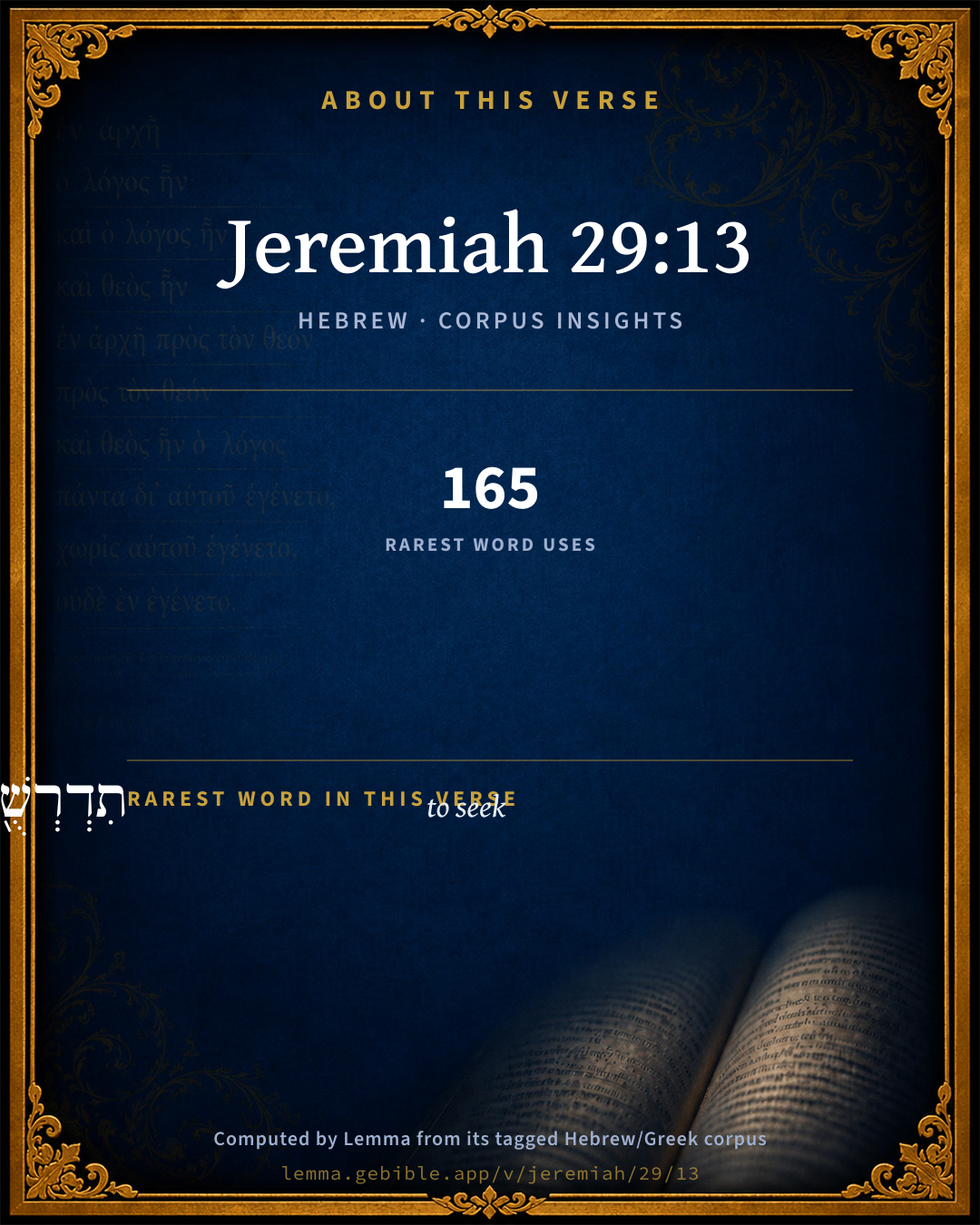
Jeremiah 29:13

Hebrew (Westminster Leningrad Codex) Jeremiah 29:13 appears in the Hebrew Old Testament. The text above is from the Westminster Leningrad Codex. Each word links to its Strong’s number, a concise gloss, and parsing drawn from the Open Scriptures Hebrew Bible morphology. Click any word for its full Brown-Driver-Briggs (BDB) entry.
Download image
Cite this verse

Jeremiah 29:13 (World English Bible). Public Domain. Lemma interlinear Bible study tool, https://lemma.gebible.app/v/jeremiah/29/13.

Show BibTeX & RIS
BibTeX
RIS
English Translation
You shall seek me, and find me, when you shall search for me with all your heart.
World English Bible · Public Domain
Download a study sheet

One document with this verse’s original text, its word-by-word gloss line, the meaning frame, cross-references with their text, attributed commentary, and full source and license credits — printable, and it pastes into notes with its structure intact.

This verse Autodidact and up

Study sheet (.html) Plain text (.txt)

A passage Seminary Student

Up to 50 verses in one chapter. A passage sheet keeps up to 6 commentary sources and 12 cross-references per verse, in the order this page ranks them, and says so on the sheet whenever that leaves anything out. Ask for a single verse and you get the Autodidact verse sheet above.

Everything on this page stays free to read, with no account — the sheet is a download of what is already on screen, not access to it.

Want to remove ads? Support Godless Engineer
Compare translations 3

The same verse in 3 English versions, stacked beneath the original-language interlinear above. Click any original word for its lexicon entry.

Each is an independent rendering of the whole verse — the interlinear is not word-aligned to these translations.

Highlighted words mark where these versions differ — a whole-verse word diff, not a word-by-word alignment.

  • World English Bible Public Domain
    You shall seek me, and find me, when you shall search for me with all your heart.
  • King James Version Public Domain
    And ye shall seek me, and find me, when ye shall search for me with all your heart.
  • unfoldingWord Literal Text CC BY-SA 4.0
    For you will seek me and find me, since you will seek me with all your heart.

unfoldingWord Literal Text — © unfoldingWord, licensed CC BY-SA 4.0. Word-aligned USFM3 via Door43 (git.door43.org/unfoldingWord/en_ult).

Versions to compare (up to 4)

3 of 4 selected

Show all 18 translations

Every available English version of this verse, each an independent rendering of the whole verse.

  • World English Bible Public Domain
    You shall seek me, and find me, when you shall search for me with all your heart.
  • Berean Standard Bible Public Domain
    You will seek Me and find Me when you search for Me with all your heart.
  • Majority Standard Bible Public Domain
    You will seek Me and find Me when you search for Me with all your heart.
  • King James Version Public Domain
    And ye shall seek me, and find me, when ye shall search for me with all your heart.
  • American Standard Version (1901) Public Domain
    And ye shall seek me, and find me, when ye shall search for me with all your heart.
  • Revised Version (1885) Public Domain
    And ye shall seek me, and find me, when ye shall search for me with all year heart.
  • Geneva Bible (1599) Public Domain
    And ye shall seeke mee and finde mee, because ye shall seeke mee with all your heart.
  • Douay-Rheims (1899) Public Domain
    You shall seek me, and shall And me: when you shall seek me with all your heart.
  • Young's Literal Translation Public Domain
    And ye have sought Me, and have found, for ye seek Me with all your heart;
  • Literal Standard Version CC BY-SA 4.0
    and you have sought Me, and have found, for you seek Me with all your heart;
  • Unlocked Literal Bible CC BY-SA 4.0
    For you will seek me and find me, since you will seek me with all your heart.
  • unfoldingWord Literal Text CC BY-SA 4.0
    For you will seek me and find me, since you will seek me with all your heart.
  • Darby Bible Public Domain
    and ye shall seek me and find me, for ye shall search for me with all your heart,
  • World Messianic Bible Public Domain
    You shall seek me and find me, when you search for me with all your heart.
  • Webster's Bible Public Domain
    And ye shall seek me, and find me, when ye shall search for me with all your heart.
  • Free Bible Version CC BY-SA 4.0
    You will look for me and you will find me when you're completely committed to looking for me.
  • Bible in Basic English Public Domain
    And you will be searching for me and I will be there, when you have gone after me with all your heart.
  • JPS Tanakh (1917) Public Domain
    And ye shall seek Me, and find Me, when ye shall search for Me with all your heart.

Literal Standard Version (2020), Covenant Press — licensed CC BY-SA 4.0. Text via the HelloAO Bible API (eBible.org). Unlocked Literal Bible (unfoldingWord) — licensed CC BY-SA 4.0. Text via the HelloAO Bible API (eBible.org). unfoldingWord Literal Text — © unfoldingWord, licensed CC BY-SA 4.0. Word-aligned USFM3 via Door43 (git.door43.org/unfoldingWord/en_ult). Free Bible Version, Dr. Jonathan Gallagher — licensed CC BY-SA 4.0. Text via the HelloAO Bible API (eBible.org).

Word by word

More ways to search: Search by grammar → Find every occurrence → Compare this word →

Practice this passage: Drill this verse → Learn its vocabulary →

תִדְרְשֻׁ֖נִי
dârash
H1875
“to seek · me”
Verb, Qal, Imperfect, 2nd Person, Masculine, Plural + Suffix, Personal, 1st Person, Common, Singular
Part of Speech
Verb
Stem
Qal
Form
Imperfect
Person
2nd Person
Gender
Masculine
Number
Plural
Full BDB Definition

Origin: a primitive root

TWOT: 455

to resort to, seek, seek with care, enquire, require - (Qal) - to resort to, frequent (a place), (tread a place) - to consult, enquire of, seek - of God - of heathen gods, necromancers - to seek deity in prayer and worship - God - heathen deities - to seek (with a demand), demand, require - to investigate, enquire - to ask for, require, demand - to practice, study, follow, seek with application - to seek with care, care for - (Niphal) - to allow oneself to be enquired of, consulted (only of God) - to be sought, be sought out - to be required (of blood)
  1. וּבִקַּשְׁתֶּ֥ם bâqash H1245 “and · to seek” Conjunction + Verb, Piel, Sequential Perfect, 2nd Person, Masculine, Plural
  2. אֹתִ֖י ʼêth H853 “- · me” Particle, Direct Object + Suffix, Personal, 1st Person, Common, Singular
  3. וּמְצָאתֶ֑ם mâtsâʼ H4672 “and · to find” Conjunction + Verb, Qal, Sequential Perfect, 2nd Person, Masculine, Plural
  4. כִּ֥י kîy H3588 “that” Conjunction
  5. בְּכָל kôl H3605 “in/at · all of” Preposition + Noun, Common, Masculine, Singular, Construct
  6. לְבַבְכֶֽם lêbâb H3824 “heart · your” Noun, Common, Masculine, Singular, Construct + Suffix, Personal, 2nd Person, Masculine, Plural

About this verse

These counts appear in no published source. They are computed here, from the morphology-tagged text and Lemma’s own curated glosses. What Lemma adds →

7
words
7
distinct lemmas
Prophets
section

Grammatical profile

  • 3 verbs
  • 2 nouns
  • 1 conjunction
  • 1 particle

Verb forms

  • וּבִקַּשְׁתֶּ֥ם Piel · Sequential Perfect
  • וּמְצָאתֶ֑ם Qal · Sequential Perfect
  • תִדְרְשֻׁ֖נִי Qal · Imperfect

Cross-references

25

Topical passages linked to Jeremiah 29:13 in the Treasury of Scripture Knowledge — connected by theme and wording, ordered by reader-vote popularity; previews shown in the World English Bible.

  • Deuteronomy 4:29–31 But from there you shall seek Yahweh your God, and you shall find him, when you search after him with all your heart and with all your soul.
  • Psalms 119:2 Blessed are those who keep his statutes, Who seek him with their whole heart.
  • Matthew 7:7 "Ask, and it will be given you. Seek, and you will find. Knock, and it will be opened for you.
  • Psalms 119:10 With my whole heart, I have sought you. Don't let me wander from your commandments.
  • Jeremiah 24:7 I will give them a heart to know me, that I am Yahweh: and they shall be my people, and I will be their God; for they shall return to me with their whole heart.
  • Joel 2:12 "Yet even now," says Yahweh, "turn to me with all your heart, And with fasting, and with weeping, and with mourning."
  • Psalms 91:15 He will call on me, and I will answer him. I will be with him in trouble. I will deliver him, and honor him.
  • Luke 11:9–10 "I tell you, keep asking, and it will be given you. Keep seeking, and you will find. Keep knocking, and it will be opened to you.
  • Isaiah 55:6–7 Seek you Yahweh while he may be found; call you on him while he is near:
  • Psalms 119:145 I have called with my whole heart. Answer me, Yahweh! I will keep your statutes.
  • 2 Chronicles 31:21 In every work that he began in the service of the house of God, and in the law, and in the commandments, to seek his God, he did it with all his heart, and prospered.
  • Psalms 119:58 I sought your favor with my whole heart. Be merciful to me according to your word.
  • 2 Chronicles 6:37–39 yet if they shall repent themselves in the land where they are carried captive, and turn again, and make supplication to you in the land of their captivity, saying, We have sinned, we have done perversely, and have dealt wickedly;
  • 2 Chronicles 22:9 He sought Ahaziah, and they caught him (now he was hiding in Samaria), and they brought him to Jehu, and killed him; and they buried him, for they said, He is the son of Jehoshaphat, who sought Yahweh with all his heart. The house of Ahaziah had no power to hold the kingdom.
  • Amos 5:4–6 For thus says Yahweh to the house of Israel: "Seek me, and you will live;
  • 1 Kings 8:47–50 yet if they shall repent themselves in the land where they are carried captive, and turn again, and make supplication to you in the land of those who carried them captive, saying, We have sinned, and have done perversely, we have dealt wickedly;
  • Zephaniah 2:1–3 Gather yourselves together, yes, gather together, you nation that has no shame,
  • 2 Kings 23:3 The king stood by the pillar, and made a covenant before Yahweh, to walk after Yahweh, and to keep his commandments, and his testimonies, and his statutes, with all [his] heart, and all [his] soul, to confirm the words of this covenant that were written in this book: and all the people stood to the covenant.
  • Psalms 119:69 The proud have smeared a lie upon me. With my whole heart, I will keep your precepts.
  • Deuteronomy 30:1–20 It shall happen, when all these things are come on you, the blessing and the curse, which I have set before you, and you shall call them to mind among all the nations, where Yahweh your God has driven you,
  • Hosea 5:15–6:3 I will go and return to my place, until they acknowledge their offense, And seek my face. In their affliction they will seek me earnestly."
  • Jeremiah 3:10 Yet for all this her treacherous sister Judah has not returned to me with her whole heart, but only in pretense, says Yahweh.
  • 1 Kings 2:4 That Yahweh may establish his word which he spoke concerning me, saying, If your children take heed to their way, to walk before me in truth with all their heart and with all their soul, there shall not fail you (said he) a man on the throne of Israel.
  • Leviticus 26:40–45 "'If they confess their iniquity, and the iniquity of their fathers, in their trespass which they trespassed against me, and also that, because they walked contrary to me,
  • Psalms 32:6 For this, let everyone who is godly pray to you in a time when you may be found. Surely when the great waters overflow, they shall not reach to him.

Cross-references courtesy of OpenBible.info (CC BY 4.0).

Hebrew and Greek witnesses Masoretic Hebrew ↔ Greek Septuagint

The same verse in the two great witnesses to the Old Testament, shown verse-for-verse.

These are two independent witnesses, not word-aligned to each other, and the Septuagint is shown in lemma (dictionary) form.

Hebrew Jeremiah 29:13 Masoretic · Westminster Leningrad Codex

וּבִקַּשְׁתֶּ֥ם אֹתִ֖י וּמְצָאתֶ֑ם כִּ֥י תִדְרְשֻׁ֖נִי בְּכָל לְבַבְכֶֽם

You shall seek me, and find me, when you shall search for me with all your heart.

World English Bible · Public Domain

Greek LXX Structure differs

In the Septuagint, Jeremiah is about an eighth shorter than the Hebrew and arranges its material differently — the Oracles Against the Nations (Hebrew chapters 46–51) appear in the middle of the Greek book, after 25:13. Because the chapter and verse boundaries do not line up, a verse-for-verse comparison with the Hebrew is not shown.

A verse-for-verse comparison isn’t shown here because the chapters and verses don’t line up. Switch to the LXX edition with the MT / LXX toggle above to read the Greek directly.

Hebrew: Westminster Leningrad Codex (CC BY 4.0). Greek: Septuagint (public domain); English from a public-domain English Septuagint. How the Septuagint differs from the Hebrew →

Targum (Aramaic paraphrase)

1

The Targum is the ancient Jewish Aramaic paraphrase of the Hebrew Scriptures — an interpretive translation, not the Hebrew text itself. Onkelos (literal) and Pseudo-Jonathan (expansive) render the Torah, and Jonathan the Prophets. Coverage is partial: where no permissively-licensed English translation exists for a verse, only the Aramaic is shown. This is verse-level text, not a word-by-word alignment to the Hebrew.

  1. Targum Jonathan Prophets (Joshua–Malachi)
    וְתִתְבְּעוּן דְחַלְתִּי וְתִשְׁכְּחוּן אֲרֵי תְבָעוּ מִן קֳדָמַי בְּכָל לִבְּכוֹן:

    (no public-domain English translation for this verse)

    Targum Jonathan — Aramaic: “Mikraot Gedolot” (public domain). English: “Sefaria Community Translation” (CC0 1.0 (public-domain dedication)); “London "Chaldee Paraphrase," 1871” (public domain). Text via Sefaria.

Commentary

Notes on Jeremiah 29:13 from classic Christian and Jewish commentators (each source and its license shown beneath its notes). The classic Christian expositions comment on the surrounding passage and are grouped to its opening verse, so a note may address several verses; the Jewish commentaries on the Tanakh (Rashi and others) are per-verse, so they appear only where the commentator wrote on this verse.

Lemma curates 59 commentaries, every one of them public domain or Creative Commons licensed, each selected and text-cleaned for this edition rather than reprinted as found. About our sources →

Trapp's Complete Commentary

John Trapp

Jer 29:13 And ye shall seek me, and find [me], when ye shall search for me with all your heart.

Ver. 13. When ye shall search for me with all your heart.] Not with a piece of your heart only, as do partialists and double minded men, qui in parabola ovis capras quaerunt. who search for a nanny goat instaed of sheep. Johannes Groppcrus, of Colen, refused a cardinalship, but forsook the gospel. So Luther did not, who, when he was offered to be cardinal if he would be quiet, replied, No, not if I might be Pope. {a}

{a} Sleidan.

John Trapp, A Commentary or Exposition upon All the Books of the Old and New Testament (1647–1656) — public domain. Text from a community e-Sword module.

Geneva Bible (1599)

Geneva Bible translators

When your oppression shall be great, and your afflictions cause you to repent your disobedience, and also when the seventy years of your captivity shall be expired, 2 Chron. 36:22; Ezra 1:1; Jer. 25:12; Dan. 9:2.

Geneva Bible (1599) marginal notes — public domain. Text via Bolls.life.

Jamieson, Fausset & Brown

Robert Jamieson, A. R. Fausset & David Brown

(Lev 26:40-42, Lev 26:44-45).

Jamieson, Fausset & Brown — Commentary Critical and Explanatory on the Whole Bible (1871) — public domain (CC PDM 1.0). Text via the HelloAO Bible API.

John Calvin's Commentaries

He confirms in other words the same thing; and yet the repetition, as we said yesterday, is not useless; for as the Jews perversely despised all threatenings, so it was difficult for them to receive any taste of God’s goodness from his promises. This then is the reason why the Prophet employs many words on this subject. By the word seek, he means prayers and supplications, as mentioned in the last verse. And Christ also, exhorting his disciples to pray, says, “Seek and ye shall find, knock and it shall be opened to you.” There is no doubt but that he speaks there of prayer; he yet adopted various modes of speaking, derived from the common habits of men. But to seek, when we feel the need of God’s grace, is nothing else than to pray. Hence the Prophet says, ye shall seek me and ye shall find me And though he addresses here the Israelites, yet this doctrine ought to be extended to the whole Church; for God testifies that he will be propitious to all who flee to him.

But as hypocrites are abundantly noisy, and seem to surpass the very saints in the ardor of their zeal, when the external profession is only regarded, the Prophet adds, Because ye shall seek me with your whole heart There is no doubt but that the Jews groaned a thousand times every year when oppressed by the Chaldeans; for they had to bear all kind of reproaches, and then they had nothing safe or secure. They were therefore under the necessity, except they were harder than iron, to offer some prayers. But God shews that the seasonable time would not come, until their prayers proceeded from a right feeling; this he means by the whole heart. It is indeed certain that men never turn to God with their whole heart, nor is the whole heart ever so much engaged in prayer as it ought to be; but the Prophet sets the whole heart in opposition to a double heart. Perfection, then, is not what is to be understood here, which can never be found in men, but integrity or sincerity.

We now then perceive the meaning of the Prophet’s words, — that the Jews, when they began in earnest to flee to God, would find him propitious, provided only they did this in sincerity of heart and not in dissimulation; and also that this would not take place soon, for their hardness and obstinacy were greater than that they could be brought to repent in a short time. Therefore God reminds them that there was need of many evils, so that they might at length turn and divest themselves of that perverseness to which they had wholly surrendered themselves.

Now the whole of this, as I have already observed, ought to be applied to the benefit of the Church; for this promise is to be extended to all the godly, — that when they call on God in their miseries, he will hear them. And Jeremiah seems to have taken this sentence from Isaiah,

“As soon as thou callest on me, I will hear thee; before thou speakest, I will stretch forth my hand.” (Isaiah 58:9)

And this circumstance also ought to be noticed, that the Prophet addressed the Jews who were miserably oppressed. Let us then know that this sentence is rightly addressed to those in distress, who seem to have God against them and displeased with them; and this is the seasonable time which is mentioned by David in Psalm 32:6.

This passage also teaches us, that it is no wonder that the Lord doubles his scourges and does not immediately pardon us, because we are not so ready to bend as to return to him on the first day. He is therefore constrained by our perverseness to chastise us for a longer time; and yet this promise is still to be held valid, that if we even late repent, God will be still propitious to us, only that the reprobate are not under this pretext to indulge in their vices; for we see that profane men trifle with God, and wickedly abuse his paternal indulgence. Let the sinner then beware lest he should lay up for himself a store of vengeance, if he waits till the end of life. But there is still a hope set before those who have been long torpid in their sins, that if they at length come, though late, they shall still come in time, for God will hear them. But the exception ought to be carefully observed, that God will not be intreated, except he is sought with the whole heart, that is, in sincerity. So there is no reason for us to wonder that his ears are often closed to our prayers, because we only pretend to seek him, and that we are endued with no sincerity appears from our life. It now follows, —

John Calvin's Commentaries (1540-1563) — public domain. Text from the Calvin Translation Society English edition (1840s-50s) via the Christian Classics Ethereal Library (ccel.org). Calvin's coverage is partial (roughly two-thirds of the Bible); uncommented books and verses are honest gaps, never fabricated. The 19th-century editor's footnotes and remarks are omitted so the notes are faithfully Calvin's own voice.

John Gill's Exposition

And ye shall seek me, and find me,.... When persons seek the Lord aright, they always find him; a God hearing prayer; a God in Christ; bestowing favours upon them; granting them his presence; indulging them in communion with him; and favouring them with fresh supplies of his grace, and everything needful for them; every mercy, temporal and spiritual; that is, when they seek him in Christ, who is the only way to the Father, under the guidance and influence of the blessed Spirit; in the exercise of faith upon him and his promises; with fervency of spirit and ardour of mind; with diligence and importunity; with earnest desires and strong affections; and, as follows, with all sincerity of soul:

when ye shall search for me with all your heart; which, as Calvin rightly observes, does not design perfection, but integrity and sincerity; when they draw nigh with a true heart, and call upon him in truth, and search for him with eagerness, with a hearty desire to find him, as men search for gold, and silver, and hid treasure.

John Gill's Exposition of the Whole Bible (1746–1763) — public domain (CC PDM 1.0). Text via the HelloAO Bible API.

Matthew Poole's English Annotations

That is, sincerely, as Psa 119:2.

Matthew Poole's English Annotations on the Holy Bible (1683–1685) — public domain. Text from a community e-Sword/MySword module.

The Pulpit Commentary

Seeking God with the whole heart.

I GOD MUST BE FOUND BEFORE BE CAN BE KNOWN AND ENJOYED. "He is not far from each one of us: for in him we live, and move, and have our being." Yet this natural nearness of God may be unrecognized by us, and may not be sufficient to bring us into the spiritual communion with him. The God of nature may be "the unknown God," or he may be recognized and yet not enjoyed as the "Portion" of the soul.

1. Sin hides the vision of God, and drives the soul into remote spiritual banishment from God, even though it cannot affect his physical presence.

2. Our natural limitations of thought and experience surround the idea of the Divine with mystery, and make us feel that though God is partly known there are still ways of God that are far beyond our ken, so that we exclaim in bewilderment and distress, "Verily, thou art a God that hidest thyself!" (Isa_45:15)

II TO BE FOUND, GOD MUST BE SEARCHED FOR WITH THE WHOLE HEART.

1. He must be searched for. God does discover himself to men unexpectedly, as to Hagar in the desert and to Moses on Horeb, though we may rest assured that even such exceptional revelations were made to souls whose habit it was to seek after him. Nevertheless before such experience, God draws near to those who do not seek him, to urge them to search and find him. (Isa_65:1) He seeks us before we seek him. Our search is the response of our hearts to his invitation. (Psa_27:8) But this search must be made. The promise of finding is attached to the condition of seeking. (Mat_7:7) The prodigal must return to his father before he can receive the welcome home. Men are waiting for God to visit them, reveal himself to them, do something that will bring them back to him. They may wait forever, and in vain. God is waiting for us. It is our part to arise and seek him.

2. This search must be with all the heart. The reason why we are disappointed of the answers of our prayers is often that our prayers are so insincere, so cold, so half-hearted. It is reasonable to expect God, the all-seeing, to answer our prayers, not according to the vigor of the language, but according to the fervency of our desires. If we value the knowledge and communion of God aright, we shall seek him with all the heart:

(1) with the heart, i.e. sincerely, spiritually, inwardly, not with mere formal inquiries; and

(2) with the whole heart, i.e. with singleness of purpose, intensity, earnestness.

III THE REWARD OF SEEKING GOD WITH ALL THE HEART WILL CONSIST IN FINDING HIM.

1. The search will be successful. God may not be found at first, or, being found, may not be recognized in the way expected. But Scripture and experience both testify to the utility and fruitfulness of the soul"s search after God. If we have not yet found, that may be because

(1) we have not sought with "all the heart;" or

(2) have not sought in the right way as far as our light and knowledge have indicated iti.e. humbly, penitently, and as Christians through Christ.

2. The success of the search will be its own reward. The finding of God is described as a blessing of the restoration. It will bring other and lower benefits in its train (ver. 14), but it is itself the greatest boon. "Blessed are they that seek God with all the heart, for they shall find him, that is enough for a perfect beatitude. To find God is to find our light, our rest, our home. To know him is life eternal; to commune with him is the joy of heaven.

The Pulpit Commentary (1880–1919), ed. H.D.M. Spence-Jones & Joseph S. Exell — public domain. Text from a community e-Sword module.

Lesson kit

Teaching starters — assembled from the data on this page, not authored interpretation. Every prompt links to the verse data it draws on. Edit before teaching.

Jeremiah, in the Prophets, opens this verse with 7 words (7 distinct Hebrew lemmas). Its most distinctive word is dârash (“to seek”). A historical commentator’s framing appears above. Read the whole chapter for the surrounding context.

Discussion questions

  1. The word dârash carries the sense “to seek.” How does it shape the verse?
  2. Deuteronomy 4:29–31 shares this passage’s theme. How do the two illuminate each other?
  3. These translations render this verse differently; the difference is in the English rendering, not the original. What questions does that raise?
  4. The verb «וּבִקַּשְׁתֶּ֥ם» is Piel Sequential Perfect. How does its form color the action?
  5. Reading how Trapp's Complete Commentary and Geneva Bible (1599) read this verse, where do the two commentators agree and where do they part?

Things to notice

Reading settings

Reading text

Shown beneath each verse's original-language words.

Old Testament
Old Testament edition

Read the OT as the Masoretic Hebrew (MT) or the Greek Septuagint (LXX).

English shown for the Greek Septuagint (in the Hebrew ↔ Greek comparison).

Comparing translations? Open the Compare panel on any verse page to stack up to four side by side.