
Psalms 63:9

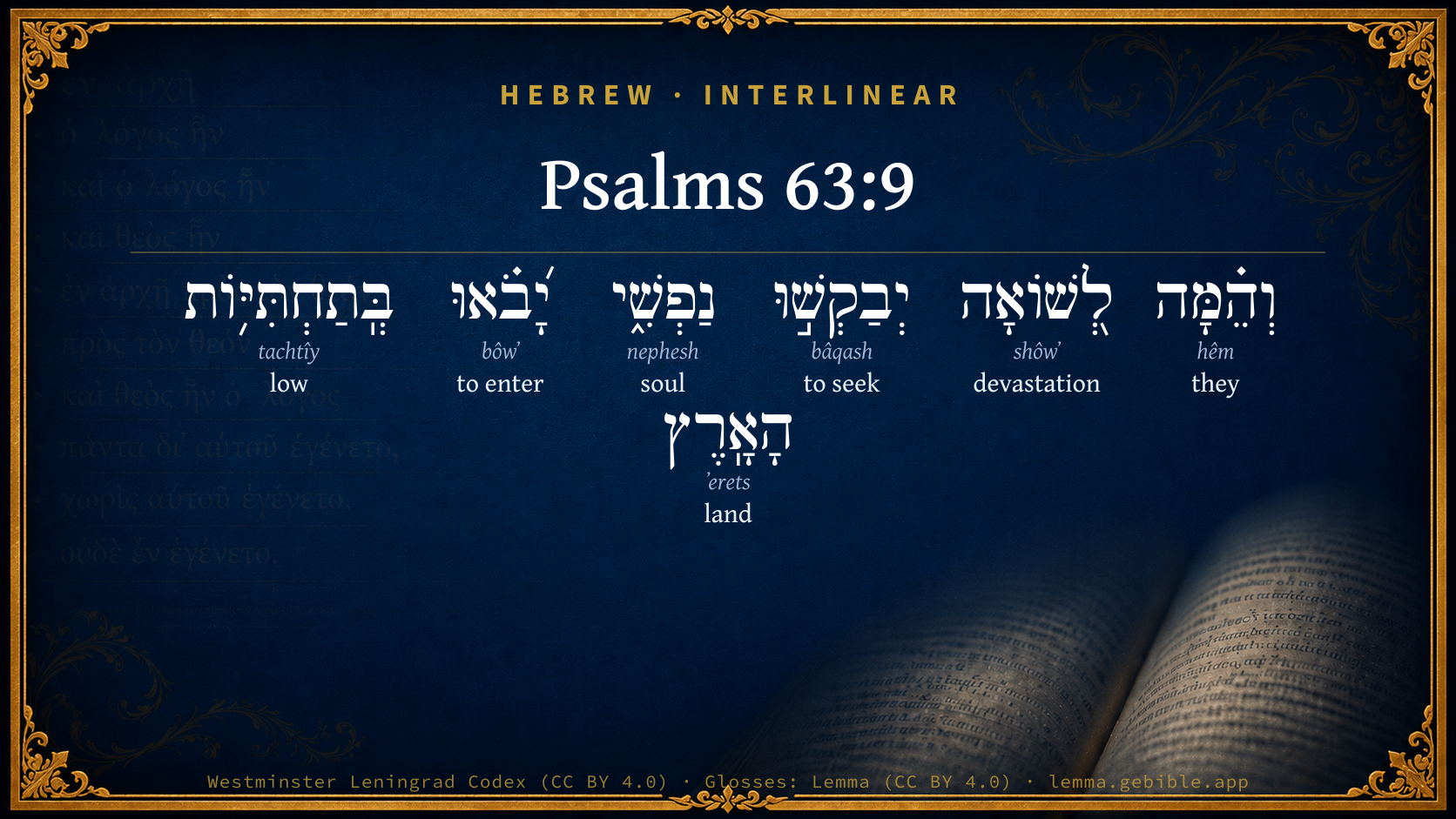
Hebrew (Westminster Leningrad Codex) Psalms 63:9 appears in the Hebrew Old Testament. The text above is from the Westminster Leningrad Codex. Each word links to its Strong’s number, a concise gloss, and parsing drawn from the Open Scriptures Hebrew Bible morphology. Click any word for its full Brown-Driver-Briggs (BDB) entry.
Download image
Cite this verse

Psalms 63:9 (World English Bible). Public Domain. Lemma interlinear Bible study tool, https://lemma.gebible.app/v/psalms/63/9.

Show BibTeX & RIS
BibTeX
RIS
English Translation
But those who seek my soul, to destroy it, Shall go into the lower parts of the earth.
World English Bible · Public Domain
Download a study sheet

One document with this verse’s original text, its word-by-word gloss line, the meaning frame, cross-references with their text, attributed commentary, and full source and license credits — printable, and it pastes into notes with its structure intact.

This verse Autodidact and up

Study sheet (.html) Plain text (.txt)

A passage Seminary Student

Up to 50 verses in one chapter. A passage sheet keeps up to 6 commentary sources and 12 cross-references per verse, in the order this page ranks them, and says so on the sheet whenever that leaves anything out. Ask for a single verse and you get the Autodidact verse sheet above.

Everything on this page stays free to read, with no account — the sheet is a download of what is already on screen, not access to it.

Want to remove ads? Support Godless Engineer
Compare translations 3

The same verse in 3 English versions, stacked beneath the original-language interlinear above. Click any original word for its lexicon entry.

Each is an independent rendering of the whole verse — the interlinear is not word-aligned to these translations.

Highlighted words mark where these versions differ — a whole-verse word diff, not a word-by-word alignment.

  • World English Bible Public Domain
    But those who seek my soul, to destroy it, Shall go into the lower parts of the earth.
  • King James Version Public Domain
    But those that seek my soul, to destroy it, shall go into the lower parts of the earth.
  • unfoldingWord Literal Text CC BY-SA 4.0
    But they, they seek my life for devastation; they will come into the lowest parts of the earth.

unfoldingWord Literal Text — © unfoldingWord, licensed CC BY-SA 4.0. Word-aligned USFM3 via Door43 (git.door43.org/unfoldingWord/en_ult).

Versions to compare (up to 4)

3 of 4 selected

Show all 18 translations

Every available English version of this verse, each an independent rendering of the whole verse.

  • World English Bible Public Domain
    But those who seek my soul, to destroy it, Shall go into the lower parts of the earth.
  • Berean Standard Bible Public Domain
    But those who seek my life to destroy it will go into the depths of the earth.
  • Majority Standard Bible Public Domain
    But those who seek my life to destroy it will go into the depths of the earth.
  • King James Version Public Domain
    But those that seek my soul, to destroy it, shall go into the lower parts of the earth.
  • American Standard Version (1901) Public Domain
    But those that seek my soul, to destroy it, Shall go into the lower parts of the earth.
  • Revised Version (1885) Public Domain
    But those that seek my soul, to destroy it, shall go into the lower parts of the earth.
  • Geneva Bible (1599) Public Domain
    Therefore they that seeke my soule to destroy it, they shall goe into the lowest partes of the earth.
  • Douay-Rheims (1899) Public Domain
    my soul hath stuck close to thee: thy right hand hath received me.
  • Young's Literal Translation Public Domain
    And they who for desolation seek my soul, Go in to the lower parts of the earth.
  • Literal Standard Version CC BY-SA 4.0
    And they who seek my soul for desolation, || Go into the lower parts of the earth.
  • Unlocked Literal Bible CC BY-SA 4.0
    But those who seek to destroy my life will go down into the lowest parts of the earth;
  • unfoldingWord Literal Text CC BY-SA 4.0
    But they, they seek my life for devastation; they will come into the lowest parts of the earth.
  • Darby Bible Public Domain
    But those that seek my soul, to destroy [it], shall go into the lower parts of the earth;
  • World Messianic Bible Public Domain
    But those who seek my soul to destroy it shall go into the lower parts of the earth.
  • Webster's Bible Public Domain
    \\63:8\\My soul followeth hard after thee: thy right hand upholdeth me.
  • Free Bible Version CC BY-SA 4.0
    Those who are trying to destroy me will go down into the grave.
  • Bible in Basic English Public Domain
    But those whose desire is my soul's destruction will go down to the lower parts of the earth.
  • JPS Tanakh (1917) Public Domain
    (63-10) But those that seek my soul, to destroy it, shall go into the nethermost parts of the earth.

Literal Standard Version (2020), Covenant Press — licensed CC BY-SA 4.0. Text via the HelloAO Bible API (eBible.org). Unlocked Literal Bible (unfoldingWord) — licensed CC BY-SA 4.0. Text via the HelloAO Bible API (eBible.org). unfoldingWord Literal Text — © unfoldingWord, licensed CC BY-SA 4.0. Word-aligned USFM3 via Door43 (git.door43.org/unfoldingWord/en_ult). Free Bible Version, Dr. Jonathan Gallagher — licensed CC BY-SA 4.0. Text via the HelloAO Bible API (eBible.org).

Word by word

More ways to search: Search by grammar → Find every occurrence → Compare this word →

Practice this passage: Drill this verse → Learn its vocabulary →

About this verse

These counts appear in no published source. They are computed here, from the morphology-tagged text and Lemma’s own curated glosses. What Lemma adds →

7
words
7
distinct lemmas
Wisdom
section

Notable vocabulary

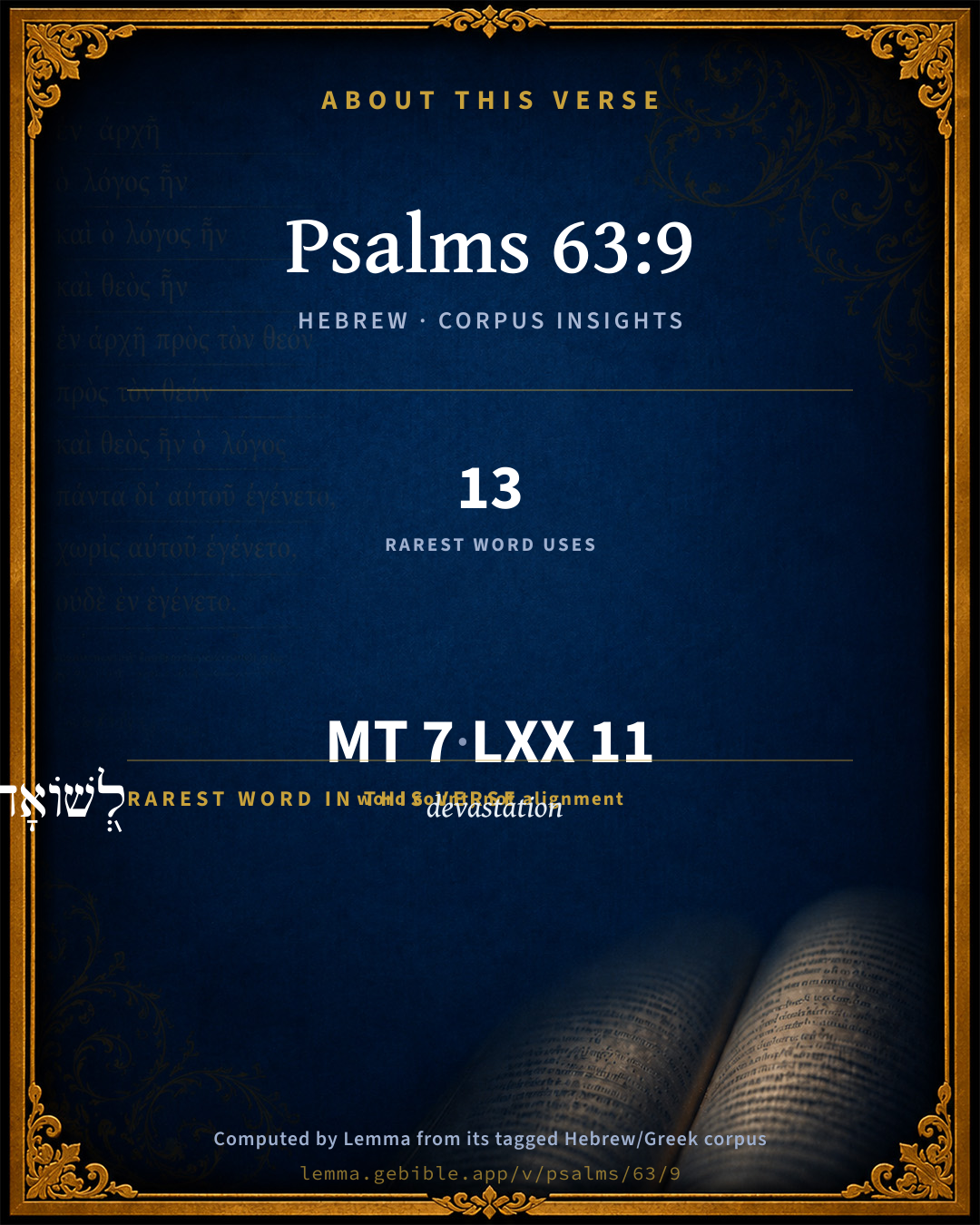
The rarest word here is לְ֭שׁוֹאָה devastation H7722 — appearing just 13 times in the whole Hebrew Bible.

Shared distinctive vocabulary

לְ֭שׁוֹאָה devastation H7722 occurs in 12 verses of the Hebrew Bible. Also found in:

Grammatical profile

  • 2 verbs
  • 3 nouns
  • 1 adjective
  • 1 pronoun

Verb forms

  • יְבַקְשׁ֣וּ Piel · Imperfect
  • יָ֝בֹ֗אוּ Qal · Imperfect

Hebrew & Septuagint length

In English translation the verse runs 18 words from the Hebrew and 17 from the Septuagint (LXX English) — closely comparable.

A rough comparison of the two English renderings, which tokenize alike — not a word-level alignment.

Word counts can differ between the Hebrew and the Greek without any difference in meaning — e.g. the Hebrew direct-object marker אֵת has no separate Greek word, and Greek often adds the article ὁ.

In the original languages it is 7 Hebrew tokens and 11 Greek tokens — but the two are counted differently (Hebrew bundles its prefixes and suffixes into one token; the Greek is in lemma form), so that isn’t a like-for-like length.

Cross-references

18

Topical passages linked to Psalms 63:9 in the Treasury of Scripture Knowledge — connected by theme and wording, ordered by reader-vote popularity; previews shown in the World English Bible.

  • Psalms 55:15 Let death come suddenly on them. Let them go down alive into Sheol. For wickedness is in their dwelling, in the midst of them.
  • Psalms 9:17 The wicked shall be turned back to Sheol, Even all the nations that forget God.
  • Psalms 40:14 Let them be disappointed and confounded together who seek after my soul to destroy it. Let them be turned backward and brought to dishonor who delight in my hurt.
  • 1 Samuel 25:29 Though men be risen up to pursue you, and to seek your soul, yet the soul of my lord shall be bound in the bundle of life with Yahweh your God; and the souls of your enemies, them shall he sling out, as from the hollow of a sling.
  • Numbers 16:30–33 But if Yahweh make a new thing, and the ground open its mouth, and swallow them up, with all that appertain to them, and they go down alive into Sheol; then you shall understand that these men have despised Yahweh.
  • Psalms 86:13 For your loving kindness is great toward me. You have delivered my soul from the lowest Sheol.
  • Isaiah 14:19 But you are cast forth away from your tomb like an abominable branch, clothed with the slain, who are thrust through with the sword, who go down to the stones of the pit; as a dead body trodden under foot.
  • Job 40:13 Hide them in the dust together. Bind their faces in the hidden place.
  • Psalms 35:4 Let those who seek after my soul be disappointed and brought to dishonor. Let those who plot my ruin be turned back and confounded.
  • Psalms 35:26 Let them be disappointed and confounded together who rejoice at my calamity. Let them be clothed with shame and dishonor who magnify themselves against me.
  • Psalms 38:12 They also who seek after my life lay snares. Those who seek my hurt speak mischievous things, And meditate deceits all day long.
  • Psalms 55:23 But you, God, will bring them down into the pit of destruction. Bloodthirsty and deceitful men shall not live out half their days, But I will trust in you.
  • Psalms 70:2 Let them be disappointed and confounded who seek my soul. Let those who desire my ruin be turned back in disgrace.
  • Isaiah 14:9 Sheol from beneath is moved for you to meet you at your coming; it stirs up the dead for you, even all the chief ones of the earth; it has raised up from their thrones all the kings of the nations.
  • Isaiah 14:15 Yet you shall be brought down to Sheol, to the uttermost parts of the pit.
  • Ezekiel 32:18–32 Son of man, wail for the multitude of Egypt, and cast them down, even her, and the daughters of the famous nations, to the lower parts of the earth, with those who go down into the pit.
  • 1 Samuel 28:19 Moreover Yahweh will deliver Israel also with you into the hand of the Philistines; and tomorrow shall you and your sons be with me: Yahweh will deliver the host of Israel also into the hand of the Philistines.
  • Acts 1:25 to take part in this ministry and apostleship from which Judas fell away, that he might go to his own place."

Cross-references courtesy of OpenBible.info (CC BY 4.0).

Hebrew and Greek witnesses Masoretic Hebrew ↔ Greek Septuagint

The same verse in the two great witnesses to the Old Testament, shown verse-for-verse.

You’re reading Greek Psalm 62 (Hebrew Psalm 63). The Septuagint counts the superscription, so verse numbers can differ from the Hebrew — chapter-level alignment, not verse-by-verse. Numbering follows Rahlfs.

These are two independent witnesses, not word-aligned to each other, and the Septuagint is shown in lemma (dictionary) form.

Hebrew Psalms 63:9 Masoretic · Westminster Leningrad Codex

וְהֵ֗מָּה לְ֭שׁוֹאָה יְבַקְשׁ֣וּ נַפְשִׁ֑י יָ֝בֹ֗אוּ בְּֽתַחְתִּיּ֥וֹת הָאָֽרֶץ

But those who seek my soul, to destroy it, Shall go into the lower parts of the earth.

World English Bible · Public Domain

Greek LXX Greek Psalm 62:9 Septuagint · lemma form

κολλάω ὁ ψυχή ἐγώ ὀπίσω σύ ἐγώ ἀντιλαμβάνω ὁ δεξιός σύ

But they vainly sought after my soul; they shall go into the lowest parts o the earth.

LXX2012 (modern English Septuagint) · Public Domain

On this verse, Keil & Delitzsch discusses the Septuagint’s reading. Read the note in Commentary ↓

Hebrew: Westminster Leningrad Codex (CC BY 4.0). Greek: Septuagint (public domain); English from LXX2012 (modern English Septuagint) (Public Domain). How the Septuagint differs from the Hebrew →

Commentary

Notes on Psalms 63:9 from classic Christian and Jewish commentators (each source and its license shown beneath its notes). The classic Christian expositions comment on the surrounding passage and are grouped to its opening verse, so a note may address several verses; the Jewish commentaries on the Tanakh (Rashi and others) are per-verse, so they appear only where the commentator wrote on this verse.

Lemma curates 59 commentaries, every one of them public domain or Creative Commons licensed, each selected and text-cleaned for this edition rather than reprinted as found. About our sources →

Trapp's Complete Commentary

John Trapp

Psa 63:9 But those [that] seek my soul, to destroy [it], shall go into the lower parts of the earth.

Ver. 9. But those that seek my soul to destroy it] Heb. Ad pracipitium, to hurl it down headlong, shall themselves be laid low enough, even in the slimy valley where are many already like them, and more (shall come after them), Job 21:31-32. And this assurance of his enemies’ downfall David had gotten by his meditations on God, Psa 63:6.

Shall go into the lower parts of the earth] i.e. Into the grave at least, if not into hell; they shall be abyssed into hell, into eternal perdition, saith Diodati.

John Trapp, A Commentary or Exposition upon All the Books of the Old and New Testament (1647–1656) — public domain. Text from a community e-Sword module.

The Treasury of David

Charles H. Spurgeon

Ver. 9. As David earnestly sought for God, so there were men of another order who as eagerly sought after his blood; of these he speaks:

But those that seek my soul, to destroy it. At his life they aimed, at his honour, his best welfare; and this they would not merely injure but utterly ruin. The devil is a destroyer, and all his seed are greedy to do the same mischief; and as he has ruined himself by his crafty devices, so also shall they. Destroyers shall be destroyed. Those who hunt souls shall be themselves the victims.

Shall go into the lower parts of the earth. Into the pits which they digged for others they shall fall themselves. The slayers shall be slain, and the grave shall cover them. The hell which they in their curse invoked for others shall shut its mouth upon them. Every blow aimed against the godly will recoil on the persecutor; he who smites a believer drives a nail in his own coffin.

Ver. 9-10. If the psalmist's divine longing was unquenched, so also was his faith; and in the latter part of the psalm he foretells with full assurance the final overthrow of his enemies. Nor did his denunciations fail to meet with a certain accuracy of fulfilment even in the battle by which his own deliverance was effected. The armies encountered in the wood of Ephraim, across the Jordan; there was "a greater slaughter that day of twenty thousand men; ""and the wood devoured more people that day than the sword devoured." That David's words concerning the lower parts of the earth, and the sword, and the foxes, had not been idly spoken: the pitfalls of the forest, and the swords of the royal pursuers, and the wild beasts that had there made their lairs, all effectually did their work; and the fate of the rebel army was shared by their leader, who, caught in the thick boughs of the oak, pierced through the heart by Joab, and cut down by his attendants, received no further funeral honours than to be cast "into a great pit in the wood, "and have "a very great heap of stones" laid upon him to cover him. Joseph Francis Thrupp, in "An Introduction to the Study and Use of the Psalms, "1860.

Ver. 9-10.

I. The enemies of the Christian. Evil spirits, evil

men, evil habits, etc., etc.

II. Their intent. To destroy the soul.

III. Their fall. Certain, shameful, destructive.

IV. Their future. Hell is reserved for them. G. J. K.

Psalms 63:10*

Ver. 9-10. See Psalms on "Ps 63:9" for further information.

Ver. 9-10.

I. The enemies of the Christian. Evil spirits, evil

men, evil habits, etc., etc.

II. Their intent. To destroy the soul.

III. Their fall. Certain, shameful, destructive.

IV. Their future. Hell is reserved for them G. J. K.

Psalms 63:11*

Charles H. Spurgeon's The Treasury of David (1869–1885) — public domain. Psalms only. Text from a community e-Sword/MySword module.

Joseph Benson's Commentary

Psa 63:9-10. But those that seek my soul, &c. — That seek to take away my life; shall go into the lower parts of the earth — Into the grave; and, if they repent not, into hell. God shall cut them off, and send them to their own place. Their enmity to David, and opposition to the counsel of God respecting him, he foresaw would be their death and their damnation, their ruin and their eternal ruin. They shall fall by the sword — Shall die in battle, as he foretold 1Sa 26:10, and as was accomplished in Saul and his followers, who were David’s greatest enemies. They shall be a portion for foxes — The carcasses of some of them shall lie unburied upon the earth, and thereby shall become a prey to wild and ravenous beasts, and especially to foxes, which abounded in those parts.

Joseph Benson's Commentary on the Old and New Testaments (1811–1818) — public domain. Text from a community e-Sword module.

Keil & Delitzsch

C. F. Keil & F. Delitzsch

The closing strophe turns towards these foes. By והמּה he contrasts with his own person, as in Psa 59:16., Psa 56:7., the party of the enemy, before which he has retreated into the desert. It is open to question whether לשׁואה is intended to be referred, according to Psa 35:17, to the persecuted one (to destroy my life), or, with Hupfeld, to the persecutors (to their own destruction, they themselves for destruction). If the former reference to the persecuted be adopted, we ought, in order to give prominence to the evidently designed antithesis to Psa 63:9, to translate: those, however, who..., shall go down into the depths of the earth (Bttcher, and others); a rendering which is hazardous as regards the syntax, after המּה and in connection with this position of the words. Therefore translate: On the other hand, those, to (their own) ruin do they seek my soul. It is true this ought properly to be expressed by לשׁואתם, but the absence of the suffix is less hazardous than the above relative rendering of יבּקּשׁוּ. What follows in Psa 63:10-11 is the expansion of לשׁואה. The futures from יבאוּ onwards are to be taken as predictive, not as imprecatory; the former accords better with the quiet, gentle character of the whole song. It shall be with them as with the company of Korah. תּחתּיּות הארץ is the interior of the earth down into its deepest bottom; this signification also holds good in Psa 139:15; Isa 44:23.

(Note: In this passage in Isaiah are meant the depths of the earth (lxx θεμέλια τῆς γῆς), the earth down to its inmost part, with its caverns, abysses, and subterranean passages. The apostle, however, in Eph 4:9 by τὰ κατώτερα τῆς γῆς means exactly the same as what in our passage is called in the lxx τὰ κατώτατα τῆς γῆς: the interior of the earth = the under world, just as it is understood by all the Greek fathers (so far as my knowledge extends); the comparative κατώτερος is used just like ἐνέρτερος.)

The phrase הגּיר על־ידי חרב here and in Jer 18:21; Eze 35:5 (Hiph., not of גּרר, to drag, tear away, but נגר, to draw towards, flow), signifies properly to pour upon = into the hands (Job 16:11), i.e., to give over (הסגּיר) into the power of the sword; effundent eum is (much the same as in Job 4:19; Job 18:18, and frequently) equivalent to effundetur. The enallage is like Psa 5:10; Psa 7:2., and frequently: the singular refers to each individual of the homogeneous multitude, or to this multitude itself as a concrete persona moralis. The king, however, who is now banished from Jerusalem to the habitation of jackals, will, whilst they become a portion (מנת = מנות), i.e., prey, of the jackals (vid., the fulfilment in Sa2 18:7.), rejoice in Elohim. Every one who sweareth by Him shall boast himself. Theodoret understands this of swearing κατὰ τὴν τοῦ βασιλέως σωτηρίαν. Hengstenberg compares the oath חי פרעה, Gen 42:15. Ewald also (217, f) assumes this explanation to be unquestionable. But the Israelite is to swear by the name of Jahve and by no other, Deu 6:13; Isa 65:16, cf. Amo 8:14. If the king were meant, why was it not rather expressed by הנשׁבּע לו, he who swears allegiance to him? The syntax does not help us to decide to what the בּו refers. Neinrich Moeller (1573) says of the בו as referred to the king: peregrinum est et coactum; and A. H. Franke in his Introductio in Psalterium says of it as referred to Elohim: coactum est. So far as the language is concerned, both references are admissible; but as regards the subject-matter, only the latter. The meaning, as everywhere else, is a searing by God. He who, without allowing himself to turn from it, swore by Elohim, the God of Israel, the God of David His anointed, and therefore acknowledged Him as the Being exalted above all things, shall boast himself or "glory," inasmuch as it shall be practically seen how well-founded and wise was this recognition. He shall glory, for the mouth of those who speak lies shall be stopped, forcibly closed, viz., those who, together with confidence in the Christ of God, have by falsehood also undermined the reverence which is due to God Himself. Psa 64:1-10 closes very similarly, and hence is placed next in order.

Keil & Delitzsch — Biblical Commentary on the Old Testament (1861–1891) — public domain (CC PDM 1.0). Text via the HelloAO Bible API. (Old Testament only.)

J. A. Alexander on Psalms

Joseph Addison Alexander

10. (Psa 63:9). And they to (their) ruin are seeking my soul; they shall go into the depths of the earth. The phrase to ruin has precisely the same sense as in Psa 35:8, namely, to their own destruction. Are seeking, will seek; the idea suggested by the future is, that if they still persist in seeking it, they will do so to their own destruction. Some obtain the same sense by a different construction, they (shall come) to ruin (who) are seeking my soul; but this supposes two ellipses, which are not to be assumed without necessity. Still less satisfactory is the construction which regards the whole verse as a single proposition: they (who) seek my soul to ruin (or destroy it) shall go, etc. To seek the soul implies a purpose of destruction, without any qualifying adjunct, even in prose. See 2Sa 16:11. The depths of the earth, literally its lower or lowest parts, which may simply mean the grave (as we say under ground), or contain an allusion to the fate of Korah and his company (Num 16:31-34). See above, on Psa 55:15.

Joseph Addison Alexander, The Psalms Translated and Explained (1850) — public domain. Text from a community e-Sword module.

Tyndale Open Study Notes

Tyndale Open Resources

63:9 The wicked were plotting to destroy the psalmist’s life through deception and lies, but they would meet their end. • The depths of the earth refers to the place of the dead.

Tyndale Open Study Notes — © Tyndale Open Resources, licensed CC BY-SA 4.0. Text via the HelloAO Bible API.

Jamieson, Fausset & Brown

Robert Jamieson, A. R. Fausset & David Brown

those . . . to destroy it--or literally, "to ruin," or, "for ruin"; that is, such as seek to injure me (are) for ruin, appointed to it (compare Psa 35:8).

shall go . . . earth--into the grave, or, to death; as their bodies are represented as a portion for--

Jamieson, Fausset & Brown — Commentary Critical and Explanatory on the Whole Bible (1871) — public domain (CC PDM 1.0). Text via the HelloAO Bible API.

Adam Clarke's Commentary

Verse 9. Lower parts of the earth.] They are appointed, in the just judgment of God, to destruction; they shall be slain and buried in the earth, and shall be seen no more. Some understand the passage as referring to the punishment of hell; which many supposed to be in the centre of the earth. So the old Psalter, - Thai sall entir in till lagher pine of hell. Lahher or laigher, lower, undermost.

Adam Clarke's Commentary on the Bible (1810–1826) — public domain. Text from a community e-Sword/MySword module.

John Calvin's Commentaries

9. And they, whilst they seek, etc. Here we find David rising to a more assured confidence, and triumphing as if he had already obtained the victory. And there is every reason to believe, that though he had escaped his difficulties, and was in circumstances of peace and prosperity when he wrote this psalm, yet he only expresses what he actually felt at the critical period when his life was in such imminent danger. He declares his conviction that the enemies who eagerly sought his life would be cut off; that God would cast them headlong into destruction; and that their very bodies should be left without burial. To be the portion of foxes, is the same thing with being left to be torn and devoured by the beasts of the field. It is often denounced as one judgment which should befall the wicked, that they would perish by the sword, and become the prey of wolves and of dogs, without privilege of sepulture. This is a fate which the best of men have met with in the world, — for good as well as bad are exposed to the stroke of temporal evil; — but there is this distinction, that God watches over the scattered dust of his own children, gathers it again, and will suffer nothing of them to perish, whereas, when the wicked are slain, and their bones spread on the field, this is only preparatory to their everlasting destruction.

John Calvin's Commentaries (1540-1563) — public domain. Text from the Calvin Translation Society English edition (1840s-50s) via the Christian Classics Ethereal Library (ccel.org). Calvin's coverage is partial (roughly two-thirds of the Bible); uncommented books and verses are honest gaps, never fabricated. The 19th-century editor's footnotes and remarks are omitted so the notes are faithfully Calvin's own voice.

The Cambridge Bible for Schools and Colleges

gen. ed. J. J. S. Perowne

9. But those &c.] They, his enemies, who are seeking his life, are emphatically contrasted with himself (Psa_59:15; Psa_56:6). While his path is upward to God, theirs is downward to the depths of Sheol. It is possible to render (cp. R.V. marg.) But they shall be destroyed that seek my life, They shall go &c.

into the lower parts of the earth] Into Sheol, swallowed up like Korah and his company of rebels. Cp. for the phrase, Isa_44:23; Eze_26:20; Psa_86:13; Eph_4:9; Deu_32:22 : and for the thought, Psa_9:15; Psa_9:17; Psa_55:15; Psa_55:23.

The Cambridge Bible for Schools and Colleges (gen. ed. J. J. S. Perowne; Cambridge University Press, 1878–1918) — public domain. Text from a community e-Sword module.

John Gill's Exposition

But those that seek my soul to destroy it,.... Meaning his life; for as for his soul, that was immaterial and immortal, and could never be destroyed by man: but as for his natural life, his enemies laid snares for that, and sought to take it away, and nothing less would satisfy them;

shall go into the lower parts of the earth; not the grave, whither the righteous go as well as the wicked; besides, by their being the portion of foxes, as follows, it seems that they should have no burial; but hell is meant, the bottomless pit. Some take it to be a prayer, as Kimchi and Ben Melech; "may they go", or "let them go", &c. see Psa 55:15. The allusion may be thought to be to the death of Korah and his company.

John Gill's Exposition of the Whole Bible (1746–1763) — public domain (CC PDM 1.0). Text via the HelloAO Bible API.

Albert Barnes' Notes on the Bible

But those that seek my soul to destroy it - Who seek my life; who endeavor to kill me. This language would well describe the purposes of Absalom and his followers.

Shall go into the lower parts of the earth - Shall descend into the earth; into the deepest graves. He would live; but they would perish.

Albert Barnes' Notes on the Bible (1834–1885) — public domain. Text from a community e-Sword/MySword module.

Matthew Poole's English Annotations

To destroy it, i.e. to take away my life.

Into the lower parts of the earth; either,

1. Into hell. Or rather,

2. Into their grave, as this phrase is used, Eze 31:14,18. But how is this true, when they are supposed to be devoured by foxes, Psa 63:10? Answ. This may be understood, either,

1. Of divers persons. Some of their slain might be buried, and others lie unburied. Or,

2. Of the same persons; they did go into the earth, but not immediately, but were first devoured of foxes, and the remainders of them were buried, as is frequently done in such cases. Or this phrase may note not so much the place as the state of the dead; this being universally said of those that die, whether they are buried or unburied, that they return to the earth or dust, Job 1:21; Ecc 12:7.

Matthew Poole's English Annotations on the Holy Bible (1683–1685) — public domain. Text from a community e-Sword/MySword module.

Whedon's Commentary on the Bible

Daniel D. Whedon

9. But those—He turns from these soul yearnings and sweet thoughts of God to the stern battle of life before him. The strong adversative force of the conjunction, joined to the pronoun, brings out the sharp contrast between him and his enemies.

That seek my soul, to destroy it—The order of the Hebrew words is, but they to destruction will seek after my soul, that is, to their own destruction, and so the parallel clause, they shall go, etc., shows that it is not what they intended for him, which is clearly enough implied, but what should overtake them, that he is speaking of. The word here rendered destruction radically denotes a loud noise, crash, and means tempestuous overthrow, ruin with a crash.

Lower parts of the earth—Not a periphrasis for grave, as elsewhere and as in Eph_4:9, for in Psa_63:10 he declares they shall be denied burial, and being a threatened punishment of bad men, it must be understood of punishment in sheol, or the future world, taking the phrase as synonymous with our Lord’s words, Joh_8:23 : “Ye are ‘εκ των κατω, (from the beneath,)” using beneath as antithetic to “τα ανω, (the above,)” in the same connexion; and more sharply defined Joh_8:44, “Ye are ‘εκ πατρος του διαβολους, (from your father the devil.)” And this is further evidence by their condition after death, Joh_8:21, “Whither I go ye cannot come,” a denunciation conditioned on their “dying in their sins,” which shows that he is speaking of the future state. In the same verse (Joh_8:23) our Lord says, “Ye are ‘εκ του κοσμου, (from the world,)” but κοσμος, world, here is to be taken figuratively in the morally bad sense of a state of society at enmity with God, as in Joh_15:8-9; 1Jn_2:15-16. Different is Joh_3:31, where εκ της γης, (of the earth,) is to be understood of humble, imperfect, perishable origin. It is clear, therefore, that both the psalmist and the Saviour, in the words in question, use language Hebraistically of future punishment.

Daniel D. Whedon (gen. ed.), Commentary on the Old and New Testaments (1874–1909) — public domain. Text from a community e-Sword module.

The Pulpit Commentary

But those that seek my soul, to destroy it, shall go into the lower parts of the earth. Professor Cheyne notes that "the psalmist has no sense of any incongruity between deeply spiritual musings and vehement denunciations of his enemies." And this is certainly true. But it is to be remembered that he views his enemies, not merely as his own fees, but as the foes of God and of Israel. As the servant of God, he must hate those who are opposed to God; as the King of Israel, he must hate those who seek to injure and ruin his people. He does not, however, desire for them suffering or torment; he only asks that they may be removed from this sphere into another world. (On David"s conception of the lower world, see the comment upon Psa_16:10 and Psa_86:13)

The Pulpit Commentary (1880–1919), ed. H.D.M. Spence-Jones & Joseph S. Exell — public domain. Text from a community e-Sword module.

John Wesley's Explanatory Notes

Shall go - Into the grave.

John Wesley, Explanatory Notes Upon the Whole Bible (1754–1765) — public domain. Text via the GEBible commentary corpus.

unfoldingWord translationNotes

Door43 World Missions Community

will go down into the lowest parts of the earth

This means they will die and go to the place of the dead. This can be stated clearly in the translation. AT: "will die and descend into the place of the dead" or "will die and go down into the place of the dead" (See: Assumed Knowledge and Implicit Information)

they will be given over to those whose hands use the sword

Here "the sword" represents death in battle, and "those whose hands use the sword" refers to enemies who kill them in battle. This can be stated in active form. AT: "God will cause them to die in battle" (See: Metonymy and Active or Passive)

they will become food for the jackals

Here "they" refers to the corpses of those who die in battle. AT: "jackals will eat their dead bodies" (See: Assumed Knowledge and Implicit Information)

the jackals

"jackals" here are a kind of long-legged wild dog. They feed on carrion, game, and fruit.

translationWords

sword

unfoldingWord translationNotes — © Distant Shores Media and the Door43 World Missions Community, licensed CC BY-SA 4.0. Source: git.door43.org/Door43/en_tn.

Rashi

Rabbi Shlomo Yitzchaki (Rashi)

Your right hand has supported me that I should not fall.

Rashi on the Tanakh — English translations: “The Judaica Press complete Tanach with Rashi, translated by A. J. Rosenberg” (CC BY 4.0); “Pentateuch with Rashi's commentary by M. Rosenbaum and A.M. Silbermann, 1929-1934” (public domain); “The Metsudah Tanach series, Lakewood, N.J” (CC BY 4.0); and “The Book of Joshua, Metsudah Publications, 1997” (CC BY 4.0). Text via Sefaria.

Lesson kit

Teaching starters — assembled from the data on this page, not authored interpretation. Every prompt links to the verse data it draws on. Edit before teaching.

Psalms, in the Wisdom, opens this verse with 7 words (7 distinct Hebrew lemmas). Its most distinctive word is shôwʼ (“devastation”). A historical commentator’s framing appears above. Read the whole chapter for the surrounding context.

Discussion questions

  1. What does “devastation” (shôwʼ) contribute to the verse as a whole?
  2. Job 30:3 shares the word «devastation» with this verse. How do the two illuminate each other?
  3. These translations render this verse differently. What is at stake in choosing one wording over another?
  4. The verb «יְבַקְשׁ֣וּ» is Piel Imperfect. How does its form color the action?
  5. Reading how Trapp's Complete Commentary and The Treasury of David read this verse, where do the two commentators agree and where do they part?

Things to notice

Reading settings

Reading text

Shown beneath each verse's original-language words.

Old Testament
Old Testament edition

Read the OT as the Masoretic Hebrew (MT) or the Greek Septuagint (LXX).

English shown for the Greek Septuagint (in the Hebrew ↔ Greek comparison).

Comparing translations? Open the Compare panel on any verse page to stack up to four side by side.