Isaiah 41:12

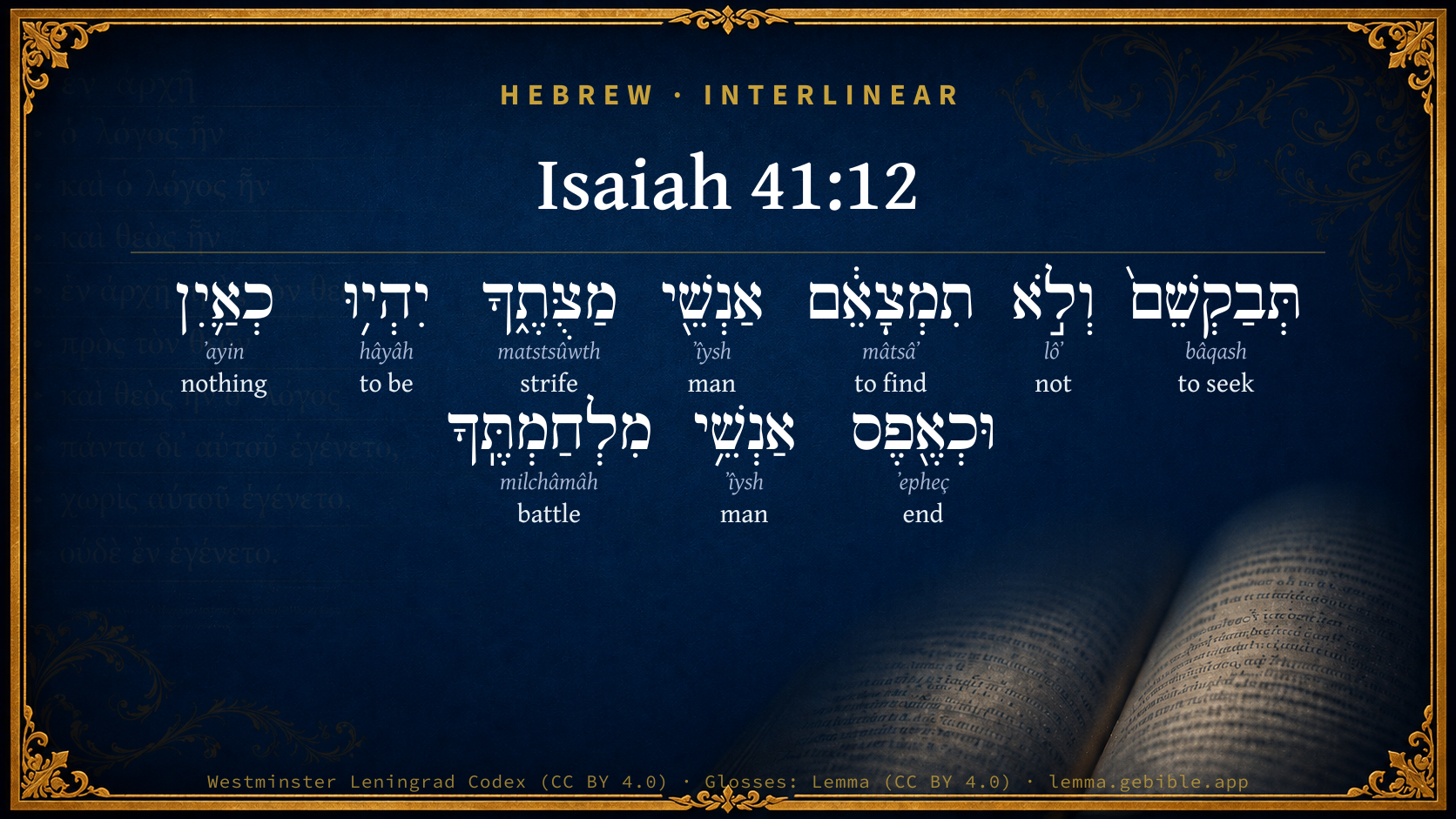
Hebrew (Westminster Leningrad Codex) Isaiah 41:12 appears in the Hebrew Old Testament. The text above is from the Westminster Leningrad Codex. Each word links to its Strong’s number, a concise gloss, and parsing drawn from the Open Scriptures Hebrew Bible morphology. Click any word for its full Brown-Driver-Briggs (BDB) entry.
Download image
Cite this verse

Isaiah 41:12 (World English Bible). Public Domain. Lemma interlinear Bible study tool, https://lemma.gebible.app/v/isaiah/41/12.

Show BibTeX & RIS
BibTeX
RIS
English Translation
You shall seek them, and shall not find them, even those who contend with you: those who war against you shall be as nothing, and as a thing of nothing.
World English Bible · Public Domain
Highlights
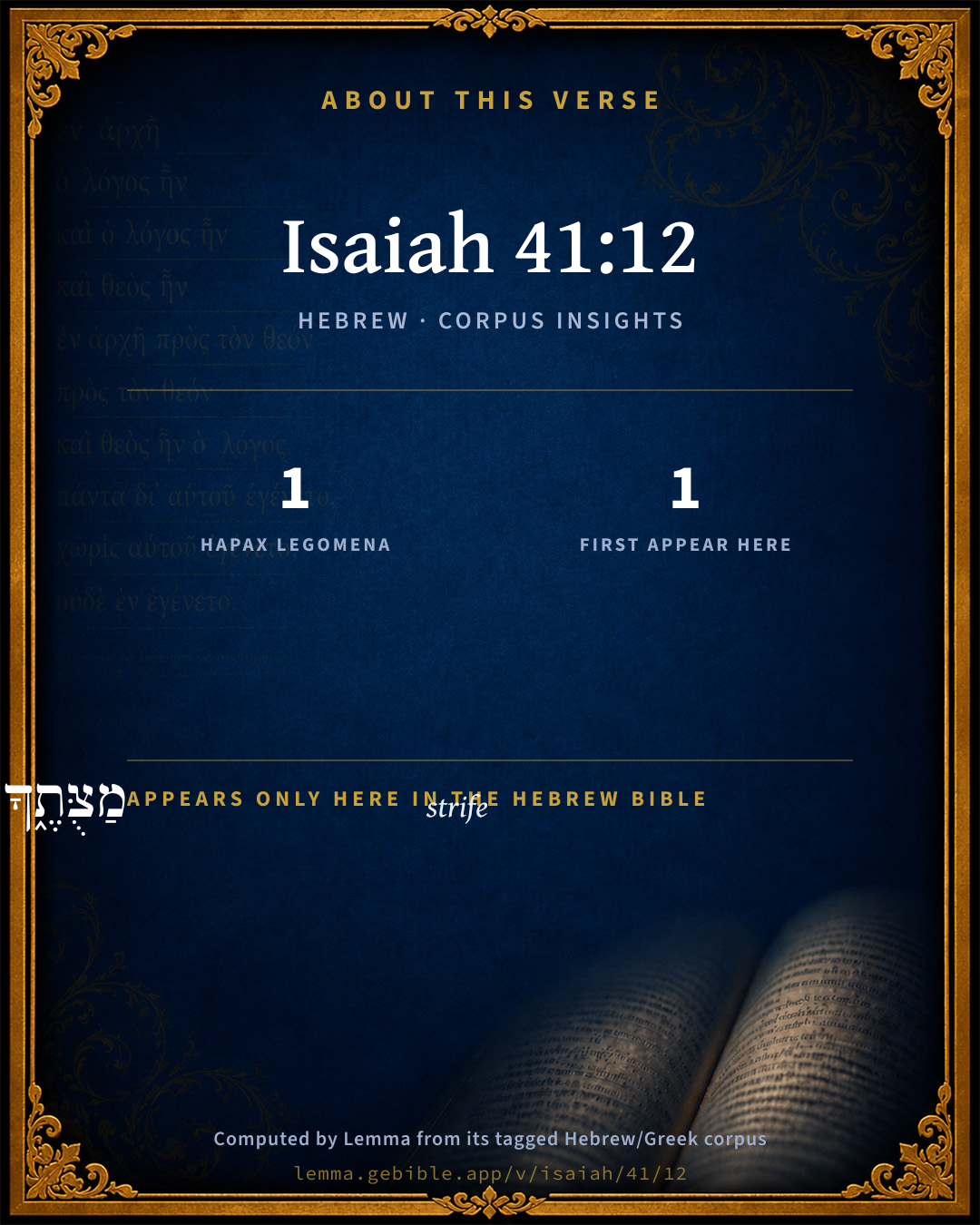
  • 1 hapax legomenon — only here in the Hebrew Bible
  • 1 first appearance in the Hebrew Bible
Full analysis ↓
Download a study sheet

One document with this verse’s original text, its word-by-word gloss line, the meaning frame, cross-references with their text, attributed commentary, and full source and license credits — printable, and it pastes into notes with its structure intact.

This verse Autodidact and up

Study sheet (.html) Plain text (.txt)

A passage Seminary Student

Up to 50 verses in one chapter. A passage sheet keeps up to 6 commentary sources and 12 cross-references per verse, in the order this page ranks them, and says so on the sheet whenever that leaves anything out. Ask for a single verse and you get the Autodidact verse sheet above.

Everything on this page stays free to read, with no account — the sheet is a download of what is already on screen, not access to it.

Want to remove ads? Support Godless Engineer
Compare translations 3

The same verse in 3 English versions, stacked beneath the original-language interlinear above. Click any original word for its lexicon entry.

Each is an independent rendering of the whole verse — the interlinear is not word-aligned to these translations.

Highlighted words mark where these versions differ — a whole-verse word diff, not a word-by-word alignment.

  • World English Bible Public Domain
    You shall seek them, and shall not find them, even those who contend with you: those who war against you shall be as nothing, and as a thing of nothing.
  • King James Version Public Domain
    Thou shalt seek them, and shalt not find them, even them that contended with thee: they that war against thee shall be as nothing, and as a thing of nought.
  • unfoldingWord Literal Text CC BY-SA 4.0
    You will seek them, but you will not find them, the men of your quarrel. They will be like nought and like nothing, the men of your battle.

unfoldingWord Literal Text — © unfoldingWord, licensed CC BY-SA 4.0. Word-aligned USFM3 via Door43 (git.door43.org/unfoldingWord/en_ult).

Versions to compare (up to 4)

3 of 4 selected

Show all 18 translations

Every available English version of this verse, each an independent rendering of the whole verse.

  • World English Bible Public Domain
    You shall seek them, and shall not find them, even those who contend with you: those who war against you shall be as nothing, and as a thing of nothing.
  • Berean Standard Bible Public Domain
    You will seek them but will not find them. Those who wage war against you will come to nothing.
  • Majority Standard Bible Public Domain
    You will seek them but will not find them. Those who wage war against you will come to nothing.
  • King James Version Public Domain
    Thou shalt seek them, and shalt not find them, even them that contended with thee: they that war against thee shall be as nothing, and as a thing of nought.
  • American Standard Version (1901) Public Domain
    Thou shalt seek them, and shalt not find them, even them that contend with thee: they that war against thee shall be as nothing, and as a thing of nought.
  • Revised Version (1885) Public Domain
    Thou shalt seek them, and shalt not find them, even them that contend with thee: they that war against thee shall be as nothing, and as a thing of nought.
  • Geneva Bible (1599) Public Domain
    Thou shalt seeke them and shalt not finde them: to wit, the men of thy strife, for they shall be as nothing, and the men that warre against thee, as a thing of nought.
  • Douay-Rheims (1899) Public Domain
    Thou shalt seek them, and shalt not find the men that resist thee: they shall be as nothing: and as a thing consumed the men that war against thee.
  • Young's Literal Translation Public Domain
    Thou seekest them, and findest them not, The men who debate with thee, They are as nothing, yea, as nothing, The men who war with thee.
  • Literal Standard Version CC BY-SA 4.0
    You seek them, and do not find them, || The men who debate with you, || They are as nothing, indeed, as nothing, || The men who war with you.
  • Unlocked Literal Bible CC BY-SA 4.0
    You will seek and will not find those who contended with you; those who warred against you will be like nothing, absolutely nothing.
  • unfoldingWord Literal Text CC BY-SA 4.0
    You will seek them, but you will not find them, the men of your quarrel. They will be like nought and like nothing, the men of your battle.
  • Darby Bible Public Domain
    Thou shalt seek them, and shalt not find them -- them that contend with thee; they that war against thee shall be as nothing, and as a thing of nought.
  • World Messianic Bible Public Domain
    You will seek them, and won’t find them, even those who contend with you. Those who war against you will be as nothing, as a nonexistent thing.
  • Webster's Bible Public Domain
    Thou shalt seek them, and shalt not find them, even them that contended with thee: they that war against thee shall be as nothing, and as a thing of naught.
  • Free Bible Version CC BY-SA 4.0
    Even though you look for your enemies, you won't find them. Those who attack you will become absolutely nothing.
  • Bible in Basic English Public Domain
    You will make search for your haters but they will not be there; those who make war against you will be as nothing and will come to destruction.
  • JPS Tanakh (1917) Public Domain
    Thou shalt seek them, and shalt not find them, even them that contended with thee; they that warred against thee shall be as nothing, and as a thing of nought.

Literal Standard Version (2020), Covenant Press — licensed CC BY-SA 4.0. Text via the HelloAO Bible API (eBible.org). Unlocked Literal Bible (unfoldingWord) — licensed CC BY-SA 4.0. Text via the HelloAO Bible API (eBible.org). unfoldingWord Literal Text — © unfoldingWord, licensed CC BY-SA 4.0. Word-aligned USFM3 via Door43 (git.door43.org/unfoldingWord/en_ult). Free Bible Version, Dr. Jonathan Gallagher — licensed CC BY-SA 4.0. Text via the HelloAO Bible API (eBible.org).

Word by word

More ways to search: Search by grammar → Find every occurrence → Compare this word →

Practice this passage: Drill this verse → Learn its vocabulary →

מַצֻּתֶ֑ךָ
matstsûwth
H4695
“strife · your”
Noun, Common, Feminine, Singular, Construct + Suffix, Personal, 2nd Person, Masculine, Singular
Part of Speech
Noun
Type
Common
Gender
Feminine
Number
Singular
State
Construct
Full BDB Definition

Origin: from H5327

TWOT: 1400b

strife, contention
  1. תְּבַקְשֵׁם֙ bâqash H1245 “to seek · them” Verb, Piel, Imperfect, 2nd Person, Masculine, Singular + Suffix, Personal, 3rd Person, Masculine, Plural
  2. וְלֹ֣א lôʼ H3808 “and · not” Conjunction + Particle, Negative
  3. תִמְצָאֵ֔ם mâtsâʼ H4672 “to find · them” Verb, Qal, Imperfect, 2nd Person, Masculine, Singular + Suffix, Personal, 3rd Person, Masculine, Plural
  4. אַנְשֵׁ֖י ʼîysh H376 “men of” Noun, Common, Masculine, Plural, Construct
  5. יִהְי֥וּ hâyâh H1961 “to be” Verb, Qal, Imperfect, 3rd Person, Masculine, Plural
  6. כְאַ֛יִן ʼayin H369 “like/as · nothing” Preposition + Noun, Common, Masculine, Singular, Absolute
  7. וּכְאֶ֖פֶס ʼepheç H657 “and · like/as · end” Conjunction + Preposition + Noun, Common, Masculine, Singular, Absolute
  8. אַנְשֵׁ֥י ʼîysh H376 “men of” Noun, Common, Masculine, Plural, Construct
  9. מִלְחַמְתֶּֽךָ milchâmâh H4421 “battle · your” Noun, Common, Feminine, Singular, Construct + Suffix, Personal, 2nd Person, Masculine, Singular

About this verse

These counts appear in no published source. They are computed here, from the morphology-tagged text and Lemma’s own curated glosses. What Lemma adds →

10
words
9
distinct lemmas
Prophets
section

Notable vocabulary

1 hapax legomenon — a word that appears only here in the entire Hebrew Bible:

  • מַצֻּתֶ֑ךָ strife H4695

First appearance in Scripture

This word makes its first canonical appearance in the Hebrew Bible here:

  • מַצֻּתֶ֑ךָ strife H4695

Shared distinctive vocabulary

וּכְאֶ֖פֶס end H657 occurs in 43 verses of the Hebrew Bible. Also found in:

Grammatical profile

  • 3 verbs
  • 6 nouns
  • 1 particle

Verb forms

  • תְּבַקְשֵׁם֙ Piel · Imperfect
  • תִמְצָאֵ֔ם Qal · Imperfect
  • יִהְי֥וּ Qal · Imperfect

Repetition

A word recurs within this verse — often emphatic in Hebrew:

  • אַנְשֵׁ֖י man H376 ×2

Hebrew & Septuagint length

In English translation the verse runs 30 words from the Hebrew and 35 from the Septuagint (LXX English) — closely comparable.

A rough comparison of the two English renderings, which tokenize alike — not a word-level alignment.

Word counts can differ between the Hebrew and the Greek without any difference in meaning — e.g. the Hebrew direct-object marker אֵת has no separate Greek word, and Greek often adds the article ὁ.

Cross-references

3

Topical passages linked to Isaiah 41:12 in the Treasury of Scripture Knowledge — connected by theme and wording, ordered by reader-vote popularity; previews shown in the World English Bible.

  • Psalms 37:35–36 I have seen the wicked in great power, Spreading himself like a green tree in its native soil.
  • Job 20:7–9 Yet he shall perish forever like his own dung, Those who have seen him shall say, 'Where is he?'
  • Isaiah 17:14 At evening, behold, terror; [and] before the morning they are no more. This is the portion of those who despoil us, and the lot of those who rob us.

Cross-references courtesy of OpenBible.info (CC BY 4.0).

Hebrew and Greek witnesses Masoretic Hebrew ↔ Greek Septuagint

The same verse in the two great witnesses to the Old Testament, shown verse-for-verse.

These are two independent witnesses, not word-aligned to each other, and the Septuagint is shown in lemma (dictionary) form.

Hebrew Isaiah 41:12 Masoretic · Westminster Leningrad Codex

תְּבַקְשֵׁם֙ וְלֹ֣א תִמְצָאֵ֔ם אַנְשֵׁ֖י מַצֻּתֶ֑ךָ יִהְי֥וּ כְאַ֛יִן וּכְאֶ֖פֶס אַנְשֵׁ֥י מִלְחַמְתֶּֽךָ

You shall seek them, and shall not find them, even those who contend with you: those who war against you shall be as nothing, and as a thing of nothing.

World English Bible · Public Domain

Greek LXX Isaiah 41:12 Septuagint · lemma form

ζητέω αὐτός καί οὐ μή εὑρίσκω ὁ ἄνθρωπος ὅς παροινέω εἰς σύ εἰμί γάρ ὡς οὐ εἰμί καί οὐ εἰμί ὁ ἀντιπολεμέω σύ

You shall seek them, and you shall not find the men who shall insolently rage against you: for they shall be as if they were not, and they that war against you shall not be.

LXX2012 (modern English Septuagint) · Public Domain

Hebrew: Westminster Leningrad Codex (CC BY 4.0). Greek: Septuagint (public domain); English from LXX2012 (modern English Septuagint) (Public Domain). How the Septuagint differs from the Hebrew →

Targum (Aramaic paraphrase)

1

The Targum is the ancient Jewish Aramaic paraphrase of the Hebrew Scriptures — an interpretive translation, not the Hebrew text itself. Onkelos (literal) and Pseudo-Jonathan (expansive) render the Torah, and Jonathan the Prophets. Coverage is partial: where no permissively-licensed English translation exists for a verse, only the Aramaic is shown. This is verse-level text, not a word-by-word alignment to the Hebrew.

  1. Targum Jonathan Prophets (Joshua–Malachi)
    תַּבְעִינוּן וְלָא תַשְׁכְּחִינוּן לְאַנְשֵׁי מַצוּתָךְ יְהוֹן כִּלְמָא וּכְלָא מִדָעַם גַבְרִין דַהֲווֹ מִתְגָרִין לְמֶעְבַּד עִמָךְ קְרָב:

    Thou shalt seek them, and shalt not find them, even them that contended with thee, they shall be as nothing; the men that stirred themselves up to make war with thee shall be less than nothing.

    Targum Jonathan — Aramaic: “Mikraot Gedolot” (public domain). English: “Sefaria Community Translation” (CC0 1.0 (public-domain dedication)); “London "Chaldee Paraphrase," 1871” (public domain). Text via Sefaria.

Commentary

Notes on Isaiah 41:12 from classic Christian and Jewish commentators (each source and its license shown beneath its notes). The classic Christian expositions comment on the surrounding passage and are grouped to its opening verse, so a note may address several verses; the Jewish commentaries on the Tanakh (Rashi and others) are per-verse, so they appear only where the commentator wrote on this verse.

Lemma curates 59 commentaries, every one of them public domain or Creative Commons licensed, each selected and text-cleaned for this edition rather than reprinted as found. About our sources →

Trapp's Complete Commentary

John Trapp

Isa 41:12 Thou shalt seek them, and shalt not find them, [even] them that contended with thee: they that war against thee shall be as nothing, and as a thing of nought.

Ver. 12. Even them that contended with thee.] Heb., The men of thy contention - thy contendents, such as this eristical age hath more than a good many. By the Quakers’ wild fancies and rude practices we may see how cross-grained these people are in contradicting everything. Many men’s spirits, saith one, today lie like that haven in Act 27:12, toward the south-west and north-west, two opposite points.

John Trapp, A Commentary or Exposition upon All the Books of the Old and New Testament (1647–1656) — public domain. Text from a community e-Sword module.

Geneva Bible (1599)

Geneva Bible translators

Because they shall be destroyed.

Geneva Bible (1599) marginal notes — public domain. Text via Bolls.life.

Jamieson, Fausset & Brown

Robert Jamieson, A. R. Fausset & David Brown

seek . . . and . . . not find--said of one so utterly put out of the way that not a trace of him can be found (Psa 37:36).

thing of naught--shall utterly perish.

Jamieson, Fausset & Brown — Commentary Critical and Explanatory on the Whole Bible (1871) — public domain (CC PDM 1.0). Text via the HelloAO Bible API.

John Gill's Exposition

They not existing, or being fled into holes and corners, to rocks and mountains, to hide themselves from the wrath of the Lamb, Rev 6:15,

even them that contended with thee; or, "the men of thy contention" (p); who contended with them, not by words and arguments, but by severe persecutions, striving thereby to hinder the progress of the Gospel, and to root Christianity out of the world:

they that war against thee shall be as nothing, and as a thing of nought: or, "the men of thy war" (q); that proclaimed and carried on war against the Christians, in order to destroy them utterly; yet they, and all their efforts, came to nothing, the Gospel prevailed, and Paganism was utterly abolished; which came to pass in Constantine's time, at the opening of the sixth seal, Rev 6:12 which is a proper comment on this text.

(p) "viros jurgii tui", Montanus. (q) "viri belli tui", Vatablus; "pugnae tuae", Montanus.

John Gill's Exposition of the Whole Bible (1746–1763) — public domain (CC PDM 1.0). Text via the HelloAO Bible API.

Albert Barnes' Notes on the Bible

Thou shalt seek them - This denotes that it would be impossible to find them, for they should cease to exist. The whole verse, with the verse following, is emphatic, repeating in varied terms what was said before, and meaning that their foes should be entirely destroyed.

Albert Barnes' Notes on the Bible (1834–1885) — public domain. Text from a community e-Sword/MySword module.

Matthew Poole's English Annotations

Thou shalt seek them, and shalt not find them; they shall be so totally consumed, that although thou searchest for them, thou shalt not be able to find them any where in the world.

Shall be as nothing, and as a thing of nought; shall be utterly brought to nought. The thing is twice repeated, to show the certainty and greatness of their destruction.

Matthew Poole's English Annotations on the Holy Bible (1683–1685) — public domain. Text from a community e-Sword/MySword module.

J. A. Alexander on Isaiah

Joseph Addison Alexander

“Thou shalt seek them and not find them, thy men of quarrel; they shall be as nothing and as nought, thy men of war (i.e., they who quarreled and made war with thee).” The first phrase contains a common Hebrew figure for complete disappearance and destruction (See Psa 37:36; Jer 50:20; Amo 8:12; Hos 5:6). The words translated ‘nothing’ and ‘nought’, strictly denote non-existence and annihilation. (See above, on Isa 40:17).

Joseph Addison Alexander, The Prophecies of Isaiah (1846–1847; New York: Scribner, 1870–1878) — public domain. Text from a community e-Sword module.

unfoldingWord translationNotes

Door43 World Missions Community

General Information:

Yahweh continues speaking to the people of Israel.

I ... will hold your right hand

Yahweh helping the people of Israel is spoken of as if he were holding their right hand. (See: Metaphor)

translationWords

Yahweh

God

right hand

fear

unfoldingWord translationNotes — © Distant Shores Media and the Door43 World Missions Community, licensed CC BY-SA 4.0. Source: git.door43.org/Door43/en_tn.

Ibn Ezra

Rabbi Abraham ibn Ezra

מנצותך ═ מצותך Thy Contention. The נ is replaced by Dagesh in צ; the form of the word is like that of מלקות. Comp. מצה strife (Prov. 17:19); ינצו strive together (Deut. 25:11).

אפס Nothing.

Ibn Ezra on the Tanakh — English translations: “Sefaria Community Translation” (CC0 1.0 (public-domain dedication)); “Yalkut, Sifsei Chachomim Chumash, Metsudah Publications, 2009” (CC BY 4.0); and “Commentary of Ibn Ezra on Isaiah - trans. by M. Friedlander, 1873” (public domain). Text via Sefaria.

Lesson kit

Teaching starters — assembled from the data on this page, not authored interpretation. Every prompt links to the verse data it draws on. Edit before teaching.

Isaiah, in the Prophets, opens this verse with 10 words (9 distinct Hebrew lemmas). Its most distinctive word is matstsûwth (“strife”). A historical commentator’s framing appears above. Read the whole chapter for the surrounding context.

Discussion questions

  1. What does “strife” (matstsûwth) contribute to the verse as a whole?
  2. 1 word here appears nowhere else in the Hebrew Bible. Why might the author reach for such rare wording?
  3. This is the first place “strife” appears in Scripture (first appears here). What does its debut here establish?
  4. How does Numbers 13:28, which shares the word «end», read alongside this verse?
  5. What does the repetition of “man” (2× in this one verse) do in this verse?
  6. The translations on this page render this verse differently — a whole-verse word diff, not a word-by-word alignment. What might account for the different wordings?
  7. «תְּבַקְשֵׁם֙» is a Piel Imperfect verb. How does that grammatical form shape the action described?
  8. Compare how Trapp's Complete Commentary and Geneva Bible (1599) read this verse. Where do they agree or differ?

Things to notice

  • 1 word in this verse appears nowhere else in the Hebrew Bible.
  • 1 word makes its first canonical appearance in Scripture here.
  • These translations choose different wording for 15 words in this verse.
  • “man” occurs 2× in this single verse.
  • 9 distinct Hebrew lemmas span 10 words in this verse.

Reading settings

Reading text

Shown beneath each verse's original-language words.

Old Testament
Old Testament edition

Read the OT as the Masoretic Hebrew (MT) or the Greek Septuagint (LXX).

English shown for the Greek Septuagint (in the Hebrew ↔ Greek comparison).

Comparing translations? Open the Compare panel on any verse page to stack up to four side by side.