
Ecclesiastes 7:25

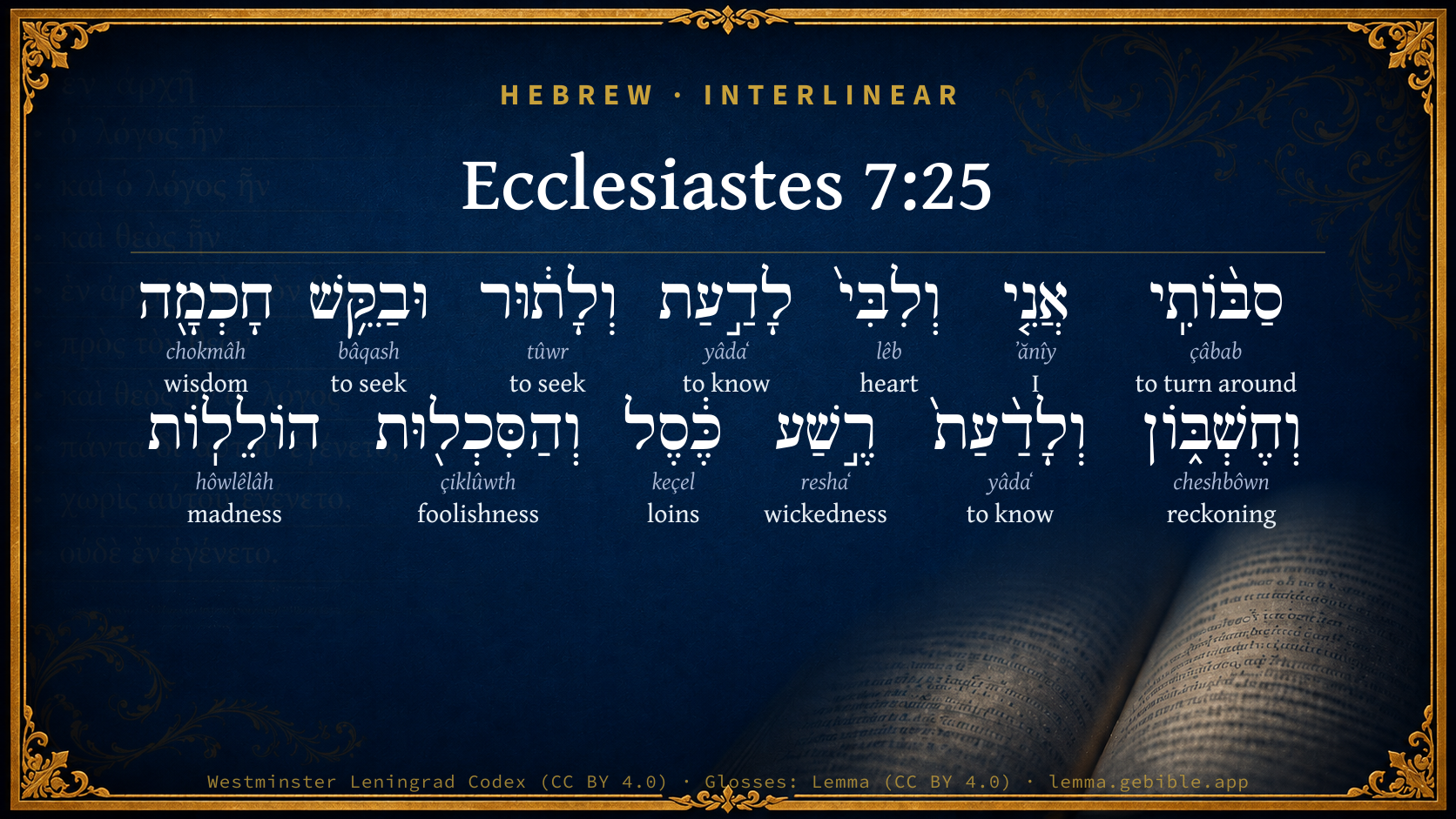
Hebrew (Westminster Leningrad Codex) Ecclesiastes 7:25 appears in the Hebrew Old Testament. The text above is from the Westminster Leningrad Codex. Each word links to its Strong’s number, a concise gloss, and parsing drawn from the Open Scriptures Hebrew Bible morphology. Click any word for its full Brown-Driver-Briggs (BDB) entry.
Download image
Cite this verse

Ecclesiastes 7:25 (World English Bible). Public Domain. Lemma interlinear Bible study tool, https://lemma.gebible.app/v/ecclesiastes/7/25.

Show BibTeX & RIS
BibTeX
RIS
English Translation
I turned around, and my heart sought to know and to search out, and to seek wisdom and the scheme of things, and to know that wickedness is stupidity, and that foolishness is madness.
World English Bible · Public Domain
Highlights Full analysis ↓
Download a study sheet

One document with this verse’s original text, its word-by-word gloss line, the meaning frame, cross-references with their text, attributed commentary, and full source and license credits — printable, and it pastes into notes with its structure intact.

This verse Autodidact and up

Study sheet (.html) Plain text (.txt)

A passage Seminary Student

Up to 50 verses in one chapter. A passage sheet keeps up to 6 commentary sources and 12 cross-references per verse, in the order this page ranks them, and says so on the sheet whenever that leaves anything out. Ask for a single verse and you get the Autodidact verse sheet above.

Everything on this page stays free to read, with no account — the sheet is a download of what is already on screen, not access to it.

Want to remove ads? Support Godless Engineer
Compare translations 3

The same verse in 3 English versions, stacked beneath the original-language interlinear above. Click any original word for its lexicon entry.

Each is an independent rendering of the whole verse — the interlinear is not word-aligned to these translations.

Highlighted words mark where these versions differ — a whole-verse word diff, not a word-by-word alignment.

  • World English Bible Public Domain
    I turned around, and my heart sought to know and to search out, and to seek wisdom and the scheme of things, and to know that wickedness is stupidity, and that foolishness is madness.
  • King James Version Public Domain
    I applied mine heart to know, and to search, and to seek out wisdom, and the reason of things, and to know the wickedness of folly, even of foolishness and madness:
  • unfoldingWord Literal Text CC BY-SA 4.0
    I turned, I and my heart, to know and to explore and seek wisdom and the scheme of things, and to know wickedness folly and the foolishness madness.

unfoldingWord Literal Text — © unfoldingWord, licensed CC BY-SA 4.0. Word-aligned USFM3 via Door43 (git.door43.org/unfoldingWord/en_ult).

Versions to compare (up to 4)

3 of 4 selected

Show all 18 translations

Every available English version of this verse, each an independent rendering of the whole verse.

  • World English Bible Public Domain
    I turned around, and my heart sought to know and to search out, and to seek wisdom and the scheme of things, and to know that wickedness is stupidity, and that foolishness is madness.
  • Berean Standard Bible Public Domain
    I directed my mind to understand, to explore, to search out wisdom and explanations, and to understand the stupidity of wickedness and the folly of madness.
  • Majority Standard Bible Public Domain
    I directed my mind to understand, to explore, to search out wisdom and explanations, and to understand the stupidity of wickedness and the folly of madness.
  • King James Version Public Domain
    I applied mine heart to know, and to search, and to seek out wisdom, and the reason of things, and to know the wickedness of folly, even of foolishness and madness:
  • American Standard Version (1901) Public Domain
    I turned about, and my heart `was set' to know and to search out, and to seek wisdom and the reason `of things', and to know that wickedness is folly, and that foolishness is madness.
  • Revised Version (1885) Public Domain
    I turned about, and my heart was set to know and to search out, and to seek wisdom and the reason of things, and to know that wickedness is folly, and that foolishness is madness:
  • Geneva Bible (1599) Public Domain
    All this haue I prooued by wisedome: I thought I will be wise, but it went farre from me.
  • Douay-Rheims (1899) Public Domain
    Much more than it was: it is a great depth, who shall find it out?
  • Young's Literal Translation Public Domain
    I have turned round, also my heart, to know and to search, and to seek out wisdom, and reason, and to know the wrong of folly, and of foolishness the madness.
  • Literal Standard Version CC BY-SA 4.0
    I have turned around, also my heart, to know and to search, and to seek out wisdom, and reason, and to know the wrong of folly, and the madness of foolishness.
  • Unlocked Literal Bible CC BY-SA 4.0
    I turned my heart to learn and examine and seek wisdom and the explanations of reality, and to understand that evil is stupid and that folly is madness.
  • unfoldingWord Literal Text CC BY-SA 4.0
    I turned, I and my heart, to know and to explore and seek wisdom and the scheme of things, and to know wickedness folly and the foolishness madness.
  • Darby Bible Public Domain
    I turned, I and my heart, to know, and to search, and to seek out wisdom and reason, and to know wickedness to be folly, and foolishness to be madness;
  • World Messianic Bible Public Domain
    I turned around, and my heart sought to know and to search out, and to seek wisdom and the scheme of things, and to know that wickedness is stupidity, and that foolishness is madness.
  • Webster's Bible Public Domain
    I applied my heart to know, and to search, and to seek out wisdom, and the reason of things, and to know the wickedness of folly, even of foolishness and madness:
  • Free Bible Version CC BY-SA 4.0
    I turned my thoughts to discover, investigate, and to find out more about wisdom and what makes sense. I wanted to know more about how stupid evil really is, and how ridiculous it is to be a fool.
  • Bible in Basic English Public Domain
    I gave my mind to knowledge and to searching for wisdom and the reason of things, and to the discovery that sin is foolish, and that to be foolish is to be without one's senses.
  • JPS Tanakh (1917) Public Domain
    I turned about, and applied my heart to know and to search out, and to seek wisdom and the reason of things, and to know wickedness to be folly, and foolishness to be madness;

Literal Standard Version (2020), Covenant Press — licensed CC BY-SA 4.0. Text via the HelloAO Bible API (eBible.org). Unlocked Literal Bible (unfoldingWord) — licensed CC BY-SA 4.0. Text via the HelloAO Bible API (eBible.org). unfoldingWord Literal Text — © unfoldingWord, licensed CC BY-SA 4.0. Word-aligned USFM3 via Door43 (git.door43.org/unfoldingWord/en_ult). Free Bible Version, Dr. Jonathan Gallagher — licensed CC BY-SA 4.0. Text via the HelloAO Bible API (eBible.org).

Word by word

More ways to search: Search by grammar → Find every occurrence → Compare this word →

Practice this passage: Drill this verse → Learn its vocabulary →

וְחֶשְׁבּ֑וֹן
cheshbôwn
H2808
“and · reckoning”
Conjunction + Noun, Common, Masculine, Singular, Absolute
Part of Speech
Conjunction + Noun
Type
Common
Gender
Masculine
Number
Singular
State
Absolute
Full BDB Definition

Origin: from H2803

TWOT: 767b

account, reasoning, reckoning
  1. סַבּ֨וֹתִֽי çâbab H5437 “to turn around” Verb, Qal, Perfect, 1st Person, Common, Singular
  2. אֲנִ֤י ʼănîy H589 “I” Pronoun, Personal, 1st Person, Common, Singular
  3. וְלִבִּי֙ lêb H3820 “and · heart · my” Conjunction + Noun, Common, Masculine, Singular, Construct + Suffix, Personal, 1st Person, Common, Singular
  4. לָדַ֣עַת yâdaʻ H3045 “to know” Preposition + Verb, Qal, Infinitive Construct
  5. וְלָת֔וּר tûwr H8446 “and · to seek” Conjunction + Preposition + Verb, Qal, Infinitive Construct
  6. וּבַקֵּ֥שׁ bâqash H1245 “and · to seek” Conjunction + Verb, Piel, Infinitive Construct
  7. חָכְמָ֖ה chokmâh H2451 “wisdom” Noun, Common, Feminine, Singular, Absolute
  8. וְלָדַ֨עַת֙ yâdaʻ H3045 “and · to know” Conjunction + Preposition + Verb, Qal, Infinitive Construct
  9. רֶ֣שַׁע reshaʻ H7562 “wickedness” Noun, Common, Masculine, Singular, Absolute
  10. כֶּ֔סֶל keçel H3689 “loins” Noun, Common, Masculine, Singular, Absolute
  11. וְהַסִּכְל֖וּת çiklûwth H5531 “and · the · foolishness” Conjunction + Particle, Definite Article + Noun, Common, Feminine, Singular, Absolute
  12. הוֹלֵלֽוֹת hôwlêlâh H1947 “madness” Noun, Common, Feminine, Plural, Absolute

About this verse

These counts appear in no published source. They are computed here, from the morphology-tagged text and Lemma’s own curated glosses. What Lemma adds →

13
words
12
distinct lemmas
Wisdom
section

Notable vocabulary

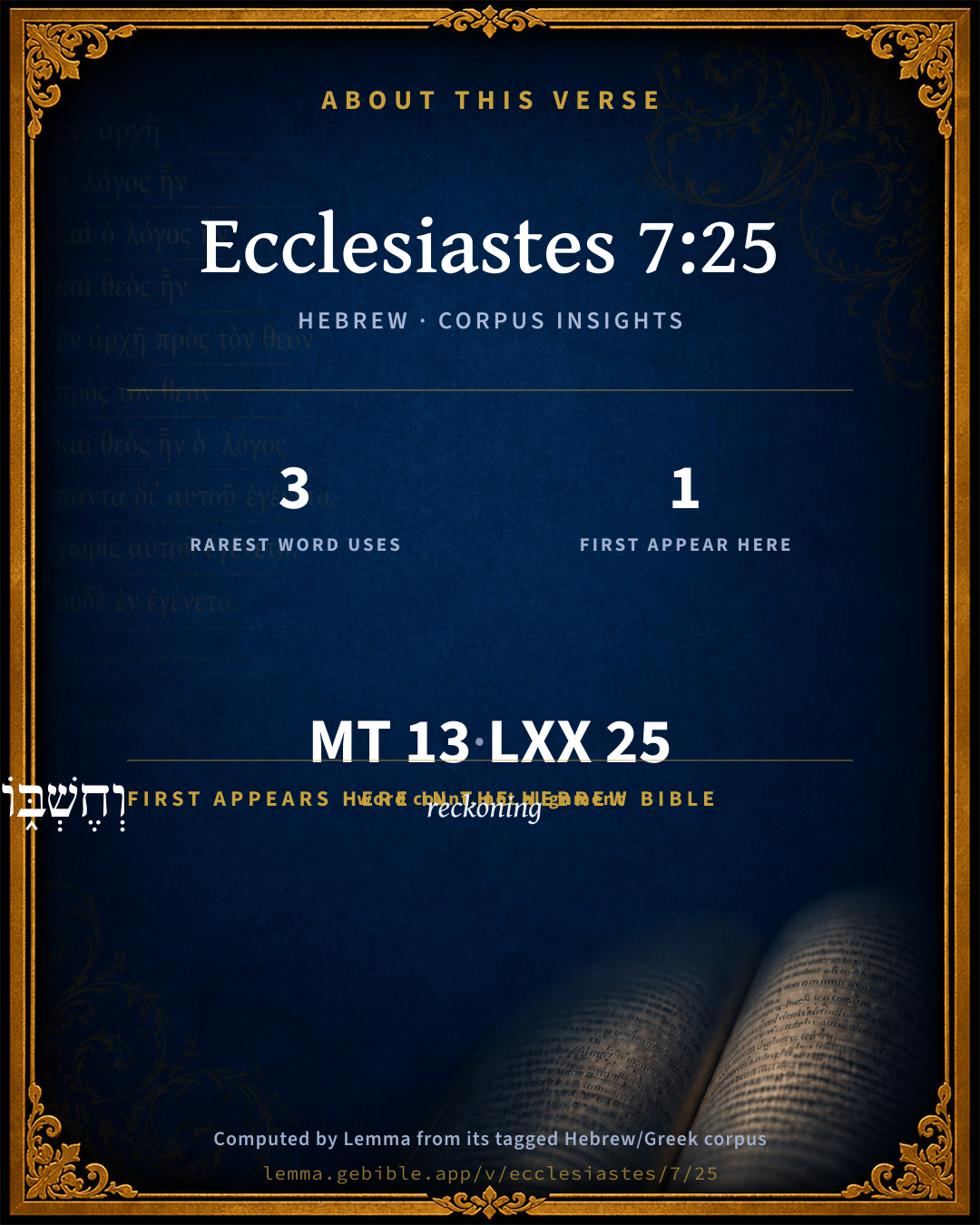
The rarest word here is וְחֶשְׁבּ֑וֹן reckoning H2808 — appearing just 3 times in the whole Hebrew Bible.

First appearance in Scripture

This word makes its first canonical appearance in the Hebrew Bible here:

  • וְחֶשְׁבּ֑וֹן reckoning H2808

Shared distinctive vocabulary

וְחֶשְׁבּ֑וֹן reckoning H2808 occurs in 3 verses of the Hebrew Bible. Also found in:

Grammatical profile

  • 5 verbs
  • 7 nouns
  • 1 pronoun

Verb forms

  • סַבּ֨וֹתִֽי Qal · Perfect
  • לָדַ֣עַת Qal · Infinitive Construct
  • וְלָת֔וּר Qal · Infinitive Construct
  • וּבַקֵּ֥שׁ Piel · Infinitive Construct
  • וְלָדַ֨עַת֙ Qal · Infinitive Construct

Repetition

A word recurs within this verse — often emphatic in Hebrew:

  • לָדַ֣עַת to know H3045 ×2

Hebrew & Septuagint length

In English translation the verse runs 34 words from the Hebrew and 16 from the Septuagint (LXX English) — the Septuagint runs noticeably shorter here. See the side-by-side →

A rough comparison of the two English renderings, which tokenize alike — not a word-level alignment.

Word counts can differ between the Hebrew and the Greek without any difference in meaning — e.g. the Hebrew direct-object marker אֵת has no separate Greek word, and Greek often adds the article ὁ.

In the original languages it is 13 Hebrew tokens and 25 Greek tokens — but the two are counted differently (Hebrew bundles its prefixes and suffixes into one token; the Greek is in lemma form), so that isn’t a like-for-like length.

Cross-references

17

Topical passages linked to Ecclesiastes 7:25 in the Treasury of Scripture Knowledge — connected by theme and wording, ordered by reader-vote popularity; previews shown in the World English Bible.

  • Ecclesiastes 10:13 The beginning of the words of his mouth is foolishness; and the end of his talk is mischievous madness.
  • Joshua 7:13 Up, sanctify the people, and say, Sanctify yourselves against tomorrow: for thus says Yahweh, the God of Israel, There is a devoted thing in the midst of you, Israel; you can not stand before your enemies, until you take away the devoted thing from among you.
  • Genesis 34:7 The sons of Jacob came in from the field when they heard it. The men were grieved, and they were very angry, because he had done folly in Israel in lying with Jacob's daughter; which thing ought not to be done.
  • 2 Samuel 13:12 She answered him, No, my brother, do not force me; for no such thing ought to be done in Israel. Don't you do this folly.
  • Proverbs 17:12 Let a bear robbed of her cubs meet a man, Rather than a fool in his folly.
  • Proverbs 26:11 As a dog that returns to his vomit, So is a fool who repeats his folly.
  • Ecclesiastes 1:13–17 I applied my heart to seek and to search out by wisdom concerning all that is done under the sky. It is a heavy burden that God has given to the sons of men to be afflicted with.
  • Ecclesiastes 2:1–3 I said in my heart, "Come now, I will test you with mirth: therefore enjoy pleasure;" and, behold, this also was vanity.
  • Ecclesiastes 2:12 I turned myself to consider wisdom, madness, and folly: for what can the king's successor do? Just that which has been done long ago.
  • Ecclesiastes 2:15 Then said I in my heart, "As it happens to the fool, so will it happen even to me; and why was I then more wise?" Then said I in my heart that this also is vanity.
  • Ecclesiastes 2:20 Therefore I began to cause my heart to despair concerning all the labor in which I had labored under the sun.
  • Ecclesiastes 3:16–17 Moreover I saw under the sun, in the place of justice, that wickedness was there; and in the place of righteousness, that wickedness was there.
  • Ecclesiastes 7:27 Behold, this have I found, says the Preacher, one to another, to find out the scheme;
  • Ecclesiastes 9:1–3 For all this I laid to my heart, even to explore all this: that the righteous, and the wise, and their works, are in the hand of God; whether it is love or hatred, man doesn't know it; all is before them.
  • Jeremiah 12:1–2 Righteous are you, Yahweh, when I contend with you; yet would I reason the cause with you: why does the way of the wicked prosper? why are all they at ease who deal very treacherously?
  • 2 Peter 2:3–9 In covetousness they will exploit you with deceptive words: whose sentence now from of old doesn't linger, and their destruction will not slumber.
  • 2 Peter 3:3–9 knowing this first, that in the last days mockers will come, walking after their own lusts,

Cross-references courtesy of OpenBible.info (CC BY 4.0).

Hebrew and Greek witnesses Masoretic Hebrew ↔ Greek Septuagint

The same verse in the two great witnesses to the Old Testament, shown verse-for-verse.

Here the Septuagint runs noticeably shorter than the Hebrew — LXX2012 (modern English Septuagint) 16 words vs World English Bible 34. A rough length comparison of the two English translations, not a word-level alignment — read both below.

These are two independent witnesses, not word-aligned to each other, and the Septuagint is shown in lemma (dictionary) form.

Hebrew Ecclesiastes 7:25 Masoretic · Westminster Leningrad Codex

סַבּ֨וֹתִֽי אֲנִ֤י וְלִבִּי֙ לָדַ֣עַת וְלָת֔וּר וּבַקֵּ֥שׁ חָכְמָ֖ה וְחֶשְׁבּ֑וֹן וְלָדַ֨עַת֙ רֶ֣שַׁע כֶּ֔סֶל וְהַסִּכְל֖וּת הוֹלֵלֽוֹת

I turned around, and my heart sought to know and to search out, and to seek wisdom and the scheme of things, and to know that wickedness is stupidity, and that foolishness is madness.

World English Bible · Public Domain

Greek LXX Ecclesiastes 7:25 Septuagint · lemma form

κυκλόω ἐγώ καί ὁ καρδία ἐγώ ὁ γιγνώσκω καί ὁ κατασκέπτομαι καί ζητέω σοφία καί ψῆφος καί ὁ γιγνώσκω ἀσεβής ἀφροσύνη καί σκληρίαν καί περιφορά

That which is far beyond what was, and a great depth, who shall find it out?

LXX2012 (modern English Septuagint) · Public Domain

On this verse, Keil & Delitzsch discusses the Septuagint’s reading. Read the note in Commentary ↓

Hebrew: Westminster Leningrad Codex (CC BY 4.0). Greek: Septuagint (public domain); English from LXX2012 (modern English Septuagint) (Public Domain). How the Septuagint differs from the Hebrew →

Commentary

Notes on Ecclesiastes 7:25 from classic Christian and Jewish commentators (each source and its license shown beneath its notes). The classic Christian expositions comment on the surrounding passage and are grouped to its opening verse, so a note may address several verses; the Jewish commentaries on the Tanakh (Rashi and others) are per-verse, so they appear only where the commentator wrote on this verse.

Lemma curates 59 commentaries, every one of them public domain or Creative Commons licensed, each selected and text-cleaned for this edition rather than reprinted as found. About our sources →

Trapp's Complete Commentary

John Trapp

Ecc 7:25 I applied mine heart to know, and to search, and to seek out wisdom, and the reason [of things], and to know the wickedness of folly, even of foolishness [and] madness:

Ver. 25. I applied mine heart.] Circuivi ego et cot meum, so the original runs; I and my heart turned about, or made a circle to know, &c. He took his heart with him, and resolved, hard or not hard, to make further search into wisdom’s secrets. Difficulty doth but whet on heroic spirits: it doth no whit weaken but waken their resolutions to go through with the work. When Alexander met with any hard or hazardous piece of service, he would say, Iam periculum par anime Alexandri, He ever achieved what he enterprised, because he never accounted anything impossible to be achieved. David was well pleased with the condition of bringing in to Saul the foreskins of a hundred Philistines. If a bowl run downhill, a rub in the way does but quicken it; as if up hill, it slows it. A man of Solomon’s make, one that hath a free, noble, princely spirit, speaks to wisdom, as Laelius in Lucan did to Caesar,

“ Iussa sequi tam velle mihi, quam posse, necesse. ”

And to know the wickedness of folly.] The "sinfulness of sin." {Rom 7:13} Sin is so evil that it cannot have a worse epithet given it. "Mammon of unrighteousness," {Luk 16:11} is the next odious name to the devil.

Even the foolishness of madness.] That by one contrary he might the better know the other. Folly may serve as a foil to set off wisdom; as gardeners suffer some stinking stuff to grow near their sweetest flowers.

John Trapp, A Commentary or Exposition upon All the Books of the Old and New Testament (1647–1656) — public domain. Text from a community e-Sword module.

Joseph Benson's Commentary

Ecc 7:25. I applied my heart to know — I was not discouraged, but provoked, by the difficulty of the work, to undertake it. To know, search, and seek out wisdom — He useth three words signifying the same thing, to intimate his vehement desire, and vigorous and unwearied endeavours after it. And the reason of things — Both of God’s various providences, and of the counsels and courses of men. To know the wickedness, &c — Clearly and fully to understand the great evil of sin.

Joseph Benson's Commentary on the Old and New Testaments (1811–1818) — public domain. Text from a community e-Sword module.

Keil & Delitzsch

C. F. Keil & F. Delitzsch

But, on the other side, he can bear testimony to himself that he has honestly exercised himself in seeking to go to the foundation of things: "I turned myself, and my heart was there to discern, and to explore, and to seek wisdom, and the account, and to perceive wickedness as folly, and folly as madness." Regarding sabbothi, vid., under Ecc 2:20 : a turning is meant to the theme as given in what follows, which, as we have to suppose, was connected with a turning away form superficiality and frivolity. Almost all interpreters-as also the accentuation does - connect the two words ולבּי אני; but "I and my heart" is so unpsychological an expression, without example, that many Codd. (28 of Kennicott, 44 of de Rossi) read בּלבּי daer )i with my heart. The erasure of the vav (as e.g., Luther: "I applied my heart") would at the same time require the change of סבותי into הסבּותי. The Targ., Jerome, and the Venet. render the word בלבי; the lxx and Syr., on the contrary, ולבי; and this also is allowable, if we place the disjunctive on אני and take ולבי as consequent: my heart, i.e., my striving and effort, was to discern (Aben Ezra, Herzf., Stuart), - a substantival clause instead of the verbal את־לבּי ונתתּי, Ecc 1:13, Ecc 1:17. Regarding tur in an intellectual sense, vid., Ecc 1:13. Hhěshbon, with hhochmah, we have translated by "Rechenschaft" account, ratio; for we understand by it a knowledge well grounded and exact, and able to be established, - the facit of a calculation of all the facts and circumstances relating thereto; נתן חשׁבין is Mishnic, and = the N.T. λόγον ἀποδιδόναι. Of the two accus. Ecc 7:25 following לדעת, the first, as may be supposed, and as the determination in the second member shows, is that of the obj., the second that of the pred. (Ewald, 284b): that רשׁע, i.e., conduct separating from God and from the law of that which is good, is kěsěl, Thorheit, folly (since, as Socrates also taught, all sinning rests on a false calculation, to the sinner's own injury); and that hassichluth, Narrheit, foolishness, stultitia (vid., sachal, and Ecc 1:17), is to be thus translated (in contradistinction to כּסל), i.e., an intellectual and moral obtuseness, living for the day, rising up into foolery, not different from holeloth, fury, madness, and thus like a physical malady, under which men are out of themselves, rage, and are mad. Koheleth's striving after wisdom thus, at least is the second instance (ולדעת), with a renunciation of the transcendental, went towards a practical end. And now he expresses by ומוצא one of the experiences he had reached in this way of research. How much value he attaches to this experience is evident from the long preface, by means of which it is as it were distilled. We see him there on the way to wisdom, to metaphysical wisdom, if we may so speak - it remains as far off from him as he seeks to come near to it. We then see him, yet not renouncing the effort after wisdom, on the way toward practical wisdom, which exercises itself in searching into the good and the bad; and that which has presented itself to him as the bitterest of the bitter is - a woman.

Keil & Delitzsch — Biblical Commentary on the Old Testament (1861–1891) — public domain (CC PDM 1.0). Text via the HelloAO Bible API. (Old Testament only.)

Jamieson, Fausset & Brown

Robert Jamieson, A. R. Fausset & David Brown

Literally, "I turned myself and mine heart to." A phrase peculiar to Ecclesiastes, and appropriate to the penitent turning back to commune with his heart on his past life.

wickedness of folly--He is now a step further on the path of penitence than in Ecc 1:17; Ecc 2:12, where "folly" is put without "wickedness" prefixed.

reason--rather, "the right estimation" of things. HOLDEN translates also "foolishness (that is, sinful folly, answering to 'wickedness' in the parallel) of madness" (that is, of man's mad pursuits).

Jamieson, Fausset & Brown — Commentary Critical and Explanatory on the Whole Bible (1871) — public domain (CC PDM 1.0). Text via the HelloAO Bible API.

Adam Clarke's Commentary

Verse 25. I applied mine heart] I cast about, סבותי sabbothi, I made a circuit; I circumscribed the ground I was to traverse; and all within my circle I was determined to know, and to investigate, and to seek out wisdom, and the reason of things. Has man reason and understanding? If so, then this is his work. God as much calls him to use these powers in this way, as to believe on the Lord Jesus that he may be saved; and he that does not, according to the means in his power, is a slothful servant, from whom God may justly take away the misemployed or not used talent, and punish him for his neglect. Every doctrine of God is a subject both for reason and faith to work on.

To know the wickedness of folly, even of foolishness and madness.]

"And my own heart, with scrutiny severe,

By far the harder task survey'd; intent

To trace that wisdom which from heaven descends,

Fountain of living waters, and to explore

The source of human folly, whose foul streams

Intoxicate and kill."-C.

Adam Clarke's Commentary on the Bible (1810–1826) — public domain. Text from a community e-Sword/MySword module.

Ellicott's Commentary for English Readers

(25) The reason of things.—The corresponding verb “to count” is common. This noun is almost peculiar to this book, where it occurs again in Ecc_7:27; Ecc_7:29; Ecc_9:10; save that in 2Ch_26:15 we have the plural in the sense of military engines.

A Bible Commentary for English Readers, edited by Charles John Ellicott (1878–1897) — public domain. Text from a community e-Sword module.

The Cambridge Bible for Schools and Colleges

gen. ed. J. J. S. Perowne

25. I applied mine heart to know] The present text and punctuation give, as in the marginal reading of the A. V., I and my heart. The expression has no exact parallel in O. T. language, but harmonizes with the common mode of speech, familiar enough in the poetry of all times and countries, furnishing a title (“My Soul and I”) to a poem of Whittier’s, in which a man addresses his heart or soul (comp. Luk_12:19), as something distinguishable from himself. So in ch. Ecc_1:13 we have “I gave my heart.” Here the thought implied seems to be that of an intense retrospective consciousness of the experience, or experiment, of life which the seeker is about to narrate. The words indicate another return to the results of that experience and the lessons it had taught him. He turned to ask the “reason,” better perhaps, the plan or rationale, of the prevalence of madness and folly. We note, as before in ch. Ecc_2:12, the Stoic manner of dealing with the follies of men as a kind of mental aberration.

The Cambridge Bible for Schools and Colleges (gen. ed. J. J. S. Perowne; Cambridge University Press, 1878–1918) — public domain. Text from a community e-Sword module.

John Gill's Exposition

I applied mine heart to know, and to search, and to seek out wisdom,.... Or, "I and my heart turned about" (h); took a circuit, a tour throughout the whole compass of things; looked into every corner, and went through the circle of knowledge, in order to search and find out what true wisdom is; which is no other than Christ, and a spiritual knowledge of him; a variety of words is used to express his eager desire after wisdom, and the diligent search he made, from which he was not discouraged by the difficulties he met with; see Ecc 1:13;

and the reason of things; either in nature or providence: or the estimation (i) of them; the excellency of them, how much they are to be accounted of, esteemed, and valued; as Christ, the Wisdom of God, and all things relating to him, should;

and to know the wickedness of folly, even of foolishness and madness; the exceeding sinfulness of sin, the folly and madness that are in it; sin is the effect of folly, and the excess of it, and a spiritual madness; it is true of all sin in general, but especially of the sin of uncleanness, which Solomon seems to have in view by what follows; see Ecc 1:17; and may chiefly intend the wickedness of his own folly, and the foolishness of his own madness.

(h) "circuivi ego et cor meum", Pagninus, Montanus, Mercerus, Gejerus. (i) "estimationem rerum", Mercerus.

John Gill's Exposition of the Whole Bible (1746–1763) — public domain (CC PDM 1.0). Text via the HelloAO Bible API.

Albert Barnes' Notes on the Bible

Reason - The same word is translated “account” Ecc 7:27, “invention” Ecc 7:29, and “device” Ecc 9:10 : it is derived from a root signifying “to count.”

Albert Barnes' Notes on the Bible (1834–1885) — public domain. Text from a community e-Sword/MySword module.

Haydock's Catholic Bible Commentary

Much. Protestants, "the which is far off, and exceeding deep, who can find it out?" (Haydock)

George Leo Haydock (1774–1849), Haydock's Catholic Family Bible and Commentary, 1859 edition — public domain. Excludes Psalms (Douay-Rheims chapter numbering differs from Protestant) and Deuterocanonical books (Catholic canon only).

Matthew Poole's English Annotations

I applied mine heart; I was not discouraged, but provoked by the difficulty of the work to undertake it; which is an argument of a great and generous soul.

To know, and to search, and to seek out; he useth three words signifying the same thing, to intimate his vehement desire and vigorous and unwearied endeavour after it.

The reason of things, both of God’s various providences, and of the differing and contrary counsels and courses of men.

To know the wickedness of folly, that I might clearly and fully understand the great evil of sin, and all that wickedness and folly or madness which is bound up in the hearts of all men by nature, and which discovers itself in the course of their lives.

Matthew Poole's English Annotations on the Holy Bible (1683–1685) — public domain. Text from a community e-Sword/MySword module.

Whedon's Commentary on the Bible

Daniel D. Whedon

25. I applied mine heart to know — is my heart turned to know? The writer resumes his practical inquiry in a new direction. He searches to know the actual cause of the intense and appaling wickedness of men. And the reason, etc. — Hebrew, to know the reason of wickedness and vice and folly, which is madness. So awful a fact must have some adequate cause, if it can only be found.

Daniel D. Whedon (gen. ed.), Commentary on the Old and New Testaments (1874–1909) — public domain. Text from a community e-Sword module.

The Pulpit Commentary

I applied mine heart to know; more literally, I turned myself, and my heart was set to know. We have the expression, "tamed myself," referring to a new investigation in Ecc_2:20 and elsewhere; but the distinguishing the heart or soul from the man himself is not common in Scripture (see on ch. 11:9), though the soul is sometimes apostrophized, as (Luk_12:19 comp. Psa_103:1 Psa_146:1) The writer here implies that he gave up himself with all earnestness to the investigation. Unsatisfactory as his quest had been hitherto. He did not relinquish the pursuit, but rather turned it in another direction, where he could hope to meet with useful results. The Septuagint has, "I and my heart traveled round (ejkuklwsa) to know;" the Vulgate, Lustravi universa animo meo ut scirem. And to search, and to seek out wisdom. The accumulation of synonymous verbs is meant to emphasize the author"s devotion to his self-imposed task and his return from profitless theoretical investigation to practical inquiry. And the reason of things. Cheshbon (ver. 27; Ecc_9:10) is rather "account," "reckoning," than "reason the summing-up of all the facts and circumstances rather than the elucidation of their causes. Vulgate, rationem; Septuagint, yhfon. The next clause ought to be rendered, And to know wickedness as (or, to be) folly, and foolishness as (to be) madness. His investigation led him to this conclusion, that all infringement of God"s laws is a misjudging aberration a willful desertion of the requirements of right reason and thatmental and moral obtuseness is a physical malady which may be called madness. (comp. Ecc_1:17 Ecc_2:12 Ecc_10:13)

Vers. 25-28.

Bad women a curse to society.

It is generally considered that in this language we have the conclusion reached by Solomon, End that his polygamy was largely the explanation of the very unfavorable opinion which he formed of the other sex. A monarch who takes to himself hundreds of wives and concubines is scarcely likely to see much of the best side of woman"s nature and life. And if marriage is divinely intended to draw out the unselfish, affectionate, and devoted qualities of feminine nature, such a purpose could not be more effectually frustrated than by an arrangement which assigns to a so-called wife an infinitesimal portion of a husband"s time, attention, interest, and love. For this reason it is not fair to take the sweeping statement of this passage as expressing a universal End unquestionable truth. What is said of the bitterness of the wicked woman, and of the mischief she does in society, remains for ever true; but there are states of society in which good women are as numerous as are good men, and in which their influence is equally beneficial.

I THE INJURIOUSNESS OF BAD WOMEN EXEMPLIFIES THE PRINCIPLE THAT THE ABUSE AND CORRUPTION OF GOOD THINGS IS OFTEN THE CAUSE OF THE WORST OF ILLS.

II THE WICKEDNESS OF BAD WOMEN DISPLAYS ITSELF IN THEIR HABIT OF ENSNARING THE FOOLISH; FOR THEY WILL NOT AND CANNOT SIN ALONE.

III THE PRESENCE OF BAD WOMEN IN SOCIETY IS THE GREAT TEMPTATION TO WHICH MEN ARE LIABLE, AND THE GREAT TEST BY WHICH THEY ARE TRIED.

IV THE BITTERNESS OF BAD WOMEN MAY BY CONTRAST SUGGEST THE EXCELLENCE OF THE VIRTUOUS AND THE PIOUS, AND MAY PROMPT TO A GRATEFUL RECOGNITION OF THE INDEBTEDNESS OF SOCIETY TO HOLY AND KINDLY FEMININE INFLUENCES. T.

The Pulpit Commentary (1880–1919), ed. H.D.M. Spence-Jones & Joseph S. Exell — public domain. Text from a community e-Sword module.

John Wesley's Explanatory Notes

And seek - He useth three words signifying the same thing, to intimate his vehement desire, and vigourous, and unwearied endeavours after it. The reason - Both of God's various providences, and of the counsels and courses of men. The wickedness - Clearly and fully to understand the great evil of sin.

John Wesley, Explanatory Notes Upon the Whole Bible (1754–1765) — public domain. Text via the GEBible commentary corpus.

Rashi

Rabbi Shlomo Yitzchaki (Rashi)

And again, I turned about to know and to search out and to seek the wisdom of the passage of the Red Heifer and the computation of the end of the Redemption.

and to know the wickedness of folly to foresee the ultimate end of heresy. וְהַסִכְלוּת הוֹלֵלוֹת, and the confusion and madness therein.

Rashi on the Tanakh — English translations: “The Judaica Press complete Tanach with Rashi, translated by A. J. Rosenberg” (CC BY 4.0); “Pentateuch with Rashi's commentary by M. Rosenbaum and A.M. Silbermann, 1929-1934” (public domain); “The Metsudah Tanach series, Lakewood, N.J” (CC BY 4.0); and “The Book of Joshua, Metsudah Publications, 1997” (CC BY 4.0). Text via Sefaria.

Lesson kit

Teaching starters — assembled from the data on this page, not authored interpretation. Every prompt links to the verse data it draws on. Edit before teaching.

Ecclesiastes, in the Wisdom, opens this verse with 13 words (12 distinct Hebrew lemmas). Its most distinctive word is cheshbôwn (“reckoning”). The Greek Septuagint runs shorter here. A historical commentator’s framing appears above. Read the whole chapter for the surrounding context.

Discussion questions

  1. What does “reckoning” (cheshbôwn) contribute to the verse as a whole?
  2. The word “reckoning” first appears here in Scripture. What is being introduced at this debut?
  3. Ecclesiastes 7:27 shares the word «reckoning» with this verse. How do the two illuminate each other?
  4. “to know” occurs 2× in this one verse. What is the effect of the repetition?
  5. Compared with the Hebrew, the Septuagint runs shorter here. What questions does that raise?
  6. These translations render this verse differently; the difference is in the English rendering, not the original. What questions does that raise?
  7. The verb «סַבּ֨וֹתִֽי» is Qal Perfect. How does its form color the action?
  8. Reading how Trapp's Complete Commentary and Joseph Benson's Commentary read this verse, where do the two commentators agree and where do they part?

Things to notice

Reading settings

Reading text

Shown beneath each verse's original-language words.

Old Testament
Old Testament edition

Read the OT as the Masoretic Hebrew (MT) or the Greek Septuagint (LXX).

English shown for the Greek Septuagint (in the Hebrew ↔ Greek comparison).

Comparing translations? Open the Compare panel on any verse page to stack up to four side by side.