
1 Samuel 19:2

Hebrew (Westminster Leningrad Codex) 1 Samuel 19:2 appears in the Hebrew Old Testament. The text above is from the Westminster Leningrad Codex. Each word links to its Strong’s number, a concise gloss, and parsing drawn from the Open Scriptures Hebrew Bible morphology. Click any word for its full Brown-Driver-Briggs (BDB) entry.
Download image
Cite this verse

1 Samuel 19:2 (World English Bible). Public Domain. Lemma interlinear Bible study tool, https://lemma.gebible.app/v/1-samuel/19/2.

Show BibTeX & RIS
BibTeX
RIS
English Translation
Jonathan told David, saying, Saul my father seeks to kill you: now therefore, please take care of yourself in the morning, and live in a secret place, and hide yourself:
World English Bible · Public Domain
Download a study sheet

One document with this verse’s original text, its word-by-word gloss line, the meaning frame, cross-references with their text, attributed commentary, and full source and license credits — printable, and it pastes into notes with its structure intact.

This verse Autodidact and up

Study sheet (.html) Plain text (.txt)

A passage Seminary Student

Up to 50 verses in one chapter. A passage sheet keeps up to 6 commentary sources and 12 cross-references per verse, in the order this page ranks them, and says so on the sheet whenever that leaves anything out. Ask for a single verse and you get the Autodidact verse sheet above.

Everything on this page stays free to read, with no account — the sheet is a download of what is already on screen, not access to it.

Want to remove ads? Support Godless Engineer
Compare translations 3

The same verse in 3 English versions, stacked beneath the original-language interlinear above. Click any original word for its lexicon entry.

Each is an independent rendering of the whole verse — the interlinear is not word-aligned to these translations.

Highlighted words mark where these versions differ — a whole-verse word diff, not a word-by-word alignment.

  • World English Bible Public Domain
    Jonathan told David, saying, Saul my father seeks to kill you: now therefore, please take care of yourself in the morning, and live in a secret place, and hide yourself:
  • King James Version Public Domain
    But Jonathan Saul's son delighted much in David: and Jonathan told David, saying, Saul my father seeketh to kill thee: now therefore, I pray thee, take heed to thyself until the morning, and abide in a secret place, and hide thyself:
  • unfoldingWord Literal Text CC BY-SA 4.0
    so Jonathan declared to David, saying, “Saul my father is seeking to kill you. And now, please guard yourself in the morning and stay in a secret place and hide yourself.

unfoldingWord Literal Text — © unfoldingWord, licensed CC BY-SA 4.0. Word-aligned USFM3 via Door43 (git.door43.org/unfoldingWord/en_ult).

Versions to compare (up to 4)

3 of 4 selected

Show all 18 translations

Every available English version of this verse, each an independent rendering of the whole verse.

  • World English Bible Public Domain
    Jonathan told David, saying, Saul my father seeks to kill you: now therefore, please take care of yourself in the morning, and live in a secret place, and hide yourself:
  • Berean Standard Bible Public Domain
    so he warned David, saying, “My father Saul intends to kill you. Be on your guard in the morning; find a secret place and hide there.
  • Majority Standard Bible Public Domain
    so he warned David, saying, “My father Saul intends to kill you. Be on your guard in the morning; find a secret place and hide there.
  • King James Version Public Domain
    But Jonathan Saul's son delighted much in David: and Jonathan told David, saying, Saul my father seeketh to kill thee: now therefore, I pray thee, take heed to thyself until the morning, and abide in a secret place, and hide thyself:
  • American Standard Version (1901) Public Domain
    And Jonathan told David, saying, Saul my father seeketh to slay thee: now therefore, I pray thee, take heed to thyself in the morning, and abide in a secret place, and hide thyself:
  • Revised Version (1885) Public Domain
    And Jonathan told David, saying, Saul my father seeketh to slay thee: now therefore, I pray thee, take heed to thyself in the morning, and abide in a secret place, and hide thyself:
  • Geneva Bible (1599) Public Domain
    And Ionathan told Dauid, saying, Saul my father goeth about to slay thee: nowe therefore, I pray thee, take heede vnto thy selfe vnto the morning, and abide in a secret place, and hide thy selfe.
  • Douay-Rheims (1899) Public Domain
    And Jonathan told David, saying: Saul my father seeketh to kill thee: wherefore look to thyself, I beseech thee, in the morning, and thou shalt abide in a secret place and shalt be hid.
  • Young's Literal Translation Public Domain
    and Jonathan son of Saul delighted exceedingly in David, and Jonathan declareth to David, saying, `Saul my father is seeking to put thee to death, and, now, take heed, I pray thee, in the morning, and thou hast abode in a secret place, and been hidden,
  • Literal Standard Version CC BY-SA 4.0
    and Jonathan son of Saul delighted in David exceedingly, and Jonathan declares [it] to David, saying, “My father Saul is seeking to put you to death, and now, please take heed in the morning, and you have abided in a secret place and been hidden,
  • Unlocked Literal Bible CC BY-SA 4.0
    So Jonathan told David, “Saul my father seeks to kill you. Therefore be on your guard in the morning and hide yourself in a secret place.
  • unfoldingWord Literal Text CC BY-SA 4.0
    so Jonathan declared to David, saying, “Saul my father is seeking to kill you. And now, please guard yourself in the morning and stay in a secret place and hide yourself.
  • Darby Bible Public Domain
    But Jonathan Saul's son delighted much in David. And Jonathan told David, saying, Saul my father seeks to kill thee; and now, I pray thee, take heed to thyself in the morning, and abide in a secret place and hide thyself;
  • World Messianic Bible Public Domain
    Jonathan told David, saying, “Saul my father seeks to kill you. Now therefore, please take care of yourself in the morning, live in a secret place, and hide yourself.
  • Webster's Bible Public Domain
    But Jonathan, Saul's son, delighted much in David: and Jonathan told David, saying, Saul my father seeketh to kill thee: now, therefore, I pray thee, take heed to thyself until the morning, and abide in a secret place, and hide thyself:
  • Free Bible Version CC BY-SA 4.0
    so he warned him, “My father Saul is trying to kill you. So be careful tomorrow morning—find a place to hide and stay hidden.
  • Bible in Basic English Public Domain
    And Jonathan said to David, Saul, my father, is purposing your death: so now, take care in the morning, and keep yourself safe in a secret place:
  • JPS Tanakh (1917) Public Domain
    And Jonathan told David, saying: 'Saul my father seeketh to slay thee; now therefore, I pray thee, take heed to thyself in the morning, and abide in a secret place, and hide thyself.

Literal Standard Version (2020), Covenant Press — licensed CC BY-SA 4.0. Text via the HelloAO Bible API (eBible.org). Unlocked Literal Bible (unfoldingWord) — licensed CC BY-SA 4.0. Text via the HelloAO Bible API (eBible.org). unfoldingWord Literal Text — © unfoldingWord, licensed CC BY-SA 4.0. Word-aligned USFM3 via Door43 (git.door43.org/unfoldingWord/en_ult). Free Bible Version, Dr. Jonathan Gallagher — licensed CC BY-SA 4.0. Text via the HelloAO Bible API (eBible.org).

Word by word

More ways to search: Search by grammar → Find every occurrence → Compare this word →

Practice this passage: Drill this verse → Learn its vocabulary →

וְנַחְבֵּֽאתָ
châbâʼ
H2244
“and · to hide”
Conjunction + Verb, Niphal, Sequential Perfect, 2nd Person, Masculine, Singular
Part of Speech
Conjunction + Verb
Stem
Niphal
Form
Sequential Perfect
Person
2nd Person
Gender
Masculine
Number
Singular
Full BDB Definition

Origin: a primitive root [compare H2245 ]

TWOT: 588

to withdraw, hide - (Niphal) to hide oneself - (Pual) to be forced into hiding - (Hiphil) to hide - (Hophal) to be hidden - (Hithpael) - to hide oneself, draw back - to draw together, thicken, harden
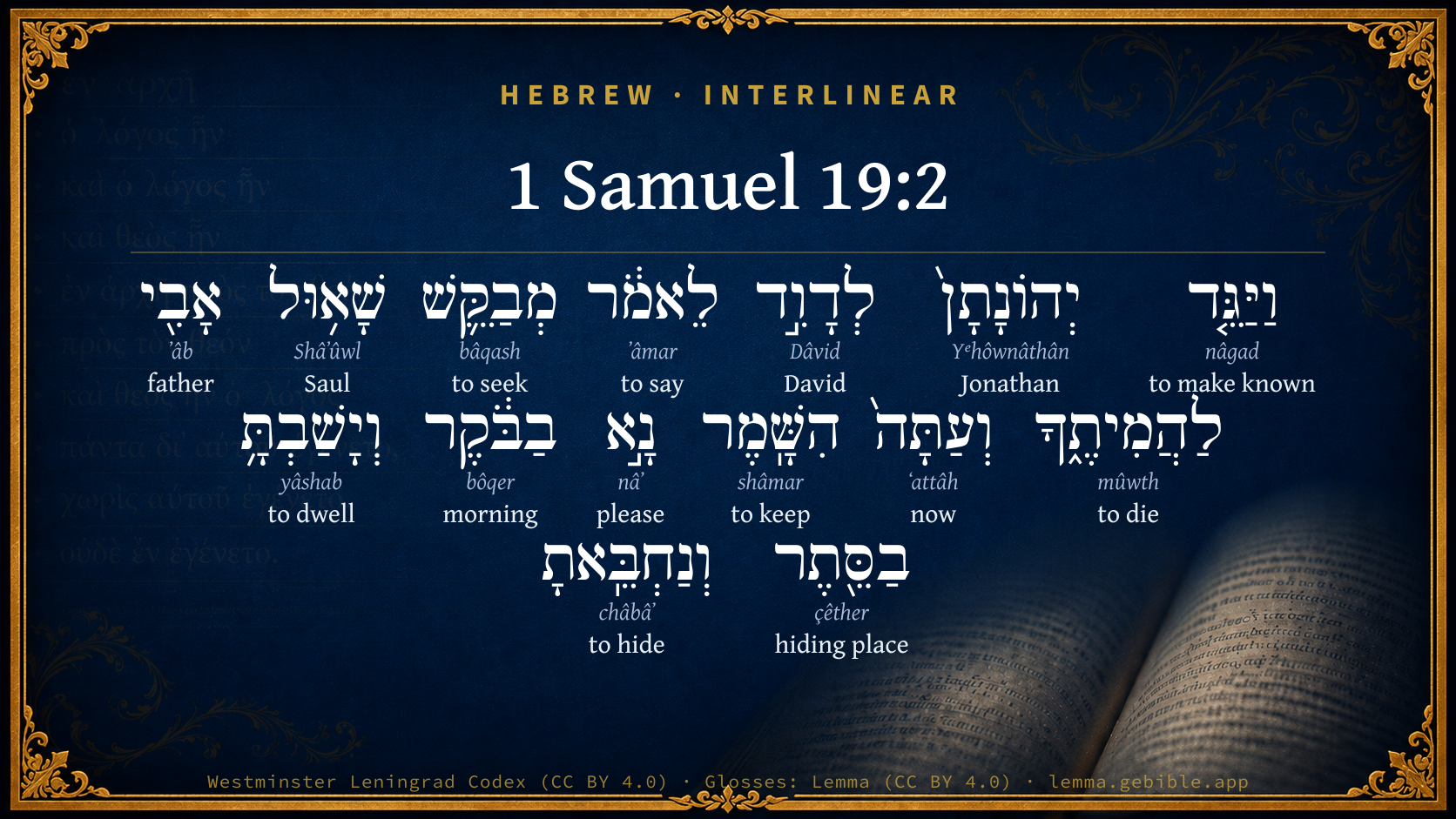
  1. וַיַּגֵּ֤ד nâgad H5046 “and · to make known” Conjunction + Verb, Hiphil, Sequential Imperfect, 3rd Person, Masculine, Singular
  2. יְהוֹנָתָן֙ Yᵉhôwnâthân H3083 “Jonathan” Noun, Proper
  3. לְדָוִ֣ד Dâvid H1732 “to/for · David” Preposition + Noun, Proper
  4. לֵאמֹ֔ר ʼâmar H559 “to say” Preposition + Verb, Qal, Infinitive Construct
  5. מְבַקֵּ֛שׁ bâqash H1245 “seeking” Verb, Piel, Participle Active, Masculine, Singular, Absolute
  6. שָׁא֥וּל Shâʼûwl H7586 “Saul” Noun, Proper
  7. אָבִ֖י ʼâb H1 “father · my” Noun, Common, Masculine, Singular, Construct + Suffix, Personal, 1st Person, Common, Singular
  8. לַהֲמִיתֶ֑ךָ mûwth H4191 “to die · you” Preposition + Verb, Hiphil, Infinitive Construct + Suffix, Personal, 2nd Person, Masculine, Singular
  9. וְעַתָּה֙ ʻattâh H6258 “and · now” Conjunction + Adverb
  10. הִשָּֽׁמֶר shâmar H8104 “keep” Verb, Niphal, Imperative, 2nd Person, Masculine, Singular
  11. נָ֣א nâʼ H4994 “please” Particle, Exhortation
  12. בַבֹּ֔קֶר bôqer H1242 “in/at the · morning” Preposition, Determined + Noun, Common, Masculine, Singular, Absolute
  13. וְיָשַׁבְתָּ֥ yâshab H3427 “and · to dwell” Conjunction + Verb, Qal, Sequential Perfect, 2nd Person, Masculine, Singular
  14. בַסֵּ֖תֶר çêther H5643 “in/at the · hiding place” Preposition, Determined + Noun, Common, Masculine, Singular, Absolute

About this verse

These counts appear in no published source. They are computed here, from the morphology-tagged text and Lemma’s own curated glosses. What Lemma adds →

15
words
15
distinct lemmas
Historical
section

Shared distinctive vocabulary

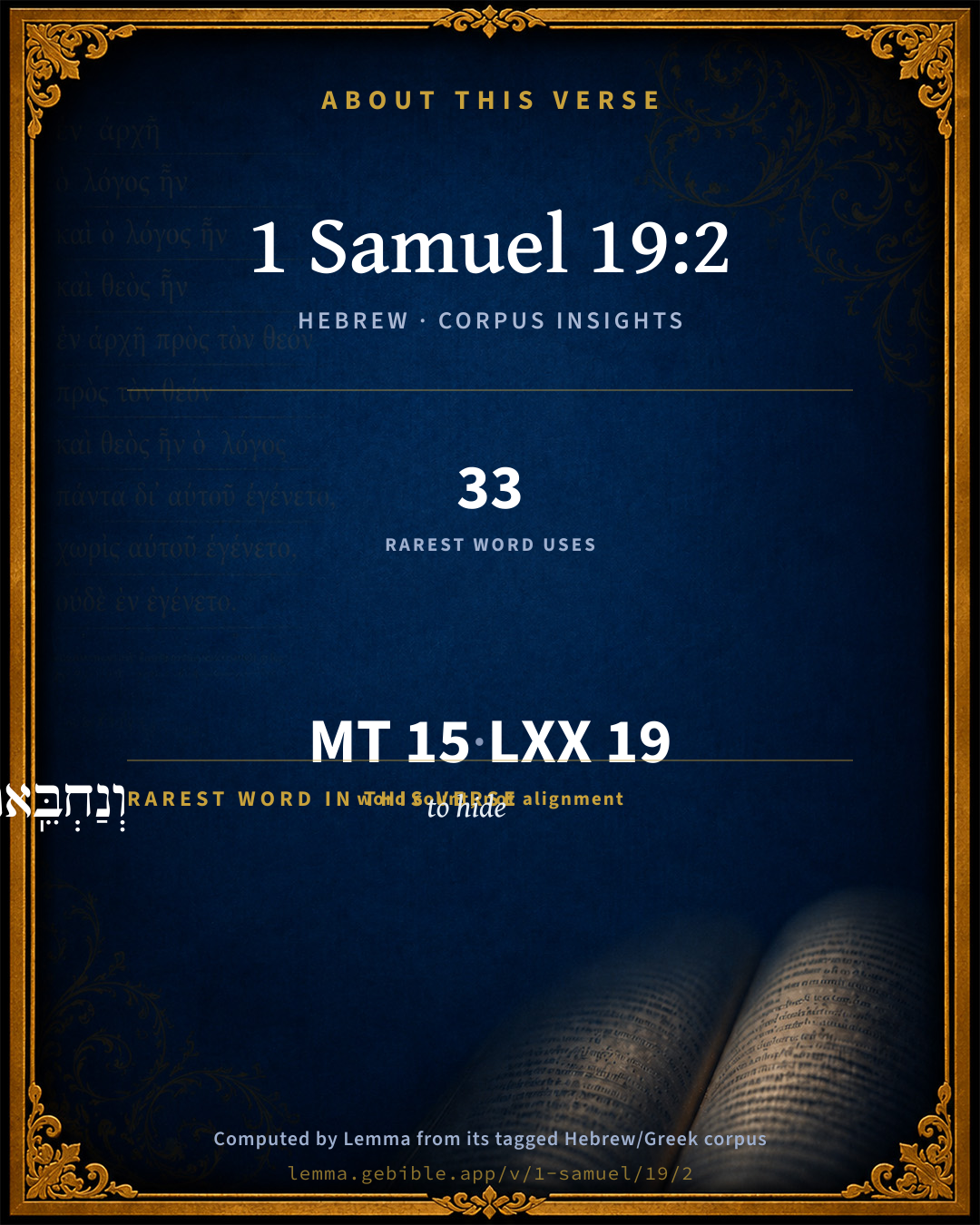
וְנַחְבֵּֽאתָ to hide H2244 occurs in 33 verses of the Hebrew Bible. Also found in:

Grammatical profile

  • 7 verbs
  • 6 nouns
  • 1 adverb
  • 1 particle

Verb forms

  • וַיַּגֵּ֤ד Hiphil · Sequential Imperfect
  • לֵאמֹ֔ר Qal · Infinitive Construct
  • מְבַקֵּ֛שׁ Piel · Participle Active
  • לַהֲמִיתֶ֑ךָ Hiphil · Infinitive Construct
  • הִשָּֽׁמֶר Niphal · Imperative
  • וְיָשַׁבְתָּ֥ Qal · Sequential Perfect
  • וְנַחְבֵּֽאתָ Niphal · Sequential Perfect

Hebrew & Septuagint length

In English translation the verse runs 30 words from the Hebrew and 31 from the Septuagint (LXX English) — closely comparable.

A rough comparison of the two English renderings, which tokenize alike — not a word-level alignment.

Word counts can differ between the Hebrew and the Greek without any difference in meaning — e.g. the Hebrew direct-object marker אֵת has no separate Greek word, and Greek often adds the article ὁ.

In the original languages it is 15 Hebrew tokens and 19 Greek tokens — but the two are counted differently (Hebrew bundles its prefixes and suffixes into one token; the Greek is in lemma form), so that isn’t a like-for-like length.

Cross-references

8

Topical passages linked to 1 Samuel 19:2 in the Treasury of Scripture Knowledge — connected by theme and wording, ordered by reader-vote popularity; previews shown in the World English Bible.

  • Proverbs 17:17 A friend loves at all times; And a brother is born for adversity.
  • Acts 9:24 but their plot became known to Saul. They watched the gates both day and night that they might kill him,
  • 1 Samuel 18:1–3 It happened, when he had made an end of speaking to Saul, that the soul of Jonathan was knit with the soul of David, and Jonathan loved him as his own soul.
  • 1 Samuel 20:2 He said to him, "Far from it; you shall not die: behold, my father does nothing either great or small, but that he discloses it to me; and why should my father hide this thing from me? It is not so."
  • Psalms 16:3 As for the saints who are in the earth, They are the excellent ones in whom is all my delight.
  • Acts 23:16 But Paul's sister's son heard of their lying in wait, and he came and entered into the barracks and told Paul.
  • 1 John 3:12–14 unlike Cain, who was of the evil one, and killed his brother. Why did he kill him? Because his works were evil, and his brother's righteous.
  • John 15:17–19 "I command these things to you, that you may love one another.

Cross-references courtesy of OpenBible.info (CC BY 4.0).

Hebrew and Greek witnesses Masoretic Hebrew ↔ Greek Septuagint

The same verse in the two great witnesses to the Old Testament, shown verse-for-verse.

These are two independent witnesses, not word-aligned to each other, and the Septuagint is shown in lemma (dictionary) form.

Hebrew 1 Samuel 19:2 Masoretic · Westminster Leningrad Codex

וַיַּגֵּ֤ד יְהוֹנָתָן֙ לְדָוִ֣ד לֵאמֹ֔ר מְבַקֵּ֛שׁ שָׁא֥וּל אָבִ֖י לַהֲמִיתֶ֑ךָ וְעַתָּה֙ הִשָּֽׁמֶר נָ֣א בַבֹּ֔קֶר וְיָשַׁבְתָּ֥ בַסֵּ֖תֶר וְנַחְבֵּֽאתָ

Jonathan told David, saying, Saul my father seeks to kill you: now therefore, please take care of yourself in the morning, and live in a secret place, and hide yourself:

World English Bible · Public Domain

Greek LXX 1 Samuel 19:2 Septuagint · lemma form

καί ἀποἀγγέλλω ιωναθαν ὁ δαυίδ λέγω σαούλ ζητέω θανατόω σύ φυλάσσω οὖν αὔριον πρωΐ καί κρύπτω καί καταἵζω κρυβῇ

And Jonathan, Saul's son, loved David much: and Jonathan told David, saying, Saul seeks to kill you: take heed to yourself therefore to-morrow morning, and hide yourself, and dwell in secret.

LXX2012 (modern English Septuagint) · Public Domain

On this verse, Haydock's Catholic Bible Commentary discusses the Septuagint’s reading. Read the note in Commentary ↓

Hebrew: Westminster Leningrad Codex (CC BY 4.0). Greek: Septuagint (public domain); English from LXX2012 (modern English Septuagint) (Public Domain). How the Septuagint differs from the Hebrew →

Targum (Aramaic paraphrase)

1

The Targum is the ancient Jewish Aramaic paraphrase of the Hebrew Scriptures — an interpretive translation, not the Hebrew text itself. Onkelos (literal) and Pseudo-Jonathan (expansive) render the Torah, and Jonathan the Prophets. Coverage is partial: where no permissively-licensed English translation exists for a verse, only the Aramaic is shown. This is verse-level text, not a word-by-word alignment to the Hebrew.

  1. Targum Jonathan Prophets (Joshua–Malachi)
    וְחַוֵי יְהוֹנָתָן לְדָוִד לְמֵימָר בָּעֵי שָׁאוּל אַבָּא לְמִקְטְלָךְ וּכְעַן אִסְתַּמַר כְּעָן בְּצַפְרָא וְתִתַּב בְּסִתְרָא וְתִטַמָר:

    (no public-domain English translation for this verse)

    Targum Jonathan — Aramaic: “Mikraot Gedolot” (public domain). English: “Sefaria Community Translation” (CC0 1.0 (public-domain dedication)); “London "Chaldee Paraphrase," 1871” (public domain). Text via Sefaria.

Commentary

Notes on 1 Samuel 19:2 from classic Christian and Jewish commentators (each source and its license shown beneath its notes). The classic Christian expositions comment on the surrounding passage and are grouped to its opening verse, so a note may address several verses; the Jewish commentaries on the Tanakh (Rashi and others) are per-verse, so they appear only where the commentator wrote on this verse.

Lemma curates 59 commentaries, every one of them public domain or Creative Commons licensed, each selected and text-cleaned for this edition rather than reprinted as found. About our sources →

Trapp's Complete Commentary

John Trapp

1Sa 19:2 But Jonathan Saul’s son delighted much in David: and Jonathan told David, saying, Saul my father seeketh to kill thee: now therefore, I pray thee, take heed to thyself until the morning, and abide in a secret [place], and hide thyself:

Ver. 2. But Jonathan Saul’s son.] And heir apparent to the kingdom, which might have made him an enemy to David, whom he knew likely to succeed his father.

And Jonathan told David.] Wherein he did him a most friendly office, for darts foreseen are dintless, {a} and to his father no disservice at all; by hindering him from imbruing his hands in innocent blood.

Saul my father seeketh to kill thee.] Before he had sought to do it more covertly; but now more overtly; so true is that of Luther, Hypocritis nihil est crudelius, impatientius, et vindictae cupidius, &c., there is nothing in the world more cruel, more impatient, and more vindictive, than are hypocrites: truly they are very serpents, spiteful, venemous, and revengeful.

Take heed to thyself until the morning,] viz., That thou be not surprised by my father’s assassins and cut-throats.

Abide in a secret place.] Such a hidingplace, as thou knowest of, near to Saul’s walk: where thou mayest hear what passeth betwixt us; and what thou hearest not I will tell thee.

{a} Praevisa iacula minus feriunt.

John Trapp, A Commentary or Exposition upon All the Books of the Old and New Testament (1647–1656) — public domain. Text from a community e-Sword module.

Joseph Benson's Commentary

1Sa 19:2. But Jonathan delighted much in David, and told David — Jonathan disobeyed the command, and, instead of murdering David, pleads his innocence and merits, as reasons for saving him. He also discovered his father’s design and fixed resolution to destroy him, and certainly in neither case acted inconsistently with his duty to his father, and king. “He,” says Dr. Dodd, “who knows of a conspiracy against an innocent person’s life, and doth not discover it; or, who kills such a one by another’s instigation and command, is himself a murderer; and no duty to a father, or allegiance to a prince, can oblige any one to shed innocent blood. Jonathan was therefore so far from acting contrary to his duty and allegiance, in refusing to become his father’s instrument in murdering David, that he gave a noble instance of filial piety, affection, and duty, in his repeated endeavours to preserve him from so unnatural a crime; and humanity and virtue will ever applaud him for the generous concern he expressed for the honour of his father and the preservation of his friend.” Take heed to thyself until the morning — Jonathan knew not but some of the servants might be either so obsequious to Saul, or so envious at David, as to put the orders in execution which Saul had given, if they could light on David.

Joseph Benson's Commentary on the Old and New Testaments (1811–1818) — public domain. Text from a community e-Sword module.

Adam Clarke's Commentary

Verse 2. Take heed to thyself until the morning] Perhaps the order was given to slay him the next day; and therefore Jonathan charges him to be particularly on his guard at that time, and to hide himself.

Adam Clarke's Commentary on the Bible (1810–1826) — public domain. Text from a community e-Sword/MySword module.

Ellicott's Commentary for English Readers

(2) Jonathan told David.—The danger Jonathan saw was a very present one. A very slight expression on the part of a powerful king of his earnest desire to get rid of an obnoxious subject, however eminent or great, is sufficient to stir up unscrupulous men to commit the murder which they might fancy would be acceptable to their master.

A Bible Commentary for English Readers, edited by Charles John Ellicott (1878–1897) — public domain. Text from a community e-Sword module.

The Cambridge Bible for Schools and Colleges

gen. ed. J. J. S. Perowne

2. until the morning] Rather, in the morning.

The Cambridge Bible for Schools and Colleges (gen. ed. J. J. S. Perowne; Cambridge University Press, 1878–1918) — public domain. Text from a community e-Sword module.

John Gill's Exposition

But Jonathan, Saul's son, delighted much in David,.... In his company and conversation; he loved him with a love of complacency, and was constant and steadfast in it, and which was a kind providence to David; for by this means he came to the knowledge of Saul's designs upon him, and could the better guard against him:

and Jonathan told David, saying, Saul my father seeketh to kill thee; to inform him of which was acting the part of a sincere and faithful friend:

now therefore, I pray thee, take heed of thyself until the morning: it seems it was now evening when he informed him of it; and as he knew not what emissaries Saul might have out that night in quest of him, he advises him to take care of himself, and not expose himself to any danger, and to keep a strict guard about him; and in the morning he would try to conciliate his father to him, when he might hope, having slept upon it, that he would be in a better temper, and more disposed to hear what might be said to him:

and abide in a secret place, and hide thyself; he seems to suggest as if it was not safe for him to be in his own house, and in his own bedchamber that night, but that it was advisable to retire to some private place, where it might not be known or suspected that he was there. By what follows he means some field, and a private place in it.

John Gill's Exposition of the Whole Bible (1746–1763) — public domain (CC PDM 1.0). Text via the HelloAO Bible API.

Haydock's Catholic Bible Commentary

Morning. Septuagint add, "to-morrow." (Menochius)

George Leo Haydock (1774–1849), Haydock's Catholic Family Bible and Commentary, 1859 edition — public domain. Excludes Psalms (Douay-Rheims chapter numbering differs from Protestant) and Deuterocanonical books (Catholic canon only).

Matthew Poole's English Annotations

Lest he kill thee before I discourse with him, and endeavour to reconcile him to thee; which I think not fit to attempt as yet, whilst he is in the fit of rage against thee; but I intend to do in the morning, when I may hope to find him in a better temper.

Matthew Poole's English Annotations on the Holy Bible (1683–1685) — public domain. Text from a community e-Sword/MySword module.

Whedon's Commentary on the Bible

Daniel D. Whedon

2. Take heed to thyself until the morning — For in the darkness of the night Saul’s servants would be most likely to execute their master’s bloody purpose.

Daniel D. Whedon (gen. ed.), Commentary on the Old and New Testaments (1874–1909) — public domain. Text from a community e-Sword module.

The Pulpit Commentary

Vers. 2, 3. Until the morning. Rather, "in the morning." Saul"s purpose was taking shape, and as there are always men too ready to commit crime at the bidding of a king, there was the danger that secret murder might be the quick result of Saul"s open communication of his wishes to his men of war. Jonathan, therefore, warns David of the king"s malice, and urges him to hide himself until he has made a last entreaty for him. This was to take place in the field, the open common land. There was no idea of David overhearing the conversation, but when the king took his usual walk Jonathan was to join him, and hold a conference with him apart in the unenclosed hill pastures. After probing his father"s real feelings he would continue his walk, and, without awakening any suspicions, would meet David and communicate to him the result. What I see, that I will tell thee. More exactly, "I will see what (he says), and will tell thee."

The Pulpit Commentary (1880–1919), ed. H.D.M. Spence-Jones & Joseph S. Exell — public domain. Text from a community e-Sword module.

Lesson kit

Teaching starters — assembled from the data on this page, not authored interpretation. Every prompt links to the verse data it draws on. Edit before teaching.

1 Samuel, in the Historical, opens this verse with 15 words (15 distinct Hebrew lemmas). Its most distinctive word is châbâʼ (“to hide”). A historical commentator’s framing appears above. Read the whole chapter for the surrounding context.

Discussion questions

  1. What does “to hide” (châbâʼ) contribute to the verse as a whole?
  2. Genesis 3:8 shares the word «to hide» with this verse. How do the two illuminate each other?
  3. These translations render this verse differently; the difference is in the English rendering, not the original. What questions does that raise?
  4. The verb «וַיַּגֵּ֤ד» is Hiphil Sequential Imperfect. How does its form color the action?
  5. Reading how Trapp's Complete Commentary and Joseph Benson's Commentary read this verse, where do the two commentators agree and where do they part?

Things to notice

Reading settings

Reading text

Shown beneath each verse's original-language words.

Old Testament
Old Testament edition

Read the OT as the Masoretic Hebrew (MT) or the Greek Septuagint (LXX).

English shown for the Greek Septuagint (in the Hebrew ↔ Greek comparison).

Comparing translations? Open the Compare panel on any verse page to stack up to four side by side.