1 Samuel 24:9

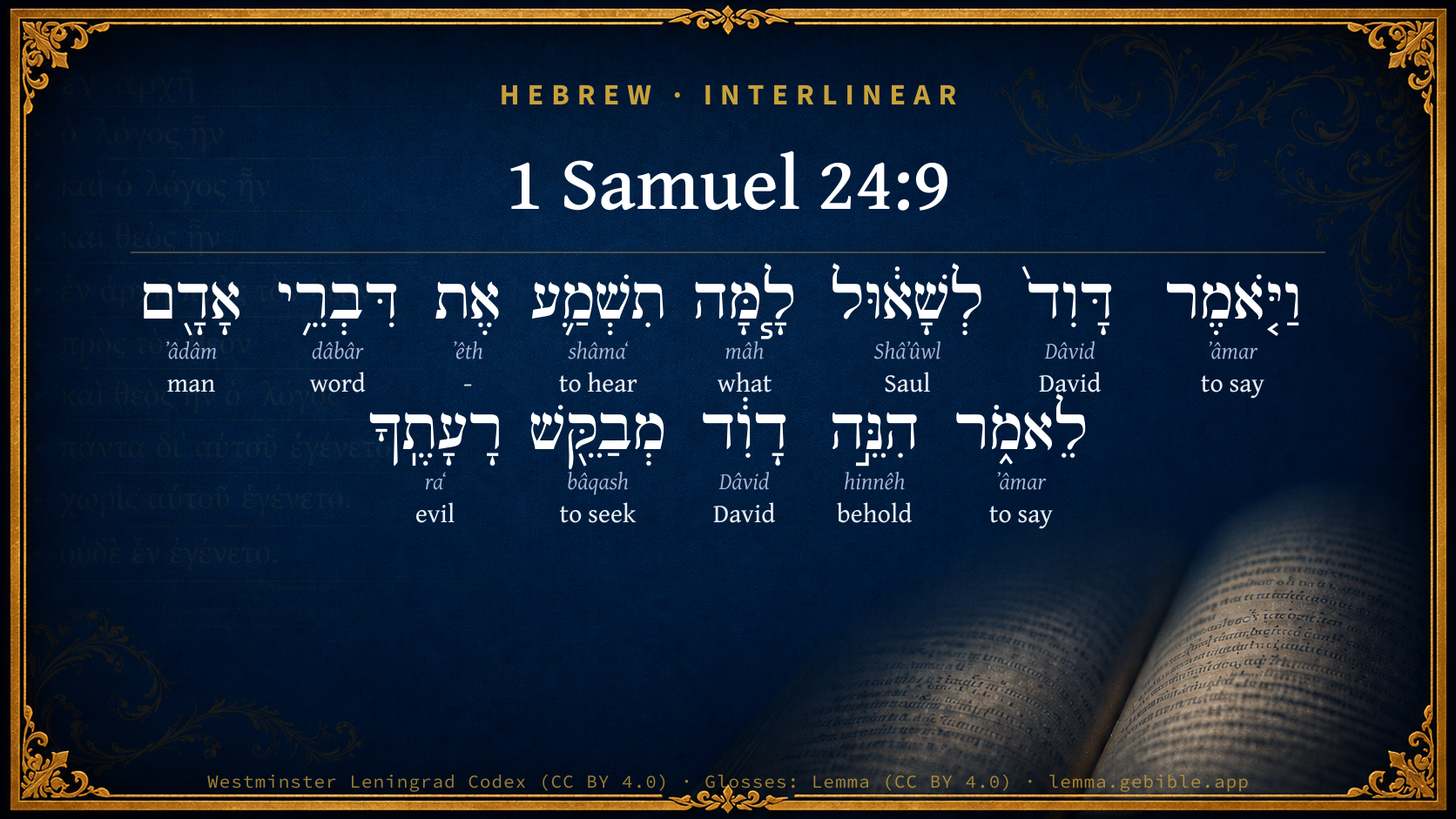
Hebrew (Westminster Leningrad Codex) 1 Samuel 24:9 appears in the Hebrew Old Testament. The text above is from the Westminster Leningrad Codex. Each word links to its Strong’s number, a concise gloss, and parsing drawn from the Open Scriptures Hebrew Bible morphology. Click any word for its full Brown-Driver-Briggs (BDB) entry.
Download image
Cite this verse

1 Samuel 24:9 (World English Bible). Public Domain. Lemma interlinear Bible study tool, https://lemma.gebible.app/v/1-samuel/24/9.

Show BibTeX & RIS
BibTeX
RIS
English Translation
David said to Saul, Why listen you to men's words, saying, Behold, David seeks your hurt?
World English Bible · Public Domain
Download a study sheet

One document with this verse’s original text, its word-by-word gloss line, the meaning frame, cross-references with their text, attributed commentary, and full source and license credits — printable, and it pastes into notes with its structure intact.

This verse Autodidact and up

Study sheet (.html) Plain text (.txt)

A passage Seminary Student

Up to 50 verses in one chapter. A passage sheet keeps up to 6 commentary sources and 12 cross-references per verse, in the order this page ranks them, and says so on the sheet whenever that leaves anything out. Ask for a single verse and you get the Autodidact verse sheet above.

Everything on this page stays free to read, with no account — the sheet is a download of what is already on screen, not access to it.

Want to remove ads? Support Godless Engineer
Compare translations 3

The same verse in 3 English versions, stacked beneath the original-language interlinear above. Click any original word for its lexicon entry.

Each is an independent rendering of the whole verse — the interlinear is not word-aligned to these translations.

Highlighted words mark where these versions differ — a whole-verse word diff, not a word-by-word alignment.

  • World English Bible Public Domain
    David said to Saul, Why listen you to men's words, saying, Behold, David seeks your hurt?
  • King James Version Public Domain
    And David said to Saul, Wherefore hearest thou men's words, saying, Behold, David seeketh thy hurt?
  • unfoldingWord Literal Text CC BY-SA 4.0
    And David said to Saul, “Why do you listen to the words of a man, saying, ‘Behold, David is seeking your harm’?

unfoldingWord Literal Text — © unfoldingWord, licensed CC BY-SA 4.0. Word-aligned USFM3 via Door43 (git.door43.org/unfoldingWord/en_ult).

Versions to compare (up to 4)

3 of 4 selected

Show all 18 translations

Every available English version of this verse, each an independent rendering of the whole verse.

  • World English Bible Public Domain
    David said to Saul, Why listen you to men's words, saying, Behold, David seeks your hurt?
  • Berean Standard Bible Public Domain
    and said to Saul, “Why do you listen to the words of men who say, ‘Look, David intends to harm you’?
  • Majority Standard Bible Public Domain
    and said to Saul, “Why do you listen to the words of men who say, ‘Look, David intends to harm you’?
  • King James Version Public Domain
    And David said to Saul, Wherefore hearest thou men's words, saying, Behold, David seeketh thy hurt?
  • American Standard Version (1901) Public Domain
    And David said to Saul, Wherefore hearkenest thou to men's words, saying, Behold, David seeketh thy hurt?
  • Revised Version (1885) Public Domain
    And David said to Saul, Wherefore hearkenest thou to men’s words, saying, Behold, David seeketh thy hurt?
  • Geneva Bible (1599) Public Domain
    Dauid also arose afterward, and went out of the caue, and cryed after Saul, saying, O my lorde the King. And when Saul looked behinde him, Dauid inclined his face to the earth, and bowed himselfe.
  • Douay-Rheims (1899) Public Domain
    And David also rose up after him: and going out of the cave cried after Saul, saying: My lord the king. And Saul looked behind him: and David bowing himself down to the ground, worshipped,
  • Young's Literal Translation Public Domain
    And David saith to Saul, `Why dost thou hear the words of man, saying, Lo, David is seeking thine evil?
  • Literal Standard Version CC BY-SA 4.0
    And David says to Saul, “Why do you hear the words of man, saying, Behold, David is seeking your calamity?
  • Unlocked Literal Bible CC BY-SA 4.0
    David said to Saul, “Why do you listen to the men who say, 'See, David is seeking your harm?'
  • unfoldingWord Literal Text CC BY-SA 4.0
    And David said to Saul, “Why do you listen to the words of a man, saying, ‘Behold, David is seeking your harm’?
  • Darby Bible Public Domain
    And David said to Saul, Why dost thou listen to words of men, saying, Behold, David seeks thy hurt?
  • World Messianic Bible Public Domain
    David said to Saul, “Why do you listen to men’s words, saying, ‘Behold, David seeks to harm you’?
  • Webster's Bible Public Domain
    \\24:8\\David also rose afterward, and went out of the cave, and cried after Saul, saying, My lord the king. And when Saul looked behind him, David stooped with his face to the earth, and bowed himself.
  • Free Bible Version CC BY-SA 4.0
    “Why do you pay attention to people who say, ‘Watch out, David wants to harm you’?” David asked.
  • Bible in Basic English Public Domain
    And after that David came out of the hollow rock, and crying after Saul said, My lord the king. And when Saul gave a look back, David went down on his face and gave him honour.
  • JPS Tanakh (1917) Public Domain
    (24-10) And David said to Saul: 'Wherefore hearkenest thou to men's words, saying: Behold, David seeketh thy hurt?

Literal Standard Version (2020), Covenant Press — licensed CC BY-SA 4.0. Text via the HelloAO Bible API (eBible.org). Unlocked Literal Bible (unfoldingWord) — licensed CC BY-SA 4.0. Text via the HelloAO Bible API (eBible.org). unfoldingWord Literal Text — © unfoldingWord, licensed CC BY-SA 4.0. Word-aligned USFM3 via Door43 (git.door43.org/unfoldingWord/en_ult). Free Bible Version, Dr. Jonathan Gallagher — licensed CC BY-SA 4.0. Text via the HelloAO Bible API (eBible.org).

Word by word

More ways to search: Search by grammar → Find every occurrence → Compare this word →

Practice this passage: Drill this verse → Learn its vocabulary →

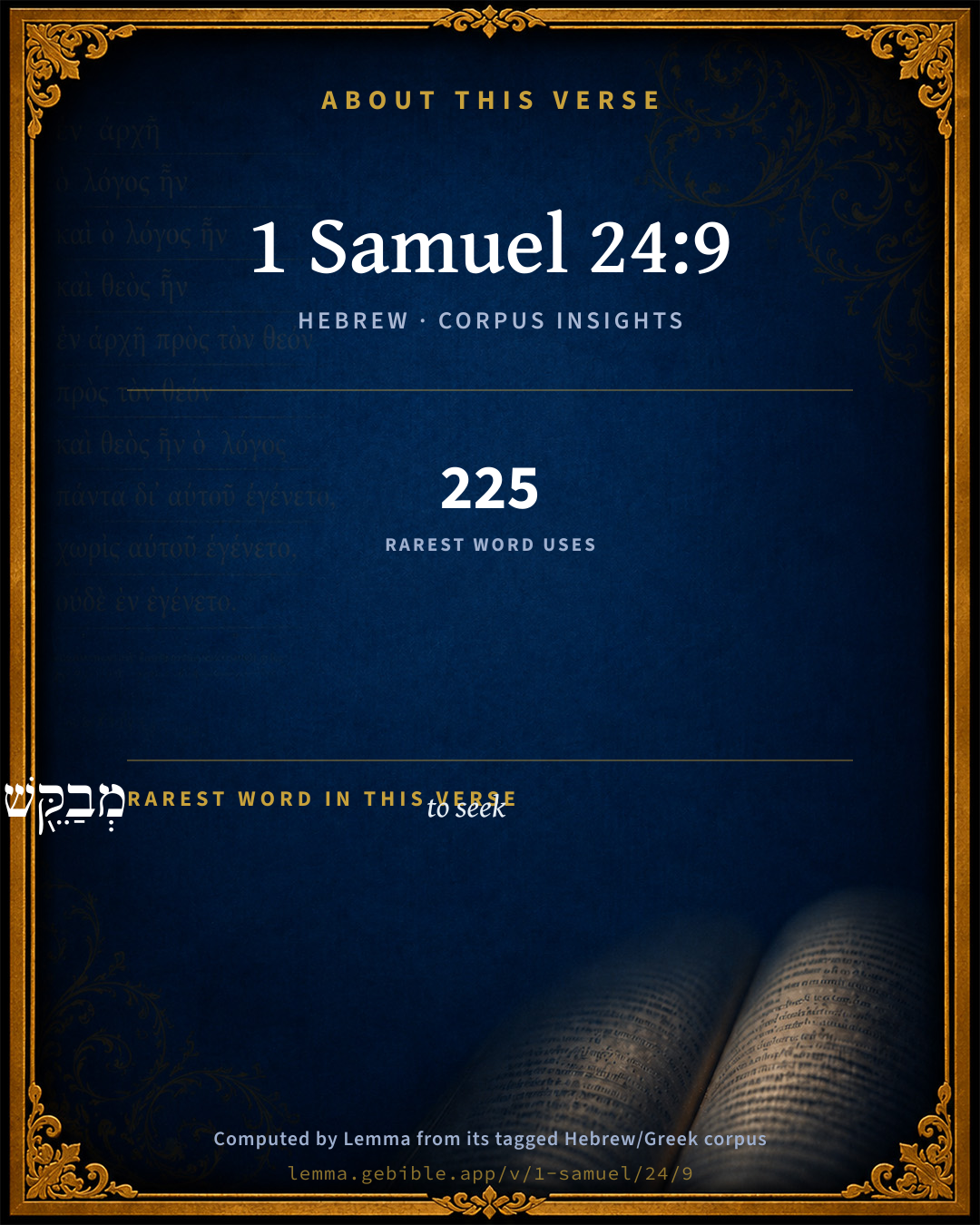
מְבַקֵּ֖שׁ
bâqash
H1245
“seeking”
Verb, Piel, Participle Active, Masculine, Singular, Absolute
Part of Speech
Verb
Stem
Piel
Form
Participle Active
Gender
Masculine
Number
Singular
State
Absolute
Full BDB Definition

Origin: a primitive root

TWOT: 276

to seek, require, desire, exact, request - (Piel) - to seek to find - to seek to secure - to seek the face - to desire, demand - to require, exact - to ask, request - (Pual) to be sought
  1. וַיֹּ֤אמֶר ʼâmar H559 “and · to say” Conjunction + Verb, Qal, Sequential Imperfect, 3rd Person, Masculine, Singular
  2. דָּוִד֙ Dâvid H1732 “David” Noun, Proper
  3. לְשָׁא֔וּל Shâʼûwl H7586 “to/for · Saul” Preposition + Noun, Proper
  4. לָ֧מָּה mâh H4100 “to/for · what” Preposition + Particle, Interrogative
  5. תִשְׁמַ֛ע shâmaʻ H8085 “to hear” Verb, Qal, Imperfect, 2nd Person, Masculine, Singular
  6. אֶת ʼêth H853 “-” Particle, Direct Object
  7. דִּבְרֵ֥י dâbâr H1697 “words of” Noun, Common, Masculine, Plural, Construct
  8. אָדָ֖ם ʼâdâm H120 “man” Noun, Common, Masculine, Singular, Absolute
  9. לֵאמֹ֑ר ʼâmar H559 “to say” Preposition + Verb, Qal, Infinitive Construct
  10. הִנֵּ֣ה hinnêh H2009 “behold” Particle, Demonstrative
  11. דָוִ֔ד Dâvid H1732 “David” Noun, Proper
  12. רָעָתֶֽךָ raʻ H7451 “evil · your” Noun, Common, Feminine, Singular, Construct + Suffix, Personal, 2nd Person, Masculine, Singular

About this verse

These counts appear in no published source. They are computed here, from the morphology-tagged text and Lemma’s own curated glosses. What Lemma adds →

13
words
11
distinct lemmas
Historical
section

Grammatical profile

  • 4 verbs
  • 6 nouns
  • 3 particles

Verb forms

  • וַיֹּ֤אמֶר Qal · Sequential Imperfect
  • תִשְׁמַ֛ע Qal · Imperfect
  • לֵאמֹ֑ר Qal · Infinitive Construct
  • מְבַקֵּ֖שׁ Piel · Participle Active

Repetition

Words recur within this verse — often emphatic in Hebrew:

  • וַיֹּ֤אמֶר to say H559 ×2
  • דָּוִד֙ David H1732 ×2

Hebrew & Septuagint length

In English translation the verse runs 16 words from the Hebrew and 41 from the Septuagint (LXX English) — the Septuagint runs noticeably longer here. See the side-by-side →

A rough comparison of the two English renderings, which tokenize alike — not a word-level alignment.

Word counts can differ between the Hebrew and the Greek without any difference in meaning — e.g. the Hebrew direct-object marker אֵת has no separate Greek word, and Greek often adds the article ὁ.

Cross-references

13

Topical passages linked to 1 Samuel 24:9 in the Treasury of Scripture Knowledge — connected by theme and wording, ordered by reader-vote popularity; previews shown in the World English Bible.

  • Proverbs 29:12 If a ruler listens to lies, All of his officials are wicked.
  • Ecclesiastes 7:21–22 Also don't take heed to all words that are spoken, lest you hear your servant curse you;
  • Leviticus 19:16 "'You shall not go up and down as a slanderer among your people; neither shall you stand against the life of your neighbor. I am Yahweh.
  • 1 Samuel 26:19 Now therefore, please let my lord the king hear the words of his servant. If it be Yahweh that has stirred you up against me, let him accept an offering: but if it be the children of men, cursed be they before Yahweh: for they have driven me out this day that I shouldn't cling to Yahweh's inheritance, saying, Go, serve other gods.
  • Psalms 101:5 I will silence whoever secretly slanders his neighbor. I won't tolerate one who is haughty and conceited.
  • Psalms 141:6 Their judges are thrown down by the sides of the rock. They will hear my words, for they are well spoken.
  • Proverbs 16:28 A perverse man stirs up strife. A whisperer separates close friends.
  • Proverbs 17:4 An evil-doer heeds wicked lips. A liar gives ear to a mischievous tongue.
  • Proverbs 18:8 The words of a gossip are like dainty morsels: They go down into a person's innermost parts.
  • Proverbs 25:23 The north wind brings forth rain: So a backbiting tongue brings an angry face.
  • Proverbs 26:20–22 For lack of wood a fire goes out; Without gossip, a quarrel dies down.
  • Proverbs 26:28 A lying tongue hates those it hurts; And a flattering mouth works ruin.
  • James 3:6 And the tongue is a fire. The world of iniquity among our members is the tongue, which defiles the whole body, and sets on fire the course of nature, and is set on fire by Gehenna.

Cross-references courtesy of OpenBible.info (CC BY 4.0).

Hebrew and Greek witnesses Masoretic Hebrew ↔ Greek Septuagint

The same verse in the two great witnesses to the Old Testament, shown verse-for-verse.

Here the Septuagint runs noticeably longer than the Hebrew — LXX2012 (modern English Septuagint) 41 words vs World English Bible 16. A rough length comparison of the two English translations, not a word-level alignment — read both below.

These are two independent witnesses, not word-aligned to each other, and the Septuagint is shown in lemma (dictionary) form.

Hebrew 1 Samuel 24:9 Masoretic · Westminster Leningrad Codex

וַיֹּ֤אמֶר דָּוִד֙ לְשָׁא֔וּל לָ֧מָּה תִשְׁמַ֛ע אֶת דִּבְרֵ֥י אָדָ֖ם לֵאמֹ֑ר הִנֵּ֣ה דָוִ֔ד מְבַקֵּ֖שׁ רָעָתֶֽךָ

David said to Saul, Why listen you to men's words, saying, Behold, David seeks your hurt?

World English Bible · Public Domain

Greek LXX 1 Samuel 24:9 Septuagint · lemma form

καί ἀναἵστημι δαυίδ ὀπίσω αὐτός ἐκ ὁ σπήλαιον καί βοάω δαυίδ ὀπίσω σαούλ λέγω κύριος βασιλεύς καί ἐπιβλέπω σαούλ εἰς ὁ ὀπίσω αὐτός καί κύπτω δαυίδ ἐπί πρόσωπον αὐτός ἐπί ὁ γῆ καί προςκυνέω αὐτός

And David rose up and went after him out of the cave: and David cried after Saul, saying, My lord, O king! and Saul looked behind him, and David bowed with his face to the ground, and did obeisance to him.

LXX2012 (modern English Septuagint) · Public Domain

Hebrew: Westminster Leningrad Codex (CC BY 4.0). Greek: Septuagint (public domain); English from LXX2012 (modern English Septuagint) (Public Domain). How the Septuagint differs from the Hebrew →

Targum (Aramaic paraphrase)

1

The Targum is the ancient Jewish Aramaic paraphrase of the Hebrew Scriptures — an interpretive translation, not the Hebrew text itself. Onkelos (literal) and Pseudo-Jonathan (expansive) render the Torah, and Jonathan the Prophets. Coverage is partial: where no permissively-licensed English translation exists for a verse, only the Aramaic is shown. This is verse-level text, not a word-by-word alignment to the Hebrew.

  1. Targum Jonathan Prophets (Joshua–Malachi)
    וְקָם דָוִד בָּתַר כֵּן וּנְפַק מִן מְעַרְתָּא וּקְרָא בָּתַר שָׁאוּל לְמֵימָר רִבּוֹנִי מַלְכָּא וְאִסְתְּכֵי שָׁאוּל לַאֲחוֹרוֹהִי וּכְרַע דָוִד עַל אַפּוֹהִי עַל אַרְעָא וּסְגִיד:

    (no public-domain English translation for this verse)

    Targum Jonathan — Aramaic: “Mikraot Gedolot” (public domain). English: “Sefaria Community Translation” (CC0 1.0 (public-domain dedication)); “London "Chaldee Paraphrase," 1871” (public domain). Text via Sefaria.

Commentary

Notes on 1 Samuel 24:9 from classic Christian and Jewish commentators (each source and its license shown beneath its notes). The classic Christian expositions comment on the surrounding passage and are grouped to its opening verse, so a note may address several verses; the Jewish commentaries on the Tanakh (Rashi and others) are per-verse, so they appear only where the commentator wrote on this verse.

Lemma curates 59 commentaries, every one of them public domain or Creative Commons licensed, each selected and text-cleaned for this edition rather than reprinted as found. About our sources →

Matthew Henry's Commentary

We have here David's warm and pathetic speech to Saul, wherein he endeavours to convince him that he did him a great deal of wrong in persecuting him thus and to persuade him therefore to be reconciled.

I. He calls him father (Sa1 24:11), for he was not only, as king, the father of his country, but he was, in particular, his father-in-law. From a father one may expect compassion and a favourable opinion. For a prince to seek the ruin of any of his good subjects is as unnatural as for a father to seek the ruin of his own children.

II. He lays the blame of his rage against him upon his evil counsellors: Wherefore hearest thou men's words? Sa1 24:9. It is a piece of respect due to crowned heads, if they do amiss, to charge it upon those about them, who either advised them to it or should have advised them against it. David had reason enough to think that Saul persecuted him purely from his own envy and malice, yet he courteously supposes that others put him on to do it, and made him believe that David was his enemy and sought his hurt. Satan, the great accuser of the brethren, has his agents in all places, and particularly in the courts of those princes that encourage them and give ear to them, who make it their business to represent the people of God as enemies to Caesar and hurtful to kings and provinces, that, being thus dressed up in bear-skins, they may "be baited."

III. He solemnly protests his own innocence, and that he is far from designing any hurt or mischief to Saul: "There is neither evil nor transgression in my hand, Sa1 24:11. I am not chargeable with any crime, nor conscious of any guilt, and, had I a window in my breast, thou mightest through it see the sincerity of my heart in this protestation: I have not sinned against thee (however I have sinned against God), yet thou huntest my soul," that is, "my life." Perhaps it was about this time that David penned the seventh psalm, concerning the affair of Cush the Benjamite (that is, Saul, as some think), wherein he thus appeals to God (Sa1 24:3-5): If there be iniquity in my hands, then let the enemy persecute my soul and take it, putting in a parenthesis, with reference to the story of this chapter, Yea, I have delivered him that without cause is my enemy.

IV. He produces undeniable evidence to prove the falsehood of the suggestion upon which Saul's malice against him was grounded. David was charged with seeking Saul's hurt: "See," says he, "yea, see the skirt of thy robe, Sa1 24:11. Let this be a witness for me, and an unexceptionable witness it is; had that been true of which I am accused, I should now have had thy head in my hand and not the skirt of thy robe, for I could as easily have cut off that as this." To corroborate this evidence he shows him, 1. That God's providence had given him opportunity to do it: The lord delivered thee, very surprisingly, to day into my hand, whence many a one would have gathered an intimation that it was the will of God he should now give the determining blow to him whose neck lay so fair for it. When Saul had but a very small advantage against David he cried out, God has delivered him into my hand (Sa1 23:7), and resolved to make the best of that advantage; but David did not so. 2. That his counsellors and those about him had earnestly besought him to do it: Some bade me kill thee. He had blamed Saul for hearkening to men's words and justly; "for," says he, "if I had done so, thou wouldest not have been alive now." 3. That it was upon a good principle that he refused to do it; not because Saul's attendants were at hand, who, it may be, would have avenged his death; no, it was not by the fear of them, but by the fear of God, that he was restrained from it. "He is my lord, and the Lord's anointed, whom I ought to protect, and to whom I owe faith and allegiance, and therefore I said, I will not touch a hair of his head." Such a happy command he had of himself that his nature, in the midst of the greatest provocation, was not suffered to rebel against his principles.

V. He declares it to be his fixed resolution never to be his own avenger: "The Lord avenge me of thee, that is, deliver me out of thy hand; but, whatever comes of it, my hand shall not be upon thee" (Sa1 24:12), and again (Sa1 24:13), for saith the proverb of the ancients, Wickedness proceedeth from the wicked. The wisdom of the ancients is transmitted to posterity by their proverbial sayings. Many such we receive by tradition from our fathers; and the counsels of common persons are very much directed by this, "As the old saying is." Here is one that was in use in David's time: Wickedness proceedeth from the wicked, that is, 1. Men's own iniquity will ruin them at last, so some understand it. Forward furious men will cut their own throats with their own knives. Give them rope enough, and they will hang themselves. In this sense it comes in very fitly as a reason why his hand should not be upon him. 2. Bad men will do bad things; according as men's principles and dispositions are, so will their actions be. This also agrees very well with the connexion. If David had been a wicked man, as he was represented, he would have done this wicked thing; but he durst not, because of the fear of God. Or thus: Whatever injuries bad men do us (which we are not to wonder at; he that lies among thorns must expect to be scratched), yet we must not return them; never render railing for railing. Though wickedness proceed from the wicked, yet let it not therefore proceed from us by way of retaliation. Though the dog bark at the sheep, the sheep does not bark at the dog. See Isa 32:6-8.

VI. He endeavours to convince Saul that as it was a bad thing, so it was a mean thing, for him to give chase to such an inconsiderable person as he was (Sa1 24:14): Whom does the king of Israel pursue with all this care and force? A dead dog; a flea; one flea, so it is in the Hebrew. It is below so great a king to enter the lists with one that is so unequal a match for him, one of his own servants, bred a poor shepherd, now an exile, neither able nor willing to make any resistance. To conquer him would not be to his honour, to attempt it was his disparagement. If Saul would consult his own reputation, he would slight such an enemy (supposing he were really his enemy) and would think himself in no danger from him. David was so far from aspiring that he was, in his own account, as a dead dog. Mephibosheth thus calls himself, Sa2 9:8. This humble language would have wrought upon Saul if he had had any spark of generosity in him. Satis est prostrsse leoni - Enough for the lion that he has laid his victim low. What credit would it be to Saul to trample upon a dead dog? What pleasure could it be to him to hunt a flea, a single flea, which (as some have observed), if it be sought, is not easily found, if it be found, is not easily caught, and, if it be caught, is a poor prize, especially for a prince. Aquila non captat muscas - The eagle does not dart upon flies. David thinks Saul had no more reason to fear him than to fear a flea-bite.

VII. He once and again appeals to God as the righteous Judge (Sa1 24:12 and Sa1 24:15): The Lord judge between me and thee. Note, The justice of God is the refuge and comfort of oppressed innocence. If men wrong us, God will right us, at furthest, in the judgment of the great day. With him David leaves his cause, and so rests satisfied, waiting his time to appear for him.

Matthew Henry's Commentary on the Whole Bible (1708–1710) — public domain (CC PDM 1.0). Text via the HelloAO Bible API.

Trapp's Complete Commentary

John Trapp

1Sa 24:9 And David said to Saul, Wherefore hearest thou men’s words, saying, Behold, David seeketh thy hurt?

Ver. 9. Wherefore hearest thou men’s words?] The tale hearer is no less faulty than the tale bearer; for as this carrieth the devil in his tongue, so doth that other in his ear. David blameth not so much Saul as his toadies, yet showeth that both were blameworthy.

John Trapp, A Commentary or Exposition upon All the Books of the Old and New Testament (1647–1656) — public domain. Text from a community e-Sword module.

Ellicott's Commentary for English Readers

(9) Wherefore hearest thou men’s words?—David had many deadly enemies at the court of Saul, who evidently laboured with success to deepen Saul’s jealousy, and to widen the breach which already existed between the king and David. Doeg has been already mentioned as one of the more prominent of these slanderers; another was Cush the Benjamite, who was alluded to in the inscription which heads the seventh Psalm. The Ziphites and their representatives at the royal residence also belonged to this class of malicious foes spoken of here.

A Bible Commentary for English Readers, edited by Charles John Ellicott (1878–1897) — public domain. Text from a community e-Sword module.

The Cambridge Bible for Schools and Colleges

gen. ed. J. J. S. Perowne

9–15. David pleads his innocence

9. men’s words] Calumniators like “Cush the Benjamite,” against whom Psalms 7 is directed, strove to inflame Saul’s mind against David. That Psalm has been with much probability referred to this period of his life. David’s protestation of innocence in 1Sa_24:3-4 of the Psalm is closely parallel to his words in 1Sa_24:10-11; and his appeal to the judgment of Jehovah in 1Sa_24:8-9 of the Psalm resembles that in 1Sa_24:15.

The Cambridge Bible for Schools and Colleges (gen. ed. J. J. S. Perowne; Cambridge University Press, 1878–1918) — public domain. Text from a community e-Sword module.

John Gill's Exposition

And David said to Saul, wherefore hearest thou men's words,.... The false charges and accusations, that some of Saul's courtiers brought against David, as Doeg the Edomite, and such like sycophants and flatterers, to whom Saul hearkened, and believed what they said, and acted upon it. David chose rather to lay the blame on Saul's courtiers than on himself; and he began with him in this way, the rather to reconcile him to him, and cause him to listen to what he had to say: and represents them as

saying to him:

behold, David seeketh thy hurt? seeks to take away thy life, and seize upon thy crown and throne; than which nothing was more foreign from him.

John Gill's Exposition of the Whole Bible (1746–1763) — public domain (CC PDM 1.0). Text via the HelloAO Bible API.

Albert Barnes' Notes on the Bible

David was quite aware that there were flatterers at Saul’s court who were continually inflaming the King’s mind by their false accusations against him. This explains the language of many of the Psalms, e. g. Ps. 10; Psa 11:1-7; Psa 12:1-8; 35; and many more.

Albert Barnes' Notes on the Bible (1834–1885) — public domain. Text from a community e-Sword/MySword module.

Matthew Poole's English Annotations

He prudently and modestly translates the fault from Saul to his followers and evil counsellors.

Matthew Poole's English Annotations on the Holy Bible (1683–1685) — public domain. Text from a community e-Sword/MySword module.

The Pulpit Commentary

Vers. 9, 10. In his address David complained of Saul"s listening to men"s words, which slanderously represented him as lying in wait to kill the king. (comp. 1Sa_22:8) In answer to their calumnies he now pleads Saul"s own experience of his deeds. Some bade me kill thee. Hebrew, "he bade to kill thee." The literal rendering is, "Jehovah delivered thee today into my hand, and bade kill thee." The A.V supplies some, or, more exactly, one said." This is supported by the Syriac and Chaldee, but the literal rendering is probably the right one. Had David killed Saul, it would have seemed as if it were ordered by Providence so to be, and as if by putting Saul into his power God had intended his death. But what seem to us to be the leadings of Providence are not to be blindly followed. Possibly David"s first thought was that God intended Saul to die, and so the Vulgate, "I thought to kill thee. But immediately a truer feeling came over his mind, and he recognised that opportunities, such as that just given him, may be temptations to be overcome. The highest principles of religion and morality do not bend to external circumstances, but override them.

The Pulpit Commentary (1880–1919), ed. H.D.M. Spence-Jones & Joseph S. Exell — public domain. Text from a community e-Sword module.

Lesson kit

Teaching starters — assembled from the data on this page, not authored interpretation. Every prompt links to the verse data it draws on. Edit before teaching.

1 Samuel, in the Historical, opens this verse with 13 words (11 distinct Hebrew lemmas). Its most distinctive word is bâqash (“to seek”). The Greek Septuagint runs longer here. A historical commentator’s framing appears above. Read the whole chapter for the surrounding context.

Discussion questions

  1. What does “to seek” (bâqash) contribute to the verse as a whole?
  2. How does Proverbs 29:12, which shares this passage’s theme, read alongside this verse?
  3. What does the repetition of “to say” (2× in this one verse) do in this verse?
  4. The Septuagint runs longer here than the Hebrew. What might account for the difference?
  5. The translations on this page render this verse differently — a whole-verse word diff, not a word-by-word alignment. What might account for the different wordings?
  6. «וַיֹּ֤אמֶר» is a Qal Sequential Imperfect verb. How does that grammatical form shape the action described?
  7. Compare how Matthew Henry's Commentary and Trapp's Complete Commentary read this verse. Where do they agree or differ?

Things to notice

Reading settings

Reading text

Shown beneath each verse's original-language words.

Old Testament
Old Testament edition

Read the OT as the Masoretic Hebrew (MT) or the Greek Septuagint (LXX).

English shown for the Greek Septuagint (in the Hebrew ↔ Greek comparison).

Comparing translations? Open the Compare panel on any verse page to stack up to four side by side.