
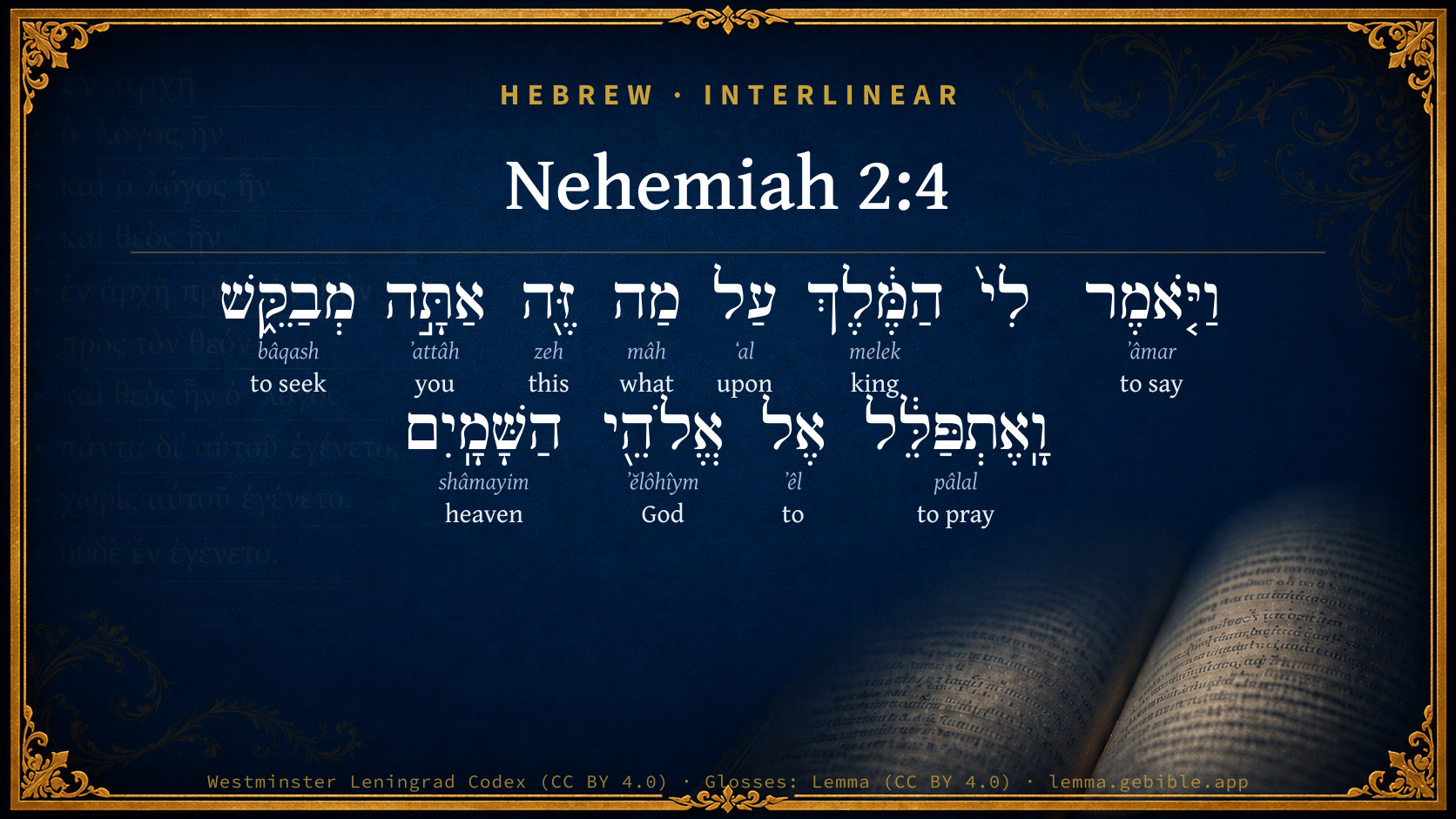
Nehemiah 2:4

Hebrew (Westminster Leningrad Codex) Nehemiah 2:4 appears in the Hebrew Old Testament. The text above is from the Westminster Leningrad Codex. Each word links to its Strong’s number, a concise gloss, and parsing drawn from the Open Scriptures Hebrew Bible morphology. Click any word for its full Brown-Driver-Briggs (BDB) entry.
Download image
Cite this verse

Nehemiah 2:4 (World English Bible). Public Domain. Lemma interlinear Bible study tool, https://lemma.gebible.app/v/nehemiah/2/4.

Show BibTeX & RIS
BibTeX
RIS
English Translation
Then the king said to me, For what do you make request? So I prayed to the God of heaven.
World English Bible · Public Domain
Download a study sheet

One document with this verse’s original text, its word-by-word gloss line, the meaning frame, cross-references with their text, attributed commentary, and full source and license credits — printable, and it pastes into notes with its structure intact.

This verse Autodidact and up

Study sheet (.html) Plain text (.txt)

A passage Seminary Student

Up to 50 verses in one chapter. A passage sheet keeps up to 6 commentary sources and 12 cross-references per verse, in the order this page ranks them, and says so on the sheet whenever that leaves anything out. Ask for a single verse and you get the Autodidact verse sheet above.

Everything on this page stays free to read, with no account — the sheet is a download of what is already on screen, not access to it.

Want to remove ads? Support Godless Engineer
Compare translations 3

The same verse in 3 English versions, stacked beneath the original-language interlinear above. Click any original word for its lexicon entry.

Each is an independent rendering of the whole verse — the interlinear is not word-aligned to these translations.

Highlighted words mark where these versions differ — a whole-verse word diff, not a word-by-word alignment.

  • World English Bible Public Domain
    Then the king said to me, For what do you make request? So I prayed to the God of heaven.
  • King James Version Public Domain
    Then the king said unto me, For what dost thou make request? So I prayed to the God of heaven.
  • unfoldingWord Literal Text CC BY-SA 4.0
    And the king said to me, “For what is this you are seeking?” And I prayed to the God of heaven.

unfoldingWord Literal Text — © unfoldingWord, licensed CC BY-SA 4.0. Word-aligned USFM3 via Door43 (git.door43.org/unfoldingWord/en_ult).

Versions to compare (up to 4)

3 of 4 selected

Show all 18 translations

Every available English version of this verse, each an independent rendering of the whole verse.

  • World English Bible Public Domain
    Then the king said to me, For what do you make request? So I prayed to the God of heaven.
  • Berean Standard Bible Public Domain
    “What is your request?” replied the king. So I prayed to the God of heaven
  • Majority Standard Bible Public Domain
    “What is your request?” replied the king. So I prayed to the God of heaven
  • King James Version Public Domain
    Then the king said unto me, For what dost thou make request? So I prayed to the God of heaven.
  • American Standard Version (1901) Public Domain
    Then the king said unto me, For what dost thou make request? So I prayed to the God of heaven.
  • Revised Version (1885) Public Domain
    Then the king said unto me, For what dost thou make request? So I prayed to the God of heaven.
  • Geneva Bible (1599) Public Domain
    And the King said vnto me, For what thing doest thou require? Then I prayed to the God of heauen,
  • Douay-Rheims (1899) Public Domain
    Then the king said to me: For what dost thou make request? And I prayed to the God of heaven,
  • Young's Literal Translation Public Domain
    And the king saith to me, `For what art thou seeking?' and I pray unto the God of the heavens,
  • Literal Standard Version CC BY-SA 4.0
    And the king says to me, “For what are you seeking?” And I pray to the God of the heavens,
  • Unlocked Literal Bible CC BY-SA 4.0
    Then the king said to me, “What do you want me to do?” So I prayed to the God of heaven.
  • unfoldingWord Literal Text CC BY-SA 4.0
    And the king said to me, “For what is this you are seeking?” And I prayed to the God of heaven.
  • Darby Bible Public Domain
    And the king said to me, For what dost thou make request? So I prayed to the God of the heavens.
  • World Messianic Bible Public Domain
    Then the king said to me, “What is your request?” So I prayed to the God of heaven.
  • Webster's Bible Public Domain
    Then the king said to me, For what dost thou make request? So I prayed to the God of heaven.
  • Free Bible Version CC BY-SA 4.0
    “So what do you want?” the king asked me. I prayed to the God of heaven, and answered the king,
  • Bible in Basic English Public Domain
    Then the king said to me, What is your desire? So I made prayer to the God of heaven.
  • JPS Tanakh (1917) Public Domain
    Then the king said unto me: 'For what dost thou make request?' So I prayed to the God of heaven.

Literal Standard Version (2020), Covenant Press — licensed CC BY-SA 4.0. Text via the HelloAO Bible API (eBible.org). Unlocked Literal Bible (unfoldingWord) — licensed CC BY-SA 4.0. Text via the HelloAO Bible API (eBible.org). unfoldingWord Literal Text — © unfoldingWord, licensed CC BY-SA 4.0. Word-aligned USFM3 via Door43 (git.door43.org/unfoldingWord/en_ult). Free Bible Version, Dr. Jonathan Gallagher — licensed CC BY-SA 4.0. Text via the HelloAO Bible API (eBible.org).

Word by word

More ways to search: Search by grammar → Find every occurrence → Compare this word →

Practice this passage: Drill this verse → Learn its vocabulary →

וָֽאֶתְפַּלֵּ֔ל
pâlal
H6419
“and · to pray”
Conjunction + Verb, Hithpael, Sequential Imperfect, 1st Person, Common, Singular
Part of Speech
Conjunction + Verb
Stem
Hithpael
Form
Sequential Imperfect
Person
1st Person
Gender
Common
Number
Singular
Full BDB Definition

Origin: a primitive root

TWOT: 1776

to intervene, interpose, pray - (Piel) to mediate, judge - (Hithpael) - to intercede - to pray
  1. וַיֹּ֤אמֶר ʼâmar H559 “and · to say” Conjunction + Verb, Qal, Sequential Imperfect, 3rd Person, Masculine, Singular
  2. הַמֶּ֔לֶךְ melek H4428 “the · king” Particle, Definite Article + Noun, Common, Masculine, Singular, Absolute
  3. עַל ʻal H5921 “upon” Preposition
  4. מַה mâh H4100 “what” Particle, Interrogative
  5. זֶּ֖ה zeh H2088 “this” Pronoun, Demonstrative, Masculine, Singular
  6. אַתָּ֣ה ʼattâh H859 “you” Pronoun, Personal, 2nd Person, Masculine, Singular
  7. מְבַקֵּ֑שׁ bâqash H1245 “seeking” Verb, Piel, Participle Active, Masculine, Singular, Absolute
  8. אֶל ʼêl H413 “to” Preposition
  9. אֱלֹהֵ֖י ʼĕlôhîym H430 “God(s) of” Noun, Common, Masculine, Plural, Construct
  10. הַשָּׁמָֽיִם shâmayim H8064 “the · heaven(s)” Particle, Definite Article + Noun, Common, Masculine, Plural, Absolute

About this verse

These counts appear in no published source. They are computed here, from the morphology-tagged text and Lemma’s own curated glosses. What Lemma adds →

12
words
11
distinct lemmas
Historical
section

Grammatical profile

  • 3 verbs
  • 3 nouns
  • 2 pronouns
  • 3 prepositions
  • 1 particle

Verb forms

  • וַיֹּ֤אמֶר Qal · Sequential Imperfect
  • מְבַקֵּ֑שׁ Piel · Participle Active
  • וָֽאֶתְפַּלֵּ֔ל Hithpael · Sequential Imperfect

Cross-references

10

Topical passages linked to Nehemiah 2:4 in the Treasury of Scripture Knowledge — connected by theme and wording, ordered by reader-vote popularity; previews shown in the World English Bible.

  • Philippians 4:6 In nothing be anxious, but in everything, by prayer and petition with thanksgiving, let your requests be made known to God.
  • Nehemiah 1:4 It happened, when I heard these words, that I sat down and wept, and mourned certain days; and I fasted and prayed before the God of heaven,
  • Proverbs 3:6 In all your ways acknowledge him, And he will direct your paths.
  • Nehemiah 1:11 Lord, I beg you, let now your ear be attentive to the prayer of your servant, and to the prayer of your servants, who delight to fear your name; and please prosper your servant this day, and grant him mercy in the sight of this man. Now I was cup bearer to the king.
  • 1 Kings 3:5 In Gibeon Yahweh appeared to Solomon in a dream by night; and God said, Ask what I shall give you.
  • Mark 10:51 Jesus asked him, "What do you want me to do for you?" The blind man said to him, "Rhabboni, that I may see again."
  • Esther 5:6 The king said to Esther at the banquet of wine, What is your petition? and it shall be granted you: and what is your request? even to the half of the kingdom it shall be performed.
  • Esther 7:2 The king said again to Esther on the second day at the banquet of wine, What is your petition, queen Esther? and it shall be granted you: and what is your request? even to the half of the kingdom it shall be performed.
  • Esther 5:3 Then said the king to her, What will you, queen Esther? and what is your request? it shall be given you even to the half of the kingdom.
  • 2 Samuel 15:31 One told David, saying, Ahithophel is among the conspirators with Absalom. David said, Yahweh, please turn the counsel of Ahithophel into foolishness.

Cross-references courtesy of OpenBible.info (CC BY 4.0).

Hebrew and Greek witnesses Masoretic Hebrew ↔ Greek Septuagint

The same verse in the two great witnesses to the Old Testament, shown verse-for-verse.

These are two independent witnesses, not word-aligned to each other, and the Septuagint is shown in lemma (dictionary) form.

Hebrew Nehemiah 2:4 Masoretic · Westminster Leningrad Codex

וַיֹּ֤אמֶר לִי֙ הַמֶּ֔לֶךְ עַל מַה זֶּ֖ה אַתָּ֣ה מְבַקֵּ֑שׁ וָֽאֶתְפַּלֵּ֔ל אֶל אֱלֹהֵ֖י הַשָּׁמָֽיִם

Then the king said to me, For what do you make request? So I prayed to the God of heaven.

World English Bible · Public Domain

Greek LXX Structure differs

The Septuagint has no separate book of Nehemiah. Its Greek text is the second half of Esdras B (2 Esdras), chapters 11–23; Ezra is the first half (1–10).

A verse-for-verse comparison isn’t shown here because the chapters and verses don’t line up. Switch to the LXX edition with the MT / LXX toggle above to read the Greek directly.

Hebrew: Westminster Leningrad Codex (CC BY 4.0). Greek: Septuagint (public domain); English from a public-domain English Septuagint. How the Septuagint differs from the Hebrew →

Commentary

Notes on Nehemiah 2:4 from classic Christian and Jewish commentators (each source and its license shown beneath its notes). The classic Christian expositions comment on the surrounding passage and are grouped to its opening verse, so a note may address several verses; the Jewish commentaries on the Tanakh (Rashi and others) are per-verse, so they appear only where the commentator wrote on this verse.

Lemma curates 59 commentaries, every one of them public domain or Creative Commons licensed, each selected and text-cleaned for this edition rather than reprinted as found. About our sources →

Trapp's Complete Commentary

John Trapp

Neh 2:4 Then the king said unto me, For what dost thou make request? So I prayed to the God of heaven.

Ver. 4. Then the king said unto me] Some think that Nehemiah looked thus sad before the king on purpose, to make way to this his request.

For what dost thou make request?] Not for any other honour or great office about the court or in the country; not for any private friend, or the like, but the good of the Church. Thus Nebridius, in Jerome, though a courtier and nephew to the empress, yet never made suit but for the relief of the poor afflicted. Thus Terence, that noble general under Valens, the emperor, being bidden to ask what he would, asked nothing but that the Church might be rid of Arians. And when the emperor, being himself an Arian, tore his petition, he said he would never ask anything for himself if he might not prevail for the Church (Theodoret).

So I prayed to the God of heaven] Darting up an ejaculation, a sudden and secret desire to God, to order and speed his petition. Begin all with prayer, and then expect a blessing. Call in the Divine help, if it be but by darting out our desires to God. Thus Moses cried to God, yet said nothing, Exo 14:15. Hannah was not heard, and yet she prayed. Austin reports the custom of the Egyptian Churches, to pray frequently and fervently, but briefly, and by way of ejaculation, ne fervor languesceret, lest their heat should abate, Crebras habere orationes, sed brevissimas et raptim eiaculatas.

John Trapp, A Commentary or Exposition upon All the Books of the Old and New Testament (1647–1656) — public domain. Text from a community e-Sword module.

Joseph Benson's Commentary

Neh 2:4. Then the king said, For what dost thou make request? — Something thou wouldest have, what is it? The king had an affection for him, and was not pleased to see him dejected, and thus gave him encouragement to tell his mind. So I prayed to the God of heaven — I silently in my mind besought God to direct my thoughts and words, and to incline the king’s heart to grant my request.

Joseph Benson's Commentary on the Old and New Testaments (1811–1818) — public domain. Text from a community e-Sword module.

Tyndale Open Study Notes

Tyndale Open Resources

2:4 With a prayer: The king was subject to the God of heaven, and Nehemiah needed God’s guidance and provision as he made his request.

Tyndale Open Study Notes — © Tyndale Open Resources, licensed CC BY-SA 4.0. Text via the HelloAO Bible API.

Geneva Bible (1599)

Geneva Bible translators

I desired God in mine heart to prosper mine enterprise.

Geneva Bible (1599) marginal notes — public domain. Text via Bolls.life.

Adam Clarke's Commentary

Verse 4. So I prayed to the God of heaven.] Before he dared to prefer his request to the king, he made his prayer to God, that his suit might be acceptable: and this he does by mental prayer. To the spirit of prayer every place is a praying place.

Adam Clarke's Commentary on the Bible (1810–1826) — public domain. Text from a community e-Sword/MySword module.

Ellicott's Commentary for English Readers

(4) So I prayed to the God of heaven.—The first note of that habit of ejaculatory prayer which is a characteristic of this book.

A Bible Commentary for English Readers, edited by Charles John Ellicott (1878–1897) — public domain. Text from a community e-Sword module.

The Cambridge Bible for Schools and Colleges

gen. ed. J. J. S. Perowne

4. For what dost thou make request] See Est_4:8; Est_7:1; Est_7:7. The king is favourable, and asks how he can render assistance.

So I prayed] Literally, ‘And I prayed’. Nehemiah instantaneously turns from the great king of Persia to the King of kings. The simplicity with which Nehemiah narrates this little incident of his momentary ejaculatory prayer adds wonderfully to the vividness of the scene. For Nehemiah’s habit of recourse to prayer see ch. Neh_4:4; Neh_4:9, Neh_5:19, Neh_6:9; Neh_6:14, Neh_13:14.

It is not easy to parallel this act of ejaculatory prayer from the Old Testament. In the New Testament we turn to the examples of our Lord, e.g. Joh_11:41; Joh_12:27; Luk_23:34; and St Stephen, Act_7:60.

The object of his prayer is doubtless for wisdom to make his request aright and for a favourable assent from the king. He could not but expect that the king would be startled by the magnitude of a request, first to nominate his cupbearer as the royal commissioner at Jerusalem, and then to empower him to rebuild its walls and defences.

The Cambridge Bible for Schools and Colleges (gen. ed. J. J. S. Perowne; Cambridge University Press, 1878–1918) — public domain. Text from a community e-Sword module.

John Gill's Exposition

Then the king said unto me, for what dost thou make request?.... The king supposed that there was a meaning in those looks and words of his, that he had a favour to ask of him, and therefore encourages him to it; or the king of himself moved this, as being desirous of doing anything for him he would propose, to make him easy:

so I prayed to the God of heaven; secretly, in an ejaculatory way, giving him thanks for thus disposing the king's heart towards him, and entreating he might be directed what to ask, and in a proper manner, and that he might succeed.

John Gill's Exposition of the Whole Bible (1746–1763) — public domain (CC PDM 1.0). Text via the HelloAO Bible API.

Albert Barnes' Notes on the Bible

I prayed to the God of heaven - Mentally and momentarily, before answering the king.

Albert Barnes' Notes on the Bible (1834–1885) — public domain. Text from a community e-Sword/MySword module.

Haydock's Catholic Bible Commentary

Heaven, a fervent ejaculation, in secret, (Tirinus) to touch the king’s heart, (Calmet) and to enable me to speak in a proper manner. (Menochius)

George Leo Haydock (1774–1849), Haydock's Catholic Family Bible and Commentary, 1859 edition — public domain. Excludes Psalms (Douay-Rheims chapter numbering differs from Protestant) and Deuterocanonical books (Catholic canon only).

Matthew Poole's English Annotations

I prayed to the God of heaven, to direct my thoughts and words, and to incline the king’s heart to grant my request.

Matthew Poole's English Annotations on the Holy Bible (1683–1685) — public domain. Text from a community e-Sword/MySword module.

Whedon's Commentary on the Bible

Daniel D. Whedon

4. For what dost thou make request — The king’s heart was at once touched with sympathy for the sorrow of his cupbearer, and prompted to offer him assistance. Thus God disposeth the hearts of kings.

I prayed — That he might so order his request as to secure the king’s favour. He that would prevail with men and kings must first know how to prevail in prayer with God.

Daniel D. Whedon (gen. ed.), Commentary on the Old and New Testaments (1874–1909) — public domain. Text from a community e-Sword module.

The Pulpit Commentary

Then the king said unto me, For what dost thou make request? Artaxerxes understood that a complaint was contained in Nehemiah"s speech, and that he must have a request to make. With gracious kindliness he facilitates its utterance. So I prayed to the God of heaven. Nehemiah was emphatically a man of prayer. In every danger, in every difficulty, still more at any crisis, prayer rose to his lips. (see Neh_4:4, 9 5:19 6:9, 14 13:14, etc.) Sometimes, as now, the prayer was offered silently and swiftly.

Ejaculatory prayer.

"So I prayed to the God of heaven." Nehemiah, saddened by the report he had received of the condition of the Jews who had returned to their land, had formed a purpose to visit them, that he might encourage them, and take the lead in fortifying the city, and putting affairs into a more hopeful condition. His doing so depended on the consent of the monarch whose cupbearer he was, and his obtaining a commission from him. Already he had prayed for success in his intended application, and now that the desired opportunity presented itself he felt the importance of the moment, and in the king"s presence sent up mentally another prayer. We have here

I PRAYER BY A GREAT AND WEALTHY MAN. Such have many temptations to neglect prayer; temptations to pride and self-dependence, to worldliness and self- indulgence, tending to the loss of all sense of their need of God and spiritual good; to entire absorption in the cares of their position; to false shame before their equals, etc.; yet they need prayer as much as the poorest, and in some respects more. They equally need Divine mercy as sinners, and Divine help and guidance; and they have special responsibilities, temptations, and power for good or evil, and so need special grace. In undertaking such a work as Nehemiah proposed to himself, the greatest may well feel their need of Divine aid. It is pleasing to contemplate such men when they are men given to prayer. Many instances in the Bible: Abraham, Jacob, Moses, David, Solomon, Hezekiah, Daniel, Cornelius.

II PRAYER AT AN UNUSUAL PLACE AND TIME. Not in temple or synagogue or secret chamber; but in the presence of a king and queen, and while engaged in ministering to them. Learn that no place is unsuitable, no time unseasonable, for prayer; for God is everywhere, and his ear always open.

III SILENT PRAYER. Was perhaps an exercise of mind and heart, unknown to the king. Prayer is not confined to audible utterance. This is desirable where practicable, even in private worship; for utterance aids thought and feeling; and it is indispensable to common prayer. One must speak that all may unite. A silent meeting, as amongst the Friends, may be a true prayer-meeting to individuals, but hardly a meeting for united prayer. But in Nehemiah"s circumstances audible words would have been unsuitable: and always the worth and efficacy of prayer spring not from the words, but the principles and feelings they represent. It is ever what passes in the mind and heart which makes prayer to be prayer. As much as there is of desire, directed to God in faith, so much is there of prayer. "Prayer is the soul"s sincere desire, Uttered or unexpressed, The motion of a hidden fire, That trembles in the breast.

Much of the truest prayer cannot be spoken. "Groanings which cannot be uttered.

IV A SHORT PRAYER. Length is in some measure, and under some circumstances, an element of true prayer. He who satisfies himself, in his regular seasons of worship, with a sentence or two, is guilty of irreverence, and shows that he has no delight in communion with God. But on such an occasion as that in the text, only brief prayer is possible or needful. And how much may be expressed or implied in a few words; how much love, or trust, or longing! In like manner much meaning may be in a short prayer. Instances: the Lord"s prayer; the publican"s; that of the thief on the cross.

V AN EJACULATORY PRAYER. A short, fervent prayer "darted" upwards on a sudden occasion, when special need of God"s help was unexpectedly felt. The habit of thus praying is much to be desired.

1. Occasions for such prayers are as numerous as the varying exigencies of life, especially the sudden and unanticipated, and when longer prayer is impossible.

(1) On receiving some great, unexpected blessing, or becoming suddenly conscious of preservation from imminent peril. To cry, "Bless the Lord!" in the hearing of others may often be inexpedient; but in the heart is always suitable.

(2) When involved in unexpected perplexity. "Lord, guide me." The "cry" of Moses at the Red Sea, referred to in Exo_14:15, may have been a mental ejaculation.

(3) When suddenly exposed to obvious danger. Bodily, as the disciples in a storm: Lord, save us; we perish." Peter sinking: "Lord, save me." Or moral and spiritual: sudden assaults of fierce temptation. "Lord, help me.

(4) When suddenly betrayed into sin. Wait not for the hour of prayer before seeking pardon, but lift up your heart at once in a "Lord. have mercy upon me.

(5) When any special demands on Christian principle are unexpectedly made, and the consequent special need for Divine assistance is felt.

(6) In connection with any important and difficult duty. In business, family life, Christian activity, (visiting the poor, distributing alms, seizing an opportunity for giving religious counsel). On entering church; before sermon (short prayer for the preacher and yourself); on leaving church, etc.

(7) Under all varieties of feeling. When the heart is touched and tender towards God (gratitude, admiration, penitence, love, desire) or towards men (affection, solicitude, etc. Gen_43:29). When pleasure is felt at the sight of happiness or goodness, or pain at sight of misery or sin. (In walking through the streets; prayer for those you feel you cannot help or save.)

2. The value of such prayers.

(1) As evidencing and cultivating the devout spirit. Those who have the spirit of prayer can hardly be content with stated times, or fail to look to God in unexpected necessities, or praise him at once for unexpected blessings. And thus the spirit of prayer is cherished and maintained. Is one way of fulfilling the command, "Pray without ceasing.

(2) As maintaining habitual converse with God. We should esteem it a calamity if he were to restrict our approaches to him to certain hours; let us not limit ourselves in a similar manner.

(3) As aiding to sanctify the whole life. By blending worship and devout sentiment with every part of it.

(4) As securing constant Divine assistance. Nehemiah"s prayer was heard; so will ours be.

The Pulpit Commentary (1880–1919), ed. H.D.M. Spence-Jones & Joseph S. Exell — public domain. Text from a community e-Sword module.

John Wesley's Explanatory Notes

Let, &c. - My sadness comes not from any disaffection to the king, for whom my hearty prayers are that he may live forever; but from another cause. Sepulchres - Which by all nations are esteemed sacred and inviolable. He saith not a word of the temple as he spake before a Heathen king who cared for none of these things. I prayed - To direct my thoughts and words, and to incline the king's heart to grant my request.

John Wesley, Explanatory Notes Upon the Whole Bible (1754–1765) — public domain. Text via the GEBible commentary corpus.

Keil & Delitzsch

C. F. Keil & F. Delitzsch

Then the king, feeling interested, asked him: For what dost thou make request? על בּקּשׁ, to make request for or concerning a thing, like Ezr 8:23; Est 4:8; Est 7:7. The question shows that the king was inclined to relieve the distress of Jerusalem which had been just stated to him. "And so I prayed to the God of heaven," to ensure divine assistance in the request he was about to lay before the king. Then Nehemiah answered (Neh 2:5), "If it please the king, and if thy servant is well-pleasing before thee, (I beg) that thou wouldest send me to Judah, to the city of my fathers' sepulchres, that I may build it." לפני ייטב, here and Est 5:14, is of like meaning with בּעיני ייטב or טּוב, Est 8:5; Sa2 18:4 : if thy servant is right in thine eyes, i.e., if he thinks rightly concerning the matter in question. The matter of his request is directly combined with this conditional clause by אשׁר, the connecting term, I beg, being easily supplied from the king's question: For what dost thou beg?

Keil & Delitzsch — Biblical Commentary on the Old Testament (1861–1891) — public domain (CC PDM 1.0). Text via the HelloAO Bible API. (Old Testament only.)

unfoldingWord translationNotes

Door43 World Missions Community

I replied to the king

"Then I replied to the king"

your servant

Nehemiah refers to himself this way to show his submission to the king.

in your sight

Here sight represents judgment or evaluation. AT: "in your judgment" (See: Metaphor)

the city of my fathers' tombs

"the city where my ancestors are buried"

that I may rebuild it

Nehemiah does not plan to do all of the building himself, but he will be the leader of the work. AT: "that I and my people may rebuild it" (See: Synecdoche)

translationWords

king

pray

God

heaven

good

servant

send

kingdom of Judah

ancestor

grave

queen

unfoldingWord translationNotes — © Distant Shores Media and the Door43 World Missions Community, licensed CC BY-SA 4.0. Source: git.door43.org/Door43/en_tn.

Rashi

Rabbi Shlomo Yitzchaki (Rashi)

For what do you make request What do you request of me and I shall do it for you.

And I prayed And I said before the king in my prayer, “May it be Your will, O God of the heavens, that You fulfill my petition and my request.”

Rashi on the Tanakh — English translations: “The Judaica Press complete Tanach with Rashi, translated by A. J. Rosenberg” (CC BY 4.0); “Pentateuch with Rashi's commentary by M. Rosenbaum and A.M. Silbermann, 1929-1934” (public domain); “The Metsudah Tanach series, Lakewood, N.J” (CC BY 4.0); and “The Book of Joshua, Metsudah Publications, 1997” (CC BY 4.0). Text via Sefaria.

Lesson kit

Teaching starters — assembled from the data on this page, not authored interpretation. Every prompt links to the verse data it draws on. Edit before teaching.

Nehemiah, in the Historical, opens this verse with 12 words (11 distinct Hebrew lemmas). Its most distinctive word is pâlal (“to pray”). A historical commentator’s framing appears above. Read the whole chapter for the surrounding context.

Discussion questions

  1. What does “to pray” (pâlal) contribute to the verse as a whole?
  2. How does Philippians 4:6, which shares this passage’s theme, read alongside this verse?
  3. These translations render this verse differently. What is at stake in choosing one wording over another?
  4. «וַיֹּ֤אמֶר» is a Qal Sequential Imperfect verb. How does that grammatical form shape the action described?
  5. Compare how Trapp's Complete Commentary and Joseph Benson's Commentary read this verse. Where do they agree or differ?

Things to notice

Reading settings

Reading text

Shown beneath each verse's original-language words.

Old Testament
Old Testament edition

Read the OT as the Masoretic Hebrew (MT) or the Greek Septuagint (LXX).

English shown for the Greek Septuagint (in the Hebrew ↔ Greek comparison).

Comparing translations? Open the Compare panel on any verse page to stack up to four side by side.