Nahum 3:7

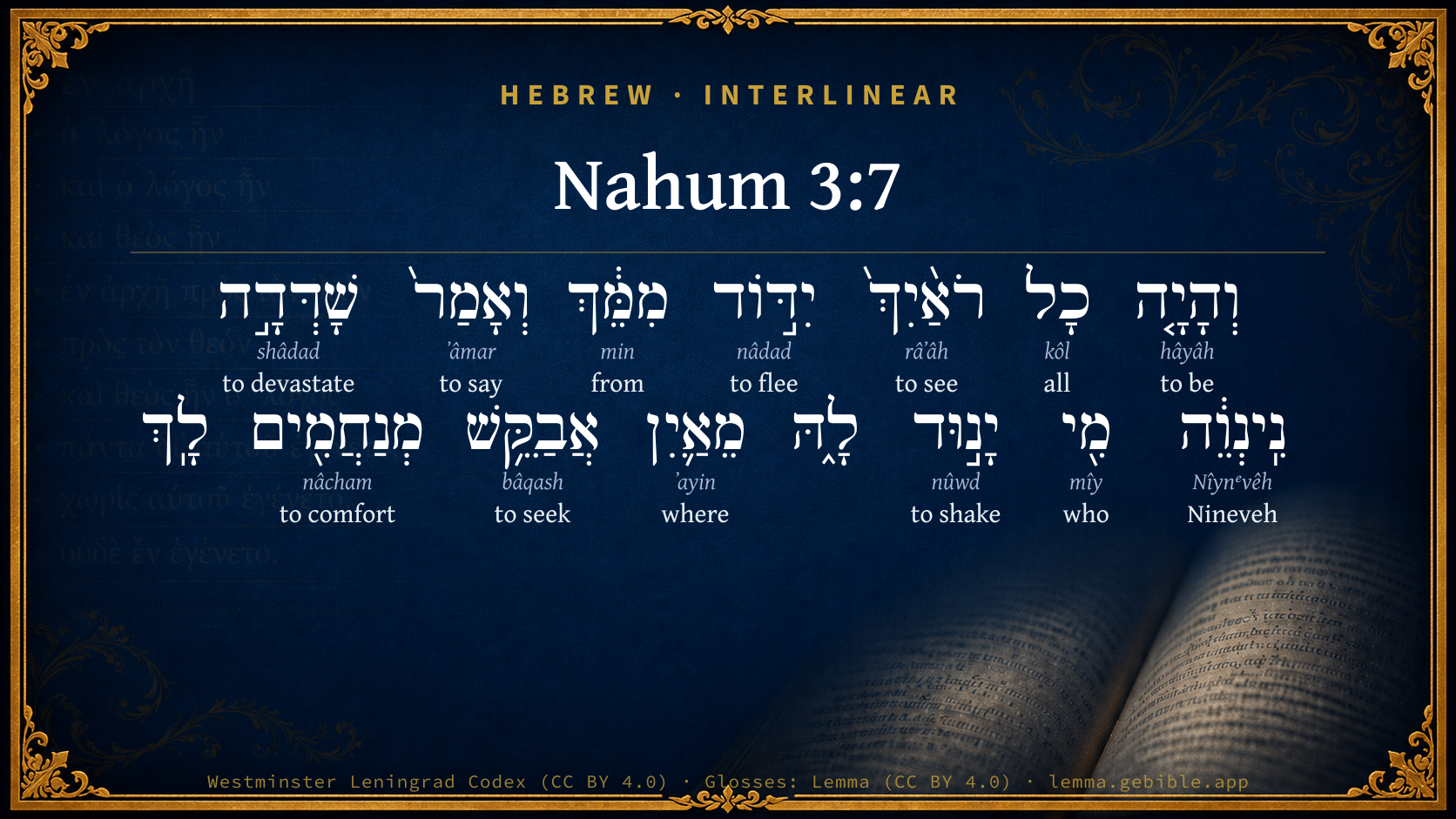
Hebrew (Westminster Leningrad Codex) Nahum 3:7 appears in the Hebrew Old Testament. The text above is from the Westminster Leningrad Codex. Each word links to its Strong’s number, a concise gloss, and parsing drawn from the Open Scriptures Hebrew Bible morphology. Click any word for its full Brown-Driver-Briggs (BDB) entry.
Download image
Cite this verse

Nahum 3:7 (World English Bible). Public Domain. Lemma interlinear Bible study tool, https://lemma.gebible.app/v/nahum/3/7.

Show BibTeX & RIS
BibTeX
RIS
English Translation
It will happen that all those who look at you will flee from you, and say, 'Nineveh is laid waste Who will mourn for her?' Where will I seek comforters for you?"
World English Bible · Public Domain
Download a study sheet

One document with this verse’s original text, its word-by-word gloss line, the meaning frame, cross-references with their text, attributed commentary, and full source and license credits — printable, and it pastes into notes with its structure intact.

This verse Autodidact and up

Study sheet (.html) Plain text (.txt)

A passage Seminary Student

Up to 50 verses in one chapter. A passage sheet keeps up to 6 commentary sources and 12 cross-references per verse, in the order this page ranks them, and says so on the sheet whenever that leaves anything out. Ask for a single verse and you get the Autodidact verse sheet above.

Everything on this page stays free to read, with no account — the sheet is a download of what is already on screen, not access to it.

Want to remove ads? Support Godless Engineer
Compare translations 3

The same verse in 3 English versions, stacked beneath the original-language interlinear above. Click any original word for its lexicon entry.

Each is an independent rendering of the whole verse — the interlinear is not word-aligned to these translations.

Highlighted words mark where these versions differ — a whole-verse word diff, not a word-by-word alignment.

  • World English Bible Public Domain
    It will happen that all those who look at you will flee from you, and say, 'Nineveh is laid waste Who will mourn for her?' Where will I seek comforters for you?"
  • King James Version Public Domain
    And it shall come to pass, that all they that look upon thee shall flee from thee, and say, Nineveh is laid waste: who will bemoan her? whence shall I seek comforters for thee?
  • unfoldingWord Literal Text CC BY-SA 4.0
    It will come about that everyone looking at you will flee from you and say, ‘Nineveh is destroyed; who will sympathize with her?’ From where can I find a comforter for you?”

unfoldingWord Literal Text — © unfoldingWord, licensed CC BY-SA 4.0. Word-aligned USFM3 via Door43 (git.door43.org/unfoldingWord/en_ult).

Versions to compare (up to 4)

3 of 4 selected

Show all 18 translations

Every available English version of this verse, each an independent rendering of the whole verse.

  • World English Bible Public Domain
    It will happen that all those who look at you will flee from you, and say, 'Nineveh is laid waste Who will mourn for her?' Where will I seek comforters for you?"
  • Berean Standard Bible Public Domain
    Then all who see you will recoil from you and say, ‘Nineveh is devastated; who will grieve for her?’ Where can I find comforters for you?”
  • Majority Standard Bible Public Domain
    Then all who see you will recoil from you and say, ‘Nineveh is devastated; who will grieve for her?’ Where can I find comforters for you?”
  • King James Version Public Domain
    And it shall come to pass, that all they that look upon thee shall flee from thee, and say, Nineveh is laid waste: who will bemoan her? whence shall I seek comforters for thee?
  • American Standard Version (1901) Public Domain
    And it shall come to pass, that all they that look upon thee shall flee from thee, and say, Nineveh is laid waste: who will bemoan her? whence shall I seek comforters for thee?
  • Revised Version (1885) Public Domain
    And it shall come to pass, that all they that look upon thee shall flee from thee, and say, Nineveh is laid waste: who will bemoan her? whence shall I seek comforters for thee?
  • Geneva Bible (1599) Public Domain
    And it shall come to passe, that al they that looke vpon thee, shall flee from thee, and say, Nineueh is destroyed, who will haue pitie vpon her? where shall I seeke comforters for thee?
  • Douay-Rheims (1899) Public Domain
    And it shall come to pass that every one that shall see thee, shall flee from thee, and shall say: Ninive is laid waste: who shall bemoan thee? whence shall I seek a comforter for thee?
  • Young's Literal Translation Public Domain
    And it hath come to pass, Each of thy beholders fleeth from thee, And hath said: `Spoiled is Nineveh, Who doth bemoan for her?' Whence do I seek comforters for thee?
  • Literal Standard Version CC BY-SA 4.0
    And it has come to pass, || Each of your beholders flees from you, || And has said: Nineveh is spoiled, || Who bemoans for her? From where do I seek comforters for you?”
  • Unlocked Literal Bible CC BY-SA 4.0
    It will come about that everyone who looks at you will flee from you and say, 'Nineveh is destroyed; who will weep for her?' Where can I find anyone to comfort you?”
  • unfoldingWord Literal Text CC BY-SA 4.0
    It will come about that everyone looking at you will flee from you and say, ‘Nineveh is destroyed; who will sympathize with her?’ From where can I find a comforter for you?”
  • Darby Bible Public Domain
    And it shall come to pass, [that] all they that see thee shall flee from thee, and shall say, Nineveh is laid waste! Who will bemoan her? whence shall I seek comforters for thee?
  • World Messianic Bible Public Domain
    It will happen that all those who look at you will flee from you, and say, ‘Nineveh is laid waste! Who will mourn for her?’ Where will I seek comforters for you?”
  • Webster's Bible Public Domain
    And it shall come to pass, that all they that look upon thee shall flee from thee, and say, Nineveh is laid waste: who will bemoan her; whence shall I seek comforters for thee?
  • Free Bible Version CC BY-SA 4.0
    Then everyone who sees you will shun you saying, “Nineveh is ruined! But who is going to mourn your loss?” Where should I look to find anyone to comfort you?
  • Bible in Basic English Public Domain
    And it will come about that all who see you will go in flight from you and say, Nineveh is made waste: who will be weeping for her? where am I to get comforters for her?
  • JPS Tanakh (1917) Public Domain
    And it shall come to pass, that all they that look upon thee shall flee from thee, and say: 'Nineveh is laid waste; who will bemoan her? whence shall I seek comforters for thee?'

Literal Standard Version (2020), Covenant Press — licensed CC BY-SA 4.0. Text via the HelloAO Bible API (eBible.org). Unlocked Literal Bible (unfoldingWord) — licensed CC BY-SA 4.0. Text via the HelloAO Bible API (eBible.org). unfoldingWord Literal Text — © unfoldingWord, licensed CC BY-SA 4.0. Word-aligned USFM3 via Door43 (git.door43.org/unfoldingWord/en_ult). Free Bible Version, Dr. Jonathan Gallagher — licensed CC BY-SA 4.0. Text via the HelloAO Bible API (eBible.org).

Word by word

More ways to search: Search by grammar → Find every occurrence → Compare this word →

Practice this passage: Drill this verse → Learn its vocabulary →

מֵאַ֛יִן
ʼayin
H370
“from · where”
Preposition + Particle, Interrogative
Part of Speech
Preposition + Particle
Type
Interrogative
Full BDB Definition

Origin: probably identical with H369 in the sense of query (compare H336 )

TWOT: 75f

where?, whence?
  1. וְהָיָ֤ה hâyâh H1961 “and · to be” Conjunction + Verb, Qal, Perfect, 3rd Person, Masculine, Singular
  2. כָל kôl H3605 “all of” Noun, Common, Masculine, Singular, Construct
  3. רֹאַ֨יִךְ֙ râʼâh H7200 “seeing · you” Verb, Qal, Participle Active, Masculine, Plural, Construct + Suffix, Personal, 2nd Person, Feminine, Singular
  4. יִדּ֣וֹד nâdad H5074 “to flee” Verb, Qal, Imperfect, 3rd Person, Masculine, Singular
  5. מִמֵּ֔ךְ min H4480 “from · you” Preposition + Suffix, Personal, 2nd Person, Feminine, Singular
  6. וְאָמַר֙ ʼâmar H559 “and · to say” Conjunction + Verb, Qal, Perfect, 3rd Person, Masculine, Singular
  7. שָׁדְּדָ֣ה shâdad H7703 “to devastate” Verb, Pual, Perfect, 3rd Person, Feminine, Singular
  8. נִֽינְוֵ֔ה Nîynᵉvêh H5210 “Nineveh” Noun, Proper
  9. מִ֖י mîy H4310 “who” Particle, Interrogative
  10. יָנ֣וּד nûwd H5110 “to shake” Verb, Qal, Imperfect, 3rd Person, Masculine, Singular
  11. אֲבַקֵּ֥שׁ bâqash H1245 “to seek” Verb, Piel, Imperfect, 1st Person, Common, Singular
  12. מְנַחֲמִ֖ים nâcham H5162 “comforting” Verb, Piel, Participle Active, Masculine, Plural, Absolute

About this verse

These counts appear in no published source. They are computed here, from the morphology-tagged text and Lemma’s own curated glosses. What Lemma adds →

15
words
13
distinct lemmas
Prophets
section

Notable vocabulary

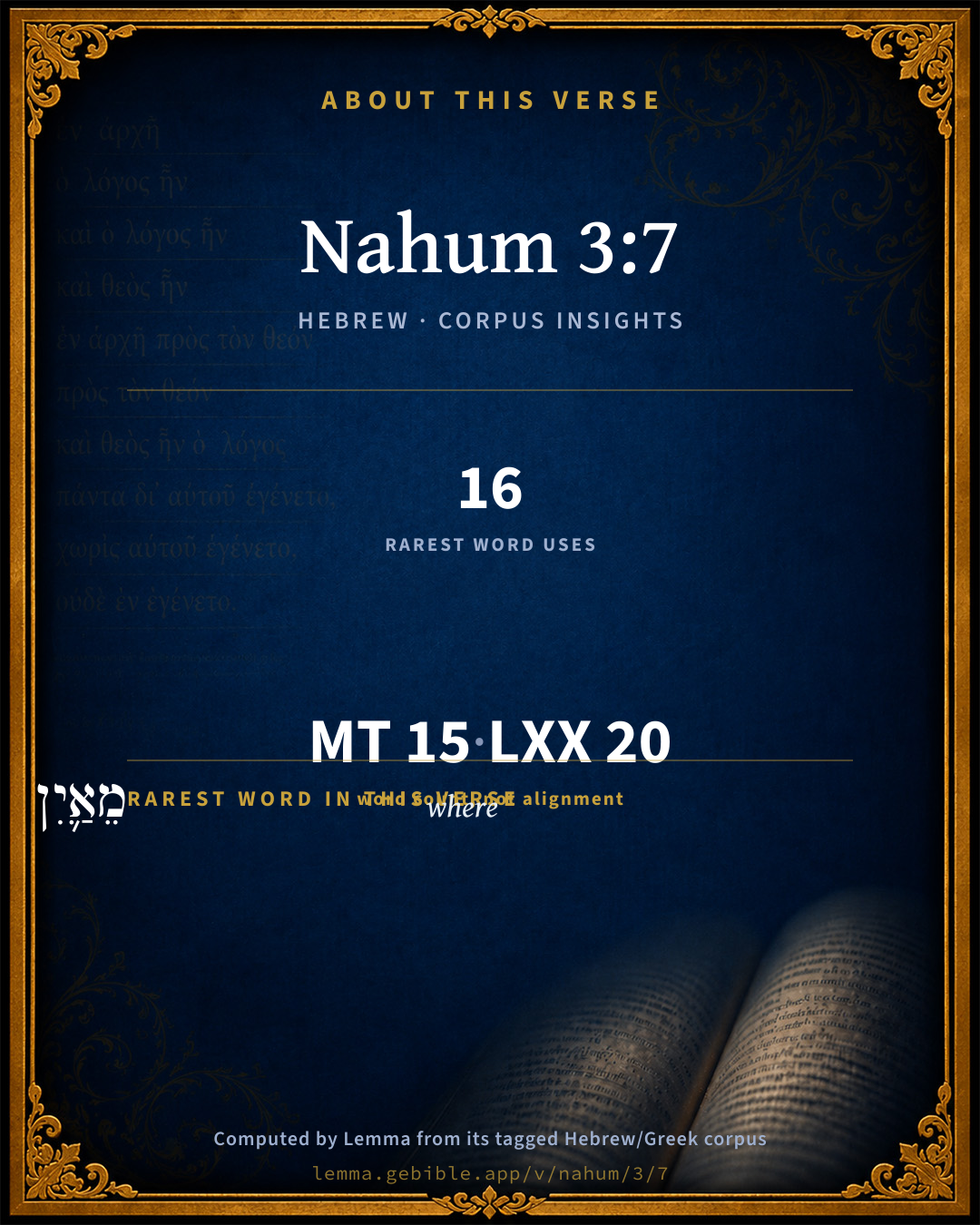
The rarest word here is מֵאַ֛יִן where H370 — appearing just 16 times in the whole Hebrew Bible.

Shared distinctive vocabulary

מֵאַ֛יִן where H370 occurs in 16 verses of the Hebrew Bible. Also found in:

Grammatical profile

  • 8 verbs
  • 2 nouns
  • 3 prepositions
  • 2 particles

Verb forms

  • וְהָיָ֤ה Qal · Perfect
  • רֹאַ֨יִךְ֙ Qal · Participle Active
  • יִדּ֣וֹד Qal · Imperfect
  • וְאָמַר֙ Qal · Perfect
  • שָׁדְּדָ֣ה Pual · Perfect
  • יָנ֣וּד Qal · Imperfect
  • אֲבַקֵּ֥שׁ Piel · Imperfect
  • מְנַחֲמִ֖ים Piel · Participle Active

Hebrew & Septuagint length

In English translation the verse runs 32 words from the Hebrew and 32 from the Septuagint (LXX English) — the same length.

A rough comparison of the two English renderings, which tokenize alike — not a word-level alignment.

Word counts can differ between the Hebrew and the Greek without any difference in meaning — e.g. the Hebrew direct-object marker אֵת has no separate Greek word, and Greek often adds the article ὁ.

In the original languages it is 15 Hebrew tokens and 20 Greek tokens — but the two are counted differently (Hebrew bundles its prefixes and suffixes into one token; the Greek is in lemma form), so that isn’t a like-for-like length.

Cross-references

10

Topical passages linked to Nahum 3:7 in the Treasury of Scripture Knowledge — connected by theme and wording, ordered by reader-vote popularity; previews shown in the World English Bible.

  • Isaiah 51:19 These two things have happened to you. Who will bemoan you? Desolation and destruction, and the famine and the sword; how shall I comfort you?
  • Jeremiah 15:5 For who will have pity on you, Jerusalem? or who will bemoan you? or who will turn aside to ask of your welfare?
  • Revelation 18:10 standing far away for the fear of her torment, saying, 'Woe, woe, the great city, Babylon, the strong city! For your judgment has come in one hour.'
  • Numbers 16:34 All Israel that were round about them fled at the cry of them; for they said, Lest the earth swallow us up.
  • Jeremiah 51:9 We would have healed Babylon, but she is not healed: forsake her, and let us go everyone into his own country; for her judgment reaches to heaven, and is lifted up even to the skies.
  • Lamentations 2:13 What shall I testify to you? what shall I liken to you, daughter of Jerusalem? What shall I compare to you, that I may comfort you, virgin daughter of Zion? For your breach is great like the sea: who can heal you?
  • Nahum 1:1 An oracle about Nineveh. The book of the vision of Nahum the Elkoshite.
  • Nahum 2:9–10 Take the spoil of silver. Take the spoil of gold, for there is no end of the store, the glory of all goodly furniture.
  • Jeremiah 51:41–43 How is Sheshach taken! and the praise of the whole earth seized! how is Babylon become a desolation among the nations!
  • Revelation 18:16–19 saying, 'Woe, woe, the great city, she who was dressed in fine linen, purple, and scarlet, and decked with gold and precious stones and pearls!

Cross-references courtesy of OpenBible.info (CC BY 4.0).

Hebrew and Greek witnesses Masoretic Hebrew ↔ Greek Septuagint

The same verse in the two great witnesses to the Old Testament, shown verse-for-verse.

These are two independent witnesses, not word-aligned to each other, and the Septuagint is shown in lemma (dictionary) form.

Hebrew Nahum 3:7 Masoretic · Westminster Leningrad Codex

וְהָיָ֤ה כָל רֹאַ֨יִךְ֙ יִדּ֣וֹד מִמֵּ֔ךְ וְאָמַר֙ שָׁדְּדָ֣ה נִֽינְוֵ֔ה מִ֖י יָנ֣וּד לָ֑הּ מֵאַ֛יִן אֲבַקֵּ֥שׁ מְנַחֲמִ֖ים לָֽךְ

It will happen that all those who look at you will flee from you, and say, 'Nineveh is laid waste Who will mourn for her?' Where will I seek comforters for you?"

World English Bible · Public Domain

Greek LXX Nahum 3:7 Septuagint · lemma form

καί εἰμί πᾶς ὁ ὁράω σύ ἀποπηδάω ἀπό σύ καί εἶπον δείλαιος νινευη τίς στενάχω αὐτός πόθεν ζητέω παράκλησις αὐτός

And it shall be that every one that sees you shall go down from you, and shall say, Wretched Nineve! who shall lament for her? whence shall I seek comfort for her?

LXX2012 (modern English Septuagint) · Public Domain

Hebrew: Westminster Leningrad Codex (CC BY 4.0). Greek: Septuagint (public domain); English from LXX2012 (modern English Septuagint) (Public Domain). How the Septuagint differs from the Hebrew →

Targum (Aramaic paraphrase)

1

The Targum is the ancient Jewish Aramaic paraphrase of the Hebrew Scriptures — an interpretive translation, not the Hebrew text itself. Onkelos (literal) and Pseudo-Jonathan (expansive) render the Torah, and Jonathan the Prophets. Coverage is partial: where no permissively-licensed English translation exists for a verse, only the Aramaic is shown. This is verse-level text, not a word-by-word alignment to the Hebrew.

  1. Targum Jonathan Prophets (Joshua–Malachi)
    וִיהֵי כָּל דִי יַחֲזִינֵיךְ יִתְרְחַק מִנֵיךְ וְיֵימַר אִתְבְּזִיזַת נִינְוֵה מָן יִדְוֵי עֲלָךְ אֵיפֹא אַשְׁכַּח מְנַחֲמִין לָךְ:

    (no public-domain English translation for this verse)

    Targum Jonathan — Aramaic: “Mikraot Gedolot” (public domain). English: “Sefaria Community Translation” (CC0 1.0 (public-domain dedication)); “London "Chaldee Paraphrase," 1871” (public domain). Text via Sefaria.

Commentary

Notes on Nahum 3:7 from classic Christian and Jewish commentators (each source and its license shown beneath its notes). The classic Christian expositions comment on the surrounding passage and are grouped to its opening verse, so a note may address several verses; the Jewish commentaries on the Tanakh (Rashi and others) are per-verse, so they appear only where the commentator wrote on this verse.

Lemma curates 59 commentaries, every one of them public domain or Creative Commons licensed, each selected and text-cleaned for this edition rather than reprinted as found. About our sources →

Trapp's Complete Commentary

John Trapp

Nah 3:7 And it shall come to pass, [that] all they that look upon thee shall flee from thee, and say, Nineveh is laid waste: who will bemoan her? whence shall I seek comforters for thee?

Ver. 7. And it shall come to pass that all they that look upon thee shall flee from thee] Thou shalt be a very Magormissabib, a terror to all that are round about thee, so that they shall decline thee and stand aloof off. Resilient a te, they shall leap back from thee (saith the Vulgate translation), as if they had trod upon a snake. Ubi simul hominum mores exprimit, saith Gualther. This is the manner of most people: they measure friendship by profit, and shamefully forsake those in adversity whom they were wont to follow and fawn upon in prosperity. David complains of such dealing, and Ovid, and many others, Tempora si fuerint nubila solus eris. Cum fortuna petit nullus amicus erit.

And say, Nineveh is laid waste] Which most men held impossible, and never looked to have seen such a day. So Rome was called Aurea golden and Aeterna eternal, and the Romans once thought (as it is said Dionysius did) that the monarchy of the world had been tied unto them with chains of adamant. But God confuted their golden dreams by breaking their empire, and giving up their city six different times in one hundred and thirty-nine years into the hands of the barbarians, who exercised therein all kinds of cruelty. Besides that, it is observed that Rome since it became Papal was never besieged by any enemy, but it was taken. The final ruin of it is daily expected, according to that prophecy of St John, "Babylon is fallen, is fallen," Rev 18:2, and that other of Sibylla before recited,

“ Tota eris in cineres; quasi nunquam Roma fuisses. ”

Who will bemoan her?] Heb. Who will move (his lips) for her. Some perhaps will shake his head or shoot his bolt at her; but none open his mouth to bemoan her. It was the just hand of God to set off all hearts and shut up all mouths from her, that had been so unreasonably merciless and hard hearted, Lam 2:13.

Whence shall I seek comforters for thee?] q.d. So odious thou art that none will do thee that good office; or if they would, so calamitous thou art that no comfort will fasten. For as to sore eyes the gentlest medicine is troublesome, so is comfort ministered to such as are in a hopeless condition. The ear that tasteth words as the mouth doth meat is at such a time embittered and out of taste.

John Trapp, A Commentary or Exposition upon All the Books of the Old and New Testament (1647–1656) — public domain. Text from a community e-Sword module.

Jamieson, Fausset & Brown

Robert Jamieson, A. R. Fausset & David Brown

all . . . that look upon thee--when thou hast been made "a gazing stock" (Nah 3:6).

shall flee from thee--as a thing horrible to look upon. Compare "standing afar off," Rev 18:10.

whence shall I seek comforters for thee?--Compare Isa 51:19, which Nahum had before his mind.

Jamieson, Fausset & Brown — Commentary Critical and Explanatory on the Whole Bible (1871) — public domain (CC PDM 1.0). Text via the HelloAO Bible API.

Adam Clarke's Commentary

Verse 7. Who will bemoan her?] In such cases, who pities the delinquent? She has been the occasion of ruin to multitudes, and now she is deservedly exposed and punished. And so it should be thought concerning Nineveh.

Adam Clarke's Commentary on the Bible (1810–1826) — public domain. Text from a community e-Sword/MySword module.

John Calvin's Commentaries

When he says, כל-ראיך, cal-raik, ‘whosoever sees thee,’ we hence learn again that רואי, ruai, at the end of the last verse, is to be taken for example or spectacle; for the Prophet proceeds with the same subject: I will make thee, he says, an example, or a spectacle. — For what purpose? that whosoever sees thee may depart from thee And it was an evidence of horror, though some think it to have been a reward for her cruelty, that no one came to Nineveh, but that she was forsaken by all friends in her desolation. And they take in the same sense what follows, Who will condole with her? and whence shall I seek comforters for thee? For they think that the Ninevites are here reproached for their cruelty, because they made themselves so hated by all that they were unworthy of sympathy; for they spared none, they allowed themselves full liberty in injuring others, they had gained the hatred of all the world. Hence some think that what is here intimated is, that the Ninevites were justly detested by and so that no one condoled with them in so great a calamity, inasmuch as they had been injurious to all: “It shall then happen, that whosoever sees thee shall go far away from thee and shall say, Wasted is Nineveh; who will condole with her? Whence shall I call comforters to her?”

But I know not whether this refined meaning came into the Prophet’s mind. We may explain the words more simply, that all would flee far away as a proof of their horrors and that the calamity would be such, that no lamentation would correspond with it. Who will be able to console with her? that is, were the greatness of her calamity duly weighed, though all were to weep and utter their meanings, it would not yet be sufficient: all lamentations would be far unequal to so great a calamity. The Prophet seems rather to mean this. Who then shall condole with her? and whence shall I seek comforters, as though he said, “The ruin of so splendid a city will not be of an ordinary kind, but what cannot be equaled by any lamentations.” It then follows —

John Calvin's Commentaries (1540-1563) — public domain. Text from the Calvin Translation Society English edition (1840s-50s) via the Christian Classics Ethereal Library (ccel.org). Calvin's coverage is partial (roughly two-thirds of the Bible); uncommented books and verses are honest gaps, never fabricated. The 19th-century editor's footnotes and remarks are omitted so the notes are faithfully Calvin's own voice.

Ellicott's Commentary for English Readers

(7) Shall flee from thee.—As in the case of the destruction of Korah, men flee from the stricken city lest they share her punishment. Nor is she an object of compassion whose cruelties have been as extensive as her empire. Hers is the fate of the fallen tyrant—left to

__________“vainly groan.

With pangs unfelt before, unpitied and alone.”

A Bible Commentary for English Readers, edited by Charles John Ellicott (1878–1897) — public domain. Text from a community e-Sword module.

The Cambridge Bible for Schools and Colleges

gen. ed. J. J. S. Perowne

7. flee from thee] In terror at her judgment.

Whence shall I seek comforters] The words imply that none will be found to pity her, as Jer_15:5; Isa_51:19.

The Cambridge Bible for Schools and Colleges (gen. ed. J. J. S. Perowne; Cambridge University Press, 1878–1918) — public domain. Text from a community e-Sword module.

John Gill's Exposition

And it shall come to pass, that all they that look upon thee shall flee from thee,.... As something loathsome and abominable, not fit to be come near unto, or touched; and as astonished and amazed at an object so forlorn and miserable, and lest they should partake of the same punishment:

and say, Nineveh is laid waste; utterly destroyed; its walls broke down, its houses demolished, its substance plundered, and its inhabitants killed, or carried captive; who could have thought it, when it was once so stately, rich, and powerful? but so it is indeed!

who will bemoan her? there are none left in her to do it; and as for others, her neighbours, whom she has oppressed and cruelly used, these will laugh and rejoice, instead of lamenting her case:

whence shall I seek comforters for thee? none from among her inhabitants, being destroyed, or carried into a foreign land; and none from among the nations round about, who will rather deride and insult than pity and comfort; so wretched and miserable would her case be!

John Gill's Exposition of the Whole Bible (1746–1763) — public domain (CC PDM 1.0). Text via the HelloAO Bible API.

Albert Barnes' Notes on the Bible

All they that look upon thee shall flee from thee - through terror, lest they should share her plagues, as Israel did, when the earth swallowed up Korah, Dathan and Abiram; and they who “had been made rich by Babylon, stand ajar off, for the fear of her torment. All they who look on thee” Rev 18:15. She was set as a thing to be “gazed at.” He tells the effect on the gazers. “Each one who so gazed” at her should flee; one by one, they should gaze, be scared, flee (compare Psa 31:11; Psa 64:8). Not one should remain. “Who will bemoan her?” Not one should pay her the passing tribute of sympathy at human calamity, the shaking of the head at her woe (compare Job 16:4-5). Whoever had no compassion shall find none.

Albert Barnes' Notes on the Bible (1834–1885) — public domain. Text from a community e-Sword/MySword module.

Haydock's Catholic Bible Commentary

Bemoan. Literally, "shake his head:" the latter words are not in [the] Hebrew. (Haydock) --- Some supply, move his lips: but head will answer as well. This is a sign of derision or of pity, Job xlii. 11., and Matthew xxvii. 39. (Calmet)

George Leo Haydock (1774–1849), Haydock's Catholic Family Bible and Commentary, 1859 edition — public domain. Excludes Psalms (Douay-Rheims chapter numbering differs from Protestant) and Deuterocanonical books (Catholic canon only).

Matthew Poole's English Annotations

It shall come to pass; it will most certainly be. All they that look upon thee, so soon as ever thou art seen and discovered, O Nineveh, in thy vileness,

shall flee from thee, with hatred, loathing, and abhorrence for thy former pride and wickedness. and for thy present miseries.

And say, with wonder, scorn, rejoicing, and spreading the news,

Nineveh is laid waste; taken, sacked, emptied of inhabitant, yea, utterly subverted, that it may be no more a rival with Babylon: it is certain that it is not now where it once stood.

Who will bemoan her? whose bowels will be moved for her that had no bowels for any one; who will move foot or, hand toward her relief?

Whence? from what place? She hath wronged all her neighbours, and ruined, some of them; from amidst these surely not one may be fetched to speak comfortably to her; these do with reason upbraid her former cruelty and pride, and rejoice in her present calamity and ruin, and strangers will not be concerned for her.

Matthew Poole's English Annotations on the Holy Bible (1683–1685) — public domain. Text from a community e-Sword/MySword module.

The Pulpit Commentary

Shall flee from thee. As an object of disgust, or fearing to be involved in thy ruin. (Rev_18:10, Rev_18:15) Who will bemoan her? No one will pity her for her well deserved chastisement. (Jer_15:5) Whence shall I seek, etc.? Truly, nowhere in all the world. (comp. Isa_51:19)

The Pulpit Commentary (1880–1919), ed. H.D.M. Spence-Jones & Joseph S. Exell — public domain. Text from a community e-Sword module.

John Wesley's Explanatory Notes

Shall flee - With loathing and abhorrence. Will bemoan - Whose bowels will be moved for her that had no bowels for any one.

John Wesley, Explanatory Notes Upon the Whole Bible (1754–1765) — public domain. Text via the GEBible commentary corpus.

Scofield Reference Notes

C. I. Scofield

Nineveh

(See Scofield "Nah 1:1")

The Scofield Reference Bible (1917 edition), notes by C. I. Scofield — public domain. Text from a community e-Sword module.

Rashi

Rabbi Shlomo Yitzchaki (Rashi)

shall wander away from you—Shall distance himself from you.

Rashi on the Tanakh — English translations: “The Judaica Press complete Tanach with Rashi, translated by A. J. Rosenberg” (CC BY 4.0); “Pentateuch with Rashi's commentary by M. Rosenbaum and A.M. Silbermann, 1929-1934” (public domain); “The Metsudah Tanach series, Lakewood, N.J” (CC BY 4.0); and “The Book of Joshua, Metsudah Publications, 1997” (CC BY 4.0). Text via Sefaria.

Lesson kit

Teaching starters — assembled from the data on this page, not authored interpretation. Every prompt links to the verse data it draws on. Edit before teaching.

Nahum, in the Prophets, opens this verse with 15 words (13 distinct Hebrew lemmas). Its most distinctive word is ʼayin (“where”). A historical commentator’s framing appears above. Read the whole chapter for the surrounding context.

Discussion questions

  1. What does “where” (ʼayin) contribute to the verse as a whole?
  2. How does Genesis 29:4, which shares the word «where», read alongside this verse?
  3. These translations render this verse differently. What is at stake in choosing one wording over another?
  4. «וְהָיָ֤ה» is a Qal Perfect verb. How does that grammatical form shape the action described?
  5. Compare how Trapp's Complete Commentary and Jamieson, Fausset & Brown read this verse. Where do they agree or differ?

Things to notice

Reading settings

Reading text

Shown beneath each verse's original-language words.

Old Testament
Old Testament edition

Read the OT as the Masoretic Hebrew (MT) or the Greek Septuagint (LXX).

English shown for the Greek Septuagint (in the Hebrew ↔ Greek comparison).

Comparing translations? Open the Compare panel on any verse page to stack up to four side by side.