
Psalms 83:16

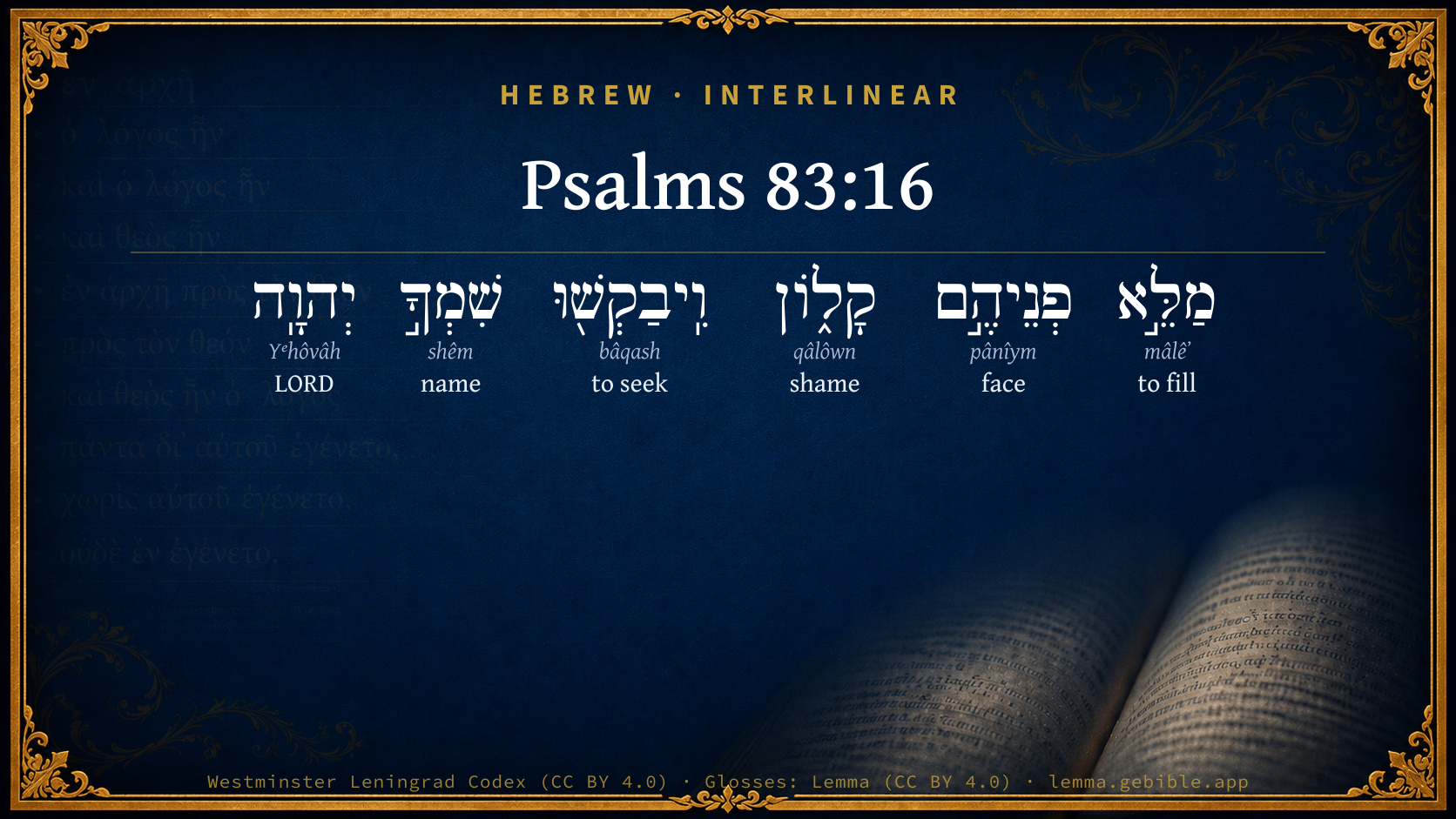
Hebrew (Westminster Leningrad Codex) Psalms 83:16 appears in the Hebrew Old Testament. The text above is from the Westminster Leningrad Codex. Each word links to its Strong’s number, a concise gloss, and parsing drawn from the Open Scriptures Hebrew Bible morphology. Click any word for its full Brown-Driver-Briggs (BDB) entry.
Download image
Cite this verse

Psalms 83:16 (World English Bible). Public Domain. Lemma interlinear Bible study tool, https://lemma.gebible.app/v/psalms/83/16.

Show BibTeX & RIS
BibTeX
RIS
English Translation
Fill their faces with confusion, That they may seek your name, Yahweh.
World English Bible · Public Domain
Download a study sheet

One document with this verse’s original text, its word-by-word gloss line, the meaning frame, cross-references with their text, attributed commentary, and full source and license credits — printable, and it pastes into notes with its structure intact.

This verse Autodidact and up

Study sheet (.html) Plain text (.txt)

A passage Seminary Student

Up to 50 verses in one chapter. A passage sheet keeps up to 6 commentary sources and 12 cross-references per verse, in the order this page ranks them, and says so on the sheet whenever that leaves anything out. Ask for a single verse and you get the Autodidact verse sheet above.

Everything on this page stays free to read, with no account — the sheet is a download of what is already on screen, not access to it.

Want to remove ads? Support Godless Engineer
Compare translations 3

The same verse in 3 English versions, stacked beneath the original-language interlinear above. Click any original word for its lexicon entry.

Each is an independent rendering of the whole verse — the interlinear is not word-aligned to these translations.

Highlighted words mark where these versions differ — a whole-verse word diff, not a word-by-word alignment.

  • World English Bible Public Domain
    Fill their faces with confusion, That they may seek your name, Yahweh.
  • King James Version Public Domain
    Fill their faces with shame; that they may seek thy name, O LORD.
  • unfoldingWord Literal Text CC BY-SA 4.0
    Fill their faces shame, that they may seek your name, Yahweh.

unfoldingWord Literal Text — © unfoldingWord, licensed CC BY-SA 4.0. Word-aligned USFM3 via Door43 (git.door43.org/unfoldingWord/en_ult).

Versions to compare (up to 4)

3 of 4 selected

Show all 18 translations

Every available English version of this verse, each an independent rendering of the whole verse.

  • World English Bible Public Domain
    Fill their faces with confusion, That they may seek your name, Yahweh.
  • Berean Standard Bible Public Domain
    Cover their faces with shame, that they may seek Your name, O LORD.
  • Majority Standard Bible Public Domain
    Cover their faces with shame, that they may seek Your name, O LORD.
  • King James Version Public Domain
    Fill their faces with shame; that they may seek thy name, O LORD.
  • American Standard Version (1901) Public Domain
    Fill their faces with confusion, That they may seek thy name, O Jehovah.
  • Revised Version (1885) Public Domain
    Fill their faces with confusion; that they may seek thy name, O LORD.
  • Geneva Bible (1599) Public Domain
    Fill their faces with shame, that they may seeke thy Name, O Lord.
  • Douay-Rheims (1899) Public Domain
    So shalt thou pursue them with thy tempest: and shalt trouble them in thy wrath.
  • Young's Literal Translation Public Domain
    Fill their faces `with' shame, And they seek Thy name, O Jehovah.
  • Literal Standard Version CC BY-SA 4.0
    Fill their faces [with] shame, || And they seek Your Name, O YHWH.
  • Unlocked Literal Bible CC BY-SA 4.0
    Fill their faces with shame so that they might seek your name, Yahweh.
  • unfoldingWord Literal Text CC BY-SA 4.0
    Fill their faces shame, that they may seek your name, Yahweh.
  • Darby Bible Public Domain
    Fill their faces with shame, that they may seek thy name, O Jehovah.
  • World Messianic Bible Public Domain
    Fill their faces with confusion, that they may seek your name, LORD.
  • Webster's Bible Public Domain
    \\83:15\\So persecute them with thy tempest, and make them afraid with thy storm.
  • Free Bible Version CC BY-SA 4.0
    Shame them in defeat so that they come to you, Lord!
  • Bible in Basic English Public Domain
    Let their faces be full of shame; so that they may give honour to your name, O Lord.
  • JPS Tanakh (1917) Public Domain
    (83-17) Fill their faces with shame; that they may seek Thy name, O LORD.

Literal Standard Version (2020), Covenant Press — licensed CC BY-SA 4.0. Text via the HelloAO Bible API (eBible.org). Unlocked Literal Bible (unfoldingWord) — licensed CC BY-SA 4.0. Text via the HelloAO Bible API (eBible.org). unfoldingWord Literal Text — © unfoldingWord, licensed CC BY-SA 4.0. Word-aligned USFM3 via Door43 (git.door43.org/unfoldingWord/en_ult). Free Bible Version, Dr. Jonathan Gallagher — licensed CC BY-SA 4.0. Text via the HelloAO Bible API (eBible.org).

Word by word

More ways to search: Search by grammar → Find every occurrence → Compare this word →

Practice this passage: Drill this verse → Learn its vocabulary →

About this verse

These counts appear in no published source. They are computed here, from the morphology-tagged text and Lemma’s own curated glosses. What Lemma adds →

6
words
6
distinct lemmas
Wisdom
section

Notable vocabulary

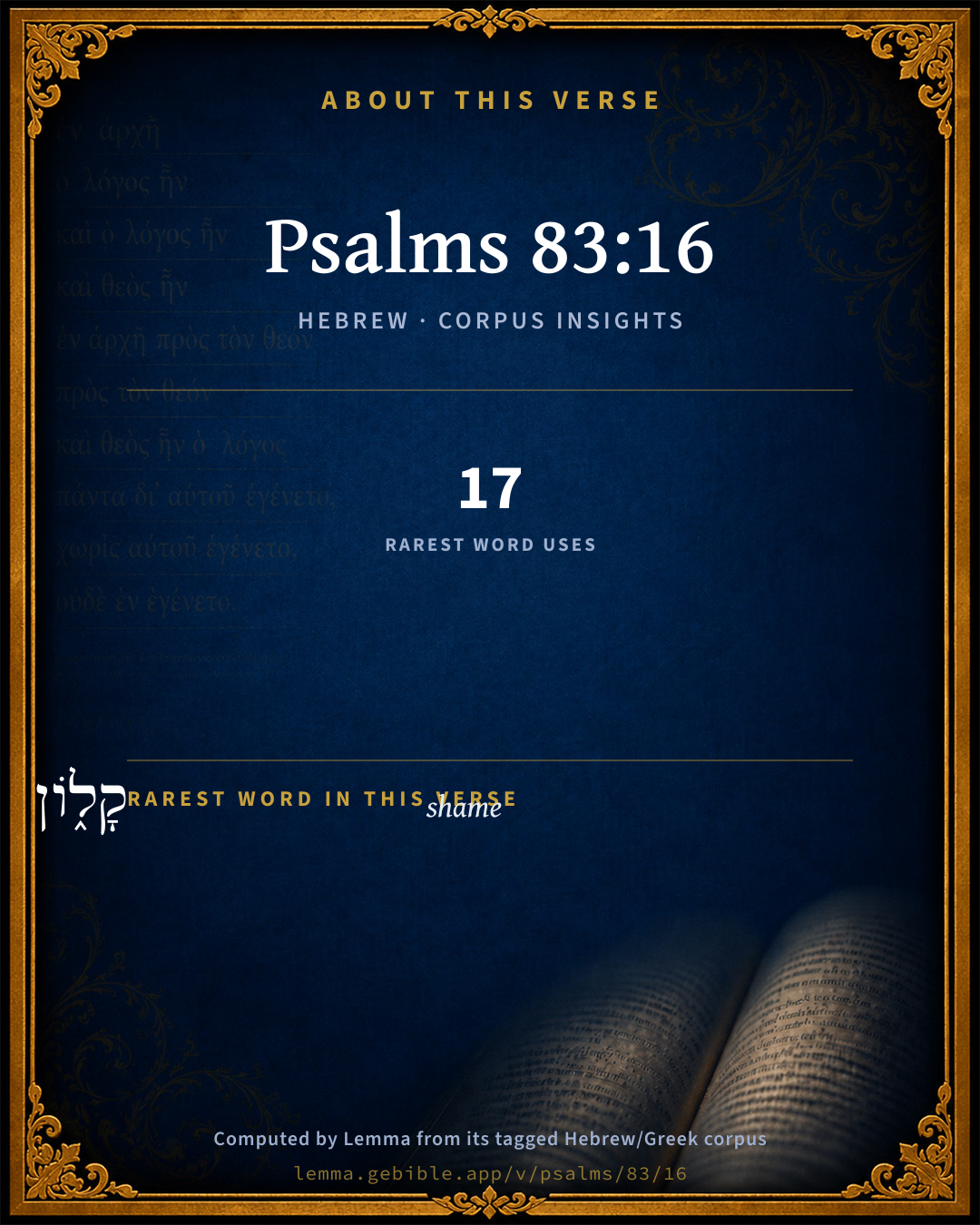
The rarest word here is קָל֑וֹן shame H7036 — appearing just 17 times in the whole Hebrew Bible.

Shared distinctive vocabulary

קָל֑וֹן shame H7036 occurs in 17 verses of the Hebrew Bible. Also found in:

Grammatical profile

  • 2 verbs
  • 4 nouns

Verb forms

  • מַלֵּ֣א Piel · Imperative
  • וִֽיבַקְשׁ֖וּ Piel · Jussive

Hebrew & Septuagint length

In English translation the verse runs 12 words from the Hebrew and 13 from the Septuagint (LXX English) — closely comparable.

A rough comparison of the two English renderings, which tokenize alike — not a word-level alignment.

Word counts can differ between the Hebrew and the Greek without any difference in meaning — e.g. the Hebrew direct-object marker אֵת has no separate Greek word, and Greek often adds the article ὁ.

Cross-references

6

Topical passages linked to Psalms 83:16 in the Treasury of Scripture Knowledge — connected by theme and wording, ordered by reader-vote popularity; previews shown in the World English Bible.

  • Psalms 6:10 May all my enemies be ashamed and dismayed. They shall turn back, they shall be disgraced suddenly.
  • Psalms 9:19–20 Arise, Yahweh! Don't let man prevail. Let the nations be judged in your sight.
  • Job 10:15 If I am wicked, woe to me. If I am righteous, I still shall not lift up my head, Being filled with disgrace, And conscious of my affliction.
  • Psalms 34:5 They looked to him, and were radiant. Their faces shall never be covered with shame.
  • Psalms 109:29 Let my adversaries be clothed with dishonor. Let them cover themselves with their own shame as with a robe.
  • Psalms 132:18 I will clothe his enemies with shame, But on himself, his crown will be resplendant."

Cross-references courtesy of OpenBible.info (CC BY 4.0).

Hebrew and Greek witnesses Masoretic Hebrew ↔ Greek Septuagint

The same verse in the two great witnesses to the Old Testament, shown verse-for-verse.

You’re reading Greek Psalm 82 (Hebrew Psalm 83). The Septuagint counts the superscription, so verse numbers can differ from the Hebrew — chapter-level alignment, not verse-by-verse. Numbering follows Rahlfs.

These are two independent witnesses, not word-aligned to each other, and the Septuagint is shown in lemma (dictionary) form.

Hebrew Psalms 83:16 Masoretic · Westminster Leningrad Codex

מַלֵּ֣א פְנֵיהֶ֣ם קָל֑וֹן וִֽיבַקְשׁ֖וּ שִׁמְךָ֣ יְהוָֽה

Fill their faces with confusion, That they may seek your name, Yahweh.

World English Bible · Public Domain

Greek LXX Greek Psalm 82:16 Septuagint · lemma form

οὕτως καταδιώκω αὐτός ἐν ὁ καταιγίς σύ καί ἐν ὁ ὀργή σύ ταράσσω αὐτός

Fill their faces with dishonor; so shall they seek your name, O Lord.

LXX2012 (modern English Septuagint) · Public Domain

Hebrew: Westminster Leningrad Codex (CC BY 4.0). Greek: Septuagint (public domain); English from LXX2012 (modern English Septuagint) (Public Domain). How the Septuagint differs from the Hebrew →

Commentary

Notes on Psalms 83:16 from classic Christian and Jewish commentators (each source and its license shown beneath its notes). The classic Christian expositions comment on the surrounding passage and are grouped to its opening verse, so a note may address several verses; the Jewish commentaries on the Tanakh (Rashi and others) are per-verse, so they appear only where the commentator wrote on this verse.

Lemma curates 59 commentaries, every one of them public domain or Creative Commons licensed, each selected and text-cleaned for this edition rather than reprinted as found. About our sources →

Trapp's Complete Commentary

John Trapp

Psa 83:16 Fill their faces with shame; that they may seek thy name, O LORD.

Ver. 16. Fill their faces with shame] By confounding their confidences, and blasting their designs. They promised themselves a triumph, but let them have the canvas.

That they may seek thy name, O Lord] Ut inviti cogantur quis sit tam potens Iehovah rogitare , that they may even in despite of their heads be compelled to inquire after thee. It is storied of Sennacherib, that, after the destruction of his huge army at Jerusalem, demanding of some about him what might be the reason that the irresistible God of heaven so favoured the Jewish nation, as he had found by sad experience? answer was given, that Abraham, from whom they descended, sacrificed unto him his only son, which purchased this protection to his posterity. If that will win him, saith he, I will spare him two of my sons, to procure him to be on my side; which Sharezer and Adrammelech, his sons, hearing of, prevented their own deaths by his (Bib. Castal. Tabul.).

John Trapp, A Commentary or Exposition upon All the Books of the Old and New Testament (1647–1656) — public domain. Text from a community e-Sword module.

The Biblical Illustrator

Joseph S. Exell

Psa_83:16

Fill their faces with shame; that they may seek Thy name, O Lord.

Shame leading to salvation

I. Ungodly men have good cause to be ashamed--

1. Because of the wrong they are doing to their Maker. You pride yourself upon your uprightness and integrity; but must God alone, then, be made to Suffer through your injustice? Out of all beings, must He alone who made all other beings be the only one to be neglected?

2. There are many ungodly men who ought to be ashamed because they are acting in opposition to light and knowledge, contrary to their conscience, and against their better judgments.

3. Because of their postponements of what they know to be right.

4. Because of their violation of vows which they have made.

5. Because of their not loving the Lord Jesus Christ, and not trusting such a Saviour as He is.

6. A man ought to be ashamed who will not even think of these things.

II. Now, concerning these ungodly people, let me show you that shame is a very desirable thing if it drives them to God. Hence the prayer, Fill their faces with shame, that they may seek thy name, O Lord.

1. Sometimes shame attends the breaking up of self-righteousness.

2. I have known this shame to operate in some when they have done wrong, and have lost the repute they enjoyed among their fellow-creatures.

3. So have I seen failure driving a man to the strong for strength.

4. I have also known men brought to Christ with shame of another sort, shame of mental error leading to a humble faith.

III. The Lord is willing now to receive those who are ashamed of themselves.

1. You are the sort of man to come to Christ, because, first, you have the greatest need of Him. In the time of famine, we give the meal away first to the most hungry family.

2. If you are ashamed of yourself, you are the man to come to Christ, because you will make no bargains with Him. You will say, Save me, Lord, at any price, and in any way!

3. And you are the man who will give Him all the glory if you are saved. (C. H. Spurgeon.)

The Biblical Illustrator, edited by Joseph S. Exell (c. 1880s–1900s) — public domain. Text from a community e-Sword module.

Joseph Benson's Commentary

Psa 83:16-18. Fill, &c., that they may seek thy name — That, being disappointed of their hopes, and discerning the impotence of their idols, they may own and worship thee as the only true God. Let them be put to shame and perish — But those of them that will not humble themselves before thee, let them be utterly destroyed. That men may know — Or, that they may know, namely, by dear-bought experience, even by their own ruin, what they would not know by information for their own good; that thou art the Most High — The most high God, and the God, not only of thy people Israel, as the heathen fancy, and as their gods are supposed to be confined to their particular and several territories, but the God and governor of all the nations and parts of the earth.

Joseph Benson's Commentary on the Old and New Testaments (1811–1818) — public domain. Text from a community e-Sword module.

J. A. Alexander on Psalms

Joseph Addison Alexander

17. (Psa 83:16). Fill their face with shame, and (men) will seek thy name, Jehovah! With the first clause compare Psa 49:7; Psa 89:45. Some refer the last clause also to the enemies; but their destruction is still anticipated in the next verse, and to seek the name of God can hardly be expressive of a compulsory humiliation. The word translated shame is very strong, and means contempt, disgrace, or ignominy.

Joseph Addison Alexander, The Psalms Translated and Explained (1850) — public domain. Text from a community e-Sword module.

Geneva Bible (1599)

Geneva Bible translators

That is, be compelled by thy plagues to confess thy power.

Geneva Bible (1599) marginal notes — public domain. Text via Bolls.life.

Adam Clarke's Commentary

Verse 16. That they may seek thy name] Let them be confounded in all their attempts on Israel; and see, so manifestly, that thou hast done it, that they may invoke thy name, and be converted to thee.

Adam Clarke's Commentary on the Bible (1810–1826) — public domain. Text from a community e-Sword/MySword module.

Ellicott's Commentary for English Readers

(16) Thy name, O Lord.—Rather, thy name (which is) Jehovah. The nations were to seek Him not only as God, but as Jehovah God of Israel. This is proved by Psa_83:18. No doubt the thought uppermost in the verse is the submission of the heathen to Jehovah’s power. But we may, looking back, read in it a nobler wish and a grander hope—the prophetic hope of a union of nations in a belief in the common fatherhood of God.

A Bible Commentary for English Readers, edited by Charles John Ellicott (1878–1897) — public domain. Text from a community e-Sword module.

The Cambridge Bible for Schools and Colleges

gen. ed. J. J. S. Perowne

16. Fill their faces with shame] Or, disgrace. Let them be disgraced by defeat and disappointed in their project. But this is only as the means to the higher end, that they may seek Jehovah’s name, recognising in Israel’s God the God of revelation, and submitting themselves to His Will.

The Cambridge Bible for Schools and Colleges (gen. ed. J. J. S. Perowne; Cambridge University Press, 1878–1918) — public domain. Text from a community e-Sword module.

John Gill's Exposition

Fill their faces with shame,.... For their sins, or rather through disappointment, not being able to put their desperate and deep laid schemes into execution: or "with lightness" (o); instead of a weight of honour and glory upon them, let them be despised. R. Joseph Kimchi renders it, "fill their faces with fire"; let their faces be as if they were on fire, as men's faces are, who are put to an exceeding great blush, or are most sadly confounded and ashamed:

that they may seek thy name, O Lord; not they themselves, who are filled with shame; for it is imprecated, that they be ashamed, and troubled for ever, and so as to perish, Psa 83:17 but others; for the words may be supplied, as in Psa 83:18 "that men may seek thy name, or that thy name may be sought": the judgments of God upon wicked men are sometimes the means of arousing others, and putting them upon seeking the Lord, his face, and his favour; that God would be merciful to them, pardon their iniquities, avert judgments from them, and preserve them from threatened calamities; and this is a good end, when answered; see Isa 26:9.

(o) Heb. "levitate", Piscator; so Ainsworth.

John Gill's Exposition of the Whole Bible (1746–1763) — public domain (CC PDM 1.0). Text via the HelloAO Bible API.

Albert Barnes' Notes on the Bible

Fill their faces with shame - As those who are disappointed and foiled in their plans - such disappointment and confusion commonly manifesting itself in the face. The prayer here is, that their enemies might be so baffled in their designs - that they might be made so to feel how vain and hopeless were all their plans - that there might be such a manifest interposition of God in the case, as that they should be led to see that Yahweh reigned; that it was in vain to contend with him, and that his people were under his protection.

That they may seek thy name, O Lord - That they may be led to seek thee. This explains the drift and design of the whole prayer in the psalm. It is not a malignant prayer for the destruction of their enemies; it is not a wish that they might be made to suffer; but it is a prayer that the divine dealing might be such as to lead them to the acknowledgment of the true God. It is a benevolent thing to desire that men may be brought to the knowledge of the true God, though it be through the discomfiture of their own plans, by defeat, or by suffering. Anything that leads people to an acquaintance with God, and results in securing his friendship and favor, is a gain, and will be cause of thankfulness in the end.

Albert Barnes' Notes on the Bible (1834–1885) — public domain. Text from a community e-Sword/MySword module.

Matthew Poole's English Annotations

That being disappointed of their hopes, and discerning the impotency of their idols, they may own and worship thee as the only true God.

Matthew Poole's English Annotations on the Holy Bible (1683–1685) — public domain. Text from a community e-Sword/MySword module.

The Treasury of David

Charles H. Spurgeon

Ver. 16. Fill their faces with shame; that they may seek thy name, O Lord. Shame has often weaned men from their idols, and set them upon seeking the Lord. If this was not the happy result, in the present instance, with the Lord's enemies, yet it would be so with his people who were so prone to err. They would be humbled by his mercy, and ashamed of themselves because of his grace; and then they would with sincerity return to the earnest worship of Jehovah their God, who had delivered them.

None.

Ver. 16. A prayer for the Pope and his priests.

Psalms 83:17*

Charles H. Spurgeon's The Treasury of David (1869–1885) — public domain. Psalms only. Text from a community e-Sword/MySword module.

Whedon's Commentary on the Bible

Daniel D. Whedon

16. That they may seek thy name—Or, And they shall seek thy name. They will never inquire after the true God until their false dependencies are swept away, and this latter can be effected only by judgments which, like the plagues of Egypt, are above the arm of flesh to avert. The seeking after God, here, is that which is forced by the pressure of judgments, but the ulterior, true seeking, is anticipated as a possible and desired result.

Daniel D. Whedon (gen. ed.), Commentary on the Old and New Testaments (1874–1909) — public domain. Text from a community e-Sword module.

The Pulpit Commentary

Fill their faces with shame; i.e. cause their enterprise to fail, and so bring them to shame and confusion of face. That they may seek thy Name, O Lord. A merciful purpose lies behind the greater number of Divine visitations. They are intended to scourge men into submission, and cause them to turn to God. The psalmist, being in full sympathy with God, desires that his merciful intentions may have effect.

The issue of Divine judgments on the wicked.

"That they may seek thy Name, O Lord." This is a very remarkable qualifying of our idea that psalmists prayed in a revengeful spirit for the destruction of the national enemies. In truth, their supreme idea was the glorifying of God, and they asked for judgments because through judgments would come the honouring of God"s Name; and, in this honouring, the higher blessing for the foes themselves. Here the psalmist prays, "Fill their faces with shame;" but he sees in their humiliation the hope that they will be drawn to God.

I WE MAY PRAY FOR THE HUMILIATION OF OUR ENEMIES.

II WE MAY NOT PRAY IN VIEW MERELY OF THEIR SUFFERING.

III WE MAY PRAY, IF WE DESIRE THEIR LASTING GOOD THROUGH THEIR HUMILIATION.

IV WE MAY PRAY, IF WE SET. BEFORE OURSELVES THE GLORY OF GOD IN THEIR RECOVERY.

It is a sign of triumph over hateful and revengeful feelings if we can pray God to deal with our enemies in the wisdom of his righteous love. It is not befitting that the Christian should ever think of judgments and punishments as merely destructive. To him all judgment is remedial, all punishment is corrective. God will get honour to his Name out of all his dealings. It should be shown that the "forever" and the "perish" of ver. 17 are to be treated as poetical terms. Or ver. 16 may be regarded as the better view, which the psalmist was hardly able to keep to. Ver. 17 falls back upon the harsher view of God"s dealing with his foes. Christianity willingly lets pass the harsher view, and sets ever more prominently before us the better and more hopeful view. "Speaker"s Commentary" on ver. 16 says, "This is a feeling altogether peculiar to God"s people." The object of all the judgments which the true prophet desires is to bring all nations into subjection to God. Their calamities will be converted into blessings, unless they persist in rebellion. R.T.

The Pulpit Commentary (1880–1919), ed. H.D.M. Spence-Jones & Joseph S. Exell — public domain. Text from a community e-Sword module.

John Wesley's Explanatory Notes

May seek - May own and worship thee as the only true God.

John Wesley, Explanatory Notes Upon the Whole Bible (1754–1765) — public domain. Text via the GEBible commentary corpus.

unfoldingWord translationNotes

Door43 World Missions Community

Fill their faces with shame

Here "faces" represents the whole person. AT: "Make them very ashamed" (See: Synecdoche)

they might seek your name

Here "name" represents God's power. God's enemies acknowledging that God is powerful is spoken of as if they are seeking to find Yahweh. AT: "they might acknowledge that you are powerful" (See: Metonymy and Metaphor)

seek your name

Possible meanings are 1) God's enemies admit that God is powerful or 2) God's enemies are asking God for help or 3) God's enemies start to worship and obey him.

May they be put to shame and be terrified forever

This can be stated in active form. AT: "Make them ashamed and terrified forever" (See: Active or Passive)

may they perish in disgrace

"may they die while they are ashamed"

translationWords

face

shame

name

Yahweh

terror

eternity

perish

disgrace

unfoldingWord translationNotes — © Distant Shores Media and the Door43 World Missions Community, licensed CC BY-SA 4.0. Source: git.door43.org/Door43/en_tn.

Rashi

Rabbi Shlomo Yitzchaki (Rashi)

and with Your whirlwind Tourbillon in French, whirlwind.

Rashi on the Tanakh — English translations: “The Judaica Press complete Tanach with Rashi, translated by A. J. Rosenberg” (CC BY 4.0); “Pentateuch with Rashi's commentary by M. Rosenbaum and A.M. Silbermann, 1929-1934” (public domain); “The Metsudah Tanach series, Lakewood, N.J” (CC BY 4.0); and “The Book of Joshua, Metsudah Publications, 1997” (CC BY 4.0). Text via Sefaria.

Lesson kit

Teaching starters — assembled from the data on this page, not authored interpretation. Every prompt links to the verse data it draws on. Edit before teaching.

Psalms, in the Wisdom, opens this verse with 6 words (6 distinct Hebrew lemmas). Its most distinctive word is qâlôwn (“shame”). A historical commentator’s framing appears above. Read the whole chapter for the surrounding context.

Discussion questions

  1. The word qâlôwn carries the sense “shame.” How does it shape the verse?
  2. Job 10:15 shares the word «shame» with this verse. How do the two illuminate each other?
  3. The translations on this page render this verse differently — a whole-verse word diff, not a word-by-word alignment. What might account for the different wordings?
  4. The verb «מַלֵּ֣א» is Piel Imperative. How does its form color the action?
  5. Reading how Trapp's Complete Commentary and The Biblical Illustrator read this verse, where do the two commentators agree and where do they part?

Things to notice

Reading settings

Reading text

Shown beneath each verse's original-language words.

Old Testament
Old Testament edition

Read the OT as the Masoretic Hebrew (MT) or the Greek Septuagint (LXX).

English shown for the Greek Septuagint (in the Hebrew ↔ Greek comparison).

Comparing translations? Open the Compare panel on any verse page to stack up to four side by side.